Introduction
The incidence of both type 1 and type 2 diabetes is increasing worldwide. Although there has been a large increase in type 1 diabetes (Onkamo et al. Reference Onkamo, Vaananen, Karvonen and Tuomilehto1999; Harjutsalo et al. Reference Harjutsalo, Sjoberg and Tuomilehto2008), an epidemic expansion of type 2 diabetes has been considered to be the main contributor to the increase in European countries, including Finland (Passa Reference Passa2002; Lammi et al. Reference Lammi, Blomstedt, Moltchanova, Eriksson, Tuomilehto and Karvonen2008). In addition to other complications, persons with diabetes suffer from higher rates of depression compared to the general population (Viinamaki et al. Reference Viinamaki, Niskanen and Uusitupa1995; Hanninen et al. Reference Hanninen, Takala and Keinanen-Kiukaanniemi1999; Talbot & Nouwen, Reference Talbot and Nouwen2000; Anderson et al. Reference Anderson, Freedland, Clouse and Lustman2001; de Groot et al. Reference de Groot, Anderson, Freedland, Clouse and Lustman2001; Ali et al. Reference Ali, Stone, Peters, Davies and Khunti2006; Knol et al. Reference Knol, Twisk, Beekman, Heine, Snoek and Pouwer2006; Nouwen et al. Reference Nouwen, Winkley, Twisk, Lloyd, Peyrot, Ismail and Pouwer2010). The mechanisms responsible for this association remain unclear. Diabetes or its treatment may influence the risk for depression, depression or its treatment may influence diabetes, or the two may share common causes, such as metabolic disorders, obesity or lifestyle factors (Knol et al. Reference Knol, Twisk, Beekman, Heine, Snoek and Pouwer2006; Hamer et al. Reference Hamer, Stamatakis, Kivimaki, Pascal Kengne and Batty2010; Kivimäki et al. Reference Kivimäki, Tabák, Lawlor, Batty, Singh-Manoux, Jokela, Salo, Virtanen, Oksanen, Pentti, Witte and Vahtera2010).
A study in The Netherlands found that antidepressant use was elevated 2 months before and 3 months after the diagnosis of diabetes, suggesting a short-term increase in depression associated with diabetes diagnosis (Knol et al. Reference Knol, Geerlings, Grobbee, Egberts and Heerdink2009). A similar pattern was observed in the Whitehall II study (Kivimaki et al. Reference Kivimaki, Batty, Jokela, Ebmeier, Vahtera, Virtanen, Brunner, Tabak, Witte, Kumari, Singh-Manoux and Hamer2011), which also showed that antidepressant use was more common among individuals with diagnosed diabetes, although long-term use of antidepressants was not associated with subsequent risk of undiagnosed diabetes or higher plasma glucose levels. A study from the USA examining middle-aged persons in a primary health-care setting found that persons with type 2 diabetes were more likely to be diagnosed with depression within 2 years from the diabetes diagnosis; however, if patients with or without diabetes made more than four primary care visits during the study period, the association disappeared (O'Connor et al. Reference O'Connor, Crain, Rush, Hanson, Fischer and Kluznik2009).
Given that patients diagnosed with diabetes are regularly in contact with primary health care, they may be more likely to be diagnosed and treated for other medical conditions, including depression (detection or ascertainment bias). Together these findings imply that the aspects of clinical diagnosis and medical treatment may be particularly important in characterizing the association between diabetes and depression in the general population.
Previous research on the socio-economic inequalities in medical treatment suggests that individuals with high socio-economic position (SEP) are treated more actively. High SEP has also been associated with better treatment among individuals with diabetes (Edwards et al. Reference Edwards, Burns, McElduff, Young and New2003; McWilliams et al. Reference McWilliams, Meara, Zaslavsky and Ayanian2009; Wilf-Miron et al. Reference Wilf-Miron, Peled, Yaari, Shem-Tov, Weinner, Porath and Kokia2010) and with higher prevalence of antidepressant use, even though mental health problems are more common among individuals with low SEP (Kivimaki et al. Reference Kivimaki, Gunnell, Lawlor, Davey Smith, Pentti, Virtanen, Elovainio, Klaukka and Vahtera2007). Thus, socio-economic differences can be used as a marker to further investigate the role of diagnosis-related associations between diabetes and depression; the diagnosis-related associations are expected to be stronger among individuals with high compared to low SEP.
The aim of this study was to examine the association between diabetes diagnosis and treatment of depression. Using longitudinal register-based data from diabetic individuals before and after the diagnosis of diabetes, we examined whether treatment for depression changes after versus before diabetes diagnosis and whether this change is dependent on SEP. We had two competing hypotheses. First, if the association between diabetes and depression is due to detection/ascertainment bias, we would expect treatment for depression to increase after the diagnosis of diabetes in the short term (within 1 year of diagnosis) and in the long term (over the follow-up period). Furthermore, we would expect these changes to be larger among persons with higher SEP because they are likely to receive more active treatment. As an alternative to the ascertainment hypothesis, we considered the common cause hypothesis. Assuming that diabetes and depression share some common underlying pathophysiological pathways, such as poor glucose metabolism (Knol et al. Reference Knol, Twisk, Beekman, Heine, Snoek and Pouwer2006; Hamer et al. Reference Hamer, Stamatakis, Kivimaki, Pascal Kengne and Batty2010), we could expect that the treatment of diabetes would also have a positive effect on depressive symptoms. If the common cause hypothesis is correct, we would find decreasing probability of treatment for depression after versus before the diagnosis of diabetes. Given that adherence to medical treatment is likely to be higher among individuals with higher SEP (DiMatteo, Reference DiMatteo2004; Wamala et al. Reference Wamala, Merlo, Bostrom, Hogstedt and Agren2007; Marcum et al. Reference Marcum, Zheng, Perera, Strotmeyer, Newman, Simonsick, Shor, Bauer, Donohue and Hanlon2013), this change might also be stronger among individuals with high compared to low SEP because the treatment effects are expected to be more potent among the former.
Method
Data collection
Data on persons diagnosed with diabetes in Finland in 1996–2002 were obtained from the FinDM II database (Sund & Koski, Reference Sund and Koski2009), which includes individuals with diabetes identified from: (1) the register of individuals eligible for elevated reimbursement of medication costs for chronic conditions including diabetes, (2) the prescription register including all reimbursed medicines purchased, (3) the national hospital discharge registers including all in-patient care and out-patient hospital visits, (4) the cause-of-death register, and (5) the medical birth register. Diabetes diagnosis was considered to be made if a person was on hypoglycemic medication or had been hospitalized for diabetes. Use of hypoglycemic medication is registered in the reimbursement register of the Social Insurance Institution, which is appointed special reimbursement rights for hypoglycemic medication costs (data from 1964 to 2007) and medication purchases registered (data from 1994 to 2007) with the Anatomical Therapeutic Chemical (ATC) classification code A10. Diabetes type was determined on the basis of prescription data. A comparison to a local diabetes register of the Helsinki metropolitan area has demonstrated good coverage of diabetic patients in the nationwide register (Sund et al. Reference Sund, Harno, Ranta and Tolppanen2010).
Persons in permanent institutional care were excluded because SEP cannot be reliably ascribed to them from the registers used. Follow-up data containing indicators of depression and dates of death for the cohort were also obtained from the FinDM II database. Indicators for depression care included the purchase on antidepressants (ATC: N06A) in 1997–2007 and hospitalization with a main diagnosis of depression (ICD-10: F32–F33) in 1996–2007. Sociodemographic data on sex, age as a continuous variable and income were obtained from Statistics Finland. Data on income were extracted from the individual-level annual employment statistics compiled from several administrative registers. These were classified into quintiles according to family net income, and adjusted for family size according to the Organization for Economic Cooperation and Development (OECD) equivalence scale (OECD, 2012). The Finnish personal identity codes unique to each resident and used in all registers allowed deterministic record linkage within and between registers.
For the purposes of the current study, we focused on the patients with type 2 diabetes who were 35–65 years old at the time of diabetes diagnosis between 1999 and 2002 (mean age = 54.1 years, s.d. = 7.1; 39% women). To provide a sufficient longitudinal setting, each patient also had to have register-based data on depression treatment available at least 2 years before and 2 years after the year of diabetes diagnosis to be included in the sample; for most included individuals the follow-up period was much longer than the 5 years required by this inclusion criteria (average follow-up time 10.8 years). The results were essentially the same when this exclusion criterion was not used (data not shown). The final sample included 18 217 unique individuals contributing a total of 196 884 person-observations over the follow-up period.
Statistical analysis
Associations between diabetes diagnosis, time and indicators of depression care (antidepressant medication use and hospitalization for depression) were assessed with population-averaged multilevel logistic models. Time was coded in years and centered for each participant so that time = 0 at the year when the participant was diagnosed diabetes, time < 0 before diagnosis and time ⩾0 after diagnosis. One covariate (main effect of diabetes diagnosis) assessed whether there was an overall change in the level of depression before (time < 0) versus after (time ⩾0) diabetes diagnosis. Another covariate assessing the difference in the trajectory of depression care over time was constructed as the interaction effect between diabetes diagnosis and time. Thus, the final model allowed depression care to change in level and time before versus after diabetes diagnosis. At each year a participant could receive antidepressant prescription or hospitalization for depression. These outcomes were examined in separate models. The role of socio-economic differences was assessed by including interaction effects between income and the three components of the depression care trajectory (main effect of time, main effect of diagnosis, and the interaction effect between the two). All models were further adjusted for sex, age at diabetes diagnosis and year at diabetes diagnosis. In addition, to adjust for the potential confounding effects of selective attrition over time (mostly due to deaths occurring after the diagnosis of diabetes), we applied the method of pattern mixture modeling (Hedeker & Gibbons, Reference Hedeker and Gibbons1997) by including in all models a covariate that indicated the years of follow-up after the participant's diabetes diagnosis. The random-intercept logistic regression models were fitted using the xtlogit package of Stata release 12.1 (Stata Corporation, USA).
Results
Antidepressant medication use
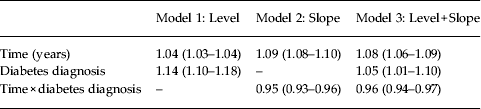
The use of antidepressant medication was observed for 11.4% (22448/196884) of the person-year observations. In total, 28.2% (5139/18217) of the unique individuals in the sample had at least one antidepressant prescription during the follow-up period. When examining only the level of change before and after diabetes diagnosis, there was a 14% increase in the odds of using antidepressant medication (Table 1, model 1). However, there was also evidence for a changing slope over time associated with diabetes diagnosis (model 2), so both change in level and slope were included in the final model (model 3). Model 3 indicated a minor 5% increased odds in the overall level of antidepressant medication use after diabetes diagnosis but a less steeply increasing slope; before diagnosis, the odds of medication use increased by 1.08 per year [95% confidence interval (CI) 1.06–1.09] but after diagnosis this rate attenuated to 1.03 per year (95% CI 1.03–1.04, p < 0.001 for difference between before versus after), as indicated by the interaction effect between time and diabetes diagnosis (slope after diabetes diagnosis = 1.079 × 0.957 = 1.03).
Use of antidepressant medication before and after diagnosis of diabetes

Values are odds ratios (and 95% confidence intervals) of logistic population-averaged multilevel models (n = 18 217 participants, n = 196 884 person-year observations). All models are adjusted for sex, age at diabetes diagnosis, year of diabetes diagnosis, and years of follow-up after diabetes diagnosis. Time is centered at age at diabetes diagnosis. The diabetes diagnosis variable has the value 0 before diagnosis and 1 after diagnosis.
We then examined whether there were socio-economic differences in these change patterns by including interaction effects of continuously coded income quintiles and all of the three components of model 3 (time, diabetes diagnosis, time × diabetes diagnosis). High income was associated with lower antidepressant medication use [odds ratio (OR) 0.87 per quintile, 95% CI 0.85–0.89] but did not modify the associations of diabetes diagnosis with level or slope of medication use before versus after diagnosis (all p values > 0.18). The results of this model are illustrated in Fig. 1 for participants in the highest and lowest income quintiles.
Risk of antidepressant medication before and after diabetes diagnosis by income level (low = lowest income quintile, high = highest income quintile).

Hospitalization for depression
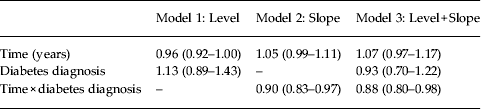
Hospitalization for depression was observed for 0.4% (752/196884) of the person-year observations over the follow-up period. In total, 2.5% (458/18217) of the participants in the sample were hospitalized for depression at least once during the follow-up period. There was no change in overall level of hospitalization risk before versus after diabetes diagnosis after the change in slope over time was taken into account (Table 2). The interaction effect between diagnosis and time indicated that the risk of hospitalization remained constant over time before diabetes diagnosis (OR 1.07, 95% CI 0.98–1.17) but decreased with time after diagnosis (OR 0.94 per year, 95% CI 0.91–0.98, p = 0.004 for difference in slope before versus after diagnosis).
Risk of hospitalization for depression before and after diagnosis of diabetes

Values are odds ratios (and 95% confidence intervals) of logistic population-averaged multilevel models (n = 18 217 participants, n = 196 884 person-year observations). All models are adjusted for sex, age at diabetes diagnosis, year of diabetes diagnosis, and years of follow-up after diabetes diagnosis. Time is centered at age at diabetes diagnosis. The diabetes diagnosis variable has the value 0 before diagnosis and 1 after diagnosis.
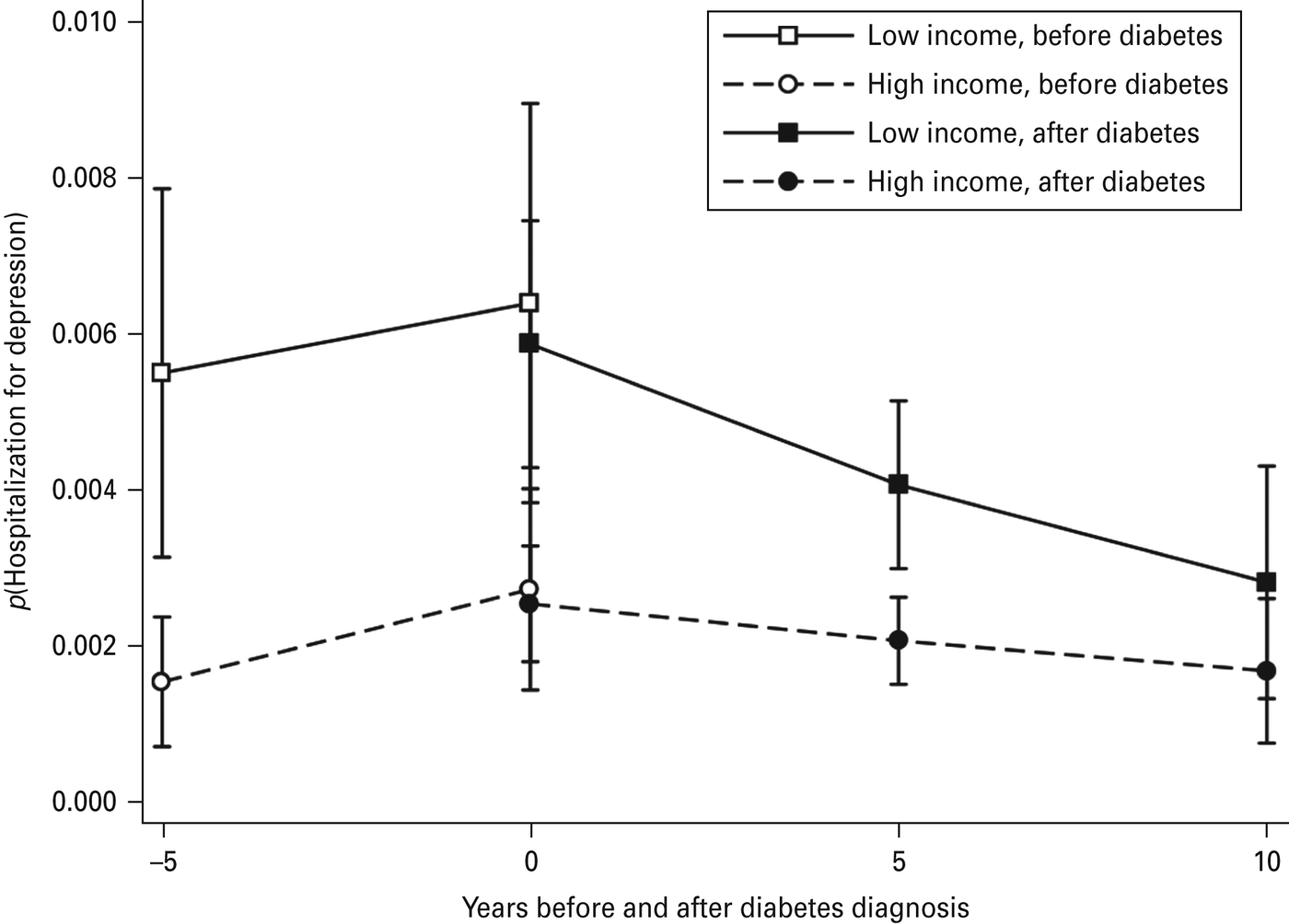
Socio-economic differences in the risk of hospitalization in relation to time before and after diabetes diagnosis were tested for by including interaction effects with income level and time, diabetes diagnosis and time by diagnosis in model 3 (Table 2). High income was related to lower risk of hospitalization (OR 0.80 per income quintile, 95% CI 0.74–0.87) but did not modify associations with diabetes diagnosis (all p values > 0.54). The parallel patterns for individuals with high versus low income are shown in Fig. 2.
Risk of hospitalization for depression before and after diabetes diagnosis by income level (low = lowest income quintile, high = highest income quintile).

Discussion
Previous studies of the association between diabetes and risk of depression have identified differential diagnosis and treatment patterns as potential explanatory factors for the association; depression may be identified more often in people who are diagnosed with diabetes. If, however, diabetes and depression share common physiological correlates, treatment for diabetes might also alleviate symptoms of depression. We used longitudinal register-based data on diabetes diagnosis, antidepressant treatment and hospitalizations due to depression among all Finnish individuals with type 2 diabetes to examine these patterns in more detail. Within the year following diabetes diagnosis, there was a minor increase in antidepressant medication use but not in hospitalization for depression. The longitudinal change in antidepressant use over time was less steep after the diabetes diagnosis, and hospitalization risk also decreased after the diagnosis. These associations between diabetes diagnosis and depression treatment were not modified by the participant's SEP. Together these findings support the common cause hypothesis (i.e. treatment for diabetes is also beneficial to prevention of depression) rather than the detection/ascertainment hypothesis (i.e. diabetic individuals have higher rates of depression because they receive more medical attention in general).
Some previous studies have observed a transient increase in the use of antidepressants after the diagnosis of diabetes (Knol et al. Reference Knol, Geerlings, Grobbee, Egberts and Heerdink2009; Kivimaki et al. Reference Kivimaki, Batty, Jokela, Ebmeier, Vahtera, Virtanen, Brunner, Tabak, Witte, Kumari, Singh-Manoux and Hamer2011). Consistent with these findings, we found a modest increase in the incidence of antidepressant use within the year following the diabetes diagnosis. The diagnosis of a chronic disease may adversely affect people's mental health, but people tend to adjust psychologically to their medical conditions. People going through the diagnosis of diabetes may be more likely to be diagnosed also with depression, as suggested by the detection/ascertainment bias hypothesis. However, there was no evidence of increased antidepressant medication use or hospitalization for depression after diabetes diagnosis over the long term; in fact the risk of antidepressant use increased more modestly and hospitalization for depression decreased more steeply after than before the diagnosis of diabetes. These patterns are in contrast to the detection/ascertainment bias hypothesis, but are in agreement with the hypothesis that treatment of diabetes has a beneficial effect on preventing future depression risk. Although our findings suggest that treatment of diabetes is accompanied by decreasing levels of depression risk, the present data do not allow us to identify what aspects of diabetes treatment might be responsible for these changes. In addition to the biological effects of diabetes medication, the adoption of healthier lifestyles (e.g. quitting smoking, increased exercise, better diet) after having been diagnosed with diabetes might decrease the later risk of depression among diabetic patients, as better health behaviors are associated with lower risk of depression.
Our study also included SEP as a potential moderator factor in the association between diabetes diagnosis and subsequent treatment for depression. Although there were considerable differences in the overall level of depression treatment between income groups (higher income being associated with lower probability of treatment), income did not moderate the short- or long-term patterns of depression treatment. High SEP is generally associated with receiving better medical care. The lack of effect moderation by SEP therefore provides indirect evidence against the hypothesis that depression would be more likely to be detected after than before the diagnosis of diabetes due to detection/ascertainment bias.
The longitudinal patterns of depression treatment need to be interpreted in the context of changing treatment practices during the study period. The increasing use of antidepressants over the years observed in the present sample reflects the increasing rate of antidepressant prescriptions, which has been documented previously in the general population in Finland (Manderbacka et al. Reference Manderbacka, Sund, Koski, Keskimaki and Elovainio2011). The decrease in hospitalizations, in turn, reflects a general trend of changing medical practice towards increased ambulatory care of mental disorders (Pirkola & Sohlman, Reference Pirkola and Sohlman2005). In line with earlier research suggesting depression to be more common among persons with diabetes in lower SEP (Bell et al. Reference Bell, Smith, Arcury, Snively, Stafford and Quandt2005; Engum et al. Reference Engum, Mykletun, Midthjell, Holen and Dahl2005; Kogan et al. Reference Kogan, Brody and Chen2009; Dismuke & Egede, Reference Dismuke and Egede2010; Gary-Webb et al. Reference Gary-Webb, Baptiste-Roberts, Pham, Wesche-Thobaben, Patricio, Pi-Sunyer, Brown, Jones-Corneille and Brancati2011), low income was in our study associated with higher odds for medicine use and hospitalizations. Differential development was not detected in either of the time trajectories after the diagnosis.
In this study we were able to examine an unselected population of Finnish residents with diabetes. The data for persons with diabetes were collected from comprehensive administrative registers drawing on clinical diagnoses. The data on medicine use were collected from the register of reimbursed prescription medicine costs, and are therefore likely to have good coverage. The data for hospitalizations were collected from the hospital discharge register, the accuracy of which has been assessed to be good (Sund, Reference Sund2012). For income, we were also able to use individual level register data, which form the base of tax registers, allowing us to avoid both reporting bias and ecological bias. However, our register data did not cover persons with diabetes treated with diet only or undiagnosed cases; therefore our results cover only persons with medically treated diagnosed diabetes. As the registers used do not contain clinical data, we cannot estimate the effect of disease severity on the results. Some of the participants may have been diagnosed with diabetes prior to prescription of medication if they had first been treated with non-pharmaceutical interventions. We were also able to use two indicators of depression care, namely antidepressive medication use and hospitalizations due to depression. The similarity of the results concerning antidepressant medication use and hospitalization for what are likely to be more serious cases of depression, add credibility to our findings.
Our results suggest a net effect of decreased depression treatment after compared to before diabetes diagnosis, supporting the common cause hypothesis rather than the detection/ascertainment bias hypothesis. However, the two hypotheses are not necessarily mutually exclusive, and both mechanisms may be operating at the same time. If this was the case, our results suggest that the effects of common cause are larger than the effects of detection bias, producing a net effect of decreased level of depression treatment.
Conclusions
Our study suggests that the association between diabetes and receiving treatment for depression is unlikely to be explained by the higher detection rate for depression among individuals with diabetes. Instead, the present longitudinal data suggest that individuals diagnosed with diabetes are less likely to be treated for depression over time. This suggests that there may be a common cause between diabetes and depression and that treatment for diabetes may help to prevent future depression among diabetic individuals, although the present data do not provide direct evidence for an underlying biological association between diabetes and depression.
Acknowledgments
This study was partially funded by the Social Insurance Institution (SII), which had no involvement in the design, data collection, findings or decision to publish.
Declaration of Interest
None.