Introduction
Post-weaning colibacillosis (PWC) is a common diarrhoeal disease of newly weaned pigs, resulting from the colonisation and proliferation of enterotoxigenic Escherichia coli (ETEC) in the small intestine. Diarrhoea usually lasts between 4 and 14 days and is associated with decreased performance, health, and welfare and may ultimately lead to death depending upon the severity.
In-feed antimicrobial growth promoters (AGP) have long played a part in the control of PWC (Hampson, Reference Hampson1994). However, due to increasing concerns about their routine use in pig production, they are now banned within the EU (Regulations (EC) No 1831/2003 and 1334/2003). Consequently, focus has been shifted to finding alternative, non-pharmaceutical, strategies for the prevention and control of PWC, such as the manipulation of dietary ingredients, to minimise substrate availability to ETEC within the distal small intestine and modification of management practices. It has been suggested that PWC is sensitive to dietary protein supply and that it may be possible to limit the extent of PWC by lowering the protein content of the diet (Prohászka and Baron, Reference Prohászka and Baron1980; Nyachoti et al., Reference Nyachoti, Omogbenigun, Rademacher and Blank2006; Wellock et al., Reference Wellock, Fortomaris, Houdijk and Kyriazakis2006). However, Nyachoti et al. (Reference Nyachoti, Omogbenigun, Rademacher and Blank2006) and Wellock et al. (Reference Wellock, Fortomaris, Houdijk and Kyriazakis2006) also noted detrimental effects on performance with a decrease in protein supply. Increasing weaning age may be one way of minimising the risk of PWC without penalising performance. Older pigs may be less sensitive to PWC and better able to cope with increased levels of protein in the diet, due to an easier transition to solid feed and an increased ability to combat infection.
The objective of the current experiment was to investigate the effects of post-weaning dietary protein supply and weaning age on the performance of pigs in the absence of AGP when artificially challenged with ETEC. An analysis of the data regarding the effect of experimental treatment on ETEC shedding and enteric health is reported separately (Wellock et al., 2008).
Material and methods
Animals and housing
A total of 104 pigs (Large White × Landrace) of both sexes from 10 litters weaned at either 4 weeks (28.2 ± 1.20 days) or 6 weeks (40.8 ± 1.31 days) of age and weighing 8.0 ± 0.98 kg and 13.0 ± 1.94 kg (mean ± s.d.), respectively, were used in the experiment. At weaning (day 0), pigs were removed from the sow, weighed, moved to separate building and individually housed in pens (2 × 1 m). The pens had a 0.2 m-deep transparent plastic partitioning along their length to enable visual contact between adjacent pens. Each pen was bedded with sawdust and equipped with a single feeder and a nipple drinker. The environmental temperature was maintained at 25.6 ± 1.20°C and 22.6 ± 0.60°C for the 4- and 6-week weaned pigs, respectively, for the first 3 days after weaning and then decreased by 1°C/week for the remainder of the experiment. Lights were on from 0800 till 1800 h and night lights were maintained between 1800 and 0800 h. Fresh feed and water was available ad libitum throughout the experiment.
Diets and feeding
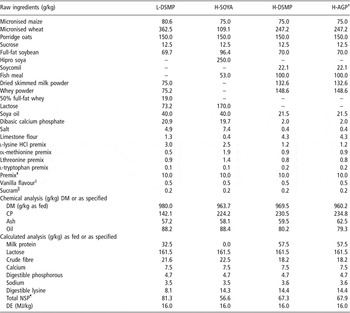
All pigs had access to a standard creep feed (16.0 MJ DE/kg and 235 g CP/kg; DE, digestible energy) free from AGP during the last 14 days of suckling to allow animals to have experience of solid feed before weaning. At weaning, 92 pigs were given ad libitum access to one of the four experimental diets for 2 weeks: a high-protein diet and a low-protein diet, both containing dried skimmed milk powder (DSMP) as the main protein source and free from AGP (H-DSMP and L-DSMP, respectively); a high-protein, AGP-free diet where DSMP was replaced with soybean meal (SOYA) (H-SOYA), and a high-protein DSMP-containing diet with added AGP [ZnO (3100 mg/kg), Cu (170 mg/kg) and avilamycin (Maxus G200, Elanco Animal Health Ltd, Basingstoke, UK; 40 mg/kg)] (H-AGP). All three high-protein (H) diets were formulated to contain 230 g CP/kg and the low-protein (L) diet to contain 130 g CP/kg. Diets were formulated to contain 16.0 MJ DE/kg as fed and were balanced for sodium and lactose content, and amino acid composition as a proportion of total protein (for justification, see Discussion). DSMP accounted for 25% of the CP in the DSMP diets, the maximum amount able to be achieved in the L-DSMP diet, to enable appropriate comparison between L-DSMP and H-DSMP. On day 14, a standard grower ration (190 g CP/kg and 14.5 MJ DE/kg) was fed to all animals until 10 weeks of age. Diets were formulated within the nutritional constraints of the experiment from readily available commercial ingredients using a commercial formulation programme. The composition and chemical analyses of the experimental diets are shown in Table 1.
Diet composition and chemical analysis

NSP = non-starch polysaccharide; DE = digestible energy; DM = dry matter.
†Added antimicrobials, ZnO = 3100 mg/kg, Cu = 170 mg/kg and avilamycin (Maxus G200 Elanco Animal Health Ltd, Basingstoke, UK) = 40 mg/kg.
‡Provided per kilogram of complete diet: 12 500 IU of vitamin A, 2250 IU of vitamin D3, 250 mg of vitamin E, 5 mg of vitamin K3, 4.2 mg of vitamin B1, 5.7 mg of vitamin B2, 5.2 mg of vitamin B6, 42 mg of vitamin B12, 42 mg of nicotinic acid, 21 mg of pantothenic acid, 1.1 mg of folic acid, 150 mg of biotin, 250 mg of choline chloride, 199 mg FE (as FeSO4.H2O), 20 mg of Cu (as CuSO4), 65 mg Mn (as MnO), 0.5 mg Co (CoCO3), 10 mg Zn (as ZnO), 2.2 mg I (as Ca(IO3)2), 0.3 mg Se (as NaSEO4).
§Claremont Ingredients, Newcastle-under-Lyme, UK.
||Pancosma SA, Geneva, Switzerland.
¶Values based on data reported by Bach Knudsen (Reference Bach Knudsen1997).
Experimental design
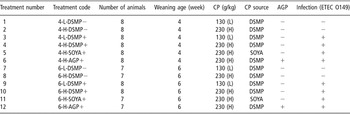
The experiment consisted of a complete 2 × 2 × 2 factorial combination of weaning age (4 v. 6 week), dietary protein content (H v. L) and experimental ETEC challenge, infected (+) v. sham (−). There were an additional four treatments to allow the effects of protein source (DSMP v. SOYA) and AGP inclusion (yes v. no) to be investigated in challenged pigs of both weaning ages. The experimental design is shown in Table 2. Pigs were assigned to the experimental treatments per weaning age based on body weight (BW) and sex, as far as possible, with littermates equally divided across treatment groups. Treatments were assigned to pens with each of the treatments being represented in each of the experimental rooms. Six pigs from each weaning age on day 0 and four pigs per treatment on day 6 were euthanased to assess enteric health (see Wellock et al., 2008). Performance of the remaining animals was monitored until 10 weeks of age (day 28 for 6-week weaned and day 42 for 4-week weaned animals). The Animal Experiments Committee of the Scottish Agricultural College approved the protocol used in this study (EDAE 20/2003) for consistency with UK Home Office regulations.
Experimental design

AGP = antimicrobial growth promoters; DSMP = dried skimmed milk powder; ETEC = enterotoxigenic Escherichia coli; SOYA = soybean meal.
Added antimicrobials, ZnO = 3100 mg/kg; CuSO4 = 170 mg/kg and avilamycin (Maxus G200) = 40 mg/kg.
Experimental infection
The pigs were infected with 109 cfu of ETEC (E. coli O149) suspended in 10 ml phosphate buffer solution (PBS) on day 3 post weaning following the methodology and results of Houdijk et al. (Reference Houdijk, Anderson and Kyriazakis2005). These pathogens were derived from clinical cases of PWC (Veterinary Laboratories Agency, Surrey, UK) and were characterised as having the required virulence factors to induce PWC (Adhesion factors K91, K88 (F4)). The infection was administered per os, using a stomach tube with an additional 10 ml PBS for rinsing. Non-infected animals were given 20 ml of PBS as a sham infection. For information on preparation of the inoculum, see Wellock et al. (2008).
Measurements
Food intake and BW
Pigs were fed at 0900 h each day with a known amount of feed, and individual feed intake was recorded by weighing refusals the next day at the same time. BW was measured on days −3, 0, 3, 6, 9, and 14 and weekly thereafter until the end of the trial. In addition, 6-week weaned pigs were weighed at 4 weeks of age. The frequency of weight recording was to investigate the transient effect of sub-clinical PWC on the growth rate expected post infection.
Statistical analyses
The data were analysed as three separate factorial arrangements; a 2 × 2 × 2 analysis of weaning age (4 v. 6 week), protein content (H v. L) and infection (+ v. −) (treatments 1 to 4 and 7 to 10); a 2 × 2 analysis of weaning age (4 v. 6 week) and protein source (DSMP v. SOYA) (treatments 4, 5, 10 and 11); and a 2 × 2 analysis of weaning age (4 v. 6 week) and AGP inclusion (yes v. no) (treatments 4, 6, 10 and 12). The effect of the main factors, along with any interactions, was determined by restricted maximum likelihood (REML) to account for unbalanced data caused by missing pigs in four of the treatments (see Table 2) and the removal of one pig from the trial (see below). BW at 4 weeks of age was used as a covariate in all analyses. The individual pig was used as the experimental unit and litter as a random factor. All statistical analyses were performed by Genstat 5 for Windows (release 4.2, service pack 2, 2001; Lawes Agricultural Trust, Rothamsted, Hertfordshire, UK). Because the effect of weaning age was investigated in each of three separate statistical analyses, three P-values for each of the factors were determined. As these were not always identical, the largest P-value is presented to prevent over-interpretation of the results.
Results
General
Neither ETEC O149 nor any other strain of ETEC was observed in any of the animals prior to the challenge, or in the non-infected animals post challenge. None of the animals suffered from clinical PWC or had to be removed from the experiment due to illness. One animal in treatment group 12 (6-H-AGP+) was not infected due to poor feed intake (<50 g/day), and was consequently removed from the experiment.
Feed intake
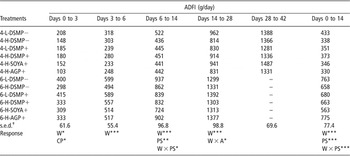
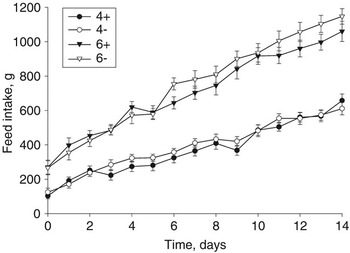
The effect of experimental treatment on average daily feed intake (ADFI) over the experimental period is shown in Table 3. There was no effect (P > 0.05) of infection on feed intake throughout the experimental period, although infected 4-week weaned animals displayed a slight drop in intake in the 3-day period following infection (days 3 to 6) (Figure 1).
Effect of weaning age (4 v. 6 week), crude protein level (H v. L), protein source (DSMP v. SOYA), antimicrobial growth promoter inclusion (H-DSMP+ v. H-AGP+) and infection (+ v. −) on average daily feed intake (ADFI)

4 = 4 week weaned; 6 = 6 week weaned; W = weaning age (6 v. 4 week); CP = crude protein content (H-DSMP v. L-DSMP); PS = protein source (H-DSMP+ v. H-SOYA+); A = antimicrobials (H-AGP+ v. H-DSMP+); DSMP = dried skimmed milk powder; SOYA = soybean meal; AGP = antimicrobial growth promoters; +/− represents presence or absence, respectively, of infection with enterotoxigenic Escherichia coli.
H = 230 g CP/kg; L = 130 g CP/kg.
*P < 0.05, **P < 0.01, ***P < 0.001.
†s.e.d. for the W × CP × INF interaction.
Effect of weaning age (4 v. 6 week) and experimental infection (+ v. −) on daily feed intake (±s.e.). Infection occurred on day 3.

As expected, there was a significant effect of weaning age on ADFI throughout the whole experimental period. The 6-week weaned animals consumed a mean ± s.e. of 961 ± 34.5 g/day over the 0- to 28-day period compared with only 612 ± 19.6 g/day for the 4-week weaned pigs over the same time period (P < 0.001). However, feed intake did not differ between 4- and 6-week weaned animals when compared at the same age. For example, between 8 and 10 weeks of age (i.e. days 14 to 28 for the 6-week weaned and days 28 to 42 for the 4-week weaned), the mean ± s.e. ADFIs of the 4- and 6-week weaned pigs were 1365 ± 30.1 and 1337 ± 42.8 g/day, respectively.
Animals fed the L diets tended to consume more than those on the corresponding H diets, although this was only significant over the first 6 days of the experiment (days 0 to 6), with pigs on the L and H diets consuming a mean ± s.e. of 365 ± 20.4 and 322 ± 16.7 g/day, respectively (P = 0.031). Protein source had an effect (P < 0.001) on ADFI over both the 6 to 14 and 0 to 14 day periods with animals fed the DSMP-based diet consuming more than those on the SOYA diet. Over the 14-day dietary treatment period (days 0 to 14), animals fed the DSMP-based diet consumed an average ± s.e. of 518 ± 48.5 g/day compared with 439 ± 39.7 g/day for the animals on the SOYA-based diet. There was a weaning age × protein source interaction over the 6 to 14 day (P = 0.035), 0 to 14 day (P < 0.001) and 0 to 28 day (P < 0.001) periods. This was due to the 6-week weaned animals having a much greater ADFI on the DSMP diet compared with those on the SOYA diet than the 4-week weaned pigs that only displayed a small increase in ADFI on the H-DSMP diet (Table 3).
There was no effect of AGP inclusion on ADFI. There was a weaning age × AGP inclusion interaction over the 14 to 28 day (P = 0.046) and 0 to 28 day (P = 0.043) period. The 4-week weaned animals on the AGP diet consumed less than those on the non-AGP diet, whereas the reverse was true for the 6-week weaned animals (Table 3).
Growth rate
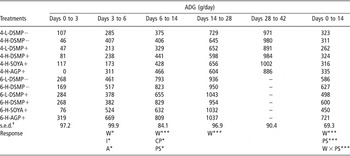
The average daily gain (ADG) of animals on the 12 treatment groups is shown in Table 4. There was an effect (P = 0.014) of infection on ADG in the 3-day period immediately post infection (days 3 to 6), with non-infected animals gaining an average ± s.e. of 413 ± 39.2 g/day compared with only 303 ± 31.2 g/day for the infected animals. Although the non-infected animals outperformed their infected counterparts over the 0 to 14 day period (450 v. 421 g/day), this was not significant (P = 0.314). There was no effect of infection on ADG over the latter part of the trial.
Effect of weaning age (4 v. 6 week), crude protein level (H v. L), protein source (DSMP v. SOYA), antimicrobial growth promoter inclusion (H-DSMP+ v. H-AGP+) and infection (+ v. −) on average daily gain (ADG)

4 = 4 week weaned; 6 = 6 week weaned; W = weaning age (6 v. 4 week); CP = crude protein content (H-DSMP v. L-DSMP); PS = protein source (H-DSMP+ v. H-SOYA+); A = antimicrobials (H-AGP+ v. H-DSMP+); DSMP = dried skimmed milk powder; SOYA = soybean meal; AGP = antimicrobial growth promoters; +/− represents presence or absence, respectively, of infection with enterotoxigenic Escherichia coli.
H = 230 g CP/kg; L = 130 g CP/kg.
*P < 0.05, ***P < 0.001.
†s.e.d. for the W × CP × INF interaction.
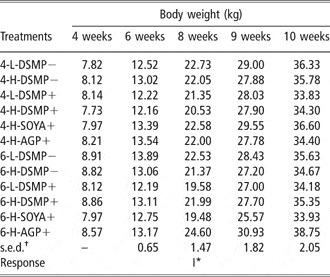
There was a significant effect of weaning age on ADG with the 6-week weaned animals growing faster than the 4-week weaned animals throughout the experimental period. Over the 28-day period (days 0 to 28), the 4- and 6-week weaned animals gained on average ± s.e. of 478 ± 15.6 and 785 ± 26.9 g/day, respectively (P < 0.001). However, at the same age both 4- and 6-week weaned pigs were gaining comparable amounts. Over the 28 to 42 day experimental period, the 4-week weaned animals gained an average of 952 g/day, which corresponds to an ADG of 993 g/day for the 6-week weaned animals over the same range (days 14 to 28). This resulted in equal (P = 0.506) mean ± s.d. BWs of 35.2 ± 3.43 and 35.5 ± 4.87 kg for the 4- and 6-week weaned pigs, respectively, at 10 weeks of age (see Table 5).
Effect of weaning age (4 v. 6 week), crude protein level (H v. L), protein source (DSMP v. SOYA), antimicrobial growth promoter inclusion (H-DSMP+ v. H-AGP+) and infection (+ v. −) on body weight at a given age

4 = 4 week weaned; 6 = 6 week weaned; I = Infection (infected v. non-infected); DSMP = dried skimmed milk powder; SOYA = soybean meal; AGP = antimicrobial growth promoters; +/− represents presence or absence, respectively, of infection with enterotoxigenic Escherichia coli.
H = 230 g CP/kg; L = 130 g CP/kg.
*P < 0.05.
†s.e.d. for the W × CP × INF interaction.
Animals on the H diet tended to gain more than those fed the L diet, although this was only significant over the 6 to 14 day period (P = 0.033). Over the 14 day dietary trial period, 4-week weaned pigs on the H diet had a mean ± s.e. ADG of 318 ± 20.9 g/day compared with an ADG of 284 ± 17.5 g/day of pigs fed the L diet (P = 0.138). In the second 2-week period of the experiment (days 14 to 28), pigs previously fed the L diet gained more than those previously fed the H diet, 834 v. 727 g/day, although this was not significant (P = 0.205). Compared with their non-infected counterparts, infected 4-week weaned pigs on the H diet demonstrated a larger decrease in ADG immediately post infection (days 3 to 6) than those on the L diet, −42% and −25%, respectively. This effect was considerably smaller in the 6-week weaned pigs, with infected pigs on the H and L diets displaying a −26% and −19% reduction, respectively, compared with their non-infected counterparts on the same diets (CP × weaning age; P = 0.088).
Animals on the DSMP treatment gained more than those on the SOYA treatment. Over the 0 to 14 day period, animals on the DSMP+ and SOYA+ treatments gained an average ± s.e. of 462 ± 46.8 and 373 ± 33.5 g/day, respectively (P < 0.001). The inclusion of AGP tended to increase ADG. However, this was only significant in the immediate post-infection period (days 3 to 6), with animals on the AGP treatment gaining an average ± s.e. of 464 ± 69.2 g/day compared with 363 ± 60.4 g/day (P = 0.045) for those on the non-AGP treatment.
Feed conversion efficiency
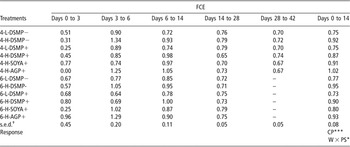
Table 6 shows the effect of experimental treatment on feed conversion efficiency (FCE). There was no effect of infection (P = 0.104) or weaning age (P = 0.412) on FCE throughout the trial. Infected and non-infected animals had a mean ± s.e. FCE of 0.80 ± 0.145 and 0.82 ± 0.154, respectively (P = 0.556), over the 0 to 14-day dietary treatment period, while 4- and 6-week weaned pigs had a mean ± s.e. FCE of 0.84 ± 0.022 and 0.83 ± 0.017, respectively (P = 0.488), over the same time period.
Effect of weaning age (4 v. 6 week), crude protein level (H v. L), protein source (DSMP v. SOYA), antimicrobial growth promoter inclusion (H-DSMP+ v. H-AGP+) and infection (+ v. −) on feed conversion efficiency (FCE)

4 = 4 week weaned; 6 = 6 week weaned; W = weaning age (6 v. 4 week); CP = crude protein content (H-DSMP v. L-DSMP); PS = protein source (H-DSMP+ v. H-SOYA+); DSMP = dried skimmed milk powder; SOYA = soybean meal; AGP = antimicrobial growth promoters; +/− represents presence or absence, respectively, of infection with enterotoxigenic Escherichia coli.
H = 230 g CP/kg; L = 130 g CP/kg.
*P < 0.05, ***P < 0.001.
†s.e.d. for the W × CP × INF interaction.
There was an effect (P < 0.001) of CP level on FCE over the 2-week dietary treatment period (days 0 to 14) with animals offered the H diet having better FCE than those on the L diet, 0.89 v. 0.74, respectively. There was no effect (P < 0.10) of protein source on FCE, although there was a weaning age × protein source interaction (P = 0.020) on FCE over the 0 to 14 day period. Four-week weaned animals on the DSMP diet had a poorer FCE than those on the SOYA diet, whereas the reverse was true for the 6-week weaned animals. The FCE of pigs on the AGP diet was numerically higher than those on the non-AGP diet 0.97 v. 0.81, respectively (P = 0.072), over the 0 to 14 day period. There was a larger effect of AGP inclusion on the 4-week than on the 6-week weaned animals, with the 4-week weaned animals on the AGP diet displaying a 17% improvement compared with only a 2% improvement for the 6-week weaned pigs. There were no effects of infection, weaning age or previous feeding treatment on FCE when all animals were fed the same diet (days 14 to 28).
Discussion
In-feed AGP have been withdrawn from pig feeds within the EU since January 2006, at least partly in recognition of the growing problem of antibiotic resistance of important pathogens including ETEC (Barton, Reference Barton1999). Consequently, there is a growing need to find alternative, non-pharmaceutical, strategies to ameliorate enteric conditions such as PWC without the use of AGP. Manipulating dietary protein supply to decrease protein availability to ETEC in the distal small intestine, and the consequent production of harmful fermentation by-products, such as amines (Porter and Kenworthy, Reference Porter and Kenworthy1969), is one way in which this could be achieved. However, with this decreased risk of PWC, a detrimental effect on performance is observed (Nyachoti et al., Reference Nyachoti, Omogbenigun, Rademacher and Blank2006; Wellock et al., Reference Wellock, Fortomaris, Houdijk and Kyriazakis2006). Increasing weaning age may decrease sensitivity to PWC due to the establishment of regular intake of solid feed during lactation, resulting in a more mature and stabilised gut morphology and physiology, preventing the colonisation of ETEC (Nabuurs, Reference Nabuurs1995; Nabuurs et al., Reference Nabuurs, Hoogendoorn and van Zijderveld-van Bemmel1996; Pluske et al., Reference Pluske, Williams and Aherne1996 and Reference Pluske, Hampson and Williams1997). Because of this increased ability to combat infection, later-weaned pigs may therefore be able to cope better with greater levels of protein in the diet than their earlier-weaned counterparts and thus improve the trade-off between minimising the risk of PWC and maximising performance.
To induce sub-clinical PWC, and thus better elucidate the role of weaning age and protein nutrition on ameliorating the effects of PWC, pigs were orally inoculated with 109 cfu ETEC O149 after the results of Houdijk et al. (Reference Houdijk, Anderson and Kyriazakis2005). Infection was carried out on day 3 post weaning to ensure that pigs were eating a sufficient quantity of solid feed before being exposed to ETEC. Infection was established successfully with colonies of the infective ETEC strain being recovered from all infected pigs post infection (see Wellock et al., 2008). There was a detrimental effect of infection on performance with non-infected animals outperforming their infected counterparts. These effects, however, were short lived, with infection only decreasing ADG in the immediate post-infection period (days 3 to 6; P = 0.019). This effect on performance is comparable to other studies where a single dose of ETEC of similar magnitude was given (Sarmiento et al., Reference Sarmiento, Casey and Moon1988; Krsnik et al., Reference Krsnik, Yammine, Pavicic, Balennovic, Njari, Vrbanac and Valpotic1999; Madec et al., Reference Madec, Bridoux, Bounaix, Cariolet, Duval-Iflah, Hampson and Jestin2000). For example, Madec et al. (Reference Madec, Bridoux, Bounaix, Cariolet, Duval-Iflah, Hampson and Jestin2000) reported a 77% decrease in ADG immediately post infection (days 0 to 2), followed by a prompt recovery and the same level of weight gain in the second week post infection. Over the 9-day post-infection period, Madec et al. (Reference Madec, Bridoux, Bounaix, Cariolet, Duval-Iflah, Hampson and Jestin2000) reported that pigs infected with 1012 cfu ETEC on day 4 post weaning gained an average of 11% less than their uninfected counterparts. This compares to a 7% decrease in this experiment over the 6-day post-infection period.
Infection had a greater impact on the performance of 4-week weaned pigs than those weaned at 6 weeks of age. In the 3-day post-infection period (days 3 to 6), infection decreased ADG by 39.5% and 13.5% in the 4- and 6-week weaned pigs, respectively, when compared with their non-infected counterparts (P = 0.014). This may reflect a better immunological status of the older pigs, allowing them to better combat the infection (Edwards, Reference Edwards2004). Alternatively, it may have been a consequence of using the same experimental dose for both weaning ages rather than being age or weight dependent and hence exposing 4-week weaned pigs to a relatively greater degree of infection. The 4-week weaned pigs received an average of 1.28 × 10⁸ cfu ETEC/kg BW compared with 7.69 × 10⁷ cfu/kg BW for those weaned at 6 weeks. However, within and across weaning ages there was no linear relationship (r = 0.008, P = 0.940) between BW on the day of infection and ADG as a percentage BW over the immediate post-infection period (days 3 to 6). This suggests BW at infection was less important than weaning age.
Increasing weaning age per se led to improved performance, with pigs weaned at 6 weeks outperforming those weaned at 4 weeks of age throughout the experimental period. This was as expected, and may have been due in part to increased solid feed intake pre-weaning, which was shown to improve post-weaning performance (Okai et al., Reference Okai, Aherne and Hardin1976; English et al., Reference English, Robb and Dias1980; Lawlor et al., Reference Lawlor, Lynch, Caffrey and O’Doherty2002). Although all animals had access to creep for the same amount of time pre-weaning, older pigs would be expected to be consuming more than those weaned earlier to try and decrease the deficit between their increased nutrient requirements and that gained from the sow’s milk. As expected, weaning had a larger impact on the ADG of pigs weaned at 4 weeks than those weaned at 6 weeks (P = 0.016). In the immediate post-weaning period (days 0 to 3), pigs weaned at 4 and 6 weeks gained an average of −73% and −56%, respectively than those in the 3-day period immediately before weaning (days −3 to 0). However, at the same age, pigs from both weaning ages were consuming the same amount of feed and had very similar BWs, thus suggesting no long-term performance advantage of later weaning.
Very few, if any, studies have used controlled infections to investigate the effect of protein supply on piglet performance and health, with most concentrating on the effects of non-starch polysaccharide supply (e.g. McDonald et al., Reference McDonald, Pethick, Pluske and Hampson1999; Hopwood et al., Reference Hopwood, Pethick, Pluske and Hampson2004; Montagne et al., Reference Montagne, Cavaney, Hampson, Lalles and Pluske2004). The infectious challenge had a much greater impact on the performance of animals offered the H diet than those offered the L diet, with infected animals on H diet displaying a much larger decrease in ADG than pigs on the L diet (P = 0.088). This was especially true for the 4-week weaned animals. Infected 4-week weaned pigs on the H and L diets demonstrated a 42% and 25% decrease, respectively, in ADG immediately post infection (days 3 to 6) compared to their non-infected counterparts. The corresponding decreases in ADG in infected 6-week weaned pigs fed the H and L diets were 26% and 19%, respectively. Consequently, whereas uninfected pigs on the H diet had a greater advantage over those on the L diet over the 3-day post-infection period, infected pigs on the H diet performed similar to those on the L diet. This suggests that increased protein in the distal small intestine may have created a more favourable environment for the proliferation of ETEC, thus making the consequences of PWC greater for animals on high-CP diets, especially for earlier-weaned animals. The fact that lowering CP led to significantly firmer faeces post infection (P < 0.05) and led to a decrease in the number of ETEC shed in the faeces post infection, especially in the 4-week weaned pigs (P = 0.093), supports this finding (see Wellock et al., 2008). Therefore, while the impact of PWC on performance cannot be completely avoided, decreasing dietary CP level may help to minimise the impact of PWC, especially in earlier-weaned animals and particularly in sub-optimal environments. These benefits may be even greater in environments where the infectious challenge is expected to be larger than that used here, including under commercial conditions where clinical PWC is often observed and group housing enables the spread of infection and re-infection from one pig to another. It is important to note that the manipulation of dietary protein invariably affects the level of dietary fibre in the experimental diets, which have been shown to affect the development of PWC in newly weaned pigs (e.g. McDonald et al., Reference McDonald, Pethick, Pluske and Hampson1999; Pluske et al., Reference Pluske, Black, Pethick, Mullan and Hampson2003) and should be considered when interpreting the current results.
To minimise the detrimental effect of lowering dietary CP level on performance, while maintaining the beneficial effects to enteric health, on performance Nyachoti et al. (Reference Nyachoti, Omogbenigun, Rademacher and Blank2006) supplemented the low-protein diets (210, 190 or 170 g CP/kg) with crystalline amino acids to achieve equal standardised ileal-digestible contents of lysine, methionine plus cysteine, threonine and tryptophan in all diets, including the control (230 g CP/kg). However, a decrease in performance was reported once the dietary protein level fell to 190 g CP/kg or below. This was also observed by Wellock et al. (Reference Wellock, Fortomaris, Houdijk and Kyriazakis2006), who balanced amino acid composition as a proportion of total protein, once CP was reduced from 230 to 180 g CP/kg. Although the supplementation of amino acids is becoming increasingly common in commercial practice, it is more difficult to apply in starter diets and may be more applicable for growers where diets are formulated to a lower total protein level. For example, it would be exceedingly difficult to maintain constant lysine and other key amino acids at the level of a high-CP diet (230 g CP/kg) and achieve a low-protein diet (130 g CP/kg) without creating a potentially serious deficiency of non-essential amino acids. This is especially true in the EU where only four synthetic amino acids are currently available for use, with synthetic valine and isoleucine not yet available. As a consequence, amino acids were balanced as a proportion of total protein in all the four diets used here. A CP content of 130 g CP/kg was chosen for the L-DSMP diet after Prohászka and Baron (Reference Prohászka and Baron1980) and Wellock et al. (Reference Wellock, Fortomaris, Houdijk and Kyriazakis2006) to create a sufficiently large contrast from 230 g CP/kg (H-DSMP) to fully test the hypothesis.
Pigs on DSMP diet had greater ADFI, ADG and improved FCE than those on the SOYA diet as reported by Wellock et al. (Reference Wellock, Fortomaris, Houdijk and Kyriazakis2006), who described a reduction in pig performance when SOYA replaced DSMP in diets containing 230, 180 or 130 g CP/kg. As the largest decrease in performance was reported for pigs fed the 230 g CP/kg protein diets, the effect of SOYA inclusion was tested here at the high-protein level only, to reduce the number of experimental treatments. It might be expected that older pigs would be less sensitive to dietary antigens and therefore are able to perform better on diets containing cheaper protein sources such as SOYA. However, this was not the case with 6-week weaned pigs on SOYA, showing a larger decrease in ADFI and ADG than pigs on the DSMP diet, compared with those weaned at 4 weeks over the dietary treatment period (days 0 to 14). Inclusion of AGP in the diet improved performance, particularly in the period immediately post infection, with infected pigs on the AGP diet gaining considerably more than those on the non-AGP diet. This highlights the protective properties of AGP and the fact that pigs will be at greater risk to PWC in the absence of in-feed AGP.
Conclusions
The experimental enterotoxigenic E. coli challenge had a greater impact on the performance of pigs weaned at 4 weeks than those weaned at 6 weeks. However, there was no long-term performance advantage of increasing weaning age from 4 to 6 weeks with no difference in body weight among pigs at 10 weeks of age. Challenged pigs on the high-protein diet displayed a much greater drop in performance than those on the low-protein diet when compared with their non-infected counterparts. Therefore, in the absence of antimicrobial growth promoters, decreasing the level of dietary protein may help to minimise impact of post-weaning colibacillosis on performance, especially in earlier-weaned pigs and when conditions are less favourable. Further work will determine whether there are long-term effects of the concomitant reduction in post-weaning growth if this strategy is adopted.
Acknowledgements
This research was financially supported by ABN Ltd, Frank Wright Ltd, Home-Grown Cereals Authority, Meat and Livestock Commission/British Pig Executive, Primary Diets Ltd and Provimi Ltd with match funding from Defra, through the Sustainable Livestock Production LINK programme. The authors would like to acknowledge Paul Toplis of Primary Diets Ltd, UK, for the formulation and manufacture of the experimental diets, Biomathematics and Statistics Scotland for help with the statistical analysis, Terry McHale, Dave Anderson and Lesley Deans for technical assistance.