Two of the most iconic photos of the 1956 Hungarian revolution involve a colossal statue of Stalin, erected in 1951 and toppled on the first day of the anti-Soviet uprising. One of these pictures shows Stalin's decapitated head, abandoned in the street as curious pedestrians amble by. The other shows a tall stone pedestal with nothing on it but a lonely pair of bronze boots. Situated near Heroes' Square, Hungary's national pantheon, the Stalin statue had served as a symbol of Hungary's subjugation to the Soviet Union; and its ceremonious and deliberate destruction provided a poignant symbol for the fall of Stalinism.
Thirty-eight years before, at the beginning of an earlier Hungarian revolution, another despised statue was toppled in Budapest, also marking a break from foreign subjugation, albeit to a different power. Unlike the Stalin statue, which stood for only five years, this statue—the so-called Hentzi Monument—had been “a splinter in the eye of the [Hungarian] nation” for sixty-six years. Perceived by many Hungarians as a symbol of “national humiliation” at the hands of the Habsburgs, the Hentzi Monument remained mired in controversy from its unveiling in 1852 until its destruction in 1918. The object of street demonstrations and parliamentary disorder in 1886, 1892, 1898, and 1899, and the object of a failed “assassination” attempt in 1895, the Hentzi Monument was even implicated in the fall of a Hungarian prime minister. It is perhaps fitting that the destruction of this controversial monument—which had come to embody the irreconcilable differences between the Habsburg dynasty and the Hungarian nation—coincided perfectly with the dissolution of the Austro-Hungarian monarchy.
The destruction of the Hentzi Monument was one of the many “iconoclastic episodes” that accompanied the end of Habsburg rule in Central Europe.Footnote 1 Indeed, “[r]evolutions are a time for destruction, for smashing,” a maxim that applies equally well to the French Revolution in 1789, the Russian Revolution in 1918, and, of course, the Hungarian Revolutions in 1918–1919 and 1956.Footnote 2 In all of these upheavals, the very statues and monuments that had been erected in order to bolster the ruling powers became objects of iconoclastic ire and symbols of old, discredited regimes. The Hentzi Monument had many parallels in the Habsburg Empire, such as the Marian column in Prague and statues of Emperor Joseph II across the realm. Emblems of dynastic legitimacy (and later, targets of nationalist rage), their destruction marked the denouement in an ever-sharpening debate over the relationship between dynasty and nation.
In the past two decades, a growing body of scholarly literature has examined the overlapping and intertwined “politics of commemoration” and “politics of national identity,” with particular focus on the Habsburg lands.Footnote 3 This focus is quite natural, because here, in particular, the tensions between a supranational dynasty and the increasingly assertive national movements helped transform public spaces into symbolic battlegrounds, pitting competing historical narratives against one another. These tensions rose in the second half of the nineteenth century, with a noticeable upswing in the 1880s and 1890s, as the emergence of mass politics—and the concomitant sharpening of political rhetoric—accelerated the nationalization of urban space in the Habsburg Empire as a whole. In Hungary, where the Revolution of 1848–1849 (and the failed war of independence against Habsburg rule) remained defining moments in the national narrative, this process was all the more acute.
The controversy over the Hentzi Monument was rooted in the complicated relationship between Hungary and the Habsburg Empire. Ever since Ferdinand I assumed the crown of Hungary in 1526, the Habsburg emperor also reigned as the King of Hungary—with a few notable exceptions. Although the emperor and the king were unified in one person, the standard-bearers of the Hungarian nation considered Hungary a separate kingdom with a distinct and inviolable constitutional tradition. This was matched by aspirations for a separate and independent Hungarian army, an aspiration that was briefly realized during the Revolution of 1848–1849, when the Hungarian National Guard (Honvédség) became the basis for a separate Hungarian Honvéd army, which fought—and lost—its war of independence from the Habsburg Empire. Under the command of General Arthur Görgey, a Hungarian, the Honvéd army fought against the Habsburg emperor in the name of the Hungarian king, who had been one and the same person before the Hungarians dethroned Francis Joseph in 1849. Once the Hungarian war of independence was crushed in August 1849, Hungary was reintegrated into the Habsburg Empire, but Francis Joseph was not crowned King of Hungary until the Austro-Hungarian compromise restored some of Hungary's historic rights in 1867.
General Hentzi and the Siege of Buda, May 1849
The Revolution of 1848 pitted nation against dynasty, and General Heinrich Hentzi played a crucial role in the eventual victory of dynasty over nation. Born in Debrecen, Hungary, to a noble family of Swiss origin, Hentzi rose through the military ranks, becoming a general in the Austrian army during the Revolution of 1848. His moment of glory (or infamy, depending on one's perspective) came during the siege of Buda's Castle Hill in May 1849, when he and several thousand Austrian troops held out for three weeks against the thirty thousand Hungarian Honvéd troops under the command of Arthur Görgey. The Honvéd army had already driven the Austrian army out of most of Hungary, and Görgey expected the siege of Castle Hill to be over quickly, especially since General Hentzi had allegedly given his word to Lajos Kossuth that he would never turn his weapons against his fellow Hungarians.Footnote 4
In the end, Hentzi had no hesitation in turning his weapons against the Hungarian Honvéd army, and he even ordered his troops to bombard Pest into submission. As General Görgey related to Kossuth in the midst of the bombardment:
Yesterday evening, General Hentzi's threats were carried out most horribly. With a number of well-aimed shots, he managed all at once to set on fire most of the magnificent buildings along the Danube. Before long, strong winds stoked the fire, and turned Pest's nicest parts to ash. It was a horrific sight! The entire city was engulfed in a sea of flames, with balls of smoke and burning grenades showering down upon the unfortunate city with an awful thunder, like a celestial downpour. No pen can describe the enormity of the sight with complete accuracy.Footnote 5
As a result of the bombardment, many of the city's finest buildings—including the Redout, the Lipót Church, and the Queen of England Hotel—were burned to the ground. Hentzi even instructed Colonel Alois Alnoch to place explosives on the Chain Bridge, the first suspension bridge connecting Buda and Pest and, as such, a symbol of Hungary's path to modernization. The bridge, which had recently been completed, had not yet been opened to traffic; and Austrian soldiers were ironically among the first to cross it. In the end, the explosives never went off, and the Chain Bridge suffered only minor damage. (As the poet Endre Ady wrote sixty years later, “I am an ancient bridge, who has seen a lot and whom Hentzi could not even destroy.”)Footnote 6
For many Hungarians, the wanton destruction of Pest was all the more reprehensible, because Hentzi appeared to have bombarded the city “with no reason and no aim.”Footnote 7 Some blamed Hentzi's “inhumanity, savagery, unbridled fury, and vengefulness”; General Görgey viewed it as evidence of Hentzi's “cannibal personal gratification.”Footnote 8 As Görgey related in his memoirs, after the bombardment of Pest, he wanted to make an example out of Hentzi “as a warning for those who have an itching for purposefully augmenting the horrors of war.”Footnote 9 Castle Hill finally fell to the Honvéd army on 21 May 1849, and Hentzi was killed on St. George Square with sword in hand.
Despite claims to the contrary, the bombardment of Pest did in fact serve important strategic purposes. It gave the Austrian army time to regroup, and it also allowed Tsar Nicholas to send the Russian army to Austria's aid.Footnote 10 As one contemporary observed, the bombardment of Pest “proved to be the weight that tipped the scales and brought the ruinous civil war to an end.”Footnote 11 Indeed, Hentzi's three-week defense of Buda prevented the Honvéd army from marching on Vienna and enabled General Haynau and Tsar Nicholas to suppress the Hungarian insurrection. As a result, supporters of the Habsburg dynasty could rightly view Hentzi as “the brave defender of Buda,” who had died in “heroic defense” of Castle Hill. For some, like the Austrian officer, Ottakar Prochazka, Hentzi's modest grave in Buda, which was “marked by a cross cut from a tree on the spot where he fell,” became a solemn place of pilgrimage. “[I]t is to be hoped,” he wrote in 1851, “that an everlasting monument will exist in the heart of every true Austrian for generations to come, and therefore it needs no monument of stone.”Footnote 12
Hentzi Monument or Monument to the Fallen Soldiers?
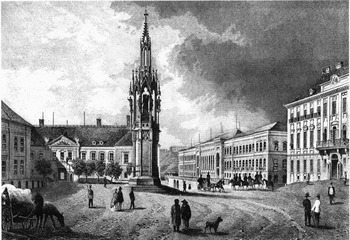
Emperor Francis Joseph, in contrast to Prochazka, wanted a monument in stone for the general who, perhaps more than anyone else, helped keep the Habsburg Empire intact during its period of crisis. The young emperor had already cultivated a kind of hero's cult around General Hentzi: on 26 March 1850, Hentzi posthumously became a knight in the Order of Maria Theresa;Footnote 13 in the same year, a large painting of Hentzi's heroic death—commissioned from Fritz L'Allemand—was hung in Francis Joseph's bedroom in the Viennese Hofburg.Footnote 14 On 11 June 1852, after three years of construction, the 139-ton “Hentzi” military paddle steamer was launched in Venice.Footnote 15 One month later, on 11 July 1852, a monument to Hentzi and his soldiers—designed by Wilhelm Paul Eduard Springer and executed by the Viennese sculptors Hans Gasser and Franz Bauer—was brought from Vienna to Buda, where it was ceremoniously unveiled.Footnote 16 This highly ornate, neo-Gothic monument was erected on St. George Square, on the very spot where Hentzi had been killed three years earlier (Figure 1). It commemorated Hentzi, Colonel Alnoch, and the 418 Austrian soldiers who died—in the words of its front plaque—as “a sacrifice for their emperor and fatherland.” Situated on one of the highest points in Buda and rising to a height of sixty-six feet, the granite, cast-iron, and bronze monument towered above the surrounding one-story buildings and could even be seen from Pest, which was still partly in ruins.
The Hentzi Monument on St. George Square (1850s). From János Hunfalvy and Ludwig Rohbock, Ungarn und Siebenbürgen in malerischen Original-Ansichten: ihrer interessantesten Gegenden, Städte, Badeorte, Kirchen, Burgen, Paläste und sonstigen Baudenkmäler alter und neuer Zeit (Darmstadt, 1865).

As historian Alice Freifeld has observed, the Hentzi Monument “was as histrionic as it was provocative.”Footnote 17 Resting on a stepped granite base, the monument's massive, six-sided, cast-iron pedestal was inscribed with the names of Hentzi, Alnoch, and the 418 fallen soldiers—who were mostly of Polish or Croatian origin. Atop the pedestal, a soldier lay dying with sword in hand, and a cherubic angel rose above him, one hand holding a laurel, the other pointing wistfully to the hereafter. The angel and the dying soldier were covered by a neo-Gothic cupola, which rested on six pillars and ascended into a lofty, cruciform spire. These pillars were adorned with allegorical figures made of bronze, each one personifying a military virtue: allegiance to the flag, truth, religion, chivalry, vigilance, and self-sacrifice.Footnote 18 The figures were covered by small, neo-Gothic canopies, each one ascending into smaller cruciform spires. Freifeld points to the religious character of the monument, noting that “the sculptor attempted to capture the poignancy of the matryrology by appealing to the romantic instincts of the time.”Footnote 19 In the words of a French traveler to Hungary, this neo-Gothic cenotaph was “un monument d'aspect religieux.”Footnote 20
Francis Joseph personally attended the dedication ceremony during his 1852 imperial tour of Hungary, which was described by one contemporary as a “true victory march.”Footnote 21 After quashing the revolution, Vienna reasserted its rule over Hungary, introduced German as the language of administration, instituted strict police surveillance and heavy taxation, and now added insult to injury by erecting a monument to General Hentzi. The dedication ceremony, which was attended by three archdukes, forty generals, and hundreds of officers, was a triumphant display of authority by the pillars of the Habsburg dynasty.Footnote 22 Also in attendance was Josip Jelačić, ban of Croatia, who was possibly even more despised by Hungarian nationalists than General Hentzi. Jelačić and his royal-imperial Croatian troops had invaded Hungary in September 1848, contributing to the Habsburg victory over the Hungarian revolution.
On the symbolic level, the dedication of the Hentzi Monument, like the imperial tour in general, was a celebration of imperial power, an effort to reassert Habsburg legitimacy and authority after the Revolution of 1848.Footnote 23 At the same time, however, some contemporaries viewed the dedication ceremony as a form of reconciliation between nation and dynasty. A German poem, for example, portrayed the Hentzi Monument as an act of fraternal reconciliation—“a palm tree of peace” planted in the reunited fatherland.Footnote 24 Kirk Savage has demonstrated a similar rhetoric with regard to Civil War monuments in the United States, noting that they served to reconcile “state sovereignty” and the “union.”Footnote 25 In the Habsburg context, this is analogous to the reconciliation of sovereign Hungary and the indivisible Habsburg Empire.
There was a flip side to reconciliation, however. As Savage also points out, one side “could just as easily see reconciliation as treason, and many did.”Footnote 26 In fact, for many Hungarians, the Hentzi Monument was not a symbol of reconciliation, but rather “an affront to the nation,” for it lionized the “treasonous” general who had betrayed his native land. As such, the monument served as a painful reminder that Hungary, after a brief period of independence, had again become a vassal state of the Habsburg Empire. The monument was often likened to the “Gessler hat” from Friedrich Schiller's William Tell, the archetypical symbol of senseless and arbitrary humiliation. (Gessler was the governor of Schwyz, who commanded the Swiss burghers to show as much respect for his own hat, which was mounted on a pole, as they did for his own person.)Footnote 27 As a French tourist observed, “The sight of the Hentzi Monument seemed to get on the nerves of our [Hungarian] tour guide.” Upon seeing the despised monument, the tour guide reportedly yelled the following:
This damned Castle Hill has sure been great for us! The Austrians, a nation of thieves! If they returned to the whole world everything they have taken, nothing would remain of their empire but a few coins and a few crumbs!
As this outburst illustrates, the Hentzi Monument struck a raw nerve in Hungarian nationalists, who viewed it as a potent symbol of all their grievances against the centralizing, Germanizing tendencies of the Habsburg Empire.
The debate over the monument took place on a semantic level, as well. Supporters of the monarchy generally referred to it as the “monument to the fallen soldiers,” whereas Hungarian nationalists consistently identified it—and denigrated it—as the “Hentzi monument.” Indeed, it was often assumed that the figure of the dying soldier was a depiction of General Hentzi, lending weight to the latter appellation.Footnote 28 The semantic battle, already evident at the dedication in 1852, continued throughout the monument's sixty-six year existence.Footnote 29 In 1895, after a Hungarian nationalist's unsuccessful attempt to blow up the monument, the Viennese daily Das Vaterland noted that “the Buda monument has . . . unjustly been called the Hentzi monument. It is a memorial for more than four hundred loyal (eidestreue) soldiers who fell in their service to His Majesty and for the preservation of the monarchy.”Footnote 30 The debate over the name of the monument is nicely illustrated in a police report written after the 1895 attack. Although the report initially referred to “the Hentzi Monument” (A Hentzi féle emlékszobor), this appellation was subsequently crossed out and changed to “the soldiers' monument on St. George Square” (A szent György téren levő katona emlékszobor).Footnote 31
The Compromise of 1867 and the Limits of Reconciliation
The monument remained a point of contention, even after the Compromise (Ausgleich/ Kiegyezés) of 1867 transformed the unitary Habsburg Empire into the dualist Austro-Hungarian monarchy. The compromise granted autonomy to the Kingdom of Hungary with regard to internal affairs, but not with regard to “common affairs,” such as foreign policy, the army, and the finances needed for their support. For opponents of the Compromise, such as members of the Kossuth-inspired Independence Party, the idea of a joint army was particularly anathema; the Habsburg army had historically served as a “tool of absolutism, reaction and oppression.”Footnote 32 Hungarian politicians of all stripes wanted to recreate the revolutionary Honvéd army of 1849, a demand that was obviously unacceptable to Francis Joseph. However, Francis Joseph, who was finally crowned King of Hungary in 1867, did show some willingness to concede a little ground on this matter. In 1868, he introduced universal military conscription, but he also ordered the creation of national guard units (Landwehr in German; Honvédség in Hungarian) within the joint army, deeming them “a valuable augmentation of the common defense.”Footnote 33
The new Hungarian national guard was by no means a Hungarian army. However, the language of command was Hungarian, and the oath of allegiance was to the Hungarian constitution and the Hungarian king (who was, of course, Francis Joseph). It had cavalry and infantry; but unlike the joint army, it did not have full artillery. As István Deák has pointed out, Hungarians viewed the 1868 military laws as “merely provisional”; and for the next five decades, Hungarian politicians strove to rectify this situation. For the duration of the Austro-Hungarian monarchy, they tried to expand the Hungarian national guard into a Hungarian army; and at the very least, they hoped to make Hungarian the language of command and service for all joint army regiments originating from Hungary.Footnote 34 As a result, debates over the joint army became a defining feature of Hungarian politics in the period of dualism, sometimes leading to violent street demonstrations.
Although the Hungarian national guard and the joint army both swore allegiance to Francis Joseph, the former swore allegiance to him as Hungarian king; the latter, as Habsburg emperor. The Hungarian king and the Habsburg emperor could be reconciled in the person of Francis Joseph, but it was not so easy when it came to reconciling the conflicting historical memories of 1848–1849.Footnote 35 Indeed, one group's martyrs were the other group's villains, and this was nowhere more evident than in the case of General Hentzi: the “brave defender of Castle Hill” in the eyes of the joint army, the treasonous destroyer of Pest in the eyes of the Hungarian national guard.Footnote 36
The Jansky Affair, 1886
In the 1880s and 1890s, the Hentzi Monument was a perennial flashpoint in the increasingly tense relations between the two halves of the Austro-Hungarian monarchy. The first major flare-up came in 1886 with the so-called “Jansky affair,” but already in the early 1880s there were signs that the monument had become an object of scorn in the eyes of many Hungarians. On 2 November 1881, a number of youths laid an “enormous wreath of garlic” (hatalmas foghagyma-koszoru) around the base of the Hentzi Monument and strewed many heads of garlic all around. A street sweeper found the garlic the following morning, but the youths had already left a message at the offices of Függetlenség (Independence), the newspaper of the Independence Party. Printed in gold letters on a cord made of garlic skins, the message read: “Patriotism of the heroic defender of Castle Hill—The Hungarian still lives, Buda is still standing” (A hazafiság a vár hős védőjének—Él magyar, áll Buda még).Footnote 37 Of course, the “heroic defenders of Castle Hill” was a sarcasfic reference to General Hentzi. The Budapest police saw the 2 November mischief as provocation and deemed it worthy of investigation. They spent the next two months trying to identify the youthful pranksters, but to no avail.Footnote 38
Two years later, the Budapest police had similar difficulties identifying “Antiszobrista” (Anti-statue-ist), the author of a threatening note sent to the Budapest municipality in May 1884. Antiszobrista demanded the immediate removal of the Hentzi Monument (as well as a monument on Jenő Square in Temesvár), or else “a secret society would blow up and destroy the monuments with dynamite.”Footnote 39 The Hungarian ministry of the interior responded to this threat by asking the Budapest police to assign additional police to St. George Square, particularly since Archduke Joseph's palace was located right next to the object of Antiszobrista's hatred.
The laying of a garlic wreath in 1881 received passing mention in the pages of Függetlenség (and the bomb threat in 1884 received nary a mention in the contemporary press), but the laying of a laurel wreath five years later set off a controversy that would fill the pages of Hungary's newspapers for months and send tremors through Hungarian public life for the next three decades. The so-called “Jansky affair” erupted in 1886 when General Ludwig Jansky, commander of the joint army in Budapest, decided to pay his respects to General Hentzi and his soldiers who had lost their lives in the “heroic defense” of Castle Hill. Jansky, together with his troops, laid a wreath on the graves of Hentzi and his soldiers, who were buried in the Krisztinaváros (Christina-town) military cemetery, at the foot of Castle Hill. The wreath-laying ceremony, which took place on 21 May, the twenty-seventh anniversary of Hentzi's death, set off a controversy that reverberated in parliament, in the press, and in the streets.
General Jansky portrayed the wreath-laying ceremony as an unofficial act of reconciliation, but many Hungarians viewed it as an act of raw provocation. As Vasárnapi Ujság (Sunday News) pointed out, the many Hungarian soldiers under Jansky's command were forced to pay respect to this “treasonous” general.Footnote 40 During heated debates in the Hungarian parliament, Gábor Ugron, a member of the Independence Party, characterized the entire affair as an “assault and injury” to the entire Hungarian nation, especially since the joint army was made up of Hungarian soldiers and partly financed by Hungarian taxpayers.Footnote 41 Writing from exile in Turin, Italy, Lajos Kossuth condemned it as an “insult to the Hungarians.”Footnote 42 Even Hungarian Prime Minister Kálmán Tisza, whose Liberal Party supported the Compromise, publicly decried the wreath-laying ceremony as “tactless and incorrect.”Footnote 43
Hungarian students took to the streets of Budapest, demanding, first and foremost, the removal of the despised monument. As Robert Nemes has shown for an earlier period, university students were “the foot soldiers of the Hungarian national movement,” and they often saw themselves as the “the vanguard of the national cause.”Footnote 44 On 23–24 May 1886, students repeatedly tried to storm Castle Hill in order to “vent their anger at the Hentzi Monument,” but their efforts were met by strong—and sometimes bloody—resistance by the Budapest police.Footnote 45 The minister of education tried to reign in the students, but politicians like Gábor Ugron egged them on, and Hungarian newspapers often likened them to freedom fighters. A new wave of street violence erupted between 6 June and 10 June, during which time graffiti was scrawled on the Hentzi Monument.Footnote 46 Crown Prince Rudolph urged military intervention in Budapest, but the police were apparently up to the task.Footnote 47
The Jansky affair reopened the wounds of 1848–1849, which the Compromise of 1867 had partially healed. As Cato Censorius, an anonymous pamphleteer, observed:
The year 1867 cured the Hungarian nation from the wound that was inflicted with raw brutality by the absolutist government, but now we fear that the year 1886 will reopen this wound, which has been continuously bleeding for the past 19 years, though it did not hurt.Footnote 48
The pamphlet then turned its attention to the Hentzi Monument, calling on Hungarians to avoid it if they find themselves on Castle Hill, so that they will not have to blush out of national shame. The pamphlet reached its dramatic climax, demanding the removal of the monument once and for all:
We have sacrificed our national autonomy, our [national] independence; we have sacrificed our army; we sacrifice money and blood, so why can't the crown sacrifice something to this people, which has suffered so much, which has borne so much [pain].
And what, pray tell, is this great sacrifice that we ask for? What we are asking for, we should [in fact] do ourselves; but before we do this, we ask them to get rid of the Hentzi statue!
That is all!Footnote 49
The Hentzi Monument remained in place for the time being, but the demands of Hungarian nationalists grew even bolder. As the military historian Gunther Rothenberg has noted, the debate over the army law in 1889 was a “turning point in Hungarian politics and the history of dualism,” because it marked the introduction of the demand that all joint army regiments in the Kingdom of Hungary should use Hungarian (not German) as the language of command.Footnote 50 This was viewed as a step toward dividing the joint army; and as such, Francis Joseph found it intolerable.
A Monumental Debate, 1892
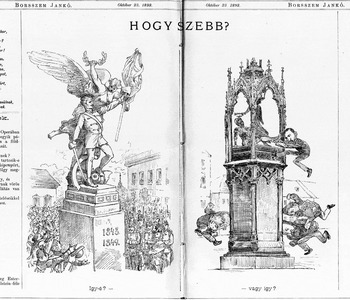
On the symbolic level, Francis Joseph did make a concession to Hungarian national sentiment, which ironically led to the next stage in the controversy over the Hentzi Monument. In 1892, on the twenty-fifth anniversary of his coronation as King of Hungary, Francis Joseph allowed a Honvéd monument to be erected on Castle Hill's Dísz Square, not far from the Hentzi Monument. Designed by the Hungarian sculptor György Zala and financed by a nationwide collection effort, the bronze Honvéd Monument was an explicit counterpoint to the Hentzi Monument, a symbolic representation of a countervailing historical narrative (Figure 2). It depicts a Honvéd soldier standing atop a broken cannon, holding a lowered sword in his right hand and a raised flag in his left. The flag, portraying the Virgin Mary with the infant Jesus in her arms, bears the slogan “freedom or death.” Like the Hentzi Monument, the Honvéd Monument also has a figure with a wreath in its hand. Yet the figure on the Hentzi Monument is a cherubic angel pointing to the hereafter, whereas the figure on the Honvéd Monument is a Winged Victory placing a laurel on the head of a wounded Honvéd soldier. The symbolic counterpoint also extended to the pedestals, both of them bearing the date of the fateful battle for Castle Hill (21 May 1849). On the Hentzi Monument, this commemorated the valiant Austrian soldiers—and their fearless general and lieutenant—who made the ultimate sacrifice for “emperor and fatherland” (Kaiser und Vaterland). On the Honvéd Monument, it commemorated the valiant Hungarian soldiers who died in their patriotic struggle “for a free homeland” (Szabad Hazáért).Footnote 51 Unlike the Austrian soldiers, who were listed by name, the Hungarian soldiers remained “nameless” martyrs for the national cause.
Which is more beautiful? Like this?—or like this? From Borsszem Jankó, 23 October 1892.

The Honvéd Monument was the culmination of a “monument mania” that enveloped Hungary in the second half of the nineteenth century, beginning in the neoabsolutist period with “neutral” statues of Hungarian poets, actors, and linguists, and progressing from the 1860s onward to more controversial statues of Hungarian statespeople and revolutionaries.Footnote 52 A Honvéd monument was dedicated in Debrecen in 1861; in Arad, nine years later. A monument to Sándor Petőfi, the Hungarian national poet and a central figure in the Revolution of 1848, was erected in Budapest in 1882Footnote 53; and a monument in honor of the thirteen martyrs of Arad, who were executed in 1849, was erected in Arad in 1890. Still, the Honvéd Monument in Budapest, by virtue of its location, constituted one of the most important watersheds in the contested commemoration of 1848–1849. As Lajos Kossuth observed from exile:
There are two monuments on Castle Hill . . . One was erected by the emperor of Austria, before he was crowned king of Hungary, in honor of Hentzi, who once . . . sank to his feet in [his] Austrian general's uniform and begged me to protect his family. He swore his allegiance to the Hungarian fatherland and asked me to give him the opportunity to serve the fatherland. . . . And he responded to [my gesture] by becoming the “brave” (I kid you not) defender of Castle Hill in the service of the Austrian emperor—who was not yet king of Hungary—[and fighting] against the Hungarian nation; by bombarding the capital of Hungary; by trying to blow up the bridges; by refusing to hand over Castle Hill to its legal owners: the Hungarian nation. The first monument, the Hentzi Monument, is dedicated to his memory. The second [monument] was erected out of reverence for the nation, honoring the bravery of its victors. The simultaneous presence of both memorials on Castle Hill gives expression to such contradictory conceptions.Footnote 54
Indeed, for Kossuth, the two monuments gave expression to two “contradictory conceptions” of Hungarian history, one that viewed Hentzi as the brave martyr who quelled a civil war and saved the monarchy and one that viewed him as the imperial aggressor who terrorized Pest and defeated the Hungarian war of independence.
For Imre Ivanka, a member of the ruling Liberal Party and himself a former member of the Honvéd army in 1849, the unveiling of the new Honvéd Monument presented a golden opportunity for reconciling the two contradictory conceptions of Hungarian history. Ivanka, who felt it was high time to overcome the conflicting feelings about 1849, proposed an unveiling ceremony, in which the commander of the joint army and the president of the Honvéd central committee would lay a wreath on the Honvéd Monument to the accompaniment of the Hungarian anthem. They would then do the same at the Hentzi Monument, to the accompaniment of the Habsburg anthem.
Ivanka's plan was approved by Prime Minister Gyula Szapáry, who could view it as a “moral victory” for the Hungarian national cause. Indeed, as Pesti Hírlap (Pest News) pointed out, the commander of the joint army would do what was previously unthinkable: honor the Honvéd troops who had stormed Castle Hill (and killed Hentzi) in 1849. Pesti Hírlap viewed this as the last stage in a drawn-out healing process, a mutually conciliatory gesture that would finally “drape a veil over the past.”Footnote 55 These sentiments were echoed by the Neue Pester Journal, as well. “[T]his day is not devoted solely to the past,” the German-language newspaper proclaimed. “It is also a celebration of the future. It will be clear as day that the struggle, for which heroes on both sides had to lose their lives, is completely over, that nothing remains of it besides the commemoration of the manly dignity demonstrated by both sides.”Footnote 56
The sentiments expressed by Ivanka, Szapáry, and many of Hungary's newspapers were by no means universal. Indeed, when word of the ceremony reached the leaders of the Independence Party, the mood was far from conciliatory. Incensed at the idea of Honvéd members honoring Hentzi, Károly Eötvös called on fellow members of the opposition to join him in the Abazzia coffeehouse, where they could plan a coordinated response to this “assault against the nation” (nemzetellenes merénylet).Footnote 57 In Eötvös's view, the fact that the wreath-laying ceremony was planned by standard-bearers of the Hungarian revolution—and not, as in 1886, by a commander of the joint army—made it all the more lamentable. As he saw it, members of the Honvéd central committee—like Imre Ivanka—had “denied their past, polluted the memory of their deceased comrades-in-arms, and insulted the Hungarian nation.”Footnote 58
With Eötvös at the helm, opposition to the wreath-laying ceremony grew into a nationwide movement. Veterans of 1848, such as 70-year-old Dániel Irányi and 62-year-old Ignác Helfy, lent their moral support; and Lajos Kossuth again expressed his indignation from exile.Footnote 59 In parliament, Eötvös was joined by Lajos Hentaller, Albert Apponyi, and Gábor Ugron, who vociferously denounced the “desecration of the Hungarian nation” and “the pernicious, evil outrage against the memory of the fallen Honvéd soldiers of 1849.”Footnote 60 Protest gatherings were held in Arad, Komárom, Szentes, Csongrád, Nyitra, Kolozsvár, and elsewhere, with university students again at the vanguard. As in 1886, the Hungarian nationalist press, particularly Egyetértés (Accord), the organ of the Independence Party, fanned the flames of opposition to the planned ceremony of reconciliation.
The socialist press, on the other hand, viewed the entire controversy as a distraction from the more pressing issues of the day, such as the wretched working conditions and squalid living conditions of the proletariat, which were a breeding ground for the cholera epidemic that was sweeping Budapest at the time. As Népszava (People's Word), the Hungarian-language weekly of the Social Democrats, put it, “It does not concern us.”Footnote 61 As the newspaper saw it, the controversy over the Hentzi Monument pitted the “commemoration of the revolution” against the “commemoration of tyranny,” and neither the former nor the latter had done anything for the benefit of the workers. Both sides were exploiting the controversy for their own purposes, and Népszava preferred not to waste too many words on it. The Arbeiterpresse, the German-language weekly of the Hungarian Social Democrats, went one step further: it chose not to waste any words on it.Footnote 62
As the historian Gusztáv Gratz has observed, Imre Ivanka and other members of the ruling party “sharpened the dissonance” in public life that they were initially hoping to dampen.Footnote 63 Alongside the perennial debates over the limits of the Austro-Hungarian compromise in general, and the nature of the joint army in particular, Hungarian public life was increasingly dominated by the conflict between church and state. Debates over mandatory civil marriage, the civil registration of births and deaths, and the full recognition of the Jewish faith pitted conservatives against liberals throughout Gyula Szapáry's brief tenure as prime minister (1890–1892). Although Szapáry's “rigid handling” of church-state relations led to his eventual resignation, many contemporaries also blamed the prime minister's weakened stature on the controversy over the Hentzi Monument.Footnote 64 Szapáry resigned on 9 November 1892, exactly a week after the planned ceremony. In the end, the common ceremony never took place, and the dedication of the Honvéd Monument was postponed until 21 May 1893, the forty-forth anniversary of the event it commemorated.
Blown Out of Proportion, 1895
Lajos Kossuth, the living symbol of Hungary's struggle for independence, passed away in Turin, Italy, on 20 March 1894, less than a year after the dedication of the Honvéd Monument. Banned from returning to Hungary during his lifetime, Kossuth's body was brought back to Budapest for burial; and his coffin lay in state at the National Museum (where the Hungarian revolution had begun in 1848) until his funeral on 2 April. Although Francis Joseph refused to declare the funeral a state occasion, hundreds of thousands of mourners took to the streets of Budapest to bid Kossuth farewell. Radical Hungarian newspapers like Olvasd! (Read This!) interspersed eulogies for Kossuth with anti-Habsburg vitriol (such as the poem, “To Hungary's slaves”).Footnote 65
Olvasd! also agitated against the Hentzi Monument, repeatedly calling for its removal from Castle Hill. In July 1894, when it was rumored that Lajos Hentaller, an outspoken member of the Independence Party, intended to blow up the Hentzi Monument with the help of Hungarians from the countryside, Olvasd! deemed this perfectly natural. Since the “people of the capital” (A főváros népe) had already tolerated this “national humiliation” for more than forty years, it was up to “patriots from the countryside” (vidéki hazafiak) to remove this blight.Footnote 66 (This romantic glorification of Hungarians from the countryside and the concomitant disparagement of the cosmopolitan, deracinated inhabitants of the capital were widespread among Hungarian conservatives at the turn of the century.)
In July 1894, Olvasd! published a poem calling for the destruction of the Hentzi Monument, opening with the following stanza:
In Hungary's center
On Castle Hill (what eternal shame!)
A statue stands
For our enemy: the tyrannical Austrian,
Murderer Hentzi.
Its shadow is so dark
That it envelops the whole country.Footnote 67
The anti-Hentzi campaign continued in the following year, when Olvasd! published a lengthy anti-Habsburg article (“Destroy It”), which concluded with the rallying cry, “Destroy all that is not Hungarian, destroy the Hentzi Monument.”Footnote 68
On 1 April 1895, at roughly one o'clock in the morning, a “tall, strong man with a thick circle-beard and dark mustache, wearing a light-colored coat and having the appearance of a gentleman” approached St. George Square and attempted to blow up the Hentzi Monument.Footnote 69 The explosion shattered windows on Castle Hill, but it caused almost no damage to its target.Footnote 70 According to a police report, the perpetrator had hoped that “in Vienna they would be outraged [by the attack] and perhaps a revolution would come of it.”Footnote 71 Suspicion immediately landed on Adorján Szeless, editor of Olvasd!, who had allegedly told an acquaintance about his plan to dynamite the Hentzi Monument.Footnote 72 He managed to flee abroad, first to France, where he was temporarily held in French custody.Footnote 73 With Szeless out of reach, the police arrested Zoltán Takáts—who had written the above-mentioned article “Destroy It”—for “incitement against the relationship with the other state of the monarchy.”Footnote 74 Meanwhile, Szeless moved from France to Switzerland, then to England, and finally back to France, all the while publishing inflammatory articles in Olvasd! He lived under an alias (Karl Müller) in Zurich, but he published a small book in Geneva under his real name. In this book, Fekete Könyv (Black Book), he described his simmering anger toward the Hentzi Monument; his anger had come to a raging boil during the Hentzi affair of 1892.Footnote 75
In Olvasd!, Szeless described himself as “bujdosó” (exiled one), establishing a direct link to seventeenth-century anti-Habsburg rebels who had also been exiled from their homeland.Footnote 76 Szeless's newfound status as a kind of folk hero presented a conundrum for the Hungarian police. A handwritten proclamation posted on the National Museum on April 8, 1895, praised the “Hungarian sentiment” of Zoltán Takáts and “the person who blew up the cursed Hentzi Monument.”Footnote 77 With such expressions of popular support for the attack on the Hentzi Monument, the police may have been secretly pleased that they had been unable to apprehend Szeless. One contemporary journalist ruminated on what might happen if the police ever did catch Szeless, speculating that his capture would turn him into a “patriotic martyr.” “It would probably be best,” the author concluded, “if the police never find the assailant.”Footnote 78
Regicide, Relocation, and Rededication, 1898–1899
The contemporary press described Szeless's attack on the Hentzi Monument as an “assassination” attempt (Attentat/merénylet); so, it is perhaps fitting that a real assassination provided a pretext for the eventual removal of the contested monument from Castle Hill.Footnote 79 On 10 September 1898, Empress Elizabeth was assassinated in Geneva, Switzerland, and the aggrieved Hungarians in Budapest—“ever grateful for the sympathy she had shown for them in their past misfortunes”—donated 350,000 florins to erect a monument in her memory.Footnote 80 The emperor-king, perhaps grateful for the outpouring of sympathy or perhaps simply recognizing an opportunity to save face, declared that the future monument would be erected on St. George Square, the current site of the Hentzi Monument.Footnote 81 Although the possibility of bringing the monument to Vienna was apparently considered,Footnote 82 the ministry of war decided to move it to the infantry cadet school in the Hűvösvölgy district of Buda, where it would also serve as a tombstone for Hentzi's fallen soldiers (whose bodies were to be exhumed from the soon-to-be-abandoned Krisztinaváros cemetery at the foot of Castle Hill).Footnote 83 A lead article in the Budapesti Hírlap (Budapest News) praised this decision as evidence that the feelings of the Hungarian nation had finally “triumphed in the king's heart.” The decision to remove the monument was seen as all the more noteworthy, because it came about peacefully. “We did not demolish it,” observed the Budapesti Hírlap. “It was not smashed by violence, but by royal edict. A new mindset has replaced the old—vengeance has given way to reconciliation.”Footnote 84
The removal from a public square on Castle Hill to the enclosed garden of a military academy on the outskirts of Budapest endowed the Hentzi Monument with a different semiotic status.Footnote 85 The monument was not placed in a museum, which would have perhaps turned it into “a detached object of historical reflection rather than [an] icon of an ongoing civil religion.”Footnote 86 Nonetheless, there was hope that the change of context would diminish the decades-old sting of the monument.
Although the monument assumed a new semiotic status, it was not universally interpreted as a conciliatory gesture on the part of Francis Joseph. Austrian opponents of the compromise, who resented any concessions to the Hungarians, as well as Hungarian opponents of the compromise who found even these concessions to be insufficient, made their opinions clear. As a British tourist observed, the proposal to remove the Hentzi Monument “at once led to a furious outcry throughout Germanic Austria, which it needed all the patience and tact of the emperor Francis Joseph to allay.”Footnote 87 In Hungary, the outcry took the form of a parliamentary obstruction, led by Ferenc Kossuth, who had returned to Hungary after his father's death and become the leader of the Independence Party. For Kossuth, the relocation of the monument was an even greater insult than simply leaving it in place; he believed the new context would send the wrong message to Hungary's young cadets. “The Hentzi Monument,” he told parliament, “was until now just a memorial, a sad memorial.”
Now, however, they want to turn it into a living altar. What can this monument possibly teach the youth? Only that at the order of the emperor of a foreign country (who was not yet the king of Hungary), it was the glory of a Hungarian-born soldier to violate an oath taken on the Hungarian constitution . . . it was his glory, after taking the oath, to raise weapons against his fatherland, to bombard his fatherland's undefended capital city, and to forget everything that is sacred to a patriot.Footnote 88
Kossuth's parliamentary speech was viewed as disingenuous demagoguery by the Social Democratic press, which dished out its own share of demagoguery in return. According to Népszava, Ferenc Kossuth and other members of the Independence Party resembled Hentzi more than they resembled the heroes of the Hungarian revolution, because their parliamentary obstructionism—like Hentzi's bombardment of Pest—constituted the breaking of an oath taken on the constitution. An article entitled “The Hentzi-Incitement” accused them of “dulling the people's self-consciousness with the Hentzi [Monument]” and of “soothing their torturous wounds with a statue of iron instead of the balm of the law.”Footnote 89 Népszava disparagingly referred to the leaders of the Independence Party as “coffeehouse heroes” (kávéházi hősök) who ignored the “thousand important matters” facing the people of Hungary and displayed bravery only when ranting against a mere corpse.
The Hentzi Monument was rededicated on 12 August 1899, a day before the fiftieth anniversary of General Görgey's surrender to the Russian army. The monument was unveiled at its new home in the garden of the cadet school, where it also served as a tombstone for the fallen Austrian soldiers. (As it was subsequently revealed, Hentzi's remains were not actually reburied; they had apparently fallen victim to grave robbers in the 1850s.)Footnote 90 Francis Joseph was present at the dedication on Castle Hill in 1852; this time, however, Archduke Joseph, palatine of Hungary, represented the emperor-king. After the ceremony at the cadet school, mounted police had to disperse hostile Hungarian demonstrators who expressed their outrage that the monument had not simply been destroyed or dismantled. Egyetértés called the dedication ceremony an “anti-Magyar demonstration”Footnote 91; and Ferenc Kossuth, echoing the sentiments of his late father, excoriated it as an “insult to the nation.”Footnote 92 In protest against the “Hentzi celebration,” a separate “Honvéd celebration” was organized on August 12, with a procession leading from the Honvéd Monument on Castle Hill to the Krisztinaváros church, where a solemn mass was recited in memory of the Honvéd members who had fallen in 1849.Footnote 93
Though pushed to Budapest's periphery in 1899, the Hentzi Monument remained central to the rhetoric of political denunciation in turn-of-the-century Hungary. A potent symbol of Hungarian national self-abnegation, Hentzi was long gone; but the controversy and notoriety surrounding the monument turned him into a household name—and a politically charged epithet. As Endre Ady observed, “Hentzi hussar” referred disparagingly to Hungarian politicians who illegitimately claimed “the honorable Hungarian name,” but were in fact “instruments, yes base instruments, of the [Habsburg] authorities.”Footnote 94
Fall of the Habsburgs—Fall of Hentzi, 1918
“The literal fall of a monument,” wrote Dario Gamboni, “seems to be predestined to symbolize the metaphorical fall of the regime that had ordered its erection.”Footnote 95 The Hentzi Monument was no exception. It remained in the cadet school until its destruction during the first days of Hungary's democratic revolution in 1918. As the Austro-Hungarian monarchy dissolved in October 1918, a kind of nationalistic iconoclasm swept over its former domains, targeting symbols of Habsburg hegemony that were seen to be at odds with the national cultures of the emerging successor states.Footnote 96 Similar to the fate of the Marian column in Prague, which was toppled by Czech nationalists on 3 November, the Hentzi Monument fell victim to Hungarian nationalists seeking a symbolic break from what they perceived as centuries of Habsburg oppression.
The symbolic break came on 1 November 1918, the day after a young Hungarian merchant named Károly Tolnay walked into the cadet school and declared his intention to blow up the monument. He threatened to come back with five thousand men if he was not given permission to do so, and he reportedly proclaimed that “[t]his monument, which is an insult to Hungary [and] a disgrace to her memory, must disappear from the face of the earth.”Footnote 97 After drawn-out deliberations, Tolnay was instructed to get written permission from the newly established national council, if he wanted to destroy the Hentzi Monument. He did as instructed and on the next day he returned to the cadet school to accomplish his task. Pesti Hírlap (Pest News) celebrated the destruction of this “infamous” monument, which had come to symbolize the irreconcilable tension between the Habsburg dynasty and the Hungarian nation. Hentzi was portrayed as an embodiment of Habsburg oppression; after all, he had bombarded Pest “in the name of the Habsburg dynasty.” As Pesti Hírlap observed, Francis Joseph had always favored the “dead Hentzi” over the “living [Hungarian] nation,” and only with the outbreak of revolution could the Hungarian nation finally destroy this “insult cast in metal” (ércbe öntött gyalázat).
Although the final denouement in the sixty-six year saga of this “insult cast in metal” came in autumn 1918, questions arose afterwards about the fate of the largely salvageable rubble. The figure of the dying soldier, which had often been identified as General Hentzi, was the primary object of Tolnay's iconoclastic fury; but the six allegorical figures (as well as some other architectural elements) were left largely unblemished. Did these objects have any inherent value as historical testimonies or objets d'art, or could they be tossed into the furnaces to be melted down and then endowed with a new function in the newly independent Hungary? As Viktória Czaga, an archivist at the Budapest city archives, has recently shown, these questions were posed by Budapest's military leadership, which solicited an expert opinion from a local sculptor.Footnote 98 The sculptor József Róna, reflecting on the significance of the monument, observed the following:
Ever since the erection of the Hentzi Monument it was a splinter in the eye of the nation, a “Gessler hat.” Setting up [the monument] in the heart of the country was felt as a humiliation by every patriotic person. I admit that the monument has a measure of artistic value, but I find it preposterous to commemorate today's great events of national transformation by referring to the remains of the Hentzi Monument, since irrespective of the political context, this would only produce an unsatisfactory artistic resolution. It is absolutely certain that the Hungarian nation would like to immortalize these great events in a more grandiose and more dignified way.
Róna then offered his unequivocal suggestion: “Dismantle the monument and sell it as junk iron.” He did, however, make one caveat. Because the late Hans Gasser, who had sculpted the allegorical figures, was buried in Budapest, Róna suggested placing one of his statues in the Budapest city museum. The military commander initially ordered all six allegorical figures to be donated to the City Museum, but in the end they were auctioned at Budapest's Ernst Museum on 3 February 1920.Footnote 99
All proceeds from the auction were donated to Jövő Nemzedék (Future Generation), a children's charity, whose name seemed to augur hope that a contested past might give way to a more conciliatory future. If the auction catalog is any indication, the highly contested Hentzi Monument had already begun to drift into oblivion. Of the six allegorical statues up for auction, only three of them—Religion, Chivalry, and Vigilance—were actually labeled correctly. Self-Sacrifice (Önfeládozás) had metamorphosed ever so slightly into martyrdom (Vértanuság), whereas Truth (Igazság) and Loyalty to the Flag (Hűség a zászlóhoz) had disappeared completely. In the catalogue, these two allegories were identified instead as Beauty (Szépség) and Freedom (Szabadság).Footnote 100
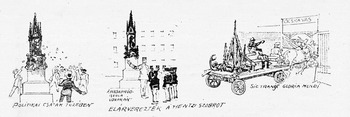
Private Hungarian collectors purchased five of the six allegories, with Vigilance fetching the highest price. Loyalty to the Flag, which found no buyer at the auction, was purchased by the military history museum, where it was joined six years later by Self-Sacrifice. Chivalry ended up at the Kiscelli Museum (part of the Budapest Historical Museum), from where it was stolen—along with a number of other statues—following World War II.Footnote 101 Truth and Vigilance remained in private hands, eventually serving as garden ornaments at a house in Keszthely, near Lake Balaton.Footnote 102 The rest of the monument was carted off to a junk yard, as depicted in a satirical cartoon from the week of the auction. Sic transit gloria mundi (thus passes the glory of the world) reads the caption underneath this image, implying that the Hentzi Monument and the decades-long brouhaha surrounding it were soon to be nothing but a fleeting memory (Figure 3). Throughout the 1920s and 1930s, the bygone Hentzi Monument occasionally garnered attention in the popular press,Footnote 103 but as a “national insult” it was greatly overshadowed by more recent national tragedies, such as the dismemberment of Greater Hungary by the Treaty of Trianon in 1920. Indeed, by 1930, an article on Budapest's former statues could even claim that “[t]his generation barely remembers the despised Hentzi Monument.”Footnote 104
In the heat of the political debates—They auctioned off the Hentzi Monument—Sic transit gloria mundi. From Borsszem Janko, 8 February 1920.

If the Hentzi Monument had been largely forgotten in Hungary, its memory was alive and well in interwar Czechoslovakia, one of the primary beneficiaries of Trianon. With the shutting down of Hungarian universities in formerly Hungarian territories and the introduction of the anti-Semitic Numerus clausus law in 1920, many Hungarian students ended up in Czechoslovakia, where their rabble-rousing reputation from the 1880s and 1890s preceded them. Indeed, a report on the “orientation of Hungarian students,” which was filed at the Prague police headquarters in 1932, warns that “ever since 1867, Hungarian students have lived on the basis of the revolutionary tradition of 1848–49.” As evidence, the report cites two incidents surrounding the Hentzi Monument:
First of all, in the 1880s, when [the students] tried to blow up the Hentzi monument in the Buda Castle with dynamite. . . . then in the 1890s, when Corporal Jansky held a speech in the cadet school in Budapest, where the Hentzi monument had been brought, touting Hentzi as a model for royal-imperial officers in the service of the emperor. The Jansky affair brought about colossal turmoil, and the students were at the forefront.Footnote 105
The report mixes up some of the details—the Jansky affair took place in 1886, when the monument was still on Castle Hill, and the attack by Szeless occurred in 1895—but the report nonetheless captures the highly charged atmosphere that enveloped the Hentzi Monument and animated Hungarian students throughout the dualist period.
The centennial of Hentzi's death fell on 21 May 1949, four years after the end of World War II, three months before the dawn of Hungary's Stalinist era, and two and a half years before the dedication of the colossal Stalin statue. The sesquicentennial of Hentzi's death fell at a more propitious time: a decade after the fall of communism, eight years after the departure of the last Soviet troops, and one month after Hungary joined NATO. Unlike the 100th anniversary, the 150th anniversary was marked by an official ceremony at the cadet school in Hűvösvölgy, with Austrian and Hungarian diplomats in attendance.
At the initiative of József Holló, a retired major-general in the Hungarian army and now the director of Hungary's military history museum, a new Hentzi monument—this time, a simple stone stele—was placed atop the crypt in the cadet school courtyard, where the controversial monument had stood between 1899 and 1918. A wreath was placed in front of the new monument, and Major-General (ret.) Holló addressed the diplomats, generals, and other dignitaries present. In his speech, he referred to Hentzi as a “defender of Castle Hill” (várvédő), making no mention of the destruction of Pest wrought by his forces, nor their role in suppressing the Hungarian war of independence. The original Hentzi Monument received brief mention, not as an “insult to the nation,” but rather as a suitable memorial (emlékmű). Major-General Holló ended his speech with the following flourish:
Now, as we respectfully bow our heads before the restored crypt, let me remind you of the soldier's ancient credo, according to which the fallen soldier is no longer an enemy (az elesett katona többé nem ellenfél).
Without wrath, pathos or regard for our former antagonism, we are obligated to commemorate our former enemies, who kept their soldier's oath faithfully and honorably.
This is necessitated by the thriving cooperation between Austria and Hungary, the good relations that have arisen since those historical times, and the continuing development and promising outlook of military relations between the two nations (a két nemzet közötti katonai kapcsolatok).Footnote 106
Like General Ludwig Jansky in 1886, Major-General Holló viewed the commemoration ceremony in 1999 as an act of reconciliation necessitated, in part, by “military honor.”Footnote 107 Unlike the nineteenth-century commemoration, the late-twentieth-century celebration generated no public controversy and received only passing mention in the contemporary Hungarian press.Footnote 108 Apart from the tempestuous century that had elapsed between the two commemorations, there was another major difference, which now made it possible for a Hungarian major-general to pay his respects to Hentzi and even erect a new kind of monument on his (alleged) final resting place. This difference was the very existence of a Hungarian national army and an independent Hungarian state. General Jansky, commander of the joint army in Budapest, had been a living symbol of Hungarian subjugation to Austria, a reminder of Hungary's thwarted national aspirations under Habsburg rule. Major-General Holló, in contrast, had risen in the ranks of a Hungarian national army (albeit under Soviet domination) and could speak in 1999 of “military relations between two nations”—between the Republic of Hungary and the Republic of Austria. With the dissolution of the Austro-Hungarian monarchy, the collapse of the Soviet Union, and the end of the conflict between nation and dynasty (or empire), perhaps Hungary had finally recovered from its “Hentzi complex.”Footnote 109
Michael Laurence Miller is assistant professor in the Nationalism Studies Program at the Central European University, Budapest. Earlier versions of this paper were presented at the weekly seminar of the History Department at Tel Aviv University and the inaugural conference of the Urban Studies Workshop at Central European University. I thank the participants for their helpful comments.