Introduction
People living with dementia (PLwD) require extensive long-term care support and most of this care is provided by family caregivers (e.g., spouse or adult child) (Gaugler and Kane, Reference Gaugler and Kane2015; Jutkowitz et al., Reference Jutkowitz, Gaugler, Trivedi, Mitchell and Gozalo2020a, Reference Jutkowitz, Gozalo, Trivedi, Mitchell and Gaugler2020b, Reference Jutkowitz, Kane, Gaugler, MacLehose, Dowd and Kuntz2017a). Even when PLwD desire to age in place with quality of life, they are at risk for transitioning to residential facilities as their need for care increases (Gaugler and Kane, Reference Gaugler and Kane2015; National Academies of Sciences, Reference Schulz and Eden2016). To help PLwD age in place requires interventions that provide their caregivers with support and skills to manage dementia-related symptoms including behavioral and psychological symptoms (e.g., agitation) and functional dependence (Gaugler and Kane, Reference Gaugler and Kane2015; Gitlin et al., Reference Gitlin, Kales and Lyketsos2012; National Academies of Sciences, Reference Schulz and Eden2016).
Tailored nonpharmacologic dyadic interventions which provide family caregivers knowledge and skills to manage dementia-related clinical symptoms are recommended as first-line treatment (Gitlin et al., Reference Gitlin, Kales and Lyketsos2012; Kales et al., Reference Kales, Gitlin and Lyketsos2019; Lyketsos et al., Reference Lyketsos2006). Randomized trials have shown that dyadic interventions (e.g., instructing in communication, task and environmental strategies) are safe and reduce dementia related behavioral symptoms, caregiver stress, and time spent caregiving (Callahan et al., Reference Callahan2006; Gitlin et al., in press - a, Reference Gitlin, Winter, Dennis, Hodgson and Hauck2010, Reference Gitlin, Winter, Dennis, Hodgson and Hauck2010b, Reference Gitlin, Hodgson, Choi, Boltz and Galvin2016a). Nevertheless, these interventions have generally not been adopted by systems of care (Boustani et al., Reference Boustani, Alder, Solid and Reuben2019; Burgdorf et al., Reference Burgdorf, Roth, Riffin and Wolff2019).
In the USA, a key challenge to widespread uptake has been the lack of a sustainable payment model for these programs. Nondrug dyadic interventions target both the PLwD and family caregiver, with both members of the care unit deriving benefit. This creates challenges for payment/reimbursement, as in contrast to PLwD, their caregivers may not be Medicare beneficiaries. In practice, dyadic interventions would likely be implemented as part of social care or a long-term care system. Financing of social and long-term care varies by state, county, and municipality. Yet, with emerging payment models such as accountable care organizations or Medicare Advantage, proven nonpharmacologic dyadic dementia interventions have the potential to become standard care (Boustani et al., Reference Boustani, Alder, Solid and Reuben2019).
To inform the widespread dissemination and implementation of nonpharmacologic dementia care interventions, it is important to understand how much caregivers value them (Gustavsson et al., Reference Gustavsson, Jonsson, McShane, Boada, Wimo and Zbrozek2010; Schulz et al., Reference Schulz, Beach, Matthews, Courtney, De Vito Dabbs and Mecca2016). Multiple cross-sectional studies have found that most caregivers of PLwD are willing to pay out-of-pocket to reduce caregiving burden (Chiu et al., Reference Chiu, Tang, Liu, Shyu and Chang1998; Gustavsson et al., Reference Gustavsson, Jonsson, McShane, Boada, Wimo and Zbrozek2010; König and Wettstein, Reference König and Wettstein2002). This includes willing to pay for technologies that assist and monitor PLwD in residential care (Schulz et al., Reference Schulz, Beach, Matthews, Courtney, De Vito Dabbs and Mecca2016). Several demographic factors have been found to be associated with willingness-to-pay (WTP) including family wealth, caregivers expressing a need for training (Gervès-Pinquié et al., Reference Gervès-Pinquié, Bellanger and Ankri2014), time spent caregiving (Jutkowitz et al., Reference Jutkowitz2019), and caregiver age (Schulz et al., Reference Schulz, Beach, Matthews, Courtney, De Vito Dabbs and Mecca2016). In a previous study and contributing to the WTP literature, we asked caregivers enrolled in a clinical trial, the Dementia Behavior Study, their WTP per session for an eight session 3 month hypothetical nonpharmacologic intervention (Gitlin et al. in press - b, Reference Gitlin2016b; Jutkowitz et al., Reference Jutkowitz2019). We asked the WTP questions prior to caregivers being assigned to treatment. We found that caregivers were willing to pay $36.00 (95% CI:$26.73, $45.27) per session for an intervention (Jutkowitz et al., Reference Jutkowitz2019).
In this follow up study, we provide a focused assessment of caregivers WTP for a hypothetical nonpharmacologic dementia intervention using baseline and follow-up data (3 month, and 6 months) from the Dementia Behavior Study (Gitlin et al., in press - b, Reference Gitlin2016b). We examined WTP for caregivers assigned to treatment and attention control groups at each time point and whether the mean WTP trajectories over time differed between groups. The treatment group received the Tailored Activity Program (TAP; described in detail below) which involved providing activities tailored to the PLwD, instructing caregivers in their daily use, and providing caregivers with disease education and stress reduction techniques. Caregivers randomly assigned to the attention control group received dementia education, general support and a home safety evaluation.
We hypothesized that caregivers randomized to TAP would be willing to pay more when responding to a hypothetical nonpharmacological dementia intervention scenario, which was similar to the program they just participated in at 3 month. That is, TAP caregivers would be willing to pay more immediately following exposure to and participation in the intervention and at a 6-month follow-up (i.e., 3 months following the conclusion of their participation in the intervention) as compared to baseline. Also, we hypothesized that this increase in WTP would be greater than the corresponding change in WTP among caregivers who received the attention control group and who responded to the same hypothetical nonpharmacological dementia intervention case scenario.
To our knowledge, prior studies on WTP for caregiver support programs have only evaluated WTP at a single time point. Cross-sectional studies, including our prior WTP evaluation, ask caregivers their WTP for a hypothetical program prior to their exposure to a particular intervention. In this approach, reported WTP does not reflect a caregiver’s informed preference. That is, caregivers are asked to report their WTP for a hypothetical program they have not experienced. Our study represents an initial attempt to understand how participation in different supportive interventions changes the amount caregivers may be willing to pay for a program that can help them manage dementia-related clinical symptoms.
Methods
Study procedures and randomization
The Dementia Behavior Study was a randomized clinical trial that recruited 250 community-dwelling PLwD and their caregivers (dyads) between 2013 and 2016 from the State of Maryland and Washington, DC (Gitlin et al., Reference Gitlin2016b). To participate in the trial, PLwD had to speak English, have a physician diagnosis of dementia, able to participate in ≥2 activities of daily living, exhibit agitated/aggressive behaviors, and have a caregiver willing to participate. Caregivers had to be English speaking, a family member (including fictive kin), ≥21 years of age, live with or near the PLwD (≤15 minutes or ≤5 miles), have access to a telephone, and plan on maintaining current residence for ≥6 months.
The study was approved by the Johns Hopkins University Institutional Review Board and a Data Safety Monitoring Board. All participants provided written informed consent. If the PLwD lacked capacity for consent, proxy consent was obtained from the responsible party, generally the primary caregiver.
Enrolled dyads participated in a baseline interview that was conducted in the PLwD or caregiver’s home by a trained interviewer and consisted of questions related to WTP, cognition, function, behavior, and demographic characteristics. The baseline interview occurred prior to treatment assignment or exposure to the treatment conditions. Following the baseline interview, dyads were randomized to TAP or an attention control group and reassessed in their home at 3 (end of treatment) and 6 months (3 months from end of treatment) by trained interviewers blinded to treatment assignment.
Treatment conditions
TAP is an occupational therapist led intervention that consists of up to eight, 1.5 hour in-home sessions over 3 months (Gitlin et al., Reference Gitlin2016b). The aim of the intervention is to reduce dementia-related symptoms including behaviors, functional dependence and caregiver distress. TAP has been described in detail elsewhere (Gitlin et al., Reference Gitlin2016b). Briefly, in the first two sessions, interventionists assess the capabilities and interests of the PLwD, caregiver knowledge of dementia and stress level, and home environmental features that support or deter activity engagement. In sessions three through six, interventionists instruct caregivers in the use of derived activities that are tailored to the PLwD’s capabilities and interests (e.g., sorting jewelry while caregiver prepares meals). In sessions seven and eight, caregivers learn to modify activities for future declines of the PLwD and adapt a range of strategies for care challenges.
For those randomized to the attention control group, research staff (i.e., not occupational therapists) delivered an education program in up to eight, 1.5-hour in-person sessions over 3 months. Caregivers were provided with basic education on dementia, generalized support and a home safety evaluation and set of home safety improvement recommendations. The education program controlled for attention and social interaction with families which is inherent in the TAP condition. The educational program had no active elements beyond basic education, and it had no theoretical basis to affect dementia-related behaviors or functional dependence; however, as this group offered support and knowledge that caregivers rarely receive, it may benefit caregiver wellbeing and be valued by caregivers.
PLwD and caregiver characteristics
Age, gender, race (White, African American, other), living status (alone, with others), educational attainment (less than a college degree or college degree), and relationship to each other (spouse, child, or other) were reported for both caregivers and PLwD. Caregivers reported the degree of financial difficulty they encountered when paying for necessities (no difficulty, not very difficult, somewhat difficult, or very difficult), their employment status, and hours of care they provided in a month separately for activities of daily living and instrumental activities of daily living. We created a measure of total hours of care by summing the hours of care provided for activities of daily living and instrumental activities of daily living. Consistent with prior studies, we assumed caregivers could not provide >16 daily hours of care (Langa et al., Reference Langa2001).
Also at baseline, the PLwD’s cognitive status was evaluated using the Mini-Mental State Examination (Folstein et al., Reference Folstein, Folstein and McHugh1975). The PLwD’s number of dementia-related behaviors (0–14) were evaluated using the Neuropsychiatric Inventory Clinician (NPI-C) (de Medeiros et al., Reference de Medeiros, Robert, Gauthier, Stella, Politis, Leoutsakos, Taragano, Kremer, Brugnolo, Porsteinsson, Geda, Brodaty, Gazdag, Cummings and Lyketsos2010). The NPI-C is completed by a caregiver who identifies the number of behaviors exhibited by the PLwD in the previous month which included: 1) delusions, 2) hallucinations, 3) agitation, 4) aggression, 5) dysphoria, 6) anxiety, 7) elation/euphoria, 8) apathy/indifference, 9) disinhibition, 10) irritability/lability, 11) aberrant motor disturbance, 12) sleep disorders, 13) appetite/eating disorders, and 14) aberrant vocalizations. Finally, the PLwD’s number of functional limitations (0–15) were evaluated using the Caregiver Assessment of Function and Upset (CAFU) (Gitlin et al., Reference Gitlin2005). Caregivers are asked to indicate if assistance was needed in the past week for each of 15 daily activities of living: 1) using the telephone, 2) shopping, 3) food preparation, 4) housekeeping, 5) laundry, 6) traveling by car/bus/etc., 7) taking medications, 8) handling finances, 9) getting into or out of a bed/chair/wheelchair, 10) eating meals, 11) bathing, 12) dressing above the waist, 13) dressing from the waist down, 14) toileting, and 15) grooming.
Willingness-to-Pay (WTP)
At each assessment (baseline, 3 months, and 6 months), caregivers in both groups were asked the following WTP question: “How much would you be willing to pay per session for an 8-session program that lasts 3 months, and was delivered by healthcare professionals in your home who provided you with ways of addressing problem behaviors of persons with dementia and also taught you stress reducing techniques?”
Following the WTP question stem, caregivers were presented with multiple payment options and asked to identify a single amount they would pay per session: $0/session, $25/session, $50/session, $75/session, $100/session, $125/session, $150/session, $175/session, $200/session, or other dollar value per session.
Statistical analysis
We descriptively compared caregivers in the treatment and attention control groups with respect to their baseline characteristics and WTP values. We compared means for continuous variables and percentages for dichotomous variables.
A large proportion of caregivers had missing WTP responses (eTable 1). We classified WTP responses of “don’t know” and “refuse to answer” as missing. In exploratory analyses, we determined response values were not missing completely at random. Therefore, prior to evaluating the WTP trajectory, we fit a mixed logistic regression model to identify predictors of missingness. This model included the combination of covariates (caregiver and PLwD age, PLwD sex, caregiver race and educational attainment, relationship of the caregiver to the PLwD, an indicator for whether the PLwD lives alone, and the caregiver’s self-reported degree of financial difficulty encountered when paying for necessities and hours of care provided per month at baseline) that yielded the lowest Akaike information criterion (Bozdogan, Reference Bozdogan1987) (eTable 2). We included these covariates in subsequent models that evaluated WTP to strengthen our assumption that WTP values were missing at random (i.e., conditional on the observed data, the distribution of missing WTP values, and of observed WTP values is the same).
We estimated the effect of TAP relative to attention control on WTP measured at baseline, 3 months, and 6 months. At each assessment a large proportion of caregivers indicated they were willing to pay $0, so we used a generalized linear mixed hurdle modeling approach to estimate treatment effects (Diggle et al., Reference Diggle, Diggle, Heagerty, Heagerty, Liang and Zeger2002; Little et al., Reference Little2012; Min and Agresti, Reference Min and Agresti2005). The generalized linear mixed hurdle estimates a subject-specific term that implicitly imputes missing response values. By controlling for predictors of missingness our modeling approach yields consistent treatment effects. In the first part, we fit a mixed logistic regression model to predict if a caregiver was willing to pay something (i.e., WTP>$0), and in the second part we fit a mixed gamma regression model with log link to predict the amount caregivers were willing to pay among those willing to pay something. The models were fit simultaneously and allowed for random effects to be correlated between them. In addition to including the set of predictors that best explained missingness (as noted above and eTable 2), to improve model precision and adjust for any residual confounding, we considered all the other covariates for inclusion in both parts of the hurdle model (Kahan et al., Reference Kahan, Jairath, Dore and Morris2014). To estimate the treatment effect in absolute terms, we first used the model to predict mean WTP values for TAP and the attention control group at baseline, 3 months, and 6 months. We then used these predicted values to calculate the within-group mean change in WTP over time and the between-group difference in these mean change values. The nonparametric bootstrap (percentile method) was used to construct 95% confidence intervals (Efron and Tibshirani, Reference Efron and Tibshirani1994).
Results
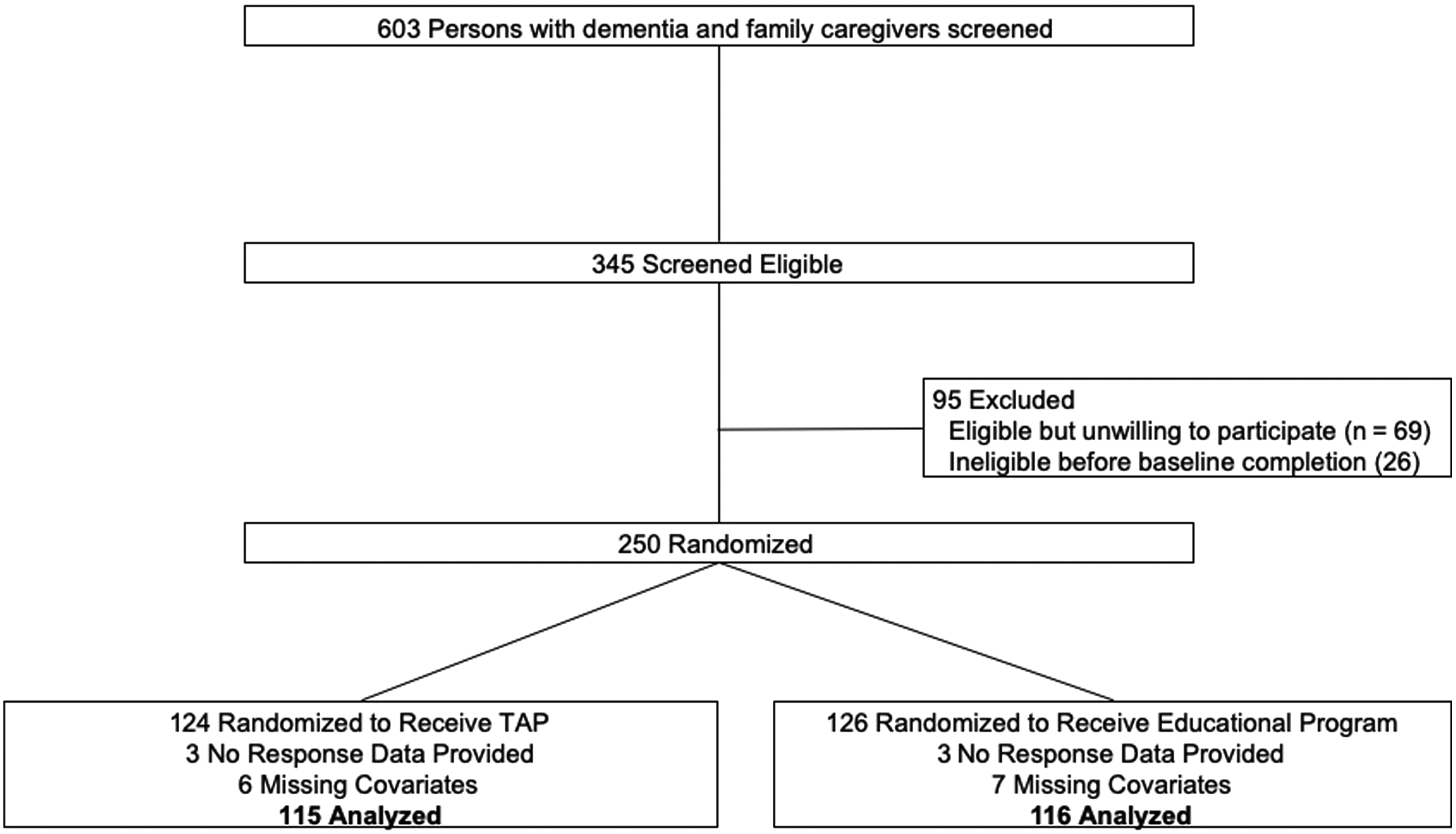
Of 603 screened dyads, 250 were found to be eligible and willing to participate in the baseline interview and were randomized to TAP (n = 124) or the attention control group (n = 126) (Figure 1). For our primary analyses, we excluded nine dyads randomized to TAP (three had no observed WTP responses at any time and six had missing data on baseline covariates). We excluded 10 dyads randomized to the attention control group (3 had no observed WTP responses at any time and 7 had missing data on baseline covariates). Our analytical sample therefore consisted of 231 dyads, (N = 115 in TAP; N = 116 in attention control). By 3 months, 46 (20%) dyads were lost to follow up or had intermittent missingness (i.e., they participated in the 6-month interview), and by 6 months 71 (31%) dyads were lost to follow up or did not answer the WTP question.
Study Flow Chart.
Note: 231 caregivers were included in the analytical sample; at baseline 20 caregivers had missing willingness-to-pay values; at 3 months 46 patients had missing willingness-to-pay values; and at 6 months 71 had missing willingness-to-pay values.

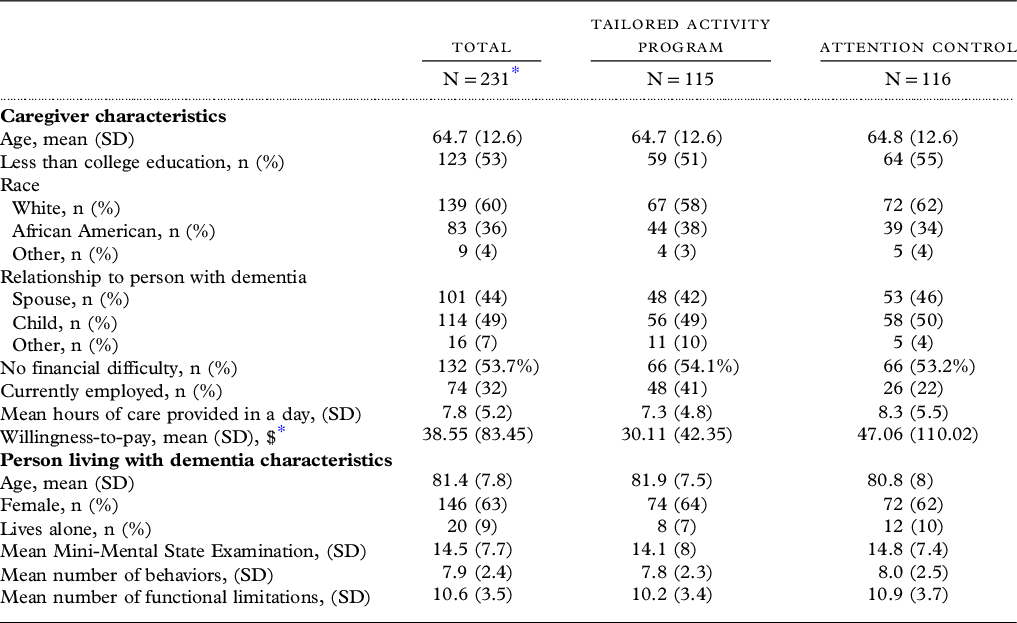
At baseline, the 231 caregivers in the analytic sample had a mean age of 64.7 (SD = 12.6) years (Table 1). Most caregivers were white (60%) with 36% of the sample identifying as African American, and 4% as other. Caregivers were either the spouse (44%) or child (49%) of the PLwD. Finally, caregivers reported providing an average of 7.8 (SD = 5.2) hours of care per day.
Baseline Demographic Characteristics

* 231 caregivers were included in the analytical sample. However, at any given timepoint, not all of the 231 caregivers had observed willingness-to-pay values. At baseline, 20 of the included 231 caregivers had missing WTP values, at 3 months, 46 caregivers had missing WTP values, and at 6 months, 71 had missing WTP values.
PLwD were a mean age of 81.4 (SD = 7.8) years and most were female (63%) and lived with another person (91%). Finally, PLwD had a mean Mini-Mental State Examination score of 14.5 (SD = 7.7), an average of 7.9 (SD = 2.4) behaviors, and 10.6 (SD = 3.5) functional limitations.
TAP group willingness-to-pay per session at baseline, 3 months, and 6 months
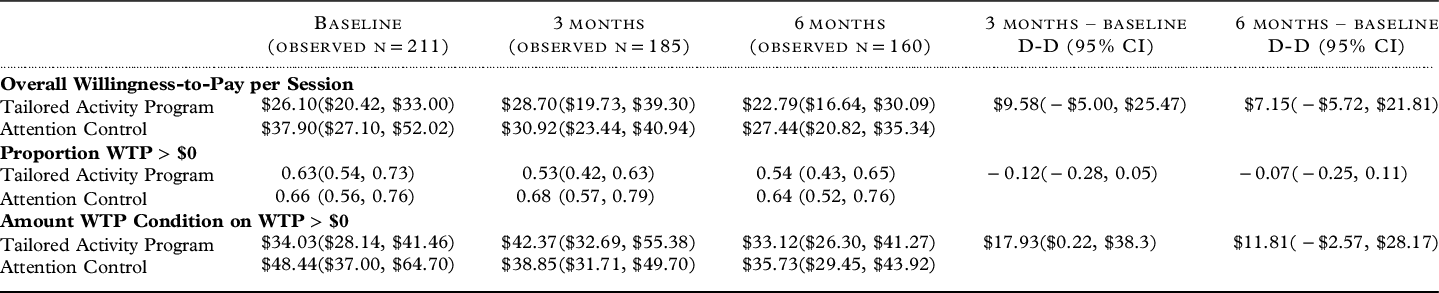
Baseline adjusted WTP per session for TAP caregivers was $26.10 (95% CI: $20.42, $33.00) (Table 2). At 3 months, adjusted WTP for TAP caregivers was $28.70 (95% CI: $19.73, $39.30) per session, which was $2.60 (95% CI: −$5.53, $12.79) more than their baseline adjusted WTP (eTable 3 for treatment coefficients). Finally, the 6 months adjusted WTP per session for TAP caregivers was $22.79 (95% CI: $16.64, $30.09), which was $3.31 (95% CI: $9.71, $3.27) less than their adjusted baseline WTP.
Adjusted Willingness-to-Pay by Group

D-D = difference-in-differences
At baseline and in adjusted analyses, 63% (95% CI: 54%, 73%) of TAP caregivers were willing to pay something (WTP >$0) per session. By 3 months and in adjusted analyses, 53% (95% CI: 42%, 63%) of TAP caregivers were willing to pay something, representing an 11 (95% CI: −0.22, 0.00) percentage point decrease from baseline. At 6 months and in adjusted analyses, 54% (95% CI: 43%, 65%) of TAP caregivers were willing to pay something, 9 percentage points below the baseline adjusted value.
Among TAP caregivers willing to pay something (WTP > $0), the baseline adjusted WTP per session was $34.03 (95% CI: $28.14, $41.46). At 3 months and among TAP caregivers willing to pay something, adjusted WTP was $42.37 (95% CI: $32.69, $55.38) per session. This represented an $8.34 (95% CI: -$1.70, $21.06) increase in adjusted WTP from baseline to 3 months. Finally, at 6 months and among TAP caregivers who were willing to pay something per session, the adjusted WTP was $33.12 (95% CI: $26.30, $41.27) which represented a -$0.91 (95% CI: −$8.62, $6.92) decrease from the baseline adjusted WTP.
Attention control group willingness-to-pay per session at baseline, 3 months, and 6 months
At baseline, adjusted WTP per session for attention control caregivers was $37.90 (95% CI: $27.10, $52.02) (Table 2). By 3 months, adjusted WTP for attention control caregivers decreased from baseline by $6.98 (95% CI: −$19.53, $4.28) to $30.92 (95% CI: $23.44, $40.94) per session. At 6 months, adjusted WTP per session for attention control caregivers was $27.44 (95% CI: $20.82, $35.34), which was −$10.46 (95% CI: −$23.26, −$0.14) less than their baseline adjusted WTP.
At baseline and in adjusted analyses, 66% (95% CI: 56%, 76%) of attention control caregivers were willing to pay something per session. At 3 months, 68% (95% CI: 57%, 79%) of attention control caregivers were willing to pay something. This represented a 0.02 (95% CI: −0.11,0.14) decrease from baseline. Finally, at 6 months and in adjusted analyses 64% (95% CI: 52%, 76%) of attention control caregivers were willing to pay something, which was 0.02 (95% CI: −0.15, 0.11) less than baseline.
At baseline and among attention control group caregivers willing to pay something per session, adjusted WTP was $48.44 (95% CI: $37.00, $64.70). At 3 months and among attention control caregivers willing to pay something, adjusted WTP decreased by $9.58 (95% CI: −$25.78, $3.26) to $38.85 (95% CI: $31.71, $49.70). At 6 months and among attention caregivers willing to pay something per session, the adjusted WTP was $35.73 (95% CI: 29.45, $43.92). This represented a $12.71 (95% CI: −$28.25, −$1.00) decrease in adjusted WTP from baseline.
Between group differences at baseline, 3 months, and 6 months
At baseline and prior to group assignment and exposure to treatment, the adjusted WTP for TAP caregivers was $11.80 (95% CI: −$27.43, $1.01) less than the WTP of attention control caregivers. From baseline to 3 months, adjusted WTP increased for TAP and decreased for the attention control. The difference in adjusted 3 month change in WTP (relative to baseline) between TAP and the attention control program was $9.58 (95% CI: −$5.00, $25.47) (Table 2). From baseline to 6 months, the adjusted WTP decreased for both TAP and attention control; however, it decreased by $7.15 more in the control arm (95% CI: −$5.72, $21.81).
At baseline and in adjusted analyses, slightly fewer caregivers (risk difference = −2%; 95% CI: −16%, 11%) in TAP were willing to pay something per session compared to caregivers assigned to the attention control arm. From baseline to 3 months, there was a decrease in TAP caregivers willing to pay something, and there was an increase in attention control caregivers willing to pay something. At 3 months, the difference in adjusted change in the proportion of caregivers willing to pay something between TAP and attention control was −0.12 (95% CI: −0.28, 0.05). At 6 months, the proportion of caregivers willing to pay something decreased in both the TAP and attention control groups relative to baseline. This decrease was greater among TAP caregivers than attention control group caregivers (risk difference = −0.07 95% CI: −0.25, 0.11).
Among those willing to pay something, from baseline to 3 months adjusted mean WTP increased for TAP caregivers and decreased for attention control caregivers. The difference in adjusted 3 month change in WTP between TAP and the attention control program was $17.93 (95% CI: $0.22, $38.30 (Table 2). From baseline to 6 months the adjusted WTP among caregivers willing to pay something decreased for both TAP and attention control; however, it decreased by $11.81 (95% CI: −$2.57, $28.17) more in the control arm (Table 2).
Discussion
We contribute to the literature by asking caregivers their WTP for an in-home intervention that may reduce dementia related behaviors, functional dependence and caregiver distress at three time periods: before exposure to a treatment condition, 3 months after expo sure to a treatment condition, and 6 months after exposure to a treatment condition. By longitudinally assessing WTP, we seek to understand how participation in supportive interventions changes the amount caregivers are willing to pay for a hypothetical intervention that can help them manage dementia related clinical symptoms. We overcome the limitations of cross-sectional designs which only assess WTP prior to experiencing the intervention. The hypothetical WTP scenario was relatable to both treatment groups. TAP, but not the attention control program, was similar to the hypothetical intervention caregivers were asked to assess at each time point.
Overall, we found that from baseline to 3 months, the adjusted mean WTP increased for TAP caregivers and decreased for attention control caregivers. That is, after participation in the TAP intervention, but not the attention control, caregivers reported slightly higher WTP. The 3 month difference-in-difference estimate was larger and favored TAP, but the effect was not statistically significant. In addition, at baseline attention control caregivers reported a higher WTP than TAP caregivers, which was primarily due to two outliers who reported a WTP ≥ $400, so we cannot rule out that changes in WTP reflect regression to the mean.
The within and between treatment differences in overall mean WTP at 3 months masked a complex underlying process. From baseline to 3 months, fewer caregivers in TAP relative to attention control were willing to pay something, while the effect was large, it was not statistically significant and was imprecisely estimated. At the same time, from baseline to 3 months and among those willing to pay something, TAP caregivers exhibited a positive and statistically significant increase in WTP relative to attention control. Thus, for the subgroup of caregivers willing to pay something, there was an increase in the amount they were willing to pay by 3 months. Our findings suggest a sorting process in which some caregivers in TAP but not attention control shifted from being willing to pay something to nothing following treatment exposure. This indicates the possibility that after participating in the program, for some caregivers their experience may not have met their expectations. Yet, among TAP caregivers willing to pay something at baseline, their average valuation increased at 3 months relative to attention control. For these caregivers, positive experiences with TAP could have contributed to expressing greater WTP for the program. Furthermore, caregivers that are willing to pay something may have a high level of readiness to learn new ways of engaging the PLwD (Gitlin and Rose, Reference Gitlin and Rose2016).
The overall 6 month difference-in-difference estimate was larger and favored TAP, but the effect was not statistically significant. TAP caregivers WTP slightly decreased relative to their baseline assessment, but this decrease was smaller than that experienced by attention control caregivers. Again, a complicated sorting process occurred. Fewer caregivers in TAP relative to attention control were willing to pay something at 6 months. However, among those willing to pay something, average WTP in TAP returned to the baseline assessment valuation while those in attention control reported a notable lower WTP. This suggests that after a period of time (6 months from baseline and 3 months from the termination of the treatment) of participation in TAP, a group of caregivers continued to more highly value paying for an in-home program that they had experienced than caregivers in the attention control group. It is important to keep in mind that 6-month follow up occurred 3 months after participation in the intervention had concluded at which point caregivers may not have been able to recall what they gained from either of the programs, TAP or the attention control. Moreover, with time, PLwD will continue to experience declines in clinical features and we do not know how this impacts WTP. Caregivers may not be able to perceive intervention benefits when their immediate situation is one in which there have been declines in PLwD (Jutkowitz et al., Reference Jutkowitz, MacLehose, Gaugler, Dowd, Kuntz and Kane2017b).
Mean WTP per session at all times is less than the average previously reported cost ($941) of delivering TAP and similar programs (Gitlin et al., Reference Gitlin, Hodgson, Jutkowitz and Pizzi2010a, Reference Gitlin, Hodgson, Jutkowitz and Pizzi2010c). However, mean WTP per session in our study is consistent with findings from other studies including Schulz et al which found that caregivers were willing to pay $49 (SD 79; median $24) per month for kitchen technology to monitor care recipients (Schulz et al., Reference Schulz, Beach, Matthews, Courtney, De Vito Dabbs and Mecca2016). The total amount caregivers reported they were willing to pay per session should be interpreted in context. First, caregivers in our study may not be representative of caregivers in other settings. The Dementia Behavior Study recruited many participants (46.3%) who reported financial difficulty paying for necessities. Caregivers with financial resources may be willing to pay more for the program (Chiu et al., Reference Chiu, Tang, Liu, Shyu and Chang1998). Second, in the USA, individuals are accustomed to partially paying for medical care (e.g., deductibles and copayments), but they generally do not pay for the full cost of care. Most caregivers believe insurance should help pay for supportive programs/technologies (Schulz et al., Reference Schulz, Beach, Matthews, Courtney, De Vito Dabbs and Mecca2016). The comparative difference in the amount caregivers were willing to pay between those in TAP versus attention control and direction of the effect speaks strongly to the value caregivers place in such programs. Future research is needed to fully understand sustainable payment models for interventions such as TAP that may or may not incorporate cost sharing informed by WTP.
Our study has several limitations. First, our findings may not be generalizable to all PLwD, caregiving situations, or nonpharmacological approaches other than TAP. To participate in our trial, PLwD had to be able to participate in ≥2 activities of daily living and exhibit clinically significant agitated/aggressive behaviors. Second, we evaluated WTP using a stated preference approach, which may be subject to bias (e.g., anchoring effect). Also, we asked caregivers the amount they would be willing to pay but not the amount they could afford to pay. The amount caregivers would actually pay in practice may be less from the monetary value they placed on the program (Blumenschein et al., Reference Blumenschein, Johannesson, Yokoyama and Freeman2001). Third, there was a significant difference in baseline WTP between attention control and TAP caregivers, so changes in WTP should be interpreted with these different starting points and the possibility of regression to the mean. We opted not to control for baseline WTP since this would exclude 20 (9%) caregivers from the analysis that had a missing baseline WTP. Finally, the WTP scenario loosely reflected the TAP intervention and we did not compare WTP for different types of caregiver supportive services. Nevertheless, this study offers important insight as to the complex relationship of WTP out-of-pocket for a supportive program and how WTP changes with exposures and time.
In conclusion, a complex sorting process distinguishes between caregivers willing to pay $0 and those willing to pay something. Caregivers are willing to pay more for a hypothetical support intervention immediately following participation in a similar program. Three-months after completing the program (6 months from baseline), TAP caregivers were willing to pay about the same amount as stated during their baseline assessment; however, caregivers in the attention control group were willing to pay substantially less than stated during the baseline assessment. Payers, care delivery systems, and long-term care providers should consider WTP findings when developing innovative payment models to help implement TAP and other nonpharmacologic home-based caregiver support programs. Also, our findings have implications for dissemination of nonpharmacological programs as exposure to program elements may be necessary for families to embrace cost sharing consistent with typical copayments for home services.
Conflict of interest
This study was supported by a grant from National Institute on Aging (Grant # R01 AG041781-01A1, 1R21AG059623, and 1R01AG060871). The sponsor had no role in the design, data collection, data analysis, and decision to publish. Dr. Gitlin is an inventor of an online program for an intervention (Tailored Activity Program) for which Johns Hopkins University, Drexel University, Thomas Jefferson University and Dr. Gitlin are entitled to royalty fees. The other authors have no conflicts of interest to declare.
Source of funding
This study was supported by grants from National Institute on Aging (Grant # R01 AG041781-01A1, 1R21AG059623, and 1R01AG060871)
Description of authors’ roles
E Jutkowitz: Designed the study, supervised the data analysis, and wrote the paper.
LT Pizzi: Designed the study, supervised the data analysis, and wrote the paper.
J Popp: Designed the study, conducted the data analysis, and wrote the paper.
KK Prioli: Designed the study and wrote the paper.
D Scerpella: Designed the study and wrote the paper.
K Marx: Designed the study and wrote the paper.
Q Samus: Designed the study and wrote the paper.
CV Piersol: Designed the study and wrote the paper.
LN Gitlin: Obtained funding, designed the study, supervised the data collection, and wrote the paper.
Supplementary material
To view supplementary material for this article, please visit https://doi.org/10.1017/S1041610221000089