Introduction
Obsessive-compulsive disorder (OCD) is characterised by the presence of persistent obsessions or compulsions, or commonly both (World Health Organization, 2019). Obsessions are intrusive and unwanted thoughts, images or urges, usually associated with anxiety. Common themes relate to contamination, order, symmetry, religion, sexual orientation, or fears around harm to self or others (Bloch et al., Reference Bloch, Landeros-Weisenberger, Rosario, Pittenger and Leckman2008). Associated compulsions typically attempt to reduce anxiety, and may be logically related, e.g. handwashing in the case of concerns about germs, or illogically related, such as flicking a light switch to avoid someone coming to harm. To meet the diagnostic criteria for OCD, the obsessions and compulsions must be time-consuming (typically more than one hour per day) or result in significant distress or impairments in functioning (World Health Organization, 2019). Approximately 30%–50% of adults with OCD report onset of symptoms during childhood, with onset before age ten being more common among males (Rasmussen and Eisen Reference Rasmussen and Eisen1990, Stewart et al., Reference Stewart, Geller, Jenike, Pauls, Shaw, Mullin and Faraone2004). Without treatment, childhood OCD tends to follow a chronic course, albeit with fluctuating levels of severity and periods of remission (Walitza et al., Reference Walitza, Melfsen, Jans, Zellmann, Wewetzer and Warnke2011). The content of obsessions and compulsions often changes with age and development (Geller et al., Reference Geller, Biederman, Faraone, Agranat, Cradock, Hagermoser, Kim, Frazier and Coffey2001).
A recent systematic review estimated a co-morbidity rate of 69% with higher co-morbidity rates in males (Sharma et al., Reference Sharma, Sharma, Balachander, Lin, Manohar, Khanna, Lu, Garg, Thomas, Au, Selles, Hojgaard, Skarphedinsson and Stewart2021). Mood disorders, anxiety disorders, neurodevelopmental disorders and obsessive-compulsive related disorders are most commonly co-morbid. OCD and anorexia nervosa (AN) are also commonly co-morbid. Approximately 5%–10% of patients with OCD will develop AN compared to 1% of the general population (Yilmaz et al., Reference Yilmaz, Halvorsen, Bryois, Yu, Thornton, Zerwas, Micali, Moessner, Burton, Zai, Erdman, Kas, Arnold, Davis, Knowles, Breen, Scharf, Nestadt, Mathews, Bulik, Mattheisen and Crowley2020). Likewise, approximately 40% of patients with AN will develop OCD across their lifespan, compared to 2% of the general population (Yilmaz et al., Reference Yilmaz, Halvorsen, Bryois, Yu, Thornton, Zerwas, Micali, Moessner, Burton, Zai, Erdman, Kas, Arnold, Davis, Knowles, Breen, Scharf, Nestadt, Mathews, Bulik, Mattheisen and Crowley2020). In addition, many symptoms and behaviours such as rigidity, obsessive worrying, ritualised behaviours, and perfectionism are common to both (Anderluh et al., Reference Anderluh, Tchanturia, Rabe-Hesketh and Treasure2003, Godier and Park Reference Godier and Park2014, Sternheim et al., Reference Sternheim, van Passel, Dingemans, Cath and Danner2022). OCD and AN have high heritability and twin studies and genome wide association studies have found a genetic overlap between the two disorders (Cederlof et al., Reference Cederlof, Thornton, Baker, Lichtenstein, Larsson, Ruck, Bulik and Mataix-Cols2015, Yilmaz et al., Reference Yilmaz, Halvorsen, Bryois, Yu, Thornton, Zerwas, Micali, Moessner, Burton, Zai, Erdman, Kas, Arnold, Davis, Knowles, Breen, Scharf, Nestadt, Mathews, Bulik, Mattheisen and Crowley2020). Furthermore, functional neuroimaging has demonstrated frontostriatal circuitry dysfunction in both AN and OCD (Funch Uhre et al., Reference Funch Uhre, Melissa Larsen, Marc Herz, Baare, Katrine Pagsberg and Roman Siebner2022, Steinglass and Walsh Reference Steinglass and Walsh2016, Vaghi et al., Reference Vaghi, Hampshire, Fineberg, Kaser, Bruhl, Sahakian, Chamberlain and Robbins2017). In OCD this may lead to poor inhibitory control (Page et al., Reference Page, Rubia, Deeley, Daly, Toal, Mataix-Cols, Giampietro, Schmitz and Murphy2009) and in AN it may mediate restrictive intake by habit formation (Sternheim et al., Reference Sternheim, van Passel, Dingemans, Cath and Danner2022).
This paper reports a unique case of a severely malnourished adolescent male who developed rhabdomyolysis and medical instability secondary to compulsive over-exercise in the context of OCD. It examines a clinical presentation that overlaps between OCD and AN, with behaviours and clinical observations suggestive of AN but psychopathology more in keeping with OCD. It also examines treatment considerations including those in a paediatric intensive care unit (ICU) setting. It discusses the ethical and legal dilemmas encountered in this complex case. The initials DT have been assigned and minor details changed to protect subject anonymity.
Case presentation
DT is a 15-year-old male with a diagnosis of OCD, transferred from an inpatient psychiatric hospital to an acute paediatric hospital. He presented with acute medical instability due to excessive exercise resulting in weight loss and malnourishment.
DT had longstanding non-impairing symptoms of OCD since the age of six involving typical symptoms of OCD in terms of repeating, ordering and routines. His presenting features began following a COVID-19 ‘lockdown’ with sporting restrictions applied. DT wanted to keep fit and pursued this through independent training. However, intrusive thoughts of becoming lazy or unfit, and distressing images of ‘unfit’ acquaintances, developed leading to compulsive exercises. Repetitive checking (kitchen cupboards and doors) and food restrictions (certain ‘treat’ foods, such as pizza, chocolate and sweets) intensified, but without any fear of fatness or body shape concerns. Four months after symptoms onset he engaged in cognitive-behavioural therapy (CBT), which coincided with sporting activities reopening and he reported temporary relief in symptoms. However, 11 months post symptom onset, DT attended a teenage disco and considered this a lazy, slovenly behaviour which triggered a deterioration. He returned to over-exercising up to 4 hours per day, at which point he was referred to Child and Adolescent Mental Health Service (CAMHS) and a diagnosis of OCD was made. He declined pharmacological treatment at that time. His academic performance remained unaffected but he withdrew from his friends and began incorporating exercise into most activities of daily living. He lost a substantial amount of weight (11 kg in 18 months), and developed stress fractures. He had two medical admissions, for rhabdomyolysis and symptomatic hypoglycaemia. Following his second admission, he was transferred to an inpatient psychiatric hospital. To counteract ward restrictions on exercise, he secretively over-exercised and reduced his oral intake resulting in medical instability. He was transferred to an emergency department and was referred to the child psychiatry liaison team for evaluation (see Figure 1 for timeline).
Timeline. m = months, IBW = ideal body weight; OCD = obsessive compulsive disorder; ICU = intensive care unit; ED = emergency department; T/f = transfer; CBT = cognitive-behavioural therapy; CY-BOCS = Children’s Yale Brown Obsessive Compulsive Scale; CAMHS = Child and Adolescent Mental Health Team.

The patient was the youngest in a sibship of three, living with his mother and father. His parents were married, middle-aged and there was no history of marital discord or family disharmony. His siblings were living outside the family home and functioning well. His father also had a history of OCD from age 14–22, which had not required treatment. There was no other family psychiatric history. The patient met all developmental milestones and had no history of adverse childhood events. He had a preference for routines and didn’t like change into teenage years but was described as affectionate with good reciprocal friendships and no communication difficulties. Pre-morbidly he was described as shy, hard-working and a high achiever. He played multiple sports to a high level and enjoyed the validation as a skilled player.
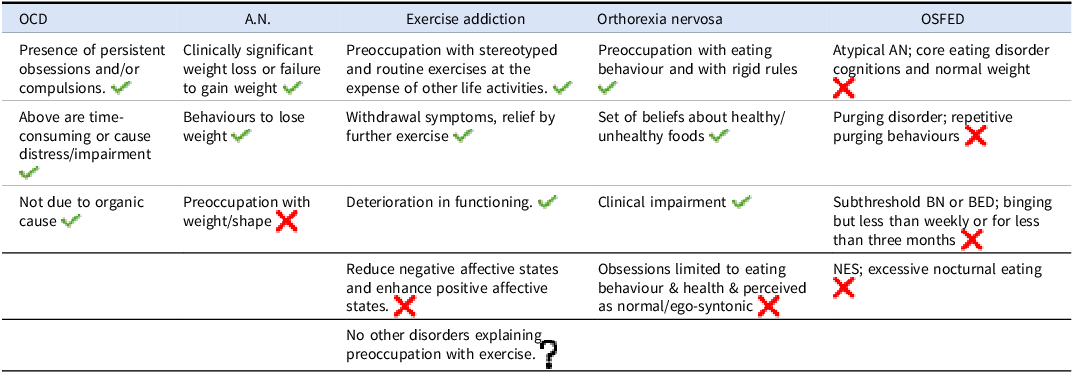
Pre-morbidly DT’s weight was 66.6 kg (109% of Ideal Body Weight (IBW)) at symptom onset. Twenty months later, on admission, his weight was 55.7 kg (85.8% of IBW). Estimated calorie intake was less than 700 calories/day and expenditure was over 3500 calories/day. Physical examination on admission revealed medical instability with nocturnal bradycardia of 20–30 bpm, hypothermia (34.6 C) and hypoglycaemia of 2.6 mmol/L. Laboratory results revealed thrombocytopenia, elevated creatinine and elevated urea (Table 1). Electrocardiogram showed sinus bradycardia with normal QTc and an echocardiogram was normal. His Children’s Yale Brown Obsessive Compulsive Scale (CY-BOCS) on admission was extremely elevated at 33 (32–40 considered extreme). Patient and mother-rated Revised Child Anxiety and Depression Scale (RCADS) supported OCD (see Figure 2). Considering his clinical history, a working diagnosis of OCD was made (see Table 2).
DT’s Self Rated Revised Child Anxiety and Depression Scale on admission; patient rated (left), mother rated (right); anything above the red line is of clinical concern.

Blood test results

Normal laboratory reference ranges are in parentheses.
Differential diagnoses with diagnostic features

OCD = obsessive compulsive disorder; A.N. = anorexia nervosa; OSFED = otherwise specified or unspecified feeding or eating disorder; BN = bulimia nervosa; BED = binge eating disorder.
A meal plan of 1,200 calories was started with regular dietician input. With psycho-education and support, he complied fully and exhibited no distress when eating food, increasing to 3800 calories over 6 weeks. Strict bed rest was recommended, however despite a desire to reduce his exercise, he was initially unable to control his compulsions. He exercised for up to 3 hours per day for the first 6–8 weeks. He developed his second episode of exercise-induced rhabdomyolysis with significantly elevated creatinine kinase (885 units/L). As he was unable to comply with rest and supportive treatment, pharmacological methods were utilised to both reduce distress and DT’s urge to exercise. Oral lorazepam and olanzapine were trialed but, despite their sedative effects, DT continued to exercise which posed a falls risk. In the context of worsening rhabdomyolysis and limited treatment options, an anaesthetic opinion was sought. There was a consensus that there was a serious and immediate risk to his life and thus he was admitted to ICU for intravenous sedation and to manage his rhabdomyolysis. He required intravenous rehydration and chemical sedation with propofol (1.2mg/kg/hr) and midazolam (8ug/kg/min) infusions. These were switched to clonidine (100 mg QDS) and diazepam (5 mg TDS) once bloods normalised. While in ICU, he required nasogastric feeding (83ml/hr infusion) to ensure adequate nourishment and hydration which was removed one week after his return to the medical ward.
DT received fortnightly occupational therapy learning grounding and relaxation techniques, and weekly family work continued using a multi-modal psychological intervention with a family-oriented exposure/response prevention (E/RP) treatment programme (March and Benton Reference March and Benton2006). The programme combines effective practices from cognitive-behavioural and family systems traditions for the treatment of OCD. Key components of the programme included psycho-education, externalising the problem, mapping the OCD, E/RP, cognitive therapy, family involvement and relapse prevention. Staff were also orientated to the approach. All were invited to view OCD as an oppressive neurobehavioural disorder distinct from DT, i.e., externalising the problem. A shared understanding of DT’s OCD was developed. Metaphors and analogies were used and OCD was characterised as an enemy to be defeated, rather than a bad habit, or unusual behaviour from DT himself. Parents and staff worked together as a support team for DT to help him resist and ‘Talk back to OCD’. He was encouraged to tolerate uncomfortable and distressing OCD thoughts without carrying out compulsive rituals until the uncomfortable feeling subsided. He was encouraged to ‘let the OCD thought pass through’ somewhat like a wave washing over him.
Psychopharmacological agents included high dose fluoxetine (60 mg daily), olanzapine (12.5 mg daily), and lamotrigine (100 mg daily) with moderate effect. Extreme agitation and anxiety were treated with low dose lorazepam (1 mg daily), while oral clonidine and diazepam were limited to his ICU stay.
Over the course of the admission, OCD symptoms gradually lessened, compulsive exercise reduced to less than 30 minutes per day, and he became more confident at engaging in exposure work. As his exercise compulsions improved, other OCD symptoms emerged. He feared being touched by people whom he perceived as overweight and repeated behaviours until it felt ‘just right’. Initially DT was anxious about leaving hospital because it was a place of safety where his OCD urges could be managed. Transitional plans included graduated extended day leave and transition outpatient appointments with CAMHS. His Children’s Yale-Brown Obsessive Compulsive Scale (CYBOCS) score was 18 (moderate severity) on discharge, DT did not complete a requested RCADS on discharge, however mother-rated psychometric scales supported improved functioning on discharge (Figure 3 and Table 3). Discharge weight was 67.4 kg, 102.9% of IBW.
Mother-rated Revised Child Anxiety and Depression Scale for DT on discharge. Anything above the red line is of clinical concern.

Mother’s Health of the Nation Outcome Scales for Children and Adolescents (HONOSCA) and Paediatric Quality of Life (PEDSQL) rating for DT on admission and discharge

HONOSCA; 52 = max score, higher scores indicating more severe difficulties.
PedsQL; 100 = max score, higher scores indicate better Quality of Life.
Four months post discharge his premorbid weight trajectory was restored with a weight of 76.6 kg and 116.0% of IBW. He was functioning well in school, maintaining normal exercise & eating patterns and was re-engaging in sports (see Figure 1 for timeline).
Discussion
Timely and accurate diagnosis is crucial for the implementation of an appropriate treatment plan. There was a particular urgency in this case as DT’s compulsion to exercise resulted in significant medical decompensation. DT already had a pre-admission diagnosis of OCD, but given the myriad of symptoms, multiple differential diagnoses were considered (Table 2). In this case, DT presented with features initially suggestive of AN, namely reduced food intake, low body weight and excessive exercise. However, there were no co-occurring concerns about weight or shape, he described unwanted worries about fitness, intrusive images of unfit acquaintances and resulting urges to exercise. Subsequent fears of fatness in others were linked to misattributions of evidence that he was unfit. Furthermore, throughout his admission he tolerated high calorie meal plans without exhibiting distress. The lack of typical eating psychopathology led us to out rule a diagnosis of AN.
The category otherwise specified or unspecified feeding or eating disorder (OSFED) was considered but outruled. This describes presentations of AN, bulimia nervosa or Binge ED termed atypical in that they do not meet full criteria of low weight or binge/purge behaviour frequency.
Orthorexia nervosa (ON), not specifically mentioned under OSFED, was considered as a differential. Preliminary diagnostic criteria define ON as being characterised by at least a six-month preoccupation with ‘healthy’ eating behaviours, rigid rules and a set of beliefs about healthy and unhealthy foods (Donini et al., Reference Donini, Barrada, Barthels, Dunn, Babeau, Brytek-Matera, Cena, Cerolini, Cho, Coimbra, Cuzzolaro, Ferreira, Galfano, Grammatikopoulou, Hallit, Håman, Hay, Jimbo, Lasson, Lindgren, McGregor, Minnetti, Mocini, Obeid, Oberle, Onieva-Zafra, Opitz, Parra-Fernández, Pietrowsky, Plasonja, Poggiogalle, Rigó, Rodgers, Roncero, Saldaña, Segura-Garcia, Setnick, Shin, Spitoni, Strahler, Stroebele-Benschop, Todisco, Vacca, Valente, Varga, Zagaria, Zickgraf, Reynolds and Lombardo2022). ON results in clinical impairment through negative effects on physical health, mental health or quality of life. The consensus-built criteria further defined fundamental differences between ON and OCD. They defined the obsession in ON as being limited to eating behaviour and health and being ego-syntonic. This is in comparison to OCD obsessions which can have varied themes and are ego-dystonic. While DT did display a rigidity about healthy eating patterns, his obsessions were unwanted, he made attempts to suppress them and he described other obsessions and compulsions unrelated to health.
Although not yet listed in the DSM-5, a diagnosis of exercise addiction was also considered. Proposed criteria include preoccupation with exercise at the expense of life activities, withdrawal symptoms relieved by exercise and impaired functioning (Terry et al., Reference Terry, Szabo and Griffiths2004). Freimuth et al suggest that, like compulsive disorders, exercise addictions are maintained by their mood-altering effects (Freimuth et al., Reference Freimuth, Moniz and Kim2011). However, while compulsive disorders involve negative reinforcement by reducing anxiety, exercise addiction may be pleasurable and mood boosting at start, but become necessary to alleviate negative states linked with exercise omission, as in DT’s case.
OCD and Autism Spectrum Disorder (ASD) are often co-morbid (van Steensel et al., Reference van Steensel, Bögels and Perrin2011). Individuals with OCD have a 4-fold higher risk of being diagnosed with ASD (Meier et al., Reference Meier, Petersen, Schendel, Mattheisen, Mortensen and Mors2015). However, DT’s social and communication developmental history did not support this. A broad psychiatric assessment did not uncover any affective or psychotic symptoms. Due to the presence of repetitive, intrusive, unwanted obsessional thoughts, associated compulsive behaviour taken to ameliorate distress, and negative effects on functioning, the diagnosis of OCD was felt to be most accurate.
An exceptional component of this patient’s case was the need for an ICU admission due to medical instability secondary to the nature and severity of his OCD. An inability to resist urges to exercise caused an immediate risk to his life due to unrelenting catabolism, muscle injury, rhabdomyolysis and autonomic instability which was leading to risk of end-organ damage. As such, there was an immediate need for medical stabilisation. The necessity to drastically reduce or stop him exercising presented a wide array of ethical, legal, moral, and practical considerations. Firstly, increasingly insistent medical advice that he stop exercising was met with increased resistance jeopardising rapport between DT and staff. As a voluntary patient in a paediatric hospital, there was no legal framework governing the use of physical restraint. Seeking a court order to direct the use of physical restraint was discussed. However, it was likely that DT would resist restraint resulting in significant energy expenditure and outside periods of restraint there would be ample opportunity for exercise. Furthermore, for a patient that may require lifelong psychiatric treatment, the potential damage to therapeutic alliance may have long-lasting detrimental effects. Unable to verbally redirect or physically restrain, with patient and parental consent, pharmacological methods and ultimately intensive care was deemed in his best interests to ensure medical stability.
Finally, appropriate pharmacological treatment of OCD was another challenging aspect of this case. Evidence supports the use of SSRIs, ideally in combination with CBT, but the response to treatment is characteristically slow with improvements often taking over 12 weeks (The National Institute for Health and Care Excellence, 2006). If after 8–12 weeks, the effect is incomplete, guidelines recommend switching to another SSRI and third line to clomipramine. Some uncontrolled studies also support the use of SSRI doses above formulary limits. In DT’s case with the presence of medical compromise there was an urgency for rapid treatment of OCD symptoms and thus the recommended pharmacological algorithm could not be adhered to. Evidence supporting the use of antipsychotics and glutamergic agents (such as memantine and lamotrigine) to augment SSRI agents in adults with OCD was used to guide treatment (Baldwin et al., Reference Baldwin, Anderson, Nutt, Allgulander, Bandelow, den Boer, Christmas, Davies, Fineberg, Lidbetter, Malizia, McCrone, Nabarro, O’Neill, Scott, van der Wee and Wittchen2014; The National Institute for Health and Care Excellence, 2006). Fortunately, following 8 weeks at fluoxetine 60 mg daily augmented with olanzapine and lamotrigine, DT noticed symptom improvement.
Conclusion
In the interests of accurate diagnosis, it is imperative that attention be given not just to the presenting features that are disrupting a patient’s functioning, but also to the underlying psychopathology. Superficial analysis of this case may have resulted in a misdiagnosis of an ED which may ultimately have delayed timely treatment. The patient incidentally exhibited signs which are pathognomonic of eating disordered behaviour – restricted food intake, excessive exercise and weight loss- but the psychopathology driving the behaviour was the result of an OCD. Furthermore, this case highlights some of the medical, legal and logistical challenges in managing a paediatric patient in a voluntary hospital setting who continually engages in a harmful behaviour – be it excessive exercise as in this case, but equally relevant to deliberate self-harm, aggression to others or attempts to abscond. Verbal redirection and pharmacotherapy can be useful in mild to moderate cases, but effectiveness wains with increasing severity. Physical restraint and legal detainment on mental health grounds pose legal and moral concerns and may damage rapport with patients and families.
Acknowledgements
To DT (pseudonym) and his family and all the multi-disciplinary teams in the hospital for the care provided in this young male’s case.
Financial support
None.
Competing interests
None.
Ethical standards
The authors assert that all procedures contributing to this work comply with the ethical standards of the relevant national and institutional committee on human experimentation and with the Helsinki Declaration of 1975, as revised in 2008. Written informed consent for publication of this case report was obtained from the patient and both parents.