Introduction
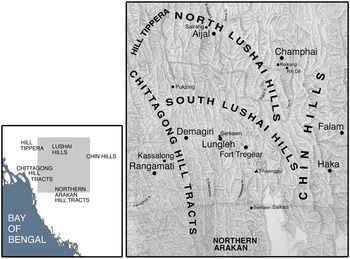
In 1937, at the peak of the rainy season in the eastern Himalayan forests of British India, a spirit moved.Footnote 1 In the village of Kelkang, the spirit controlled the body of a 36-year-old cultivator called Thanghnuaia Ralte, causing him to speak vantawng and tawnghriatloh (‘heavenly languages’ and ‘unknown languages’). It guided the illiterate farmer towards passages in Christian scriptures freshly translated by British missionaries in Aijal, the administrative centre of the Lushai Hills District (today: Mizoram) (Figure 1). Thanghnuaia assembled followers who were soon overcome with emotion and exhilaration (hlim) in church services, feasts, and prayer meetings, often dancing late into the night to the sound of booming drums. Revelations came next: the British empire would come crashing down, the local Mizo people would be free from colonial domination, and Christ's Second Coming was imminent.Footnote 2 Kelkang's medical dispensary stocked up with foreign medicines, its mission school, and Mizo pastors overseen by Welsh missionaries in Aijal—all were to be rejected. Most alarming to the Mizo chief Liannawla, who answered to colonial authorities, villagers abandoned their fields and ceased paying house tax.Footnote 3 Finally, the spirit (thlarau) dictated that, if the superintendent of the Lushai Hills District, A. G. McCall, dared to interfere, he should be killed.Footnote 4 In the upland forests of Kelkang, Christian villagers defiantly rejected colonial and missionary experts, and awaited judgment day.
Highlighted area shown on map of the Lushai Hills and region, circa 1905. Source: Author, 2018, with base map from A. W. Davis, Gazetteer of the North Lushai Hills (Shillong: Assam Secretariat, 1894), n.p.

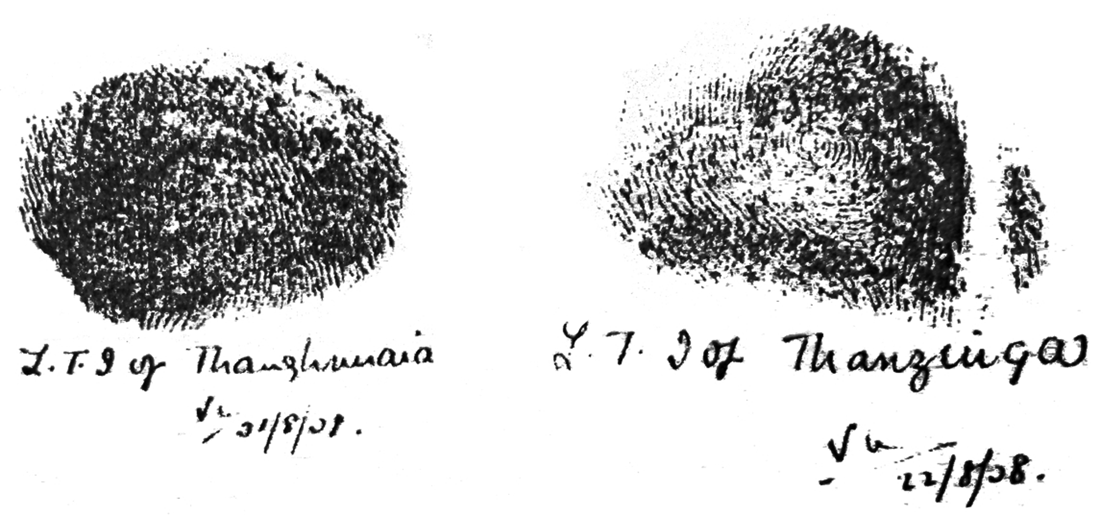
Judgment arrived on 4 September 1937, though in a guise no one expected. McCall arrived with military guard, established a strict curfew, and oversaw a five-day, open-air trial. Ninety-six men in the village were then forced into punitive work gangs and the village's firearms were confiscated. The church drum was seized, silencing the heartbeat of the movement. Kelkang's three most prominent human leaders were fingerprinted (Figure 2) and sentenced to deportation to Sylhet and three years’ rigorous imprisonment.Footnote 5 The thlarau itself escaped capture.Footnote 6
Thumbprints of Thanghnuaia Ralte and Thanzinga Pawi, August 1938. Source: ‘Mizoram Harhna Chungchang’, Mizoram Presbyterian Church Synod Centenary Archive, Aizawl, Mizoram, India.

Across South Asia in the late nineteenth and early twentieth centuries, many so-called ‘tribal’ groups accessed channels of disruptive, prophetic power in the face of British colonial domination and read the world in their favour against long odds.Footnote 7 Such moments of prophetic rebellion have often been depicted as failed ‘millennial movements’, easily quelled by the colonial state. In India's north-eastern political frontier, colonial authorities faced little trouble in putting down such revolts: the borders of the hill districts often formed a revolving door for the incarceration of spirit mediums. The notorious Jadonang was arrested in Cachar and moved to a jail in Imphal. His protégé, Gaidinliu, was arrested in Pulomi and imprisoned in jails at Gauhati, Shillong, Aijal, and Tura, consecutively. And Thanghnuaia was arrested in the Lushai Hills and jailed in the Chittagong Hill Tracts.Footnote 8 But, as historian Vinayak Chaturvedi argues, a focus on the failure of peasant movements as ‘inchoate’, ‘naïve’, or half-baked nationalisms easily quashed by imperial forces can obscure the substance of the movements themselves.Footnote 9 Prophetic tribal movements are important not for their failure, but for what they were reaching for.Footnote 10 This article lifts the veil on a little-known, spirit-led rebellion, but it reverses the polarity of conventional writings: its first objective is to ask not how the colonial state dealt with the prophetic rebellion, but how a prophetic rebellion dealt with the colonial state.
Scholars have found illuminating explanations for such moments of prophetic rebellion in theories of group derangement or individual psychosis,Footnote 11 social catharsis,Footnote 12 human imagination,Footnote 13 class struggle,Footnote 14 ‘rational adaptation’ to the challenges posed by Christian missionaries,Footnote 15 manipulation by cunning ‘prophets’,Footnote 16 the timely identification of ‘messiahs’ or probable ‘heroes’ for ‘redemptive processes’,Footnote 17 attempts to restore a ‘golden age’,Footnote 18 to secure Western material ‘cargo’,Footnote 19 or in combinations of these theories.Footnote 20 All are about the motivations of humans, whether individually or collectively. However, for those actually participating in these movements, the lead roles were played not by humans, but by an invisible world of spirits: people did what they did because of spirits.Footnote 21 Older, familiar spirits and well-known processes of spirit possession were less shouldered out of people's lives by colonial domination than implicated in new relationships with new actors, whether missionaries, officials, or tax collectors. In Northeast India, the spirit world directly influenced the ways in which many hill peoples contested political changes because invisible actors provided avenues for action against an oppressive colonial regime. And, in the Mizo world specifically, possession, even by a more novel Christian thlarau, was nothing exotic or unusual.Footnote 22
Approaching Kelkang with a more open-minded, empathetic, and Mizo-centred perspective—one that that strains (as far as is possible) to ‘see things their way’—requires historians to take seriously a world in which both religion (a word for which no Mizo-language equivalent existed) and spirit possession cannot be easily separated from reality.Footnote 23 Focusing on the Kelkang movement—an event barely known outside of Mizoram, but one that has attained almost legendary proportions within it—this article's second objective is thus not to speculate about what the moving spirit of Kelkang might symbolize, but to investigate what it did and how Mizos interacted with it.Footnote 24
The spirit of the Kelkang movement rejected the regimented hierarchies and the authority of English and Welsh experts—administrators, teachers, missionaries, doctors, and trainees. It offered an alternative vision of expertise and alphabetic literacy—one not on offer at the schools of foreign missionaries. It presented villagers with a visceral anticolonial vision and laicized Christian religious practices. And it brought together and reconciled a complex range of clans, roadworkers, and pilgrims in Kelkang according to existing Mizo logics. As the village's reputation as a community wielding transcendent Christian power circulated along expanding colonial road networks, a new role opened up for the first generations of Mizo Christians—that of the pilgrim—who returned home from Kelkang with new technologies of spiritual power.Footnote 25 While J. H. Lorrain, F. W. Savidge, and E. L. Mendus remain the household names in the regional history of Christianity in Mizoram, it was the skill of highly mobile Mizo spirit trancers, with names like Thanghnuaia, Pasina, and Thanzinga, that placed uplanders at the centre of an indigenous movement towards a specifically Mizo Christianity.
Sources
Save for the Mizo-vernacular articles written by mission-educated Mizos in the 1930s, historians have very little access to stories told by Mizo villagers themselves, particularly by the silent majority (roughly 80 per cent by the end of the 1930s) who did not read or write. Extant materials from Kelkang are unique in that, thanks to McCall's open-air trials, a colonial typewriter came to a Mizo village. It was when government officials and missionaries characterized the movement as seditious, irrational, ‘demoniacal’, and full of ‘dangerous possibilities’ that Kelkang was launched into the colonial archive.Footnote 26 Kelkang's cultivator-leaders seem to have lamented their particular misfortune in so drawing the state's eye: ‘This dancing in the Church is not an extraordinary thing,’ Thanghnuaia would tell McCall. ‘[B]ut if the Chief reports [it to the state] of course it becomes a bad thing …. There is this dancing of course in many villages.’Footnote 27 Indeed, dancers, trancers, and the spirit-possessed were common enough in the Lushai Hills District in the early 1930s, whether among those following customary practices, those identifying as Christians (with roughly 60,000 people in each of these groups), or among migrants from neighbouring regions.Footnote 28 The Kelkang trial records are thus unique in permitting a glimpse into cultural elements that typically danced beneath the radar of the colonial archive.
There is much about the records to recommend caution. Refracting between Mizo and English languages and between oral and written forms, the trial records from Kelkang are full of limitations. All 73 testimonies were recorded in a context of intimidation, and some testimonies are (perhaps strategically) curt. The depositions also reveal very little about the involvement of women at Kelkang. One of only three brief references comes from the male villager Thanvela, who records hearing ‘things [about the movement in Kelkang] from women and children’.Footnote 29 A second reference comes from the chief Liannawla, who briefly mentions a ‘women's side of this spirit business’.Footnote 30 McCall interviews only one woman—the widow Kapdaii Lushai, who was the only interviewee to ultimately refuse McCall's demand that all villagers publicly renounce the movement. Perhaps McCall's interview choices reflect what he expected to see in Kelkang: male leadership. In the early 1930s, a Welsh mission budget crunch saw the regional Presbytery's funding slashed for Mizo women's formal roles to shore up financial support for male pastors. While McCall's interview choices prevent a clearer glimpse of women's roles in Kelkang, these roles were not only present, but also, given the case of Kapdaii Lushai, perhaps even the most fervent.Footnote 31
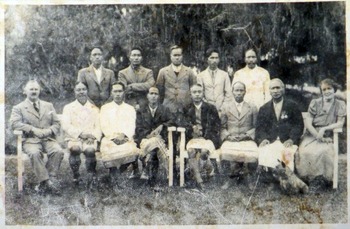
The court records contain much that is useful: they began as oral statements, under the control not of the typist, but of the testifiers, and they reflect elements of what Mizos said during an unprecedented political moment in the Lushai Hills.Footnote 32 Statements were translated and recorded on the spot by the Mizo clerk Lalbuka, with expert assistance from McCall (pictured in Figure 3).Footnote 33 The records capture a spontaneity that suggests a degree of precision: the three human leaders of the movement, Thanghnuaia and his disciples Pasina and Thanzinga, often interrupt other villagers’ testimonies, bystanders interject during other depositions, and the textual record tracks closely. The trial records also contain awkward elements seemingly sanitized from later public accounts. For instance, in memoirs published 12 years later, McCall stereotypes the movement's leaders as scripturally ignorant.Footnote 34 But, in the village court records, cultivator-mediums confidently contest McCall's claims to superior biblical knowledge and reject any notion of inferiority: when McCall presses Thanghnuaia—who was married and only visiting Kelkang—why he stayed in the village alone over the rainy season (‘Did Christ abandon a wife and children he was pledged to support[?]’), the illiterate cultivator invokes Luke 24:7 (‘Christ said unless one hates his own life and his family he is not worthy to be my disciple’).Footnote 35 Pasina Chhonglut Pawi answers the same question bluntly, perhaps even subversively implying McCall's ignorance: ‘Christ had no wife.’Footnote 36 Pasina then goes further, referencing the disciple Peter, who, like Thannghuaia, ‘also left his home and parents’.Footnote 37 Mizo villager Tlangbawia Tlao Pawi meets McCall's cynical view of Mizo mediumship head-on: ‘God always speaks through humans. Others [besides the villagers in Kelkang] have been Isaiah and the early prophets.’Footnote 38 Thus, if read carefully, and alongside the counterweights of archival materials in Mizo and English languages, as well as modern interviews in Kelkang, the court records provide a unique glimpse into a Mizo world.
Unidentified Mizo leaders, A. G. McCall, J. C. McCall, and dog, circa 1930s. Source: Collection of C. L. Hminga, BL EAP454/6/1/7.

Approaching Kelkang
A brief overview of the region's past will help position the Kelkang movement within the broader context of colonial rule. Set roughly between the Brahmaputra and Irrawaddy rivers, the mountain region that would one day be called Mizoram was towards the end of the nineteenth century home to culturally and linguistically diverse groups of people who had so far managed to exist outside of state rule. Some scholars suggest this evasion was intentional—that altitude, rugged mountains, and thick forests, combined with uplanders’ relatively egalitarian social organization, malleable identities, and mobile subsistence patterns, added up to a defensive strategy against the taxation, crowd diseases, and labour demands typical of lowland states.Footnote 39 Trade goods and guns had nonetheless scaled the mountains via long-standing trade networks,Footnote 40 hinting at the existence of the remote Raj somewhere beyond the hill populations’ northern, western, and eastern frontiers. At that time, political power in the hills was dispersed along complex webs centring on individual chiefs at the village level and articulating along lines of kinship, debt, reciprocity, marriage, and friendship.Footnote 41 The mobility of these hill polities would frustrate the first colonial surveyors in the region.Footnote 42
Most influential amongst the upland clans at the close of the nineteenth century was a group that the British would term the Lusei (later: Lushai). They and neighbouring hill populations followed lifestyles that outsiders rendered flatly as ‘animism’, though living in the region actually meant active, reciprocal, and contingent negotiation with an array of individual spirits, animals, and deities in one of the world's most complex ecosystems.Footnote 43 Some of the most important negotiations had to do with clan, and thus village, membership. Highland clans such as the Lusei, Ralte, Hmar, Fanai, and so forth had lived separately in villages each under the protection of a unique sakhua (a clan group's ‘guardian spirit’). Clan boundaries could be porous: villagers or captives might adopt another clan's sakhua and thus secure adoption into another village, through negotiations involving the destruction and consumption of animal wealth. The absence of the written word in precolonial times obscures much of these transcendent pasts today but this does not render them any less alive.
The British characterized the broader region as an ‘unadministered’ periphery devoid of true political borders. Of course, these uplands did have internal boundaries that were administered politically, agriculturally, and environmentally: this was an upland centre as much as it was a colonial frontier.Footnote 44 But colonial stereotypes painted hill populations as essentially different—as ‘head-taking savages’Footnote 45 and ‘warlike race[s]’Footnote 46 that practised ‘backwards’ slash-and-burn (or jhum) agriculture. The swathes of forest that uplanders reserved as proximate ‘hunting grounds’ crucial for both sustenance and ceremony were misrecognized as ‘uninhabited’ and ‘empty’ jungle.Footnote 47 Colonial tea, rubber, and teak plantations, as well as hundreds of thousands of imported settler-labourers, soon intruded on these forest reserves.Footnote 48 The assertions of territorial sovereignty by hill peoples in response only served to confirm the British stereotype that styled them as ‘unruly tribes’ culturally predisposed to ‘murder, pillage, and burn’.Footnote 49 The latter decades of the nineteenth century saw colonial agents respond to ‘tribal raids’ with ‘punitive expeditions’ of their own, with a particularly violent instance finally bringing the region under discussion into formal state rule.
There is little solid evidence concerning indigenous perceptions of the earliest moments of colonial rule. Certainly, the Raj's claims to abstract, overarching, and geographically expansive power made little sense in this politically atomized upland world. As stockaded colonial headquarters began to dot the landscape in the 1890s, British engineers could remark that ‘[o]ne of the things most difficult to make a Lushai understand is that the Political Officers at Fort White, Falam, Haka, Lungleh, and Aijal all serve the same Government’.Footnote 50 The sheer violence of the period would also have been astonishing. The prolonged conquest saw villages burned, families held hostage, and crops destroyed, all often amidst famine conditions.
The ‘Lushai Hills District’ was officially annexed in 1895 after years of desperate resistance; three years later, its internal subdivisions were amalgamated to create geographically the largest district in Assam Province.Footnote 51 The arrival of diverse groups of colonial agents—Punjabi carpenters, Santali labourers, Gurkha soldiers, Bengali farmers—bolstered the social diversity of the region, particularly in colonial headquarters.Footnote 52 A British superintendent oversaw the district and wielded exceptionally wide-ranging powers. The Indian Penal Code was just one of many political norms whose operation the Raj formally ‘excluded’ from the hill ‘frontier’. A regulatory ‘Inner Line’ likewise limited outsiders’ travel into the hills.Footnote 53 On the ground, defeated chiefs learned to carry out the will of a handful of local British agents, even as chieftainships were conferred or cancelled in ways that ignored highland common senses about merit and authority.
From an administrative perspective, this was a backwater region to be run on the cheap. Expedient here was a corvée labour regime that saw tens of thousands of Mizo men (and in some cases women and even children) forced to build state infrastructure and to carry goods for the government.Footnote 54 New roads, pathways, and bridges allowed the formation (and sometimes the subsequent evasion by highlanders) of new systems of state control and surveillance, as well as the development of new commercial and missionary presences that kick-started a fundamental refashioning of the region's political, ecological, and religious landscapes.Footnote 55 In these first decades of colonial rule, ordinary people had to navigate wrenching transitions to modern forms of governance, a cash economy, state borders, the written word, armed occupation, disrupted ecologies, and schemes for their permanent settlement.Footnote 56
Infrastructure provided for the circulation of the additional violence and disease that would drive Mizos towards other colonial institutions, particularly the dispensaries, schools, and churches of Christian missionaries who intended their religion's dispersal in ‘pre-packaged’ form.Footnote 57 However, like the material detritus and trade goods that had washed into the hills during the final decades of the nineteenth century, the missionary message was open to Mizo interpretation: where uplanders had repurposed umbrellas into head-scratchers or pounded foreign coinage into bullets, they now interpreted the missionary message in ways equally unintended. New and novel religious knowledge was incorporated alongside the old and familiar.Footnote 58 This occurred most significantly in periodic moments of indigenization that, from 1906 onwards, missionaries styled as ‘revivals’.Footnote 59 Upland singers likewise adapted the content and quality of missionary music to better suit their own melodic sensibilities.Footnote 60 Soon, a highland Christianity was emerging as an intricate tapestry woven by thousands of unofficial Mizo mediators—a complex process that this article will start to unravel by closely following one of its threads in a single village.
By the 1920s, a decade prior to the events at Kelkang, something new was underway in the regional landscape of Christianity. In some locales, so-called ‘amulets’ were being discarded en masse; in others, Christianity was becoming fashionable and a marker of social status. Culturally, Mizo elements of dance, music, and poetry suffused church services in increasingly open ways despite the ongoing disapproval of missionaries. A new era of diverse and self-confident Mizo Christianities paralleled the rise of new denominational, medical, and educational options in the hills. Though the complete Bible would not be available in Mizo translation until 1959, half of the population self-identified as Christian by the mid-1930s, and the broader populace was soon the most literate in Assam.
Despite the kaleidoscopically diverse social landscape in the region at colonialism's outset, a new ‘Mizo’ identity was also coalescing in the early twentieth century. British agents and census-takers misinterpreted and arguably produced several ‘tribal’ identities, but the privileging of the dominant Lushai clan's dialect in the emergent spheres of education and print media did even more to catalyse this wider identity. A newly mapped territory and its newly fixed boundaries allowed the imagination of a highland nation's origins and individuals began seeking more geographically expansive nomenclature with which to define themselves.Footnote 61 Mission-educated graduates and authors especially conscious of wider geographical scales were at the intellectual forefront, seeking to place the ‘Mizos’ within the broader frames of world geography and civilization that their schooling and, occasionally, travels underscored. The technology of writing itself helped standardize narratives of history, identity, and origin—elements that once existed in a state of relative oral flux in the hills.Footnote 62 In this article, I thus use the term ‘Mizo’ as convenient shorthand during a period in which the wider identity itself was still crystalizing—a process to which the spirit at Kelkang in fact contributed. It is a term that remains ambiguous and contested (if also hegemonic) in the region today.Footnote 63
The spirit of Kelkang
In the 1930s, the two largest missionary authorities in the district—the Welsh Calvinistic Methodist Foreign Mission in the north and the Baptist Missionary Society in the south—denounced what they saw as an exceptional ‘hornet's nest’ of end-times speculation amongst Mizo Christians, as well as the attendant dancing and ‘disorder’ that came with it, particularly in their easternmost jurisdictions.Footnote 64 Touring Welsh missionaries were amazed at how well versed Mizo students had become, on their own accord, in the Book of Revelation, and wondered at people's willingness ‘to believe literally in … the beast and the dragon, and the two hundred thousand horses with serpents as tails’.Footnote 65 For reasons difficult to pin down, Revelation, first translated into the Lushai dialect in 1911, was flung to the forefront of public discussion in the 1930s. Village children ‘repeated long passages of [Revelation] to one another from memory’.Footnote 66 Church congregants set it to the mnemonic of song, and hlim churches (literally, ‘joyful’ churches, used to designate dancing and singing congregations who were, in local idiom, ‘with the spirit’) sang its verses over and over. In Aijal, the Mizo pastor Liangkhaia felt compelled to produce a ‘Commentary on the Book of Revelation’ for distribution to adult Sunday School classes across northern Lushai Hills.Footnote 67
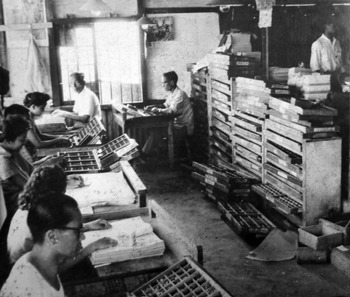
A lively and growing print news media added fuel to the growing fires of expectation. By 1936, Welsh missionary Gwenllian Mendus had launched a world current events (tunlai chanchin) column in Kristian Tlangau, the mission's popular periodical, printed at Aijal's Loch Printing Press (Figure 4) and distributed monthly across the entirety of the district.Footnote 68 Mendus was publishing for a market ravenous for Mizo-language books and articles: the Mizo script itself was only four decades old by the mid-1930s, yet Mizos were already the most literate population in broader Assam, with literacy rates that had nearly doubled across the 1930s, reaching some 20 per cent by 1941.Footnote 69 Mendus had an eager audience: ‘There is no [traditional] newspaper in Lushai so the task is a responsible one.’Footnote 70 Global conflict featured heavily in her world news columns: ‘alas, it seems at the moment as if I had nothing but wars and rumours of wars to report on,’ she confides to a friend in 1936.Footnote 71 Amidst the contemporary fervour for both the Book of Revelation and print media, these ‘wars and rumours of wars’ were not lost on Mizos. Missionary news channels emphasized looming conflicts that, when viewed by Mizos through a Revelation lens and memories of the First World War—a time at which some 2 per cent of the district's population was shipped to foreign battlefields as labourers—looked a lot like signals of Christ's revolutionary return. Christian Mizo students sang out: ‘I will keep you from the hour of trial that is coming on the whole world to test the inhabitants of the earth. I am coming soon …. Let anyone who has an ear listen to what the Spirit [thlarau] is saying to the churches.’Footnote 72
The Loch Printing Press (‘Synod Press’), detail, undated. Source: Photograph album, MPCSCA.

For the Baptist and Welsh Calvinistic missionaries who lived and worked in the region, the steadily amplifying interest in apocalyptic literature and themes was both a blessing and a curse.Footnote 73 On the one hand, it stoked an unprecedented upsurge in church attendance and boosted church coffers.Footnote 74 On the other, official missionaries fretted about the spread of ‘hysterical’ teaching and dancing in Mizo churches, promoted specific hymns that they supposed Mizo congregants would find less danceable, and condemned the ‘menace’ of ‘crude’ Mizo ‘superstition’ and the ‘waves of emotion or weird doctrines’.Footnote 75 Gwen Mendus captures the irony of the missionary quandary in a letter from 1938: the ‘chief problem this last year was the revival, strange to say’.Footnote 76
It was within this broader regional context of interest and expectation that, in April of 1937, an illiterate cultivator from Vandawt, a rural village north of Aijal, began walking eastwards across the district.Footnote 77 We know little about Thanghnuaia's early years or his family life, save that his father died when Thanghnuaia was 11, and that Thanghnuaia appears to have had both a wife and children in Vandawt.Footnote 78 He was travelling to Kelkang that year to collect a hill buffalo (sial or mithun) as a bride price for his sister.Footnote 79 The timing of his journey might suggest an intention to return home as soon as he had collected the debt, as the roughly 20-day round trip would have allowed a slower return journey (sial in tow) before the onset of the heavy monsoon rains and yet sufficient time to plant crops in Vardawt's mountainside fields—land that would have been customarily burned in February and March in preparation for sowing.
Thanghnuaia faced a tough slog eastward. He would have crossed nine mountain ranges, moving against the grain of the region's north–south-running ridges and valleys, the topographic corduroy that saw most journeys measured in walking time rather than in linear distance.Footnote 80 Arriving in Kelkang, Thanghnuaia found that the animal he had hoped to collect had died.Footnote 81 A functionalist interpretation of what happened next might suggest that a fresh sense of the distance and terrain between himself and the colonial and mission administrations in distant Aijal catalysed Thanghnuaia's subsequent ‘possession’ and emboldened his anticolonial and anti-missionary ‘revelations’.Footnote 82 A more Mizo-centred perspective—one that takes Mizo possession (zawl) on its own terms and one that does not write off the sworn testimony of Mizo villagers a priori—could suggest that the thlarau that possessed Thanghnuaia chose the location of its zawlnei (its medium or its prophet) well. The relentless rains came almost immediately, with some 102 inches falling in the region that season.Footnote 83 Behind the triple fortifications of mountain ranges, monsoon rains, and washed-out roads, the movement in Kelkang developed where state and mission power most frayed at the edges.
We can know very little of the genesis of the movement or the motives of the thlarau. A possessed Thanghnuaia began speaking vantawng (‘heavenly tongues’). The village's existing Christian converts—numbering about a third of the settlement's 180 houses and together under the administrative authority of Aijal's Welsh Calvinistic mission, its Presbytery, and its touring Mizo and foreign pastors—took notice, confirming the biblical precedents of vantawng.
Early on, the thlarau guided the illiterate Thanghnuaia and his followers towards a range of alternative ways of reading. The first innovation was a literacy of chance. In Thanghnuaia's hands, the Bible would fall open to reveal the thlarau's message for Kelkang. Alternatively, he would ‘put a piece of something in a Bible’ to divine the thlarau's message.Footnote 84 Pasina, an alphabetically literate villager, assisted by reading these revelations aloud for all.Footnote 85 Other innovations followed. Some villagers experimented with deriving verbal noises from the biblical texts, imaginatively inhabiting gospel stories; others wrote plays for communal performance from the Bible stories chosen by the thlarau. Here, the word came alive as new ways of reading presented new options for a Christianity of revelations performed, seen, and heard.Footnote 86 Still others amplified those portions of scripture in which people spoke in tongues.Footnote 87 Other innovators spelled the Mizo word kross (‘cross’) with their bodies in dances. Others still ‘would all read the Bible’ and then perform a portion of it, such as ‘imitating Christ on the Cross’.Footnote 88 Distant from the region's central hubs of schooling, the village of Kelkang would likely have been the last place that missionaries would have expected to find literacy. But this was a village soaking in it. Understood not simply in a narrow alphabetic sense, but also as the skilled interpretation of text—the ability to look at and decode textual symbols for meaning—literacy deeply touched the human experience in Kelkang in ways that command us to ‘rethink the notion of literacy as exclusively alphabetic’.Footnote 89 Mizo participants extracted rich meaning from printed text, not just as readers of biblical text, but also as users and experiencers of it.Footnote 90
Across the Lushai Hills in this era, mission schools held a near monopoly on alphabetic literacy in the region and were busily producing the first generations of Mizo pastors, evangelists, low-level administrators, and bureaucrats. Literate students—primarily males—pursued the ‘credentials of colonial modernity’, navigating standardized processes of accreditation.Footnote 91 Literacy, diplomas, and certificates made Mizos visible in the eyes of state and church authority, and served as a conduit towards subservient but nonetheless significant positions in the political, educational, medical, and religious management of their fellow Mizos.Footnote 92 District-wide, mission schools, mission dispensaries, and the mission's travelling pastorships were all staffed from the cadres of Mizo experts produced primarily in Aijal and Lungleh. At the village level, conventional literacy was most visible via hated house-tax registers and the records of the government's forced-labour demands, both of which were monitored monthly in each village by touring ‘Circle Interpreters’ and by British officials during tax-assessment years. In Kelkang, as elsewhere in India's north-east and beyond, village-level texts and the English language were not only markers of colonial modernity, but also inherently bound up with foreign domination.Footnote 93 The thlarau of Kelkang rejected all of this, instead opening up alternative and performative literacies to everyday villagers.
Many in Kelkang then began to speak in what the chief called ‘strange languages’.Footnote 94 As the villager Taibawnga Zahao would later patiently explain to McCall: ‘I myself also talk in a strange language. Sometimes my language is different to others—there are many of these languages. It is the language directed by the spirit [thlarau].’Footnote 95 Another villager, Chaldaia Fanai, used a natural metaphor: ‘If [you] put a rat inside a bamboo the noise is that of the rat and not the bamboo and it is the same when we speak it is the voice of the spirit.’Footnote 96 The nuance of this distinction was apparently important to villagers like Chawntluanga Zahao: ‘I have never heard [the mediums, the zawlnei] say that their voice is the voice of God but that they are used by the voice of God.’Footnote 97 McCall could not convince the Mizos otherwise: ‘[T]hey claimed with the utmost obstinacy that it is possible for a man to speak and the voice is not that of himself but that it is the voice of the spirit.’Footnote 98
The thlarau did this work according to the sort of sonic codes characteristic of spirits in the region, where distinctive languages evidenced spiritual power.Footnote 99 When the thlarau inaugurated a period of intense communal feasting in Kelkang, it used the voice of the human possessed to make the sound of the animal to be killed, whether goat, pig, or hill buffalo.Footnote 100 Taibawnga Zahao reported that the thlarau ‘used’ human tongues to do this: ‘It is not his noise but that of the spirit.’Footnote 101 Other villagers, predicting disaster for their neighbours still refusing or unable to participate, looked up to the skies and made ‘hissing noises’.Footnote 102 Chaldaia Fanai called the spirit language ‘mixed Latin and other languages. Sometimes they speak English’.Footnote 103 Missionaries in Aijal would assert their authority, later mocking such claims and contending that the uplanders would say ‘things such as “One! Two! Three! Right about turn!” knowing no English and thinking they are under the influence of the Spirit!’Footnote 104 But the sounds voiced by mediums are better read not as evidence of Mizo ignorance, exoticism, or excess, but as counter assertions of authority in line with spirit sonic codes and a broader rejection of colonial and missionary supremacy.Footnote 105 If the language of colonial command in the Lushai Hills was English, Mizos commanded it too, not by colonial education in mission compounds and mission schools, but via spirit possession—a pathway to knowledge antecedent to colonialism in the region, and one that leapfrogged the missionaries who, powerless to stop the process, could only label it primitive ‘spiritual pride’ or the ‘disregard of their own pastors and leaders and of the missionaries’.Footnote 106
The thlarau inaugurated a heightened sensory experience in Kelkang.Footnote 107 Bells clanged and drums boomed to commence and soundtrack meetings. The dried horns of sial were beaten together to welcome cultivators back from the fields.Footnote 108 Smells, too, had a role to play, signalling one's position in regard to the movement. ‘Any who was not a Christian they used to drive out saying they were of bad smell,’ Thankuma Chawngthu testified before McCall.Footnote 109 The chief, Liannawla Zahao—an authority figure aligned with the colonial government—was told that he ‘had a bad smell’.Footnote 110 We know that the elderly chief, himself not a Christian, suffered from ruhseh (or what missionaries knew as rheumatism); Mizos traditionally applied the curative and pungent fats of pythons, tigers, or bears to those with the affliction.Footnote 111 Perhaps physical odour and, by extension, healing authority was at issue here, for the Christians claimed that all medicines had become irrelevant: Pasina and others now possessed sufficient healing powers via the spirit.Footnote 112 But the chief's ‘bad smell’ was more likely a transcendental one—an aroma detectable by those with the thlarau and one that placed him outside of the movement. Other verbal attacks clearly concerned the chief's authority and symbols of it: ‘They told me to take off my hat otherwise they would beat me,’ Liannawla testifies.Footnote 113
The thlarau's revelations also implicated the everyday, human experience of physical movement in Kelkang.Footnote 114 The surrounding natural and built environment channelled human movement in a very specific way: the village's primary entrance was, and remains, to the east, with most inward movement coming from villagers’ sloping fields and the more populous plains below. Upon entering the village, a traveller walking westward immediately encounters a steep, upward gradient. In the 1930s, the chief's house was one of the village's westernmost buildings, positioned at altitude above other houses and distant from the village entrance—an arrangement typical in the hills, where those claiming positions of authority (chiefs, missionaries, colonial officials, healing specialists) often laid claim to the high ground.Footnote 115 Far from socially neutral ‘facts’, the locations of structures were also ‘materializations of social relations in space’.Footnote 116 To access the chief's house and its authority in Kelkang was tough going—it was an aerobic experience that had its own haptic feel, involving lactic acid and breathlessness.Footnote 117 By contrast, the original home in which the thlarau worked its wonders through Thanghnuaia (and which served as an early meetinghouse, today commemorated with a concrete monument and plaque) was located at the opposite end of the village, at the base of the hill. These observations help illuminate later events, when the thlarau began revealing its vision for the spatial reorientation of the village. The zawlnei prophesied that a church would be built at the very height of the village: the spirit, like all authority in the hills, belonged in the highest places.Footnote 118 To frustrate the prediction, Liannawla, the chief, relocated his family home to this prophesied place—a pre-emptive, spatial strike. However, when his wife became distraught at the possible consequences of so spurning the thlarau's predictions (perhaps providing a clue as to her own open-mindedness towards the claims), the chief abandoned this dwelling and the new church was built.Footnote 119
Occupying the physical high ground, the thlarau began claiming political high grounds, too. It voiced that the British empire would soon fall in a war, freeing Mizos from government (sawrkar) oppression.Footnote 120 Attendance at the Civil Surgeon's local dispensary then dwindled; children ignored the local mission-authorized school and its teacher, Dothuama; and fields increasingly lay abandoned, putting the villagers at risk of defaulting on their house tax, for the thlarau promised that husked rice would soon fall as Mizo manna from the skies.Footnote 121 Eventually, P. D. Sena—the Mizo pastor trained and authorized by the Welsh mission in Aijal to periodically visit and guide the Kelkang Christians under his bial, or touring circle—was barred from preaching. The thlarau would not permit him to speak.Footnote 122 Pasina amplified the message: Mizos ‘should not bow down to the paid servants of the Missions’.Footnote 123 Instead, preaching authority in Kelkang was radically devolved to include any hlim layperson (those ‘joyful’, meaning ‘with the spirit’).Footnote 124 The Welsh mission's prescribed order of service and Sunday School materials, all published out of Aijal, were cast aside to make room for spontaneous revelation and dancing. Finally, the thlarau rebuffed the ultimate authority of P. D. Sena's white missionary handlers: the leaders of Kelkang hlimpui (‘the great hlim’) proclaimed their independence of any mission, colonial or global authority, ‘their Missionaries, Circle staff, Superintendent or even Parliament Members’.Footnote 125
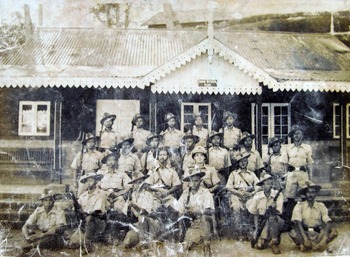
Liannawla ultimately alerted authorities. Losing control over the symbolic high ground was one problem, but losing economic productivity of the village meant defaulting on the village's annual tax—a finable offence.Footnote 126 After months of attempts to settle matters locally, messengers were dispatched to Aijal. On 4 September 1937, 36 hours after receiving the news, superintendent A. G. McCall departed Aijal with 12 soldiers of the Assam Rifles (Figure 5).Footnote 127 Kelkang's long-standing affiliation with government-contracted road-repair gangs called melveng—including many who had lived in Kelkang itself—proved advantageous here: a Public Works Department sub-officer in Aijal, a Mizo man called Rualkhuma, learned of the superintendent's plans and alerted local melveng workers. The news made a remarkably speedy journey some 200 kilometres to Kelkang, apparently via nodes of melveng camps and the customarily nimble Mizo method of relay-runners.Footnote 128 With McCall's impending arrival, the thlarau now made its biggest political claim of all—the power of death over the superintendent himself: ‘if the Superintendent interfered with the words of the Holy Spirit he should be killed.’Footnote 129
Members of the Assam Rifles outside the Indian Officer's Club, Aijal, 19 September 1930. Source: Collection of L. Sawithanga, BL EAP454/11/1/2.

Some in the village presumed that the power in Pasina's raised hand alone would make McCall ‘at once become stiff’.Footnote 130 Others were unconcerned about temporal matters: ‘let the soldiers or any other do us harm—no matter.’Footnote 131 A safer, communal strategy was finally devised in the church. Pasina would open himself to the spirit directly before the British superintendent. McCall would surely lose his temper at the sight and this would be the sign for what must follow: the village would communally trample McCall to death—a method full of meaning to which we will return.Footnote 132
McCall had informants of his own. Perhaps passing as pilgrims, his agents determined that the village had been forewarned of his arrival. Hurrying, McCall arrived early in the morning of 12 September; Pasina was arrested as he was praying in the forest, perhaps for success in the day's planned political assassination. Without his leadership, and given McCall's surprise arrival, the plot was thwarted. A boisterous crowd nevertheless gathered as the superintendent arrested the other human leaders: McCall writes that
young men commenced to press slowly forward in a surly manner—provocative and insolent. To avoid the infliction of blows from rifle butts by the escort I went for them to break them up but they only just made way and were disinclined to move off. This is very unusual behaviour for a Lushi [sic] village.Footnote 133
Oral histories in Kelkang today recall how these villagers brazenly pushed the caps off the soldiers (sipai).Footnote 134 A five-day trial ensued in the courtyard in front of the church.
Kelkang through trial records
In their reports home, Welsh missionaries would characterize all of this—Kelkang and its spirit mediums, creative literacies, alternative languages, and heightened sensory experiences—as the corruption of Christian ‘revival’ by a group of backwards primitives. Missionaries in the region had fretted about similar ‘disturbances’ periodically, sometimes taking matters into their own hands in extraordinary ways. When a group of female spirit mediums attending a Baptist mission school were accused of slandering other villagers with prophetic knowledge, one of the girls ‘was brought into hospital, told kindly that she was obviously a very sick woman and must be kept in bed and away from other people, given a few draughts of nauseating and harmless medicine and generally made a little uncomfortable’.Footnote 135 The case of Kelkang, it seemed to Welsh missionaries in the north, was a dangerously derailed version of Welsh (and other) genuine revival precedents. McCall himself mocked the ‘croaking about, trembling, shaking hands, [and] limbs’ of Kelkang's exotic, ‘jumping babbling pranks’.Footnote 136
It is tempting to follow the missionaries and McCall in viewing the phenomena at Kelkang through Euro-normative categories such as (imitated) ‘revival’ or (failed) ‘millenarianism’, or to see the booming popularity of the Book of Revelation as straightforward evidence of a contemporary Mizo concern with the end of the world. Certainly, this is how Christian missionaries, bureaucrats, and historians have approached many similar phenomena across India's north-east. But, as Arkotong Longkumer has recently shown in the Naga context, millenarianism in Northeast India need not be read in this way.Footnote 137 Given the everyday ordinariness of transformative ‘prophecy, dreams and signs’ in this upland world, the priorities of millenarianism here can be better seen as ‘transformation rather than disruption’ and as social revolution rather than revival or rapture.Footnote 138 What if we attempted to shift our perspective, to understand such movements a little more on their own, upland-normative terms—not as failed ‘end-times revivals’, but as zawl, as possession by spirits whose aim was transformation?
Possession in the Lushai Hills was routinely possible by any number of invisible agents. It was in fact McCall's conception of personhood—one in which an individual, a ‘distinctive whole’, was set ‘contrastively both against other such wholes and against a social and natural background’—that was the exotic outlier in Kelkang.Footnote 139 Indeed, such an idea of personhood remains a strange idea in the broader context of global cultures.Footnote 140 Contemporary upland logic understood that the form of Thanghnuaia's body was permeable and that invisible spirits controlled certain gifted humans—something that would have made the later fingerprinting (Figure 2) of upland spirit mediums as human individuals all the more perplexing.Footnote 141 This permeability was what Frederick M. Smith had called the ‘imposition or investiture on an individual personality of an independent and unseen external agent’.Footnote 142 It is what Mizos called zawl. In the trial records, testifiers repeatedly attempt to make the concept clear to McCall: vantawng was the human voice coopted by a spirit. They consistently and clearly distinguish a difference: ‘neither [I] nor the spirit ever talked of rice falling,’ Pasina exclaims during one interview.Footnote 143
Brought face to face with armed state authority, the villagers at Kelkang were not caught intellectually flatfooted. Instead, upland thinkers confidently articulated the theory of cultural relativism: in the Lushai Hills, those who ‘have the Holy Spirit … tremble and dance but in civilised countries they do not tremble and dance but they have joy in their hearts so the holy spirit works according to the country’.Footnote 144 Such a formulation suggests that so-called ‘tribals’ were thinking with the concept even prior to its widespread use in Western academic circles—indeed, that a little-known spirit medium called Pasina Pawi may have developed, contemporaneously, one of the key intellectual legacies of Franz Boas, celebrated founder of anthropology.Footnote 145 Pasina held that the phenomena at Kelkang could not be measured by any foreign yardstick: in the rugged upper reaches of the district, the village was its own Mizo ‘Upper Room’ complete with, in Pasina's words, its own ‘day of Pentecost’.Footnote 146 The participants in this intensely local movement remained well aware of a global scope. They confidently inserted themselves as different-but-equal members of a world historical Christian family.
Throughout the trial records, McCall parses villagers into offenders and bystanders. To do so, he asks individual villagers whether they ‘believed’ in the revelations. For many present in Kelkang, human belief was—like McCall's alternative ideas about personhood—irrelevant to the reality of possession or revelation, and yet provided an avenue to minimize blame in the eyes of the state. Villager Raltawnga Chhonghlut Pawi (a brother of Pasina) could thus tell McCall that ‘although the spirit has said [that the British empire will fall] we do not actually believe such things’—not denying the ontological reality of the spirit's voice or the potential truth of its words, but deftly absolving the village from direct culpability.Footnote 147 Chhawngthiauva Sasem Pawi said: ‘I do not believe they have such power but if the spirit directs then it is spiritual power.’Footnote 148
In certain areas like ‘belief’, Kelkang's revolution could thus be a soft one, pragmatic enough to give where necessary. For example, McCall would insist that Raltawnga publicly renounce his uplink to the thlarau; failing to do so would mean ‘many years before [Raltawnga] sees his family and the Lushai Hills again’—a particularly grave threat given the region's long history of penal transportation in the region. The villager quickly complied in front of the 100 congregants gathered, who, tellingly, held a church service as usual that evening, regardless of the military presence.Footnote 149 Others claimed ignorance: ‘I have forgotten all,’ the cultivator Dosata said when asked about the church meeting where it had been planned to kill McCall, ‘though it was only five days ago.’Footnote 150 Thangchhima Lushei confirmed that the thlarau had indeed promised rice from the skies, but Thangchhima refused to name the human possessed to say so.Footnote 151 One Kamthanga Pawi claimed to be a Roman Catholic too busy to know anything about village happenings.Footnote 152 Through deft responses, obscuration, and concealment, the village minimized direct culpability.Footnote 153
The most serious evasive technique was the planned attempt on McCall's life. The envisioned method of communal trampling offered a great advantage: ‘no one would be able to say exactly who killed [McCall].’Footnote 154 This was not only a tactic for the moral diffusion of responsibility amongst humans—the rationale undergirding military executions by firing squad—or merely an escape strategy designed for colonial courts. It was also transcendentally pragmatic: the spirit of the malevolent victim would not be identify the killer to cause him misfortune. When the famous Mizo chief Darbilli was killed by a dawithiam (a sorcerer, literally ‘someone familiar with malevolent magic’), the sorcerer had to be communally destroyed. Villagers hauled before colonial courts claimed: ‘I do not know who actually killed him—all the men of my village were there and all said they had killed him.’Footnote 155 In the same way, when a rogue tiger had to be killed in the Lushai Hills, ‘the men of the village would surround the tiger and attack simultaneously with arrows, so that the tiger would not know who had killed him’.Footnote 156
For all his knowledge of the hills, McCall's discussions of the planned assassination overlook the historical depth of communal murder, of communal trampling, as a defensive tactic in the hills—one reserved in the uplands for ultimate predators. The planned method for killing McCall was commensurate with who he was and what he had done. In the past, the metaphor of the tiger was often invoked to describe certain powerful, despotic, and unpopular British officials. Chiefs warned their villagers in the presence of such British officials: ‘Be quiet, these foreign chiefs when angry [are] like tigers.’Footnote 157 Ill-tempered British road engineers earned Mizo nicknames like Sapsakeia, the Tiger Sahib.Footnote 158 It was precisely McCall's predatory tactics—his unprecedented persecution of genuine prophets and the possessed, his storming of the village of a thlarau, his astonishing authority wielded as head of state in the hills, the most powerful creature in the forest—that made him answerable with almost formulaic strategy. That the communal nature of the planned murder might obstruct the workings of the colonial courts was an additional advantage.
If McCall missed the full significance of the plan for his assassination, he also seems not to have noticed the novelty of the variety of clans or the polyglot roadworkers and pilgrims who surrounded him in rural Kelkang. Perhaps McCall was accustomed to the linguistic and cultural heterogeneity of the bustling colonial headquarters of Aijal in which he lived his daily life—a settlement so grand that Mizos called it Zawlkhawpui (the ‘Great Village’) and where Mizo groups and family clans from across Northeast India rubbed shoulders with a dizzying array of Bengali clerks, Gurkha sepoys, Burman peddlers, Khasi contractors, Goan musicians, Naga sweepers, and North Indian schoolboys.Footnote 159
The trial records from distant Kelkang reveal the presence of an astonishingly wide range of historically distinct clan groups, from Raltes, Zahaos, and Chawngthus, to Fanais, Hrahsels, and Hmars, owing primarily to the influx of pilgrims. Offhand references in the trial records reveal some of the kaleidoscopic heterogeneity that pilgrimage produced; for instance, Runa Pawi notices how ‘those near me [in the Kelkang church] were men of other villages’.Footnote 160 This was a categorically polyglot rural village. In the 1930s, the regional dialects of the Raltes, Pawis (Lai), and Fanais were connected to, but still distinct from, the Lushai ‘Duhlian’ dialect rapidly rising under the mission's patronage in schools and print media.
This staggering diversity of clans, all gathered in a single rural village, might help us better explain the thlarau's actions as well as its greatest material demand on villagers: it ‘told people to kill animals’.Footnote 161 Such demands came comparatively late in the movement, as it gained followers and attracted pilgrims, and reveal that the spirit's logics were evolving. When the demand finally came, it was total: testifiers’ accounts are full of animal death. It was in ‘God's name’, according to Chhawngthiauva Sasem, that he, Tlangbawia Tlao, and Hnawkzama Tulian, identifying from the Pawi clan, responded to the thlarau's demands by killing ‘a pig, a goat, and a mithun [hill buffalo]’.Footnote 162 Zadala and Chaldaia, identifying as Fanai, slaughtered animal wealth, too.Footnote 163 Nunkulha, identifying as Zahao, contributed ‘pig's meat’ (vawk sa). The church elder Lianhranga killed two pigs at the thlarau's request.Footnote 164 Using Taibawnga's mouth to speak, the thlarau also required a pig from the village teacher's father.Footnote 165 Some 29 animals were killed in all, including two the day before McCall's arrival.Footnote 166 Themes of food and animal death also dominate the memories of Pi Tuahthangi, who was ten years old in 1937 and remembers well this characteristic slaughter.Footnote 167 The spirit was insistent. Holdouts were unacceptable. ‘[C]alamity would come’ to the village if animals were withheld; animals had to be given ‘on pain of calamity’.Footnote 168
What do we make of this? After all, animals often represented a cultivator's most valuable belongings. McCall's explanation held that Kelkang's leaders were shrewd performers who ‘claimed’ mediumship of the spirit for material and political gain.Footnote 169 The animal destruction he chalked up to insanity and foolishness.Footnote 170 Author Stephen Fuchs, writing about ‘tribal’ prophetic movements, assumes gullibility on the part of Kelkang's villagers: the ‘two Lushai elders … plotted the whole affair beforehand in order to make capital out of these revival tendencies in the Welsh Church of Lushai’.Footnote 171
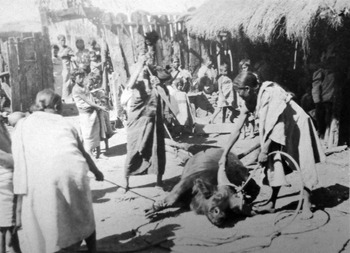
But a more upland-centred perspective—one that does not write off upland logics, but rather follows clues as to the spirit's changing motivations—suggests an alternative angle. Traditionally, villages in the region had coalesced around principles of clanship, with divisions based on traditions and genealogies of common ancestry. In the late 1890s and early 1900s, there were thus Lusei villages, Ralte villages, Hmar villages, and so forth—the foil against which later Mizo authors in Aijal would view the historical novelty of myriad swirling clans in that settlement.Footnote 172 Despite these seemingly rigid divisions, membership in single-clan village communities was both extendable and interchangeable. A villager could saphun (‘change group’) by adopting the sakhua (the clan group's ‘guardian spirit’) of the village that she hoped to join. A Ralte villager might thus safely join a Lusei village without endangering the well-being of either the migrant or the group.Footnote 173 Since the village and its well-being (its health, prosperity, wealth, and fertility) were all bound up with the single sakhua spirit, it was a necessity that newcomers, whether willing fugitives seeking refuge with a chief or unwilling captives abducted in war, should ‘adopt’ the village's sakhua. Footnote 174 This was accomplished through formalities led by a village expert (puithiam), where animal wealth was destroyed for the village sakhua and communally consumed by the sakhua and villagers (Figure 6).Footnote 175 While this guardian spirit could move along with the village, the spirit was portable only within its specific ethnic environment.
Killing a sial (or hill buffalo). Source: Photograph album, MPCSCA.

In a massively diverse Kelkang—a village attracting wonder-workers, pilgrims, and road builders from different clans across the land—there were meanings that defied colonial logic attached to animal death, feasting, saphun, and sakhua. By ordering the destruction of animal wealth in a specific moment, the spirit of Kelkang acted as required by the law of a Christian sakhua, ensuring the well-being of those living in the conditions it had created and fusing bonds between once disparate clans. In a vernacular article publicly sentencing Kelkang's inhabitants, McCall addressed Kelkang's villagers directly: ‘For peace and harmony to thrive in the society you should keep in mind what is good in the eyes of God and not the society in everything you do, in your taking care of your cattle and your behaviour towards your neighbours.’Footnote 176 But an upland-centred perspective suggests that it was precisely for ‘peace and harmony to thrive in the society’ that villagers in Kelkang did act on correct behaviour towards their cattle and neighbours, which meant destroying and consuming animal wealth for the good of the diverse human clans assembling in Kelkang. Beyond the promises of freedom from colonial domination and manna from the skies, there was thus pragmatism in adopting a new sakhua spirit—this new possessing spirit of the Mizo Kristian. And villagers acted on it. As animals were killed and the number of feasts skyrocketed, Liannawla could marvel: ‘Before this trouble about one third were Christians now two thirds are Christian.’Footnote 177
The uniquely portable Kristian thlarau at Kelkang was not pinned down to any exclusive clan or to any specific placeFootnote 178—an inclusivity that reverberated beyond the village and the year 1937. By fusing diverse clans together into one, the spirit inadvertently boosted, and co-constituted, a new sense of belonging then flickering to life across the region, whereby diverse groups of uplanders were increasingly seeing themselves as one people—as ‘Mizo’. Certainly, the broader category of ‘Mizo’ was, in part, spurred by the actions of outsiders, particularly by the state borders that had circumscribed and ‘territorialized’ the hills for the first time. But the Mizo nation was also an idea imagined by insiders and not just by those upland humans—students, authors, politicians—who would soon take up the term and use or contest it in a variety of ways. Upland spirits imagined it into existence, too. The conversions facilitated by the thlarau were not merely religious, but also inextricably ethnic and political. These conversions contributed to a broader refashioning of the social landscape already underway, playing a peripheral but still active role in generating a wider territorial identity that, inadvertently and not long thereafter, would be used to assert upland rights against the colonial and postcolonial state.
In the moment, colonial agents with preconceived ideas about ‘religion’, ‘belief’, ‘revival’, ‘millenarianism’, ‘end-times’, and the inexplicable irrationality of Kelkang's animal slaughter recognized little of the communal pragmatic potential of the Christian message in a rural village reconciling pilgrims and clans with a Christian sakhua. Viewed from another angle, the story of Kelkang's Mizo Christianity is as much about village well-being, saphun, and indigenous assertion as it is about revival and conversion. It is as much about spirit possession, emergent politics, and the local fusing of clans as it is about the speaking of tongues, an established religion, and the global extension of Christianity.
Punishing the possessed
McCall sentenced Kelkang's three human prophets to three years of rigorous imprisonment and deported them to a jail in Sylhet.Footnote 179 Robert Reid, the governor of Assam, additionally ordered that the three men ‘refrain from any public exhibition of worship or preaching any form of religion whatsoever’.Footnote 180 Local punishment was comprehensive. All 96 men in Kelkang were divided into work gangs and forced to walk to Aijal—an 18-day round trip—where they were subjected to six days of unpaid, disciplinary labour (sazai hna), levelling a mountaintop for a colonial army barracks.Footnote 181 All firearms in Kelkang were confiscated, leaving the villagers vulnerable to wild animals and less able to hunt. The rate of house tax was doubled for two years and those women previously exempted (for example, widows like Kapdaii) not only had their privileges revoked, but were forced to pay taxes retroactively. The church drum (khuang) was seized—a particularly galling punishment from the Mizo perspective, where the expression ‘dancing without a drum’ (khuang lova chai ang) conveys the peak of purposelessness and senselessness.
The superintendent then broadcast word of the punishments across the Lushai Hills, publishing two lengthy articles in the popular Mizo-language periodical Mizo leh Vai Chanchin. Footnote 182 In these, he humiliates the villagers of Kelkang (‘the people dance and shiver like monkeys’—the simile an especially grave insult in Mizo, using the word zawng in pejorative reference to humans).Footnote 183 In other correspondence, McCall holds Aijal's Welsh missionaries responsible for the uproar (buaina), issuing them with an ultimatum unprecedented in political history of the district: ‘stop the dancing or leave the Hills.’Footnote 184
Meanwhile, McCall launched an unprecedented surveillance campaign. An order ‘promulgated extensively’ across the Lushai Hills on 27 September 1938 saw Mizo speakers of vantawng (what McCall labelled ‘gabbling’) reported to the government.Footnote 185 Extant records include not only surveillance reports penned for McCall by a variety of Mizo chiefs, but also lists of the names, locations, and activities of some 48 men and 39 women singled out for special surveillance across 13 villages.Footnote 186 Some were pursued across colonial borders.Footnote 187 Private missionary letters report a steady stream of these mihlim (literally ‘joyful people’, meaning speakers of vantawng) arriving into McCall's government offices after being reported by chiefs and government officials.Footnote 188 In Aijal, one Zakamlova Lushai, who held offshoot revival meetings in his private home, was threatened with deportation.Footnote 189 Separate paper trails in the colonial archive follow Darsavunga of Reiek and the young man Neihliana from near Aijal, both for their alleged uses of vantawng.Footnote 190 Khamlova Lushai's house in Aijal (which McCall's spies alleged was the scene of ‘hysterical displays of trembling and gabbling’) was slated for destruction.Footnote 191 In all this, McCall's message was clear: ‘only authorized “[sic] persons may address members of the public on religion.’Footnote 192
But the state's dogged pursuit and incarceration of upland spirit mediums failed to stop upland spirits. Historian Zairema sees the mid-1930s as a turning point in the regional history of Christianity and as a historical moment in which Mizos first seriously contested and even seized the reigns of spiritual leadership—a process that would only deepen until the last British missionary left in 1968.Footnote 193 By 1937, congregants in places like Tanrhil were commenting that church meetings were ‘much nicer without the Sahibs!’.Footnote 194 Later, the governing Presbyterian church would come to tolerate many elements characteristic of the Kelkang experience (boisterous music, dancing, vantawng, lay prophecy), though conservative elements remained: in 1949, it published Harhna Hruaina, a guidebook to appropriate practice in revival, urging restraint, and condemning excess.Footnote 195 Meanwhile, broad feeling across the district held that the government's punishment of Kelkang villagers was too harsh.Footnote 196 As with its challenge of established church authorities, Kelkang's direct confrontation with the colonial state over foundational, transcendental matters may also have fanned the first popular Mizo demands for political representation. In 1933 and 1934, petitions for a Mizo presence on Assam's Reformed Council were forwarded to the governor of Assam, one featuring nearly 3,900 signatories.Footnote 197 Another dissolved when McCall forced its supporters to withdraw their names in a public meeting held in April of 1934. As at Kelkang, these upland nationalisms folded older clan divisions together into an emergent ethnic category of ‘Mizo’. Though it is conventionally approached anthropocentrically, this was a process also actively shaped by a spirit at Kelkang, complicating the notion of ‘secular nationalism’ as well as blurring the boundaries of politics and religion to indistinction.Footnote 198 Such ethnic imaginings—breathed to life by humans and spirits—would eventually coalesce into the region's first political parties, such as the Mizo Commoners’ Union formed in 1946 under the leadership, notably, of a Ralte-clan civic leader and a Hmar-clan entrepreneur.Footnote 199
Conclusions
Despite their claims to secular sovereignty, colonial governments often had to deal with spirits. This article has sought to show how spirits had to deal with colonial governments. In Kelkang, a specifically Mizo Christianity was forged behind the veil of the rainy season of 1937. The thlarau encouraged a vision of the uplands and of Christianity purged from British domination. This article illustrates the novel ways in which ‘conversion’, understood from a hill perspective, could be socially and politically transformative within and beyond a moment of anticolonial resistance and indigenization.Footnote 200 It advocates for a ‘more-than-human’ history extending beyond nonhuman animals, for the hills of Northeast India were also alive with spirits. It applauds and contributes to recent studies that foreground the agency of ordinary people in shaping diverse Christianities.Footnote 201
The thlarau bids us towards several broader reorientations. ‘Literacy’ understood inclusively extends beyond the alphabetic.Footnote 202 ‘Secular nationalism’ can be spirit-generated, recalling the thlarau's minor but still active role in co-forging a collective ‘Mizo’ political identity. And the concept of ‘conversion’, which until recently has earned more tacit acceptance than critical reflection, can itself be converted.Footnote 203 As Joy Pachuau and Willem van Schendel have shown, thinking with local categories like sakhua (and, as I argue here, zawl, zawlnei, and thlarau) can open up fresh perspectives on the malleability of the meanings of ‘conversion’, ‘revival’, and ‘Christianity’.Footnote 204 For the villagers of Kelkang, many of whom identified as new Christians, practices of animal death and feasting contoured to older conventions that implicated village well-being, neighbours, spirit mediumship, clanship, and adoption. ‘Conversion’ in Kelkang also meant saphun and sakhua—practices that, according to contemporary Mizo logics, could offer well-being amidst both colonial oppression and a complex and jarring flux of clans, Christian pilgrims, and roadworkers. This article argues that the foregrounding of local terminology can open up causal explanations, interpretative pathways, and complexities otherwise obscured by Western categories and frameworks.Footnote 205
However, ‘decolonizing’ these histories also calls for centring indigenous ontologies and epistemologies, attempting what historian Kenneth Mills has called ‘near immersion’ into the historical worlds of our subjects.Footnote 206 In the case of Kelkang, this requires pinpointing interpretations about how spirits operated in a particular region at a particular time. Most importantly, it calls for seeing historical evidence about spirits as historical evidence about spirits, rather than only as metaphor, symbol, cultural expression, tool, or delusion, though doing so does not preclude the possibility or even the primacy of these or other causal explanations. Such a methodological manoeuvre attempts to incorporate indigenous knowledge more seamlessly into historical narrative but does not implicate historical Mizos as ‘exotic’ or ‘irrational’.Footnote 207 To the contrary, it sidesteps both presentism and Euronormativism by exoticizing the modern perspective. To paraphrase historian Timothy Brook, the widespread inability of us moderns to see historical spirits as spirits is ‘our peculiarity, not a peculiarity of those who could’.Footnote 208
What might the more active centring of spirits look like? Anthropologists of Christianity lament that ‘the model of colonial power/missionary project on one hand and “native population” on the other has rarely been problematised’.Footnote 209 We might start by problematizing the binary itself. By ‘listening respectfully and quietly to the historical subjects’ and the sources, and by attempting to more accurately reflect the historical experience of indigenous groups and the past exigencies and intellectual contours of their worlds, a new set of actors emerges.Footnote 210 The long trend in social history has been a gradual widening of the circle of who and what mattered—children, women, non-Europeans, the environment, nonhuman animals.Footnote 211 Might the thlarau present another frontier?
Several pioneers are already pushing boundaries, responding to (and even pre-empting) recent methodological calls for scholars to defy presentism, Eurocentrism, and the assumptions of Western modernity by more thoroughly ‘infusing their histories with the [historical, non-Western] perspectives available to them despite how untenable these ideas may seem to us moderns’.Footnote 212 In a Naga context, Arkotong Longkumer sets aside neo-functionalist interpretations that would construe the thus-far untranslatable notebooks of 1930s Heraka prophet Gaidinliu as mere imitations of the state's ‘literary power’ or as talismans efficacious only ‘in the minds’ of her followers.Footnote 213 Instead, he dwells on those ‘instances where writing is provoked by the spirits’, respectfully privileging historical Naga epistemologies and imbuing his narrative with the ‘dreams, visions, and prophecy’ that attend to a Heraka sensory experience of the past.Footnote 214 In a Mughal context, Taymiya R. Zaman proposes humbly ‘attuning ourselves to the unfamiliar rhythms, presences, and voices of the past in a spirit of receptivity’.Footnote 215 She does so elsewhere when rethinking the ‘construct’ of linear time, her critique guided in part by living sufi poets who declare such notions ‘comical’.Footnote 216 Geographically further afield, David Gordon's ‘post-secular’ perspective on Zambian history centres ‘this-worldly spirits’ and what he provocatively terms their ‘invisible agency’.Footnote 217
Welcoming Mizo or other indigenous knowledges into academic analysis is no straightforward task. This article proposes one way forward: a thatched interweaving of upland and academic perspectives—combined to ‘encompass[] the best of each’Footnote 218—can serve as a theoretical blind for observing the behaviour of the thlarau in the historical wild. The spirit's motivations and intentions may remain unknowable; indeed, in this sense, the spirit is not unlike the lesser documented humans at Kelkang.Footnote 219 But the specificity and timings of the spirit's movements do underscore how the logics of spirit worlds are neither static nor timeless. Irreducible to colonial imperatives, the thlarau evolved its actions and reactions over time, initially to decades-long shifts in colonial conditions (such as the expansion of alphabetic literacy and road networks in the region) and, later, in rapid flashes of spontaneous reactions set within precise moments (such as the specific timing of its demands for the consumption of animal wealth, only after the ethnic makeup at Kelkang reached critical mass). Spirits lived in the moment. Indeed, it was precisely because human relationships with spirits were so dynamic and historically contingent that anything happened at Kelkang at all.Footnote 220
By the same token, however, the story of Kelkang does not offer up a general model of how ‘Christianity in the uplands’ became ‘upland Christianity’. Future research might usefully compare the elaborate dances between spirits and humans in adjacent locales, across other contemporary Christianities, or even across time in Kelkang itself: in recent years, the village has again spoken up from the margins, hosting tens of thousands of twenty-first-century pilgrims who travel the same colonial road networks but who now export a spirit's message through hashtags and YouTube videos.Footnote 221
A dynamic world of spirits, mediumship, and rapidly indigenizing Christianities can be glimpsed by looking for what was familiar to participants rather than exotic to colonial authors, and by attempting to see upland worlds of possession, communal trampling, and sensory experience on their own terms. As Frederick M. Smith writes in a different context, historians’ conventional ‘hermeneutic of suspicion’ (where spirits can be symbols or tools, but never spirits) continues to prove to be of much analytical value. But it ‘must not become a hermeneutic of mandatory, routine rejection’ of the historical subjects’ knowledge, wherein the scholar's worldview obliterates the historical subject's.Footnote 222 In 1937, in the Lushai Hills District, the histories of Christianity and colonialism changed when a spirit moved.