




No CrossRef data available.
Article contents
Design space exploration revisited
Published online by Cambridge University Press: 10 March 2006
Abstract
Design involves reasoning about descriptions of design artifacts, reasoning about design requirements, and reasoning about design process objectives (such as keeping to deadlines and available budget). Reasoning about these three aspects occurs during exploration, generation, and evaluation of partial design descriptions. Design space exploration involves exploration in all three related spaces: the space of partial descriptions of design artifacts, the space of design requirements, and the space of design process objectives. These spaces are vast. Explicit representation of the relations between elements in these three spaces provides the additional information needed to understand and reuse descriptions of partial design process traces, and to guide design exploration. In their Keynote Article, Woodbury and Burrow describe one of these spaces, namely, the space of design object descriptions, as a network of partial and intentional descriptions of design artifacts. The links between partial descriptions represent paths in design processes. Making the information compiled in these paths of exploration explicit, as proposed in this paper, extends the approach described by Woodbury and Burrow, increasing options for accessibility.
Keywords
Information
- Type
- RESPONSE TO KEYNOTE
- Information
- Copyright
- © 2006 Cambridge University Press
1. INTRODUCTION
Woodbury and Burrow investigate computational structures to support human user's exploration of design spaces. They define a design space as a networked structure of related descriptions of partial and intentional designs encountered in an exploration process. Accessing such spaces by computational means can facilitate human designers during design space exploration.
Woodbury and Burrow state that, despite relatively little research on the design space itself, this is where the largest gains in computational support are to be made. Designs are inherently partial, and the design space is so vast that accessibility is critical. They define accessibility as a measure of possibility: designs draw their utility from the designs that they make accessible. They can be designs with which a design is directly connected (or to be more specific, by the chain of designs of which it is a part), or by the chain of changes encountered that may be reused by analogy. Robust reuse of paths of exploration is a critical part of design space exploration. Chains between partial designs represent the steps taken in one or more design processes.
Design processes, however, entail more than the artifact itself. Design includes not only reasoning about a design artifact, but also reasoning about the given design requirements and design process objectives (Candy & Edmonds, 1996; Brazier et al., 1997; Smithers, 1998; Klein, 2000). To limit the design space to the space of artifacts and the paths between artifacts is to lose important information. This information is essential to understand excerpts of design processes, and to be able to reuse them. Brazier et al. (1997) emphasize the need of this information in the context of design rationale distinguishing three functions of design rationale: explanation, prediction, and reuse. Burge and Brown (2004) distinguish four functions: design verification, design evaluation, design maintenance, and design assistance. Reuse or, in the terminology employed by Burge and Brown, design assistance, is the function addressed in this paper. The space of descriptions of design artifacts and the links between them as proposed by Woodbury and Burrow should be extended to include this essential information.
This paper claims (as does Brazier et al., 1997) that design space exploration is a process that traverses three subspaces simultaneously: exploration of given and self-imposed design requirements, explorations of descriptions of design artifacts, and exploration of the implications of design process objectives. Exploration within and between these design spaces is an inherent part of design. These three spaces need to be represented both separately and in relation to each other so that reasoning steps within each space can be characterized in relation to steps within each of the other two spaces. These subspaces as well as their relationships are defined and illustrated in this paper: the space of design process objectives, the space of partial sets of design requirements, and the space of partial descriptions of design artifacts.
Other researchers have made similar distinctions, albeit in slightly different wording. For example, Edmonds and Candy (2002) indicate the importance of problem formulation, exploration, and evaluation often with rapid interaction between exploration and generation of designs. Evaluation includes analysis of the given requirements and how they have progressed: the tradeoffs that have been made and the results that have been effectuated. Effective exploration necessitates explicit representation of the three subspaces mentioned above, to improve options for computational access to descriptions of partial design process traces.
This paper is organized as follows. Section 2 defines the subspaces that are simultaneously traversed in a design space exploration process. Section 3 presents an example of exploration within these subspaces, and Section 4 concludes with a discussion of our research.
2. DESIGN SUBSPACES
Design space exploration is a process that simultaneously traverses three subspaces: a space of design object descriptions, a space of (sets of) design requirements, and a space of (sets of) design process objectives. Concurrent exploration within these design subspaces is an inherent part of design. These three subspaces need to be represented both separately and in relation to each other so that steps made within each of these subspaces can be characterized in relation to steps within each of the other subspaces. The roles that these subspaces play should be made explicit.
Brazier et al. (1997) and van Langen (2002) define a design process as follows. A design process, as a whole, generates a design object description (i.e., a description of the intended structure and/or form of a specific object and a prescription for its construction) that satisfies a given a set of specific design requirements and their qualifications (such as must have, should have, could have, and will not have), such that a given set of design process objectives (such as keeping the deadline and the budget) is fulfilled. Design requirements and objectives change during a design process, as do the partial descriptions of a design artifact. Often initial requirements and design process objectives are abstract and are replaced during the design process by measurable criteria. During design the feasibility of specific design requirements and objectives are often revised due to new insights that emerge during a design process. In some cases the initial source of the requirements needs to be consulted, in other cases not. Design process objectives often determine the strategy that directs and constrains the generation and modification of both sets of design requirements and descriptions of design objects.
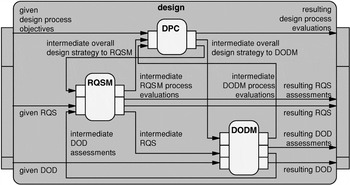
Brazier et al. (1997) have modeled the complex process of design in their generic design model (GDM, see Fig. 1). This model distinguishes reasoning about design process objectives, about (sets of) design requirements, and about descriptions of design artifacts. In van Langen (2002), the full description of GDM can be found. Here, Figure 1 is explained briefly.

The processes of design and their inputs and outputs. The larger, labeled rectangular boxes with rounded corners denote components. The smaller, rectangular boxes with sharp corners denote input/output buffers of components. Labeled lines with arrows denote information links between components.
Given a design process that is performed to meet the demands of a customer, the contents of the three subspaces simultaneously traversed during design space exploration are the following:
- Design requirements and their qualifications. In GDM, traversing this subspace is modeled by the component requirement qualification set manipulation (RQSM). Sets of design requirements include information about the required function, structure, and behavior of the design object, and qualifications that express the strength of these requirements (e.g., Brazier et al., 1997; Klein, 2000). Throughout a design space exploration process, often only a subset of the possible design requirements is considered. This subset is assessed from time to time, and revised if necessary. Subsets can also be temporarily put on hold, and new subsets explored.
- Design object descriptions. In GDM, traversing this subspace is modeled by the component design object description manipulation (DODM). Design object descriptions include information about the function, structure, and behavior of a design object (e.g., Tomiyama & Yoshikawa, 1987; Gero & Kannengiesser, 2004). For example, the design object may be a new office building within a specific environment, such as a city's financial district. Throughout a design space exploration process, a vast number of partial design object descriptions are explored and assessed against the subset of design requirements considered. Often paths of exploration are abandoned, possibly to be revisited in a later phase of design.
- Design process objectives. In GDM, traversing this subspace is modeled by the component design process coordination (DPC). Design process objectives are (qualified) requirements with respect to the design process itself, such as a deadline to be met or a limit on the consumption of a specific design resource, requiring specific strategic knowledge (e.g., Hori, 1997; Ohsuga, 1997; Stacey et al., 2000). Throughout a design space exploration process, the strategy with which design process objectives are pursued can change. The design strategy itself is evaluated from time to time and adapted if necessary. Furthermore, a customer may change the design process objectives over time (e.g., the budget is fixed but the deadline is extended), possibly requiring a (partially) new design strategy.
The processes of design that each reason individually about the contents of one of these three subspaces are the following:
- RQSM. On the basis of a given set of design requirements (i.e., a requirement qualification set), and in interaction with stakeholders (such as a customer), an RQSM process aims to generate a well-defined requirement qualification set that includes sufficient design requirement information for the generation of a satisfactory design object description. This process always operates on one (most often partial) set of design requirements called the current requirement qualification set. During an RQSM process, the contents of the current requirement qualification set may change due to the addition, modification, or deletion of design requirement information.
- DODM. A DODM process aims to generate a consistent design object description that fulfills a given requirement qualification set and that includes sufficient domain object information for the intended use of the design object description. (The intended use of a design object description is to be the basis for the assembly, construction, fabrication, or another form of implementation of the design object.) This process always operates on one (most often partial) description, called the current design object description. During a DODM process, the contents of the current design object description may vary due to the addition, modification, or deletion of domain object information.
- DPC. A DPC process influences a design process in accordance with given design process objectives. More specifically, it influences the strategies chosen within the RQSM process and the DODM process.
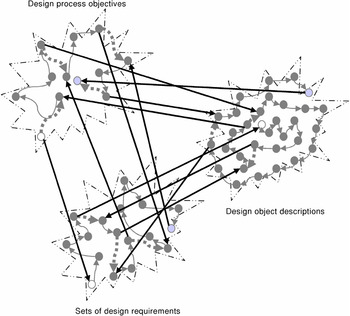
Figure 2 illustrates how the three subspaces are linked as a result of the three different types of reasoning processes within design. The figure shows three types of links: a link between two subspaces (black solid line); a link within a subspace, caused by reasoning within that subspace (gray solid line); and a link within a subspace, denoting the addition of information that resulted from reasoning within the other subspaces (gray dotted line).

The exploration links within and between design subspaces. [A color version of this figure can be viewed online at www.journals.cambridge.org]
The combination of a specific set of design process objectives, a specific requirement qualification set, and a specific design object description designates a distributed information state. That is, the state of a design exploration process can be traced back to specific states within the three subspaces. Furthermore, note that each type of link between the subspaces as shown in Figure 2 corresponds to a subset of the information links between components as shown in Figure 1:
- Following a link from the subspace of design process objectives to either one of the other subspaces is equivalent in GDM to activating the information links intermediate overall design strategy to RQSM, intermediate overall design strategy to DODM, intermediate RQS, and intermediate DOD assessments.
- Following a link from either the subspace of design requirements and their qualifications or the subspace of design object descriptions to the subspace of design process objectives is equivalent in GDM to activating the information links intermediate RQSM process evaluations and intermediate DODM process evaluations.
3. EXAMPLE
This section describes an example from practice, which shows how the three subspaces introduced in the previous section are used in design space exploration. The example is drawn from the design of the Freedom Tower in New York, many details for which can be found at www.renewnyc.com/.
Shortly after September 11, 2001, the Lower Manhattan Development Corporation (LMDC) was created to build a stronger lower Manhattan and create a lasting memorial. With extensive public participation, LMDC developed a refined vision for lower Manhattan, and a plan to achieve it:
- restoring lower Manhattan's residential base,
- stabilizing lower Manhattan's business community,
- improving the quality of life in lower Manhattan,
- developing an overall master site plan,
- designing a fitting memorial,
- ensuring the return of vibrancy and culture, and
- securing funds and helping develop a strategy to create a 21st century transportation infrastructure.
LMDC organized the development of an overarching vision for rebuilding the World Trade Center (WTC) site and revitalizing lower Manhattan, shaped by several citizen advisory councils. The Principles captured the emerging consensus of the future of lower Manhattan. Divided into design process objectives (DPOs) and design requirements (DRs), these principles (released April 2002) read as follows:
[DPO1-1] Make decisions based on an inclusive and open public process.
[DPO1-2] Assist the rapid revitalization of lower Manhattan, in a manner that does not preclude desirable future development plans.
[DPO1-3] Coordinate and encourage the infrastructure improvements that will trigger the private investment needed to sustain and enhance lower Manhattan.
[DPO1-4] Promote sustainability and excellence in design, for environmentally sensitive development.
[DR1-1] Create a memorial honoring those who were lost while reaffirming the democratic ideals that came under attack on September 11, 2001.
[DR1-2] Support the economic vitality of lower Manhattan as the financial capital of the world with new office space.
[DR1-3] Develop lower Manhattan as a diverse, mixed-use magnet for the arts, culture, tourism, education, and recreation, complemented with residential, commercial, retail, and neighborhood activities.
[DR1-4] Develop a comprehensive, coherent plan for transit access to lower Manhattan that expands regional and local connections and improves transit facilities.
[DR1-5] Connect the neighborhoods of lower Manhattan and improve the pedestrian experience of its streets.
[DR1-6] Expand and enhance public and open spaces.
[DR1-7] Preserve the historic character of lower Manhattan and the existing civic and cultural values of its cityscape.
Design requirements laid down in the Mayor's Vision Plan for lower Manhattan were the following, among others:
[DR1-A] New York City lost a critical part of its identity when the WTC towers were destroyed. A tall symbol(s) or structure(s) that would be recognized around the world is crucial to restoring the spirit of the city.
[DR1-B] All site designs should recognize the need for truck and bus access to the site, and anticipate reasonable security measures.
[DR1-C] Cultural and civic elements may be permitted in or around the memorial area(s) or elsewhere. Consideration should be made for how cultural institutions could play a role in enhancing the memorial area(s).
[DR1-D] Performing art facilities for dance, music, or theatre (300–900 seats and/or 900–2200 seats) with a footprint of 250 × 350 ft for the largest hall should be built.
[DR1-E]. Entries to the transportation station and the transit system must support preferred pedestrian travel paths, with a particular focus on the financial district (historic core), east and southeast of the site, and the World Financial Center/Battery Park City, west and southwest of the site.
[DR1-F]. Proposals must follow design parameters identified by the New York State Department of Transportation (NYSDOT) and construct solutions based on the options studied to date by NYSDOT.
[DR1-G]. Footprints for most office buildings should be in the range of 25,000–40,000 ft2.
Regarding the future of the WTC site and surrounding areas, the LMDC displayed the six initial concept plans in July 2002. In August 2002 the LMDC invited architects and planners around the world to participate in a design study.
In December 2002 an exhibit of the nine new plans produced by seven teams (from among 406 submissions) was visited by over 100,000 people and resulted in the submission of 8000 public comment cards to the LMDC. Immediately after the release of the plans, the LMDC launched an outreach campaign. By the conclusion of the campaign, the LMDC had received 12,000 comments.
Each design was evaluated against a series of quantitative and qualitative factors, including the comprehensive record of public comment:
Memorial Setting: how well does it provide an appropriate memorial setting?
Program: does the design meet the program requirements?
Parcels/Street Pattern: how well does the design establish practical street, block and development parcels?
Public Response: what is the public response to the design?
Vision: how well does it support the Mayor's Vision Plan for lower Manhattan?
Connectivity: how well does the design connect with its surroundings?
Phasing: does the design allow for phased development over time?
Public Realm: how effective is the addition to the public realm?
Private Development: does the design provide an attractive environment for private development?
Insoluble Issues: are there components that cannot be resolved?
Resolvable Issues: how significant are the issues that can be resolved?
Cost: what is the estimated cost of publicly funded elements of the plan?
After further evaluation, the designs by two teams were selected as finalists. Both concepts were further developed and in February 2003, the master concept plan by Daniel Libeskind was selected.
In September 2003 the refined master site plan was presented to the public. Although preserving the essential elements of the original plan, Daniel Libeskind's refined plan reconciled issues regarding commercial office space, retail development, the transportation network, and the site's public spaces. The refined plan shifted portions of commercial space off the site, created a new park in the area south of Liberty Street, and moved truck servicing infrastructure away from the memorial area.
In July 2004 planning went from paper to steel when the cornerstone was laid for the Freedom Tower, the first building to begin construction on the site. The design for the Freedom Tower is the result of collaboration between Daniel Libeskind and David Childs.
In June 2005, the revised design for the Freedom Tower was released. For this release, the architect, David Childs, had been charged with the task to design a building that
[DR2-1] serves as a soaring architectural tribute to liberty,
[DR2-2] meets the world's highest life safety standards,
[DR2-3] is a pioneer in environmental quality, and
[DPO2-1] remains true to Daniel Libeskind's master plan for the WTC site.
The revised Freedom Tower features a cubic base, rather than a parallelogram as originally conceived. Furthermore, the building's setback distance from West Street has been increased from 25 ft to an average of 90 ft. As part of the new design, the tower's footprint, measuring 200 × 200 ft, is the same size as the footprints of the original Twin Towers. A mast containing an antenna rises from a circular support ring to a height of 1776 ft. In keeping with the original design, the entire composition evokes the Statue of Liberty's torch and will emit light.
Construction on below-grade utility relocations, footings, and foundations for the Freedom Tower is expected to begin in the first quarter of 2006. It is projected that steel for the building will be visible above grade in 2007, with a topping out in 2009. The building is projected to be ready for occupancy in 2010.
In this example, different types of transitions within the three design subspaces can be observed:
Changes to the original set of DPOs: For example, David Childs, the architect who became involved later, had to remain true to Daniel Libeskind's master plan for the WTC site.
Changes to the original set of DRs: For example, the requirement that a tall symbol(s) or structure(s) should be erected that would be recognized around the world (and that was deemed crucial to restoring the spirit of the city) was refined to the requirement that it serve as a soaring architectural tribute to liberty.
Changes to the original design: For example, the revised Freedom Tower featured a cubic base, rather than a parallelogram as originally conceived.
The example also shows evidence of links between design subspaces. For instance, as a result of viewing the master site plan, it was realized that the truck servicing infrastructure should be moved away from the memorial area. Furthermore, the refined requirement that the building should serve as a soaring architectural tribute to liberty led to the design of a mast that evokes the Statue of Liberty's torch and will emit light, becoming its own beacon of freedom. This additional information is needed to understand the reasons for the links between the different partial and intentional design descriptions.
4. DISCUSSION
Woodbury and Burrow state that possible structures for design space are conditioned by models of exploration behavior by designers, by choices of strategies for amplifying design action, and by the limits imposed by both computation itself and our knowledge of it. Formalisms for design space exploration must simultaneously accord with designer action, implement a useful amplification strategy, and be computationally tractable.
Making the information compiled in paths of exploration explicit, as proposed in this paper, increases options for accessibility described by Woodbury and Burrow. This paper presents three subspaces that are simultaneously traversed in a design space exploration process. Distinguishing these three subspaces enhances understanding of the complexity of design as exploration, the analysis of design exploration in practice, and the development of design exploration support systems and automated design exploration systems. The example of the Freedom Tower illustrates the need to express the information in these three spaces to understand the sequence of designs.
Further research is needed to understand the ways in which the steps within each of these three spaces can be made accessible to human users without considerable information overload. Each design process can be viewed from each of the three perspectives: from the perspective of the design process objectives, from the perspective of the design requirements and their qualifications, and from the perspective of the design object descriptions. A design step within one of these spaces, for example between two design object descriptions, may be caused by new insight in the design options, given the available domain knowledge, the same design requirements and the same design process objectives. The design step, however, may also have been preceded by reinterpretation or modification of the design requirements and/or design process objectives. This information is essential to understanding a particular design step from, in this case, the perspective of design object descriptions. The human user, however, is unlikely to be interested in a complete transcript of the reasoning involved in each of the related spaces; instead, he or she is interested in the most relevant changes. More research is needed to understand the specific needs of users and/or groups of users, and to build appropriate tooling for this purpose.
A second focus for further research is to understand the support needed for design space exploration by design teams, to investigate the links between the design subspaces of different designers within the team. Finally, the implications of such explicit knowledge of design space exploration for automated design systems (e.g., automated Web service reconfiguration systems) need to be examined in greater detail.
ACKNOWLEDGMENTS
The authors are grateful to the NLnet Foundation (www.nlnet.nl/) for supporting this research.
References
REFERENCES
Brazier, F.M.T.,
van Langen, P.H.G., &
Treur, J.
(1997).
A compositional approach to modelling design rationale.
Artificial Intelligence for Engineering Design, Analysis and
Manufacturing
11(2),
125–139.Google Scholar
Burge, J.E. &
Brown, D.C.
(2004).
An integrated approach for software design checking using design
rationale.
Proc. First Int. Conf. Design Computing and Cognition
(DCC'04).
Cambridge, MA:
MIT Press.
Candy, L. &
Edmonds, E.
(1996).
Creative design of the Lotus bicycle: implications for knowledge
support systems research.
Design Studies
17(1),
71–90.Google Scholar
Edmonds, E. &
Candy, L.
(2002).
Creativity, art practice, and knowledge.
Communications of the ACM
45(10),
91–95.Google Scholar
Gero, J.S. &
Kannengiesser, U.
(2004).
The situated function–behaviour–structure
framework.
Design Studies
25(4),
373–391.Google Scholar
Hori, K.
(1997).
Where is, what is, and how can we use strategic knowledge?
Proc. First Int. Workshop on Strategic Knowledge and Concept
Formation
(Candy, L. &
Hori, K., Eds.), pp.
35–42.
Loughborough:
Loughborough University of Technology.
Klein, R.
(2000).
Knowledge modelling in design—The MOKA framework.
Proc. Artificial Intelligence in Design '00
(Gero, J.S., Ed.), pp.
77–102.
Dordrecht:
Kluwer Academic.
Ohsuga, S.
(1997).
Strategic knowledge makes knowledge based systems truly
intelligent.
Proc. First Int. Workshop on Strategic Knowledge and Concept
Formation
(Candy, L. &
Hori, K., Eds.), pp.
1–24.
Loughborough:
Loughborough University of Technology.
Smithers, T.
(1998).
Towards a knowledge level theory of design process.
Proc. Artificial Intelligence in Design '98
(Gero, J.S. &
Sudweeks, F., Eds.), pp.
3–21.
Dordrecht:
Kluwer Academic.
Stacey, M.,
Clarkson, P.J., &
Eckert, C.
(2000).
Signposting: an AI approach to supporting human decision making in
design.
Proc. ASME 2000 Design Engineering Technical Conf.
(DETC'00), pp.
141–150.
Tomiyama, T. &
Yoshikawa, H.
(1987).
Extended general design theory.
Proc. IFIP WG5.2 Working Conf. Design Theory for CAD
(Yoshikawa, H., &
Warman, E.A., Eds.), pp.
95–125.
Amsterdam:
Elsevier (North-Holland).
van Langen, P.H.G.
(2002).
The anatomy of design: foundations, models and applications.
PhD Thesis. Amsterdam:
Vrije Universiteit Amsterdam, Faculty of Sciences.
The processes of design and their inputs and outputs. The larger, labeled rectangular boxes with rounded corners denote components. The smaller, rectangular boxes with sharp corners denote input/output buffers of components. Labeled lines with arrows denote information links between components.
The exploration links within and between design subspaces. [A color version of this figure can be viewed online at www.journals.cambridge.org]
 You have
Access
- 10
- Cited by