

An Update to the Squire State Courts of Last Resort Professionalization Index
Although several measures of state courts of last resort professionalization levels have been devised, the Squire (Reference Squire2008) index has been the most commonly employed in recent years (Yanus and Gray Reference Yanus and Gray2017, 284). A significant limitation of it, however, is that it only uses data from a single year, 2004 (Frost and Lindquist Reference Frost and Lindquist2010, 776). In this paper, we update the Squire state courts of last resort professionalization index using data for 2019. Because of a change in the way state courts of last resort docket control data are currently presented, we also recode the 2004 index to make it directly comparable with the 2019 version.
Justification for an Updated Index
A measure can be considered valid if it produces predicted or plausible results. A range of relevant studies using the Squire index demonstrate that it is predictively valid. As we would hypothesize, for example, more professionalized state courts of last resort have their decisions cited more frequently by other courts (Fix and Fairbanks Reference Fix and Fairbanks2020; Gleason and Howard Reference Gleason and Howard2014–Reference Gleason and Howard5, 120; Hinkle and Nelson Reference Hinkle and Nelson2016, 403). They also enjoy greater success in cases before the United States Supreme Court (Frost and Lindquist Reference Frost and Lindquist2011, 777; Owens and Wohlfarth Reference Owens and Wohlfarth2014). More amicus briefs are filed as professionalization levels increase because of an expectation that the decisions those courts render will be more legally influential (Kane Reference Kane2018, 888–9; Perkins Reference Perkins2018, 49). In turn, because of the broader impact the decisions handed down by more professional courts have, they generate more intense policy backlashes from voters and state lawmakers (Hume Reference Hume2011). And as professionalization increases legislators become more reluctant to pursue reform plans advanced by state court chief justices, perhaps because they “perceive well-maintained courts as lacking [a need for] immediate attention” (Wilhelm et al. Reference Wilhelm, Vining, Boldt and Black2020, 151).
Judicial behavior is also influenced by professionalization levels, with higher levels being associated with more dissents being issued (Boyea and Farrar-Myers Reference Boyea and Farrar-Myers2011, 27; Hall and Windett Reference Hall and Windett2016, 27, but see Szmer, Christensen, and Kaheny Reference Szmer, Christensen and Kaheny2015). Professionalization levels impact the career decisions judges make, affecting the amount of time they opt to stay on the bench (Boyea Reference Boyea2011; Nash Reference Nash2017). Electoral effects have been uncovered, with judges on more professionalized courts being better able to raise campaign funds, fend off attack ads, and gain higher vote shares (Boyea Reference Boyea2017, 242–3; Hall Reference Hall2015, 117; Hughes Reference Hughes2019, 146).
The Squire state courts of last resort professionalization index have produced results demonstrating that it has strong predictive validity. It also is routinely entered as a control variable in studies where court professionalization is of secondary interest (e.g., Bosworth Reference Bosworth2017; Goelzhauser and Cann Reference Goelzhauser and Cann2014; Hughes Reference Hughes2020; Leonard Reference Leonard2016; Leonard and Ross Reference Leonard and Ross2014; Reference Leonard and Ross2016; Miller and Tuma Reference Miller and Tuma2020; Randazzo, Waterman, and Fix Reference Randazzo, Waterman and Fix2011; Yanus and Gray Reference Yanus and Gray2017). Updating the index allows scholars to continue to incorporate it in studies involving state courts.
Measuring State Court of Last Resort Professionalization
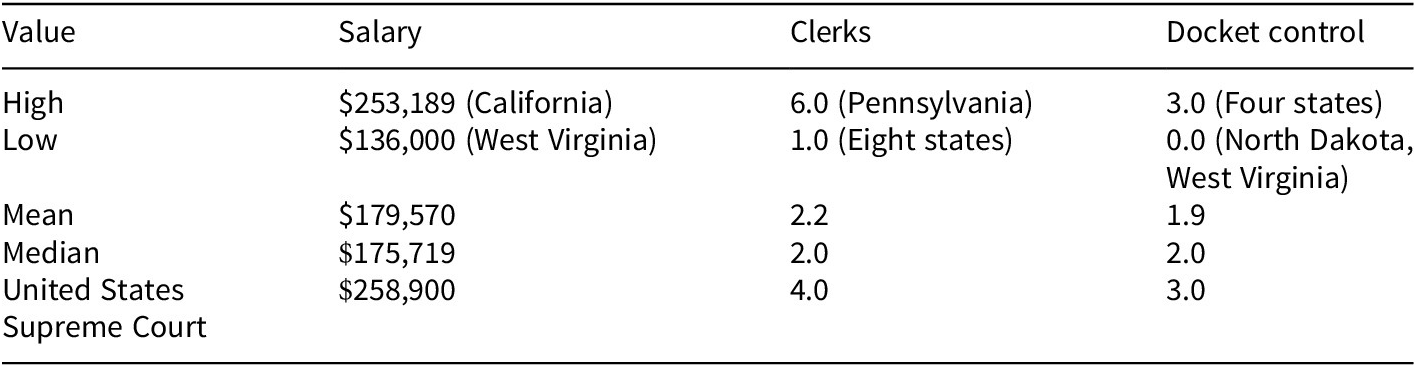
Squire’s court professionalization index has three components, each of which is compared to the United States Supreme Court as a baseline. The first component is judicial salary, which is “incorporated … on the assumption that courts that offer higher pay attract and retain better qualified judges” (Squire Reference Squire2008, 225). As with the original index, annual salaries for associate state court of last resort justices were used in the updated version. As can be seen in Table 1, in 2019 those salaries ranged from a high of $253,189 in California, which falls just short of the salary of an associate justice on the United States Supreme Court, to a low of $136,000 in West Virginia (National Center for State Courts 2019).
2019 values of the components of state court of last resort professionalization
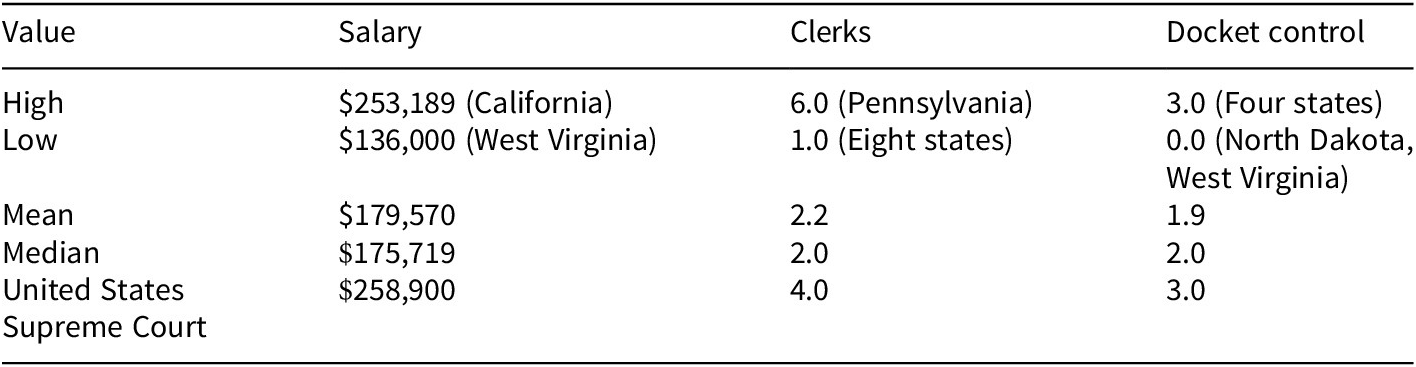
The second component in the index is staff. In the case of state courts of last resort that is taken to mean the number of law clerks per justice. The expectation is that a “court’s ability to produce and evaluate information should increase with the number of law clerks working for the justices” (Squire Reference Squire2008, 226). Some state courts of last resort provide information on the number of law clerks they employ on their websites or in official publications, but data for most courts had to be obtained directly from court officers. The number of clerks per justice in 2019 ranged from one clerk in eight states to six clerks in Pennsylvania. As shown in Table 1, Pennsylvania’s score surpasses that of the United States Supreme Court. It should be noted that some state courts of last resort provide their justices additional sorts of legal assistance, sometimes in the form of permanent professional legal staff, which is not incorporated in the component.
The final component is docket control. It is included because “Docket control gives an appellate court the ability to manage the number of cases it hears and to select the cases that it deems the most import to decide. Appellate courts that can largely determine which cases they hear have a greater ability to craft their decisions compared with appellate courts that cannot pick and choose” (Squire Reference Squire2008, 226). The United States Supreme Court effectively has complete control over its docket, allowing it to choose the cases it hears. The National Center for State Court’s Court Statistics Project currently reports docket control information for three major case categories: administrative agency, civil, and criminal. For each of these categories, it gives information on whether the court of last resort has mandatory (by right) jurisdiction or discretionary (by permission) jurisdiction (see the discussion in Court Statistics Project 2019, 40). Given the information provided the following coding scheme was devised to measure the extent to which a court enjoys control over its docket: 1.0 for by permission (complete docket control); 0.75 for by limited right; 0.5 for both by right and by permission, 0.25 for by limited permission, and 0.0 for by right (complete lack of docket control). Only a few states reported by limited rights or by limited permissions; consequently, almost all of the scores in each of the three categories for each state were 1.0, 0.5, or 0.0.
While the first two components of the 2019 index relied on the same sort of data as used in the 2004 index, the data available for measuring docket control have changed slightly over time. For 2004, the National Center for State Courts provided information on four other case categories in addition to the three major cases it still reports. So that the 2004 index and 2019 index could be directly comparable, we went back to the 2004 data and recoded it into the same three categories used with 2019 data.
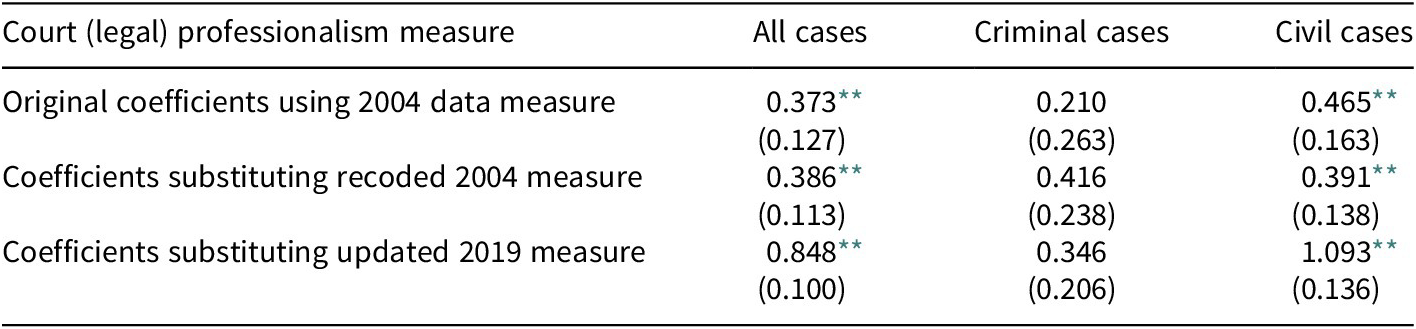
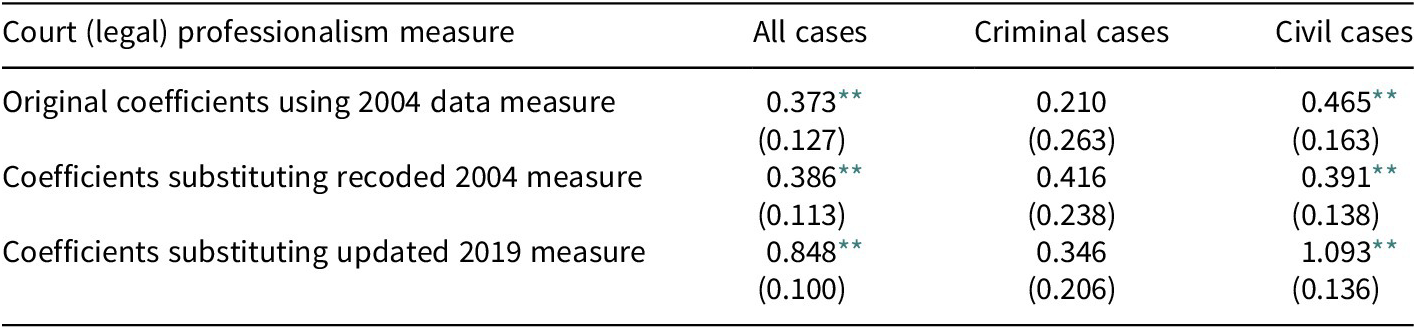
The recoding of the docket component of the 2004 professionalization index produces only minor changes in the state scores for that year. The recoded 2004 docket score correlates with the original docket score at 0.86. Moreover, because the docket score is only one of three equally weighted components in the overall index, the recoded 2004 professionalization index correlates with the original index at 0.95, and the state rankings between the two correlate at 0.92. Consequently, it would seem unlikely that any findings produced using the original 2004 index would be disturbed by the use of the recoded version. A test of that proposition appears in the Appendix, which shows that substituting the recoded 2004 court professionalization measure for the original version used in Hinkle and Nelson’s (Reference Hinkle and Nelson2016) court citation study changes the relevant coefficient only slightly and does not alter the statistical results or substantive story (interestingly, substituting the 2019 measure does not change the analysis in terms of substance, but strengthens it statistically).
State Courts of Last Resort Professionalization Index for 2019
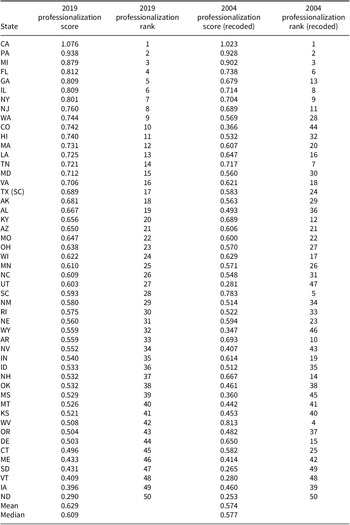
The 2019 index is presented in Table 2. As with the 2004 index, the courts of last resort that most resemble the United States Supreme Court in 2019 are almost all from wealthier and larger population states while those that bear the least resemblance are from among the poorer and smaller population states. And, again, in 2019 state courts of last resort look more like the United States Supreme Court than almost any state legislature looks like Congress (cf. Squire Reference Squire2017).
State court of last resort professionalization scores, 2019 and 2004 (recoded)
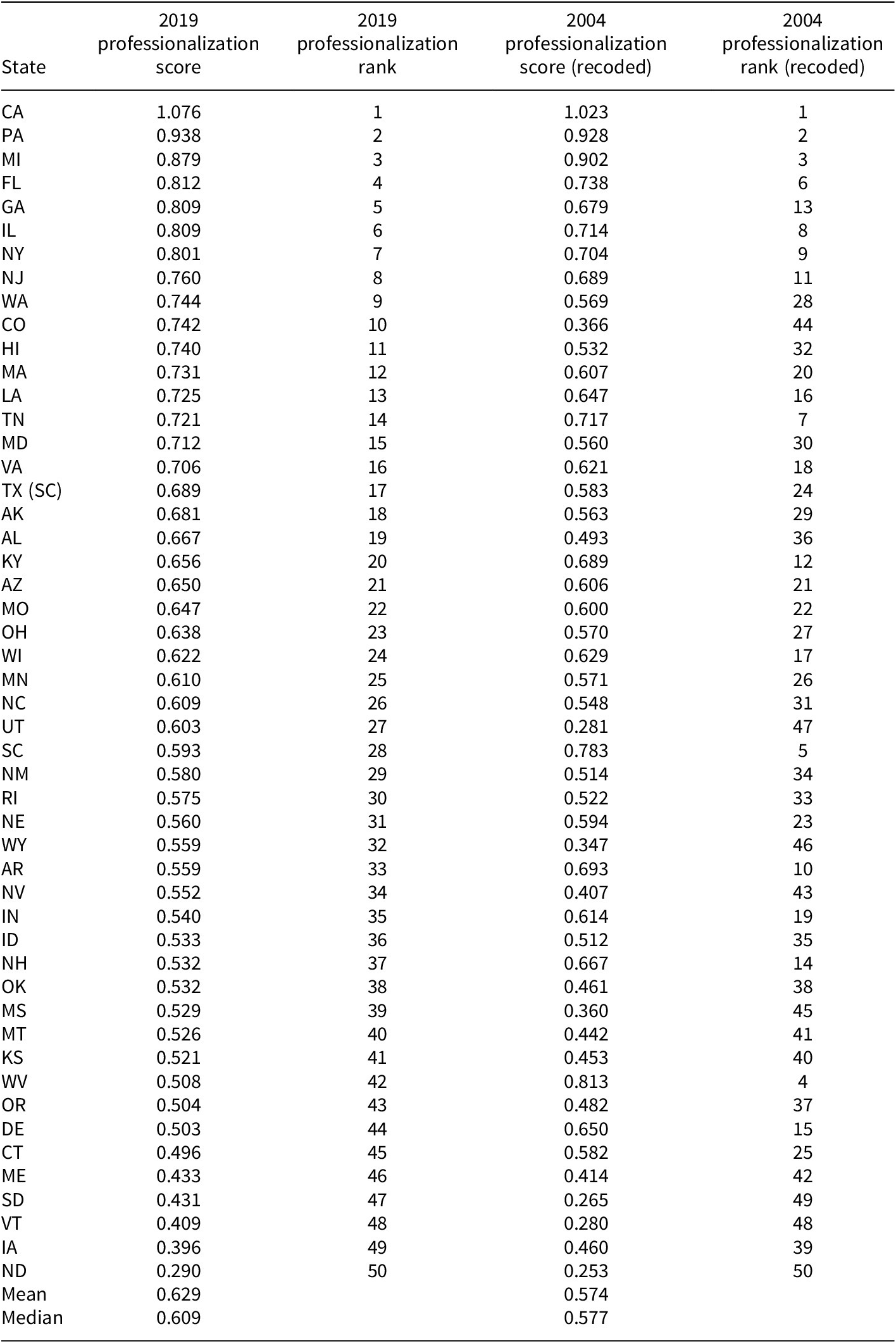
The 2019 index correlates with the recoded 2004 index at 0.71. Thus, the relative position of most state courts of last resort did not change much over the 15-year time interval between indexes. The most notable change in rank is for the West Virginia Supreme Court of Appeals, which plunged from placing fourth (0.813 recoded) in 2004 to 40 second (0.508) in 2019. The drop was driven entirely by a dramatic shift in docket control. Indeed, the court’s salary score was actually slightly higher in the newer data than in the older data (0.53 of the US Supreme Court salary score in 2019 compared to 0.49 in 2004), as was its clerks score (1.0 compared to 0.95). Its docket score, however, plummeted to 0.0 from 1.0 in the earlier time period. The decline resulted from a 2010 rule reform that changed the Supreme Court of Appeals from one that exercised complete discretionary appellate review to one that exercised mandatory appellate review. The change had a dramatic impact on the court’s workload. According to one analysis, it generated “a huge increase in the number of cases the West Virginia Supreme Court must decide each year. In 2011, the court issued 678 decisions, ‘more than triple when compared to the previous system.’ In 2012, the workload increased again to 908 decisions, which increased even more in 2013 to 1,360 decisions” (Zwerner Reference Zwerner2014, 434–5, italics in the original). These are the sorts of institutional shifts that the court professionalization index is designed to capture.
There were two other courts that saw significant movement in their rankings: Colorado from 44th (0.366 recoded) to 10th (0.742) and Utah from 47th (0.281) to 27th (0.603). Both states reported having more clerks and greater docket control than they had 15 years earlier. Both also made concerted efforts to elevate their judicial salaries relative to those paid by other states and the private sector (State of Colorado, Joint Budget Committee 2016; Utah Office of the Legislative Analyst 2018).
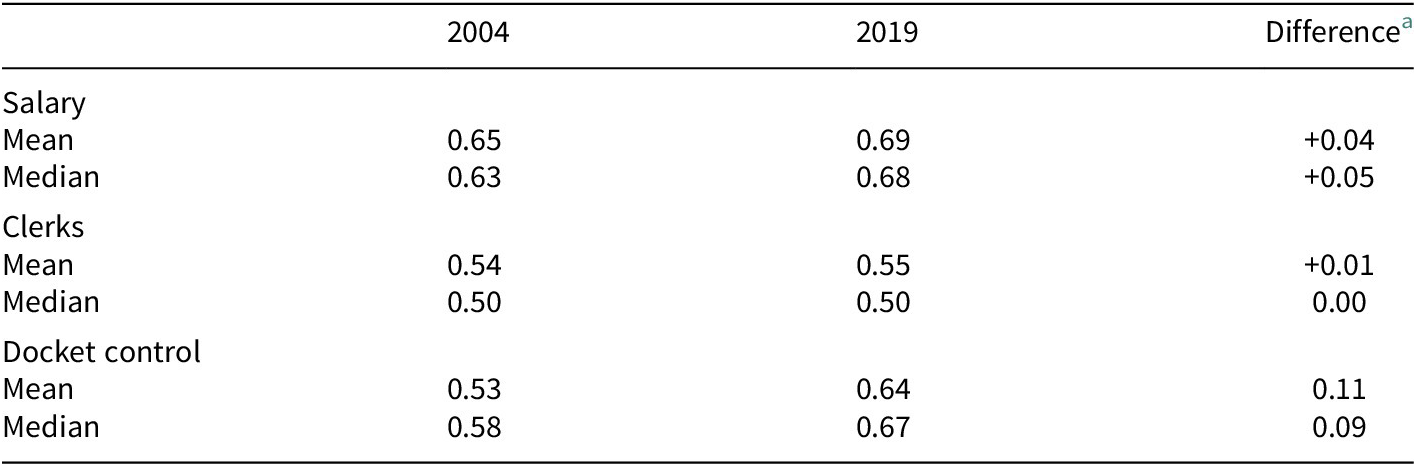
In general, between 2004 and 2019, the average state court of last resort inched closer to the standard set by the United States Supreme Court. As shown in Table 3, the most notable development occurred in docket control, with state courts gaining a bit more power over which cases they hear. They also made a little progress on salaries. But most state courts, like the Supreme Court, did not increase the number of clerks they employ.
Change in the component scores as compared to USSC, 2004–9
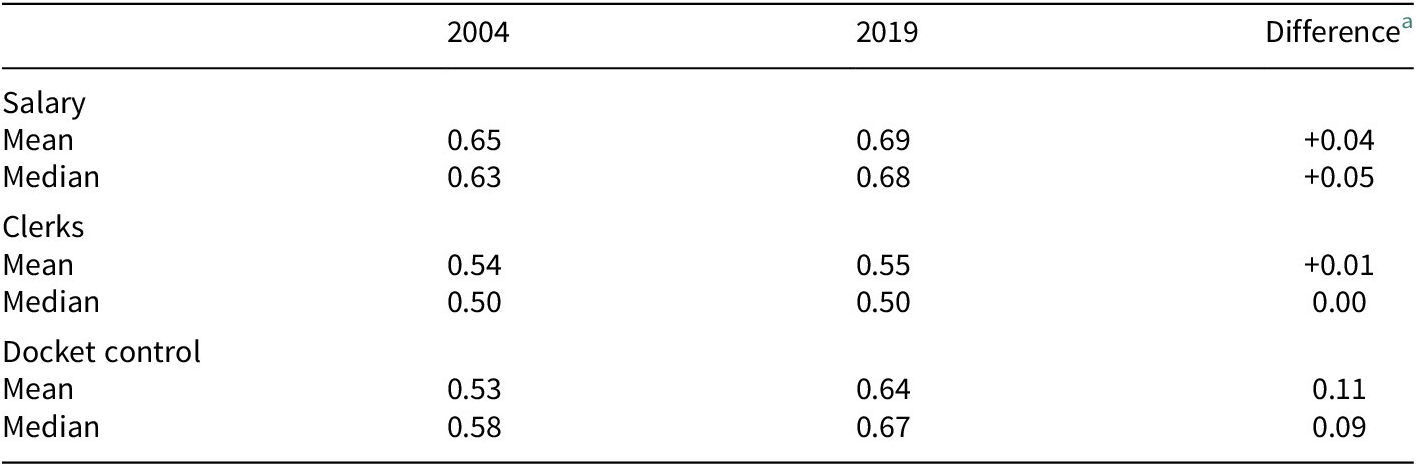
a We are of the view that because the differences between the 2004 and 2019 data are not derived from estimates, statistical significance tests are not needed. This perspective would mean that evaluating the substantive importance of the differences in means is left for the reader. There are, however, those who argue that there are underlying probabilistic data generating processes that produce the observed sample. For those who adopt this orientation, the difference in means between the 2004 and 2019 data for the number of clerks relative to the USSC is not statistically significant, the difference in means for salary relative to the USSC just misses the traditional level of significance at 0.052, and the difference in means for the docket scores relative to the USSC is statistically significant at 0.045 (all two-tailed tests).
Summary
The current version of the Squire state court of last resort professionalization index is regularly used in studies of state courts. We have updated the index for 2019, producing a second and more recent index for scholars to use. Given the relative stability between this index and its predecessor, it is unlikely that many findings will change. But the updated index incorporates the meaningful changes that have occurred in a handful of states.
That last observation raises a question about often the index needs to be revised. During the fifteen years that lapsed between the first index and the more recent one, little changed in most states, while reforms in a few places substantially shifted the relative standing of their court of last resort. It seems unlikely that the nation will experience any sweeping reform movements impacting state courts of last resort across the board. The more likely scenario is the sort of idiosyncratic changes impacting a few courts that were witnessed over the last decade and a half. Thus, looking to the future, it may be prudent to update the index every five to ten years in order to capture any notable alterations, even if newer versions of the index end up being largely consistent with earlier ones.
Data Availability Statement
Replication materials are available on UNC Dataverse at https://doi.org/10.15139/S3/OIAAIZ.
Funding Statement
The authors received no financial support for the research, authorship, and/or publication of this article.
Conflict of Interest
The authors declared no potential conflicts of interest with respect to the research, authorship, and/or publication of this article.
Author Biographies
Peverill Squire is the Hicks and Martha Griffiths Chair in American Political Institutions in the Department of Political Science at the University of Missouri. Jordan Butcher is an Assistant Professor at Arkansas State University.
Appendix
Legislative professionalism coefficients in replication of hinkle and nelson (Reference Hinkle and Nelson2016), table 2, using different measures