





Introduction
Wingleaf primrose-willow (Ludwigia decurrens Walter) is an erect, branched herbaceous plant that acts as an annual to short-lived perennial and can become woody as it matures. The exact origin of the species has been debated, but it is thought to be native to South America and the Caribbean and has since spread and become naturalized in the southeastern United States (Reddy et al. Reference Reddy, Pratt, Grewell, Harms, Cabrera Walsh, Hérnandez, Faltlhauser and Cibils-Stewart2021a; Wagner et al. Reference Wagner, Hoch and Raven2007). In addition to the United States, other areas where L. decurrens has been noted include Sri Lanka, Indonesia, China, India, and Africa, where it is typically observed along margins of rice (Oryza sativa L.) fields, marshes, ponds, slow-moving streams, and ditches (Chandrasena Reference Chandrasena1988; Kong et al. Reference Kong, Peng, You, Peng and Wang2019; Kurniadie et al. Reference Kurniadie, Widianto, Widayat, Umiyati, Nasahi and Kato-Noguchi2021).
The native versus non-native status of plants in this genus (including L. decurrens) has been widely discussed, with disjunct populations of several species in this genus occurring in the United States (Grewell et al. Reference Grewell, Netherland and Skaer Thomason2016; Reddy et al. Reference Reddy, Pratt, Grewell, Harms, Cabrera Walsh, Hérnandez, Faltlhauser and Cibils-Stewart2021a; Wagner et al. Reference Wagner, Hoch and Raven2007). Several Ludwigia species such as water primrose [Ludwigia hexapetala (Hook. & Arn) Zardini, Gu, & P.H. Raven], Uruguay waterprimrose [Ludwigia grandiflora (Michx.) Greuter & Burdet], and several subspecies of creeping waterprimrose [Ludwigia peploides (Kunth) P.H. Raven] are considered weedy in aquatic, riparian, and agricultural systems worldwide. Although it has been listed as a rice weed, L. decurrens has not been the focus of much dedicated research, as it is often grouped with other species.
Like Ludwigia congeners, L. decurrens can produce aerenchyma tissue in roots and rhizomes; however, it does not produce the pneumatophores that have been recorded in other Ludwigia (Bedoya and Madriñán Reference Bedoya and Madriñán2015). While most Ludwigia can propagate from plant fragments, this growth pattern has not been thoroughly investigated in L. decurrens, and seed is thought to be the primary method of spread (Chandrasena Reference Chandrasena1988; Eckert and Fischer Reference Eckert and Fischer2012). Persistent seedbanks are common in other Ludwigia species, allowing for rapid recruitment in managed and disturbed areas. Ludwigia decurrens can produce ∼1,000 seeds per capsule, with numerous capsules per plant, which allows it to rapidly monopolize infested areas (Chandrasena Reference Chandrasena1988). Low germination rates have been observed in L. decurrens seed, with a high level of primary dormancy that required 5 to 6 mo of dry storage or gibberellic acid treatments to break (Oziegbe et al. Reference Oziegbe, Faluyi and Oluwaranti2010; Sumudunie and Jayasuriya Reference Sumudunie and Jayasuriya2019).
Ludwigia decurrens was first reported in Butte County, CA, in 2011 in a rice field, but mapping efforts for L. decurrens were not prioritized due to localized infestations not persisting (Espino Reference Espino2011). In 2015, the California Department of Food and Agriculture (CDFA) rated L. decurrens as an “A”-rated pest with a “P” seed rating. These ratings identify the species as an economic and environmental detriment to the state and prohibit the intentional movement or sale and decertification of fields containing the weed (CDFA 2015). The “P” rating further designates zero tolerance for the weed seed in planting seed (CDFA 2015). To date, there is a scarcity of peer-reviewed, published literature regarding L. decurrens, and its documentation in California mostly relies on anecdotal reports. This invasion alert reports the presence of L. decurrens in Northern California and summarizes identifying characteristics and existing knowledge.
Materials and Methods
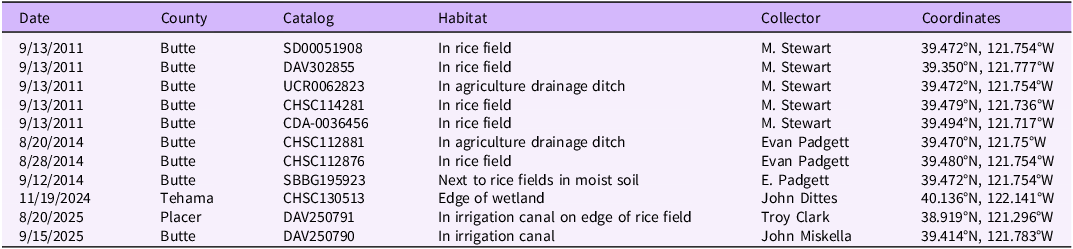
Surveys were conducted from July 21, 2025 to September 11, 2025 and focused on sites with a documented history of L. decurrens. Field crews surveyed along public roads, at state and county research facilities, and in access areas provided by landowners. Following initial field verification, data were collected on the location and extent of infestation at each confirmed site, when possible approximate number of plants was recorded. Presence of L. decurrens was recorded on Calflora (https://calflora.org) and select locations were submitted to herbaria for confirmation. Records were also retrieved from the Consortium of California website (Table 1).
Herbarium records of Ludwigia decurrens in California from the Consortium of California Herbaria (https://cch2.org/portal/collections/list.php).

Table 1. Long description
This table details electoral seat misallocations across 12 European countries between 2011 and 2019. It tracks total seats in parliament, misallocated seats, their share, total parties, and misallocated seats per party. The United Kingdom (2019) has the highest misallocated seats (79) and per-party average (7.90), while Spain (2019) follows with 46 misallocated seats (13% share across 13 parties). Iceland (2017) records the highest share of misallocated seats at 14% (9 of 63 seats). Conversely, Sweden (2018) and Denmark (2019) show the lowest shares of misallocated seats at 3% and 4%, respectively.
Results and Discussion
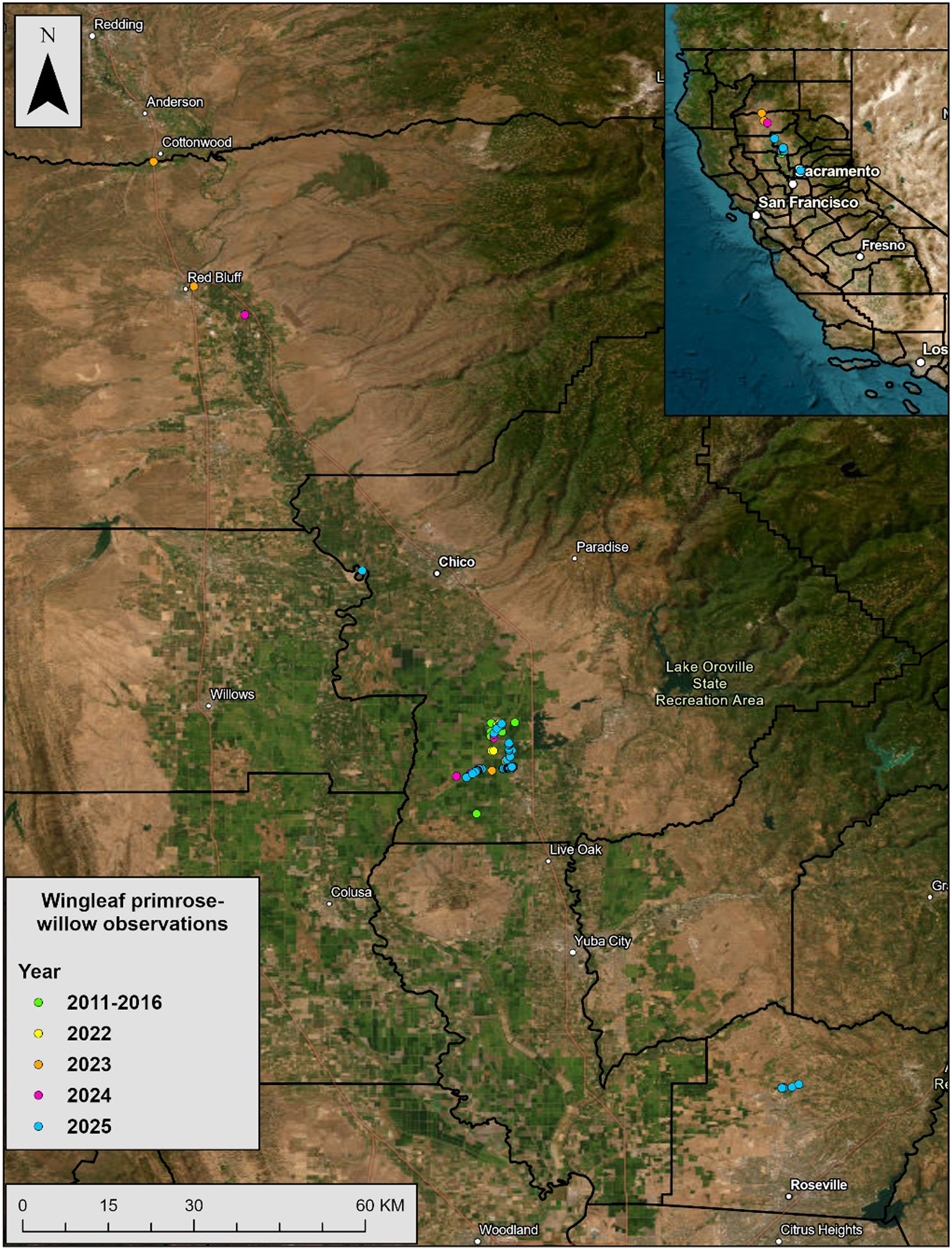
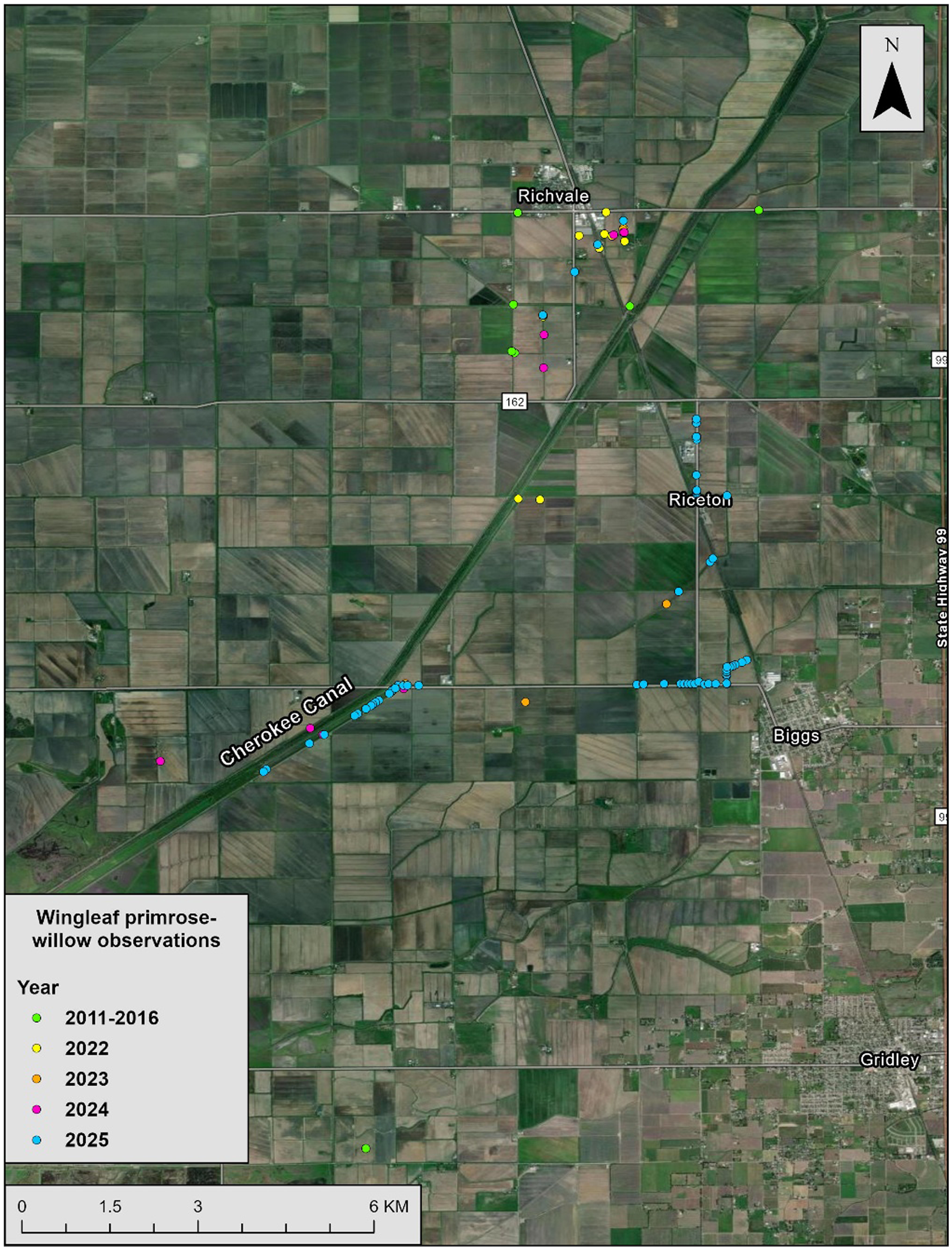
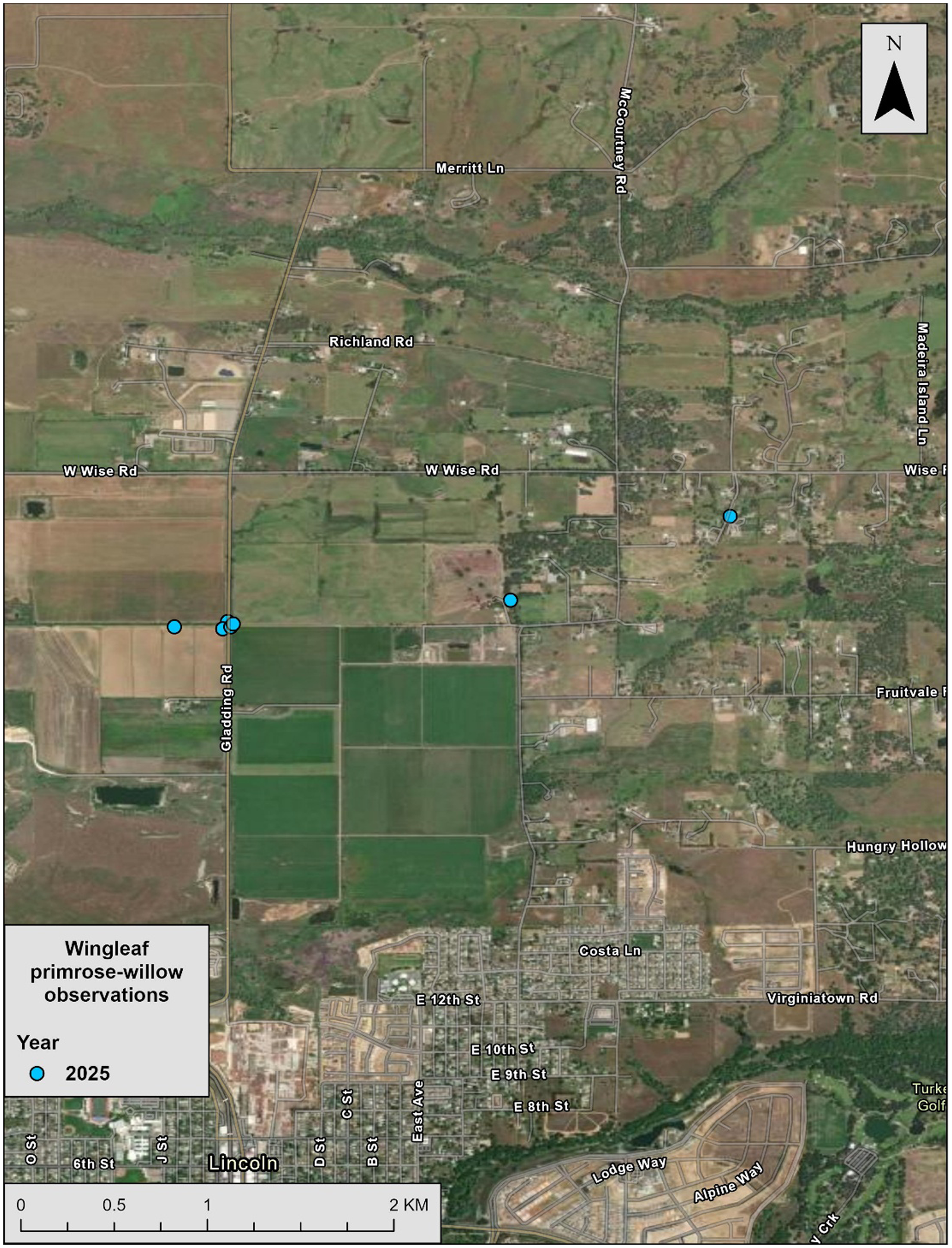
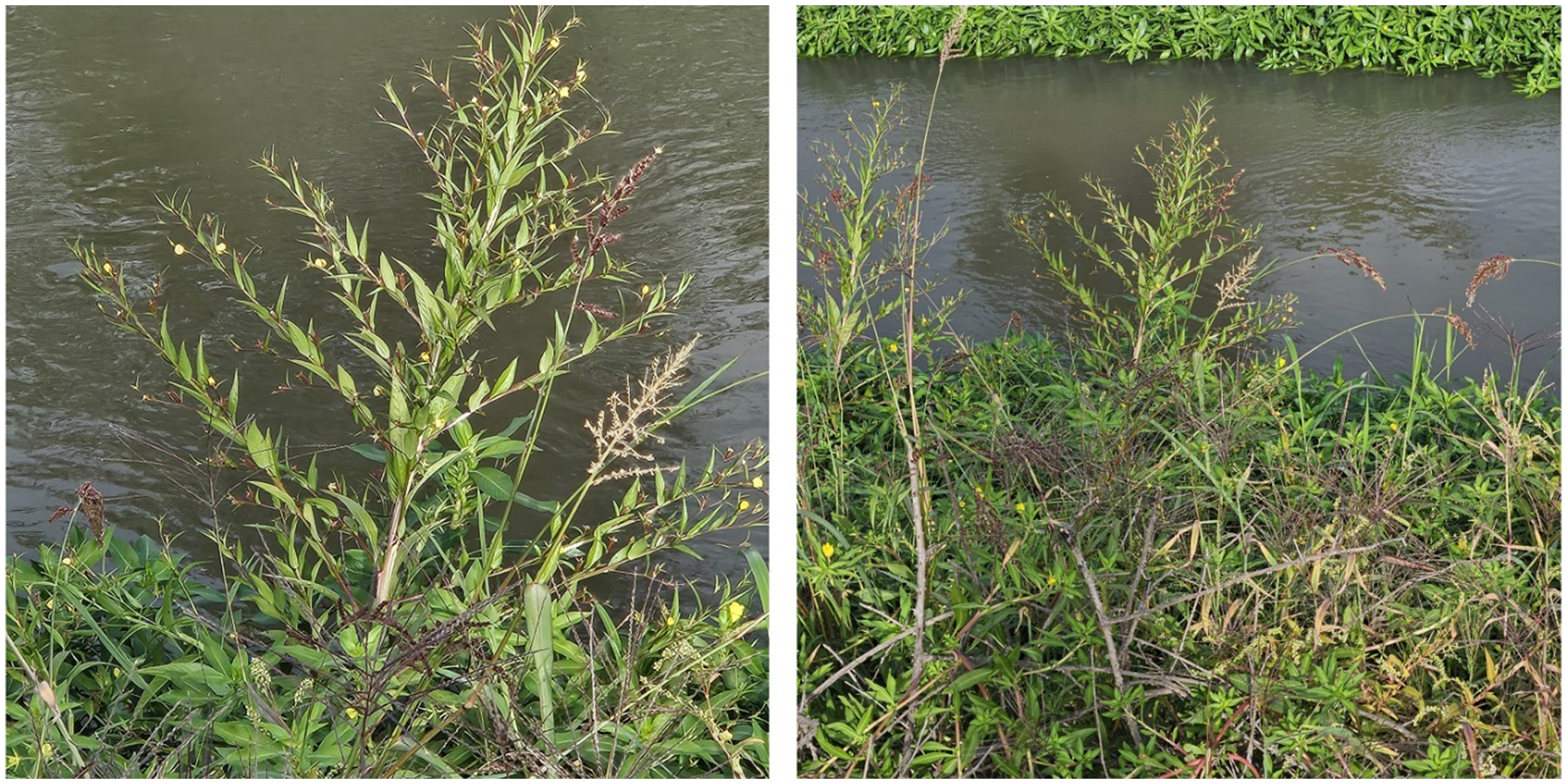
Currently, 26 records have been verified with herbarium vouchers, but for the purposes of this article, records with duplicate coordinates as well as those lacking coordinates, were omitted, resulting in 11 unique vouchered specimens (Table 1). Twenty-three samples have been vouchered in Butte County, two in Tehama County (North of Butte County), and one in Placer County. Additionally, 90 records are reported in Calflora, but each individual record can signify a single plant or hundreds of plants as noted in Calflora (Figure 1). Rice field infestations were predominantly observed on the levees (earthen embankments between fields) as well as in irrigation canals and ditches, with the farthest record in the county observed by the study survey team 17 km from the initial infestation (Figure 2). An additional record was made by an outside observer within Butte County 34 km from the initial infestation. The northernmost record in Tehama County is the farthest from the initial infestation in Butte County (184 km). In August 2025, L. decurrens was discovered in Placer County, 63 km from the nearest record in Butte County, with no contiguous water flow between the locations (Figure 3). Although dense infestations were noted, this species was not observed in monoculture; in addition to infesting rice fields, it was observed co-occurring with Mexican sprangletop [Leptochloa fusca (L.) Kunth ssp. uninervia (J. Presl) N. Snow]. In drainage and irrigation canals and ditches, patches of L. decurrens were observed to be interspersed with other common weeds, including L. hexapetala and Valley redstem (Ammannia coccinea Rottb.) (Figure 4).
Ludwigia decurrens observations in Northern California. Circles indicate observations from Calflora.org, color coded by year of observation (green = 2011–2016; yellow = 2022; orange = 2023; pink = 2024; and blue = 2025). The 2025 observations were made by the research team and uploaded to Calflora.org, except for the point west of Chico on the county border, which was made by an outside party.

Ludwigia decurrens observations in Butte County, CA. Circles indicate observations from Calflora.org, color coded by year of observation (green = 2011–2016; yellow = 2022; orange = 2023; pink = 2024; and blue = 2025). The 2025 observations were made by the research team and uploaded to Calflora.org.

Ludwigia decurrens observations in Placer County, CA. Circles indicate observations from the research team and were uploaded into Calflora.org.

Ludwigia decurrens flowering and emerging from dense Ludwigia hexapetala on the edge of the Cherokee canal, Butte County, CA.

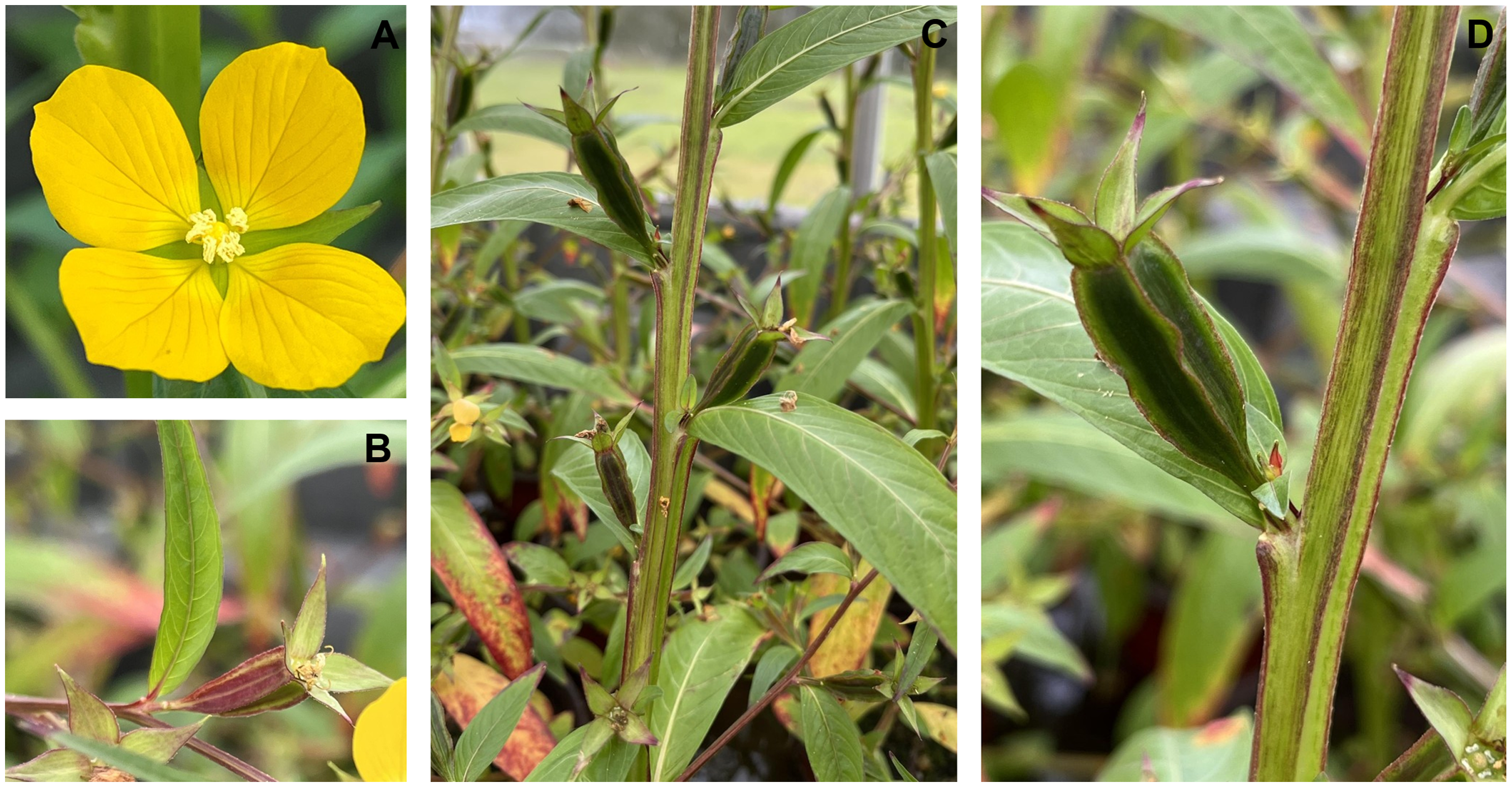
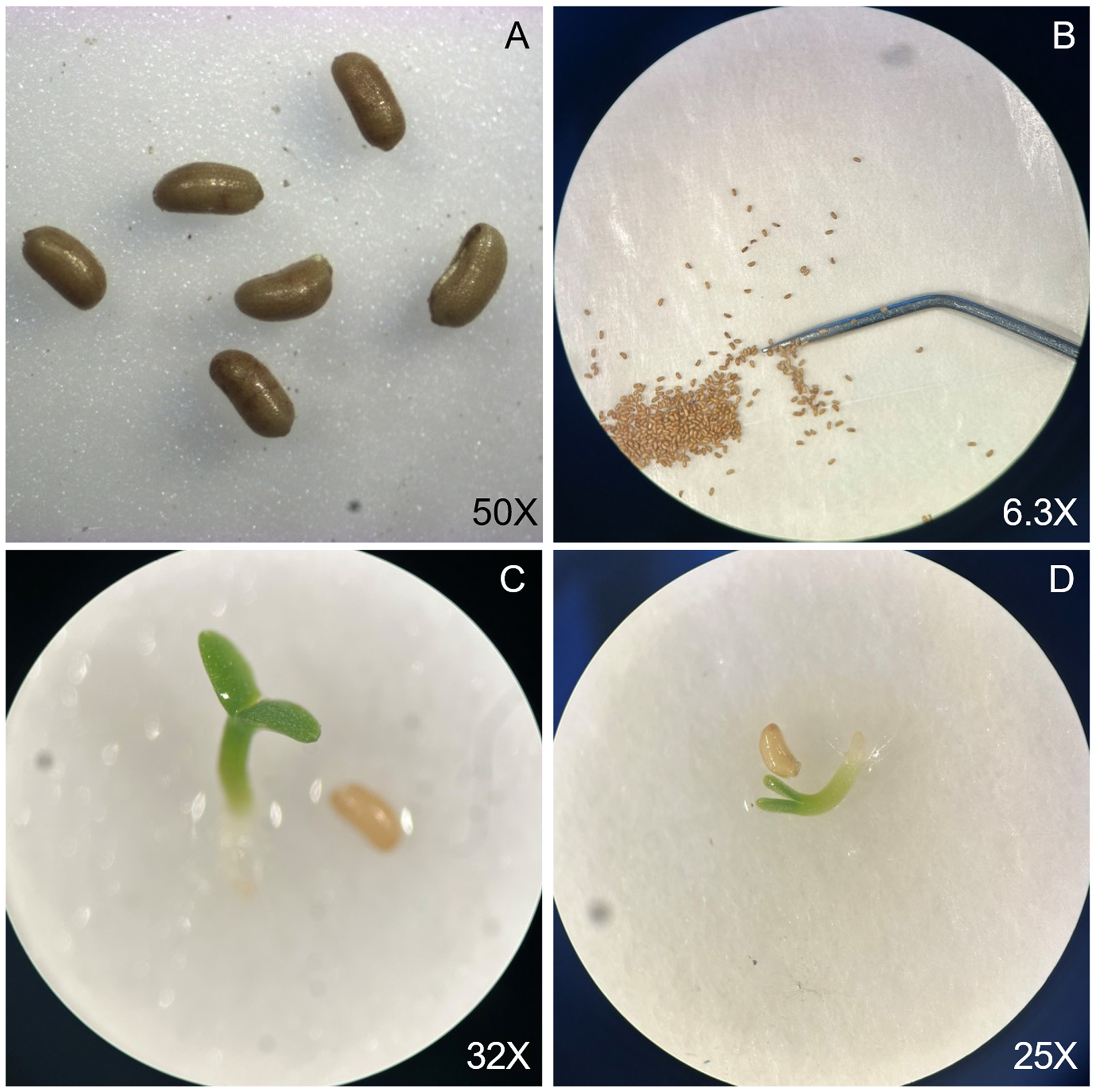
Ludwigia decurrens has simple, lanceolate to elliptical, alternate leaves that are sessile. Each leaf contains 12 to 15 main veins on each side of the mid-rib with a prominent submarginal vein (Chandrasena Reference Chandrasena1988). The most notable characteristic is four-angled and four-winged stems that extend into the decurrent leaf base (Chandrasena Reference Chandrasena1988; Wagner et al. Reference Wagner, Hoch and Raven2007). Petals are 10- to 20-mm long and 1.5- to 4-mm wide; sepals are 7- to 12-mm long and 10- to 18-mm wide. The fruit is a 1- to 4-cm-long four-sided obconical capsule on a pedicel. Leaves and capsules range from green to reddish brown in color (Figure 5). Seeds are 0.3- to 0.4-mm-long pale brown obovoids (Figure 6). Oziegbe et al. (Reference Oziegbe, Faluyi and Oluwaranti2010) mention a second variety of L. decurrens in Nigeria with five-angled stems as the dominant variety, but this does not appear to be widely observed in other species descriptions (Chandrasena Reference Chandrasena1988; Smith et al. Reference Smith, Flinchum and Seaman1977; Wagner et al. Reference Wagner, Hoch and Raven2007).
Ludwigia decurrens flower (A) and capsules (B–D) grown in a greenhouse from collected seed.

Ludwigia decurrens seed (A and B), first cotyledon stage (C), and radicle stage (D).

Ludwigia hexapetala and L. peploides commonly occur in similar environments of Northern California, and identification of L. decurrens could be confused with these species. Ludwigia peploides can be distinguished by glabrous to villous stems, deltate bracteoles, oblong to elliptic leaf blades on petioles of 0.2 to 6 cm in length, while L. decurrens lacks petioles (Grewell et al. Reference Grewell, Netherland and Skaer Thomason2016). Petals are similarly sized to those of L. decurrens (7- to 24-mm long) and capsules are 10- to 40-mm long (Grewell et al. Reference Grewell, Netherland and Skaer Thomason2016). Ludwigia hexapetala has glabrous floating stems to densely villous emergent stems including villous sepals and capsules. Petioles are 0.5 to 2.5 cm and capsules 11 to 30 mm in length (Grewell et al. Reference Grewell, Netherland and Skaer Thomason2016). Ludwigia hexapetala also typically has five to six petals, and the largest petals (20 to 30 mm) of the Ludwigia species mentioned (Grewell et al. Reference Grewell, Netherland and Skaer Thomason2016).
Management Concerns
Limited peer-reviewed and published data are currently available regarding L. decurrens, although some inferences about plant biology and impacts to agriculture may also be taken from other Ludwigia species. Ludwigia species can spread via rhizomatous growth in addition to fragmentation and seed dispersal, forming dense stands that expand and contract while also competing with other species and altering the environment (Grewell et al. Reference Grewell, Netherland and Skaer Thomason2016; Thouvenot et al. Reference Thouvenot, Haury and Thiébaut2013). Ludwigia hexapetala and L. peploides exhibit seasonal and environmental plasticity, changing growth forms and phenology particularly in response to hydrological conditions (Drenovsky et al. Reference Drenovsky, Reicholf, Futrell, Gallego-Tévar and Grewell2025; Skaer Thomason et al. Reference Skaer Thomason, Grewell and Netherland2018; Thouvenot et al. Reference Thouvenot, Haury and Thiébaut2013). This plasticity can contribute to spread and invasive potential as well as impact management efforts; foliar herbicide efficacy has been shown to be influenced by water level, but the impact that morphological differences can have on management has not been fully investigated (Enloe et al. Reference Enloe, Prince, Banu and Lauer2020; Grewell et al. Reference Grewell, Netherland and Skaer Thomason2016).
Crude extracts from L. decurrens have exhibited allelopathic effects on rice, heartshape false pickerelweed [Monochoria vaginalis (Burm. F.) C. Presl ex Kunth], and barnyardgrass [Echinochloa crus-galli (L.) P. Beauv.] although the correlation to allelopathic effects in situ has not been investigated (Kato-Noguchi and Kato Reference Kato-Noguchi and Kato2024). Similarly, extracts from L. decurrens have antibacterial and antifungal properties that may also impact soil microbiomes in infested areas (Oyedeji et al. Reference Oyedeji, Oziegbe and Taiwo2011). Ludwigia species, including L. decurrens, compete with rice, interfere with harvesting, contaminate seed, and impede water delivery in ditches and canals (Dharmaratne and Ranamukaarachchi Reference Dharmaratne and Ranamukaarachchi1991; Smith et al. Reference Smith, Flinchum and Seaman1977). As few as 4 L. decurrens m−2 can negatively impact rice dry weight, panicle length and number, and yield depending on the season (Dharmaratne and Ranamukaarachchi Reference Dharmaratne and Ranamukaarachchi1991).
Similar to the gaps in knowledge regarding L. decurrens biology, there is a lack of published information detailing best management practices; often, recommendations group multiple Ludwigia species without regard to unique morphometric characteristics. While some hand-pulling efforts utilizing large crews and continuous activities have proven effective on Ludwigia (Grewell et al. Reference Grewell, Netherland and Skaer Thomason2016; Hussner et al. Reference Hussner, Windaus and Starfinger2016), this is considered less effective in agricultural settings outside organic farming (Smith et al. Reference Smith, Flinchum and Seaman1977). Ludwigia response to mechanical harvesting is mixed, generally relying on integration with other management options such as herbicides, and can result in rapid regrowth (Chandrasena et al. Reference Chandrasena, Pinto and Sim2002; Grewell et al. Reference Grewell, Netherland and Skaer Thomason2016).
The presence of native Ludwigia species, including marsh seedbox [Ludwigia palustris (L.) Elliott] and creeping primrose willow (Ludwigia repens J.R. Forst), coupled with ecologically and horticulturally important species in the Onagraceae family has eliminated several biocontrol candidates that were not host specific to invasive Ludwigia in the United States (Reddy et al. Reference Reddy, Pratt, Grewell, Harms, Cabrera Walsh, Hérnandez, Faltlhauser and Cibils-Stewart2021a, Reference Reddy, Pratt, Grewell, Harms, Cibils-Stewart, Cabrera Walsh and Faltlhauser2021b). Additionally, two of these candidate insect species from Argentina—flea beetle (Lysathia flavipes) and defoliating weevil (Sudauleutes bosqi)—had no larval survivorship on L. decurrens (DaSilva et al. Reference DaSilva, Reddy, Pratt, Friedman, Grewell, Harms, Cibils-Stewart, Walsh, Faltlhauser and Chamorro2022; Reddy et al. Reference Reddy, Pratt, Grewell, Harms, Cibils-Stewart, Cabrera Walsh and Faltlhauser2021b). An endemic fungal pathogen (Colletotrichum gloeosporioides) was identified and was effective at controlling L. decurrens in greenhouse and field trials; however, it was not pursued as a biocontrol or bioherbicide (Boyette et al. Reference Boyette, Templeton and Smith1979).
Few studies have directly investigated herbicide efficacy on L. decurrens, although it has been grouped with other broadleaf weed species in some instances; additionally, not all herbicides can be used in both rice and aquatic systems where L. decurrens has been observed. In rice, Zahan et al. (Reference Zahan, Hossain, Chowdhury, Ali, Ali, Dessoky, Hassan, Maitra and Hossain2021) observed significant decreases in broadleaf weeds, including L. decurrens, with pendimethalin, carfentrazone-ethyl, isoproturon, pyrazosulfuron, pretilachlor, and combinations with bispyribac-sodium. Past informal recommendations have also included 2,4-D, MCPA, paraquat, thiobencarb, and triclopyr (Chandrasena Reference Chandrasena1988; Eckert and Fischer Reference Eckert and Fischer2012; Smith et al. Reference Smith, Flinchum and Seaman1977). Several of these herbicides are not registered for use in rice or aquatic systems in California, and those that are registered may have special considerations, including holding times, maximum use rates, plant growth stage, and reapplication restrictions.
In aquatic systems 2,4-D, carfentrazone-ethyl, flumioxazin, glyphosate, imazapyr, imazamox, and triclopyr have proven effective in L. hexapetala management (Caudill et al. Reference Caudill, Madsen and Pratt2021; Emerine et al. Reference Emerine, Richardson, True, West and Roten2010; Enloe et al. Reference Enloe, Prince, Banu and Lauer2020; Grewell et al. Reference Grewell, Netherland and Skaer Thomason2016). Floating primrose-willow [Ludwigia peploides (Kunth) P.H. Raven ssp. glabrescens (Kuntze) P.H. Raven] has also been shown to be controlled by 2,4-D, glyphosate, imazamox, imazapyr, and triclopyr (Sartain et al. Reference Sartain, Wersal, Madsen and Cheshier2015). Sartain et al. (Reference Sartain, Wersal, Madsen and Cheshier2015) observed that penoxsulam was not effective on L. peploides ssp. glabrescens, and suspected penoxsulam resistance has been reported in L. decurrens in Indonesia, with plants surviving and producing viable seed at four times the maximum label rate (Kurniadie et al. Reference Kurniadie, Widianto, Widayat, Umiyati, Nasahi and Kato-Noguchi2021). Research is needed to identify effective management options in rice and aquatic systems.
Many questions remain pertaining to the spread and negative impacts L. decurrens may have on California agriculture and the threat it poses to other economic and environmental resources. The spread to adjoining and disjunct counties is concerning, with the exact method of spread between geographic locations unknown, although infested seed, equipment, or rice straw are the most likely. The observed spread within Butte County, recent observations in Placer County, and detections upstream on the Sacramento River in Butte and Tehama counties all indicate that coordinated efforts between state, federal, and local agencies, as well as growers and other management professionals, are needed to prevent further establishment of this weed that threatens aquatic and agricultural systems. Identifying management strategies, researching the biology and ecology of L. decurrens, and developing best management practices should be prioritized.
Acknowledgments
The authors thank Sonia Zarate, Louie Mendoza, and other members of the Butte County Department of Agriculture, Lianne Huber, Mackenzie McConnell, Consuelo Baez Vega, Victor Barragan Jr, and Taiyu Guan. Citation of trade names does not constitute endorsement or approval of the use of such commercial products. The content of this work does not necessarily reflect the position or policy of the U.S. government, and no official endorsement should be inferred. United States Department of Agriculture is an equal opportunity employer and provider.
Funding statement
The study was funded by USDA-ARS internal funding, the California Rice Research Board, and the California Rice Commission.
Competing interests
The author(s) declare no conflicts of interest.

 Open access

