Over the past decades there has been increased interest in the relationship between the work and family domains (DiRenzo, Greenhaus, & Weer, Reference DiRenzo, Greenhaus and Weer2011; Eby, Casper, Lockwood, Bordeaux, & Brinley, Reference Eby, Casper, Lockwood, Bordeaux and Brinley2005). This research sets out to better understand the complexity of work–family dynamics in order to design multidisciplinary interventions that help employees conciliate these two important contexts of their lives. Positive and negative perspectives have shaped the literature on the work and family relationship (Mullen, Kelley, & Kelloway, Reference Mullen, Kelley, Kelloway, Korabik, Lero and Whitehead2008). The majority of studies have focused on the analysis of these constructs separately. More specifically, the work-family conflict (WFC) is defined as “a form of inter-role conflict in which the role pressures from the work and family domains are mutually incompatible in some respect” (Greenhaus & Beutell, Reference Greenhaus and Beutell1985, p. 77). In turn, a positive perspective has shown that experiences in one role can improve the quality of life in the other role, and on this positive side the most distinct concept in terms of its consistency and empirical value is work-family enrichment (WFE) (Greenhaus & Powell, Reference Greenhaus and Powell2006). More recently, studies have considered WFC and WFE as independent constructs that may occur simultaneously (e.g., Demerouti & Geurts, Reference Demerouti and Geurts2004; Frone, Reference Frone, Quick and Tetrick2003; Grzywacz, Butler, & Almeida, Reference Grzywacz, Butler, Almeida, Marcus-Newhall, Halpern and Tan2008; Rantanen, Reference Rantanen2008; Rantanen, Kinnunen, Mauno, & Tillemann, Reference Rantanen, Kinnunen, Mauno, Tillemann, Kaiser, Ringlstetter, Eikhof and Pina e Cunha2011; Rantanen, Kinnunen, Mauno, & Tement, Reference Rantanen, Kinnunen, Mauno and Tement2013). For instance, an employee may have the feeling that the time he/she spends at work gives him/her less time to be with family. Furthermore, the same employee may have the feeling that involvement in his/her work is important to understand different points of view that will help him/ her to be a better family member. A significant step towards understanding how the WFC and WFE interact in the same individual is to consider their integration in a profile (Rantanen et al., Reference Rantanen, Kinnunen, Mauno, Tillemann, Kaiser, Ringlstetter, Eikhof and Pina e Cunha2011, Reference Rantanen, Kinnunen, Mauno and Tement2013), which is the first purpose of this study. We believe that this study might consolidate previous research on WFC and WFE profiles and, in this way, contributes to an integral framework that may help human resources departments to have a holistic view of the work and family balance of employees. Moreover, surprisingly there is little evidence to illustrate possible job characteristics that relate with WFC and WFE profiles. However, Demerouti and Geurts (Reference Demerouti and Geurts2004) examined the relationship of job demands (i.e., work pressure, physical, mental, and emotional demands) and job resources (i.e., job control and social support) with work-family profiles and observed that employees who mainly reported a negative work-family relationship perceived more job demands, while the employees who mainly reported a positive work-family relationship perceived more job resources. In fact, up to now, studies related job characteristics with WFC or with WFE (e.g., Byron, Reference Byron2005; Carvalho & Chambel, Reference Carvalho and Chambel2014), and it is important to identify the job characteristics these relationships with profiles (Rantanen et al., Reference Rantanen, Kinnunen, Mauno and Tement2013). Our study has used the recognized Job-Demand-Control-Support model (JDCS; Karasek & Theorell, Reference Karasek and Theorell1990) to select job demands, job autonomy and job support, as possible correlates with work-to-family profiles.
Thirdly, we aim to test the relationship of the work-to-family conflict and enrichment profiles with well-being at work and general well-being, which can offer extensive evidence on the relationship of these profiles with employees’ well-being. More specifically, we have analyzed well-being at work (i.e., burnout and engagement) and general well-being (i.e., health perceptions and satisfaction with life). Evidence of an analysis of the relationship between these profiles and employees’ well-being was also revealed in previous studies (e.g., Rantanen et al., Reference Rantanen, Kinnunen, Mauno, Tillemann, Kaiser, Ringlstetter, Eikhof and Pina e Cunha2011, Reference Rantanen, Kinnunen, Mauno and Tement2013). In general, these studies included vigor at work, job exhaustion, psychological strain and life satisfaction as well-being variables, and their conclusions indicated that the profiles with a higher prevalence of work-family enrichment presented more vigor at work, less job exhaustion, less psychological strain and more life satisfaction. In turn, the profiles where the work-family conflict was dominant presented a tendency towards the contrary, namely less well-being.
Taken together, this study contributes to the JDCS literature by explaining how job characteristics can be related to the presence of work-to-family profiles. Additionally, it explores different combinations of WFC and WFE experiences and how these combinations are related to well-being. Finally, it examines the potential buffering effect that WFE can have on the effects of WFC.
Study hypotheses
WFE and WFC profiles
Rantanen et al. (Reference Rantanen, Kinnunen, Mauno and Tement2013) tested a four-dimensional theoretical typology of work-family balance that had previously been proposed (Demerouti & Geurts, Reference Demerouti and Geurts2004; Grzywacz et al., Reference Grzywacz, Butler, Almeida, Marcus-Newhall, Halpern and Tan2008; Rantanen, Reference Rantanen2008; Rantanen et al., Reference Rantanen, Kinnunen, Mauno, Tillemann, Kaiser, Ringlstetter, Eikhof and Pina e Cunha2011). More specifically, the four dimensions of this typology are as follows: Beneficial (high WFE and Family-to-Work Enrichment [FEW]) and low WFC and Family-to-Work Conflict (FWC); Active (high WFE, FWE, WFC and FWC); Harmful (low WFE and FWE and high WFC and FWC) and Passive (low WFE, FEW, WFC and FWC). However, an empirical test of this typology (Rantanen et al., Reference Rantanen, Kinnunen, Mauno and Tement2013) identified only two (i.e., Beneficial and Active) of the four theoretical profiles and another profile, labeled Contradictory; in this profile WFC is high, WFE is low, FWC is low and FWE is high. However, because our study focused on the work-to-family direction, we were not able to analyze the presence of this new contradictory type. Thus, our assumption is based on previous studies that support the existence of four work-to-family balance profiles (e.g., Rantanen et al., Reference Rantanen, Kinnunen, Mauno, Tillemann, Kaiser, Ringlstetter, Eikhof and Pina e Cunha2011).
More specifically, we expect that it might be possible to observe the presence of a profile where the WFE is weak and WFC is dominant (Harmful profile). Our expectation is grounded on the negative spillover effects as postulated by Lambert (Reference Lambert1990), in that demands in the work domain evoke a conflict that is transferred to the family domain. On the other hand, role expansion theories (Sieber, Reference Sieber1974) argue that having multiple roles is beneficial for the individual. Theorists who hold this position believe that the positive effects of having a strong engagement in both paid work and family life outweigh the possible stressful effects on well-being. The positive spillover hypothesis (Lambert, Reference Lambert1990) asserts that these positive effects are also transferred to the family domain. Thus, it would also be possible to observe the presence of a profile where WFE is dominant and the WFC is weak (Beneficial profile). Moreover, the segregation hypothesis (Lambert, Reference Lambert1990) asserts that the domains are separate and activities in each domain are assumed to make unique demands on the individual. Rantanen et al. (Reference Rantanen, Kinnunen, Mauno, Tillemann, Kaiser, Ringlstetter, Eikhof and Pina e Cunha2011, Reference Rantanen, Kinnunen, Mauno and Tement2013) argued that it is possible for employees to present low engagement and high indifference across both domains; thus, it is possible that a profile emerge with weak WFC and weak WFE (Passive profile). Finally, according to the theory of role balance defended by Marks and MacDermid (Reference Marks and MacDermid1996) a profile with high WFE and high WFC (Active profile) may also emerge. This theory argues that individuals act across roles with different engagement levels. Therefore, individuals may be engaged in work and family roles as they want to succeed and /or are under obligation, or rather, have to deal with the demands of these roles (Rantanen et al., Reference Rantanen, Kinnunen, Mauno, Tillemann, Kaiser, Ringlstetter, Eikhof and Pina e Cunha2011). Thus, they may have to face high demands and high resources and simultaneously have high WFE and high WFC.
Therefore, based on previous findings, our first hypothesis is established as follows:
H1: Four different WFC and WFE profiles will emerge: (1) a Harmful profile where the WFC will be dominant; (2) a Beneficial profile where the WFE will be dominant; (3); a Passive profile where the WFE and WFC will be low, (4) a Active profile where the WFE and WFC will be high.
Job characteristics and WFE and WFC profiles
The Job Demand-Control-Support model (JDCS; Karasek & Theorell, Reference Karasek and Theorell1990) is considered to be the most extensively tested and empirically validated model for understanding employees’ well-being (van der Doef & Maes, Reference van der Doef and Maes1999). This model postulates that the presence of low job demands, high job control/autonomy, and high job support results in reduced strain and high well-being. In contrast, the presence of high job demands, low job autonomy, and low job support results in high strain and low well-being (van der Doef & Maes, Reference van der Doef and Maes1999). Along with the JDCS model (Karasek & Theorell, Reference Karasek and Theorell1990), the Job-Demands-Resources model (Demerouti, Bakker, Nacheiner, & Schaufeli, Reference Demerouti, Bakker, Nachreiner and Schaufeli2001; Schaufeli & Bakker, Reference Schaufeli and Bakker2004), the Siegrist’s (Reference Siegrist1996) Effort-Reward Imbalance model, the vitamin model (Warr, Reference Warr1987), and the Conservation of Resources Theory (Hobfoll, Reference Hobfoll2002) also acknowledged that well-being results from a balance between positive (resources) and negative (demands) job characteristics.
Job demands are usually characterized in terms of quantitative aspects such as workload and time pressure (van der Doef & Maes, Reference van der Doef and Maes1999). Job control/autonomy refers to decision authority (i.e., the extent to which an employee is autonomous in task-related decisions such as timing and method control; Häusser, Mojzisch, Niesel, & Shulz-Hardt, Reference Häusser, Mojzisch, Niesel and Schulz-Hardt2010). Job support is characterized by helpful social interactions with supervisors (Karasek & Theorell, Reference Karasek and Theorell1990).
Several studies have analyzed the relationship between these job characteristics and the work-to-family relationship. Thus, job demands have been frequently related to increased WFC; i.e., greater time and energy demands in the work context result in increased interference in the family context (Byron, Reference Byron2005; Michel, Kotrba, Mitchelson, Clark, & Baltes, Reference Michel, Kotrba, Mitchelson, Clark and Baltes2011). Valcour, Ollier-Malaterre, Matz-Costa, and Brown (Reference Valcour, Ollier-Malaterre, Matz-Costa, Pitt-Catsouphes and Brown2011) postulate that greater job demands are associated with reduced perceptions of organizational support for work-life integration. Thus, job demands may be seen as a job characteristic that contributes to the WFC and does not promote employees’ skills to enrich the family domain of their lives.
In contrast, job autonomy and supervisor support seem to be strongly linked to a positive work-to-family relationship; i.e., autonomy and supervisor support are job characteristics that enrich the work domain and provide resources that help employees be better family members (Carvalho & Chambel, Reference Carvalho and Chambel2014). Therefore, literature on WFE has demonstrated that job autonomy is relevant to creating positive load effects in the forms of motivation, energy and new skills or attitudes that could be transferred to the family domain (Greenhaus & Powell, Reference Greenhaus and Powell2006). Literature has also established a link between positive supervisor support and WFE. For instance, Carvalho and Chambel (Reference Carvalho and Chambel2014) also analyzed the relationship of these specific aspects of the JDCS model and demonstrated that job demands were negatively related to WFE, whereas job autonomy and supervisor support were positively related to WFE. Moreover, these characteristics (i.e., job autonomy and job support) were negatively related to WFC (Byron, Reference Byron2005).
Additionally, Demerouti and Geurts (Reference Demerouti and Geurts2004) conducted a cluster analysis where analyzed the relationship between work-home profiles and perceived job characteristics based on the Job Demand-Control Model (Karasek, Reference Karasek1979). They showed that while employees who experienced negative interaction between work and home perceived their job conditions as less favorable (i.e., high job demands - work pressure, physical, mental, and emotional demands - and low job resources - job autonomy, supervisor support, and career opportunities), while employees who had a positive interaction between work and family had the most favorable perceptions of their job conditions (i.e., low job demands and high job resources).
Therefore, we expect that employees who perceived high WFE and WFC to also be the employees who perceive the presence of high job demands, high job autonomy, and high job support. Employees who perceived low WFE and WFC were the employees that perceived low job demands, low job autonomy and low job support.
Thus, we established:
H2: The Beneficial profile will be associated with the lowest job demands and the highest job autonomy and job support; in contrast, the Harmful profile will be associated with the highest job demands and the lowest job autonomy and job support.
H3: The Active profile will be associated with higher job autonomy, job support and job demands than the Passive profile.
WFE and WFC profiles and the well-being at work
Burnout and engagement are considered the negative and positive states experienced at work related to mental well-being and health. Work engagement is defined as positive, fulfilling, in a work-related state of mind that is characterized by vigor, dedication and absorption (Schaufeli, Bakker, & Salanova, Reference Schaufeli, Bakker and Salanova2006). Vigor is translated as high levels of energy and mental resistance as well as the desire and capacity to invest effort in work. Dedication is a feeling of relevance, enthusiasm, inspiration, pride and challenge directed towards work. Absorption is a sense of being fully concentrated and happily engrossed in one’s work, so that time passes quickly and detaching oneself from work may seem difficult. Despite work engagement having originally been presented to include these three dimensions, empirical studies have shown that vigor and dedication are its core dimensions (Llorens, Bakker, Schaufeli, & Salanova, Reference Llorens, Bakker, Schaufeli and Salanova2007). Burnout is a reaction to chronic occupational stress characterized by emotional exhaustion (i.e., the draining of emotional resources), cynicism (i.e., a negative, callous, and cynical attitude towards one’s job) and lack of professional efficacy (i.e., the tendency to evaluate one’s work negatively) (Maslach, Reference Maslach2003). However, empirical studies have shown that the core of burnout consists of emotional exhaustion and cynicism (Schaufeli & Buunk, Reference Schaufeli, Buunk, Schabracq, Winnubst and Cooper2003). Therefore, in this study work engagement and burnout were measured using only the two core dimensions.
Work-to-family research has geared its studies towards examining the relationships of the WFE and the WFC with well-being (Mullen et al., Reference Mullen, Kelley, Kelloway, Korabik, Lero and Whitehead2008). The WFE is frequently related to positive work outcomes: job satisfaction, affective commitment (McNall, Nicklin, & Masuda, Reference McNall, Nicklin and Masuda2009). In contrast, the WFC has negative consequences for well-being at work (Amstad, Fasel, Elfering, & Semmer, Reference Amstad, Meier, Fasel, Elfering and Semmer2011). For instance, Allen, Herst, Bruck, and Sutton (Reference Allen, Herst, Bruck and Sutton2000) related the WFC to burnout and psychological strain while Fiksenbaum (Reference Fiksenbaum2014) related the WFC to less engagement at work.
Previous studies that analyzed the simultaneousness of WFE and WFC concluded that profiles with high work-family enrichment and low work-family conflict had high vigor and low exhaustion (Rantanen et al., Reference Rantanen, Kinnunen, Mauno, Tillemann, Kaiser, Ringlstetter, Eikhof and Pina e Cunha2011, Reference Rantanen, Kinnunen, Mauno and Tement2013).
Therefore, based on previous studies, we state the following:
H4: The Beneficial profile will be associated with highest vigor and dedication and lowest exhaustion and cynicism; in contrast, the Harmful profile will be associated with lowest vigor and dedication and the highest exhaustion and cynicism.
H5: The Active profile will be associated with higher vigor and dedication and higher exhaustion and cynicism than the Passive profile.
Additionally, Greenhaus and Powell (Reference Greenhaus and Powell2006) argued that WFE should buffer the negative outcomes of high conflict. However, the study of Grzywacz and Bass (Reference Grzywacz and Bass2003) analyzed the presence of this interaction effect (or buffering) and concluded that its presence was somewhat dependent on the studied outcomes. Our aim is to analyze whether the WFE buffers the negative consequences of the WFC (i.e., burnout) and maintains the presence of positive work well-being outcomes (i.e., engagement). Hence, we expect WFC and WFE profiles to predict well-being at work. We state the following:
H6: The Active profile will show higher vigor and dedication and lower exhaustion and cynicism than the Harmful profile.
WFE and WFC profiles and the general well-being
The literature provides evidence that the work-family balance has consequences for well-being outside the work context (Allen et al., Reference Allen, Herst, Bruck and Sutton2000; Amstad et al., Reference Amstad, Meier, Fasel, Elfering and Semmer2011; McNall et al., 2010). Thus, it is well established that the WFE is positively related to general well-being (see meta-analysis by McNall et al., 2010). In contrast, employees who report high WFC are less satisfied with their lives (Fiksenbaum, Reference Fiksenbaum2014) and present adverse health and physical outcomes (Amstad et al., Reference Amstad, Meier, Fasel, Elfering and Semmer2011). This is in keeping with the premise that participation in multiple roles can buffer the negative effects of one role on the other (e.g., Sieber, Reference Sieber1974). Moreover, the presence of WFE can generate resources that may be essential for coping with stress-related variables (Greenhaus & Powell, Reference Greenhaus and Powell2006). In this vein, the Rantanen et al. (Reference Rantanen, Kinnunen, Mauno, Tillemann, Kaiser, Ringlstetter, Eikhof and Pina e Cunha2011) study showed that the highest well-being was presented in profiles in which the WFE was dominant and profiles where the WFC was dominant presented the lowest well-being.
Consequently, it was hypothesized that:
H7: The Beneficial profile will be associated with the highest general well-being (i.e., satisfaction with life and health perceptions); in contrast, the Harmful profile will be associated with the lowest general well-being.
H8: The Active profile will be associated with higher general well-being (i.e., satisfaction with life and health perceptions) than the Passive profile.
In keeping with our hypothesis 6, we also expect that the interactive or buffering effect to be present in relation to the general well-being. We state the following:
H9: The Active profile will show higher general well-being (i.e., high satisfaction with life, good health perceptions) than the Harmful profile.
Method
Sample
All the employees from different branches of a Portuguese bank were invited to fill a questionnaire. In total of 3924 employees invited to answer the questionnaire, the final number of participants was 1885 (48.03%). The roles of the participants were as follows: managerial (N = 725, 38.4%), administrative (N = 305, 16.2%), commercial (N = 306, 16.3%), technical (N = 361, 19.1%), and other job positions (N = 188, 10%). Over half of the respondents were male (N = 1083 = 57%). The majority of participants work in the bank between 5 and 10 years. The respondents completed an online questionnaire and were assured of the anonymity of their answers and their opportunity to receive feedback.
Measures
Work-to-family enrichment was measured using a Portuguese version of a 9-item scale (Carlson, Kacmar, Wayne, & Grzywacz, Reference Carlson, Kacmar, Wayne and Grzywacz2006) (e.g., “My involvement with my work helps me to understand different viewpoints, and this helps me be a better family member”). This scale has previously been used in Portugal (Carvalho & Chambel, Reference Carvalho and Chambel2014). The items were answered on a five-point rating scale that ranged from “totally disagree” (1) to “totally agree” (5). In order to examine the psychometric properties of the measure, we performed a Confirmatory Factor Analysis (CFA) with a one factor model and observed that this measure showed an acceptable fit to the data (χ2(25) = 858.97, p < .001; CFI = .94; TLI = .92; RMSEA = .07). With regard to factor loadings, the standardized coefficient estimates were between .64 and .90, which is above the acceptable level of .30 (< .30 shows convergent validity but not satisfactory) with a p-value of < .001. The coefficient alpha for this measure was .94.
The Work-to-family conflict was measured using a Portuguese version of the extended 15-item scale of Carlson, Kacmar, and Williams (Reference Carlson, Kacmar and Williams2000) (e.g., “After work, I am too tired when I come home to do some of the things I’d like to do”). Items were answered on a five-point rating scale that ranged from “hardly ever” (1) to “almost always” (5). In order to examine the psychometric properties of the measure we performed a CFA with a one factor model, and observed that this measure showed an acceptable fit to the data (χ2(85) = 1521.74, p > .001; CFI = .93; TLI = .92; RMSEA = .08). With regard to factor loadings, the standardized coefficient estimates were between .44 and .85. The coefficient alpha for this measure was .92.
Job characteristics were measured using the Job Content Questionnaire (Karasek et al., Reference Karasek, Brisson, Kawakami, Houtman, Bongers and Amick1998). Subscales included workload and time pressure (7 items; e.g., “I have too much to do”) and autonomy (4 items; e.g., “I have the opportunity to decide how to organize my work”). Items were scored on a five-point rating scale that ranged from “totally disagree” (1) to “totally agree” (5). The coefficient alpha for this measure was .87 for workload and time pressure and .81 for autonomy. Supervisor support was measured using a seven-item scale developed by Scandura and Graen (Reference Scandura and Graen1984), which has previously been used in Portugal (Carvalho & Chambel, Reference Carvalho and Chambel2014) (e.g., “My supervisor understands my problems and needs”). The items were scored on a seven-point rating scale that ranged from “totally disagree” (1) to “totally agree” (7). The coefficient alpha for this measure was .94.
Well-being at work was measured with the assessment of work engagement and burnout. Work engagement was measured with a Portuguese version of a scale (Schaufeli et al., Reference Schaufeli, Bakker and Salanova2006) that included vigor (3 items; e.g., “When I wake up in the morning, I feel good about going to work”) and dedication (3 items; e.g., “My work inspires me”). In order to examine the psychometric properties of the measure, we performed a CFA with a two factor model (vigor; dedication) and observed that this measure showed an acceptable fit to the data (χ2(8) = 233.63, p < .001; CFI = .97; TLI = .95; RMSEA = .05). With regard to factor loadings, the standardized coefficient estimates were between .70 and .92. The coefficient alpha for this measure was .87 for vigor and .85 for dedication.
Burnout was assessed using a Portuguese version of a scale (Maslach, Jackson, & Leiter, Reference Maslach, Jackson and Leiter1996) that included exhaustion (5 items; e.g., “I feel emotionally drained by my work”) and cynicism (5 items; e.g., “I question the significance of my work”). Respondents answered the items of both subscales on a seven-point scale that ranged from “never” (1) to “every day” (7). In order to examine the psychometric properties of the measure, we performed a CFA with a two factor model and observed that this measure showed an acceptable fit to the data (χ2(31) = 379.54, p < .001; CFI = .97; TLI = .96; RMSEA = .08). With regard to factor loadings, the standardized coefficient estimates were between .70 and .92. The coefficient alpha for this measure was .91 for exhaustion and .81 for cynicism.
General well-being was measured with the assessment of satisfaction with life and health perceptions. Satisfaction with life was assessed with the 5-item scale of Diener, Emmons, Larsen, and Griffin (Reference Diener, Emmons, Larsen and Griffin1985), which has previously been used in Portugal (Carvalho & Chambel, Reference Carvalho and Chambel2014) (e.g., “I am satisfied with my life”). Items were scored on a seven-point rating scale that ranged from “totally disagree” (1) to “totally agree” (7). The coefficient alpha for this measure was .88. A health perceptions questionnaire developed by Ware, Davies-Avery, and Donald (Reference Ware, Davies-Avery and Donald1978) was used to assess health perceptions. The scale is composed of 4-items (e.g., “My health is excellent”). Items were rated on a five-point rating scale that ranged from “definitely false” (1) to “definitely true” (5). This scale has previously been used in Portugal (Carvalho & Chambel, Reference Carvalho and Chambel2014). The coefficient alpha for this measure was .91.
Statistical analyses
Data analyses involved four phases. In the first phase, since this study used self-reported measures, we considered the recommendation of Podsakoff, MacKenzie, Podsakoff, and Lee (Reference Podsakoff, MacKenzie, Podsakoff and Lee2003) to test the error of common method variance, applying the test of single factor Harman, and performing a Confirmatory Factor Analysis of the studied variables. The model fit was assessed using relative and absolute indices. The following were used as absolute indices: (1) the chi-square goodness-of-fit test, (2) the Root Mean Square Error of Approximation (RMSEA). As the chi-square is sensitive to sample size, the calculation of relative index is strongly recommended (Bentler, Reference Bentler1990) and therefore we calculated: (1) the Tuckler Lewis Index (TLI) and (2) Comparative Fit Index (CFI). Values close to .08 for RMSEA are considered indicators of an acceptable fit, and values lower than .08 are considered indicators of a good fit model. On the other hand, for TLI and CFI, values greater than .90 are indicative of a good model fit (Hoyle, Reference Hoyle and Hoyle1995).
In the second phase, we conducted Latent Profile Analysis (LPA) using the maximum likelihood estimator of MPlus V7 (Muthén & Muthén, 1998–2012) to identify latent WFE and WFC profiles. LPA uses latent categorical variables to identify groups of individuals with similar patterns of scores within a set of variables. Following Nylund, Asparouhov, and Muthen (Reference Nylund, Asparouhov and Muthen2007), the optimal number of profiles was determined through an iterative process in which a two-profile model was estimated, and successive profiles were subsequently added. Each model was evaluated using the following criteria: (a) Log likelihood, (b) the Bayesian information criterion (BIC; Sclove, Reference Sclove1987), (c) entropy, and (d) the Lo-Mendell-Rubin adjusted likelihood radio test (LMR). The optimal solution should exhibit the following characteristics: (a) the lowest log likelihood value, (b) the lowest BIC (the BIC is used to select the model with the best fit and fewest parameters from a set of non-hierarchical models) and (c) the highest entropy value. Additionally, comparing neighboring profiles’ LMR against each other should yield significant p-value that indicates improvements in model fit as the number of profiles is successively incremented. The average latent class probabilities for each participant’s most likely latent profile membership is another criterion that may be considered. In accordance with Geiser (Reference Geiser2013), values close to 1 indicate a high precision or reliability of classification. Hence, high values in class probabilities mean that individuals, on average, are classified with high certainty into their most likely latent class. In contrast, moderate or low values indicate that there is a high uncertainty of the class assignment. Rost (Reference Rost, Petermann and Eid2006) recommended that the values on the main diagonal should be .80 or larger for a good profile solution.
In the third phase, we conducted one-way analyses of variance (ANOVAs) and paired sample t-tests to evaluate the uniqueness of the profiles generated by the LPA.
The fourth phase of the analysis was undertaken to test our hypotheses regarding differences in WFE and WFC profiles and job characteristics (i.e., job demands, autonomy and support). We conducted one-way ANCOVAs that controlled for gender, tenure, and job position, followed by post hoc comparisons using profiles as the independent variable. Separate analyses were conducted for each profile and each job characteristic. Gender, tenure and job position were included as control variables because these variables exhibited significant, albeit weak, correlations with some of criterion variables and were found to differ across profiles and, thereby, provide possible alternative explanations for our findings. The same analyses were conducted to test our hypotheses regarding WFC and WFE profiles and well-being at work and general well-being.
Results
Confirmatory factor analysis
The hypothesized 9-factor model (job autonomy, job demands, supervisor support, work-to-family enrichment, work-to-family conflict, burnout (exhaustion, cynicism), work engagement (dedication, vigor); satisfaction with life, and health perceptions, showed an acceptable fit (χ2(1393) = 7 955.74, p > .001; CFI = .92; TLI = .91; RMSEA = .05), better than the one-factor model (Δχ2(21) = 25 059.74, p < .001) in which all items were loaded on a single latent variable (χ2(1414) = 33 015.48, p < .001, CFI = .61, TLI = .59; RMSEA = .11).
Overall, the means, standard deviations and correlations were consistent with the theorized pattern of relationships (Appendix).
WFE and WFC profiles
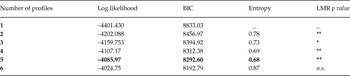
One-to six-profile solutions to identify latent WFE and WFC profiles with the LPA (Muthén & Muthén, 1998–2012) were performed. The fit of the four-profile solution to the data should have been better than the other fits (i.e., the one-, two-, three-, five-, and six-profile solutions). However, the LPA revealed that the five-profile solution provided the best fit (see Table 1). Despite the BIC presented in the six-profile solution being the lowest in comparison with the other solutions, the five-profile solution showed statistically significant improvement in model fit in comparison to six-profile solution (p < .001) while the six-solution did not produce statistically significant improvement in model fit in comparison to the five-profile solution (p < .40). The average latent class probabilities from the main diagonal are: .87 for the first profile; .77 for the second profile; .83 for the third profile; .73 for the fourth profile and .74 for the fifth profile. Despite the second, the fourth and fifth profiles did not reach the .80 profile solution, the probabilities of the individual belonging to other profiles was very low. Furthermore, in the six-solution emerged a profile with only 21 individuals that represent only 1.11% of the sample. Additionally, on the one hand we verify that the two-, three- and four- profile solutions did not capture all the WFC and WFE possible interactions and on the other hand the six-profile solution did not add any new interaction. Hence, we decided that the five-profile solution was the best one.
Fit indices for the five estimated solutions of the latent profile analyses for each sample

Notes: **p < .001; *p < .05; n.s. = non-significant.
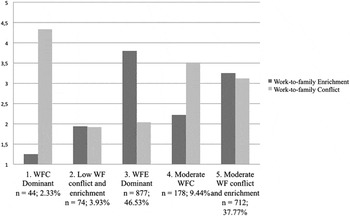
Names assigned to the profiles detected (see figure 1) were based on the results of the ANOVAs, Bonferroni pairwise comparisons and paired sample t-tests (see table 2) and on previous studies that analyzed the work-family balance typology (Demerouti & Geurts, Reference Demerouti and Geurts2004; Grzywacz et al., Reference Grzywacz, Butler, Almeida, Marcus-Newhall, Halpern and Tan2008; Rantanen, Reference Rantanen2008; Rantanen et al., Reference Rantanen, Kinnunen, Mauno, Tillemann, Kaiser, Ringlstetter, Eikhof and Pina e Cunha2011; Rantanen et al., Reference Rantanen, Kinnunen, Mauno and Tement2013). We identified a Harmful profile where WFC was dominant (n = 44; 2.33%), a Beneficial profile where WFE was dominant (n = 877; 46.53%), a Passive profile where WFC and WFE were both low (n = 74; 3.93%) and a Moderate Active profile where WFC and WFE both showed moderate values (n = 178; 9.44%). Notwithstanding our expectation that this last profile would have high values, hypothesis 1 was generally supported. Moreover, an additional type, with moderate WFC, Moderate Harmful, was detected (n = 712; 37.77%).
Work-to-Family Conflict and Enrichment Profiles.

Means (M) and standard deviations (SD) for dimensions of work-family interface for the five identified profiles

Notes: WFE = work-to-family enrichment; WFC = work-to-family conflict; a all differences between and within the WFB profiles reported are significant at the level. p< .001. η2 = partial squared eta.
One-way ANCOVAs revealed significant differences among the profiles in job characteristics and well-being variables (see table 3 and 4).
Means (M) and standard deviations (SD) for job characteristics for the five WF conflict and enrichment profiles

Notes: a Covariates included in the ANCOVA model were gender, tenure and job position; b p < .001 for all comparisons; η2 = partial squared eta.
Means (M) and standard deviations (SD) for well-being at work and subjective well-being for the five WF conflict and enrichment profiles

Notes: a Covariates included in the ANCOVA model were gender, tenure and job position; Health Perc. = Health Perceptions; b p < .001 for all comparisons; η2 partial squared eta
Job characteristics and WFE and WFC profiles
In accordance with hypothesis 2, the Beneficial profile exhibited the lowest job demands and the highest job autonomy, and the highest job support. In contrast, the Harmful profile was associated with the highest job demands and lowest job autonomy and the lowest job support. The additional profile identified - Moderate Harmful – was in line with this hypothesis. Thus, in comparison with the Harmful profile, it did not present such high values of job demands, low values of job autonomy and low values of job support. However, job demands remained high and job autonomy and support remained low. Hence, this profile reinforces this hypothesis. Thus, hypothesis 2 was supported.
In hypothesis 3 we postulated that the Active profile and the Passive profile would differ in terms of job demands, job autonomy and job support. Despite not finding a profile where WFE and WFC present high levels (Active profile) we found the Moderate Active profile. Thus, we compared the Moderate Active profile with the Passive profile. We observed that this Moderate Active Profile exhibited higher job demands, job autonomy and supervisor support than the Passive profile. Thus, hypothesis 3 was supported.
Work-to-family enrichment and Work-to-family conflict profiles and the well-being
Well-being at work
In accordance with hypothesis 4, the Beneficial profile presented the highest values of work engagement (i.e., vigor; dedication) and the lowest values of burnout (i.e., exhaustion; cynicism). Moreover, the Harmful profile exhibited the lowest values of work engagement and highest values of burnout. Once more we verified that the Moderate Harmful was in keeping with this hypothesis. Thus, in comparison with the Harmful profile, it did not present such low values of work engagement and high values of job burnout. However, work engagement remained low and burnout remained high. Hence, this profile reinforces this hypothesis. Hypothesis 4 was thus supported.
In hypothesis 5, we established a comparison in terms of well-being at work between the Active and Passive profiles. As previously explained, since an Active profile did not emerge in this sample a comparison was made with the Moderate Active profile. As expected, this Moderate Active profile presented higher exhaustion, vigor and dedication than the Passive profile. However, cynicism was higher in the Passive profile than in the Moderate Active profile. Hence, hypothesis 5 was partially supported.
In hypothesis 6, we predicted that in the Active profile, we would find higher engagement and lower burnout than in the Harmful profile. Once more, although we cannot completely test this hypothesis because we did not find an Active profile, we compared the Moderate Active profile with Moderate Harmful (low WFE and moderate WFC). We found that the Moderate Active profile showed significantly higher values of vigor and dedication and lower values of exhaustion and cynicism than the Moderate Harmful. Therefore, we consider hypothesis 6 to be supported.
General well-being
In accordance with hypothesis 7, the Beneficial profile presented the highest satisfaction with life and health perceptions and the Harmful profile exhibited the lowest satisfaction with life and health perceptions. The Moderate Harmful profile was in conformity with this hypothesis. In comparison with the Harmful profile, it did not present such low values of satisfaction with life and health perceptions. Once more, this profile reinforces this hypothesis. Thus, hypothesis 7 was supported.
Again, we analyzed hypothesis 8 using the Moderate Active profile. Hypothesis 8 stated that the Active profile would present higher general well-being (i.e., satisfaction with life and health perceptions) than the Passive profile. Regarding health perceptions between the Moderate Active and Passive profiles, our hypothesis was supported. However, we also verified that satisfaction with life in these two profiles did not differ. Accordingly, hypothesis 8 was partially supported.
Similarly to hypothesis 6, we tested the hypothesis 9 comparing the Moderate Active and the Moderate Harmful profiles. We found that the Moderate Active profile exhibited higher values for health perception than the Moderate Harmful profile. Concerning satisfaction with life, these profiles were not significantly different. Therefore, our hypothesis 9 was partially supported.
Discussion
Using a large Portuguese database and considering the work-to-family direction, this study set out to analyze the presence of WFC and WFE profiles. Moreover, the relationship of these profiles with job characteristics, well-being at work and general well-being was analyzed.
As expected, the LPA identified a Harmful profile with high WFC and low WFE, a Beneficial profile with high WFE and low WFC and a Passive profile with low WFC and WFE. An Active profile with high WFC and WFE was not observed, but rather a Moderate Active profile with moderate WFC and WFE and an additional profile with moderate WFC and low WFE were encountered, the Moderate Harmful profile. These results are in accordance with previous research (Demerouti & Geurts, Reference Demerouti and Geurts2004; Grzywacz et al., Reference Grzywacz, Butler, Almeida, Marcus-Newhall, Halpern and Tan2008; Rantanen et al., Reference Rantanen, Kinnunen, Mauno, Tillemann, Kaiser, Ringlstetter, Eikhof and Pina e Cunha2011), since we identified four different profiles of WFC and WFE. Moreover, compared with previous studies, their prevalence is not unexpected. In line with Rantanen et al. (Reference Rantanen, Kinnunen, Mauno, Tillemann, Kaiser, Ringlstetter, Eikhof and Pina e Cunha2011, Reference Rantanen, Kinnunen, Mauno and Tement2013), Demerouti and Geurts (Reference Demerouti and Geurts2004), this study reveals that the Beneficial profile has the highest prevalence. The Harmful profile, as the Passive are generally the smallest or non-existing profiles (i.e., Rantanen et al., Reference Rantanen, Kinnunen, Mauno and Tement2013). Also in keeping with the afore-mentioned findings, the Active profile prevalence is situated between the Beneficial and Harmful profiles, even though in this study this profile revealed moderate values. An important fact underlined in this study is that the positive work-family experiences are more common than the negative experiences, as previously stated (Rantanen et al., Reference Rantanen, Kinnunen, Mauno, Tillemann, Kaiser, Ringlstetter, Eikhof and Pina e Cunha2011).
In turn, regarding job characteristics, the principles of the JDCS model (Karasek & Theorell, Reference Karasek and Theorell1990) were presented in the analyzed profiles. These results are in line with previous findings on cluster analysis demonstrated by Demerouti and Geurts (Reference Demerouti and Geurts2004). More specifically, employees in the Beneficial profile were the participants whose work environments were associated with the lowest demands and the highest resources (i.e., autonomy, support). In contrast, the Harmful profile included employees who had the highest job demands and the lowest job resources. Moreover, the Moderate Active profile had more job resources and more job demands than the Passive profile.
Profiles differed in terms of well-being at work and general well-being. The Beneficial profile presented the highest workplace well-being (i.e., highest vigor and dedication and lowest exhaustion and cynicism) and the highest general well-being (i.e., satisfaction with life and health perceptions). In contrast, employees experienced the worst well-being at work and general well-being in the Harmful profile. These findings were in line with the supposition that employees’ well-being depends on the WFE and WFC. Moreover, these findings are in accordance with previous research concerning the work-to-family direction. Rantanen et al. (Reference Rantanen, Kinnunen, Mauno, Tillemann, Kaiser, Ringlstetter, Eikhof and Pina e Cunha2011) suggested that the Beneficial profile (i.e., dominant WFE) exhibited the greatest well-being, and Rantanen et al. (Reference Rantanen, Kinnunen, Mauno and Tement2013) also observed that this profile exhibited the highest vigor at work, the lowest job exhaustion and the highest life satisfaction.
Along with these results, and regarding well-being at work, the Moderate Active profile presented higher vigor, dedication and exhaustion than the Passive profile. As far as general well-being is concerned, the Moderate Active profile also presented higher health perceptions than the Passive profile. It should be noted that cynicism did not provide the expected results in the comparison of these two profiles. This result might reflect the distinction between cynicism and exhaustion since cynicism is an attitude of indifference towards work in general, whereas exhaustion is an emotional state. As argued by Kristensen, Borritz, Villadsen, and Christensen (Reference Kristensen, Borritz, Villadsen and Christensen2005), burnout should only be analyzed while accounting for exhaustion. Furthermore, this result might also be related to the fact that a profile with high WFC and WFE was not observed and cynicism might be more sensitive to high or low values of WFC and WFE. In the same vein, Moderate Active and Passive profiles did not differ in terms of satisfaction with life.
This finding might reflect that the scale items invited the participants to answer questions in terms of their understanding of their overall life satisfaction and they might have reflected more deeply and recognized the presence of WFC. Additionally, this result might also be related to the fact that an Active profile was not observed and satisfaction with life might be more sensitive to high or low values of WFC and WFE.
The comparison between the Moderate Active and the Moderate Harmful profiles allowed us to observe the prominent role that WFE plays in employees’ well-being. Indeed, by comparing two profiles where the levels of WFC were similar, we observed that the first reveled not only higher engagement but also lower burnout. Thus, the negative effects of the WFC on well-being at work are likely to have been buffered by the presence of WFE (Greenhaus & Powell, Reference Greenhaus and Powell2006; Grzywacz & Bass, Reference Grzywacz and Bass2003). In this Moderate Active profile, despite employees’ perception of a conflict between their work and family lives, they also felt that their work enriched their family life. The presence of WFE, that is, the presence of more resources (i.e., skills; psychological and physical resources; socio-capital; flexibility; material resources) and the effect that they have on employees’ quality of life may be determinant to buffer burnout. Hence, WFE is a crucial process for employees’ well-being not only because it presents a direct effect on their engagement, but also because indirectly it buffers the effect that WFC has on burnout.
Furthermore, employees in the Moderate Active profile displayed better health perceptions than employees in both Harmful and Moderate Harmful profiles. Thus, despite the presence of the WFC, its negative effect on well-being outside the work context (e.g., health perceptions) was buffered by the presence of WFE. Once more, no difference between the Moderate Active and the Moderate Harmful profiles regarding satisfaction with life, which we attribute to the same reasons described above.
Overall, the present study reinforces previous studies’ findings by ascertaining that WFC and WFE should be taken into consideration simultaneously to get the overall picture of the desired work-family balance since each individual has simultaneous perception of WFC and WFE. As emphasized by Rantanen et al. (Reference Rantanen, Kinnunen, Mauno, Tillemann, Kaiser, Ringlstetter, Eikhof and Pina e Cunha2011), this person-oriented approach helps gain general understanding of the work-to-family balance as a result of WFC and WFE and, at the same time, to examine its specific components, which allow organizations to act towards promoting a balanced work-to-family relationship at an individual level. Besides the importance of this holistic approach, in this study, we verify identical profiles of previous findings (e.g., Demerouti & Geurts, Reference Demerouti and Geurts2004; Rantanen et al., Reference Rantanen, Kinnunen, Mauno and Tement2013). Hence, the work-family balance typology is strengthened and is demonstrated that it offers the best discerning about individual’s work-family relationship. Furthermore, this study also emphasizes the importance of the work-to-family balance typology to understand the individuals’ well-being. Moreover, it reinforces the importance of job characteristics to shape this work-to-family balance typology.
The findings of this study should be interpreted within the context of its methodological shortcomings. The cross-sectional design of the survey undermines the ability to make causal inferences. Thus, disentangling antecedents and outcomes on the basis of the results is particularly difficult. Longitudinal or diary studies conducted over long time periods are the best designs for illuminating questions of causality. Moreover, the results were based solely on self-report measures, which run the risk of common method variance. However, some of the methodological recommendations by Podsakoff et al. (Reference Podsakoff, MacKenzie, Podsakoff and Lee2003) were taken into consideration. More specifically, we demonstrated the best fit of our model compared with a single factor model by conducting Confirmatory Factor Analysis; we guaranteed anonymity and confidentiality of responses; we used questions with different response-scale amplitudes; we indicated on all questionnaires that there were no right or wrong answers, we used standardized measures that had already been used in previous studies; we counterbalanced the order of the measurement of the variables conceptualized as independent, mediating and dependent; and the questionnaire, which was constructed based on measures available in the literature, was reviewed by managers who agreed to read and verify the adequacy of the issues and reduce the ambiguity of some terms.
Moreover, previous studies that have analyzed the presence of profiles (e.g., Demerouti & Geurts, Reference Demerouti and Geurts2004; Frone, Reference Frone, Quick and Tetrick2003; Rantanen et al., Reference Rantanen, Kinnunen, Mauno, Tillemann, Kaiser, Ringlstetter, Eikhof and Pina e Cunha2011, Reference Rantanen, Kinnunen, Mauno and Tement2013) have used samples with employees working in different organizations. Our study has the advantage of using employees working in the same organization. However, it should also be noted that each branch around the country has different managers, which is an important variable in the work-family balance of employees (Michel et al., Reference Michel, Kotrba, Mitchelson, Clark and Baltes2011). Therefore, it is important that future studies control the organizational culture and managers’ support in order to verify whether the same profiles are replicable. Future studies should also investigate the occurrence of these profiles in the family-to-work direction, including potential demands and resources in the family domains (i.e., spouse support; family climate).
Furthermore, further demographic data should be included in future studies; for example, information regarding the employees’ children should be collected. These data were unavailable to us for confidentiality reasons; however, we believe this information would be interesting to analyze since the demands of having children most likely increased the overall demands in the family domain, which may modify employees’ perceptions.
Nonetheless, this study has noteworthy strengths that should be mentioned. Firstly, the large sample (n = 1885) and the broad range of job positions examined are notable. Secondly, this study reinforces previous studies, providing assurance that the results regarding the application of the WFC and WFE profiles are valid and reliable in a different context. Thirdly, this study provides a contribution to JDCS (Karasek & Theorell, 1989) literature by adding that the assumptions of this model can be explained through both the work-to-family enrichment and the work-to-family conflict models. Moreover, it demonstrates their effects not only on well-being at work but also on general well-being. Future studies should combine additional resources (e.g., team work; co-worker support; family support culture) in order to integrate the work-to-family enrichment and work-to-family conflict profiles in different theoretical backgrounds and more complex work environments (i.e., Job demands Resources Model; Demerouti et al., Reference Demerouti, Bakker, Nachreiner and Schaufeli2001; Schaufeli & Bakker, Reference Schaufeli and Bakker2004; Conservation of Resources Theory; Hobfoll, Reference Hobfoll2002).
Moreover, another avenue for research on job demands is also needed. This study stated that job demands presented a negative relationship with work-family enrichment, however the meta-analytic study of Crawford, LePine, and Rich (Reference Crawford, LePine and Rich2010) stated that the relationships between job demands and work engagement were highly dependent on the nature of the demand. Hence, future studies should explore potential differentiation in the nature of demands (i.e., hindrances or challenging) and the work-to-family balance. Additionally, whether or not this job demands differentiation occurs due to the presence of resources should also be investigated.
Fourthly, another contribution of this study is that it highlights the understudied buffer effect that WFE can produce. Additional research in this line is needed since this study provides evidence of this potential buffering effect. In the same vein, another future studies should analyze the potential difference between each profile and personal resources. This line of research may provide more accurate data on whether personal resources also contribute to this buffering effect (i.e., mental resilience, self efficacy; skills; physical energy).
Lastly, and in line with the study by Rantanen et al. (Reference Rantanen, Kinnunen, Mauno and Tement2013), a novel statistical method (LPA) was applied. This ensures a more accurate detection of WFC and WFE profiles.
From a practical viewpoint, this comprehensive analysis highlights that within the same organization employees differ in terms of their work-to-family balance. Taking this aspect into account, different management styles should be shaped in order to promote the best work-to-family relationship for employees. This is an important aspect that highlights the importance of managers knowing the work-to-family context of each employee separately.
This study advances that work environments with more job resources and fewer job demands are crucial. Moreover, by promoting the Beneficial profile, organizations can ensure employees’ well-being. However, if the WFC cannot be avoided, it should be offset by the development of WFE. Thus, it reinforces that actions related to work-to-family issues should incorporate not only measures of WFC prevention, but also measures to promote WFE. In this line, a work environment that reinforces the presence of low demands, high autonomy and support is necessary, and more innovative practices in order to improve WFE need to be taken into account. Indeed, managers should invest in the autonomy of employees by allowing them to determine the pace, sequence, and methods when accomplishing tasks. Furthermore, investment in employee support should also be considered. The achievement of this support can be attained through a continuous feedback to employees and through investment in a mutual trust relationship with employees and open verbal communication in different situations. In order to reduce high job demands, managers should avoid physical and/or mental effort, which are associated with certain physiological or psychological costs (Demerouti et al., Reference Demerouti, Bakker, Nachreiner and Schaufeli2001). For instance, managers should focus on a working environment without too much pressure on employees to accomplish tasks, and an environment with job autonomy and job support.
Appendix
Means, standard deviations and correlation coefficients between variables