Introduction
Belgium was the first country to adopt proportional representation (PR), served a key role in the dissemination of PR as ‘the Belgian solution‘ (Kreuzer, Reference Kreuzer2010: 380), and devised the most prominent implementation of PR (D’Hondt). These reasons explain why the adoption of PR in Belgium has been a prominent case in the recent literature. Yet, the Belgian case remains mysterious. As we show below, at the time of the reform, the Catholic Party (Catholics henceforth) was politically dominant, largely unconcerned about extra-institutional mobilization by radicalized Socialists, and greatly advantaged by the existing electoral system. It seems as if the Catholics had no reason to adopt PR. Nevertheless, they single-handedly implemented PR and lost 26 seats in the subsequent election – a loss the party clearly expected (Delfosse, Reference Delfosse, Laurent, Delfosse and Frognier2004: 172).
While these developments seem counterintuitive from the perspective of existing approaches, we demonstrate that the Catholics had good reasons to adopt PR. More precisely, we explain why the Catholics considered electoral reform and why they choose PR over alternatives such as a majoritarian system with single-member districts (SMDs).
Why did the Catholics abolish an electoral system from which they seemed to benefit? We show that the Catholics indeed faced an electoral threat. Yet, this threat was primarily the result of the cooperation between the Labor Party (Socialists henceforth) and the Liberal Party (Liberals henceforth). The literature tends to portray socialist parties as radicals unable to enter a coalition with nonsocialist parties. Instead, we emphasize that multidimensional policy spaces make electoral coalitions other than between nonsocialist parties possible, thus allowing disadvantaged parties to band together to challenge the dominant one. In addition, majoritarian runoff systems with multi-member districts, which were common before the adoption of PR (Colomer, Reference Colomer2007), create high levels of uncertainty because small changes in vote shares can result in large changes in seat shares. Hence, what might look like political dominance is in fact a rather unstable position.
Why did the Catholics opt for PR? Alternatives to PR were available, most notably SMD. The choice of PR is therefore not straightforward (Ahmed, Reference Ahmed2013). We argue that in the presence of politically dominant parties, divisions over electoral system reform often result in intra-party conflicts that may be even more decisive than inter-party conflicts. Analyses of electoral system choice must therefore pay attention to electoral geography in combination with power dynamics within parties. In the Belgian case, PR promised to safeguard the Catholics’ majority position in parliament, while protecting the fragile balance between the party’s factions. SMD, by contrast, risked turning the Catholics into the party of rural Flanders – not least because SMD would have done little to reduce the effectiveness of the liberal-socialist cooperation.
Our findings have implications for the literature on electoral systems choice. First, electoral alliances between socialist and nonsocialist parties were not unique to Belgium. For example, the existence of liberal-socialist alliances across early 20th century Europe is well established in the literature (Luebbert, Reference Luebbert1991). Therefore, research on electoral systems choice has to consider the historical cleavage structure, electoral geography, and strategic incentives under electoral systems that give rise to the formation of different alliances.
Second, in line with recent contributions (e.g. Cox et al., Reference Cox, Fiva and Smith2019; Schröder and Manow, Reference Schröder and Manow2019), we emphasize intra-party divisions over electoral reform. More precisely, we argue that differences in exposure to electoral competition influences the reforms considered and the degree of intra-party conflict over reforms. The focus on heterogeneous preferences and expectations about how the party would fare under different electoral systems is crucial to understand why PR was eventually introduced.
Third, we provide an explanation for the Belgian case that is consistent with the seat-maximization model of individual parties. Existing accounts often refer to the common interest of nonsocialist parties in reducing the Socialists’ seat share to make sense of developments in Belgium. Instead, our account shows that the adoption of PR can be explained without abandoning electoral interest of individual parties as the main motivation for electoral reform.
We proceed as follows. In the next section, we demonstrate that existing explanations misinterpret the political dynamics in Belgium. In addition, we show why the Catholics considered an electoral reform inevitable. Subsequently, we explain why the Catholics ultimately preferred PR to its main alternatives. Lastly, we discuss the theoretical implications of the Belgian case for the literature on electoral system choice.
Why do dominant parties consider electoral reform?
This section shows that the existing literature struggles to explain why the Belgian Catholics considered electoral reform. Subsequently, we demonstrate, on a theoretical basis first and with a detailed case study next, why the Catholics considered an electoral reform inevitable.Footnote 1
Mysterious Belgium
The 1899 reform in Belgium has been a prominent case in the literature on the adoption of PR (e.g. Calvo, Reference Calvo2009; Boix, Reference Boix2010; Ahmed, Reference Ahmed2013; Barzachka, Reference Barzachka2014). Despite some important differences, these contributions have advanced our knowledge on the politics of electoral reform tremendously. However, they start from a set of assumptions that are inconsistent with developments in Belgium.
Most notably, this literature is too preoccupied with the capital-labor conflict. For instance, the influential socialist electoral threat thesis explains the adoption of PR as a reaction of established parties to the rise of socialist parties following suffrage extension (Boix, Reference Boix1999; Rokkan, Reference Rokkan2009; Leemann and Mares, Reference Leemann and Mares2014). If the electoral arena changes, established parties reform the electoral system if they believe that the emergence of new parties threatens their electoral viability in the future. If an established party expects to become the focal point around which nonsocialist voters will eventually coordinate, it does not have an incentive to support PR because the status quo will let it absorb most of the voters of the other nonsocialist parties. In contrast, if the established party cannot expect to become the dominant nonsocialist party, it has a strong incentive to support PR (the nonsocialist parties’ coordination problem).Footnote 2
Yet, the Belgian Socialists were electorally weak and mainly challenged the Liberals. It thus remains unclear why the Catholics considered the Socialists an electoral threat (Calvo, Reference Calvo2009; Ahmed, Reference Ahmed2013; Barzachka, Reference Barzachka2014). In addition, there was no coordination problem among the nonsocialist parties because the Catholics were clearly dominant. After the 1898 election, the Catholics had 112 of 152 seats in the lower chamber, while the Liberals were left with 13 seats. Moreover, the Liberals had been declining since 1884. By 1899, voters knew that they would have to vote for the Catholics, if they were primarily interested in preventing a socialist government. Nevertheless, the Catholics pushed the adoption of PR through parliament – against the votes of all socialist members of parliament (MPs) and with limited support from the Liberals. The 1893 suffrage extension cannot resolve this contradiction. The Socialists won 28 seats in the first election after suffrage extension (1894). The first increase in their seat share came only in 1900 – after the adoption of PR. Hence, there is little evidence that with universal suffrage, the Socialists became a serious electoral challenge for the Catholics. In fact, the Catholics benefited from suffrage extension, gaining 10 additional seats in 1894.Footnote 3
Observing no socialist electoral threat, Ahmed (Reference Ahmed2013) and Barzachka (Reference Barzachka2014) have offered alternative explanations for the adoption of PR in Belgium. These authors maintain several core assumptions of the socialist electoral threat thesis, most notably the assumption of fundamental conflicts between socialist and nonsocialist parties, but emphasize extra-institutional rather than purely electoral challenges. Briefly, Ahmed (Reference Ahmed2013) argues that it is not the electoral strength of socialist parties that matters, but rather the socialists’ ideological radicalization and thus the radical political consequences in the event of a socialist victory. Similarly, Barzachka (Reference Barzachka2014) identifies an extra-institutional threat that prompted the Catholics to adopt PR.Footnote 4 In her account, powerful parties that concerned about regime stability may be willing to shed legislative seats if they can expect, in exchange, to continue playing a key political role after the regime transition. Clearly, in 1899, the Socialists posed the main extra-institutional threat, similar to the 1893 general strike that led to the introduction of universal male suffrage.
Generally, the literature tends to portray socialists as politically radical. This is most visible in Ahmed (Reference Ahmed2013) who argues that the socialists’ radicalism may be such that nonsocialist parties adopt PR to avoid a socialist victory under the old electoral system under any costs. Similarly, Barzachka (Reference Barzachka2014) considers socialist extra-institutional threats to be the main determinant of PR adoption, while Boix (Reference Boix1999) expects voters of nonsocialist parties to switch their allegiance to the dominant nonsocialist one – primarily to avoid a socialist victory. Finally, Calvo (Reference Calvo2009: 282–283) assumes a common interest of nonsocialist parties in recovering the seats lost to socialists. In his account of Belgium, Liberals and Catholics cooperated against the Socialists in order to maximize their joint seat share (see also Kreuzer, Reference Kreuzer2010: 380). All these accounts thus share the assumption that nonsocialist parties have a common interest in keeping the socialists at bay even if these measures run counter to the seat maximization strategies of individual parties (see [Ahmed, Reference Ahmed2013: 180–181] and [Calvo, Reference Calvo2009: 282–283] for an explicit discussion of this point for the Belgian case, all the while correctly observing – but not theorizing – that the Liberals and the Socialists cooperated against the Catholics).
However, around the turn of the century, not all socialist parties were radical. For instance, the Belgian Socialists are generally considered reformist (e.g. Bartolini, Reference Bartolini2000; Penadés, Reference Penadés, Maravall and Sánchez-Cuenca2008; Kreuzer, Reference Kreuzer2010). Remarkably, this is also true for the source Ahmed (Reference Ahmed2013) uses: Marks et al. (Reference Marks, Mbaye and Kim2009: 630) describe the Belgian Socialists as a case of ‘socialist reformism,’ comparable to Britain and the Netherlands, but unlike the radical cases such as Germany and Italy.Footnote 5 In fact, Bartolini (Reference Bartolini2000: 85) argues that the Belgian Socialists ‘formally adopted Marxist elements in their programmatic profile and yet demonstrated a total disjunction between [this profile] and moderate and reformist political practice.’
In addition, socialist parties were often not particularly interested in PR (Penadés, Reference Penadés, Maravall and Sánchez-Cuenca2008), which raises the question of how they could be pacified with its adoption. While it is certainly true that the Catholics’ proposals for electoral reform triggered widespread protests (Barzachka, Reference Barzachka2014), the Belgian Socialists did not primarily mobilize for PR but rather for the abolition of the plural vote system. In contrast, the Socialists were sometimes openly hostile toward PR (Barthélemy, Reference Barthélemy1912: 544). Unsurprisingly, the 1899 reform introducing PR did little to dilute the Socialists’ mobilization activities. For instance, the abolition of the plural vote system was also their major demand in the 1902 general strike (Stengers, Reference Stengers2004: 254). It is thus implausible that the Catholics adopted PR in response to such threats, as Ahmed (Reference Ahmed2013) and Barzachka (Reference Barzachka2014) suggest.
If the Socialists did not constitute a threat, why did the Catholics consider an electoral reform that was going to cost them 23% of their seats in parliament – a loss the party clearly expected (Delfosse, Reference Delfosse, Laurent, Delfosse and Frognier2004: 172)? Another strand of literature emphasizes the importance of seat-vote distortions and the resulting uncertainty and redistricting problems to account for the adoption of PR (Andrews and Jackman, Reference Andrews and Jackman2005; Blais, Dobrzynska, et al., Reference Blais, Dobrzynska and Indridason2005; Colomer, Reference Colomer2005; Calvo, Reference Calvo2009; Rodden, Reference Rodden2009). Most notably, electoral competition under majoritarian rules (MRs) can lead to large seat-vote distortions, thus advantaging some parties over others (Andrews and Jackman, Reference Andrews and Jackman2005; Calvo, Reference Calvo2009). In particular, parties with inefficient, that is, dispersed geographic distributions of support – in Belgium primarily the Liberals – are the most vocal supporters of PR (Rodden, Reference Rodden2009: 5). In contrast, rural-based conservative parties – such as the Belgian Catholics – benefit from seat-vote distortions and thus have little incentive to support electoral reform.
Before the adoption of PR in 1899, Belgium relied on a two-round majority runoff system in multi-member districts, in which only the two strongest lists advanced to the second round.Footnote 6 Such systems are prone to lead to large distortions in seat-vote ratios because small differences in vote shares may result in landslide victories. In such electoral systems, overwhelming majorities in parliament may be based on a plurality of votes (in the first round). Indeed, in the Belgian case, a first-round vote share in the 1896/98 partial elections of 43.9% gave the Catholics a seat share of 73.7% in the lower chamber. The electoral system thus greatly favored the Catholics and this advantage even increased throughout the 1890s, as we show below. It thus remains unclear why the Catholics had an incentive to change such an advantageous system.
Alternatively, seat-vote distortions in combination with the sometimes unpredictable consequences of redistricting decisions or the entry of new parties can lead to high levels of uncertainty about electoral outcomes, which may induce risk-averse parties to support the adoption of more inclusive and less disproportional electoral systems such as PR (Andrews and Jackman, Reference Andrews and Jackman2005; Blais et al., Reference Blais, Dobrzynska and Indridason2005; Colomer, Reference Colomer2005). Yet, in these accounts, an increasing number of political parties competing under MR make the outcome uncertain. The Belgian case, however, shows a different dynamic. The emerging Socialists primarily challenged the Liberals, which is exactly why the Catholics were able to fortify their dominant position. In addition, it remains unclear why uncertainty about outcomes would increase the likelihood of reform because electoral reform implies new uncertainties.
Why did the Belgian Catholics consider electoral reform?
We argue that the Catholics faced an electoral threat, which made them consider electoral reform. Yet, the severity of this electoral threat was a function of the Liberals’ and Socialists’ ability to cooperate. The capital-labor conflict is not necessarily the dominant political division. In Belgium, anti-clericalism provided a common ground on which Liberals and Socialists gathered to challenge the Catholic majority (Kalyvas, Reference Kalyvas1996; Gould, Reference Gould1999). The liberal-socialist cooperation went as far as forming joint lists (‘cartel’) with candidates of both parties to pool the votes of their constituencies.Footnote 7 Hence, on the brink of extinction, the Liberals did not turn to the Catholics, their old adversary, but joined the Socialists, with whom they shared their opposition to the pro-clerical Catholics.
This second cleavage is not unique to Belgium. In most of Continental Europe, a state-church conflict added a second dimension to party competition, while in the Nordic countries, economic conflicts between the primary and the secondary sector gave rise to agrarian parties (Bartolini and Mair, Reference Bartolini and Mair1990). Importantly, this second cleavage was in no way secondary. In numerous countries, Belgium included, this second cleavage was the historically dominant one (Kalyvas, Reference Kalyvas1996; Gould, Reference Gould1999), which makes the assumption of an unidimensional policy space implausible.
There is ample evidence that cooperation between socialist and nonsocialist parties was common across Europe (Luebbert, Reference Luebbert1991). Even in countries considered to have radical socialist parties, cooperation between socialist and nonsocialist parties was possible. For instance, in Germany, district-level alliances between the Socialists and the Center Party or the Left Liberals were common throughout the period 1890–1912 (Reibel, Reference Reibel2007). Hence, the adoption of PR is not always a matter of what nonsocialist parties do in the face of insurgent socialists (the nonsocialist parties’ coordination problem). Rather, depending on a country’s cleavage structure, it might be the non-dominant parties that face the coordination problem (Rodden, Reference Rodden2009).
We argue that in Belgium, the changing coalition behavior of Liberals and Socialists caused the Catholics’ uncertainty about the desirability of the existing electoral system. While MR systems with multi-member districts, such as the Belgian one, tend to advantage the strongest party, they also create incentives for weaker parties to band together and run joint lists. Indeed, as we show below, cooperation between Liberals and Socialists was rapidly increasing. Since the absolute majority of seats in MR systems with multi-member districts may be based on small vote margins, modest changes in vote shares, for instance due to new electoral alliances, can have large effects on seat shares. Facing such uncertainties, it is not surprising that the Catholics developed an interest in reform. Ultimately, their goal was to adapt the system before the existing system’s distributional effects would turn against them.
The Catholics’ fragile dominance
In the following, we present the political process leading the Belgian Catholics to consider electoral reform. First, we discuss the developments until the adoption of universal suffrage with plural voting (1893) and the subsequent first election under the new rules (1894). In this period, a first attempt to introduce PR failed because the Catholics faced no serious electoral threat. Second, we look at the developments between 1894 and 1898, which convinced the Catholics that electoral reform was necessary. In this period, an electoral threat emerged, yet this threat was the result of the increasing liberal-socialist cooperation.
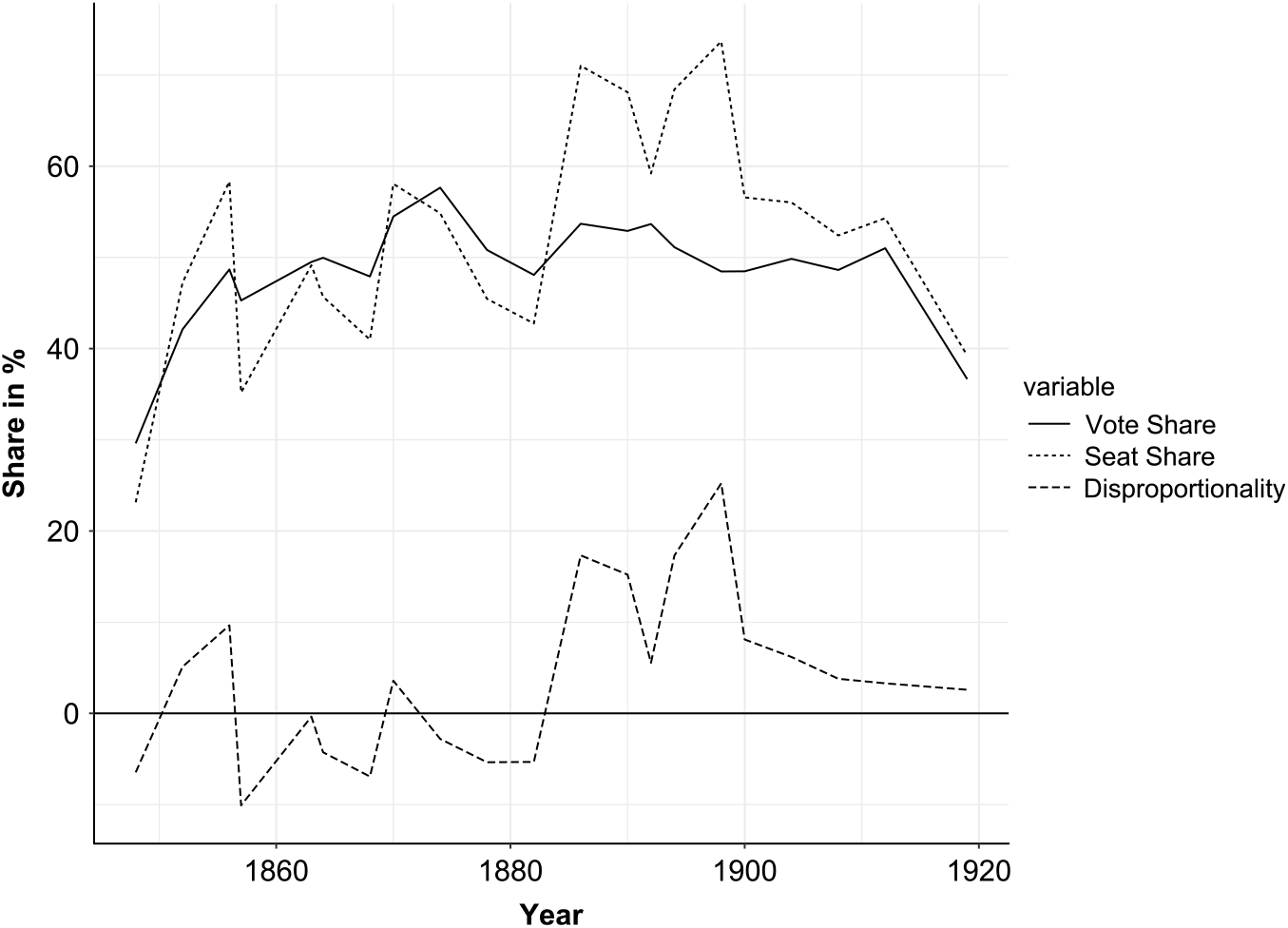
The Belgian constitution of 1831 established a parliamentary democracy with suffrage restricted to about 10% of the adult male population (Delfosse, Reference Delfosse, Laurent, Delfosse and Frognier2004: 184). The dividing line separating the two main Belgian parties, the Liberals and the Catholics, concerned the role of the Catholic Church. According to Gould (Reference Gould1999: 31), ‘anticlericalism was the central unifying tenet for liberals in Belgium.’ A key advantage of the Catholics was their strong position among rural voters, which was also to bode well for the Catholics in case of suffrage extension. Thanks to a massive mobilization effort in the run-up to the 1884 election, the Catholics gained 27 additional seats and won control of the government (Kalyvas, Reference Kalyvas1996: 189). Thereafter, the Catholics remained firmly in control of Belgian politics. Several factors cemented their political dominance. Next to suffrage restrictions, which kept the Socialists out of parliament, the Catholics benefited from their control over the small districts on the countryside, while they were able to challenge the Liberals in large urban districts. In combination with the electoral system, MR with multi-member districts, this geographical pattern of electoral competition led to large seat-vote distortions favoring the Catholics (see Figure 1).Footnote 8
Catholic party’s vote and seat shares in elections to the chamber of representatives, 1848–1919.

Unsurprisingly, the Socialists demanded the introduction of male universal suffrage, organizing mass strikes in 1890, 1891, 1892, and 1893. Given this extra-institutional challenge, the moderate Catholic Prime Minister Auguste Beernaert believed that his party would ultimately benefit from suffrage reform (Barzachka, Reference Barzachka2014: 216–217). Yet, conservative Catholics and Liberals demanded electoral safeguards. Hence, in 1893, the Belgian parliament introduced male universal suffrage. However, the new system awarded up to two extra votes to specific societal groups based on ‘capacities’ linked to the voters’ family situation, tax payments, and education. In this new electoral system, 853,628 voters had one vote, 293,678 had two, and 223,381 had three votes (Pilet, Reference Pilet2007: 23). This plural vote system was particularly relevant for the Liberals because they could not, in the absence of liberal mass organizations, expect to see their numbers boosted by suffrage extension. Indeed, despite the plural vote system, the Liberals lost 40 seats (down to 13% of all seats) in the first election under the new system (1894), while the Socialists gained 28 seats (up from zero) and the Catholics gained 10 additional seats (now controlling 68.4% of the seats). Hence, the new system allowed the Socialists to enter parliament, further accentuated the Catholics’ dominance, and accelerated the Liberals’ demise.
Beernaert also used the suffrage reform to launch a discussion about the adoption of PR. Beernaert was a long-time advocate of PR and a founding member of ‘l’association ré-formiste belge pour l’adoption de la représentation proportionnelle.’ The association had been created in response to the 1880 election, which had led to large seat-vote distortions and thus suggested a need for reform (Goblet D’Alviella, Reference Goblet D’Alviella1900: 49–51). Beernaert stayed true to the association’s reformist agenda, but he joined under rather different circumstances. Before 1884, that is before the Catholics’ massive mobilization efforts, the electoral system did not (yet) favor the Catholics (see Figure 1). In fact, Beernaert himself had suffered, when a liberal victory, greatly aided by the electoral system, ended his tenure as Minister of Public Works in the 1878 election. Hence, Beernaert’s socialization as a politician took place before the Catholics became politically dominant.
However, the Catholics did not receive Beernaert’s proposal well because the electoral system in 1894 now greatly advantaged them. Already in the decade before the suffrage extension in 1893, the Catholics were emerging as the strongest nonsocialist party. The 1893 suffrage extension with plural voting definitely cemented the Catholics’ position as the main nonsocialist party. Little surprise, then, that the Catholic MPs rejected Beernaert’s proposals already in the preparatory sessions. Among the 92 Catholic MPs, 57 voted no, 27 voted yes, and 8 abstained. Among the 60 Liberals, 18 voted no, 22 voted yes, and 20 abstained (Goblet D’Alviella, Reference Goblet D’Alviella1900: 76). There were no further votes because the sections discussed the bill before the 1894 election. After his defeat, Beernaert stepped down, while his successor, the Catholic De Burlet, removed electoral reform from the parliamentary agenda (Nohlen and Opiela, Reference Nohlen, Opiela, Sternberger and Vogel1969: 88).
Hence, up until 1894, with no adoption of PR, political developments in Belgium are perfectly in line with the literature’s expectations. The current electoral system greatly advantaged the Catholics, while suffrage extension had brought the Liberals to the brink of collapse. Hence, from the point of view of explanations emphasizing seat-vote distortions or coordination problems among nonsocialist parties, the Catholics had no reason to push for PR. While extra-institutional threats had indeed forced their hand in the area of suffrage expansion (Barzachka, Reference Barzachka2014), the Catholics’ strong grass-roots mobilization allowed them to benefit from this reform. Other than the abolition of the plural vote system, the Socialists showed little interest in electoral reform (Barthélemy, Reference Barthélemy1912: 544). In addition, after 1893, moderates among the Socialists took control of party leadership (Nohlen and Opiela, Reference Nohlen, Opiela, Sternberger and Vogel1969: 87).
The years from 1894 to 1898 seem to indicate a period of Catholic political dominance. After their decisive victory in the 1894 (general) election, the Catholics also performed well in the 1896 and 1898 partial elections, increasing their seat share from 68.4% to 73.7% in 1898.Footnote 9 Most of the Catholics’ gains came at the expense of the Liberals who saw their seat share reduced to 8.6% by 1898. In contrast, the Socialists were able to hold their seat share at 17.8%.
Yet, the Catholics’ political dominance was considerably more fragile than these numbers indicate. In the 1896/98 elections, the Catholic Party once again benefited from the electoral system’s seat-vote distortions. Their combined first-round vote share in the 1896/98 elections (43.9%) paled in comparison with their impressive seat share (73.7%). In addition, the Catholics’ vote share was declining. In the 1894 general election, the Catholics had been able to obtain 50.0% of the vote but had gained ‘only’ 68.4% of the seats. As a result, distortions were even increasing in the second half of the 1890s (see Figure 1).
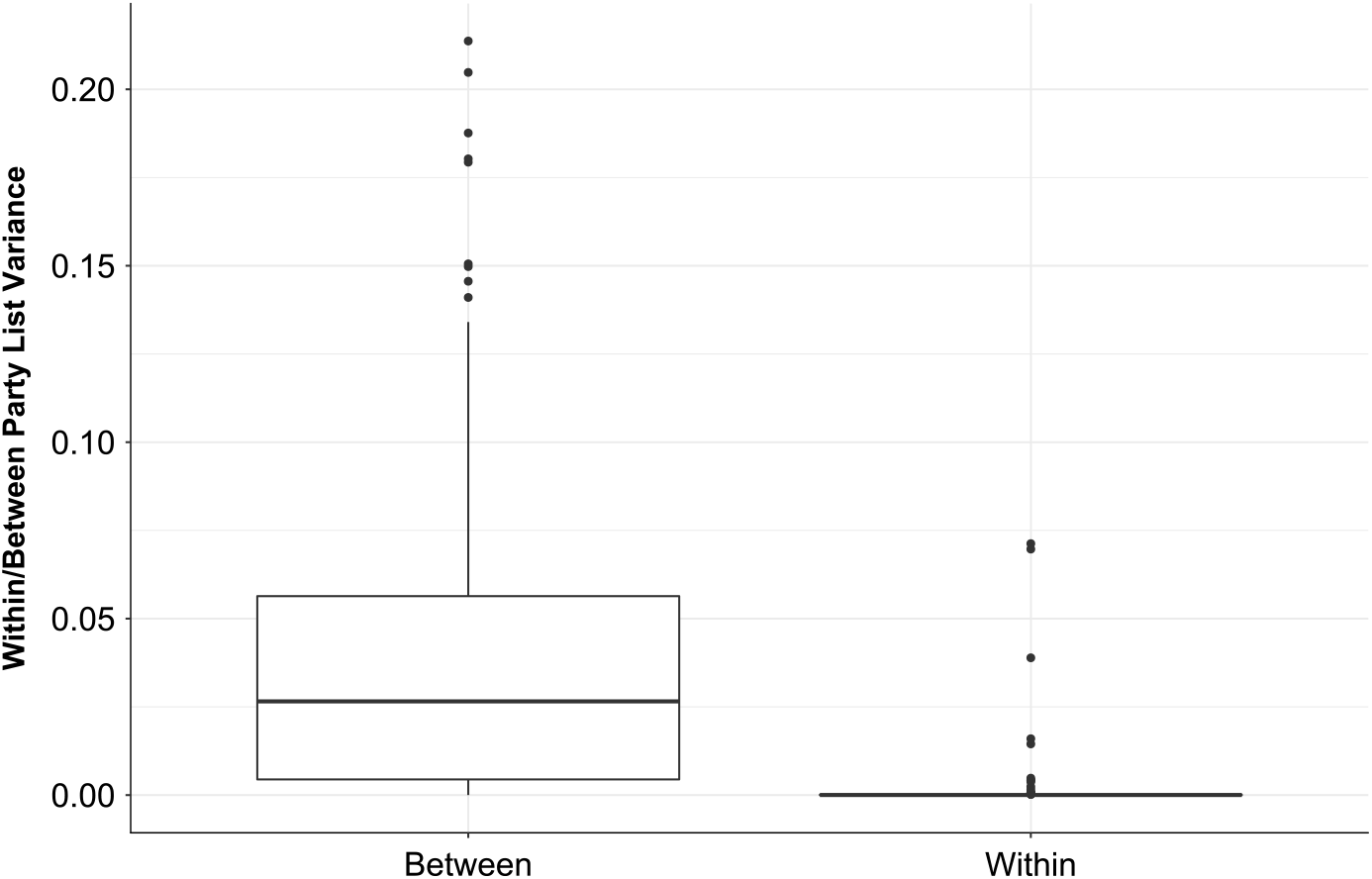
These large distortions were the result of Belgium’s majority runoff system in multi-member districts in which only the two strongest lists advance to the second round (Nohlen and Opiela, Reference Nohlen, Opiela, Sternberger and Vogel1969: 79). District sizes ranged from 1 to 18 (Brussels). Voters had as many votes as there are seats in a district but could not vote multiple times for the same candidate. Such systems are particularly prone to lead to large seat-vote distortions because they award a large number of seats to parties that may obtain only a plurality of votes in the first round. In addition, these systems often lead to bloc voting, where the strongest party wins all of the districts’ seats. In Figure 2, we plot the variance of the distribution of vote shares between (left-hand side) and within (right-hand side) all party lists. The plot shows that in the vast majority of cases, the difference of vote shares of candidates of one party is close to zero. Substantively, this implies that relatively small between-list differences already led to landslide victories for the most popular party.
Between- and within-list variance (1894, 1896, and 1898 elections).

The Brussels district illustrates these dynamics. In both the 1894 and 1896 elections, the Catholics were able to gain all 18 seats with a plurality of votes in the first round. Put differently, with vote shares of 46% (1894) and 42.4% (1896) in the first round, they won 100% of the seats.Footnote 10 However, the Brussels district also demonstrates why this electoral system was becoming a problem. If their opponents would band together, the Catholics might no longer be able to obtain a majority of the votes in the runoff and lose all 18 seats. Already in the 1894 election, progressive Liberals and the Socialists submitted a joint list (the cartel) in the districts Liége and Namur (Catholic stronghold in 1892), gaining all 14 seats in both districts. Even though the first cartel was not successful in the 1896 election in Brussels, the increasing number of electoral alliances started to become a serious threat to Catholics in many urban districts.
In the 1896/98 elections, 26.1% of the liberal and 25.9% of the socialist candidates ran on joint lists, up from 9.7% (Liberals) and 12.0% (Socialists) in 1894 and zero in 1892. The collaboration between the Liberals and Socialists was thus rapidly increasing. What is more, together, these two parties often obtained more votes in the first round than the Catholics alone. For instance, in the 1896 election in the Brussels district, together, the (conservative) liberal list and the cartel list (progressive Liberals and Socialists) would have obtained 53% of the vote in the first round. However, the cartel still struggled to get all liberal voters to support their joint lists, which explains why the Catholics still won the runoff with a 7.1% margin over the cartel list.Footnote 11 Put differently, about half of the supporters of the conservative Liberals (eliminated in the first round) supported the cartel in the runoff, while the other half supported the Catholics.
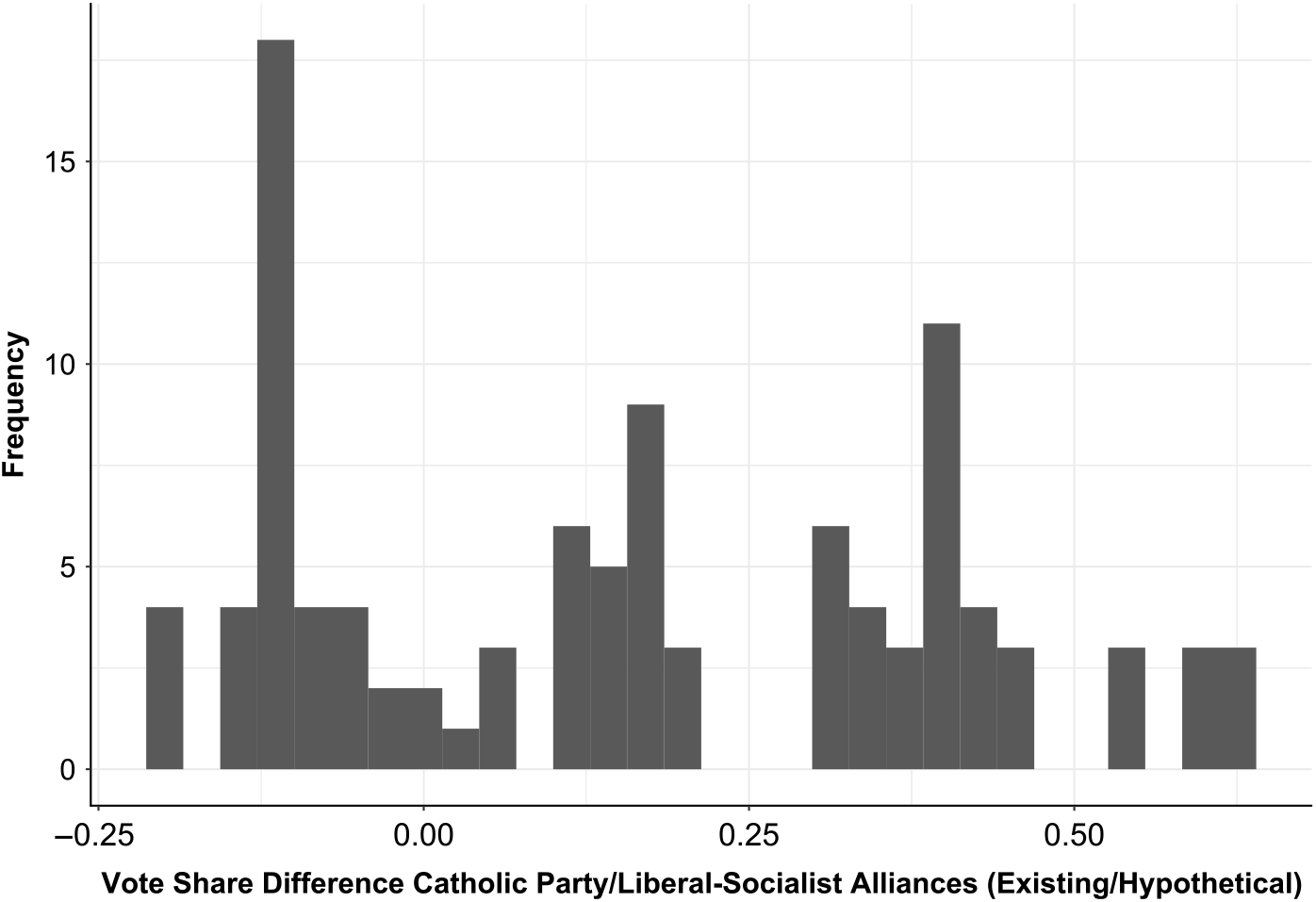
If the cartel were to become more effective, it would endanger numerous Catholic seats. Figure 3 shows the difference between the vote shares of the Catholics and the cartel in the first round of the 1896/98 elections for all the seats the Catholics had won (actual numbers where the cartel existed and the sum of the two parties’ vote shares where the cartel did not yet exist).Footnote 12 Negative values indicate that the Catholics would have lost the seats if the cartel had existed or been more effective. The figure shows that joint liberal-socialist lists would have had the potential to win up to 36 additional seats in the 1896/98 elections, thus reducing the Catholics’ seat share from 73.7% to 50%. There were thus several challenged Catholics, if we focus on electoral threats by the cartel rather than the Socialists alone. For instance, among the Catholics voting on the adoption of PR in 1899, 46.3% had a vote margin below 10% vis-à-vis the cartel (existing or hypothetical) in the previous election.
Vote share difference of catholic party and liberal-socialist alliances (existing or hypothetical), 1896/98.

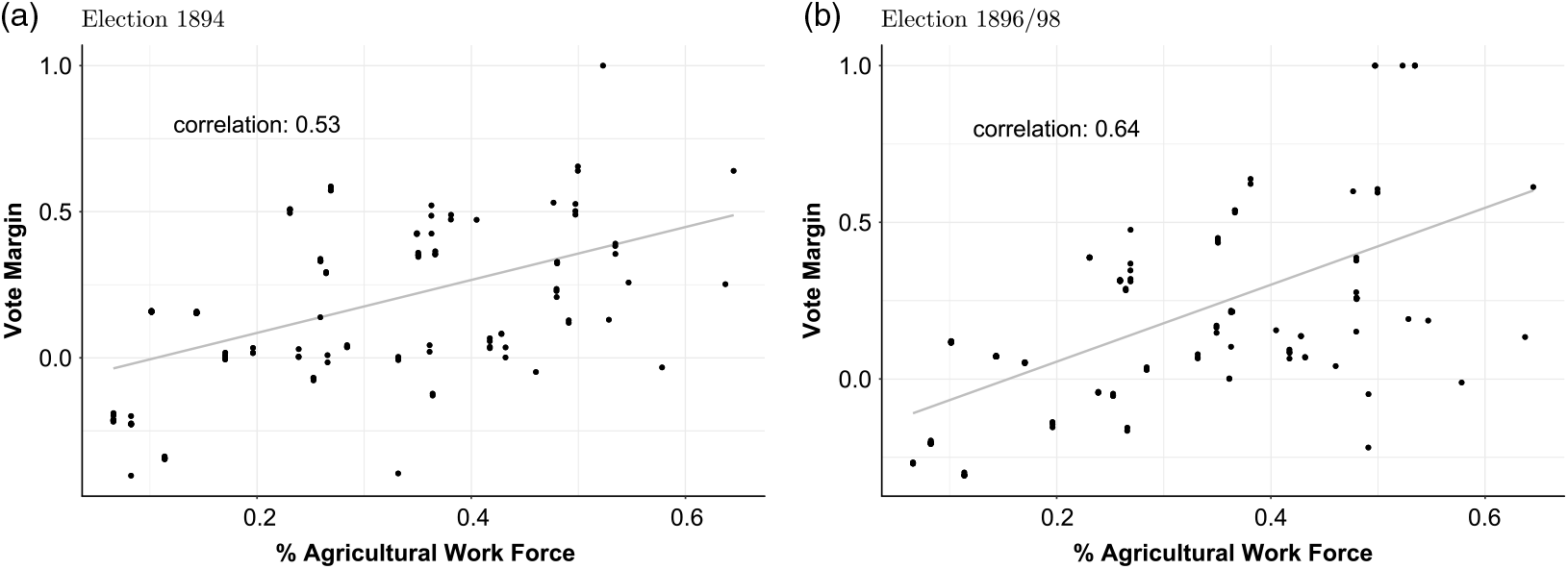
On average, Catholic vote margins for seats they had won remained stable (26.6% in both the 1894 and the 1896/98 elections). The aggregate numbers are misleading, however. Liberals increasingly withdrew from rural districts but joined forces with Socialists to challenge Catholics in urban districts. In Figure 4, we provide evidence for this pattern by displaying the Catholic first round vote margins relative to the share of the agriculture workforce in districts the Catholics had won in 1894 (left panel) and 1896/98 (right panel). The figure not only shows a positive association (i.e. Catholic vote margins are larger in more rural districts), but the correlation is also increasing. This change is due to declining Catholic vote margins in more urban districts and an increasing number of unchallenged catholic candidates in rural districts.
Vote margin catholic party and share agricultural working force.

For instance, in the Antwerp (11 seats) and Leuven districts (6 seats), the Catholic vote margin had declined by 8% and 7% points, respectively.Footnote 13 More generally, in districts with a share of the agricultural workforce below 0.2, the Catholic vote margins for seats they had won declined from 9.2% in the 1894 election to 7.2% in the 1896/98 elections. Of course, urban districts (captured by the share of the non-agricultural workforce) are also typically large districts (r = 0.67), which would make losing them electorally costly. Finally, this problem was only getting worse, as the anticipated 1900 census was promising to further increase the size of urban districts (Woeste, Reference Woeste1933: 144). For now, the Catholics were able to defend their dominant position, but the writing was on the wall that the electoral system’s distributional dynamics could turn against them.
In the late 1890s, the Catholics understood that the status quo was not tenable. This is true for the party’s progressive and urban wing, represented by the former Prime Minister Beernaert, who had already suggested PR in 1894. However, it is equally true for the conservative and rural wing, most prominently represented by Charles Woeste. Although often portrayed as the main opponent of PR, Woeste clearly understood the need for reform. In a letter to the Belgian King on 3 December 1898, Woeste (Reference Woeste1933: 154–156) not only described the current electoral system as ‘intolerable’ but also demanded a reform of the electoral system. Yet, Woeste did not suggest the adoption of PR. Rather, he believed that a breakup of large districts into smaller ones would be preferable.
Hence, in the late 1890s, the situation presented itself as follows. Facing their elimination in the lower chamber, the Liberals were getting desperate. As a result, the Liberals’ conservative wing agreed to cooperate with the Socialists (Barthélemy, Reference Barthélemy1912: 538–539). Most prominently expressed by the conservative Liberal Léon Vanderkindere in the meeting of the Ligue libérale on 8 December 1898, the Liberals were willing to ‘enter an alliance with the devil’ (i.e. the Socialists) to avoid yet another Catholic government (Delfosse, Reference Delfosse, Laurent, Delfosse and Frognier2004: 172; Barthélemy, Reference Barthélemy1912: 547). This expression became the Liberals’ battle cry for the discussions in 1899 (Goblet D’Alviella, Reference Goblet D’Alviella1900: 103), while the Catholics were shocked by the conservative Liberals’ publicly expressed willingness to cooperate with the Socialists (Delfosse, Reference Delfosse, Laurent, Delfosse and Frognier2004: 172).
In contrast, the Socialists considered the debate about the adoption of PR an unnecessary distraction. Their main demand continued to be the abolition of the plural vote system, while they showed little interest in PR (Goblet D’Alviella, Reference Goblet D’Alviella1900; Barthélemy, Reference Barthélemy1912; Nohlen and Opiela, Reference Nohlen, Opiela, Sternberger and Vogel1969; Penadés, Reference Penadés, Maravall and Sánchez-Cuenca2008). In fact, some Socialists were openly hostile toward PR because they were concerned that the goal of PR adoption was to break their hold on urban districts in Wallonia such as Liège, Charleroi, Hainaut, and Namur. In addition, the Socialists clearly understood that the Liberals’ need to cooperate with them would disappear with the adoption of PR (Barthélemy, Reference Barthélemy1912: 544).
Finally, the Catholics accepted the need for reform – not least because the status quo pushed the Liberals into the Socialists’ arms. Referring to the Liberal’s ‘alliance with the devil,’ the Liberal Paul Janson jokingly observed that the Catholics’ position with regard to electoral reform may be best described as ‘vade retro satanas’ (step back, devils) (Stengers, Reference Stengers2004: 260). With a declining vote share and decreasing vote margins in the numerically important urban districts, the Catholics faced the risk that the electoral systems’ distributional effects would turn against them, if the cooperation between the Liberals and the Socialists would continue to improve. There can be no doubt that the Catholics were aware of this problem (Barthélemy, Reference Barthélemy1912: 547; Delfosse, Reference Delfosse, Laurent, Delfosse and Frognier2004: 161–172; Stengers, Reference Stengers2004: 260; Pilet, Reference Pilet2007: 25). For instance, the Catholic newspaper Le Bien public lamented that the Catholics were too dependent on the vagaries of the Liberals and their dislike of the Socialists (Le Bien public, 16 June 1898: 1) and the remaining Liberals who still had the courage to fight revolutionary socialism (Le Bien public, 20 July 1899: 1, both cited in Delfosse, Reference Delfosse, Laurent, Delfosse and Frognier2004: 171). In a similar vein, Minister of Justice Jules van der Heuvel observed that the existing electoral system had forced the Liberals to abandon their independence in a coalition with the Socialists (Lachapelle, Reference Lachapelle1911: 180). Of course, not all Catholic MPs were equally challenged, especially in rural Flanders. Nevertheless, for the party as a whole, it was becoming increasingly clear that an electoral reform was necessary to protect the Catholics’ political dominance.
Why did the Belgian Catholics opt for PR?
There are good reasons why the Catholics considered electoral reform. Yet, why did the Catholics opt for PR? As Ahmed (Reference Ahmed2013) observes, in the late 1890s, alternatives to PR were available, most notably MR in SMD. Thus, the choice of PR is in need of an explanation. Ahmed (Reference Ahmed2013) herself argues that the Catholics preferred PR to SMD because of the Socialists’ radicalization and because they lacked strategies for containment. Yet, the increasing liberal-socialist cooperation in the 1890s is clearly inconsistent with an explanation emphasizing the Socialists’ radicalism.Footnote 14 In the following, we offer an alternative explanation.
Electoral geography can turn dominant parties into heterogeneous organizations. To occupy a majority position, dominant parties often have to make inroads into segmented and competitive electoral markets (Boix, Reference Boix2010), which breeds the potential for intra-party conflict over electoral reform. In the Belgian case, the decisive divide over electoral reform did not separate parties, but ran through the Catholics. Given their overwhelming majority in the lower chamber, the decision whether to adopt PR was one the Catholics had to make. They had increasingly come to recognize that the status quo was untenable because the party risked losing all seats in large and growing urban districts at one go. However, they struggled to decide whether they should opt for PR or SMD (or a system mixing these elements).
The Catholics’ main problem was that the two reforms would have distributional effects within the party. As we show below, PR promised to protect progressive MPs in urban districts and Wallonia. In contrast, smaller districts were expected to benefit conservative MPs in rural Flanders. No wonder that the debate about electoral reform in Belgium is often portrayed in the literature as one between the leaders of the Catholics’ progressive (Beernaert from the large Brussels district) and conservative wings (Woeste from the small Aalst district).
We argue that the Catholics opted for PR because this electoral system promised to be more effective in securing their strong political position in the long-term, while protecting the fragile balance between the party’s factions. SMD would have been beneficial for the Catholics only if their voters were concentrated. However, as we show below, in urban districts, this was not the case. Hence, there was a considerable risk that SMD would have simply replicated the Catholics’ problems with multi-member districts. In urban districts, the Catholic candidates would have faced a liberal-socialist alliance and, ultimately, lost. PR, by contrast, reduced the effectiveness of the liberal-socialist cooperation, especially in the embattled large districts, because it does not award all seats to the strongest list. Put differently, with SMD, the Catholics still risked losing the large majority of their seats in districts where they faced a strong liberal-socialist alliance (most of Wallonia and urban districts). As a result, SMD would have pushed the Catholics to the right and made the party more Flemish. Given the strength of the center-periphery cleavage and the salience of the Flemish question in Belgium, the Catholics ran the risk of becoming the party of rural Flanders (Delfosse, Reference Delfosse, Laurent, Delfosse and Frognier2004: 161–171). Hence, even for Catholic MPs not directly affected by electoral system choice, there were good reasons to prefer PR.
Hence, unlike recent contributions that stress the differing interests of party leadership and backbenchers (Cox et al., Reference Cox, Fiva and Smith2019; Schröder and Manow, Reference Schröder and Manow2019), we argue that the main line of disagreement may also stem from the programmatic interests of different factions within a party. The Catholics’ conservative and progressive wings were both interested in preserving the party’s majority position. However, the two wings’ position on PR and SMD depended on whether the new electoral system would strengthen their influence within the party by altering the geographical focus of the party’s voter base.Footnote 15
Short-term sacrifice, long-term gain
While the Catholics accepted the need for reform, they were internally divided as to whether PR or SMD should be adopted. The conservative Catholics around Woeste took the first stab at electoral reform. Since the incumbent Prime Minister Paul de Smet de Naeyer advocated a middle way, combining the division of large districts with PR in the second round, the conservative Catholics got the Belgian King Léopold II to appoint in January 1899 Jules Vandenpeereboom as the new Prime Minister. Vandenpeereboom immediately attempted to push the adoption of SMD through parliament (e.g. Goblet D’Alviella, Reference Goblet D’Alviella1900: 105; Woeste, Reference Woeste1933: 157), yet the proposal failed spectacularly. Facing opposition from Liberals, Socialists, and progressive Catholics (Goblet D’Alviella, Reference Goblet D’Alviella1900: 107), Vandenpeereboom was forced to withdraw the proposal before the vote in parliament.
Instead, Vandenpeereboom submitted another reform proposal in April 1899. This time, he suggested to adopt PR in districts with at least six seats, while MR should be maintained in smaller districts. Yet, this proposal received an even worse reception. Obviously tailored to the Catholics’ specific needs, the proposal was fiercely opposed by the Liberals and the Socialists (Goblet D’Alviella, Reference Goblet D’Alviella1900: 106–108). Worse, the conservative Catholics also rejected the proposal because they still advocated and believed in the division of larger districts (cf. Woeste, Reference Woeste1933: 163).
Once again, Vandenpeereboom was forced to withdraw the proposal. Instead, he decided to task a cross-partisan commission to develop a reform. However, the commission could not agree on a proposal and Vandenpeereboom finally stepped down (Goblet D’Alviella, Reference Goblet D’Alviella1900: 125–126; Woeste, Reference Woeste1933: 169–171). In August 1899, Vandenpeereboom was replaced by his predecessor de Smet de Naeyer who immediately produced a reform to adopt PR, which was ultimately accepted in unaltered form on 24 November 1899.
How can we account for these events? Since the Catholics controlled the large majority of seats in parliament (73.7%), their position was decisive. In addition, in response to the Vandenpeereboom proposals, the Liberals and the Socialists made a pact, now refusing to support any reform proposal and demanding a public vote on the adoption of PR and the abolition of the plural vote system (Goblet D’Alviella, Reference Goblet D’Alviella1900: 124). Hence, in order to understand why PR was ultimately adopted, we must examine why the majority of Catholics preferred PR to SMD (the January proposal) and PR in large districts only (the April proposal).
Three reasons explain why the Catholics preferred PR. First, from the point of view of seat maximization, SMD would have been beneficial only if Catholic voters were concentrated. This was certainly the case in many rural districts, especially in Flanders, but in urban districts, Catholic voters were not concentrated at all. Table 1 shows the spatial concentration of party voters in urban districts for which we were able to find canton-level (the level below the electoral districts) data in national elections. The table shows that Catholic voters were highly dispersed in Brussels and Charleroi. Yet, even in Liége, where we find the highest concentration, their dispersion was comparatively high.Footnote 16 Hence, there was considerable risk that SMD would not have solved the Catholics’ problem with multi-member districts. In urban districts, the Catholic candidates would have faced a liberal-socialist alliance and, ultimately, lost.Footnote 17
Spatial concentration of party voters

Therefore, SMD would have threatened the Catholics’ dominant position. In the 1896/98 elections, the Catholics were still able to win Antwerp (11 seats), Brussels (18), Ghent (9), and Leuven (6), while they had already lost Liége (11), Charleroi (8), and Mons (6) to the liberal-socialist alliance. However, their vote share was declining by 3–7% points in these four districts as well, forcing the Catholics into runoffs in Antwerp and Brussels. In addition, these large districts promised to become even more important in the future. To account for population movements, 14 new seats were added in 1902, of which 8 were allocated to large districts with more than eight seats. Maintaining an urban presence was thus vital to the Catholics’ survival as the governing party.
In contrast, PR allowed the Catholics to win seats in urban districts despite low levels of voter concentration. In addition, under PR, only few electoral districts on the countryside were merged. Thanks to their strong position in rural Flanders, these small rural districts allowed the Catholics to gain 56.6% of the seats with a vote share of 48.5% in the 1900 election. The Catholics maintained this advantage well into the 20th century (see Figure 1). Importantly, the Catholics were aware of these effects, as contemporary estimates projected the Catholics to hold an absolute majority under PR (Delfosse, Reference Delfosse, Laurent, Delfosse and Frognier2004: 172).Footnote 18 Hence, under PR, the Catholics had to give up seats, but not their control over government.
Second, PR provided a lifeline to the Liberals, thus ending their need to cooperate with the Socialists in order to survive (Lachapelle, Reference Lachapelle1911: 179–180; Barthélemy, Reference Barthélemy1912: 544–548; Stengers, Reference Stengers2004: 259–261). The Catholics’ main goal was to end the liberal-socialist alliance, which was about to jeopardize the Catholics’ presence in urban districts. In fact, despite their pact with the Socialists, the first Liberals already ‘fell’ during the parliamentary debate. Although they had agreed with the Socialists to oppose any government proposal unless it also contained the abolition of the plural vote system, five Liberals voted for the government’s PR proposal (Lachapelle, Reference Lachapelle1911: 158). Having been abandoned by their ally, the Socialists considered a general strike (Goblet D’Alviella, Reference Goblet D’Alviella1900: 129). Yet, since their main demand was the abolition of the plural vote system, they had no interest in using their resources to prevent the adoption of PR. The next general strike came in 1902 and demanded the abolition of the plural vote system, yet to no avail.
Importantly, the adoption of PR in 1899 did not put an end to the liberal-socialist alliance as often claimed (e.g. Calvo, Reference Calvo2009). Before 1899, liberal-socialist cooperation focused on large districts to take advantage of the disproportional features of MR with multi-member districts. Hence, in the elections between 1894 and 1898, cartel lists were primarily submitted to large districts. From 1906 onward, the liberal-socialist alliance experienced a renewal. However, under PR, the liberal-socialist alliance focused on small districts, which had allowed the Catholics to win a disproportionate share of seats in rural Flanders. Joint liberal-socialist lists were a possibility to neutralize the Catholics’ advantage in these small districts. As a result, we observe a negative relationship between district size and the likelihood of joint liberal-socialist lists under PR. In addition, the cooperation between Liberals and Socialists even intensified. Between 1906 and 1912, 57% of socialist and liberal candidates ran on joint lists, up from 26% in the 1896/98 elections.
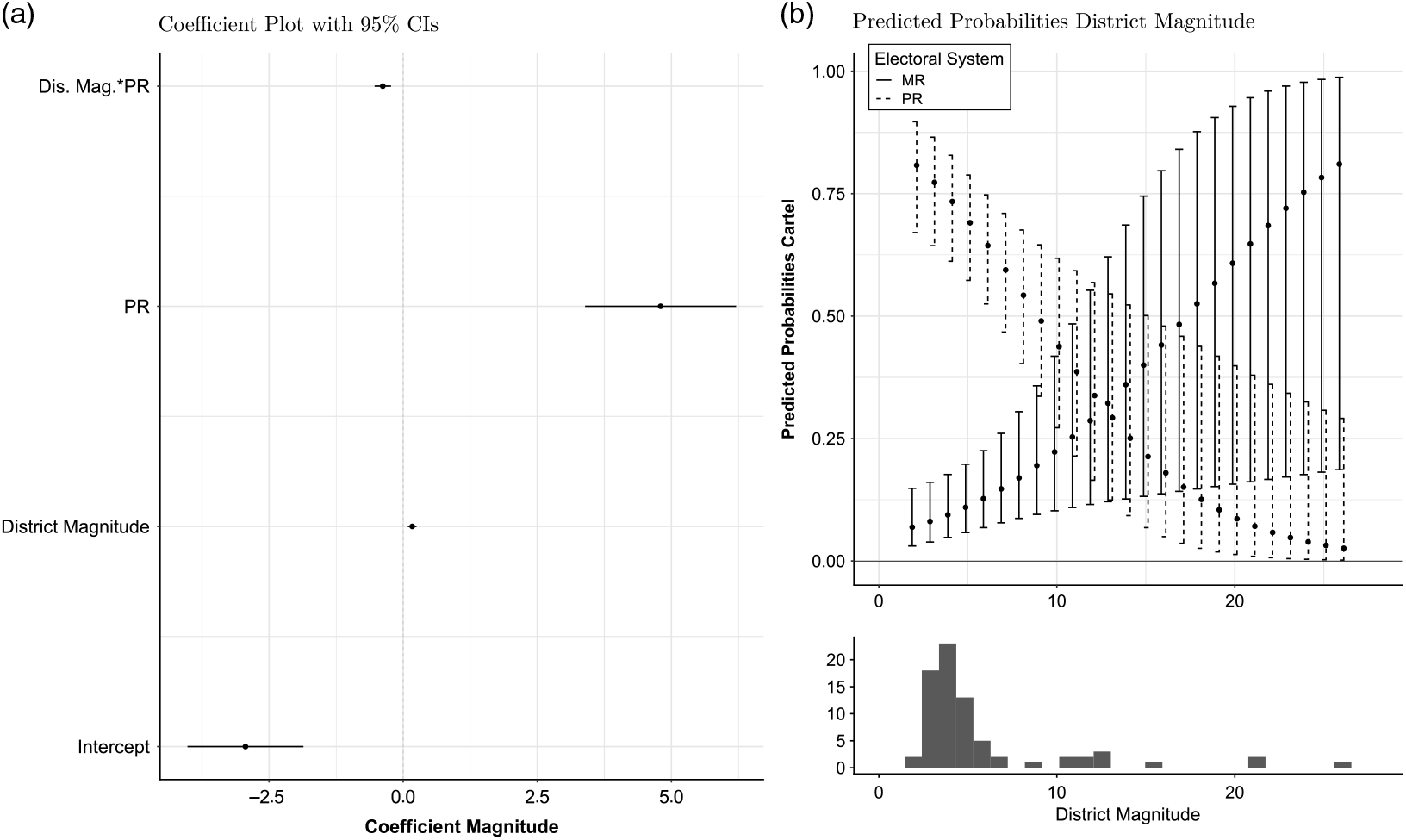
To provide evidence, we use information on party lists and district magnitude for all elections between 1894–98 and 1906–12. To estimate the effect of district magnitude on occurrence of cartel lists conditional on the electoral formula, we employ Firth’s penalized logistic estimator along with cluster robust standard errors on the district level.Footnote 19
The coefficient plot on the left-hand side of Figure 5 displays the point estimates with 95% confidence intervals. The estimates for district magnitude, a PR dummy, and their joint interaction are highly significant. To interpret the effects, we plot the predicted probabilities for district magnitude conditional on the electoral system (see right-hand side of Figure 5). As expected, the results show that under PR, cartel lists were more likely in small districts. In contrast, under MR, cartel lists were more likely in large districts, although the confidence intervals overlap due to the low number of observations as shown in the histogram below the predicted probability plot. This continued liberal-socialist cooperation clearly shows that the adoption of PR cannot be understood as a distributional conflict between the Socialists and the nonsocialist parties. The Belgian policy space at the turn of the century was multidimensional, and the Socialists were not as radical as the recent literature portrays them.
District magnitude and cartel Lists under majoritarian rules (MR) and proportional representation (PR).

Finally, SMD would have pushed the Catholics to the right because losing the urban districts would have made the party more rural, more conservative, and more Flemish. Vote margins of Catholic MPs were typically larger in rural and/or Flemish districts. Given the strength of the center-periphery cleavage and the salience of the Flemish question, the Catholics ran the risk of becoming the party of rural Flanders (Delfosse, Reference Delfosse, Laurent, Delfosse and Frognier2004: 161–171). In contrast, although the adoption of PR would certainly cost the Catholics several seats, PR would allow the Catholics to keep a sizable representation in (typically more progressive) urban districts and even regain seats in Wallonia. PR would therefore protect the balance between the progressive and the conservative wings, urban and rural districts, as well as Wallonia and Flanders within the party.
The analysis of the determinants of Catholic MP voting behavior on PR supports our argument that the division over electoral reform ran along these lines. The results, reported in Table 3 and Figure 6 in the appendix, show that mainly MPs who were sheltered from competition of cartel candidates, often in rural Flanders, opposed PR. In the 1900 election under PR rules, the Catholics indeed lost 25% of their seats in Flanders (in the 1896/98 elections, they had won all seats in Flanders). In return, they managed to hold 44% of their seats in the large Brussels district (100% in the 1896 election) and win three additional seats in Wallonia (now 36% of all seats, 31% in the 1896/98 elections).
Yet, if the Catholics were torn between a group supporting PR and another demanding SMD, why was the compromise proposal, PR in large districts only, rejected? It failed because at this point in time, both of the Catholics’ wings still believed their preferred option to be possible (Goblet D’Alviella, Reference Goblet D’Alviella1900: 113). For instance, Woeste, the leader of the conservative wing, clearly felt betrayed by Vandenpeereboom and openly fought the compromise proposal (Woeste, Reference Woeste1933: 163). At the same time, for the MPs in the embattled large districts with six or more seats, the compromise proposal offered no advantages over regular PR. In fact, because the proposal was clearly tailored to the Catholics’ needs, it triggered a hostile reaction from the Liberals and the Socialists. According to Goblet D’Alviella (Reference Goblet D’Alviella1900: 116–117), there were wild scenes in parliament. Opposition MPs played music instruments, chanted satirical songs, and threw paper balls at speakers. In terms of legitimacy, the compromise proposal was costly. The proposal even fortified the liberal-socialist cooperation, which now increased their efforts to expand the cartel to include all non-Catholic MPs (Dupriez, Reference Dupriez1901: 166). Little surprise then that the progressive Catholics did not come to Vandenpeereboom’s aid.Footnote 20
In sum, the Catholics understood that an electoral reform was necessary and the advantages of PR were clear. For the conservative Catholics and MPs from rural districts in Flanders, SMD would have been preferable, but they did not have the numbers to push their preferred option through parliament. Seeing no alternative to PR, several Catholic MPs therefore accepted the inevitable (Goblet D’Alviella, Reference Goblet D’Alviella1900: 139). Woeste (Reference Woeste1933: 174), who opposed PR to the very end, called them ‘the resigned ones.’ Hence, PR in Belgium was, among others, adopted by Catholic MPs such as Théophile de Lantsheere, the former President of the Chamber of Representatives (1884–96) and single MP of the rural Diksmuide district in West Flanders, elected with a vote share of 80% in 1896, who argued that while he still opposes PR, he accepted it as a ‘necessary evil’ (Woeste, Reference Woeste1933: 170). Nevertheless, a third of the Catholic MPs still opposed PR, which indicates that resistance remained strong.
Conclusion
The literature on the adoption of PR has made considerable progress in recent years. However, none of these approaches seems able to account for the developments in Belgium. This is not a minor issue. No case rivals Belgium in its importance for PR adoption. Not only was Belgium the first country to adopt PR at the national level, it also served as role model for other countries to follow. Yet, the causes of PR adoption in Belgium are far from idiosyncratic and bear relevance for the developments in other countries.
It is not our intention to argue that existing accounts are without merit. Quite the contrary, these accounts offer important insights. The introduction of PR was indeed motivated by electoral threats. In addition, electoral geography in combination with the existing electoral system shaped the parties’ positions toward reform. Finally, extra-institutional mobilization pushed the Catholics to adopt universal suffrage and would have made some reforms costly in terms of legitimacy. However, the Belgian case also reveals several important inadequacies of existing accounts.
We have offered an alternative explanation for the adoption of PR in Belgium. Most importantly, we have emphasized how multidimensional policy spaces make electoral coalitions other than between nonsocialist parties possible. Combined with the rather unpredictable distributional consequences of traditional MR systems and the geographically uneven exposure to electoral competition, divisions over electoral system reform emerged and resulted in large intra-party conflicts. Hence, in the Belgian case, there was indeed an electoral threat. Yet, this threat was the result of the liberal-socialist cooperation. This cooperation increased the uncertainty as to whether seat-vote distortions would continue to favor the Catholics, eventually leading the Catholics to reform the electoral system. Finally, the different reform proposals had significant distributional consequences within the Catholic Party. Given their dominant position in parliament, the choice between PR and SMD was thus primarily a function of intra-party conflicts.
Based on our analysis, we encourage the literature to take seriously factors such as cleavage structures, electoral geography, and the strategic incentives parties face under electoral systems. The literature on European political history shows that electoral alliances between socialist and nonsocialist parties as well as joint campaigns for PR were in fact quite common at the beginning of the 20th century. Even though some authors have started to recognize the importance of intra-party conflicts (Cox et al., Reference Cox, Fiva and Smith2019; Schröder and Manow, Reference Schröder and Manow2019) or coalitions between socialist and nonsocialist parties (Rodden, Reference Rodden2009; Emmenegger and Walter, Reference Emmenegger and Walter2019), they have not yet been systematically incorporated in explanations of electoral system choice. Similarly, research has only begun to explore variation in the effective degree of proportionality of PR systems (Bol et al., Reference Bol, Pilet and Riera2015; Walter and Emmenegger, Reference Walter and Emmenegger2019) and its political consequences (Carey and Hix, Reference Carey and Hix2011; Kedar et al., Reference Kedar, Harsgor and Sheinerman2016).
Supplementary material
To view supplementary material for this article, please visit https://doi.org/10.1017/S1755773919000225
Acknowledgment
We thank Florence Caron, Julia Sifringer, and Linda Wanklin for their invaluable research assistance. Earlier versions of this paper were presented in research seminars at the Université libre de Bruxelles and the University of St. Gallen as well as the 2019 conference of the Swiss Political Science Association at the University of Zurich. We thank all participants, Lucas Leemann and Markus Kreuzer as well as the anonymous reviewers for their helpful comments and suggestions. All remaining errors are the authors’ responsibility.