INTRODUCTION
The general public’s interest in the topic of mild traumatic brain injury (mTBI) is increasing while scientific knowledge about mTBI is advancing, yet still requires a great deal of clarity. Either independently or in response to the public’s interest, many media programs have sensationalized unsubstantiated dangers of mTBI (DiFazio, Silverberg, Kirkwood, Bernier, & Iverson, Reference DiFazio, Silverberg, Kirkwood, Bernier and Iverson2015). Indeed, the media has been accused in the past of purposely instilling undue fear in the public to raise the amount of media attention (Klemm, Das, & Hartmann, Reference Klemm, Das and Hartmann2014).
In the context of science journalism, framing theory is the idea that information is both conveyed and understood through frames or schemas (Goffman, Reference Goffman1974, p. 21–26; Scheufele, Reference Scheufele1999). Varying how an issue is framed in the media can influence how the audience thinks about the topic (Scheufele & Tewksbury, Reference Scheufele and Tewksbury2007), including health topics (Coleman, Thorson & Wilkens, Reference Coleman, Thorson and Wilkins2011). Often, adults rely on news media for health information (Van Slooten, Friedman, & Tanner, Reference Van Slooten, Friedman and Tanner2013). Health literacy is defined in part as “the degree to which individuals can obtain, process, and understand the basic health information and services they need to make appropriate health decisions” (Institute of Medicine, 2004, p. 1). Televised media programs have discussed, with certainty, aspects of the effects of mTBI that have little or no scientific support (Block, West, & Goldin, Reference Block, West and Goldin2016).
Studies have revealed that a patient’s negative beliefs about the timeline, consequences, and personal control after an mTBI can significantly affect the patient’s prospect of achieving a full recovery (Hou et al., Reference Hou, Moss-Morris, Peveler, Mogg, Bradley and Belli2012; Roth & Spencer, Reference Roth and Spencer2013). The effect of televised media on mTBI symptoms has not yet been researched. However, research has shown that televised media can influence participants’ symptomology and attribution beliefs about the adverse effects of other sources of potential harm, such as WiFi (Witthöft & Rubin, Reference Witthöft and Rubin2013). It has also been suggested that negative or positive beliefs about recovery from mTBI can be instilled in participants through mediums such as informational literature in a waiting room (Waldron-Perrine, Tree, Spencer, Suhr, & Bieliauskas, Reference Waldron-Perrine, Tree, Spencer, Suhr and Bieliauskas2015).
Approximately 70–90% of treated head injuries are mTBIs (Cassidy et al., Reference Cassidy, Carroll, Peloso, Borg, Von Holst, Holm and Coronado2004). It is common for mTBI patients to suffer from acute deficits in working memory (Kumar, Rao, Chandramouli, & Pillai, Reference Kumar, Rao, Chandramouli and Pillai2013), attention, and concentration (Paniak et al., Reference Paniak, Reynolds, Phillips, Toller-Lobe, Melnyk and Nagy2002). Other signs and symptoms of mTBI include headaches, dizziness, fatigue, and irritability (Reuben, Sampson, Harris, Williams, & Yates, Reference Reuben, Sampson, Harris, Williams and Yates2014). In general, mTBI patients recover from the neurophysiological effects within 10 days of the injury (Giza & Hovda, Reference Giza and Hovda2001). Those who display these signs and symptoms after 3 months are said to suffer from a constellation of symptoms collectively known as post-concussive syndrome (PCS; Bigler, Reference Bigler2008).
Silverberg and Iverson (Reference Silverberg and Iverson2011) conducted a thorough review of the literature focused on the etiology of PCS and noted that pre-existing psychological disorders such as anxiety, depression, and traumatic stress have all been shown to contribute to the development of PCS. Additionally, they explained that mood and anxiety disorders can also cause many of the same symptoms as PCS, making it difficult to differentiate PCS symptoms from symptoms of the premorbid psychological disorder (Silverberg & Iverson, Reference Silverberg and Iverson2011). Lastly, they acknowledged the impact that phenomena such as stereotype threat, diagnosis threat, and the nocebo effect can have on PCS (Silverberg & Iverson, Reference Silverberg and Iverson2011).
Several related concepts are relevant for understanding how the symptoms of mTBI can manifest differently across individuals. Steele (Reference Steele1997) described stereotype threat as the impact that allowing negative stereotypes to become self-relevant can have on abilities such as cognitive functioning. Diagnosis threat is similar to stereotype threat, but occurs when participants are made aware of their diagnosis and told that others with the same diagnosis typically perform poorly on such tests (Suhr & Gunstad, Reference Suhr and Gunstad2002). A third related concept is the nocebo effect, which describes the experience of symptoms due to beliefs and expectations of negative consequences from a benign stimulus (Vanderploeg, Belanger, & Kaufmann, Reference Vanderploeg, Belanger and Kaufmann2014). The literature on health beliefs and illness identity in mTBI has been studied largely from the perspective of diagnosis threat.
Seminal studies focusing on diagnosis threat found that this phenomenon was associated with a reduction in cognitive test scores of roughly .36 (Suhr & Gunstad, Reference Suhr and Gunstad2002) to .44 (Suhr & Gunstad, Reference Suhr and Gunstad2005) standard deviations compared to controls. However, subsequent studies have not consistently replicated those original findings (Blaine, Sullivan, & Edmed, Reference Blaine, Sullivan and Edmed2013; Carter-Allison, Potter, & Rimes, Reference Carter-Allison, Potter and Rimes2016; Kinkela, Reference Kinkela2008; Kit, Mateer, Tuokko, & Spencer-Rodgers Reference Kit, Mateer, Tuokko and Spencer-Rodgers2014; Ozen & Fernandes, Reference Ozen and Fernandes2011; Trontel, Hall, Ashendorf, & O’Connon, Reference Trontel, Hall, Ashendorf and O’Connor2013). Therefore, there is a need to better estimate the true magnitude of the diagnosis threat effect on those with a history of mTBI, as well as to understand whether diagnosis threat (or related phenomena) can be elicited by actual media reporting.
Most studies of diagnosis threat in mTBI have elicited the phenomenon by asking participants to read a vignette that manipulates participant expectancies about the effects of mTBI on cognitive task performance. Although written vignettes can serve to improve a study’s internal validity, this may come at the expense of external validity. For example, some studies about symptom expectations have asked participants to imagine that they have sustained a head injury (Edmed & Sullivan, Reference Edmed and Sullivan2015; Waldron-Perrine et al., Reference Waldron-Perrine, Tree, Spencer, Suhr and Bieliauskas2015) rather than sampling from a population with an actual history of mTBI. Therefore, there are still unanswered questions about the effects of more naturalistic exposure to information about mTBI, such as the information presented in actual televised news reports, to participants with a history of mTBI.
In summary, there is evidence to suggest that patients’ mTBI-related beliefs may explain some of the variability in perceived recovery. These beliefs may be affected by phenomena such as stereotype threat, diagnosis threat, and the nocebo effect, which may be induced by how media is framed when reporting about mTBI. As a result, mTBI patients may experience perceptions of impaired cognitive functioning and subjective symptomology of their injury beyond the effects expected from the neurometabolic injury. Those with lower functional health literacy may be more susceptible to this effect than those with higher levels of functional health literacy.
The present study had two goals. The first was to estimate the effect of sensationalized news reporting on cognitive functioning and PCS symptom severity. These outcomes were measured using the Paced Auditory Serial Addition Test (PASAT) and the Rivermead Post-Concussion Symptom Questionnaire (RPQ), respectively. The second goal was to estimate the extent to which other factors, including age group (older vs. younger), functional health literacy, and symptoms of depression and post-traumatic stress disorder (PTSD) moderate the effect of sensationalized media on cognitive functioning and PCS symptom severity. The current study seeks to build on existing research by examining the effects of actual news reports, as opposed to study-specific written vignettes, on the cognitive performance and symptom reporting of individuals with any history of remote (i.e., > 3 months) mTBI.
METHOD
Participants
The University of Colorado Colorado Springs (UCCS) Institutional Review Board approved all recruitment and investigational procedures for this study. The study methods were also pre-registered with the Open Science Foundation (https://osf.io/v4mzq/). Participants were recruited from August 2016 to May 2017 through recruitment flyers, a community research registry, and a psychology department recruitment Web site, Sona. Deception was used in recruitment to avoid demand characteristics; participants were not made aware of the true purpose of the study until after completing the study. The study was initially described as an exploration of how the participants’ ability to remember and rate information from a video clip may be affected by taking cognitive tests and psychological questionnaires. Student participants were offered extra credit for their participation. Participants who were not students were offered $10 for their participation.
To be eligible for the study, individuals had to be between the ages of 18 and 32 (younger adults) or 55 and older (older adults). Individuals remained eligible if they self-reported a history of at least one mTBI that did not occur within the last 3 months; this time frame was chosen to ensure participants were not experiencing acute mTBI symptoms. For the current study, mTBI was defined as a blow to the head that caused confusion, headaches, dizziness, nausea, or similar acute symptoms that lasted less than 24 hours after the injury. If loss of consciousness occurred, it lasted for no longer than 30 minutes.
Individuals were excluded if they self-reported ever having received a diagnosis of schizophrenia, bipolar disorder, autism, or moderate to severe TBI (i.e., loss of consciousness for greater than 30 min and/or post-traumatic amnesia lasting greater than 24 hr). Individuals were also excluded if they reported taking any medications that may alter their thinking ability. Lastly, individuals from the research registry and community members who replied to the recruitment flyers were screened by phone. This screening was done with the Memory Impairment Screen by Telephone (MIS-T; Lipton et al., Reference Lipton, Katz, Kuslansky, Sliwinski, Stewart, Verghese and Buschke2003) to ensure that participants were cognitively intact.
Materials
Memory Impairment Screen by Telephone
Lipton et al. (Reference Lipton, Katz, Kuslansky, Sliwinski, Stewart, Verghese and Buschke2003) developed the MIS-T from the Memory Impairment Screen (MIS; Buschke et al., Reference Buschke, Kuslansky, Katz, Stewart, Sliwinski, Eckholdt and Lipton1999). The MIS-T has four items and a distractor task that tests individuals’ delayed free and cued recall. This telephone screening takes approximately 4 min. Individuals can score between 0 and 8 points. Higher scores on the MIS-T suggest higher cognitive functioning. Individuals had to score a minimum of 6 points to remain eligible. This cutoff was chosen because it offers high sensitivity (93%) and moderate specificity (72%) for detecting dementia in a sample of Medicare and Medicaid recipients and community volunteers aged 65 and above. Using this cutoff, the MIS-T has a negative predictive value of .99 for dementia assuming a base rate of 10%. Therefore, it can be assumed that almost everyone in the current study who passed this screening test would not meet the diagnostic criteria for dementia (Lipton et al., Reference Lipton, Katz, Kuslansky, Sliwinski, Stewart, Verghese and Buschke2003).
Paced Auditory Serial Addition Test
The PASAT was used to measure working memory and attention (Gronwall, Reference Gronwall1977; Rao, Leo, Bernardin, & Unverzagt, Reference Rao, Leo, Bernardin and Unverzagt1991; Rao, Leo, Haughton, St. Aubin-Faubert, & Bernardin, Reference Rao, Leo, Haughton, St. Aubin-Faubert and Bernardin1989). As described by Strauss, Sherman, and Spreen (Reference Strauss, Sherman and Spreen2006), this is an auditory test in which participants are instructed to consecutively add pairs of numbers that are presented at a specific rate without interruption. The interstimulus interval was decreased from 3 s on the first trial to 2 s on the second trial, which adds greater challenge to the participants. The total number of correct responses were summed across both trials for use as the main outcome variable. Higher scores on the PASAT indicate higher levels of cognitive functioning. Raw scores were converted to Z scores for analyses using the mean and standard deviation of the sample.
Rivermead Post-Concussion Symptom Questionnaire
The RPQ was developed by King, Crawford, Wenden, Moss, and Wade (Reference King, Crawford, Wenden, Moss and Wade1995) to measure the progression of mTBI and PCS symptoms. This questionnaire asked participants to indicate how often they have suffered from a list of 16 symptoms in the past 24 hours compared to the symptoms they may have experienced before the mTBI. Each symptom was rated on a 5-point scale from 0=“Not experienced at all” to 4=“A severe problem.” The symptom severity ratings were summed and used as the main outcome variable with a higher score indicative of more suffering. Raw scores were converted to Z scores for analyses using the mean and standard deviation of the sample.
Patient Reported Outcomes Measurement Information System Depression Scale
The PROMIS computerized adaptive test version 1.0 was used to assess the participants’ depressive symptoms. This version was programmed to provide specific items based on the participants’ responses to previous questions (Assessment Center, 2015). The participants were asked to answer between four and 12 items; the test is discontinued early if the standard error of the estimate falls below the default threshold (0.3). Item response theory is used to generate t scores; higher scores indicate more severe depressive symptoms. The t scores were converted to Z scores for analysis using the sample mean and standard deviation.
Posttraumatic Stress Disorder Checklist for the Diagnostic and Statistical Manual of Mental Disorders 5th edition
The Posttraumatic Stress Disorder Checklist for the Diagnostic and Statistical Manual of Mental Disorders 5th edition (PCL-5) was created by Weathers et al. (Reference Weathers, Litz, Keane, Palmieri, Marx and Schnurr2013). It measures PTSD symptomology. This is a 20-item self-report instrument. Participants were asked to rate each item on a scale of 0 to 4. Higher summed scores indicate greater PTSD symptom severity. Raw scores were converted to Z scores for analyses using the mean and standard deviation of the sample. The base rate of PTSD in our study sample was not expected to differ significantly from the general population.
Shortened Test of Functional Health Literacy in Adults.
The Short Test of Functional Health Literacy in Adults (S-TOFHLA) was developed by Baker, Williams, Parker, Gazmararian, & Nurss (Reference Baker, Williams, Parker, Gazmararian and Nurss1999) to measure health literacy. This instrument contains two reading comprehension passages with a number of missing words. Participants were asked to select the correct word from four options and were given 1 point for each correct response, for a maximum of 36 points. Higher summed scores indicate higher levels of health literacy. Raw scores were converted to Z scores for analyses using the sample mean and standard deviation.
Video selection
To identify sensationalized and non-sensationalized video clips, the first author (C.A.B.) performed a comprehensive search for videos pertaining to mTBI that were available through YouTube.com and mainstream news organization Web sites. These videos were rated by the first author and an independent rater on several variables, such as production quality, believability, and primary topic. Ten video clips that were most closely matched on the attributes described above were then rated by the first author and two colleagues using a slightly modified version of a questionnaire developed by Hoffman and Justicz (Reference Hoffman and Justicz2016). This questionnaire was used for quantifying the sensationalized and scientific qualities of each clip.
Possible composite scores on the dimensions of sensationalized and scientific ranged from 1 (low on the attribute) to 5 (high on the attribute). The video clip with the largest difference between the sensationalism and scientific ratings, which also had the highest sensationalism rating, was selected to be the Sensationalized Media video. The video clip with the largest difference between the scientific and sensationalism ratings, which also had the highest scientific rating, was selected to be the Non-sensationalized Media video.
Procedures
After providing informed consent, qualified participants were randomly assigned, using the complete random assignment function in the randomizr package version 0.12.0 (Coppock, Reference Coppock2018) in R version 3.4.1 (R Core Team, 2017), to one of the two levels of the main independent variable, the Sensationalized or Non-Sensationalized Media group. The only difference between these two groups was the video clip that the participants would watch. Both videos had the broadcast company logo blurred out when possible to minimize the possibility that pre-existing bias about a news organization could interfere with the results.
Sensationalized video
The sensationalized video was 2 min and 55 s long and was produced by FOX. The average ratings for this video were 4.09 on the sensationalism subscale and 2.21 on the scientific subscale. It focused on prolonged symptoms following an mTBI in teenagers. A copy of the video can be found at: https://osf.io/h4ypd/.
Non-sensationalized video
The non-sensationalized video was 4 min and 31 s in length. It was produced by CBS. The average ratings for this video were 3.74 on the scientific subscale and 2.24 on the sensationalism subscale. It focused on sports-related mTBI and a promising study with a protocol to help teenage athletes recover more quickly from mTBI. A copy of the video can be found at: https://osf.io/7njeu/.
Participants from both groups first provided their demographic information and filled out the S-TOFHLA. Then, they were shown either the sensationalized or non-sensationalized video. Next, they were administered the PASAT, RPQ, PROMIS Depression Scale, and PCL-5. Following the questionnaires, participants were given a video rating sheet as well as a factual multiple-choice questionnaire about the video to correspond with the instructions they had been given at the start of their participation in the study. Lastly, participants were debriefed about the true purpose of the study and compensated.
Data Analysis
Bayesian analysis was used so that we could incorporate previous knowledge about the effects of diagnosis threat on cognition in mTBI (Blaine et al., Reference Blaine, Sullivan and Edmed2013; Carter-Allison et al., Reference Carter-Allison, Potter and Rimes2016; Kinkela, Reference Kinkela2008; Kit et al., Reference Kit, Mateer, Tuokko and Spencer-Rodgers2014; Ozen & Fernandes, Reference Ozen and Fernandes2011; Suhr & Gunstad, Reference Suhr and Gunstad2002, Reference Suhr and Gunstad2005; Trontel et al., Reference Trontel, Hall, Ashendorf and O’Connor2013) with the current results, through the use of priors.
Prior parameter estimates are used to make a rough estimate of the expected effect size based on the existing literature, before the current study data are collected. Although none of the published literature on diagnosis threat or related concepts specifically used a sensationalized media manipulation, we believed that the effect sizes obtained from these studies would nevertheless provide a reasonable prior estimate of the effect of sensationalized media because the studies used to generate our priors all investigated the diagnosis threat effect in participants with a history of mTBI. However, to account for potential differences in the specific type of diagnosis threat induction, we specified our priors to have reasonably large standard deviations to allow an adequate range of plausible effect sizes to be sampled.
Priors
Our prior estimate of the effect of diagnosis threat on cognition in those with a history of mTBI was obtained by performing a meta-analysis of the studies mentioned above (Blaine et al., Reference Blaine, Sullivan and Edmed2013; Carter-Allison et al., Reference Carter-Allison, Potter and Rimes2016; Kinkela, Reference Kinkela2008; Kit et al., Reference Kit, Mateer, Tuokko and Spencer-Rodgers2014; Ozen & Fernandes, Reference Ozen and Fernandes2011; Suhr & Gunstad, Reference Suhr and Gunstad2002, Reference Suhr and Gunstad2005; Trontel et al., Reference Trontel, Hall, Ashendorf and O’Connor2013). We used all available cognitive performance data, as reported by the original authors, and used a multivariate regression model with random effects (Konstantopoulos, Reference Konstantopoulos2011) to account for the nesting inherent in the data (level 1: test variables; level 2: tests; level 3: studies; level 4: research laboratories). This meta-analysis resulted in an estimated standardized mean difference of −0.19 (SE=0.08). More details about the meta-analysis can be found in the Supplementary Materials.
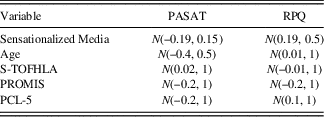
The point estimate of d=−0.19 was used as our prior for the effect of sensationalized media on cognitive performance. However, as discussed above, we chose a more conservative standard deviation for this prior by doubling the standard error obtained from the meta-analysis. This ensured that the Monte Carlo simulation explored an appropriately broad range of plausible prior effect sizes. For the effect of sensationalized media on PCS symptom reporting (RPQ scores), we also used a point estimate of 0.19 (in the positive direction to correspond to an expected increase in symptom reporting), but with a very conservative standard deviation of 0.5 to account for the uncertainty in this estimate resulting from a lack of prior data. The remaining priors were weakly informative and centered around zero, as they were not based on existing literature. The priors used in these analyses are shown in Table 1.
Prior distributions for predictors used in Bayesian analyses

Note. All priors are weakly informative priors except for PASAT on sensationalized media, which is an informative prior based on the existing literature. N=normal distribution with a given mean and standard deviation.
PASAT=Paced Auditory Serial Addition Test (sum of 3” and 2” trials), RPQ=Rivermead Postconcussion Symptom Questionnaire; S-TOFHLA=Short Test of Functional Health Literacy in Adults; PROMIS=Patient Reported Outcome Measures Information System; PCL-5=PTSD Checklist for the DSM-5.
We conducted two Bayesian t tests to examine the effect of sensationalized media on PASAT and RPQ scores. In addition, we conducted two Bayesian linear regression analyses to account for covariate effects. Both regressions used age group, S-TOFHLA, PROMIS, PCL-5, and these variables’ interactions with sensationalized media as the predictor variables and PASAT or RPQ as the outcome variable.
We used the brms (version 1.7.0; Bürkner, Reference Bürkner2017) and rstan (version 2.15.1; Stan Development Team, 2017) libraries in the R (version 3.4.1) software package (R Core Team, 2017) for these analyses. The Bayesian analyses used four chains, each with 2000 iterations (1000 warmup samples were discarded from each chain), for a total of 4000 post-warmup samples. Successful convergence was indicated by
 $\hat{R}$
(potential scale reduction factor) values close to 1 (± .01) (Gelman & Rubin, Reference Gelman and Rubin1992). Posterior predictive checks were run to visually examine whether the posterior distributions provided a reasonable match to the actual data, therefore, confirming that an acceptable model was used. The posterior predictive plots are available on the Open Science Framework project page (https://osf.io/v4mzq/).
RESULTS
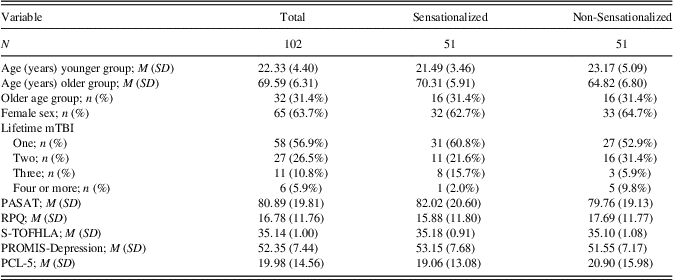
Participant demographics, mTBI history, and test scores can be found in Table 2. Due to a data collection error, information about years of education, race, ethnicity, and total months from last mTBI were only obtained from 60 (58.8%) of the 102 participants. Information about all other variables, including age and sex, were collected from all participants. All participants were screened to ensure their injury was post-acute, having occurred at least 3 months before testing. Groups did not differ on any of the covariates or demographic variables available.
Participant demographics, concussion history, and test scores

Note. mTBI=mild traumatic brain injury; PASAT=Paced Auditory Serial Addition Test (sum of 3” and 2” trials), RPQ=Rivermead Postconcussion Symptom Questionnaire; S-TOFHLA=Short Test of Functional Health Literacy in Adults; PROMIS=Patient Reported Outcome Measures Information System; PCL-5=PTSD Checklist for the DSM-5.
With Bayesian analyses, we were able to combine our prior knowledge from the research literature with our actual data collected during this study to obtain an updated estimate of the distribution of the effects, called a posterior distribution. The uncertainty in the posterior distribution is communicated through 95% credible intervals (CI). The CIs contain the values of the posterior distribution that are most likely to overlap the true population parameter value. If the CI does not overlap 0, then it is unlikely (<5% probability) that there is a true null effect of the predictor on the outcome; this is essentially equivalent to rejecting the null hypothesis (at α=.05) when using traditional significance testing (Kruschke, 2015).
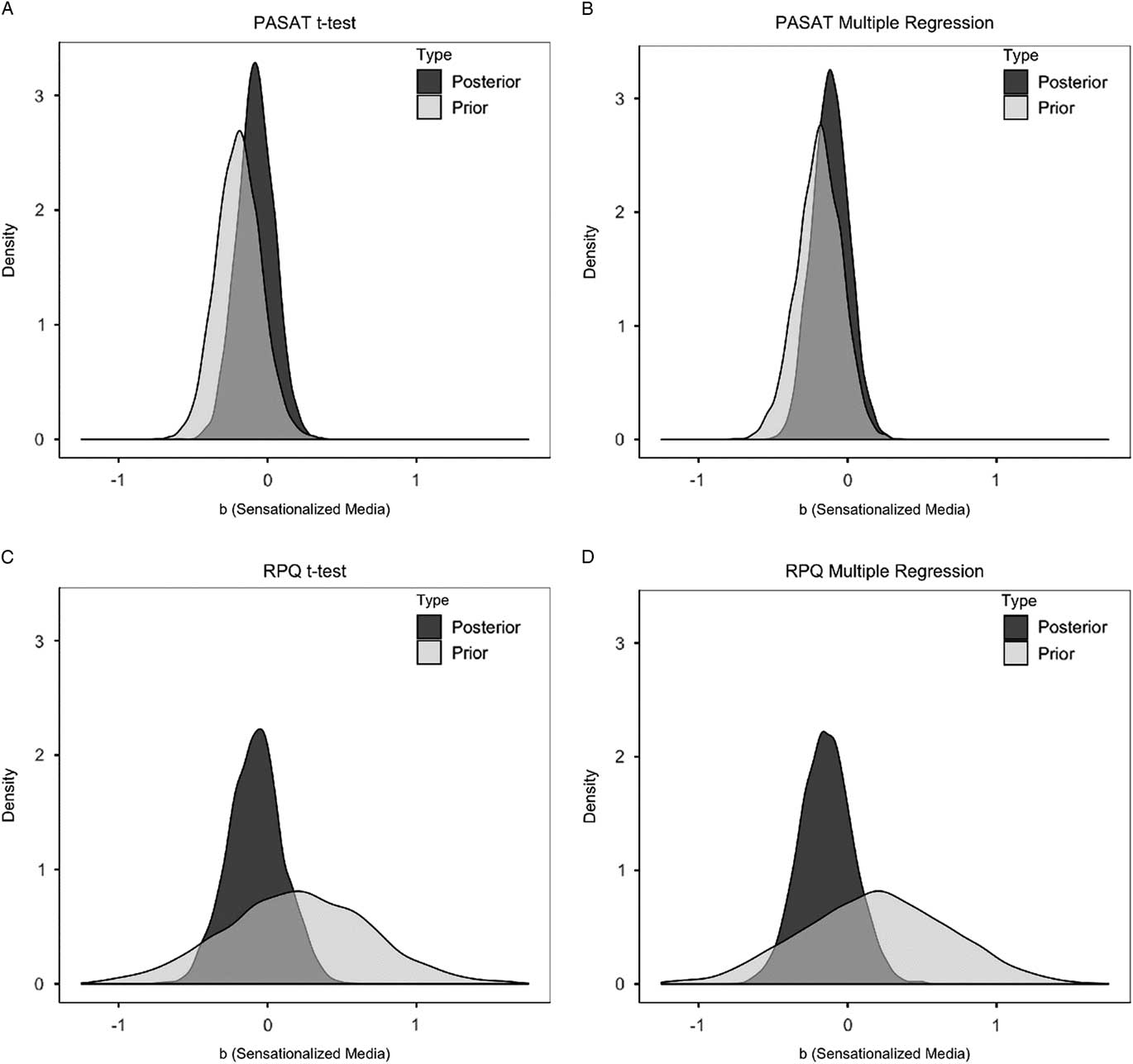
When examining the effect of sensationalized media on PASAT scores, the posterior distribution arising from this analysis had a mean β=−0.08 (SE=0.12; 95% CI [−0.32, 0.16]; see Figure 1), suggesting a very small effect of sensationalized media on PASAT performance. Expressed as a standardized mean difference, this effect size is Cohen’s d=−0.11, 95% CI [−0.51, 0.28].
Plot of prior and posterior distributions of parameter estimates for the effect of sensationalized media on PASAT and RPQ scores.

The posterior distribution arising from the t test examining differences in RPQ scores between the Sensationalized and Non-Sensationalized groups had a mean β=−0.08 (SE=0.18; 95% CI [−0.45, 0.29]; see Figure 1), also suggesting a very small effect of sensationalized media on RPQ scores. Expressed as a standardized mean difference, this effect size is Cohen’s d=−0.15, 95% CI [−0.55, 0.24].
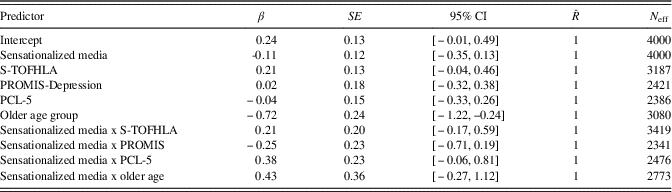
The regression of PASAT scores onto age group, S-TOFHLA, PROMIS, PCL-5, and the interactions of these variables with sensationalized media indicated that age group exerted a moderate to strong main effect on PASAT scores, such that the older participants scored around 0.7 standard deviations less than the younger participants on the PASAT. These results are shown in Table 3. Another finding to emerge from this regression was the small but likely positive main effect of health literacy (S-TOFHLA) on PASAT scores. However, the results indicate that the effect of sensationalized media on PASAT scores was not strongly dependent on age group or health literacy. Depression and PTSD symptoms were poor predictors of PASAT scores. After adjusting for the effects of covariates, the estimated effect of sensationalized media on PASAT scores became slightly more negative (−0.11 compared to −0.08) when compared to the t test results described above (Figure 1). However, this effect size estimate is too imprecise to be confident in the true direction of the effect. Nevertheless, it appears likely that, after accounting for covariate effects, sensationalized media is highly unlikely to cause more than a 0.3-SD decrease or a 0.1-SD increase in PASAT scores (see Table 3).
Parameter estimates for PASAT regression

Note. β=standardized regression coefficient; SE=standard error; CI=credible interval;
$\hat{R}$
=potential scale reduction factor; N
eff=effective sample size. S-TOFHLA=Short Test of Functional Health Literacy in Adults; PROMIS=Patient Reported Outcome Measures Information System; PCL-5=PTSD Checklist for the DSM-5.
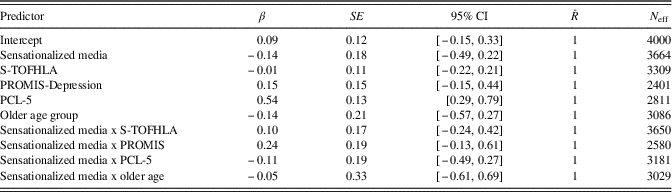
The results of the Bayesian model that regressed RPQ onto the same predictor variables described above for the PASAT regression indicated a moderately strong main effect of PTSD symptoms (PCL-5) on mTBI symptoms. However, the results provide no reason to believe that the effect of sensationalized media on RPQ scores varied according to PTSD symptomology. These results are shown in Table 4. Health literacy, depression symptoms, and age group were all shown to demonstrate negligible main effects and interaction effects with sensationalized media. After adjusting for the effects of covariates, the main effect of the sensationalized media clip actually became more negative (−0.14 compared to −0.08) when compared to the t test results described above (Figure 1). However, this effect size estimate is too imprecise to be confident in the true direction of the effect. Nevertheless, it appears likely that, after accounting for covariate effects, sensationalized media is highly unlikely to cause more than a 0.5-SD decrease or a 0.2-SD increase in concussion symptom reporting on the RPQ (see Table 4).
Parameter estimates for RPQ regression

Note. β=standardized regression coefficient; SE=standard error; CI=credible interval;
$\hat{R}$
=potential scale reduction factor; N
eff=effective sample size. S-TOFHLA=Short Test of Functional Health Literacy in Adults; PROMIS=Patient Reported Outcome Measures Information System; PCL-5=PTSD Checklist for the DSM-5.
As a manipulation check, we asked participants to respond to the statement “I believed what was said in the video” on a 5-point Likert scale ranging from “strongly agree” to “strongly disagree.” Results showed that participant ratings of the believability of videos had no moderating influence on the effects of sensationalized media on PASAT or RPQ scores (data not shown). This suggests that the results were not confounded by participants’ failure to trust the contents presented in the videos.
DISCUSSION
Based on the literature pertaining to stereotype threat, diagnosis threat, and the nocebo effect, we designed this study to determine whether exposure to actual sensationalized news reports causes a reduction in the cognitive performance or an increase in the symptom reporting of individuals with a remote history of mTBI. As such, this study is an early step toward addressing the concerns raised by neuropsychologists that patients with a history of mTBI may be negatively impacted by sensationalized media reporting about the negative consequences of brain injury (e.g., future risk of developing chronic traumatic encephalopathy [CTE; Vanderploeg, et al., Reference Vanderploeg, Belanger and Kaufmann2014]).
After participants viewed one of two video clips (sensationalized or non-sensationalized), the effect of this manipulation was estimated using a challenging test of working memory and attention (PASAT) and a measure of PCS symptomatology (RPQ). We first investigated the effect of sensationalized media in isolation using t tests, and then we examined its effect in the context of several covariates using multiple regression. These covariates included age group (older vs. younger) and measures of health literacy, depression symptoms, and PTSD symptoms. In all analyses, the use of Bayesian methods allowed us to combine our study data with existing expectations based on published effect sizes from similar studies. As such, our findings that the sensationalized media intervention used in the current study had negligible effects on PASAT and RPQ scores is not solely a function of the current sample data; rather, this finding is a function of combining the expected effect (derived from published effect sizes) with our observed data.
Although there is reason to be concerned about the sensationalized manner in which some factions of the media report on health risks, the current study suggests that exposure to actual news broadcasts that were highly discrepant in terms of their sensationalized and scientific qualities, does not cause individuals with a remote history of mTBI to suffer harm to their cognitive performance or the frequency with which they report symptoms of PCS. Furthermore, there is no reason to believe that these conclusions should differ based on age, health literacy, depression symptoms, or PTSD symptoms. While neuropsychologists should always strive to educate patients and members of the media about the scientific justification for conclusions that can be drawn about factors that influence health beliefs, this study does not suggest that sensationalized media reporting is doing substantial harm. However, the current study only addressed the acute effects of exposure to a single news segment. These results do not speak to the effects of long-term or downstream effects that may be imparted by repeated sensationalized media exposure. Such hypotheses can be addressed with future research.
We used Bayesian analysis to incorporate our prior knowledge (derived from meta-analysis), into the calculations. The results of these Bayesian t tests provided updated estimates of the effect of sensationalized media on cognitive functioning (β=−0.08; SD=0.12; [95% CI=−0.32, 0.16]) and PCS symptom severity (β=−0.08; SD=0.18 [95% CI=−0.45, 0.29]). Therefore, our prior assumption that sensationalized media would have a 0.19 standard deviation impact on PASAT and RPQ scores continues to be a credible estimate of the true effect.
Our results led to an updated estimate of the effect size produced by sensationalized media (intended to induce diagnosis threat) on cognitive test performance (β=−0.08) that was less extreme than our prior (β=−0.19). In other words, when considering our findings in the context of the larger body of research on this topic, it appears as though previous studies may have slightly overestimated the detrimental impact of this effect. One possible reason for this outcome is that factors such as the file drawer problem have led to publication bias (Rosenthal, Reference Rosenthal1979), causing studies with larger effect sizes to be published and studies with smaller effect sizes to go unpublished. Another potential explanation is that our sensationalized media clip did not induce diagnosis threat or related phenomena to the same extent as written vignettes that were designed in a laboratory setting to maximally elicit diagnosis threat (Suhr & Gunstad, Reference Suhr and Gunstad2002, Reference Suhr and Gunstad2005). One strength of the current study is that it is more likely to generalize to real-world situations than a written vignette, as televised media is one of the most common methods through which individuals consume health information (Van Slooten et al., Reference Van Slooten, Friedman and Tanner2013).
Another possible explanation for the smaller than expected effect sizes is that both media clips may have induced diagnosis threat to roughly the same extent as one another. Although the non-sensationalized media clip was rated as being more factual than the sensationalized media clip, it still could have been perceived as alarming by some participants. This explanation is plausible, especially considering that we used a between-groups design. Had we used a within-subjects design, then the relative differences between clips may have been more apparent in our results.
Along those same lines, within-subjects designs are associated with reduced measurement error and, therefore, tend to produce more precise effect size estimates. However, our concern about carryover effects caused by watching both videos led us to choose a between-groups design. As most research on diagnosis threat in mTBI has used between-groups designs, future research should consider evaluating this effect in the context of a within-subjects design. Similarly, future studies can build on the current study by using a more neutral control condition (i.e., using a video unrelated to mTBI) to determine whether diagnosis threat can be elicited by news reports on mTBI regardless of their sensationalized or scientific attributes.
It is also possible that participants already had strong beliefs about the recovery from mTBI before enrolling in this study. Collecting information about the participants’ prior education and media exposure relevant to mTBI could have helped clarify how participants’ beliefs about recovery from mTBI affected the current results. If preexisting beliefs were strong, watching a brief video clip may not have been a powerful enough stimulus to affect the dependent variables for some participants. Future studies should integrate participants’ beliefs about mTBI recovery both before and after watching the video clip to evaluate the effect of this variable. Fortunately, because random assignment was used to generate the experimental groups, it is unlikely that prior knowledge and beliefs about the effects of mTBI had a systematic influence on the results.
Consistent with prior literature (Silverberg & Iverson, Reference Silverberg and Iverson2011), PCL-5 scores were found to have a medium-sized main effect on reporting PCS symptoms. However, because of the overlap in PTSD and PCS symptoms, it is unclear whether this is a causal effect or whether it simply represents shared variance in the item content or in the methods. In our sample, the correlation between RPQ scores and PCL-5 scores was 0.62 (95% CI [0.48, 0.73]).
This study had several limitations and areas for improvement with future research. First, our sample size (N=102), although quite large compared to most studies investigating diagnosis threat in mTBI samples, did not allow for extremely precise estimates, especially considering the between groups design. With more participants, some of our imprecise effects could have been estimated more precisely. Additionally, not having complete demographic information and specific length of time since injury (other than screening out participants within 3 months of injury), limits our ability to know if our groups differed based on handedness, years of education, race, ethnicity, or specific time since last injury; however, given that random assignment was used to form our groups, this is not believed to be an important limitation.
Second, our participants were recruited from very circumscribed sources within a specific region of the United States and were well-educated. Therefore, our results may demonstrate a healthy volunteer bias in which the results found here may differ from a treatment seeking population (Delgado-Rodríguez & Llorca, Reference Delgado-Rodríguez and Llorca2004). Our results are most generalizable to populations with similar demographic characteristics. Caution should be used when generalizing our results to populations with demographic characteristics that are different from this study population.
Third, our sample was composed of individuals with mTBIs that occurred more than 3 months ago. We chose this sample so that participants’ cognition or symptom reporting would not be impacted by the acute effects of mTBI. Such an approach is consistent with previous studies, which generally excluded participants who were 3 (Blaine et al., Reference Blaine, Sullivan and Edmed2013; Carter-Allison et al., Reference Carter-Allison, Potter and Rimes2016) to 6 months (Kinkela, Reference Kinkela2008; Kit et al., Reference Kit, Mateer, Tuokko and Spencer-Rodgers2014; Ozen & Fernandes, Reference Ozen and Fernandes2011) post injury. Based on these exclusion criteria, the results from this study do not generalize to individuals who are actively recovering from a recent mTBI or to individuals with a history of moderate or severe TBI.
Because our sample consisted of individuals with a broadly defined and heterogenous history of remote mTBI, there may have been other sources of variability that were not investigated. For example, it is possible that the effects of sensationalized media may have differed based on the period of time that has elapsed since the mTBI occurred. Nevertheless, the majority of previous studies on this topic have also used a sample with high variability in time since injury (Blaine et al., Reference Blaine, Sullivan and Edmed2013; Carter-Allison et al., Reference Carter-Allison, Potter and Rimes2016; Kinkela, Reference Kinkela2008, Kit et al., Reference Kit, Mateer, Tuokko and Spencer-Rodgers2014; Ozen & Fernandes, Reference Ozen and Fernandes2011).
The current study also has numerous strengths. First, we used actual video clips broadcast by popular news organizations in the United States. Thus, the experimental manipulation is likely to have more external validity than manipulations that use laboratory-based vignettes that do not map on to the real-life experiences of individuals with mTBI. Second, our study used a sample size that was much larger than that used in existing mTBI-focused diagnosis threat studies; larger sample sizes allow for a more precise estimate of the effect size. Third, our use of Bayesian analytic methods allows our results to reflect the cumulative knowledge that has been compiled on this topic thus far. Fourth, much of the research in this area has used undergraduate student samples. Although we also used an undergraduate sample, this was supplemented with recruitment from the community, with a focus on adults aged 55 and older, to improve generalizability and determine whether this age group (which—on average—possesses lower health literacy [Kutner, Greenberg, Jin, & Paulsen, Reference Kutner, Greenberg, Jin and Paulsen2006]) is affected differently by sensationalized media compared to younger adults.
Despite concerns about possible detrimental effects of media reporting that sensationalizes the effects of concussion, the current results, when combined with prior information based on diagnosis threat and related literature, suggest that these effects on their own are negligible on the circumscribed tasks we tested. With the information we have, it appears that age group and PTSD symptoms exert medium-sized effects on cognitive performance and PCS symptom reporting, respectively. Finally, another benefit of the Bayesian approach used here is that our posterior distributions can be used as prior distributions in future studies examining the effect of sensationalized media on cognitive performance and PCS symptom reporting, for continued promotion of cumulative scientific knowledge.
ACKNOWLEDGMENTS
This manuscript was based on the first author’s master’s thesis. We sincerely appreciate the time, contributions, and support provided by Dr. Thomas A. Pyszczynski and Dr. Elizabeth Daniels. Additionally, we extend our gratitude to Caleigh Findley and Kathryn DeBlock for their assistance with this project. The posterior distributions from the main analyses are available on the Open Science Framework project page (https://osf.io/v4mzq/).
DISCLOSURE OF INTEREST
The authors report no conflicts of interest.
Supplementary material
To view supplementary material for this article, please visit https://doi.org/10.1017/S1355617718000760