Introduction
It is often argued that governments are more likely to avoid the blame for reforms they undertake – for example, by obfuscating the effects of the reform – than to claim credit for their accomplishments (e.g. Weaver, Reference Weaver1986), particularly when these reforms downsize popular programs such as the welfare state (Pierson, Reference Pierson1996). For that reason, it is often assumed that governments either do not retrench the welfare state or seek to obfuscate the reforms to avert electoral punishment. However, recent research challenges the assumption that welfare state retrenchment equates electoral hara-kiri: right-wing government parties even benefit electorally from welfare state retrenchment, only left-wing (or pro-welfare) governments are punished (Giger and Nelson, Reference Giger and Nelson2011; Schumacher et al., Reference Schumacher, Vis and van Kersbergen2013). In addition, voters seem to punish governments only if the retrenchment was an important issue in the electoral campaign (Armingeon and Giger, Reference Armingeon and Giger2008). When electoral punishment for retrenchment is not quite the iron law it aspired to be, we should also reconsider whether obfuscation is an electorally beneficial strategy for a government implementing welfare state retrenchment. Moreover, experiments demonstrate that elites’ active framing of welfare state recipients as undeserving, increasing the support for reductions in welfare to a great extent (Slothuus, Reference Slothuus2007). This suggests that government parties may avert electoral punishment, or even gain popular support, by actively advertising their retrenchments. However, under which conditions are the strategies of either advertising or concealing a retrenchment successful in electoral terms?
We propose that government and opposition play a strategic game of credit claiming and blame avoidance. The government can try to advertise or conceal the retrenchment and the opposition can choose to attack the government or not (see also Elmelund-Præstekær and Emmenegger, Reference Elmelund-Præstekær and Emmenegger2013). In case the government decides to communicate the retrenchment and frame it to its own benefit, we hypothesize that the government gains popularity if the opposition does not attack (H1), and that it keeps the status quo if the opposition attracts the governments’ view (H2). If the government obfuscates the retrenchment and the opposition stays silent, the electorate does not pick up on the reform and government support is unaffected (H3). However, if the opposition uncovers the government’s effort to obfuscate, we expect the government to face popular spanking (H4). In sum, we suggest that governments have nothing to lose and much to gain by actively communicating welfare state retrenchment.
We evaluate these hypotheses in eight major policy reforms in Denmark adopted between 1993 and 2011. For each reform, we determine the strategies chosen by the government and the opposition. We apply a new operationalization of the dependent variable – public support of the government in opinion polls – as we wish to study short-term fluctuations in government support around the time where reforms were presented for the first time. Compared with electoral results, poll standings are far less contaminated by other events than the reform of interest, which is a clear advantage when evaluating the popularity effect of welfare state reform.
In addition, we study one of the strategic tools governments have at their disposal to evade or reduce electoral punishment from reform. Although experimental studies of political communication document the importance of framing (Chong and Druckman, Reference Chong and Druckman2007a; Slothuus, Reference Slothuus2007) and the welfare state literature show the importance of language, ideas, and symbols (Cox, Reference Cox2001; Schmidt, Reference Schmidt2002, Reference Schmidt2010; Béland, Reference Béland2005), the effect of communication on electoral performance of retrenching governments is not systematically evaluated. Studies that do evaluate such effects (Giger and Nelson, Reference Giger and Nelson2011; Schumacher et al., Reference Schumacher, Vis and van Kersbergen2013) underestimate the agency of political actors in shaping their electoral fate. As we find empirical support for our main arguments, we demonstrate that by actively advertising retrenchment, governments can undo the electoral damage initially associated with welfare state retrenchment.
Reform strategy and the role of communication
Governments need to balance their reform agendas carefully against electoral ambitions (Vis, Reference Vis2010). On the one hand, governments are motivated to shape public policy according to their ideological views. On the other hand, governments want to stay in office and, therefore, avoid electoral blame for unpopular or failed policy initiatives (Strøm and Müller, Reference Strøm and Müller1999: 7). Pierson (Reference Pierson1996) claims that governments can reduce electoral risks by offering compensation to disaffected voters, dividing the opposition by attacking particular groups and by obfuscating the real policy effects of a reform. Other strategies involve interaction with other political actors: governments may try to share the blame with as many parties as possible (Weaver, Reference Weaver1986; Green-Pedersen, Reference Green-Pedersen2002), act strategically to circumvent veto players (Wenzelburger, Reference Wenzelburger2011), or keep organized interests in ignorance to prevent them from mobilizing resistance against reform (Gibson and Goodin, Reference Gibson and Goodin1999; Christiansen and Klitgaard, Reference Christiansen and Klitgaard2010).
Yet another strategy to avoid blame is to try to redefine the issue (Weaver, Reference Weaver1986). With this strategy, governments seek to alter the negative associations citizens have with the reform to positive associations. For example, governments may argue that the status quo is untenable and that a reform is economically necessary (Vis and van Kersbergen, Reference Vis and van Kersbergen2007; Wenzelburger, Reference Wenzelburger2011; Boeri and Tabellini, Reference Boeri and Tabellini2012), or they can appeal to moral sentiments (e.g. rightfulness or equality) rather than technical issues (Kangas et al., Reference Kangas, Niemela and Varjonen2014). In addition, governments may try to dispute the ‘deservingness’ of individuals receiving the welfare service or benefits that are being retrenched. By downplaying the claims of – for example, immigrants’ or young people’s entitlement to welfare – governments can mobilize support for retrenching their benefits (van Oorschot, Reference van Oorschot2000; Slothuus, Reference Slothuus2007). We can summarize these strategies on a continuum with two extremes: on the one extreme we find the active communication strategy, with which governments seek to change the voters’ thinking on an issue, and thus gain public support. At the other extreme, we find the strategy of almost complete obfuscation, with which the government seeks to avoid blame by pretending the retrenchment never happened.
In the welfare state literature, there is a tradition of studying how governments use discourses to give popular legitimacy to welfare reforms (Cox, Reference Cox2001; Schmidt, Reference Schmidt2002, Reference Schmidt2010; Béland, Reference Béland2005), which indicates that communication may play a key role for governments that seek to balance a preference for unpopular policies against their electoral ambitions. To the best of our knowledge, this line of research does not systematically trace the effect of discourses or ideas on mass public opinion across a wider range of cases. Building on the insights of the experimental framing studies, we argue that two criteria must be met for government communication to be effective. First, the government needs to communicate a ‘frame’ – that is, ‘a selective emphasis of certain aspects of a perceived reality’ (Entman, Reference Entman1993: 52) – that is believed to promote the issue at hand. Second, the government frame must prevail over competing frames offered by its opponents, first and foremost the parliamentary opposition. Although several studies show that frames in communication can move public opinion, it has been shown to happen only if they are left unchallenged by competing frames. If challenged, the effects of the different frames cancel each other out (Chong and Druckman, Reference Chong and Druckman2007b).
Yet, we do not know whether this theoretically sound mechanism helps real governments to avert electoral punishment for welfare state retrenchment. In order to analyze this uncharted terrain, we now turn to a theoretical discussion on how communication, or obfuscation by government and opposition, influences government support in the wake of unpopular welfare state reforms.
Welfare state reform and public opinion: four hypotheses of losses and gains
The presentation of reforms in parliament inevitably generates political attention. However, governments are not obliged to advertise retrenchment plans to the wider public through public speeches and media campaigns, before the presentation of such plans. Following the strategy of obfuscation, governments might just keep quiet. However, for the reasons outlined above, governments may also opt for communication and highlight – for example – the cost of the welfare program in question by depicting beneficiaries as undeserving.
The strategic situation of the opposition is different. It can choose to rebel against the retrenchment – for example, by questioning the problem identified by the government or by rejecting the government’s policy solution. The opposition has incentives to attack the reform to harvest public dissatisfaction against it. However, the opposition may also have reasons not to oppose the government in the public: it may, for example, want the government to bite the bullet so that the opposition itself does not have to do this once it gets into government. The opposition may also lack the resources to engage in an attack or it may choose to prioritize other issues. Although the former reason primarily applies to larger opposition parties with office ambition, the latter primarily applies to smaller and ideologically more extreme parties, which have neither strong parliamentary representation nor wealthy party organizations.
Table 1 depicts four hypotheses that derive from the combination of government and opposition strategies discussed above. In the first quadrant, the government actively communicates the reform in an attempt to gain public support, and the opposition does not publicly engage the government with counter arguments. In this situation, we predict that the government experiences a popularity boost (H1), because its unopposed communication alters voter perceptions of the retrenchment measure and/or the political context – for example, by depicting the current recipients as undeserving or by describing the retrenchment as the lesser of evils.
Four combinations of government and opposition strategies in unpopular reforms and four hypotheses about the reform’s impact on public support for the government

Experimental research shows that diverging frames cancel out each other’s effect on public opinion. Thus, we expect public support to remain stable (status quo) in the second quadrant (H2), where government communication is challenged by opposition communication. Here, voters are expected to stick to their predispositions.
In the third quadrant of Table 1, the government obfuscates the retrenchment while the opposition makes no attempts to start a public debate over the issue. In this case, there will be little media attention because of the absence of conflict between political elites (Bennett, Reference Bennett1990). Consequently, voter perceptions are unlikely to be altered and the reform is unlikely to prompt voters to re-evaluate their party preferences (H3).
Finally, if the opposition chooses to attack an obfuscating government, public support declines (H4). In this case, the government has not provided the public with any reason to upset the policy status quo, whereas the opposition directly argues that the proposed retrenchment is wrong. The opposition might, for instance, frame the reform as unfair by emphasizing that it hurts a highly deserving group. Thus, the opposition selectively emphasizes those aspects that benefit its cause and voter perceptions adapt to the opposition’s world view. In this situation, the opposition is likely to shy away some of the government’s supporters.
Welfare state retrenchment often entail concentrated losses in return for diffuse gains and, because of a generally risk adverse public, voters are likely to punish the government harder for possible losses than they reward possible gains (Kahneman and Tversky, Reference Kahneman and Tversky1979). Hence, we expect a negativity bias and consider it more likely that we will find a small negative effect than a small positive effect in the status quo situations (H2 and H3), and that the negative effect (H4) will be larger in magnitude than the positive one (H1). However, the central argument persists: governments are not always punished when opting for retrenchment and the effect is contingent on the strategic choices of both the governments and the opposition. Most importantly, we argue that in terms of public support, government communication is a superior strategy compared with obfuscation.
Design of the empirical study
We examined the hypotheses in a comparative case study of eight major cases of labor market-related retrenchment, enacted in Denmark between 1993 and 2011. We chose this policy field because labor market issues are highly salient to politicians and voters alike. The issue is at the core of the traditional left–right divide and it still divides left- and right-wing parties. Voters also care about the issue: most of them are in the job market, which means that unemployment policies and retirement from the labor market, potentially, have a major impact on their well-being. If communication helps governments to evade popularity plunges on such a highly salient issue, it is likely that communication will be at least as effective for less salient issues.
We chose Denmark because (1) we wanted to restrict our analysis to one case country in order to keep constant a range of otherwise relevant country variables. The popularity effect of welfare state retrenchment might, for instance, be affected by institutional procedures of political decision making and modes of interest group involvement in the decision-making process (Bonoli, Reference Bonoli2001; Klitgaard, Reference Klitgaard2008; Culpepper, Reference Culpepper2011). (2) The Danish case provides a multitude of major reforms, which is a prerequisite in order to test our theoretical arguments. Furthermore, all reforms were implemented during the 1990s and 2000s, thus keeping the societal context constant. Voters did not become significantly more volatile (www.valgprojektet.dk) nor did the mass-communication of politics become more or less important (Elmelund-Præstekær et al., Reference Elmelund-Praestekaer, Hopmann and Nørgaard2011); therefore, our theoretical assumptions about the electorate and the role of communication applies in the entire period of investigation. (3) Danish labor market reforms provide variation on the combination of government and opposition obfuscation/communication, thus we have empirical cases in all four quadrants of Table 1. (4) The Danish case enables us to evaluate the effects of communication, taking the rival explanation of ideology (Giger and Nelson, Reference Giger and Nelson2011; Schumacher et al., Reference Schumacher, Vis and van Kersbergen2013) into account, because the strategies of obfuscation and communication have been chosen by right-wing as well as left-wing governments.
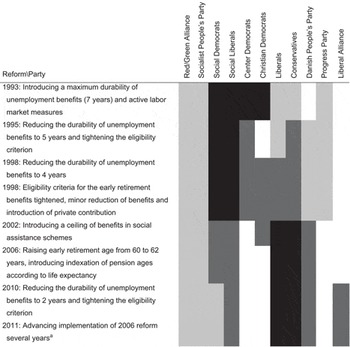
In order to identify the major labor market reforms, we surveyed five key texts on Danish welfare state reforms since the early 1990s (Green-Pedersen, Reference Green-Pedersen2002; Winther, Reference Winther2003; Larsen and Andersen, Reference Larsen and Andersen2004; Andersen, Reference Andersen2011; Klitgaard and Nørgaard, Reference Klitgaard and Nørgaard2014). To cross-validate our initial selection, it was presented to two national experts on recent welfare state development. On the basis of their evaluations, we made a few adjustments and arrived at the list presented in Table 2. The table also shows which parties supported and which opposed each of the reforms.
Eight major welfare state reforms in Denmark from 1993 to 2011 and their parliamentary support

Black=government party; gray=opposition party that supports reform measure; crossed=opposition party that opposes reform measure; blank=parties not represented in parliament.
a The reform was not tabled before the election and the table shows the parties’ position toward the reform agreement.
We limit the universe of cases to policy reforms and exclude institutional reforms. Policy reforms redistribute substantial resources with direct relevance to voters – for example, changing benefit levels and durability of welfare state programs – whereas institutional reforms redistribute institutional power resources that do not have immediate consequences for voters (cf. Elmelund-Præstekær and Klitgaard, Reference Elmelund-Præstekær and Klitgaard2012). Thus, governments are more likely to suffer popular punishment when implementing policy reforms than when opting for institutional reform. Even if the actual changes in a given policy reform have only modest negative consequences for the level of welfare experienced by citizens, the transparency and public attention associated with such reforms are potentially damaging to the electoral ambitions of reform governments (Lindbom, Reference Lindbom2010).
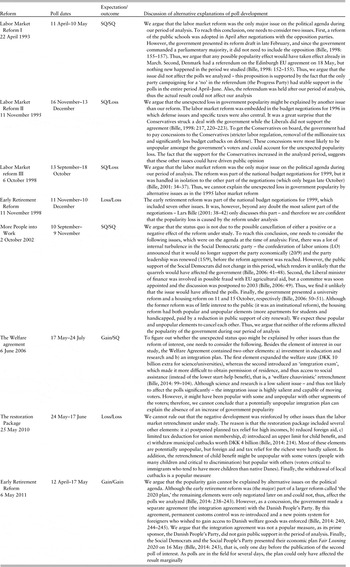
For the dependent variable, previous studies of the electoral consequences of retrenchment analyze electoral results before and after the reforms (e.g. Giger and Nelson, Reference Giger and Nelson2011; Schumacher et al., Reference Schumacher, Vis and van Kersbergen2013). However, ‘social policy does not have the outstanding relevance for voters as assumed by the social policy literature’ (Giger, Reference Giger2010: 415). At least election results are affected by a much wider range of factors. This is especially true if retrenchment is implemented in the early stage of the electoral cycle, as most scholars suggest governments do. Moreover, governments may not restrict themselves to implementing only one unpopular reform per electoral term; therefore, it is difficult to isolate the effect of a retrenchment measure on electoral results. Thus, we propose an alternative dependent variable, namely change in public support for the government as gauged by monthly opinion polls. Compared with election results, opinion polls drastically reduce the amount of factors that affect government popularity besides the retrenchment. Obviously such alternative explanations still exist and we review them using Lars Bille’s (Reference Bille1998, Reference Bille2001, Reference Bille2006, Reference Bille2014) bi-annual chronicles on Danish politics. Judging from this historical source, our reforms, in most cases, were far more important than any other issues on the political agenda. In some cases, other issues could have had an influence on public support for the government; however, we are fairly confident that our reforms had the strongest influence on public support at the time they were adopted (for further elaboration, see the Appendix). Despite the fact that polls are not consequential in the same way as election results – governments are not rejected from office due to a plunge in the polls, only from lost elections – governments have been shown to react to polls as if they were true election results (Hobolt and Klemmensen, Reference Hobolt and Klemmensen2005). Therefore, we assume that parties use poll standings to evaluate what wins public support. We use a quality weighted average of several polls, and this way we have ~4500 respondents at each time point.Footnote 1 We calculate standard errors to determine whether changes in government support in the pre- and post-retrenchment polls are statistically significant.
Policy making is a complex process and it is difficult to pinpoint the exact moment that a solution or a problem was defined. However, to track government poll performance, we need a specific time point that is comparable across cases. Moreover, we need to consider a time point where the issue at hand is discussed not only at the elite level but also transpires to the voter level, as we assume that voters react to reforms only when the consequences are certain. Because almost all Danish policy reforms are negotiated in complicated processes and adopted by coalitions between the government and non-government parties, the outcome of the reform is only known when a final reform agreement is presented. Therefore, we focus on the day a reform agreement is publicized.
In order to measure our independent variables, we analyze whether governments obfuscate or communicate reforms by surveying key government documents to detect possible discussion of retrenchment measures before the presentation of the reform agreement. If we cannot find such discussions or other indications of retrenchment ambitions, we conclude that the government opted for obfuscation. We rely on multiple data sources such as election manifestos of the incumbent parties, the coalition agreement as formulated by the coalition partners, and the major speeches of the Prime Minister. We also look for policy papers or reform proposals from the government preceding the presentation of the reform agreement. This type of material might not cause voter reactions; however, if governments choose communication over obfuscation, they are likely to begin by framing the issue to their advantage in such outlets. The strategic choice of opposition parties is explored by surveying the five largest daily newspapers – that is, Politiken, Berlingske, Jyllands-Posten, Ekstra Bladet, and B.T. (using the database Infomedia) – for direct and indirect citations of opposition politicians, during the weeks following the presentation of a reform.Footnote 2 The news media is ideal for our purpose, because we are interested in the opposition’s extra parliamentary activities. Public criticism is a prerequisite for oppositions to expose obfuscating governments or counter-argue with communicating governments. If the opposition chooses to attack the government, news media is likely to pick up on it because of the news value of direct political confrontation (Schudson, Reference Schudson2003).
Analysis
The empirical analysis is organized in four parts, one for each hypothesis. Each of the hypotheses is evaluated on the basis of two reforms, which are analyzed in chronological order. Each case study begins with a brief description of the central elements of the retrenchment. This is followed first by an analysis of the government’s strategy (obfuscation or communication) and next by the opposition’s strategy (attack or no attack). Finally, we conclude whether or not the reforms affected the public support of the government as expected in the relevant hypothesis.
H1: Government communication and no opposition attack: government gain
The right-wing government of the 2000s enacted two reforms that were communicated and unopposed by the opposition. The first reform was enacted in 2006 and it included several components designed to prevent early retirement from the labor market. First, it was decided to let the early retirement age rise gradually from 60 to 62 years in 2019 until 2022. Second, the pension age should rise gradually from 65 years in 2024 to 67 years in 2027. Third, it was decided to index the pension age automatically in accordance with an increasing life expectancy, beginning in 2025. Moreover, the eligibility criteria of the early retirement benefits were tightened (Government, 2006). The government carefully communicated the reform before it was officially presented on 20 June. On several occasions in 2005/06, the government advertised intentions to retrench the public pension schemes. The Prime Minister argued in his New Year’s Speech on 1 January 2006, that ‘we need to gradually postpone the point in time when we normally retire from the work life. That means that we have to reconsider the regulation of early retirement benefits and pensions’ (our translation). The same argument was presented in the opening speech of the parliament as early as 4 October 2005. The retirement age was also a core issue in the work of the government-appointed Welfare Commission (appointed in late 2003 and finishing late 2005). The commission was formally obligated to encourage and engage in a public debate about its analyses and reform proposals. Thus, the commission’s members and employees gave no less than 422 public presentations (Welfare-Commission, 2006). The opposition did not publicly challenge the government after the retrenchment was presented.Footnote 3 The Red/Green Alliance was not mentioned in the news, and while the Socialist People’s Party problematized inequality and the reform’s alleged marginal effect on the employment rate the party did so in only a very few instances.
The 2011 reform was very similar in content to the 2006 reform, as it basically advanced the implementation of the latter by 5 years. In addition, it reduced the maximum duration of the early retirement benefit from 5 to 3 years (Government, 2011a). Compared with the 2006 reform, the Prime Minister was even more direct in his communication of the retrenchment in 2011: in his New Year’s speech on 1 January 2011, he pledged to abolish the early retirement benefits entirely, while pointing to what he called ‘the special Danish ability to take action in due time’ in order to circumvent ‘mass demonstrations and violence in the streets as we have seen in several European cities’ (our translation). He concluded that Denmark faced two related problems, namely rising public budget deficits and a demographic challenge due to increasing numbers of elderly people leaving the work force. Furthermore, he argued that ‘the early retirement program hits the bull’s eye in these two major challenges; we have to use our common cash chest wisely. And we need to bring more people into work […]. The government thus proposes to gradually abolish the early retirement benefits’ (Jyllands-Posten, 3 January 2012, our translation). On 25 January, the government followed up this pledge by a concrete reform proposal, which included the abolishment of the early retirement benefits, increasing retirement age, and a new so-called senior pension (Government, 2011b). During negotiations with the Social Liberals and Danish People’s Party, concessions were given and the final agreement was presented on 13 May (Government, 2011a). At this point in time, the two major opposition parties – that is, the Socialist People’s Party and the Social Democrats – did not question the governments’ ‘economic responsibility’ frame.Footnote 4 In fact they spent most of their media time explaining why they might implement the reform if they were to gain office after the upcoming election – which they eventually didFootnote 5 – even though they did not support the reform agreement.
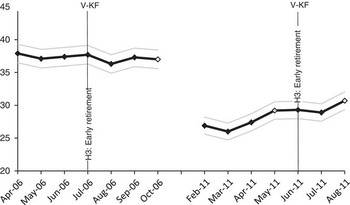
The combination of energetic government communication and oppositional silence situates the 2006 and the 2011 reforms in the first quadrant of Table 1. Here, we expect the governments to gain public support. Figure 1 shows that public support for the government rose in both cases, albeit only significantly in 2011, and the result cannot be explained by other issues (see Appendix). As (major) loss of public support in case of retrenchment is expected by conventional wisdom, we believe that our findings, to the contrary, demonstrate the importance of government communication and calibration of public expectations.
Government support in polls before and after retrenchment measure (H1).
Note: Grey and white diamonds denote significant change in poll rating compared with the month before at a respectively 90% and 95% confidence interval. Lines denote 1 month after reform (e.g. our dependent variable).

H2: Government communication and opposition attack: status quo
When the Social Democratic government took office in late January 1993, it was a key ambition to combat the structural unemployment, which had reached double digits (Government, 1993: 2, 10). Thus, it presented a labor marked reform after just 3 months in office – a reform that is often seen as a conceptional prelude to the later reforms in 1995 and 1998 (see below). Key elements of the 1993 reform were the introduction of a 7-year limit to the durability of unemployment benefits and a significant shift in Danish labor market policy toward active measures, as opposed to passive benefits (Torfing, Reference Torfing2004; Klitgaard and Nørgaard, Reference Klitgaard and Nørgaard2014). Thus, the reform enforced stricter obligations to participate in labor market programs in return for benefits, and such activation would no longer re-qualify the unemployed individual to a new period with benefits. Finally, the government saw education as an important tool to improve on the skills of unemployed persons and bring them back to the labor market (Folketingstidende 1992/93: 8884 ff.). Although the new government had little time to advertise the reform before it was presented on 21 April, it managed to do so: the coalition agreement openly declared that the unemployment issue was ‘Denmark’s biggest social and economic problem’ (Government, 1993: 2, our translation), and it announced the implementation of ‘innovative reform measures’ to get more people into jobs. The content of the reform was not spelled out in details, but it was evident that activation, education, and stricter individual obligations would figure prominently (Government, 1993: 11–14). The Prime Minister was more specific in his first speech in parliament (on 3 February), where he highlighted that the reform would clarify ‘rights and responsibilities’ of individuals and that the durability of unemployment benefits would be restricted to 7 years. The oppositional critique of the reform was pronounced.Footnote 6 The right-wing opposition did not believe in the activation paradigm, and argued that the new labor market programs and education initiatives would ‘only camouflage the actual unemployment figures’ (our translation) and that the reform would only guarantee increasing public spending – not an enlarged labor force (Politiken, 21 April). The Liberals described the reform as ‘mistaken’, because it did not reduce the benefit levels to strengthen incentives to work. Finally, the left-wing opposition found no prospects in the reform, as ‘it would force more unemployed onto the lower social assistance benefits and not into jobs’ (Berlingske Tidende, 21 April, our translation).
In 2002, the right-wing successor announced an encompassing reform entitled ‘More people into work’. The content of this reform was quite different from the changes in 1993: it introduced a ceiling on social assistance benefits, designed to increase the economic incentives for recipients to make a greater effort in getting back into the labor market (Government, 2002a). In addition, the social assistance benefits were reduced to the level of the student allowance for people under the age of 25 years. Finally, all unemployed were obliged to take any ‘reasonable’ job offered to them and unemployed, holding a higher education, should be willing to take jobs that entail commuting up to 4 hours a day. Before the presentation of the final agreement on 7 October, the government engaged in various activities to alert the public. In May, the government published a report on the existing system and its challenges (Government, 2002c), presenting the overall goals of the reform to be presented in September. This government proposal was publicized on 14 September and it argued that ‘it is of paramount importance that we get many more people on the labor market and into employment. Otherwise we might be forced to reduce the welfare’ (Government, 2002b: 3, our translation). With a work force shrinking in relative size compared with the group of citizens depending on income compensating programs, unemployed should be ‘available for the labor market […] but availability rules can only be effective if there are consequences for not following them’ (Government, 2002b: 17, our translation). Moreover, the government recurrently emphasized that especially the young, immigrants, and unskilled workers had only weak incentives to seek regular jobs and that ‘shifting from passive welfare to active employment should entail an increase in personal income’ (Government, 2002b: 19, our translation). Therefore, the reform was yesterday’s news when it was presented in October, which might be the reason why it generated only moderate levels of media attention.Footnote 7 However, the Socialist People’s Party actively opposed the reform by arguing that it does not help to kick a man already lying down (Berlingske Tidende, 8 October).
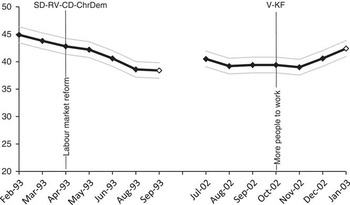
With proactive communication on behalf of the government and the opposition alike, the 1993 and the 2002 reforms fit the second quadrant in Table 1, where we expect a government status quo in the polls. During the relevant period of analysis, the governments lost 0.6 and 0.4 points, respectively, which clearly is within the error margins of the point estimates of the polls (see Figure 2), and the status quo is not due to other issues’ possible cancellation of either a positive or a negative effect of the reforms under study (see Appendix). Thus, we are fairly certain that the retrenchments had no, or at the most a very limited, impact on the public support of the reforming governments.
Government support in polls before and after retrenchment measure (H2).
Note: Grey and white diamonds denote significant change in poll rating compared with the month before at a respectively 90% and 95% confidence interval. Lines denote 1 month after reform (e.g. our dependent variable).

H3: Government obfuscation and no opposition attack: status quo
In order to evaluate the effects of government obfuscation and a relatively silent opposition, we analyze the labor market reforms in 1995 and 1998. The 1995 reform reduced the duration of unemployment benefits from 7 to 5 years, and put an end to the possibility of participating in ordinary education while receiving such benefits. In addition, work requirements were increased from 26 to 52 weeks of ordinary work for benefits eligibility (Folketingstidende, Tillæg A, 1995/96: 140–151, 152–167). The reform was embedded in budget negotiations for the next year and it was neither mentioned in the 1994 election manifestos of the incumbent parties nor mentioned in the Prime Minister’s major speeches in parliament. In fact, the government did not mention the reform until a final agreement with the Conservatives was reached in late November. By embedding the reform in the budget negotiations, the number of actors with information about its content was greatly reduced and the government could more easily manage the communication flow about the retrenchment measures. The strategy succeeded as none of the newspaper articles about the reform, in the period between late November and late December, carried any substantial critique of the reform on behalf of the opposition.Footnote 8 The Liberals criticized the government for lacking ambition, whereas the left-wing parties sporadically leveled a ‘too deep cut’-argument, but it was primarily related to the entire national budget rather than the specific labor market reform.
The reform in 1998 took up the lead from the reforms in 1995 and in 1993, as it, once again, reduced the duration of the unemployment benefits: this time to 4 years. The reform also obliged the unemployed to participate in labor market programs for the last 3 years of the benefit period (Folketingstidende, Tillæg A, 1998/99: 492–502). The decision-making process of the 1998 retrenchment was very similar to the one in 1995: the negotiations were embedded in the national budget negotiations and the retrenchment was neither mentioned in the government parties’ election manifestos, before the 1998 election held in March, nor was it discussed in the coalition agreement published soon after the election. The reform was initially prepared by a ministerial committee, and on 7 July the newspaper Berlingske Tidende mentioned that the committee was discussing further reductions in unemployment benefits. Throughout September, and until October, the Prime Minister denied, however, that such a measure was in the making (Politiken, 30 August; 9 September). The government continued to obfuscate until the final reform agreement was officially presented by the Prime Minister in his Opening Speech in Parliament on 6 October. None of the opposition parties attacked the reform in the media.Footnote 9 In fact, the media did not mention the reform at all in the aftermath of the presentation. This probably occurred because rumors about a reform of the early retirement scheme – to which we will return later – received a lot of attention in this period.
In sum, the labor market reforms in 1995 and 1998 were obfuscated and shielded from public debate, or attempts on behalf of the opposition to challenge the government, in the media. According to H3, this situation should yield an electoral status quo in the polls. Yet, Figure 3 shows that government support declined significantly after both reforms. The unexpected drop in government popularity after the 1995 reform might be explained by other issues than the reform itself, but the 1998 drop cannot be explained in this way (see Appendix). We, thus, suggest that in a situation of government obfuscation and absence of opposition attack, the general status quo bias of individuals causes a decrease in support for the government.
Government support in polls before and after retrenchment measure (H3).
Note: Grey and white diamonds denote significant change in poll rating compared with the month before at a respectively 90% and 95% confidence interval. Lines denote 1 month after reform (e.g. our dependent variable).

H4: Government obfuscation and opposition attack: government loss
Finally, we discuss two reforms that were obfuscated by the government and attacked by the opposition. First, we consider the 1998 early retirement reform that introduced individual private contributions to the scheme, tighter eligibility criteria, and a 9% cutback on the replacement rate for some groups (Folketingstidende, Tillæg A, 1998/99: 472). The reform was – just as the two labor market reforms discussed above – embedded in the national budget negotiations for the following year, and the Prime Minister did not mention the retrenchment in any of his major speeches. Nor was the reform touched upon in the incumbent parties’ election manifestos and their coalition agreement. When the government presented its budget proposal in August, the need to expand the supply of labor to cope with an aging population was emphasized, but the early retirement scheme was not mentioned as a possible part of a solution. In short, the 1998 reform was as obfuscated as the labor market reforms analyzed in the former section. However, the presentation of the reform agreement (on 25 November) ignited a media storm, and the government was severely criticized by the Socialist People’s Party, the Red/Green Alliance, and to some extent, the Danish People’s Party.Footnote 10 These parties argued that the reform did not solve anything, but was a problem in itself because it would create social inequality. The proposed increase in individual contributions would undermine the universalism of the program and it might prompt the least well-off workers to opt out. In addition, the most needy, and thus deserving people, would not physically be able to postpone their retirement and they would not benefit from the incentives to stay on longer.
In 2010, the right-wing government reduced the duration of the unemployment benefits from 4 to 2 years. Moreover, it became more difficult to re-qualify for a new period with benefits, as one now had to be employed for 52 weeks over a period of 3 years and not 6 years as before (Government, 2010b). These measures were part of a larger reform that publicly addressed the problem of increasing unemployment, but the retrenchment of the unemployment benefits was never mentioned as a potential solution. On the contrary, the Prime Minister and the Minister of Labor repeatedly ruled out such measures, even when the government-appointed Labor Market Commission called for it (e.g. Jyllands-Posten, 20 August 2009). Neither was the issue mentioned in the Prime Minister’s opening speech in parliament in October, in his New Year’s speech, nor in the coalition agreement (Government, 2010a) presented in February 2010, although this document discussed a range of detailed labor market initiatives. The presentation of the reform agreement (on 25 May) prompted considerable media attention and the opposition confronted the government:Footnote 11 the chairman of the Social Democrats ‘could hardly find words’ to characterize the situation where the ‘unemployed first must pay for the economic crisis and the collapse of the banks with their jobs and next they are told also to pay with their unemployment benefits’ (Jyllands-Posten, 26 May), and the Socialist People’s Party accused the government of breaking an electoral promise. Both parties described the retrenchment as ‘unsympathetic’ and ‘un-Danish’ (Jyllands-Posten, 26 May).
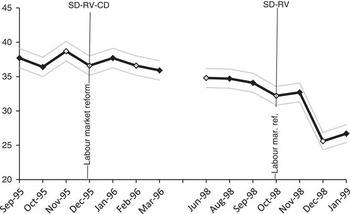
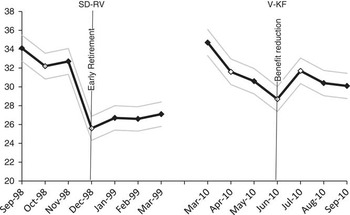
Thus, the 1998 and the 2010 reforms fit the situation depicted in the fourth quadrant of Table 1, where the government obfuscates while the opposition levels a full-blown attack on the government in the media. In this situation, we expect the government to suffer losses in public support (H4). Figure 4 indeed supports this proposition, as it is evident that the government lost public support in the aftermath of each reform – 1.9% in 2010 and a staggering 7.1% in 1998 – and these results are robust when considering alternative explanations for declining government support (see Appendix).
Government support in polls before and after retrenchment measure (H4).
Note: Grey and white diamonds denote significant change in poll rating compared with the month before at a respectively 90% and 95% confidence interval. Lines denote 1 month after reform (e.g. our dependent variable).

Discussion
Welfare state researchers often assume that obfuscation is the preferred strategy for governments that wish to retrench popular programs without electoral suffering. Recent studies do, however, show that such reforms are not necessarily electoral hara-kiri for governments (Armingeon and Giger, Reference Armingeon and Giger2008; Giger and Nelson, Reference Giger and Nelson2011; Schumacher et al., Reference Schumacher, Vis and van Kersbergen2013). Our study provides new empirical evidence for this conclusion, as only four out of eight major Danish reforms during the 1990s and 2000s had detectable negative consequences for the government when measured by monthly opinion polls. Moreover, we pitch two novel theoretical arguments, which we empirically validate: first, we argue that a government can gain from implementing welfare state retrenchment if it chooses to communicate the reform while the opposition decides not to oppose the government in the media. Second, we argue that a government is able to retain a popularity status quo in situations where the government and the opposition alike opt for proactive communication.
We also predict that governments face a popular spanking when they obfuscate the retrenchment and the opposition decides to attack the government on the issue. This expectation is indeed supported by our cases. Contrary to our expectation, however, we find that governments also suffer losses if the opposition chooses not to attack an obfuscating government. On this basis, we consider a minor revision of our theoretical model: governments are (only) punished for welfare state retrenchment if they obfuscate, and the severity of the punishment depends on the opposition’s decision to attack or not to attack the government. A government can, however, evade a drop in public support if it chooses to communicate, and the government even benefits from the retrenchment if the opposition decides not to attack.
Our study moves beyond the question of whether governments are punished for welfare state retrenchment and discusses what strategies the government may opt for to evade such punishment. The conclusion is clear: seen from the government’s perspective, communication is superior to obfuscation. The same goes for the opposition: by attacking the government the opposition increases the likelihood that the government will lose support. Therefore, we show that governments have much more leeway to push through unpopular reforms than is commonly assumed.
In order to qualify the conclusion, we need to consider alternative explanations of fluctuation in government support. First, we note that communication seems to matter to left- as well as right-wing governments. Unfortunately, we do not have all possible combinations of government and opposition strategy in our sample; we miss a situation in which a left-wing government communicates while the opposition chooses not to attack in the media. Thus, we cannot empirically show that Social Democrats benefit from the communication of retrenchment the same way right-wing governments do. We do find, however, that communication matters equally for both kinds of governments in case of opposition attack. There is no reason to suspect that a communicating left-wing government should not, at least, be able to stay at the status quo if the opposition chooses not to attack. Moreover, recent experimental studies demonstrate that the ability of parties to lead public opinion, through framing of welfare state issues, is equally strong for right-wing and left-wing parties (Slothuus and de Vreese, Reference Slothuus and de Vreese2010). Thus, we suggest that communication is superior to ideology when understanding why welfare state retrenchments sometimes – and sometimes does not – negatively affect government popularity.
Next, we find no indication that the decline in public support is less severe for government parties if the main opposition party of the left (Social Democrats) or the right (Liberals) agrees to the reform. Four of the analyzed reforms were implemented in such broad coalitions; however, in two instances, the government lost public support (the 1998 reforms), whereas it gained in only one (the 2006 reform). Likewise, the government lost support in two cases (1995 and 2010) and gained in one (2011) after having implemented reforms using a narrow coalition without the major opposition party. Furthermore, other opposition parties do not attack, more or less, depending on whether the main opposition party works with the government or not: the opposition attacked the government in two of four reforms that were adopted in broad (1998 and 2002) and narrow (1993 and 2010) coalitions. It is, however, important to note that no reforms were supported by all the parties, and thus there was always a ‘real’ opposition. This might not always be the case – especially in political systems with few parties – and thus we cannot rule out that policy consensus might diminish the effect of communication in such situations.
Although having qualified our argument by considering alternative explanations of fluctuation in the level of government support within the Danish case, we need to consider the wider applicability of our argument. Extant research has concluded that Denmark has institutional, political, and cultural particularities that make it less troublesome for the government to retrench the welfare state compared with many other countries (Cox, Reference Cox2001; Green-Pedersen, Reference Green-Pedersen2002; Klitgaard, Reference Klitgaard2007). Although such studies focus on the elite level, our argument relates to the voter level, and if we assume that Danes are no more keen on losing entitlements than, for instance, Americans or Germans (Pierson, Reference Pierson2001) our case is no different to most others. Thus, we propose that our theoretical argument travels well to other countries and that our empirical results are indicative for welfare state reforms and government communication in general.
In conclusion, we believe that our study breaks important new ground by demonstrating the fruitfulness of using experimental framing studies to predict popularity effects of welfare reform. Thus, we urge future studies to combine insights from the fields of political communication and the field of welfare state research – a combination that is still rare to find today (Wolfe et al., Reference Wolfe, Jones and Baumgartner2013). We also urge future studies to engage in the difficult task of gathering data on government communication strategies of a larger set of comparable reforms in different countries to control more systematically for alternative explanations.
Acknowledgements
An earlier version of this article was presented in the workshop “Beyond Class Politics” at the ECPR Joint Sessions of Workshops, Mainz, Germany, 11–15 March 2013, at the 70th MPSA Annual Conference, Chicago, IL, 12–15 April 2012, and that the Dutch-Danish Workshop “Parties, Interest Groups and Welfare Reform”, University of Southern Denmark, 29 March 2012. The authors sincerely thank the participants at these events as well as the anonymous EPSR reviewers for constructive and supportive comments. The usual disclaimer applies. The research was supported by the Danish Council of Independent Research.
Discussion of alternative explanations of development in the polls