Implications
Swine semen storage allows the widespread dissemination of valuable genetic material. However, loss of quality of semen during storage is a trouble in animal system production. In this sense, the use of hormones, such as IGF-I, in insemination doses has been related to the improvement of some aspects of quality of semen. Nevertheless, the use of this hormone has been associated with increased production of free radicals by spermatozoa. Therefore, the association of IGF-I with an antioxidant such as vitamin E may be beneficial for artificial insemination programmes. This study was set up to determine the effects of IGF-I associated with vitamin E on standard semen parameters and antioxidant activities following the cooling of boar semen.
Introduction
The ability to maintain the quality and fertility of cooled semen for more than 48 h would be a major advance in the use of artificial insemination in swine. Therefore, research has been conducted in an attempt to reduce the negative effects of cooling boar semen.
Oxidative activity is a factor that is associated with a decline in animal fertility during the period that semen remains in storage (Ball et al., Reference Ball, Medina, Gravance and Baumber2001). Reactive oxygen species (ROS) generated during this time induce lipid peroxidation, which leads to a decrease in sperm motility and irreversible changes to the proteins and nucleic acids of spermatozoa, and stimulates apoptosis and cell death (Lewis and Aitken, Reference Lewis and Aitken2005; Erenpreiss et al., Reference Erenpreiss, Spano, Erenpreisa, Bungum and Giwercman2006).
In pigs, boar sperm is especially susceptible to lipid peroxidation because of the higher content of polyunsaturated fatty acids of cell membrane, whereas a reduced antioxidant capacity has been reported compared with bovine sperm (Cerolini et al., Reference Cerolini, Maldjian, Surai and Noble2000). Thus, its use in artificial insemination is limited after storage at temperatures from 5°C to 15°C. During the storage of semen, in general way, antioxidants, such as vitamin E, are able to suppress lipid peroxidation by the capture of peroxyl radicals involved in the peroxidation chain (Wolf et al., Reference Wolf, Wolf and Ruocco1998). In this way, the addition of vitamin E to diluents may increase sperm's resistance to lipid peroxidation in boars (Cerolini et al., Reference Cerolini, Maldjian, Surai and Noble2000; Johannisson et al., Reference Johannisson, Wallgren and Rodriguez-Martinez2003; Breininger et al., Reference Breininger, Beorlegui, O'Flaherty and Beconi2005). Therefore, this technique could be a method that increases the fertilising capacity of cooled semen used for artificial insemination.
It is known too that the sperm metabolism is important for the fertilising potential of the spermatozoa. Several chemical substances have been linked to metabolic control of the sperm cell, including the growth factor insulin-like type I (IGF-I) in bovine (Henricks et al., Reference Henricks, Koubae, Lackey, Boone and Gray1998) and swine (Silva et al., Reference Silva, Zangeronimo, Murgas, Rocha, Chaves, Pereira and Cunha2011). According to previous studies in buffalo, this substance acts as a metabolic activator of sperm that is involved in cell movement (motility and intensity of movement) by increasing carbohydrate metabolism, and consequently, the fertilising capacity of the sperm (Selvaraju et al., Reference Selvaraju, Reddy, Nandi, Rao and Ravindra2009). However, cellular energy metabolism is related to the generation of a higher amount of free radicals (O'Flaherty et al., Reference O'Flaherty, Beconi and Beorlegui1997), which could affect semen quality and fertilising ability of spermatozoa.
Some studies have identified that IGF-I occurs in seminal plasma, whereas corresponding receptors have been detected in sperm cells of boars (Hirai et al., Reference Hirai, Boersma, Hoeflich, Wolf, Foll, Aumuller and Braun2001) and rabbits (Minelli et al., Reference Minelli, Liguori, Collodel, Lattaioli and Castellini2011). It has also been shown that, immediately after the addition of this hormone in semen, sperm quality is improved in equine (Macpherson et al., Reference Macpherson, Simmen, Simmen, Hernandez, Sheerin, Varner, Loomis, Cadario, Miller, Brinsko, Rigby and Blanchard2002), buffalo (Selvaraju et al., Reference Selvaraju, Reddy, Nandi, Rao and Ravindra2009) and boar (Silva et al., Reference Silva, Zangeronimo, Murgas, Rocha, Chaves, Pereira and Cunha2011). Thus, a method to improve the quality of cooled boar semen could be the addition of a metabolic activator such as IGF-I, along with an antioxidant such as vitamin E.
The objective of this study was to evaluate the effects of the combining of the addition of vitamin E (added before cooling), with IGF-I (added after storage), on the quality of cooled boar semen.
Material and methods
Animals and semen collection
Semen samples from four Agroceres PIC boars were collected at the Artificial Insemination Centre of Fazenda São Paulo, located in Oliveira, Minas Gerais, Brazil. Three ejaculates from each of four animals were used, totalling 12 samples. Whole ejaculates without the gel fraction were collected during routine farm operations in July 2011.
All ejaculates fulfilled the minimum requirements for use in artificial insemination: >70% total motility, <20% cytoplasmic droplets and total number of spermatozoa >200 × 106/ml (Silva et al., Reference Silva, Zangeronimo, Murgas, Rocha, Chaves, Pereira and Cunha2011). After the initial evaluation, the semen was diluted 1 : 1 with a BTS (Beltsville Thawing Solution®, Porto Alegre, Brazil) extender at 37°C. Then the sperm concentration was evaluated using a commercial spectrophotometer (Spermacue, Minitube of Brazil, Porto Alegre, Brazil). A final dilution of the appropriate ejaculates with BTS extender to 3 × 10⁹ spermatozoa per 100 ml was performed. From each ejaculate, 10 insemination doses were processed, which were maintained at room temperature and low light for 90 min.
Experimental procedure
Immediately after processing, different amounts of vitamin E (dl-α-tocopherol acetate, Sigma-Aldrich, São Paulo, Brazil) were added to the insemination doses, obtaining final concentrations of 0, 100, 200, 300 and 400 μg/ml of semen. Then two 10 ml aliquots of semen samples were pipetted into test tubes. One aliquot was supplemented with 30 ng/ml of recombinant human IGF-I (BioVision, Mountain view, CA, USA; 100 mg), and second aliquot was used as control. Aliquots were incubated in a water bath at 37°C for 120 min. The remaining of the semen was stored in a refrigerator at 15°C. The same evaluation procedure in test tubes was performed after 24 and 72 h of storage.
At 10 and 120 min after the addition of IGF-I, sperm motility, the intensity of movements, the live : dead ratio, glucose concentration and acrosomal damage were evaluated. The MDA (malondialdehyde) concentration was measured only at 120 min.
Microscopic evaluation
To assess motility, three subsamples of each sample were placed on warm glass slides (37°C). The slides were examined under a phase contrast microscope (400×). A total of 10 microscopic fields were assessed to determine the percentage of spermatozoa showing rapid motility and the intensity of movement. Spermatic motility was expressed as the percentage of mobile cells, and the intensity of movements was classified on a 0 to 5 scale, with 0 being low intensity and 5 the maximum intensity. The live : dead ratio (%) was calculated by counting the number of live cells (without colour) and dead cells (pink) by optical microscopy (400×), after combining one drop of semen with one drop of eosin–nigrosin (Blom, Reference Blom1950). Sperm morphology (%) was evaluated using a mixture of semen and 3% formol-citrate with a phase contrast microscope (1000×). The total amount of morphological abnormalities was calculated, considering acrosome, head and tail abnormalities. The same three operators evaluated all samples, and a consistent sample handling protocol was used throughout the study. Differences >10% from the mean were considered outliers. In this case, new evaluations were conducted.
Biochemical evaluation
To assess the MDA concentration (lipid peroxidation), the QuantiChrom™ TBARS assay kit (DTBA-100; Bioassay Systems, Hayward, CA, USA) was used according to the instructions of the manufacturer. The determination of glucose levels was measured by an enzyme colorimetric method, using the endpoint, following the manufacturer's instructions (ANALISA GLUCOSE-PP®, Belo Horizonte, Brazil).
Statistical analysis
A randomised block design (ejaculate) in a factorial scheme of ((2 × 4) + 2) × 4, including two levels of IGF-I, four levels of vitamin E, two controls (with or without IGF-I, without the addition of vitamin E) and four storage periods, with a split plot design (incubation times) was utilised (with the exception of MDA concentration and glucose intake in which just one incubation time was assessed). In total, 12 replicates (one ejaculate each) were used in the experiment.
ANOVA for the factorial scheme with additional treatments was carried out using the GLM procedure. The factorial was unfolded when P < 0.10. The controls were compared with the other treatments by the Dunnett test, the analysis of the effect of vitamin E was performed by regression analysis and the analysis of the effect of IGF-I was performed using the F-test. The averages obtained for acrosomal damage were ArcSin transformed, and glucose intake was square root transformed. The intensity of movements was assessed using non-parametric statistical analysis. In this case, the Friedman test was applied to evaluate differences between vitamin E levels, and Wilcoxon test to evaluate the IGF-I. Alpha was set at 0.05. All statistical analyses were performed using the SAS System for Windows version 6.10.
Results
Microscopic analysis
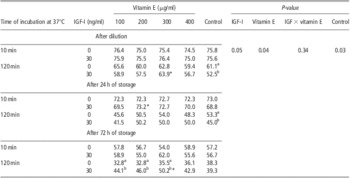
No interaction between vitamin E and IGF-I was observed (P > 0.10) for sperm motility in insemination doses before cooling or storage for 24 h (Table 1). Before cooling, no effect (P > 0.05) of IGF-I was observed 10 min after its addition, but it reduced (P < 0.05) sperm motility after 120 min, only in samples without the addition of vitamin E. Compared with the control, the addition of 300 μg/ml of vitamin E + 30 ng/ml of IGF-I resulted in higher motility (P < 0.05) at 120 min of incubation.
Influence of the addition of IGF-I before incubation at 37°C on the total motility (%) of boar sperm diluted in extender with different concentrations of vitamin E and stored at 15°C (n = 12 ejaculates from four boars)

*In line, differ of control by Dunnett test (P < 0.05).
a,bDifferent letters in column denote significant differences by the F-test (P < 0.05).
After 24 h of storage, IGF-I also reduced (P < 0.05) sperm motility at 120 min after its addition in semen without the addition of vitamin E. At this storage time point, the addition of 200 μg/ml of vitamin E + 30 ng/ml of IGF-I increased (P < 0.05) sperm motility only after 10 min of incubation, but not at 120 min. After 72 h, IGF-I improved (P < 0.05) sperm motility in semen supplemented with 100, 200 or 300 μg/ml of vitamin E at 120 min of incubation. Compared with the control, the use of 300 μg/ml of vitamin E + 30 ng/ml of IGF-I increased sperm motility in this time of incubation.
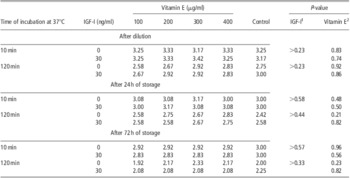
No effect of vitamin E or IGF-I was observed (P > 0.31) on the intensity of movement of spermatozoa (Table 2).
Influence of the addition of IGF-I before incubation at 37°C on the intensity of sperm movements of boar sperm diluted in extender with different concentrations of vitamin E and stored at 15°C (n = 12 ejaculates from four boars)

1No significance at Wilcoxon test (P > 0.05).
2No significance at Friedman test (P > 0.05).
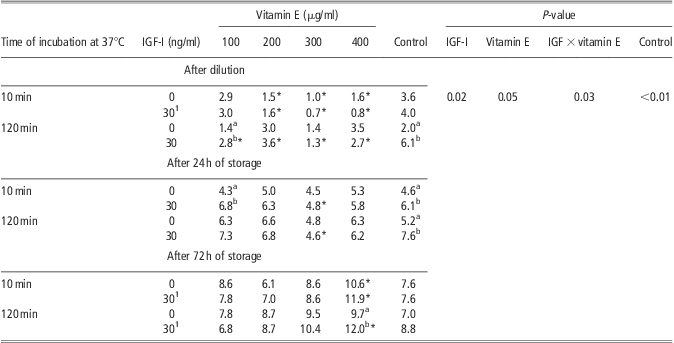
An interaction (P = 0.03) between vitamin E and IGF-I was observed for acrosomal damage (Table 3). The addition of IGF-I increased the percentage of acrosomal damage (P = 0.02) after 120 min in pre-cooling semen without the addition of vitamin E or with 100 μg/ml of vitamin E. After 24 h of storage, IGF-I also increased acrosomal damage after 120 min of incubation, but only in insemination doses that did not receive vitamin E. After 72 h, this effect was observed only in samples that were supplemented with 400 μg/ml of vitamin E.
Influence of the addition of IGF-I before incubation at 37°C on the acrosomal damage (%) of boar sperm diluted in extender with different concentrations of vitamin E and stored at 15°C (n = 12 ejaculates from four boars)
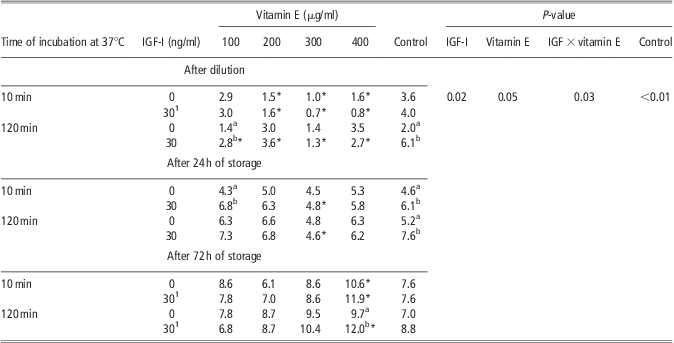
*In line, differ of control by Dunnett test (P < 0.05).
1Linear effect (P < 0.05).
a,bDifferent letters in column denote significant differences by the F-test (P < 0.05).
The addition of 200 μg/ml or more of vitamin E reduced (P < 0.05) the amount of acrosomal damage only in pre-cooling semen, with or without IGF-I. In the presence of IGF-I, vitamin E had a linear effect and, after 120 min of incubation, all samples had less acrosomal damage compared with the control. After 24 h of storage, the use of 300 μg/ml of vitamin E was effective in reducing acrosomal damage due to IGF-I supplementation. After 72 h of storage, the addition of 400 μg/ml of vitamin E increased acrosomal damage in samples that had received IGF-I.
Biochemical analysis
No interaction (P = 0.69) was observed between vitamin E and IGF-I on the MDA concentration (Table 4). The addition of IGF-I decreased (P < 0.05) the concentration of this substance only in insemination doses stored for 72 h that had received no vitamin E before cooling (control). The addition of 400 μg/ml of vitamin E was effective (P < 0.01) in reducing the MDA concentration before and after 72 h of storage.
Influence of the addition of IGF-I before incubation at 37°C on the MDA concentration (μM/ml) after 120 min of incubation of boar sperm diluted in extender with different concentrations of vitamin E and stored at 15°C (n = 8 ejaculates from four boars)
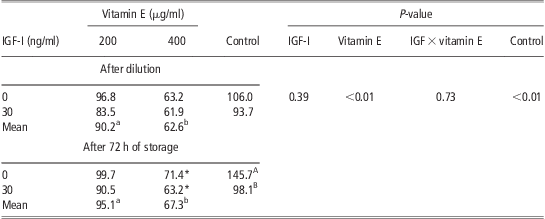
MDA = malondialdehyde.
*In line, differ of control by Dunnett test (P < 0.05).
A,B,a,bMeans followed by different capital letters in column or lowercase in line differ by F-test (P < 0.05).
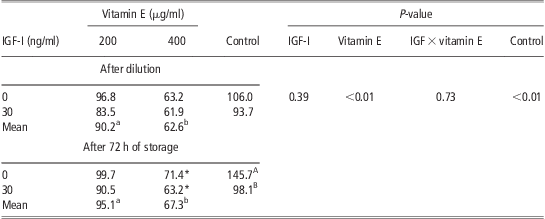
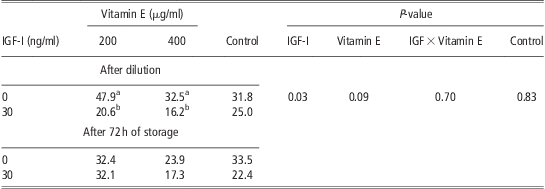
No interaction between vitamin E and IGF-I was observed (P = 0.70) in terms of glucose intake by spermatozoa (Table 5). The addition of IGF-I reduced glucose intake (P = 0.03) only in pre-cooling samples supplemented with vitamin E. No effect (P = 0.09) of vitamin E was observed for this parameter.
Influence of the addition of IGF-I before incubation at 37°C on the glucose intake (mg/dl) during 120 min of incubation of boar sperm diluted in extender with different concentrations of vitamin E and stored at 15°C (n = 8 ejaculates from four boars)
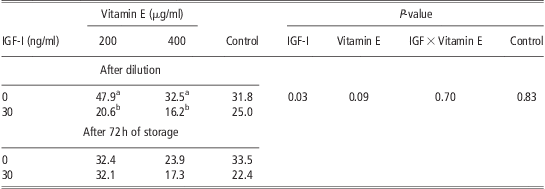
a,bMeans followed by different letters in column differ by F-test (P < 0.05).
Discussion
The concentration of IGF-I utilised in insemination doses is close to the physiological concentration found in boar seminal plasma (in natura, 8.4 to 22.2 ng/ml; Hirai et al., Reference Hirai, Boersma, Hoeflich, Wolf, Foll, Aumuller and Braun2001; Lackey et al., Reference Lackey, Gray and Henricks2002). This ensures that there are significant levels of this hormone in insemination doses before and after processing. Silva et al. (Reference Silva, Zangeronimo, Murgas, Rocha, Chaves, Pereira and Cunha2011), investigating the addition of IGF-I ranging from 50 to 150 ng/ml, recommended an optimal level of 150 ng/ml for insemination doses stored for 24 h and 78 ng/ml for doses stored for 72 h, but suggest that lower levels than those tested may also have physiological effects on boar semen. In the present work, 30 ng/ml was chosen because of previous observations that had showed an effect of this hormone on sperm motility, acrosomal damage and the MDA concentration in boar semen (unpublished observation). This concentration also ensures physiological concentrations after semen dilution.
Studies have indicated that IGF-I has the ability to improve sperm motility by accelerating the consumption of energy substrates by sperm cells. However, the formation of free radicals can be stimulated (Selvaraju et al., Reference Selvaraju, Reddy, Nandi, Rao and Ravindra2009; Minelli et al., Reference Minelli, Liguori, Collodel, Lattaioli and Castellini2011). In the present work, the use of IGF-I and vitamin E had little effect on sperm motility.
In boar, Breininger et al. (Reference Breininger, Beorlegui, O'Flaherty and Beconi2005) found that 200 μg/ml of vitamin E is the optimum concentration for motility and resistance to lipid peroxidation in samples of thawed semen. In the present work, both vitamin E (400 μg/ml) and IGF-I were effective in reducing the MDA production during 120 min of incubation time at 37°C of boar semen after 72 h of storage at 15°C. This suggests a possible antioxidant effect of these substances in insemination doses stored for a prolonged period of time. The antioxidant effect of IGF-I has also been observed in buffaloes (Selvaraju et al., Reference Selvaraju, Reddy, Nandi, Rao and Ravindra2009), rodents (Gancarczyk et al., Reference Gancarczyk, Kuklińska, Sadowska, Strzeżek and Bilińska2006), boars (Silva et al., Reference Silva, Zangeronimo, Murgas, Rocha, Chaves, Pereira and Cunha2011) and rabbits (Alvarez and Storey, Reference Alvarez and Storey1987). These studies observed positive effects of IGF-I on glutathione peroxidase or superoxide dismutase activity.
Considering the semen stored for a longer period (72 h), it is possible to discern the limited capacity of the antioxidant system in sperm cells. Although positive results have been obtained in lipid peroxidation with the use of IGF-I and vitamin E, these substances have not been able to maintain the quality of insemination doses over the storage period. It is known that stored boar semen shows a continuous increase in ROS, which inevitably affects some functions of the sperm (Alvarez and Storey, Reference Alvarez and Storey1987). Thus, more studies should be conducted to look at the relationship between substances with antioxidant effects and metabolic activators.
IGF-I increased acrosomal damage in pre-cooling samples or those stored for 24 h and that had not received vitamin E. It was observed that vitamin E was effective in preventing this damage only in semen stored for 24 h, but not in semen stored for 72 h. This result suggests that IGF-I can in fact increase the metabolic activity of spermatozoa and the oxidative stress in sperm cells that is positively correlated to the degree of acrosomal damage when antioxidant substances are low (Nabil-Aziz et al., Reference Nabil-Aziz, Saleh, Sharma, Lewis-Jones, Esfandiari, Thomas and Agarwal1999). Although vitamin E had reduced the MDA concentration in the present work, high concentrations of this vitamin may have been oxidised in samples stored for a long time, which could have changed the characteristics of the plasma membrane, affecting its fluidity and, consequently, its cellular structure (Dalvit et al., Reference Dalvit, Cetica and Beconi1998). More studies on the early effects of vitamin E must be conducted to investigate the correlation between a higher concentration of vitamin E and acrosomal damage.
With respect to carbohydrate intake, Silva et al. (Reference Silva, Zangeronimo, Murgas, Rocha, Chaves, Pereira and Cunha2011) found that IGF-I reduced fructose intake in boar sperm, arguing that this hormone could be involved in the intake of another carbohydrate. The results of the present work indicate that glucose uptake is also reduced in the presence of IGF-I. In accordance with Baronos (Reference Baronos1971), glucose and fructose are not the only energy sources for boar sperm cells; mannose, sorbitol, lactate, inositol, volatile fatty acids and citrate have also been cited. In this case, such substances could be involved in sperm cell energy metabolism induced by IGF-I.
Conclusion
The addition of 400 μg/ml of vitamin E during the processing of pig insemination doses reduces MDA production in boar semen stored at 15°C for 72 h, regardless of the presence of IGF-I additive. Addition of IGF-I after heating ensures higher sperm motility after 120 min of incubation at 37°C only when added at doses stored for 72 h containing until 300 μg/ml.
Acknowledgements
The authors thank the Fazenda São Paulo, located in Oliveira, Minas Gerais, Brazil, for providing the boars, CNPq (National Council for Scientific and Technological Development, Brazil), FAPEMIG (Foundation for Research Support of Minas Gerais, Minitube do Brasil) and the Post-graduate Program in Veterinary Science of Department of Veterinary Medicine of Federal University of Lavras for providing the necessary facilities to carry out this work.