

I. Introduction
Like many other aspects of Soqotri morphology, the present subject has practically no history of research: since Bittner's pioneering remarks (Reference Bittner1918: 62–6), the Soqotri broken plural has not been discussed in the scholarly literature, even within the summary descriptions of Modern South Arabian as a group.Footnote 2 We are lucky, however, to have a clearly elaborated theoretical and comparative background for our study, namely, Robert Ratcliffe's groundbreaking studies on the broken plural in Semitic (Reference Ratcliffe1998a, Reference Ratcliffe1998b). Of particular value for our investigation are Ratcliffe's instructive overviews of the comparable systems in Soqotri's sister tongues, Harsusi (Reference Ratcliffe1998a: 189–95; Reference Ratcliffe1998b: 93–5) and especially Jibbali (Reference Ratcliffe1998a: 196–201; Reference Ratcliffe1998b: 95–7).
This article is based on an exhaustive perusal of the glossaries of the two volumes of Kogan and Naumkin, Corpus of Soqotri Oral Literature (CSOL I, Reference Naumkin and Kogan2014, and CSOL II, Reference Naumkin and Kogan2018). For most patterns, exhaustive – or nearly exhaustive – lists of examples have been compiled, which makes these findings relevant also from a quantitative point of view: they show how frequent (or, for that matter, regular or productive)Footnote 3 is this or that pattern (or, better, this or that singular/plural correlation).
The phonological system of Soqotri vowels, of crucial relevance for any study in the field of Soqotri morphology, follows Kogan and Naumkin Reference Kogan, Naumkin, Elmaz and Watson2014, where only five vocalic elements are considered phonemic: a, e, o, i, u (the latter of rather limited distinctive load). The distinсtion between a and ε, usually conditioned by the surrounding consonants and, therefore, essentially non-phonemic, will nevertheless be maintained in the transcription.
The main goal of this article is to produce an accurate description of the synchronic facts based on solid lexical evidence. No fully-fledged diachronic assessment of the Soqotri system of broken plural has been attempted. Still, a few basic historical observations will be given where appropriate, both in the main body of the article and its concluding section.
Before proceeding to the evidence, I would like to offer a word of gratitude to our beloved Soqotri informants, ‘Isa Gum‘an al-Da‘rhi and Ahmad ‘Isa al-Da‘rhi, whose extraordinary linguistic skills and exemplary devotion have made this study possible. The article is dedicated to the memory of Robert Ratcliffe, whose revolutionary ideas on the broken plural problem have influenced me so profoundly from my earliest student days up to now.
II. The evidence
a. Singular nouns with e or i in the last syllable (mostly, but not exclusively, quadriconsonantal) typically produce plurals with a-replacementFootnote 4 (o < *ā or *ā́)Footnote 5
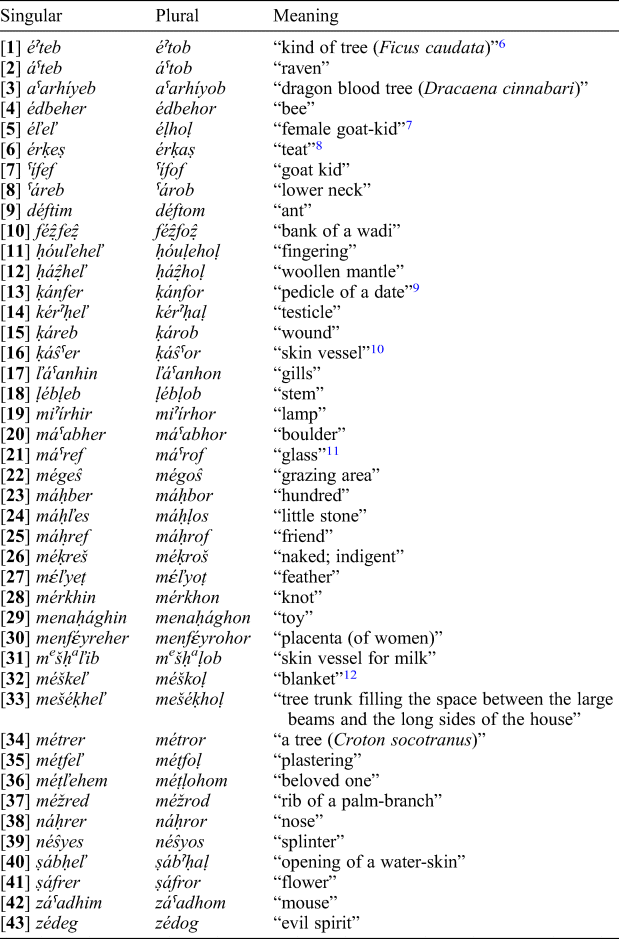
There are several groups of examples displaying more complex developments certainly or very probably along the same lines.
• Examples where the emergence of o in the second syllable is simultaneous with a vocalic shift in the first syllable (most probably a kind of vocalic accommodation): míṣ̌her, pl. máḳhor “goat pen”, míˀšer, pl. médkor “billy goat”,Footnote 13 ḥ ímhim, pl. ḥ émhom “charcoal”, ḷ éḳham, pl. ḷ áḳhom “kind of tree (Commiphora parvifolia)”Footnote 14, móṣfin, pl. méṣfon “something plaited”, ṣ éľheľ, pl. ṣ óḷhoḷ “a little wadi”, kémbeb, pl. kómbob “remains of dry leaves on a palm trunk”, ḳ eḥ íľh in, pl. ḳ aḥ éḷhon “egg”. No clear-cut rules can be posited for this limited and rather heterogeneous evidence, but the main trend is clear: e and especially i tend to be avoided in the plural form, being replaced by a/ε or o.
• Examples where the vowel of the second syllable is a/ε rather than o: f érhim, pl. f έrh εm “girl”, míṭh εn, pl. máṭ an “a shrub”, ˁázgeheľ, pl. ˁázg εh εḷ “penis”. While the attribution of these examples to the present class appears tempting,Footnote 15 the unexpected behaviour of the vowel in the second syllable of the plural form is difficult to explain.
• Varia: k εn, pl. k óhon “colour, shape”, méraḥt, pl. méroḥt “eating mat”, šεm, pl. šóhom “name”, tε, pl. t óho “meat”, t εyš, pl. toš “he-goat used as a sire”.Footnote 16
The historical background of this type of broken plural formation has been discussed at some length in Kogan Reference Kogan2015: 476–7, where it is considered one of the hallmarks of the linguistic identity of MSA.Footnote 17 For the comparative evidence from continental MSA see Bittner Reference Bittner1909: 70–71, Rubin Reference Rubin2010: 66–7, Watson Reference Watson2012: 58 (Mehri); Ratcliffe Reference Ratcliffe1998a: 193 (Harsusi); Bittner Reference Bittner1915: 55–6, Ratcliffe Reference Ratcliffe1998a: 200, Rubin Reference Rubin2014: 82–3 (Jibbali).Footnote 18
b. Plurals of quadriconsonantal nouns with a-insertion (the “maktab- > makātib-” type)Footnote 19
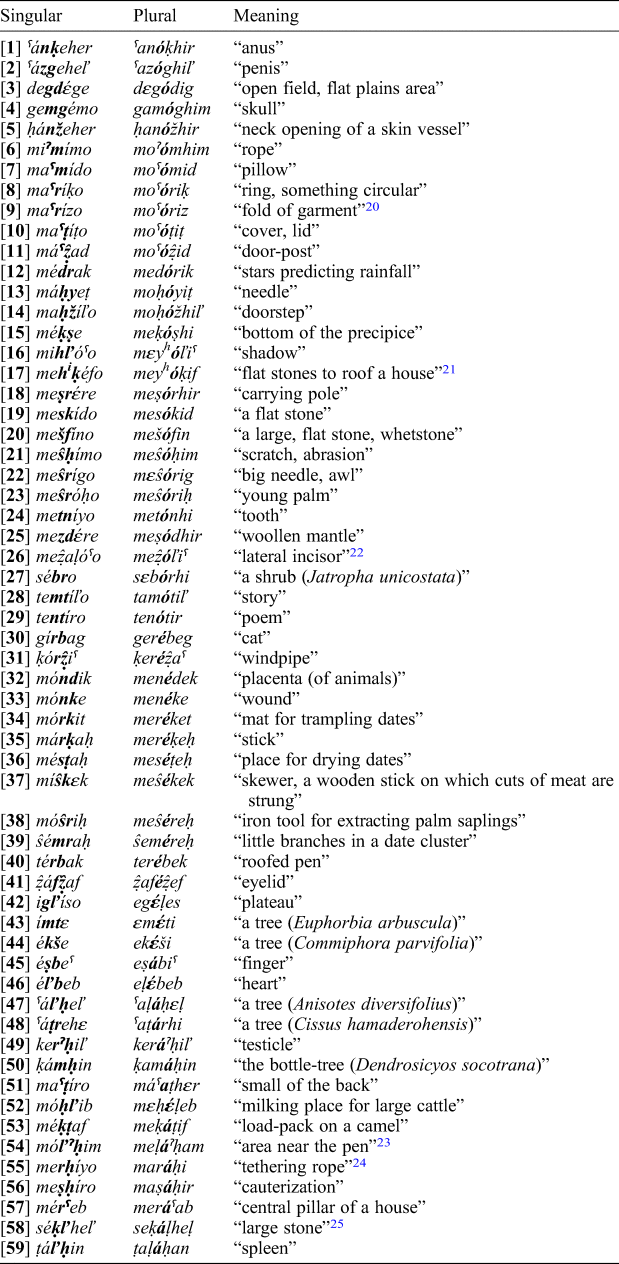
• The diachronically expected variety of this pattern (examples [1]–[29]) displays o (< *ā or *ā́) breaking the C2C3 consonantal cluster of the singular and has i in the last syllable. Many examples involve mV-prefixed nouns, particularly the me-C1C2iC3-o type. Only 7 out of 30 examples from this subgroup do not display the feminine marker in the singular.
• Another prominent type is C1eC1eC2eC3 type (examples [30]–[41]), whose diachronical background remains to be established.Footnote 26 None of the twelve examples involved has the feminine marker.
• The remaining examples ([42]–[59]) do not easily lend themselves to a diachronic analysis. Most of them must belong to one of the two types discussed above, but the picture has been obscured by the influence of gutturals and emphatics.
For this type of plural formation as a prominent feature of the “South Semitic” area – comprising Arabic,Footnote 27 Ethiopian SemiticFootnote 28 and MSA (in all probability, also Epigraphic South Arabian)Footnote 29 – see Kogan Reference Kogan2015: 167 and 476; and Bulakh and Kogan Reference Bulakh and Kogan2011: 23–6. For parallel phenomena in continental MSA see Ratcliffe Reference Ratcliffe1998a: 193, (Harsusi); Bittner Reference Bittner1909: 66–9, Jahn Reference Jahn1905: 45– 9 (Mehri); Bittner Reference Bittner1915: 53–5, Ratcliffe Reference Ratcliffe1998a: 199–200, Rubin Reference Rubin2014: 83 (Jibbali).Footnote 30
c. Plurals of the nomen unitatis/nomen collectivum type
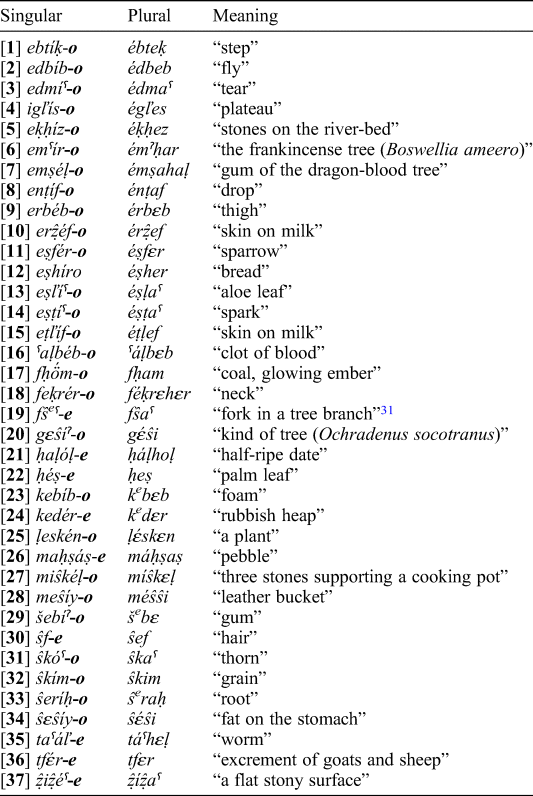
• The high percentage of examples with (presumably, prosthetic) initial vowel ([1]–[15]) is noteworthy.
As far as one can judge from Ratcliffe Reference Ratcliffe1998a: 193 and 199, this pluralization strategy is uncommon in continental MSA,Footnote 32 or at least much less prominent than in Soqotri. In a broader “South Semitic” context, it is well attested in Arabic (Ratcliffe Reference Ratcliffe1998a: 94; Fischer Reference Fischer1987: 49–50) and Tigre (Ratcliffe Reference Ratcliffe1998a: 180–1; Bulakh and Kogan Reference Bulakh and Kogan2011: 8–9, 15–6).Footnote 33 However, in none of these languages has the singulative/collective opposition been grammaticalized into a fully-fledged means of pluralization: in both Arabic and Tigre, the collective forms exist side-by-side with “true” broken plurals, to which they can be opposed functionally/semantically.Footnote 34 In other words, the Soqotri situation at this point appears to be virtually unique in a comparative (South) Semitic perspective.
d. Patterns with prefixed *ˀV-Footnote 35

• Examples [1]–[8] display the pattern eC1C2oC3, which can be confidently traced back to *ˀV-C1C2āC3-, reliably attested in Arabic,Footnote 39 Ethiopian SemiticFootnote 40 and, within MSA, in Jibbali.Footnote 41 Nearly all of them represent geminated consonantal roots (C1C2C2);Footnote 42 the only example from a geminated root that does not take this pattern is [11] ḥor, pl. áˀḥrεr “goat pen”.
• Examples [9]–[14] and [15]–[19] belong to the patterns eC1C2εC3 and eC1C2eC3 respectively, both diachronically uncertain.Footnote 43
• Examples [20]–[28] cannot be reliably attributed to any of the above groups because the vocalism of the second syllable is obscured by the influence of the gutturals and/or emphatics.
• Examples with the feminine ending (Bittner Reference Bittner1918: 64) comprise one group with ε-vocalism ([29]–[34]) and another with e-vocalism ([35]–[37]). In the former the feminine ending is -o, while in the latter it is -e. Footnote 44
• In examples [38]–[44] the original vocalism is obscured by the neighbouring gutturals and emphatics; the feminine ending is uniformly -o.
• In examples [45]–[52] the vowel of the second syllable has become o because of the vocalic harmony around the last radical guttural.
• Examples [53]–[58] are derived from roots with the third weak radical and do not follow any systematic pattern.
As one learns from Ratcliffe Reference Ratcliffe1998a: 196–7, the Soqotri inventory of *ˀV-prefixed broken plurals comes very close to the Jibbali system,Footnote 45 where the patterns VC1C2ɔC3, VC1C2εC3 and VC1C2eC3-t are all common, and contrasts with the Harsusi system, where *ˀV-prefixed patterns do not seem to play any significant role (cf. the summary of the Harsusi system in Ratcliffe Reference Ratcliffe1998a: 195). The same is true of the Mehri system as described in Rubin Reference Rubin2010: 66–8 (but note Bittner Reference Bittner1909: 63–4).
e. Plurals in -ihin, -hin, -in
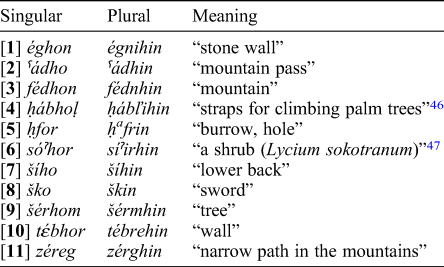
As argued in Kogan Reference Kogan2015: 474–5, the traditional perception of such forms – both in Soqotri and throughout MSA – as reflecting the “sound masculine plural”Footnote 48 can scarcely be correct. There are two main reasons behind this conclusion.
On the one hand, nouns using this way of pluralization in MSA do not belong to morphological classes which normally use external masculine plural in languages where broken plurals are available – namely, “derived nouns such as participles and verbal nouns” (Ratcliffe Reference Ratcliffe1998a: 219).Footnote 49 Indeed, as the chart above plainly shows, the relevant Soqotri lexemes belong to simple morphological structures (most of them can be reasonably qualified as “primary nouns”) which, both formally and functionally, are totally different from participles of derived stems or nomina agentis of Arabic and Geez, typically pluralized with the external masculine markers -ūna/-īna and -ān respectively.
On the other hand, practically all the Soqotri forms involved display o (presumably < *ā) in the second syllable of the singularFootnote 50 – a feature known to be associated with the C1iC2C3ān- pattern in Arabic (Ratcliffe Reference Ratcliffe1998a: 86).Footnote 51
f. Plurals in -yhon Footnote 52

This small group comprises exclusively kinship terms, probably brought together via semantic attraction.Footnote 53 It is difficult to say why these nouns opted for an n-extended broken plural. Since most of the singulars are (synchronically) biconsonantal, Arabic examples like nār- “fire”, pl. nīrān-, extensively discussed in Ratcliffe Reference Ratcliffe1998a: 85–6, readily come to mind as a possible analogy.Footnote 54
g. The С1éС2(h)oC3 pattern
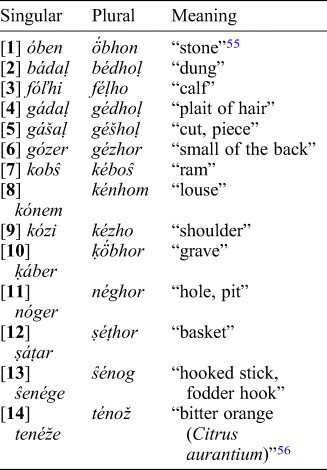
h. The С1íС2(h)oC3 pattern

The patterns С1éС2(h)oC3 and С1íС2(h)oC3, dealt with in this and the preceding section, are almost certainly traceable to a common prototype.Footnote 57 Since o in the second syllable may go back to either long or stressed short *a, both *C1iC2áC3- and *C1iC2āC3- are theoretically possible. There are two reasons to prefer the second solution, although neither of the two is truly compelling.
• The pattern *C1iC2aC3- is likely behind С1i/eС2(h)εC3 in group l below, where it is diachronically expected as it rather regularly corresponds to C1eC2áC3-e/ε structures in the singular. It would be a priori unusual to see the same *C1iC2aC3- prototype reflected as С1é/íС2(h)oC3 when applied to nouns with no feminine ending and as С1i/eС2εC3 when this ending is present: an Arabic-like distribution *C1VC2C3- > *C1iC2āC3- (Ratcliffe Reference Ratcliffe1998a: 77–81) vs. *C1i/uC2C3-at- > *C1i/uC2aC3- (ibid. 88–91) would appear more natural.Footnote 58 This is not necessarily so, however, in view of the Geez correlations such as ˀəgr “foot”, pl. ˀəgar (Ratcliffe Reference Ratcliffe1998a: 166–8).Footnote 59
• The “parasitic” h, often featuring before o, is usually considered a safe witness of the etymological length of the vowel following it (LS 22–3; Rhodokanakis Reference Rhodokanakis1915: 16 and elsewhere). Now about two-thirds of the 31 plural forms recorded in groups g and h display a “parasitic” h. These rather indecisive statistics are further marred by the fact that about a half of the С1i/eС2εC3 plurals in group l also reflect this feature.
Within MSA, the *С1VС2oC3 pattern is fairly common also in the continental languages, see Ratcliffe Reference Ratcliffe1998a: 189–90 for Harsusi; Bittner Reference Bittner1909: 55–6, Rubin Reference Rubin2010: 67 for Mehri; Bittner Reference Bittner1915: 50, Ratcliffe Reference Ratcliffe1998a: 196, Rubin Reference Rubin2014: 83 for Jibbali. Their diachronic evaluation is faced with the same difficulties as in Soqotri.Footnote 60
i. The С1éС2oyC3 pattern
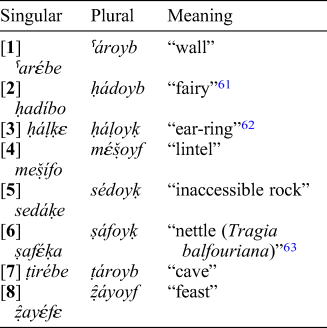
The pattern С1áС2oyC3 is an exact formal parallel to the Arabic С1aС2āˀiC3- pattern (Bittner Reference Bittner1918: 65),Footnote 64 and the nature of the singular/plural correlation is exactly the same in both languages: the pattern is favoured by nouns with a long vowel in the second syllable, followed by the feminine marker (Ratcliffe Reference Ratcliffe1998a: 97–9). A comparable phenomenon in Geez is somewhat more remote insofar as the “default consonant” in the second syllable of the plural form is usually w rather than y (Ratcliffe Reference Ratcliffe1998a: 170).Footnote 65 The Epigraphic South Arabian evidence, difficult to interpret precisely because of the purely consonantal script, is discussed in Ratcliffe Reference Ratcliffe1998a: 174–5 and Stein Reference Stein2003: 76–7. Within MSA, a few comparable examples have been registered in Harsusi (Ratcliffe Reference Ratcliffe1998a: 194) and Mehri (Bittner Reference Bittner1909: 65), but, apparently, not in Jibbali.Footnote 66
j. The С1aС2yoC3 pattern

This rather marginal pattern can be plausibly connected with the Mehri pattern C1eC2yōC3, extensively dealt with in Diem Reference Diem1979: 64–75 (see also Bittner Reference Bittner1909: 57–58 and Kogan Reference Kogan2015: 469).
k. The С1éС2eC3 pattern

This rather prominent plural pattern is among the most difficult to evaluate diachronically.
Its main structural feature – breaking the C2C3 consonantal cluster of the singular – brings it close to the well-known *C1iC2āC3- and *C1iC2aC3- structures repeatedly discussed throughout this article, but the origin of the e-vowel in both syllables is still difficult to explain. It is easy to observe that the С1éС2eC3 structure of the plural pattern is exactly the same as that of the 3 sg. m. of the perfect of the inactive type in the basic stem. Now the latter can be safely traced to *C1iC2aC3 in view of the corresponding feminine form C1iC2έC3-o (Naumkin et al. Reference Naumkin, Bulakh, Cherkashin, Kogan, Issa and Gumaan2014: 27–8). One could surmise that С1éС2eC3 is indeed a regular outcome of *C1iC2aC3, presumably stressed on the first syllable and leaving unstressed the a-vowel of the second syllable. Within this approach, the Soqotri С1eС2eC3 and С1éС2(h)oC3/С1íС2(h)oC3 patterns could be safely traced back to *C1iC2aC3- and *C1iC2āC3- respectively. We are left, however, with the С1i/eС2(h)εC3 pattern discussed in the following section l: for all practical purposes, *C1iC2aC3 is the most expected and legitimate prototype of this sequence, and it is hard to see why it should have given two competing outcomes – С1éС2eC3 and С1í/éС2(h)εC3 – within the system of the Soqotri broken plural.
l. The С1í/éС2(h)εC3 pattern
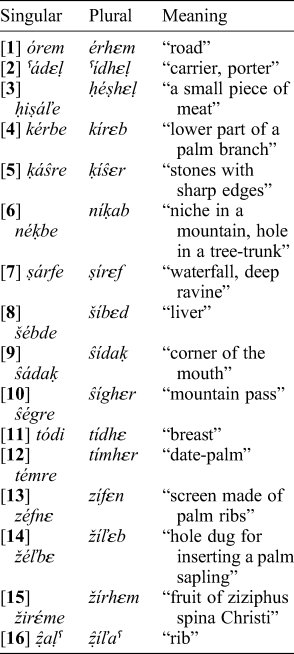
• In nine out of 16 examples, the correlation C1éC2C3-e/ε Footnote 68 > С1í/éС2(h)εC3 is observed, clearly identical to Arabic C1i/uC2C3-at- > C1i/uC2aC3- (Ratcliffe Reference Ratcliffe1998a: 88–90). This way of plural formation is well attested also in continental MSA: Harsusi (Ratcliffe Reference Ratcliffe1998a: 191–2), Mehri (Bittner Reference Bittner1909: 52–3, Rubin Reference Rubin2010: 67–8), Jibbali (Bittner Reference Bittner1915: 47–9, Ratcliffe Reference Ratcliffe1998a: 199, Rubin Reference Rubin2014: 83–4). Furthermore, in all continental languages a special “mixed” type of plural is common, consisting of the a-inserted base and the external feminine plural marker.Footnote 69 Outside Arabic and MSA, this correlation is very prominent in Tigre (Ratcliffe Reference Ratcliffe1998a: 180–2), where, however, Arabic influence cannot be ruled out (Bulakh and Kogan Reference Bulakh and Kogan2011: 15–21, Reference Bulakh and Kogan2013: 83). For the limited, but relatively certain ESA evidence see Ratcliffe Reference Ratcliffe1998a: 173–4, Stein Reference Stein2003: 75.
• In two cases ([3] ḥiṣáľe and [15] žirέme), the singular displays a vowel after the second radical, which does not fit the above correlation, where ε in the plural breaks the C2C3 cluster in the singular. One wonders, therefore, whether these two examples might be alternatively ascribed to group c (the nomen collectivum/nomen unitatis type).
• The remaining five cases involve nouns with no feminine marker. Their presence in this group is, at present, difficult to explain.
m. The С1íy(h)εC3 pattern
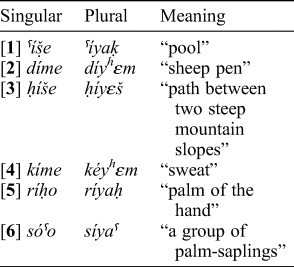
This group is a transparent sub-type of the correlation described under l, with -y- featuring as the default second consonants for biconsonantal singulars with i < *ī. Footnote 70 Similarly structured pairs are common elsewhere in languages where the *C1VC2C3-at- > *C1VC2aC3- correlation is attested (see Ratcliffe Reference Ratcliffe1998a: 88 for Arabic, p. 180 for Tigre).
n. The С1íy(h)oC3 patternFootnote 71

С1íy(h)oC3 is a subtype of the С1éС2(h)oC3/С1íС2(h)oC3 pattern (sections g and h), with y functioning as default second consonant for biconsonantal singulars. Comparison with the similarly structured correlation in the preceding section m (also six examples) is instructive: five out of six examples in m have an overt i in the singular, but none in n, where e predominates; all examples in m, but only a half in n, display the feminine marker.
o. The “mixed type”

Soqotri does not productively use the “mixed” type of plural in which internal modifications of the stem are accompanied by the addition of the ending *-tVn, otherwise characteristic of external feminine plural. This way of plural formation, very common in Jibbali (Bittner Reference Bittner1915: 52–3, Ratcliffe Reference Ratcliffe1998a: 198–9),Footnote 72 is, however, not totally alien to Soqotri, as seen already by Bittner (Reference Bittner1918: 64) and confirmed by modern research. Such examples, with the stem structure C1eC2oC3-, are limited to a handful of – apparently archaic – examples listed above.Footnote 73
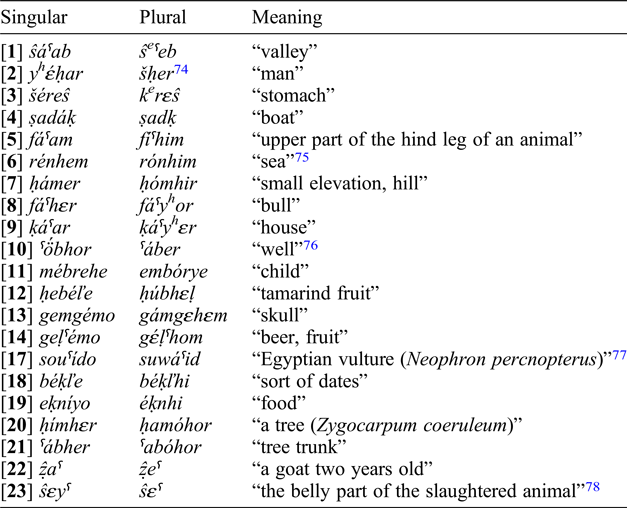
p. A few unique, atypical broken plural formations are summarized here
III. The broken plural of Soqotri in a diachronic perspective
In his discussion of the relevance of the broken plural problem for genealogical classification of Semitic (Kogan Reference Kogan2015: 166–71), the present author has limited the scope of his analysis to Arabic and Geez, usually excluding the MSA facts from consideration because of the heavily understudied historical phonology and morphology of these languages. The Soqotri evidence analysed in this article, aiming to develop and supplement Ratcliffe's pioneering insights into the Harsusi and Jibbali systems of broken plural, allows a preliminary assessment of the place of the Soqotri system both within and outside MSA, thus bringing somewhat greater clarity into the thorny field of Modern South Arabian linguistic diachrony.
In Ratcliffe Reference Ratcliffe1998a: 206, four fundamental features shared by most languages of the “South Semitic” areaFootnote 79 in the domain of the broken plural formation are listed. Soqotri participates prominently in each of them.
• The *C1VC2C3-at- > *C1VC2aC3- correlationFootnote 80 = groups l and m.
• Plurals with *ˀa- = group d.
• The pattern *C1aC2āC3iC4- for quadriconsonantal nouns = group b.Footnote 81
• The pattern *C1aC2āy/wiC3- for triconsonantal nouns with a long vowel in the second syllable = group i.
Further commonalities between Soqotri and the languages of the “South Semitic” area are in evidence.
• The singulative-collective opposition = group c.Footnote 82
• The *C1VC2āC3- > *C1iC2C3ān- correlation = group e. Ratcliffe, adhering to the traditional interpretation of the MSA n-plurals as external masculine, was unable to observe their similarity to the Arabic facts and listed the latter among “features of the Arabic system which do not find parallels in other southern languages” (Reference Ratcliffe1998a: 210). The new evaluation of the MSA correlation allows us to broaden seriously the diachronic importance of this feature, thus counterbalancing the rather indecisive Ethiopian evidence.Footnote 83
• The pattern *C1iC2āC3- = groups g, h, n, is very prominent in Arabic (Ratcliffe Reference Ratcliffe1998a: 77), but not attested in Geez. Its presence in Tigre may be attributed to Arabic influence (Bulakh and Kogan Reference Bulakh and Kogan2011: 21–3, Reference Bulakh and Kogan2013: 83–4).
• Soqotri shares with other MSA languages one of the two singular-plural correlations which Ratcliffe (Reference Ratcliffe1998a: 210) defines as specific innovations of this subgroup, namely the correlation in which “an (etymologically) long high vowel … in the last syllable of the singular alternates with a long non-high vowel … in the last syllable of the plural” = group a. It does not actively participate, however, in the second of these features, where essentially the same shift affects biconsonantal structures as well.Footnote 84
• By far the most remarkable feature of broken plural formation which Soqotri does not obviously share with most other languages of the “South Semitic” group is the *u/ū insertion (Ratcliffe Reference Ratcliffe1998a: 207), prominently attested in Arabic (ibid. 77, 105) and on good grounds reconstructible for Geez (ibid. 167–8) and Ethiopian Semitic in general. There is no need to stress that the validity of this observation is seriously relativized by our inability safely to establish the Soqotri reflexes of proto-Semitic u-vowels.Footnote 85 In such a context, a closer look at the continental MSA evidence is mandatory.
The clearest possible parallel to the Arabic C1uC2ūC3- pattern is C1eC2ewweC3 in Harsusi, which is quite a prominent means of plural formation in this language (Ratcliffe Reference Ratcliffe1998a: 190). The possibility of Arabic influence, apparently hinted at by Ratcliffe (ibid.), can hardly be discarded in this case, particularly since there is no trace of such formation in Jibbali, by far the most conservative among the continental MSA, and even in Mehri.Footnote 86
In Ratcliffe Reference Ratcliffe1998a: 197, the author somewhat obliquely identifies the widespread Jibbali pattern εC1C2eC3(V)t with *ˀa-C1C2uC3-at-, most probably underlying the *ˀaC1C23C3-t pattern in Geez. As we have seen above in connection with group d, this may well be the case also for similarly structured Soqotri pattern(s), but there can hardly be any positive proof for such a conclusion before the fate of *u in both languages is elucidated.Footnote 87
All in all, Ratcliffe's conclusion (Reference Ratcliffe1998a: 207), according to which “both MSA languages have plurals that could plausibly be interpreted as reflecting CuCuuC and ˀaCCuuC” appears rather premature. This leaves enough room for an alternative hypothesis, according to which the u-isogloss has never reached the proto-MSA system of broken plural.


