1. Introduction
The Lower Carboniferous flysch (Culm flysch) of the Istanbul Zone is an over 1500 m thick turbiditic sandstone–shale sequence marking the onset of the Variscan deformation in the Pontides. It forms the highest stratigraphic unit in the 5 km thick Ordovician to Carboniferous sedimentary sequence, deposited on a long-standing passive continental margin south of Laurussia. The Istanbul Palaeozoic sequence of the Pontides has been compared and correlated with similar sequences in central and western Europe, including the Moesian platform in Romania and Bulgaria, Moravo-Silesia (Brunovistulian) in the Czech Republic and the Rhenohercynian zone in Germany and Belgium (e.g. Pharaoh, Reference Pharaoh1999; Kalvoda et al. Reference Kalvoda, Leichmann, Babek and Melichar2003, Reference Kalvoda, Babek, Fatka, Leichmann, Melichar, Nehyba and Spacek2008; Sunal et al. Reference Sunal, Satir, Natal'in and Toraman2008), all deposited on the northern passive margin of the Rheic ocean. The closure of the Rheic ocean and the ensuing collision with the Armorican terrane assemblage in the Carboniferous led to the Variscan deformation (e.g. Tait et al. Reference Tait, Bachtadse, Franke and Soffel1997). The Variscan deformation was the last major orogenic event in Central Europe, therefore the provenance of the Devonian–Carboniferous turbidites in Central Europe can be confidently traced to distinct terranes (e.g. Schäfer et al. Reference Schäfer, Neuroth, Ahrendt, Dörr and Franke1997). In contrast, the Pontides were affected by the Triassic and Early Tertiary closures of the Palaeo- and Neotethyan oceans, respectively, and the resultant Cimmeride and Alpide deformations, so that the Carboniferous flysch of the Pontides has no obvious provenance in the adjacent tectonic zones. The Istanbul Zone is a good example of a small crustal fragment within younger sequences that is difficult to set into a solid geodynamic context. In this study we use sandstone framework petrography, detrital zircon and rutile geochronology and geochemistry to reconstruct the provenance of the Carboniferous flysch of the Pontides, and hence to trace the origin of the Istanbul Zone.
2. Geological setting
The Pontides consist of three terranes amalgamated during Cretaceous times (Okay & Tüysüz, Reference Okay, Tüysüz, Durand, Jolivet, Horváth and Séranne1999). These are the Strandja, Istanbul and Sakarya zones (Fig. 1). The Istanbul Zone, located along the southwestern Black Sea coast, consists of a Precambrian crystalline basement overlain by a continuous, well-developed transgressive sedimentary sequence extending from Ordovician to Carboniferous (Fig. 2; Görür et al. Reference Görür, Monod, Okay, Şengör, Tüysüz, Yiğitbaş, Sakinç and Akkök1997). The Palaeozoic sequence was folded and possibly thrust-faulted during the Late Carboniferous Hercynian orogeny, and is unconformably overlain by Lower Triassic and younger sedimentary strata. The Istanbul Zone is separated from the Sakarya Zone by the Intra-Pontide suture and from the Strandja Massif by the right-lateral strike-slip West Black Sea Fault (Fig. 3). The Sakarya and Strandja terranes exhibit Late Triassic and Late Jurassic–Early Cretaceous metamorphism and deformation, respectively, which are not observed in the Istanbul Zone.
Simplified tectonic map of Europe showing the Variscan units. The cross-hatched pattern indicates regions with medium- to high-grade Carboniferous metamorphism. The triangles on the sutures indicate subduction polarities and the arrows the vergence of Variscan deformation. BM – Bohemian Massif; Ç – Çamlık granitoid; D – Dobrugea; K – Kazdağ Massif; MS – Moravo-Silesia; IAE – Izmir–Ankara–Erzincan suture; P – Pulur Massif; SM – Strandja Massif; T – Tatra mountains; WBF – West Black Sea Fault (modified after Okay et al. Reference Okay, Bozkurt, Satir, Yiğitbaş, Crowley and Shang2008).

Stratigraphic columns of the Pontide terranes showing the major plutonic and metamorphic events (modified from Okay, Satır & Siebel, Reference Okay, Satir, Siebel, Gee and Stephenson2006).

The distribution of pre-Jurassic rocks in the Istanbul Zone (simplified from Türkecan & Yurtsever, Reference Türkecan and Yurtsever2002, and Aksay et al. Reference Aksay, Pehlivan, Gedik, Bilginer, Duru, Akbaş and Altun2002). Note the different Carboniferous and Triassic facies in the western and eastern parts of the Istanbul Zone, and the trend of the facies boundary, which is highly oblique to the Intra-Pontide suture (modified after Okay, Satır & Siebel, Reference Okay, Satir, Siebel, Gee and Stephenson2006). WBF – West Black Sea Fault.

3. The stratigraphy of the Istanbul Zone
3.a. Precambrian basement
The crystalline basement of the Istanbul Zone crops out widely in the Bolu Massif, with smaller outcrop areas in the Karadere and in the Armutlu peninsula (Fig. 3). The basement is divided into four units (Ustaömer & Rogers, Reference Ustaömer and Rogers1999; Yiğitbaş et al. Reference Yiğitbaş, Kerrich, Yilmaz, Elmas and Xie2004): (a) a metamorphic sequence dominated by quartzo-feldspathic gneiss and amphibolite; (b) a disrupted mafic–ultramafic sequence consisting of amphibolite, metapyroxenite, metaperidotite and metagabbro; (c) meta-andesites with minor metarhyolites and metasedimentary rocks; (d) voluminous intrusive granitoids. The plutons, which make up more than half of the basement, are Neoproterozoic (590–560 Ma) calc-alkaline tonalites to granodiorites (Chen et al. Reference Chen, Siebel, Satir, Terzioğlu and Saka2002; Ustaömer, Mundil & Renne, Reference Ustaömer, Mundil and Renne2005; Okay et al. Reference Okay, Bozkurt, Satir, Yiğitbaş, Crowley and Shang2008). The Rb/Sr biotite ages from the Karadere basement are 548–545 Ma, showing that the basement was not heated above 300 °C after the latest Proterozoic (Chen et al. Reference Chen, Siebel, Satir, Terzioğlu and Saka2002).
3.b. The Palaeozoic series in the western part of the Istanbul Zone
The well-developed Palaeozoic series around Istanbul have been studied since the middle of the 20th century (e.g. Paeckelmann, Reference Paeckelmann1938; Okay, Reference Okay1947; Kaya, Reference Kaya1969; Haas, Reference Haas1968; Ustaömer et al. Reference Ustaömer, Ustaömer, Gerdes and Zulauf2010). They form an exclusively sedimentary sequence, more than 5 km thick, extending from Ordovician to Carboniferous (Fig. 2).
In the Istanbul region the lowermost exposed Palaeozoic rocks are violet to pinkish fluvial arkosic sandstone, conglomerate and minor shale, more than 1000 m thick, exposed over large regions in the Asian part of the city of Istanbul (Fig. 4). These continental clastics, assumed to be Ordovician in age, are overlain by white cross-bedded quartzites, locally with ripple marks, 200–300 m thick, deposited in a tide-dominated shore environment. The quartzites pass laterally and vertically into a sequence of greywacke, siltstone and shale, 200 m thick, deposited in a lagoonal to shallow marine environment. The upper parts of this Gözdağ Formation include a chamosite–oolite horizon with Lower Silurian (Llandoverian) brachiopods, ostrocods, corals and conodonts (Haas, Reference Haas1968). The Gözdağ Formation is overlain by a shallow marine carbonate sequence of Middle to Late Silurian (Wenlock and Ludlow) to Early Devonian (Sieganian) age. The carbonates indicate an increasingly deepening marine environment towards the southeast (Haas, Reference Haas1968). The limestones pass up into richly fossiliferous shales and siltstones of latest Early Devonian (late Emsian) age, which are in turn overlain by thinly to irregularly banded marly nodular limestones, marls and shales of latest Early Devonian (Late Emsian) to earliest Carboniferous (Tournaisian) age, deposited in deep water (Çapkınoğlu, Reference Çapkinoğlu2000, Reference Çapkinoğlu2005; Göncüoğlu, Boncheva & Göncüoğlu, Reference Göncüoğlu, Boncheva and Göncüoğlu2004). Above the nodular limestone comes a characteristic horizon, 40 m thick, of black Middle to Late Tournaisian radiolarian cherts intercalated with shales containing phosphatic nodules (Okay, Reference Okay1947; Noble et al. Reference Noble, Tekin, Gedik and Pehlivan2008). The radiolarian cherts are overlain by siliciclastic turbidites of the Trakya Formation, over 1500 m in thickness. In the lower part of the Trakya Formation, there are tongues of in situ shallow-marine upper Visean bioclastic limestones (Kaya & Mamet, Reference Kaya and Mamet1971). The Trakya Formation is overlain unconformably by the lowermost Triassic red sandstones and conglomerates.
Simplified geological map of the Istanbul region showing the outcrops of the Carboniferous flysch and the sample localities (modified from Türkecan & Yurtsever, Reference Türkecan and Yurtsever2002). For location, see Figure 3.

3.c. The Palaeozoic sequence in the eastern part of the Istanbul Zone
In the eastern part of the Istanbul Zone in the Karadere region, sandstones with possible early Ordovician (Tremodacian) acritarchs lie unconformably over the crystalline basement (Dean et al. Reference Dean, Monod, Rickards, Demir and Bultynck2000). The sandstones are overlain sharply by quartzites, which pass up to a black mudstone–shale series with local horizons rich in Ordovician (early Arenig to Llanvirn) graptolites (Fig. 2). The mudstones are overlain by dark limestones with shale and siltstone intercalations with Ordovician (Caradoc) conodonts. The Silurian is represented by black shales with graptolites and acritarchs indicative of the Llandovery and Wenlock (Dean et al. Reference Dean, Monod, Rickards, Demir and Bultynck2000). The Devonian carbonates lie over the Silurian with an angular unconformity (Boztuğ, Reference Boztuğ1992).
The upper parts of the Palaeozoic succession are best exposed around the city of Zonguldak. The succession starts with Upper Devonian (Frasnian–Famennian) neritic carbonates, which pass up without interruption into Tournaisian dolomite reef limestones and Visean shallow marine carbonates and shales (Dil, Reference Dil1976). The uppermost Visean consists of alternating limestones and shales, and grades into the Namurian black shales. These are overlain by coal-bearing lacustrine, fluviatile and fluviomarine clastic rocks, ~ 3500 m in thickness and of Namurian and Westphalian age. The clastics were deposited in large south-facing deltas on the margin of Laurussia (Kerey, Reference Kerey, Dixon and Robertson1984; Kerey, Kelling & Wagner, Reference Kerey, Kelling and Wagner1986).
The stratigraphic differences between the western and eastern parts of the Istanbul Zone are best interpreted as a result of lateral facies changes. Analogous Palaeozoic facies differences exist in the Polish Variscan zones (e.g. Narkiewicz, Reference Narkiewicz2007), in the Brunovistulian (Kalvoda et al. Reference Kalvoda, Leichmann, Babek and Melichar2003; Kalvoda & Bábek, Reference Kalvoda and Bábek2010), in the Hercynian of Europe between the Ardennes and the Rheinisches Schiefergebirge (e.g. Rutten, Reference Rutten1969, p. 115) and in the Moesian Platform, where neritic carbonate deposition in the Tournaisian in the north is replaced by radiolarian chert sedimentation in the south in the Elovitza region (Haydoutov & Yanev, Reference Haydoutov and Yanev1997).
3.d. Late Carboniferous deformation and Early Permian plutonism
The Palaeozoic deposition in the Istanbul region ends in the Early Carboniferous and is followed by shortening deformation with the generation of recumbent folding, local cleavage and minor thrusting. The minor folds generally show an E–NE vergence (Zapcı, Akyüz & Sunal, Reference Zapci, Akyüz and Sunal2003); however, the age of the structures, whether Variscan or later, is not well constrained. Nevertheless, the observation that the lowermost Triassic red beds step down from Carboniferous to Ordovician (Fig. 5) indicates significant deformation, uplift and erosion in the Late Carboniferous–Permian interval. The deformed Palaeozoic rocks are intruded by a Permian granite east of Istanbul with early Late Permian (c. 255 Ma) zircon U–Pb and biotite K–Ar ages (Yılmaz, Reference Yilmaz1977; Şahin et al. Reference Şahin, Güngör, Aysal and Öngen2009). In the Zonguldak region the Palaeozoic sequence extends into the Upper Carboniferous (Westphalian) coal measures, followed by thrust-faulting and folding. Several of the coal seams in the Zonguldak basin are inverted (Loboziak & Dill, Reference Loboziak and Dil1973).
Geological map of the Gebze region (modified from Ketin, Reference Ketin1983). Note the erosional truncation of the Palaeozoic sequence at the base of the Triassic series. Location of the sandstone samples is indicated. For location, see Figure 4.

4. Carboniferous flysch: the Trakya Formation
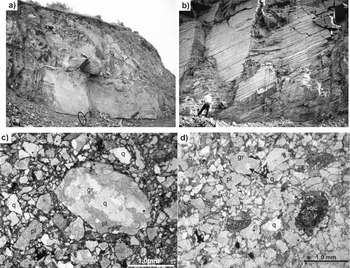
The Trakya Formation consists predominantly of an alternation of sandstone, siltstone and shale. It is the highest stratigraphic unit of the Istanbul Palaeozoic sequence (Paeckelmann, Reference Paeckelmann1938; Kaya, Reference Kaya1969, Reference Kaya1971) and underlies most of the city of Istanbul, especially west of the Bosphorus (Fig. 4). Sandstone beds are thicker and more frequent in the lower parts of the sequence (Fig. 6a); the upper part of the sequence consists of millimetre-scale parallel-laminated, fine-grained, dark sandstones, siltstones and shales with 5–20 cm thick bedding (Fig. 6b). This facies, exposed in large quarries, can form packages up to 50 m thick. Within this laminated facies there are coarse- to medium-grained, dark-grey sheet sandstones, which range up to 2 m in bed thickness, with sharp erosive bases. Such sandstones may be massive or normally graded. The sedimentological features of the Trakya Formation indicate deposition from turbidity currents.
(a) Thickly-bedded feldspar-rich sandstones from the basal parts of the Trakya Formation from the Gebze region. Hammer for scale is 32 cm long. (b) Rhythmically interbedded fine-grained sandstone, siltstone and shale, which characterizes most of the Trakya Formation. Person is 180 cm tall. (c, d) Photomicrographs from the sandstones of the Trakya Formation. All in plane polarized light. (c) Large granitic clast (gr) with quartz (q) and plagioclase (pl). The euhedral shapes of some plagioclase grains in the matrix indicate a magmatic origin. Note the poor sorting and the abundance of the matrix, sample 7. (d) Volcanic clasts and a small granitic fragment; again note the euhedral shape of the plagioclase grains, sample 3.

The Trakya Formation is deformed by folding and intense faulting. Slaty cleavage is locally observed in the siltstones and shales but has not developed in the sandstones, which are generally free of penetrative deformation. Apatite fission track studies show that the Trakya Formation has experienced temperatures of above 120 °C (M. Zattin, pers. comm.); however, quartz grains in the sandstones show no evidence of recrystallization, indicating that the burial temperatures did not exceed ~ 300 °C.
5. Petrography and detrital modes of the Carboniferous sandstones
We sampled thickly to medium-bedded, medium- to coarse-grained sandstone beds for petrography. In most outcrops the sandstones are yellowish brown due to the oxidation of the chlorite-rich matrix and alteration of unstable lithic fragments; we chose grey to dark-grey fresh sandstones from quarries, road sections and drill cores. Because of deformation and scarcity of continuous outcrops, the relative stratigraphic position of most of the samples is not clear. The exception is the Gebze region east of Istanbul, where a ~ 200 m section from the base of the Trakya Formation above the Tournaisian radiolarian cherts was sampled (Fig. 5). The Gebze samples represent the basal parts of the Trakya Formation, whereas the rest of the samples come from its middle and upper parts.
Compositional data from sandstone point counts were collected from 21 samples. The location of the samples is shown in Figures 4 and 5 and their coordinates are given in Table 1. The point-counted sandstones were free of penetrative strain and recrystallization. The petrographic thin-sections were stained with potassium rhodizonate for plagioclase and with sodium cobaltinitrite for potassium feldspar identifications, respectively. However, almost all the plagioclase is albite and there is very little potassium feldspar in the sandstones. The point counting was done using the Gazzi–Dickinson method (e.g. Dickinson, Reference Dickinson1970; Ingersoll et al. Reference Ingersoll, Bullard, Ford, Grimm, Pickle and Sares1984), whereby sand-sized (> 0.03 mm) monominerallic components of lithic fragments are counted as individual mineral grains, and only aphanitic grains (< 0.03 mm) are classed as lithic fragments. More than 400 framework grains were identified in each section. The indeterminate grains average less than 3 % of the total count. Petrographic counting parameters and modal point-count data are presented in Table 1.
Locations and modal compositions of Carboniferous sandstones

rc – road cut; q – quarry; c-15 m – core sample at 15 m depth; Q – total quartz; Qm – monocrystalline quartz; Qp – polycrystalline quartz; F – feldspar; L – rock fragments; Lv – volcanic; Lm – metamorphic Ls – sedimentary rock fragments; n – number of point counts; m – matrix
Petrographically the sandstones of the Trakya Formation are feldspathic to lithic greywackes and subgreywackes (Pettijohn, Potter & Siever, Reference Pettijohn, Potter and Siever1987). They are poorly sorted and consist of angular to subangular grains in a voluminous matrix (Fig. 6c, d). The matrix, defined as grains less than 0.03 mm across, makes up between 12 and 22 % of the rock (Table 1). It is chlorite rich but also contains silt-size particles of feldspar and quartz. In some cases it is difficult to differentiate between the ‘matrix’ and deformed and diagenetically altered very fine-grained volcanic lithic grains.
The sandstones from the Trakya Formation generally consist of approximately equal amounts of feldspar, quartz and lithic fragments (Fig. 7). Quartz forms individual monocrystalline grains with irregular outlines. It is also found as globular, oval inclusions in plagioclase crystals in granitoidic clasts (Fig. 6c). Polycrystalline quartz is rare and consists mainly of fine-grained quartzite. Plagioclase has two modes of origin. Coarse-grained subhedral to euhedral crystals are derived from a magmatic protolith, as also shown by the presence of individual plagioclase crystals in granitic and volcanic clasts (Fig. 6c, 6d). Rounded plagioclase grains with oriented inclusions have been derived from metamorphic rocks.
Sandstone compositional data from the Trakya Formation plotted on ternary diagrams. (a) Q–F–L provenance discrimination diagram (Dickinson et al. Reference Dickinson, Beard, Brakenridge, Erjavec, Ferguson, Inman, Knepp, Lindberg and Ryberg1983). (b) Volcanic, metamorphic and sedimentary lithic components and provenance (Ingersoll & Suczek, Reference Ingersoll and Suczek1979).

The most common lithic grains are slightly metamorphic fine-grained andesite to trachyte consisting of murky chlorite, feldspar and leucoxene (Fig. 6d). A yellowish brown palagonitized and chloritized volcanic glass is common in sandstones from the Gebze region. Second in abundance are metamorphic rock grains, mainly phyllite, muscovite-schist, chlorite-schist and quartz-micaschist (Fig. 7b). The sedimentary lithic fragments are rare and include quartzite, slate and siltstone; carbonate grains are very scarce. Calcite, present in a few samples, is of secondary origin and occurs as veins or replaces feldspar. Detrital chlorite and muscovite are common but minor constituents, making up a few per cent each (Table 1).
Sandstones from the Gebze region from the lower parts of the Trakya Formation are rich in feldspar, which makes up 50–60 % of the grains. The average sandstone composition in the Gebze region is Q26F56L18, whereas the average sandstone composition from the other regions is Q43F29L26 (Table 1). The amount of plagioclase appears to decrease upwards in the sequence at the expense of quartz with minor enrichment in lithic grains (Fig. 7).
The framework modal data from the Carboniferous sandstones plot near the centre of the Q–F–L diagram, mainly within the deeply eroded or dissected magmatic arc field with minor overlap to the recycled orogenic field (Fig. 7a). A magmatic arc provenance is also indicated by the volcanic–metamorphic–sedimentary lithic diagram (Fig. 7b), and by the Qp–Lvm–Lsm (polycrystalline quartz – volcanic + metavolcanic lithics – sedimentary + metasedimentary lithics) diagram (Ingersoll & Suczek, Reference Ingersoll and Suczek1979).
Microconglomerates and pebbly sandstones make up less than 1 % of the Trakya Formation. They are found as 1–3 m thick beds associated with coarse-grained sandstones. The clasts in the conglomerates are well-rounded, polished and covered with a brown tarnish; they range in size from a few millimetres to 10 cm. Observations in three separate conglomerate outcrops (coordinates: 35T 06 54 380 – 45 63 218, 35T 06 56 672–45 62 337, 35T 06 55 483 – 45 54 674) have shown that ~ 80 % of the clasts consist of quartz, the rest are quartz-micaschist, granitoid and sandstone.
6. Detrital zircon and rutile geochronology
6.a. Methods
Four sandstone samples, two from the Asian side of the Bosphorus (Gebze-3 and Scutaria-8) and two from the European side (Maslak-1B and 18) were chosen for detrital zircon and rutile analysis. Zircons and rutiles were extracted using standard techniques involving crushing, sieving, heavy liquid separation and hand-picking. The zircon and rutile separates were mounted in epoxy, ground to expose cores of crystals and polished, and were analysed using Laser Ablation Inductively Coupled Plasma Mass Spectrometry (LA-ICP-MS) in the Institut für Geowissenschaften, Johannes Gutenberg-Universität Mainz, using a New Wave Research UP-213 (wavelength 213 nm) laser system combined with an Agilent 7500ce quadrupole-ICP mass spectrometer (LA-Q-ICP-MS).
For zircon U–Pb analysis, purification of the zircon surface was achieved by pre-ablating the analysis spot with five laser shots with a beam diameter larger than the analysis spots. Each analysis consists of a background measurement of 40 seconds, followed by 30 seconds of sample analysis. The U–Pb data were collected by ablating zircons with a laser beam diameter of 40–50 μm, a beam energy density of about 3.5 J/cm2, and a repetition rate of 10 Hz. The aerosol produced during ablation was transported to the ICP-MS in a mixed Ar–He carrier gas at a flow rate of 1.3 l/minute. Isotopes were measured in time-resolved mode. Dwell times for each isotope of individual mass scans are 10 ms for 232Th and 238U, 30 ms for 201Hg, 204Hg+Pb and 206Pb, and 50 ms for 207Pb and 208Pb. Th and U concentrations, 206Pb/204Pb ratios, as well as 207Pb–235U, 206Pb–238U and 208Pb–232Th ages were calculated off-line from time-resolved raw counts. No common Pb correction was made because of the imprecise 206Pb/204Pb ratios. The zircon standard PL (Plesovice; 337.1 ± 0.4 Ma; Slama et al. Reference Slama, Kosler, Condon, Crowley, Gerdes, Hanchar, Horstwood, Morris, Nasdala, Norberg, Schaltegger, Schoene, Tubrett and Whitehouse2008) was used as a primary standard to correct for laser-induced as well as ICP-induced mass fractionation by integrating the same time segments for each sample and standard zircon (Jackson et al. Reference Jackson, Pearson, Griffin and Belousova2004). The accuracy of ages cannot currently be better determined than ~ 2 %, based on long-term reproducibility of the zircon standards GJ-1, which was also used to calculate U and Th concentrations (Jackson et al. Reference Jackson, Pearson, Griffin and Belousova2004), 91500 (Wiedenbeck et al. Reference Wiedenbeck, Alle, Corfu, Griffin, Meier, Oberli, Von Quadt, Roddick and Speigel1995) and Mud Tank (Black & Gulson, Reference Black and Gulson1978).
Rutiles were analysed closely following the procedure described in Zack et al. (in press). Here, trace elements (V, Cr, Zr, Nb, Sn, Hf, Ta, W and U) were determined first by ablating material from 10 μm diameter spots. These results were not only used to determine rock type and metamorphic temperatures (see Section 7), but also to find high-U rutiles suitable for LA-Q-ICP-MS dating. In a second run, rutiles with U concentrations > 5 ppm were analysed for U–Pb age determinations employing a laser beam of 50 μm after cleaning the surface with 70 μm laser shots. Isotopes and dwell times are identical to zircon setup. The rutile standard R10 (1090 ± 5 Ma; Luvizotto et al. Reference Luvizotto, Zack, Triebold and von Eynatten2009) was used as a primary standard. In contrast to zircon dating, 206Pb/208Pb ratios can be used for a very robust and reliable common Pb correction, due to the fact that rutiles are generally extremely Th-poor (see Zack et al. in press for further details). Comparison with another rutile standard (R19; 489.5 ± 0.9 Ma; Zack et al. in press) reveals that accuracy is currently limited to ~ 2 %.
6.b. Results
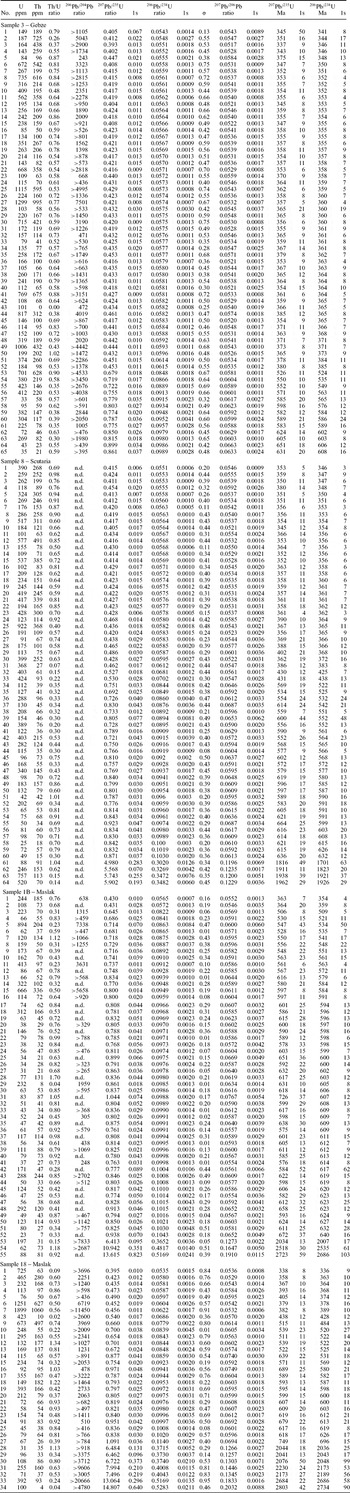
A total of 234 detrital zircons from four samples were dated, which assures that no important fraction (> 5 %) of the zircon age population is missed (e.g. Vermeesch, Reference Vermeesch2004). Sixteen zircon analyses were discarded due to irregular ablation signals. The remaining 218 zircons are apparently concordant and are considered further (Table 2). For the correlation of isotopic and stratigraphic ages we use the geological time scale of Gradstein et al. (Reference Gradstein, Ogg, Smith, Bleeker and Lourens2004).
U–Pb isotope data from the detrital zircons from the Carboniferous sandstones of the Istanbul Zone

1s – error of the values in the preceding column
Zircons from the Carboniferous sandstone samples show predominantly a bimodal age distribution, with Cambrian–Neoproterozoic (520 to 640 Ma; 49 % of all zircons) and Late Devonian–Early Carboniferous (335–390 Ma; 42 %) ages (Fig. 8a). Zircons of these ages are euhedral to subhedral and mostly show oscillatory and rarely sector zoning (Fig. 9), consistent with a magmatic source. Apart from these two dominant groups, there is a small population of Silurian–Ordovician ages (425–485 Ma; 2 %). The third largest population consists of 14 Palaeoproterozoic to Archaean zircons (1700–2700 Ma; 6 %). These zircons are rounded and generally show a gradual zoning (Fig. 9), suggesting a more complex history. The most striking pattern is the absence of zircon ages between 700 and 1700 Ma, characteristic for terranes derived from West Africa and Armorica (Fig. 10, Nance & Murphy, Reference Nance and Murphy1994; Linneman et al. Reference Linnemann, McNaughton, Romer, Gehmlich, Drost and Tonk2004).
Histograms showing the age distribution of Palaeozoic–Neoproterozoic (a) detrital zircons from four Carboniferous sandstone samples and (b) detrital rutiles from two samples. The ages are grouped in 10 Ma intervals.

Cathode Luminescence and Back Scattered Electron images of some of the analysed zircons (a–g) and rutile (h). Note the euhedral to subhedral habits and sector and oscillatory zoning of the Late Devonian–Early Carboniferous (a, b, d) and Neoproterozoic (c, e, f) zircons indicating a magmatic protolith. The Palaeoproterozoic zircons, on the other hand, are rounded and have smoother zoning profiles (g, f).

Histogram showing the age distribution of all the detrital zircons from four Carboniferous sandstone samples.

Zircons from sample Gebze-3, stratigraphically the lowermost sample, are dominantly earliest Carboniferous (c. 359 Ma, 52 zircons), with only 13 Cambrian–Neoproterozoic zircons (Figs 11a, 12a). Samples Scutaria-8 and Maslak-18 yielded approximately equal numbers of earliest Carboniferous (38 zircons) and Cambrian–Neoproterozoic zircons (24 zircons); the sample Maslak-1B contains predominantly Cambrian–Neoproterozoic zircons (49 zircons) with only two earliest Carboniferous (358 Ma) zircons (Fig. 11c).
Histograms showing the age distribution of Palaeozoic–Neoproterozoic detrital zircons from four Carboniferous sandstone samples. Note the systematic change in zircon ages between the samples. The ages are grouped in 10 Ma intervals. For location of samples, see Figure 4.

U–Pb Concordia diagrams of detrital zircons and rutiles from the Carboniferous flysch of the Trakya Formation. Data-point error elipses are 2 sigma. Please notice that errors used in the text are always ≥ 1.5 %, here 357 ± 5 Ma and 359 ± 5 Ma (see Section 6.a). For location of samples, see Figure 4.

The Late Devonian–Early Carboniferous zircons exhibit a narrow age range; the concordia ages for the Gebze-3 and Scutaria-8 zircon samples can be assumed to belong to one age group, where pooled ages are 359 ± 5 and 357 ± 5 Ma, respectively (Fig. 12a, c). In contrast, the Cambrian–Neoproterozoic zircon ages are distributed between 520 Ma and 640 Ma, suggesting that the source rocks comprised magmatic protoliths of various ages. This is clear in Gebze-3, Scutaria-8 and Maslak-1B, where the Cambrian–Neoproterozoic zircons are spread out on the concordia (Fig. 12b, d, e).
Detrital rutile in sandstone is predominantly derived from medium- to high-grade metamorphic rocks and/or from recycled sediments (Force, Reference Force1980). Table 3 and Figure 8b give the U–Pb ages of 35 detrital rutiles from two sandstone samples (Gebze-3 and Maslak-18). They show a pronounced Late Devonian–Early Carboniferous age peak (368 ± 12 Ma,) with only one Neoproterozoic rutile. The concordia age of the sample Maslak-18 is 360 ± 4 Ma (Fig. 12f), coeval with the equivalent zircon ages from Gebze-3 and Scutaria-8 samples (Fig. 12a, c).
U–Pb isotope data from the detrital rutiles from the Carboniferous sandstones of the Istanbul Zone

1s – error of the values in the preceding column
Coeval zircon and rutile ages indicate that the Late Devonian–Early Carboniferous metamorphism was closely associated with magmatism (Fig. 8). The age spectra of rutile and zircon can be best explained by a scenario where both minerals are from one localized area that has experienced one Late Devonian–Early Carboniferous metamorphic event (recorded by rutile) and several earlier magmatic periods and/or received sedimentary detritus (recorded by zircon) before this last metamorphic event. The older rutiles, if there were any, must have been overprinted by the Late Devonian–Early Carboniferous metamorphism. The well-defined rutile age peak, and the narrow time interval between the rutile ages and the depositional age of the Trakya Formation (c. 340–330 Ma), indicate that the cooling age of this metamorphic terrane was only slightly older than the deposition of the Trakya Formation.
7. Detrital zircon and rutile geochemistry
Figure 13 shows the REE patterns of the detrital zircons from two sandstone samples. Although the zircons are of various ages they all show enrichment in HREE, negative Eu and positive Ce anomalies, which are typical features of magmatic zircons. The Th/U ratios of zircons are between 0.3 and 0.9 (Table 2), characteristic, although not conclusive, for magmatic zircons (e.g. Teipel et al. Reference Teipel, Eichhorn, Loth, Rohrmüller, Höll and Kennedy2004).
Primitive-mantle normalized incompatible element patterns of detrital zircons from the Carboniferous sandstone sample 8 (a) and 1B (b).

The trace element composition of detrital rutile can provide information on the nature of the protolith including the metamorphic facies and temperature of metamorphism in the source region (Zack, von Eynatten & Kronz, Reference Zack, von Eynatten and Kronz2004; Triebold et al. Reference Triebold, Von Eynatten, Luvizotto and Zack2007; Meinhold et al. Reference Meinhold, Anders, Kostopoulos and Reischmann2008a). One hundred rutile grains from three sandstone samples (3, 18 and 1B) have been analysed for trace elements. The Zr concentrations in the detrital rutiles fall predominantly in the range 20–1000 ppm, Cr 10–1000 ppm, Nb 200–3100 ppm (Table 4). The Cr and Nb concentrations of detrital rutiles have been used to define the protolith (Zack, von Eynatten & Kronz, Reference Zack, von Eynatten and Kronz2004; Triebold et al. Reference Triebold, Von Eynatten, Luvizotto and Zack2007). Rutiles from three sandstone samples indicate a metamorphic provenance dominated by metapelitic rocks (Fig. 14).
Trace element concentrations of the detrital rutiles from the Carboniferous sandstones

Geochemistry of the detrital rutiles. Metamorphic temperatures are calculated from the Zr contents of rutiles, using Tomkins, Powell & Ellis (Reference Tomkins, Powell and Ellis2007) calibration for a pressure of 10 kbar. The log(Cr/Nb) axis after Triebold et al. (Reference Triebold, Von Eynatten, Luvizotto and Zack2007) provides an indication of the nature of the protolith (mafic or pelitic).

Zirconium content of rutile has been suggested as a geothermometer by Zack, Moraes & Kronz (Reference Zack, Moraes and Kronz2004) based on the reaction:

Zirconium contents of rutiles from three sandstone samples indicate a dominantly amphibolite-facies metamorphic provenance with metamorphic temperatures mostly in the range of of 550 to 750 °C (Fig. 14).
8. Discussion
8.a. Provenance
The sandstone framework petrography indicates a predominantly magmatic provenance for the siliciclastic turbidites of the Trakya Formation. The detrital zircon ages indicate that the magmatic rocks in the source region were Neoproterozoic (640 to 520 Ma) and Late Devonian to Early Carboniferous (390–335 Ma). Some of the Neoproterozoic magmatic clasts could have been recycled from sedimentary rocks, however, the scarcity of sedimentary clasts in the Carboniferous sandstones make this a slight possibility. The metamorphic clasts are second in abundance in the Carboniferous sandstones; the geochemistry of the detrital rutiles and their isotopic ages indicate a metamorphic source of Upper Devonian–Lower Carboniferous amphibolite-facies metapelites and metabasites. The sedimentary clasts are rare, and carbonate clasts are virtually absent. The sandstone discrimination diagrams suggest that the Trakya Formation was being supplied from a dissected magmatic arc.
The scarcity of the sedimentary clasts and absence of carbonate fragments implies that the Palaeozoic series of the Istanbul Zone, which includes an 850 m thick Upper Silurian–Devonian carbonate sequence, was not a major source during Early Carboniferous times. The absence of Mesoproterozoic detrital zircons, recorded in the Ordovician quartzites of the Istanbul Zone (Ustaömer et al. Reference Ustaömer, Ustaömer, Gerdes and Zulauf2010), also shows that the source of the Carboniferous sandstones was outside the Istanbul Zone. The virtual absence of Archaean to Palaeoproterozoic detrital zircons and abundance of the Neoproterozoic zircons exclude the Palaeoproterozoic (2300–2100 Ma) Ukranian shield (Baltica) north of the Black Sea as a source area (Bogdanova et al. Reference Bogdanova, Pashkevich, Gorbatschev and Orlyuk1996; Claesson et al. Reference Claesson, Bogdanova, Bibikova and Gorbatschev2001).
Neoproterozoic (590–560 Ma) granitoids are widespread in Europe, extending from the Variscan massifs of central Europe through the Carpathians into the Pontides (e.g. Neubauer, Reference Neubauer2002). The Neoproterozoic magmatism was produced in the Pan-African/Cadomian magmatic arcs, which characterize the northern margins of Gondwana (e.g. Stern, Reference Stern1994) and hence Pan-African/Cadomian magmatism is widespread in the peri-Gondwana terranes including Avalonia and Armorican terrane assemblage (cf. Ustaömer et al. Reference Ustaömer, Ustaömer, Gerdes and Zulauf2010). In contrast, Neoproterozoic granitoids are not known from the Sakarya Zone or from the Strandja Massif, and appear to be rare in Bulgaria and Greece (Carrigan et al. Reference Carrigan, Mukasa, Haydoutov and Kolcheva2006; Sunal et al. Reference Sunal, Satir, Natal'in and Toraman2008).
Late Devonian–Early Carboniferous magmatic and metamorphic rocks, a major source for the Lower Carboniferous flysch of the Istanbul Zone, are not known from the Eastern Mediterranean region and the Balkans (cf. fig. 10 of Meinhold et al. Reference Meinhold, Reischmann, Kostopoulos, Lehnert, Matukov and Sergeev2008b). The Variscan metamorphism in Bulgaria and in Turkey is of Late Carboniferous age (330–310 Ma, Okay et al. Reference Okay, Satir, Maluski, Siyako, Monie, Metzger, Akyüz, Yin and Harrison1996; Okay, Satır & Siebel, Reference Okay, Satir, Siebel, Gee and Stephenson2006; Topuz et al. Reference Topuz, Altherr, Kalt, Satir, Werner and Schwartz2004, Reference Topuz, Altherr, Schwartz, Dokuz and Meyer2007; Velichkova et al. Reference Velichkova, Handler, Neubauer and Ivanov2004). The Variscan plutonism in the same area is middle Carboniferous–Early Permian in age (320–270 Ma, Okay et al. Reference Okay, Satir, Tüysüz, Akyüz and Chen2001; Okay, Monod & Monié, Reference Okay, Monod and Monié2002; Carrigan et al. Reference Carrigan, Mukasa, Haydoutov and Kolcheva2005; Sunal et al. Reference Sunal, Natal'in, Satir and Toraman2006, Reference Sunal, Satir, Natal'in and Toraman2008; Topuz et al. Reference Topuz, Altherr, Schwartz, Dokuz and Meyer2007, Reference Topuz, Altherr, Siebel, Schwarz, Zack, Hasözbek, Barth, Satir and Şen2010; Anders, Reischmann & Kostopoulos, Reference Anders, Reischmann and Kostopoulos2007; Ustaömer, Ustaömer & Robertson, Reference Ustaömer, Ustaömer and Robertson2010) with the exception of one Early Devonian (c. 398 Ma) granitoid in NW Turkey (Çamlık granitoid in Fig. 1; Okay et al. Reference Okay, Satir, Maluski, Siyako, Monie, Metzger, Akyüz, Yin and Harrison1996; Okay, Satır & Siebel, Reference Okay, Satir, Siebel, Gee and Stephenson2006). Sunal et al. (Reference Sunal, Satir, Natal'in and Toraman2008) report Early Carboniferous (c. 350 Ma) ages from the cores of Late Carboniferous zircons in the granitoids of the Strandja Massif. Such zircons are, however, absent in the Carboniferous metasediments of the Strandja Massif, indicating that such granitoids, if present, were not exposed in Early Carboniferous times.
Late Devonian to Early Carboniferous magmatism, although absent in the eastern Mediterranean, is widespread in the Armorican terranes such as the French Massif Central (Faure et al. Reference Faure, Bé Mézème, Duguet, Cartier and Talbot2005), the Mid-German Crystalline High (e.g. Anthes & Reischmann, Reference Anthes and Reischmann2001), the Bohemian Massif (Finger et al. Reference Finger, Roberts, Haunschmid, Schermaier and Steyrer1997) and the Tatra mountains in the western Carpathians (Poller et al. Reference Poller, Janak, Kohut and Todt2000). It is in generally calc-alkaline, intermediate to basic in chemistry and exhibits a significant mantle contribution (e.g. Shaw, Downes & Thirwall, Reference Shaw, Downes and Thirlwall1993; Pin & Paquette, Reference Pin and Paquette2002); it is generally interpreted as having been produced during the southward subduction of the Rheic ocean. Late Devonian–Early Carboniferous metamorphism has also been described from the Variscan massifs of central Europe (e.g. Schulmann et al. Reference Schulmann, Kröner, Hegner, Wendt, Konopasek, Lexa and Stipska2005; Kroner et al. Reference Kroner, Mansy, Mazur, Aleksandrowski, Mann, Huckriede, Lacquement, Lamarche, Ledru, Pharaoh, Zedler, Zeh, Zulauf and McCann2008; Poller et al. Reference Poller, Janak, Kohut and Todt2000).
8.b. Geological evolution of the Istanbul Zone
In terms of the crystalline basement, the Palaeozoic stratigraphy and palaeobiogeography, the Istanbul Zone is correlated with Avalonia, and the Intra-Pontide suture with the Rheic suture (Stampfli & Borel, Reference Stampfli and Borel2002; Kalvoda et al. Reference Kalvoda, Leichmann, Babek and Melichar2003; Okay, Satır & Siebel, Reference Okay, Satir, Siebel, Gee and Stephenson2006; Okay et al. Reference Okay, Bozkurt, Satir, Yiğitbaş, Crowley and Shang2008; Bozkurt et al. Reference Bozkurt, Winchester, Yigitbaş and Ottley2008; Sunal et al. Reference Sunal, Satir, Natal'in and Toraman2008; Ustaömer et al. Reference Ustaömer, Ustaömer, Gerdes and Zulauf2010). An Avalonian origin for the Istanbul Zone is also supported by the detrital zircons from the Ordovician and Silurian sandstones (Ustaömer et al. Reference Ustaömer, Ustaömer, Gerdes and Zulauf2010), which show an absence of 2400 to 2050 Ma detrital zircons, a characteristic feature for Avalonia (Samson et al. Reference Samson, D'Lemos, Miller and Hamilton2005). In this context, the Trakya Formation can be compared with the coeval turbidites in the Rhenohercynicum, which have a similar mineralogical composition to those from the Trakya Formation, including an upward decrease in modal feldspar in sandstones (cf. Floyd et al. Reference Floyd, Leveridge, Franke, Shail and Dörr1990).
Avalonia was accreted to the southern margin of Laurussia during Late Ordovician–Early Silurian times. Palaeomagnetic studies (Evans et al. Reference Evans, Hall, Saribudak and Aykol1991) indicate that in the Middle Silurian to Carboniferous interval, the Istanbul Zone was also located on the southern margin of Laurussia and was facing the Rheic ocean in the south (Fig. 15a). As the Istanbul Zone is free of Devonian or Carboniferous magmatism and has characteristics of a passive continental margin, the Rheic ocean must have been consumed by southward subduction, leading eventually to a collision with a Devonian–Carboniferous magmatic arc (Fig. 15b). The Carboniferous flysch of the Trakya Formation marks the onset of this collision, which must have been gentle, as it did not lead to deep burial and metamorphism of the Istanbul terrane.
Schematic cross-sections depicting the geological evolution of the Istanbul Zone.

The sandstone discrimination diagrams and detrital zircon ages indicate that the sandstones were supplied from a dissected magmatic arc of Late Devonian–Early Carboniferous age. The source region was devoid of Mesoproterozoic (1700–700 Ma) zircons, a characteristic feature of the Armorican terranes (Nance & Murphy, Reference Nance and Murphy1994; Linnemann et al. Reference Linnemann, McNaughton, Romer, Gehmlich, Drost and Tonk2004; Ustaömer et al. Reference Ustaömer, Ustaömer, Gerdes and Zulauf2010), which also comprise Late Devonian–Early Carboniferous magmatic rocks (e.g. Finger et al. Reference Finger, Roberts, Haunschmid, Schermaier and Steyrer1997). These features indicate that the source of the Carboniferous flysch of the Istanbul Zone was a colliding Armorican terrane. As there are no Armorican terranes in the present vicinity of the Istanbul Zone, it must have been located during the Early Carboniferous close to the Armorican terrane assemblages, possibly the Bohemian Massif (Fig. 16). Avalonian terranes (e.g. Moravo-Silesia) east of the Bohemian Massif are stratigraphically similar to the Istanbul Zone, including the Visean flysch and the Upper Carboniferous coal measures (e.g. Narkiewics, Reference Narkiewicz2007; Kalvoda et al. Reference Kalvoda, Leichmann, Babek and Melichar2003, Reference Kalvoda, Babek, Fatka, Leichmann, Melichar, Nehyba and Spacek2008). If this view is correct, then the Istanbul Zone must have been translated by strike-slip along the Trans-European suture zone (Fig. 16). Sinistral strike-slip has been independently postulated along this zone in the region of Dobrugea (e.g. Gradinaru, Reference Gradinaru1984; Seghedi, Reference Seghedi2009). Banks & Robinson (Reference Banks, Robinson and Robinson1997) also postulated Early Jurassic sinistral displacement along the Trans-European suture zone. Although the precise location of the Istanbul Zone during Carboniferous times is not known, geometrical constraints suggest that the total amount of slip along the Trans-European suture zone must have been at least several hundred kilometres.
Early Carboniferous palaeogeography showing a possible location of the Istanbul Zone. TESZ – Trans-European suture zone.

By the Early Cretaceous the Istanbul Zone was situated on the southern margin of Laurasia between the Moesian and Scythian platforms (cf. Fig. 1; Okay, Şengör & Görür, Reference Okay, Şengör and Görür1994), from where it was displaced south to its present location with the Cretaceous opening of the West Black Sea basin. Therefore, the sinistral displacement of the Istanbul Zone must have occurred between Carboniferous and Early Cretaceous times, most likely in the Triassic–Early Cretaceous interval.
9. Conclusions
The Lower Carboniferous siliciclastic turbidites of the Istanbul Zone form an over 1500 m thick sequence marking the onset of the Variscan deformation. The sandstone framework petrography indicates that the source region consisted predominantly of intermediate volcanic and plutonic rocks and subordinate metamorphic rocks. Carbonate clasts are absent and sedimentary rock clasts are rare. Sandstone discrimination diagrams indicate a dissected magmatic arc as a source. Detrital zircon and rutile geochronology and geochemistry indicate a single source characterized by a Late Devonian to Early Carboniferous (390–335 Ma) magmatism and amphibolite-facies metamorphism with an overprinted Cambrian–Neoproterozoic (640 to 520 Ma) basement.
The Istanbul Zone is widely regarded as being part of the Avalonian terranes of central and western Europe. In the Silurian to Carboniferous, Avalonia formed part of the south-facing passive margin of Laurussia, which in the Early Carboniferous collided with the Armorican terranes leading to the Variscan orogeny. The Armorican terranes are characterized by the absence of Mesoproterozoic (700–1700 Ma) detrital zircons and by major Late Devonian–Early Carboniferous arc magmatism. The presence of magmatic clasts of Late Devonian–Early Carboniferous age and absence of Mesoproterozoic zircons in the Carboniferous flysch of the Istanbul Zone indicate a derivation from an Armorican terrane, especially since Late Devonian–Early Carboniferous magmatic and metamorphic rocks are not known in the eastern Mediterranean region. The stratigraphic similarities between the Istanbul Zone and the Avalonian terranes in eastern Europe, especially Moravo-Silesia in the Czech Republic, and the known strike-slip activity along the Trans-European suture zone, suggest that during Carboniferous times the Istanbul Zone was located further northwest, close to the Bohemian Massif, and has been translated by strike-slip movements into its Cretaceous location between Crimea and Moesia (Fig. 16).
Acknowledgements
We thank Gültekin Topuz and Burcu Altuntug for help with the samples. Aral Okay thanks the Turkish Academy of Sciences (TÜBA) for partial support. Thomas Zack thanks the German Science Foundation (DFG; grant Za285/7-1) and Geocycles for financial support. J. Kalvoda and an anonymous reviewer provided in-depth reviews, which improved the original manuscript.