Introduction
‘…by definition, ethical problems remain unresolved. By their unresolved quality they provoke a desire to search, to oppose, to think and to research.’
‘…providers of inpatient psychiatric care effectively become the setting of last resort for persons with severe, persistent, and frequently dangerous impairments who have not adequately responded to services available in the community… Because such care is often provided within a context of significant resource limitations, there is sometimes an unnecessary reliance on restrictive intervention measures’ (Donat, Reference Donat2005, p. 1105).
This article was prompted by the effective police deployment of a Taser in a person centred, recovery oriented, low secure unit. It was also the only occasion that a Taser had been used in the unit's three year history. Whilst it was decisive in ending a dangerous clinical situation (Little & Burt, Reference Little and Burt2012), it was important to explore the literature on Tasers and to consider contemporary psychiatric practice.
Difficult realities
Whether popularized or scholarly, psychiatry has a history of both harming and helping others. With the success of the consumer movement, complementary medicines and non government sector service provision, psychiatry's role in mental health has been appropriately questioned. It has been seen as intrusive with the medicalization of human experience, and authoritarian and abusive in its control and treatment of involuntary patients particularly. The observation that diagnosis and treatment has been both helpful and unhelpful is also true for other branches of medicine and surgery. Well intentioned action has also resulted in both positive and negative outcomes in educational, religious and law enforcement agencies suggesting that this is a universal human phenomenon.
Over time, the management of violence associated with mental illness has resulted in restraint by the use of chains, straitjackets and medication. In spite of attempts to protect however, deaths have occurred. Following a 20 year review, and prior to the availability of medication, Derby (Reference Derby1933) found that 980 hospitalized patients with manic depressive disorder had died, a significant percentage of whom had died from ‘exhaustion’. In a review of lethal catatonia, 78% of patients had died despite medication (Mann et al. Reference Mann, Caroff, Bleier, Welz, Kling and Hayashida1986) and more recently, 58 deaths occurred from cocaine associated, ‘fatal excited delirium’ (Ruttenber et al. Reference Ruttenber, Lawler-Heavner, Yin, Wetli, Hearn and Mash1997). Sadly, deaths have also occurred from attempts at physically restraining the disturbed person. Various mechanisms have been noted including the possible role of ‘positional asphyxia’, deep vein thrombosis, pulmonary embolism and metabolic acidosis (Mohr et al. Reference Mohr, Petti and Mohr2003; Ball, Reference Ball2005). Our current understanding of mental disorder is insufficient and as a result, disturbance, injury and death remain as a definable complication.
Conducted energy devices (CEDs)
CEDs are tools of law enforcement. Taser (Thomas A Swift's Electric Rifle) is the trade name for the most popular CED where electrodes are shot out as darts, compared with ‘stun guns’ where the barbs are fixed. They are high voltage/low current devices that can cause painful, involuntary muscle contractions which briefly incapacitate the person. The effect, which is variable, is dependent upon the electrical characteristic of the device, the placement and distance between the darts and the condition of the person being tasered. Skin contact is not required (Fish & Geddes, Reference Fish and Geddes2001). Unintended effects have resulted in emergency department attendances (Robb et al. Reference Robb, Close, Furyk and Aitken2009). CEDs are the most recent ‘less lethal alternative’ in a Use-of-Force Continuum for managing the disturbed civilian and have been used by over 10,000 US Police Departments since the 1970s (White & Ready, Reference White and Ready2009).
The debate over CED use is ‘complex, polarising and important’ (Link & Estes, Reference Link and Estes2008). Papers that are hesitant towards Taser use include the figure of 50,000 volts and omit the low current. However, the exact current is specific to each device, 0.004 amperes for the M26 model (Jenkinson et al. Reference Jenkinson, Neeson and Bleetman2006) to a peak current of 18 amperes for 10 milliseconds with the X26 model (Robb et al. Reference Robb, Close, Furyk and Aitken2009). Amnesty International reported 290 deaths to the commission of inquiry although subsequently revised this figure downwards (White & Ready, Reference White and Ready2009). In the same useful review of all known fatal and non fatal accounts in the media, the authors noted that the use of force by police is rare, occurring in 1% of police-citizen encounters. Given that there are 43 million such encounters in a given year, this equates to 1100 incidents per day across the US.
There are various studies that demonstrate the relative safety of CEDs. In the laboratory, swine, which may be more vulnerable to ventricular fibrillation (VF), required 8–20 times the energy output of the Taser R26 in order to produce VF. The lower figure occurred when the barb was immediately overlying the heart, an unlikely barb placement in real life situations (Link & Estes, Reference Link and Estes2008). In human studies, the cardiac function of exercising volunteers was not significantly affected by Taser (Vilke et al. Reference Vilke, Sloane, Suffecool, Kolkhorst, Neuman, Castillo and Chan2009). In the field, the person is less likely to be healthy, frequently under the influence of illicit substances and is resistive. Ordog et al. (Reference Ordog, Wasserberger, Schlater and Balasubramanium1987) compared the adverse outcomes on people who had been shot or tasered by police for violent or criminal behaviour and who had presented to an ED. Matched for age, sex and drug misuse, none of the Taser victims had long term effects whereas 50% of those with bullet wounds did. In the same study, three (1.4%) of the 218 people who had been tasered died whereas 11 (50%) died from bullet wounds. Of the three deaths from the tasered group, all had high concentrations of phenylcyclidine, one was also on digoxin and had sick sinus syndrome and a mitral-valve prolapse. Further, the three patients, had gone into cardiac arrest 5–25 minutes after deployment, suggesting that immediate induction of VF was an unlikely mechanism for death. A New Zealand field trial showed no or only minor injury (New Zealand Police, 2008). Finally, and in contrast to 18,108 British police officers who were assaulted in 1992, CED deployment has resulted in a reduction in police injuries (Jenkinson et al. Reference Jenkinson, Neeson and Bleetman2006).
Ethical considerations
‘…and where we may rightly choose the lesser of two evils but in so acting we still choose an evil and in this sense we do something wrong’ (De Wijze, Reference De Wijze2004, p. 463).
This quotation captures part of the moral dilemma that is faced in the physical management of a person who has not been able to settle using less intrusive means. There is less written on the ethical aspects of Taser use compared with the seclusion and restraint literature but ethical considerations are similar. Dix (Reference Dix2008) and Dix & Betteridge (Reference Dix and Betteridge2002) considered seclusion and restraint in the UK and suggested that there are three positions. Seclusion and restraint, and by extension Taser use, are morally wrong and cannot be justified in principle. Second, that when faced with extreme aggression, there are rare circumstances in which the use of physical interventions remains the most effective option. A third approach has been a treatment argument, whereby the re-establishment of limits in a quiet, low stimulus environment is helpful. However, as the authors point out, the evidence for this is weak, and to refer to seclusion as treatment is ‘as good as outlawed by the MHA Code of Practice’.
Mohr (Reference Mohr2010) explored the use of restraint using the four ethical principles of autonomy, beneficence, non maleficence and justice. Autonomy, at least initially appears to be a compelling argument against the uninvited use of physical force. There are however difficulties. Conceptually Dworkin (Reference Dworkin1976) noted that the suggestion that an individual chooses independently is flawed as individuals are influenced by the family, society and culture in which they live. Further, paternalistic behaviour need not necessarily be associated with loss of liberty or coercion (Little, Reference Little1996). Mohr (Reference Mohr2010) then considered beneficence and non maleficence. However, there is little evidence that physical intervention is therapeutic and this position may be dismissed. Non maleficence initially appears obvious but the apparent clarity is lost when non maleficence includes the prevention of harm where there has been less injury to person and police with Taser use (Ordog et al. Reference Ordog, Wasserberger, Schlater and Balasubramanium1987; Jenkinson et al. Reference Jenkinson, Neeson and Bleetman2006). Pain can also be approached with Pellegrino's (Reference Pellegrino1998) rule of double effect. Briefly, an action having two effects, one good and one bad, is permissible if five conditions are fulfilled: 1) the act itself is good or at least morally neutral; 2) only the good effect is intended and not the bad effect; 3) the good effect is not achieved through the bad effect; 4) there is no alternative way to obtain the good effect; and 5) there is a proportionately grave risk for running the risk. The fourth principle of justice whereby people are treated fairly and equitably can also be challenged. The argument stands in contrast to the sentiment that, ‘Every citizen should have the right to be admitted against his or her will, to be treated without loss of dignity, in a first class psychiatric service’.
The moral dilemma of whether to use physical intervention, or for the police to use a Taser, is not easily resolved by subjectively weighting competing ethical principles. In philosophy, this is considered as the problem of ‘dirty hands’: ‘Can we do something in the short term that is wrong, but in the end, is right?’ (Rynard & Shugarman, Reference Rynard and Shugarman2000). It is usually defended as an inevitable part of political reality, but others have noted the same tension in other realms including breaches of confidentiality as in the Tarasoff case (Tarassoff v Regents, 1976). The difficulty is how can an act be both wrong and not wrong. Rynard & Shugarman (Reference Rynard and Shugarman2000) explored the nuances and justifications including the suggestion that agents that dirty their hands cannot be measured by the ordinary rule ‘You don't know what it's like to work here’. De Wijze (Reference De Wijze2004) pursued this and noted a distinction between regret, ‘How much better if it had been otherwise’ and remorse, ‘I ought not to have acted in that wrongful way’ and accordingly will not repeat it. He gives emotional space to those situations when we act knowing that we were complicit in the immoral project of others, yet still retain some measure of pride and relief that all things considered, we managed to prevent a greater evil from occurring. However we must accept the justified anger, resentment and indignation of others who have been harmed by our actions. As Mohr (Reference Mohr2010) also stated, ‘Unfortunately clinicians who are dedicated to the good of their patients have to bear the guilt and opprobrium of a difficult decision, even when that might not be of their own doing but is part of psychiatric practice and psychiatry's history. Importantly, feeling guilty is not to be confused with being guilty.
Doing it differently
‘I assert then, in plain and distinct terms, that in a properly constructed building, with a sufficient number of suitable attendants, restraint is never necessary, never justifiable, and always injurious, in all cases of lunacy whatsoever.’ Thus declared ‘house surgeon’ Robert Gardiner Hill of the Lincoln asylum in Lincoln, England in 1838. By that point he was immune to incredulous responses which he caricatured as ‘What! Let loose a Madman! Why he will tear us to pieces!’ For him, the proof of the proverbial English pudding was in the eating. In 1833, a total of 12,003 hours and 1,109 instances of restraint were recorded for 44 of 87 patients in the asylum at Lincoln. Five years later with an expanded census of 148, no instances were recorded for the entire year. (Belkin, Reference Belkin2002, p. 663).
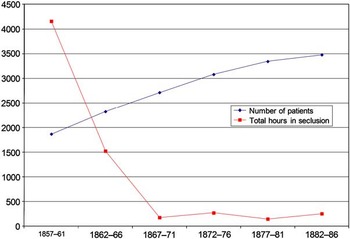
The case for being able to use less intrusive interventions is relatively robust and not only improves safety but also improves the treatment experience for patients and families (Robins et al. Reference Robins, Sauvageot, Cusack, Suffoletta-Maierle and Frueh2005; Frueh et al. Reference Frueh, Knapp, Cusack, Grubaugh, Sauvageot, Cousins, Yim, Robins, Monnier and Hiers2005). Firstly, Strumpf & Tomes (Reference Strumpf and Tomes1993) and Gordon et al. (Reference Gordon, Harvey, Marsden and Shivayogi1999) traced the origins of contrasting rates of restraint use between the US and the UK and suggested that if it is possible to do it differently in one area, it is possible to do it in others. Secondly, others have demonstrated that it is possible to reduce restraint use and to do so without an attendant increase in staff injury or cost (Andrews, Reference Andrews1978; Taxis, Reference Taxis2002; Smith et al. Reference Smith, Davis, Bixler, Lin, Altenor, Altenor, Hardentstine and Kopchick2005; LeBel & Goldstein, Reference Lebel and Goldstein2005). Thirdly, there are a variety of demonstrated mechanisms by which this can occur. They can be imposed (Andrews, Reference Andrews1978; Busch & Shore, Reference Busch and Shore2000; Erwin & Philibert, Reference Erwin and Philibert2006) or internally led endeavours. The former is effective. In a nineteenth century Cornish asylum, and despite increasing patient numbers, seclusion was significantly reduced as shown in Figure 1. It took time, often at the cost of the medical superintendants who were described as either being ahead of their time, or who found difficulty in carrying the committee with them and were forced to resign or curtail their plans (Andrews, Reference Andrews1978). Finally, Dix & Betteridge (Reference Dix and Betteridge2002) noted that 40% of UK PICUs do not have seclusion rooms in their own facility and when it had been available, may have been useful on two occasions in six years. Instead each instance was managed by 40 minutes of difficult restraint. Interestingly staff agreed that had seclusion been available, it would likely have been used more often, a concern also explicitly discussed in relation to Taser use (Kleinig, Reference Kleinig2007).
(Colour online) Numbers of patients and hours of seclusion by years in a nineteenth century Cornish asylum

It is suggested that the same principles for reducing the use of restraint can apply equally to Taser use: ‘This requires strong leadership from the top down. It means finding new ways of hiring, orienting and mentoring staff to embrace a different culture. It involves using timely data to track progress. It requires hiring former patients (consumers) to help in the training and debriefing process. We [formally] review each restraint and seclusion situation to see what can be learned to prevent aggression from escalating into another episode…This is no quick fix; it requires ongoing and continuous attention’ (Sharfstein, Reference Sharfstein2008, p. 197). Others have been more specific in their recommendations of violence protocols (Sclafani, Reference Sclafani1986), with the expert practice of the experienced psychiatric nurse (Johnson & Hauser, Reference Johnson and Hauser2001), with a psychologically minded approach (Gunderson, Reference Gunderson1978; Mistral et al. Reference Mistral, Hall and McKee2002; Hansen & Slevin, Reference Hansen and Slevin1996; O'Connor, Reference O'Connor1998) and ward atmosphere as well as the physical environment itself (Lanza et al. Reference Lanza, Kayne, Hicks and Milner1994; Dvoskin et al. Reference Dvoskin, Radomski, Bennett, Olin, Hawkins, Dotson and Drewnicky2002). Interestingly, such culture change can persist over two decades and despite changes in staff and shorter hospital length of stays (Burti et al. Reference Burti, Andreone and Mazzi2004).
Final Remarks
CEDs are tools of law enforcement. Their use is guided and monitored by the relevant police authority. The question may reasonably be asked as to what place psychiatry has in commenting on Taser use. The NZ Taser Trial (New Zealand Police, 2008) found that the most common use was in the context of family violence on a residential property where the subject was an intoxicated male aged between 25 and 29, who was wielding a knife, machete or baseball bat. It was possible to resolve 83% of all incidents without Taser deployment. Similar results were found for the 27 of 127 (21%) incidents where the ‘presence of a mental health illness was indicated’; 30–34 year old males in a residential setting carrying weapons. However, only 19 had a past contact with psychiatric services. Of the 19, 11 were referred for assessment and of those, three had psychosis and three depression. In the remaining eight, ‘police comments indicated that they may have experienced mental health issues on the basis of patients indicating that they had attempted suicide in the past and wanted to be killed by police’. No-one was hospitalized which also requires further understanding. Again, the situation was resolved without using a Taser on 18 occasions, (67%).
It is suggested that psychiatry has experience in considering the management of people who are occasionally both mentally ill and violent. Gordon et al. (Reference Gordon, Harvey, Marsden and Shivayogi1999) argued that the task is not to monitor restraint but to get someone better. If this requires restraint during their journey, do so safely, effectively, humanely, proportionately and for the minimum periods of time that current understanding allows. Similarly, Dworkin (Reference Dworkin1976) detailed a number of guidelines. He included those methods that support self respect, dignity and the fundamental identity of the person, those that are not destructive of the ability of the individual to reflect rationally and to avoid those methods that penetrate the body or rely on deception.
Tasers may be misused. That they were used on NZ Maori and Pacific Islanders in the NZ Taser Trial on 60% of occasions raises broader, socio-political questions as to an understanding and management of violence in a community. In this issue, Little & Burt (Reference Little and Burt2012) describe the use of a Taser in what the authors regarded as an exceptional circumstance: a seriously unwell man with a weapon on a gentle, person centred recovery unit. Upon his recovery, the patient was able to contribute to an advance care directive should he become unwell again.
As authors, we remain uneasy that our papers may be used as a justification for Taser use. We would not wish to languish in the proposition that the Taser is a less ‘lethal alternative’ and by so doing, not continue to ‘search, oppose, think and research’ for a better understanding and management of those rare occasions where mental illness and violence intersect. We therefore invite comment as to how best manage this most difficult of situations.
Acknowledgements
Thanks are extended to all of the staff at the Bowman Unit – a job well done. Thanks are also extended to the librarians who helped in the literature search: Gemma and Catriona at Ballarat and Mary and Jennifer at Burnie.