Introduction
Gregarines (Phylum Apicomplexa, Class Sporozoea) are protozoans found in the digestive tracts and body cavities of various planktonic invertebrates including Polychaeta, Chaetognatha, Crustacea, Mollusca, and Tunicata (see Théodoridès Reference Théodoridès1989). The sub-class Gregarinia is divided into four orders, Blastogregarinida, Archgregarinida, Eugregarinida and Neogregarinida on the basis of life cycle characteristics and cytomorphological differences (Hausmann & Hülsmann Reference Hausmann and Hülsmann1996). The life cycles of eugregarines associated with terrestrial insects are well known. For example, Gregarina korogi Hoshide, an eugregarinid parasite of the cricket, Gryllus yemma Ohmachi et Matsuura, passes through five stages: sporozoite, cephaline, gamont, gametocyst and oocyst (Hoshide & Todd Reference Hoshide and Todd1993). The first three stages occur inside the host's digestive tract and the latter two stages outside the host. The oocyst is ingested by the host and enters the digestive tract. The sporozoites emerge from the oocyst and attach to epithelium cells. This stage is referred to as the cephaline. After detachment from epithelium cells, the cephaline grows into a motile stage, the gamont. Gamonts join together in pairs (syzygy stage) and form a gametocyst, which loses its motility. At the gametocyst stage, eugregarines are excreted with the host's faeces. Then the gametocyst discharges many oocysts.
Avdeev (Reference Avdeev1985) found two eugregarinid species, Cephaloidophora pacifica Avdeev and Cephaloidophora indica Avdeev, in the digestive tract and mid-gut gland of Antarctic krill, Euphausia superba Dana. The first species was found in the area of Elephant Island (55ºE; Atlantic sector) and westwards to Balleny Islands (175ºW; Pacific sector), and the western part of the Indian sector (30º–68ºE). The second species was found only in waters of the eastern part of the Indian sector (110º–148ºE). Dolzhenkov et al. (Reference Dolzhenkov, Avdeev and Timonin1987) pointed out that the geographical differences in the occurrence of the two eugregarinids might be used as a biological indicator of the structure of krill population.
The intensity of C. pacifica has been known to increase significantly with the maturity of the host (Takahashi et al. Reference Takahashi, Kawaguchi, Kobayashi and Toda2004). Avdeev & Vagin (Reference Avdeev and Vagin1987) found a significant correlation in numbers between eugregarines and clots in diverticula, and suggested the eugregarines had a pathological effect on krill. Electron microscopic observations by Kawaguchi (unpublished observations) revealed that C. pacifica in the mid-gut gland may cause destruction of microvilli on the surface of hepatic cells, and those in the hind-gut may absorb nutrients from the epithelial cells. Euphausia superba is considered to be a key species of the Antarctic ecosystem because of its high biomass and important role (Hempel Reference Hempel, Siegfried, Condy and Laws1985). The occurrence of eugregarines and their negative impact on krill are therefore important factors affecting the Antarctic marine ecosystem. The objectives of the present study are to examine the circumpolar occurrence of the eugregarines parasitizing the Antarctic krill, and to evaluate the relationship between geographical locations and variation in eugregarine infection in krill.
Materials and methods
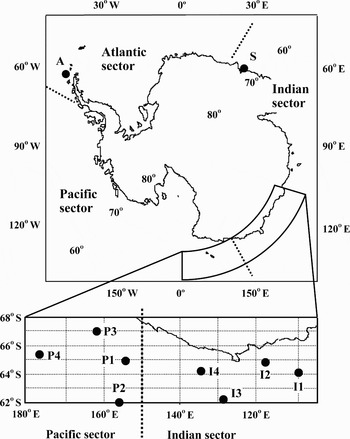
Antarctic krill were collected from Atlantic, Indian and Pacific sectors of the Southern Ocean (Fig. 1). Samples from the Atlantic sector were collected in the vicinity of the Antarctic Peninsula (A) during the 7th Antarctic Expedition from October 1994–March 1995 by the RV Kaiyo-maru of the Japan Fisheries Agency. Samples were collected with the KYMT net (Kaiyo-maru mid-water trawl: mouth area of 9 mReference Avdeev2, mesh aperture of 3.4 mm) (National Research Institute of Far Seas Fisheries 1995). Samples from the Pacific (P1-P4) and Indian (I1-I4) sectors were captured from October 1977 to February 1978 by the RV Banshu-maru. Samples were collected with the surface mid-water trawl (mouth area of 360 mReference Avdeev2, mesh aperture of 15 mm) (Japan Marine Fishery Resources Research Center 1978). Samples from near Syowa Station (S) in the Indian sector were collected with a parasol net from April to December 1982. These samples were immediately fixed in 10% buffered formalin seawater on board.
Locations of the samples used in the present study, A = Antarctic Peninsula, S = Syowa Station, I1-I4 = Indian sector, P1-P4 = Pacific sector.

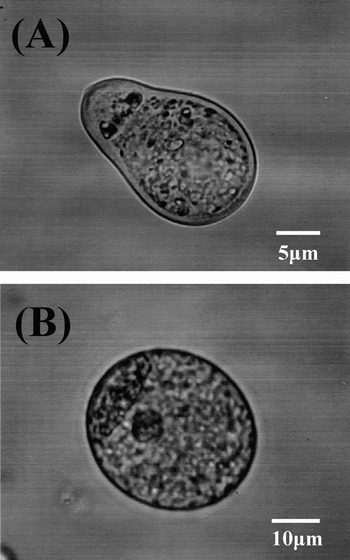
In the laboratory, about 20 individual krill were chosen randomly from each sample. Body length was measured from the anterior margin of the orbit to the tip of the telson in 1 mm size classes (Siegel Reference Siegel1982, Miller Reference Miller1983). Maturity stage and sex were classified according to Makarov & Denys (Reference Makarov and Denys1981), and they were grouped into five divisions: juvenile, sub-adult male, sub-adult female, adult male and adult female. The digestive tracts were removed, put on a glass slide, and torn to pieces with forceps. Two motile stages of the eugregarine, immature gamont and mature gamont stages as defined by Avdeev (Reference Avdeev1987) were then counted under an inverted microscope (Fig. 2).
a. Immature gamont, and b. mature gamont of Cephaloidophora pacifica.

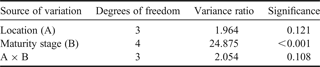
The interaction between geographical location and maturity stage of krill was evaluated using an analysis of variance (ANOVA). Geographical locations were grouped into four divisions; Pacific sector (P1-P4), Indian sector (I1-I4), Atlantic sector (A), and Syowa Station (S). Parasite counts were distributed approximately as a negative binomial, and every station had a variance greater than the mean, indicating an over-dispersed distribution. For comparison of variation in the abundance of eugregarines, the data was therefore transformed using a log10 function to reduce the bias of very high numbers. The goodness of fit was tested by the Chi-square test at a 5% level of significance. All statistical analyses were carried out using the Statistical Package for the Social Science (SPSS) for Windows, version 15.0.
The term “prevalence” as used in this paper is defined as the number of infected hosts by a particular parasite species divided by the number of hosts examined for that parasite species and the term “intensity” is defined as the number of individuals of a particular parasite species in a single infected host (Bush et al. Reference Bush, Lafferty, Lotz and Shostak1997).
Results
All eugregarines in this study were Cephaloidophora pacifica (Fig. 2). They were found at all locations with 96.4% of prevalence, and showed a remarkably wide range in numbers (Table I). Prevalence of C. pacifica was 95.0% in the Pacific sector, 100.0% in the Indian sector, 93.3% in the Indian sector, and 90.0% in the Atlantic sector. Samples from the Indian sector consisted of both sub-adult and adult krill, while at the Antarctic Peninsula, sub-adults dominated. Samples from Syowa Station were composed of juvenile krill only. Intensity of C. pacifica ranged from 0 to 8089 ind host-1; mean intensity (± SD) was 350.4 ± 787.8 ind host-1 (Table I). Intensities of more than 1000 eugregarines were found in 22 specimens, while only seven krill had no eugregarines. Intensity, range and mean ± SD at the locations where sub-adult and adult dominated were much greater than at the locations dominated by juveniles.
Percentage occurrence of C. pacifica and maturity stage of krill at each location in this study. Numbers in parenthesis indicate the total numbers of krill which had no eugregarines.

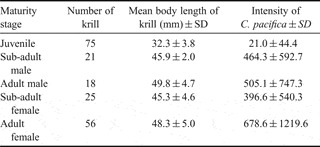
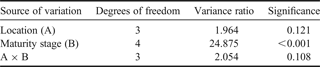
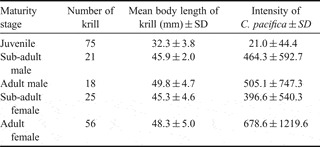
Krill body length varied between 25.8 and 56.5 mm (mean: 41.6 ± 8.9) with 41.5% females, 20.0% males and 38.5% juveniles. As the host matured, mean body length increased in both male and female and intensities of C. pacifica also increased (Table II). Statistical analyses revealed that the geographical location did not have a significant effect on intensity of C. pacifica (P = 0.121, Table III). On the other hand, the intensity of C. pacifica was significantly different at each maturity stage (P < 0.001, Table III).
Mean body length and intensity of C. pacifica at each maturity stages of krill.
Interaction of geographical location and maturity stage of krill (details of ANOVA).
Discussion
Cephaloidophora pacifica occurred in Euphausia superba from all sites examined. Avdeev (Reference Avdeev1985) studied these parasites of E. superba in 1982 around Elephant Island and westwards to the east of the Indian sector, and during 1984 from the eastern part of Riiser–Larsen Sea (30ºE) to the middle of Sodruzhestva Sea (68ºE). Dolzhenkov et al. (Reference Dolzhenkov, Avdeev and Timonin1987) pointed out that areas of occurrence of the two eugregarinid species C. pacifica and C. indica were separated, and C. indica was found in E. superba only in the eastern part of the Indian sector (110–148ºE). However, in this study, all eugregarines found in the Indian sector (110–135ºE) were identified as C. pacifica which can therefore be considered as distributed throughout the Southern Ocean.
The present study on C. pacifica demonstrated that their distribution show the overdispersed pattern (i.e., the standard deviation is greater than the mean). This frequency distribution pattern is typically found in parasites living in marine species (Boxshall Reference Boxshall1974, Tanner et al. Reference Tanner, Curtis, Sole and Gyapay1980, Jakob Reference Jakob1987, Takahashi et al. Reference Takahashi, Kawaguchi, Kobayashi and Toda2004). Takahashi et al. (Reference Takahashi, Kawaguchi, Kobayashi and Toda2004) suggested that this difference may be due to the body length and the maturity stage composition of hosts. Thus, larger krill have more eugregarines than smaller krill at the same maturity stage. Statistical analyses showed C. pacifica abundance increases with the maturity of the krill. On the other hand, the geographical location did not have a significant effect, thus the variation of intensity for each station may be primarily influenced by the stage compositions of the Antarctic krill.
The high prevalence of C. pacifica indicates that the relation between the eugregarines and Antarctic krill is strong. Takahashi et al. (Reference Takahashi, Kawaguchi, Kobayashi and Toda2003) survey of Antarctic krill from the vicinity of the Antarctic Peninsula showed similar results, with 98.2% of krill (n = 383) being infected with C. pacifica. Avdeev (Reference Avdeev1985) reported that eugregarines were found in 75.0% of krill examined (n = 1848) in the Pacific and Indian sectors of the Southern Ocean. Avdeev & Vagin (Reference Avdeev and Vagin1987) suggested that the eugregarines in the mid-gut gland have a pathological effect because of the close correlation between the number of eugregarines and clots in the diverticula of the mid-gut gland. A histological study of Kawaguchi (unpublished observations) revealed that the eugregarines cause damage to mid-gut gland and intestinal epithelium. Therefore, heavy infestation by eugregarines may have negative impacts on krill biomass and productivity. The results of the present study show that infestation of Antarctic krill by C. pacifica is a circum-Antarctic phenomenon, and it occurs throughout the Southern Ocean. It is important to take into account the ecological influences of eugregarine infestation on the Antarctic krill, due to the fact that krill is a key species of the Antarctic marine ecosystem.
Acknowledgements
We are grateful to Drs K. Hoshide, Yamaguchi University and S. Imai, Nippon Veterinary and Animal Science University, for their helpful information on the eugregarinid protozoans, S. Taguchi, Soka University and T. Kikuchi, Yokohama National University, for their valuable comments. We also thank the officers and crew of the RV Kaiyo-maru and the RV Banshu-maru for their assistance. This research was partially funded by the Sasagawa Scientific Research Grant from The Japan Science Society to Masaki Kobayashi.