Introduction
There are four meta-analyses currently published in the English literature on the use of tranexamic acid in sinonasal surgery.Reference Kang and Hwang1–Reference Pundir, Pundir, Georgalas and Fokkens4 However, each meta-analysis did not fully include all available studies within the literature for their quantitative analyses. The purpose of this study was to summarise and update information on efficacy of tranexamic acid use in sinus and nasal surgery.
The objectives of this study were: (1) to assess the effect of using tranexamic acid on sinus and nasal surgery; (2) to assess primary outcome measures of intra-operative blood loss, quality of the surgical field and duration of surgery; (3) to determine if there is a difference between topical or intravenous administration of tranexamic acid in sinus surgery on the primary outcomes described above; and (4) to determine whether oral or intravenous tranexamic acid has any effect on nasal surgery (i.e. rhinoplasty or septoplasty).
Materials and methods
Search strategy
A literature search was performed on four medical databases: Cochrane Library, Embase, Medline and PubMed on 31 October 2019. The Embase search was a combination of Medical Subject Heading (‘MeSH’) terms *“TRANEXAMIC ACID”/ AND *OTORHINOLARYNGOLOGY/ whereas the Medline search was *“TRANEXAMIC ACID”/ AND *OTOLARYNGOLOGY/, the PubMed search was (Tranexamic acid).ti,ab AND (ENT).ti,ab OR (Otology).ti,ab OR (Rhinology).ti,ab OR (Laryngology).ti,ab OR (Otorhinolaryngology).ti,ab, and the Cochrane Library search was *Tranexamic Acid*. The initial results were reviewed by the first author (DY) and relevant articles were selected to review in full.
There was no use of human participants or animals in this study. All ethical policy and key considerations were carefully adhered to. No data contain any patient identifiable or shared data.
Study selection
Only randomised, placebo-controlled trials with results published as mean with or without standard deviation were included for quantitative analysis. Articles that were not published in English, non-randomised, controlled trials and trials without appropriate published outcome measures for quantitative analysis were excluded. Full articles were obtained and reviewed for all randomised, placebo-controlled trials of tranexamic acid use in sinus or nasal surgery. We used the revised risk of bias in randomised trials (‘RoB 2’) tool to assess the quality of studies included in the quantitative analysis.
Data collection
From included studies, we analysed the amount of intra-operative blood loss, quality of the surgical field and duration of surgery. Data were extracted only from papers with specific published results (i.e. mean and standard deviation). In studies where the quality of the surgical field was published using multiple time intervals, a combined mean and standard deviation was calculated.
Papers with results published in terms of charts or graphs without attached numerical values were excluded. All corresponding authors from excluded studies were contacted to obtain appropriate data for meta-analysis; unfortunately, we were not able to obtain any additional results.
Analysis
Data from the included studies were extracted by the first author (DY). Data analysis was performed using dedicated meta-analysis software (Review manager (Revman), version 5.0; the Nordic Cochrane Centre, The Cochrane Collaboration, Copenhagen, Denmark). Standardised mean differences and 95 per cent confidence intervals (CIs) were calculated using a fixed effect model.
Results
Search results
A total of 75 studies were identified, with duplicates removed, on initial searches of Cochrane Library, Medline, Embase and PubMed. Titles and abstracts were reviewed, and 23 studies were identified for review.
Following a review of the 23 identified studies, 6 studies were excluded for the following reasons: (1) 1 study had no direct comparison with a placebo; (2) 4 studies did not have appropriate published numerical data to be included in the quantitative analysis; and (3) 1 study was an abstract publication with no appropriate numerical data published to be included in the quantitative analysis.
A further four papers had previously conducted meta-analyses on the use of tranexamic acid in nasal or sinus surgery.Reference Kang and Hwang1–Reference Pundir, Pundir, Georgalas and Fokkens4 All excluded studies are summarised in Appendix 1 and the Preferred Reporting Items for Systematic Reviews flow diagram is shown in Appendix 2.
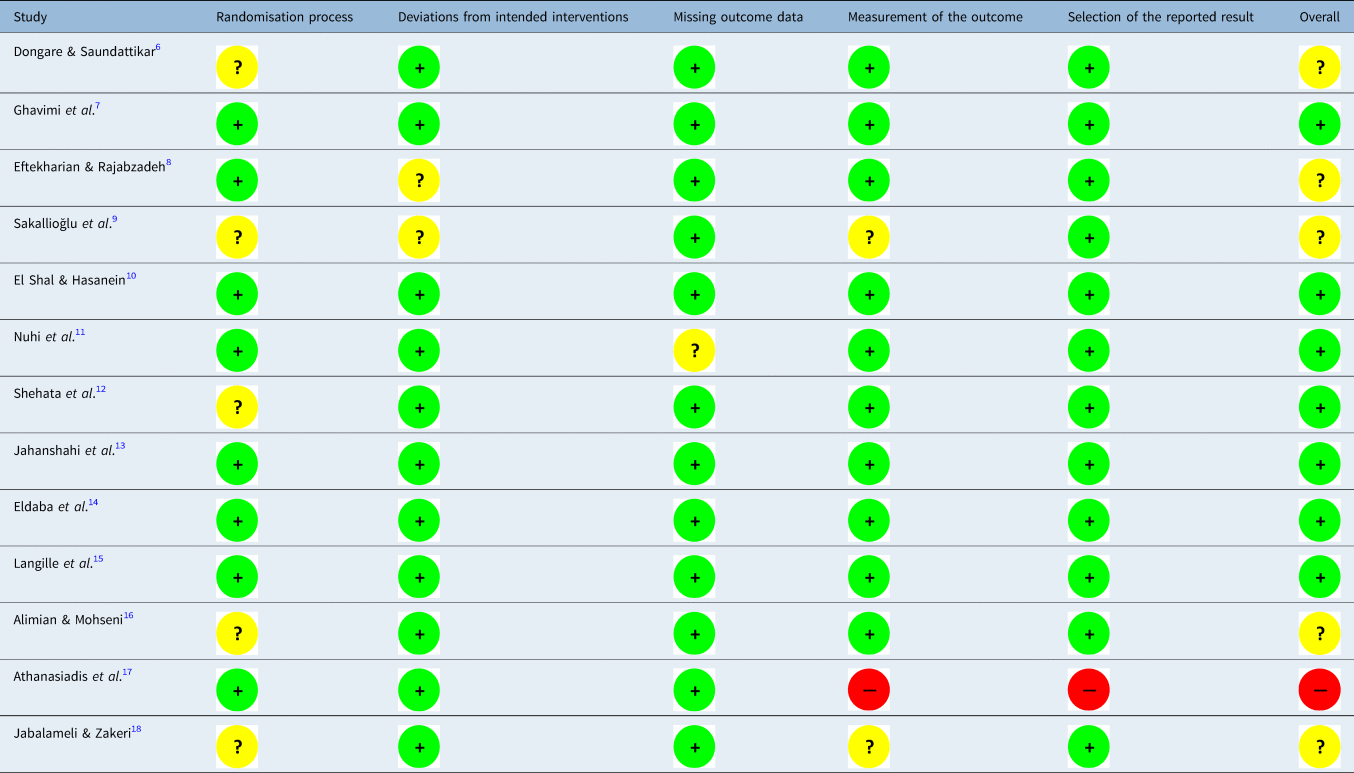
Using the risk of bias 2 tool, the remaining 13 papers were assessed for risk of bias.Reference Sterne, Savović, Page, Elbers, Blencowe and Boutron5 Following quality assessment, 7 papers were graded as having some concerns, 1 paper was graded as high risk of bias and the other 5 papers were considered low risk. Table 1 summarises the risk assessments of individual studies. Ten papers studied the effects of tranexamic acid on sinus surgery, and 3 papers were on nasal surgery.Reference Dongare and Saundattikar6–Reference Jabalameli and Zakeri18
Risk of bias 2 tool quality assessment

Green circle with plus symbol = low risk; yellow circle with question mark = some concerns; red circle with minus sign = high risk
The study by Athanasiadis et al. was the only ‘intra-individual study design’ in the quantitative analysis,Reference Athanasiadis, Beule and Wormald17 and the remaining 12 studies allocated individuals to an intervention or placebo-controlled arm.Reference Dongare and Saundattikar6–Reference Alimian and Mohseni16,Reference Jabalameli and Zakeri18 Eldaba et al. was the only study involving a paediatric population.Reference Eldaba, Amr and Albirmawy14
The study by Athanasiadis et al. was a 3-arm randomised, controlled trial (100 mg tranexamic acid, 1 g tranexamic acid and saline).Reference Athanasiadis, Beule and Wormald17 We have only included the results for the 100 mg group for quantitative analysis because the 1 g group did not have appropriate published data to be included.
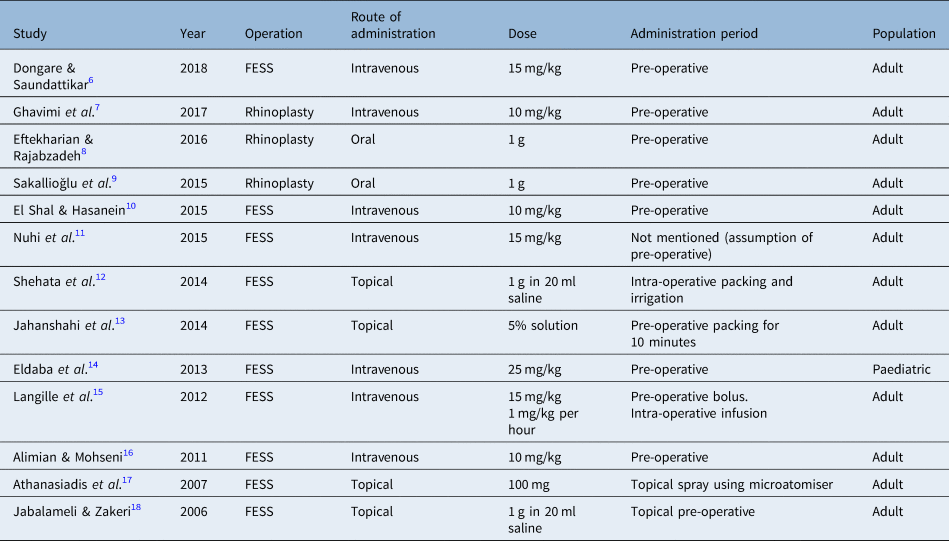
Concentration of tranexamic acid varied between all the included studies as shown in Table 2; therefore we were not able to obtain a meaningful meta-analysis regarding a specific dose of tranexamic acid.
Tranexamic acid doses

FESS = functional endoscopic sinus surgery
Blood loss
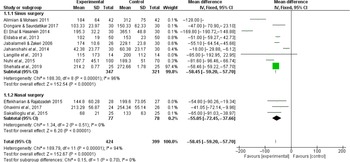
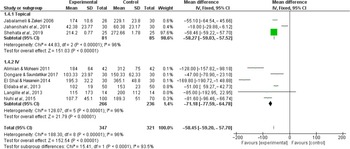
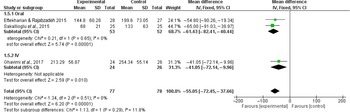
Twelve studies were included in the quantitative analysis of intra-operative surgical blood loss (nine sinus surgery and three rhinoplasty studies). In comparison with placebo, the tranexamic acid group had less blood loss (standard mean difference, −58.45; 95 per cent CI = −59.20 to −57.70) in both sinus surgery (standard mean difference, −58.45; 95 per cent CI = −59.20 to −57.70) and nasal surgery (standard mean difference, −55.05; 95 per cent CI, −72.45 to −37.66). The measure of heterogeneity was chi2 = 188.30, df = 8 (p < 0.00001) and (I2) = 96 per cent in the sinus surgery group and the measure of heterogeneity was chi2 = 1.34, df = 2 (p < 0.51) and (I2) = 0 per cent in the nasal surgery group (Figure 1).
Tranexamic acid compared with placebo blood loss forest plot. SD = standard deviation; IV = inverse variance; CI = confidence interval

Surgical field quality
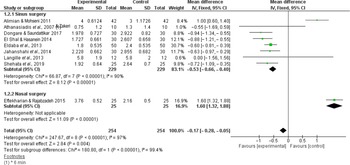
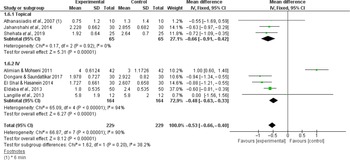
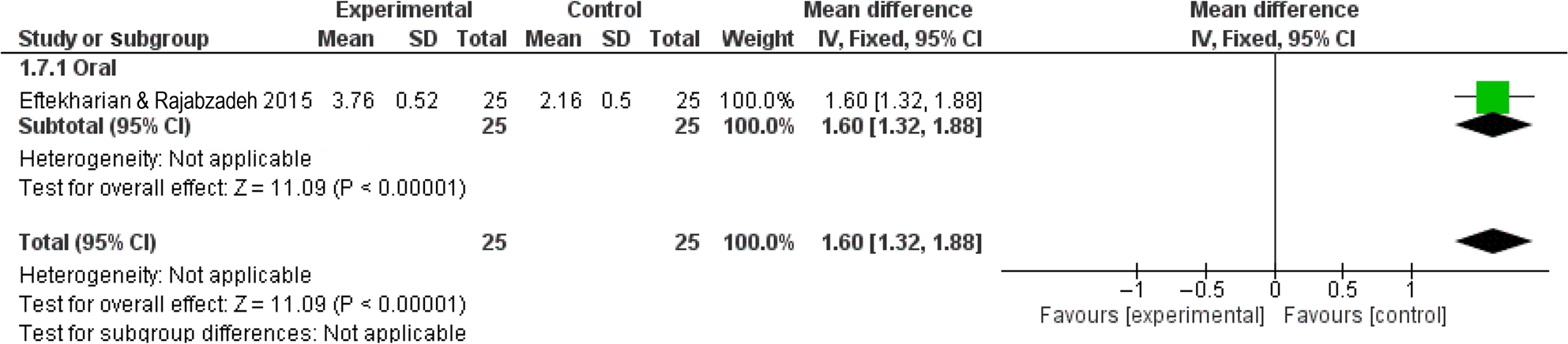
Eight sinus surgery and one nasal surgery study rated the quality of the surgical field. Overall results favoured the intervention group (standard mean difference, −0.17; 95 per cent CI = −0.28 to −0.05). When compared with placebo, the tranexamic acid intervention group was superior in comparison to the placebo group for sinus surgery (standard mean difference, −0.53; 95 per cent CI = −0.66 to −0.40). In contrast, tranexamic acid worsens the surgical field for nasal surgery as demonstrated in Figure 2 (standard mean difference, 1.60; 95 per cent CI, 1.32 to 1.88). Sinus surgery standard mean difference was −0.53 (95 per cent CI = −0.66 to −0.40) and measure of heterogeneity was chi2 = 66.87, df = 7 (p < 0.00001) and I2 = 90 per cent, while nasal surgery standard mean difference was 1.60 (95 per cent CI = 1.32 to 1.88 and measure of heterogeneity was chi2 = 102.11 df = 4 (p < 0.00001), I2 = 96 per cent). There is currently no available study that shows the effect of intravenous tranexamic acid on nasal surgery.
Tranexamic acid compared to placebo surgical field quality forest plot. SD = standard deviation; IV = inverse variance; CI = confidence interval

Duration of surgery
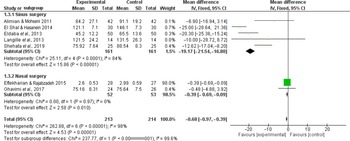
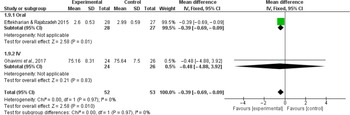
Figure 3 shows that the tranexamic acid intervention group had a shorter duration of surgery in comparison with placebo (standard mean difference = −0.68; 95per cent CI = −0.97 to −0.39) in both sinus surgery (5 studies) and nasal surgery (2 studies). Standard mean difference in sinus surgery was −19.17 (95 per cent CI = −21.54 to −16.80) and measure of heterogeneity was chi2 = 25.11 (df = 4 (p < 0.0001), I2 = 84 per cent), while nasal surgery had a standard mean difference of −0.39 (95 per cent CI = −0.69 to −0.09) and measure of heterogeneity of chi2 = 262.88 (df = 6, I2 = 98 per cent).
Tranexamic acid compared to placebo duration of surgery forest plot. SD = standard deviation; IV = inverse variance; CI = confidence interval

Subgroup analysis
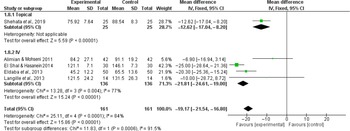
We found that in sinus surgery, topical or intravenous administration of tranexamic acid had lower blood loss, improved surgical field quality and had shorter duration of surgery compared with placebo (Figures 4, 5 and 6). As for nasal surgery, both oral and intravenous administration of tranexamic acid reduced intra-operative blood loss (Figure 7). There was only one study that concluded using oral tranexamic acid worsened the surgical field quality for nasal surgery (Figure 8); however, it reduced duration of surgery (Figure 9). Intravenous tranexamic acid provided no additional benefit in duration of nasal surgery (Figure 9).
Subgroup analysis: topical versus intravenous tranexamic acid on blood loss in sinus surgery. SD = standard deviation; IV = inverse variance; CI = confidence interval

Subgroup analysis: topical versus intravenous tranexamic acid on surgical field quality in sinus surgery. SD = standard deviation; IV = inverse variance; CI = confidence interval

Subgroup analysis: topical versus intravenous tranexamic acid on duration of surgery in sinus surgery. SD = standard deviation; IV = inverse variance; CI = confidence interval

Subgroup analysis: oral versus intravenous tranexamic acid on blood loss in nasal surgery. SD = standard deviation; IV = inverse variance; CI = confidence interval

Subgroup analysis: oral tranexamic acid on surgical field quality in nasal surgery. SD = standard deviation; IV = inverse variance; CI = confidence interval

Subgroup analysis: oral versus intravenous tranexamic acid on duration of surgery in nasal surgery. SD = standard deviation; IV = inverse variance; CI = confidence interval

Discussion
Background
Because of the narrow space and rich blood supply within the nasal cavity, intra-operative bleeding causes significant reduction in visual acuity, subsequently increasing the risk of surgical complications, poorer surgical outcomes, duration of surgery and even preventing completion of the procedure on some occasions.Reference Kang and Hwang1–Reference Kim, Kim, Kang, Jin and Hwang3
Multiple methods have been described to reduce intra-operative bleeding to obtain better visualisation of the surgical field, such as controlled hypotension, use of a topical vasoconstrictor, pre-operative steroid administration, patient positioning, bipolar cautery and infiltration into the pterygopalatine fossa amongst many other methods.Reference Kang and Hwang1,Reference Kim, Kim, Kang, Jin and Hwang3,Reference Pundir, Pundir, Georgalas and Fokkens4
The Wormald and Boezaart grading scales are two validated scoring systems for surgical field quality; the scoring principles are incremental changes from a clear to a vague surgical field.Reference Ping, Zhao, Sun, Lu and Li2 We only included studies that used these grading scales in our quantitative analysis.
Mode of action of tranexamic acid
Surgical trauma, hypothermia, administration of crystalloid fluids during and after surgery, and consumption of coagulation factors and platelets have been known to activate fibrinolysis during surgery.Reference Kim, Kim, Kang, Jin and Hwang3 Tranexamic acid is a synthetic anti-fibrinolytic agent that acts as a competitive antagonist to the lysine site of plasminogen, inhibiting the tissue plasminogen activator.Reference Shehata, Ibrahim and Abd-El-Fattah12,Reference Jabalameli and Zakeri18 This action will inhibit fibrin binding to plasminogen. In the clotting cascade, tranexamic acid prevents fibrinolysis and stabilises blood clot formation, which results in a reduction in bleeding.Reference Kim, Kim, Kang, Jin and Hwang3,Reference Shehata, Ibrahim and Abd-El-Fattah12
Generally tranexamic acid is well tolerated and considered a safe medication at the appropriate dosage. Nausea and vomiting are known as the commonest side effects, and hypotension has been observed if administered rapidly.Reference Dunn and Goa19 Meta-analysis by Pundir et al. showed no significant difference in occurrence of nausea and vomiting in patients taking tranexamic acid in comparison with placebo.Reference Pundir, Pundir, Georgalas and Fokkens4
The risk of a thromboembolic event secondary to tranexamic acid use has always been a concern. However, studies have shown that there is no increased risk of thromboembolic events in tranexamic acid treatment groups in comparison with controls.Reference Franchini, Mengoli, Marietta, Marano, Vaglio and Pupella20,Reference Kim, Park, Kim and Seo21
Comparison with other meta-analyses
Compared to the Kang and HwangReference Kang and Hwang1 meta-analysis studying the effects of topical tranexamic acid in functional endoscopic sinus surgery, the study by Baradaranfar et al.Reference Baradaranfar, Dadgarnia, Mahmoudi, Behniafard, Atighechi and Zand22 did not contain results that were appropriate to be included in the quantitative meta-analysis and therefore this study was excluded. However, we included an additional study by Athanasiadis et al.Reference Athanasiadis, Beule and Wormald17 Ping et al.Reference Ping, Zhao, Sun, Lu and Li2 had 11 studies included in their meta-analysis, while our review included 13 studies. We excluded MehdizadehReference Mehdizadeh, Ghassemi, Khakzad, Mir, Nekoohesh and Moghadamnia23 et al. and Sakallioğlu et al.Reference Sakallioğlu, Polat, Soylu, Düzer, Orhan and Akyiğit9 from our review as their primary outcomes were oedema and ecchymosis, which are not our primary outcomes. All other appropriate studies within the quantitative analysis of Ping et al.Reference Ping, Zhao, Sun, Lu and Li2 have been included in our review.
Kim et al.Reference Kim, Kim, Kang, Jin and Hwang3 (2018) included 7 studies in their quantitative analysis, compared with this review which included 10 studies. The study results published by Chhapola et al.Reference Chhapola and Matta24 and Moise et al.Reference Moise, Agachi, Dragulin, Mincu and Stelea25 were not suitable for quantitative analysis; therefore they were excluded in our review.
Lastly, Pundir et al.Reference Pundir, Pundir, Georgalas and Fokkens4 included five studies in their quantitative analysis published prior to 2013. Our review included studies published after 2013, and a summary of a comparison of these is shown in Appendix 3.
Limitations
Heterogeneity is the variation in effect estimates beyond chance. Statistical heterogeneity almost always occurs in meta-analysis because of clinical and methodological diversity; however, it is important to consider the extent of consistency of the studies’ results. I2 describes the percentage of variability in effect estimates that is a result of heterogeneity rather than sampling error (chance). The interpretation of I2 must be taken with caution as the threshold can be misleading because the importance of inconsistencies depends on several factors, such as strength of evidence for heterogeneity, magnitude and direction of effects.Reference Higgins, Thomas, Chandler, Cumpston, Li and Page26
We acknowledge that the I2 within our meta-analysis varied between 0 and 96 per cent, which represents substantial to considerable heterogeneity. The use of different scoring systems for the quality of surgical fields may have contributed to the heterogeneity of our analyses. Therefore, those results would need to be interpreted with caution.
Subgroup analyses should also be interpreted with caution as there are few studies included in the quantitative analysis. Further studies are required to provide more statistically significant results.
All included studies have a variation in the dose and administration of tranexamic acid. This reflects the current clinical diversity in our practice. Unfortunately, because of this variation, quantitative analysis on the individual route of administration and dosage of tranexamic acid is not possible.
Implication for research
Ideally a larger multi-centred randomised, blinded, prospective controlled trial should be conducted to provide further conclusive evidence on the use of tranexamic acid in sinus and nasal surgery. It would also be clinically relevant to investigate the most efficacious mode of administration and dose of tranexamic acid use in nasal or sinus surgical procedures.
We attempted to contact corresponding authors from excluded studies to obtain appropriate data for meta-analysis; unfortunately, we were not able to obtain any additional results. Most authors did not respond to our request and of those who responded, they no longer had original data for further interpretation because of the passage of time.
Generally, all studies included were small, with the largest study containing 170 adults.Reference Nuhi, Tabrizi, Zarkhah and Ashrafi11 All data included in this meta-analysis were from studies that published raw numerical data for analysis. A further updated meta-analysis could be performed if authors of the excluded studies provided specific numerical data such as the mean with or without the standard difference.
• Tranexamic acid reduces blood loss and surgical duration and improves surgical field quality in sinus surgery
• In nasal surgery, tranexamic acid has been shown to improve surgical time and reduce blood loss but does not improve surgical field quality
• There was no difference between blood loss, surgical field quality and surgical duration between topical or intravenous administration of tranexamic acid in sinus surgery
• Due to variation in concentration and mode of administration, a standard technique cannot be recommended from this meta-analysis
• Due to the limited number of studies, future randomised, controlled trials on the efficacy of tranexamic acid in rhinology cases are recommended
Presently, there are no randomised, controlled trials studying the effect of intravenous tranexamic acid on the quality of the surgical field in nasal surgery.
Conclusion
Our review strongly suggests that tranexamic acid reduces blood loss, decreases surgical duration and improves surgical field quality in sinus surgery. For nasal surgery however, it was shown to reduce blood loss and surgical duration but does not improve surgical field quality. Given the number of studies included in the quantitative analysis, a larger multicentred randomised, controlled trial is recommended.
Competing interests
None declared
Appendix 1. Excluded studies

Appendix 2. Preferred Reporting Items for Systematic Reviews (PRISMA) 2009 flow diagram

Appendix 3. Comparison with other meta-analyses