INTRODUCTION
Higher body mass index (BMI) is associated with increased risk of diabetes, cardiovascular disease, some cancers and all-cause mortality (Jung, Reference Jung1997; Seidell, Reference Seidell2005; Lawlor et al. Reference Lawlor, Hart, Hole and Davey Smith2006). However, there is a growing body of evidence that greater BMI may protect against a range of mental health problems. The German psychiatrist Ernst Kretschmer, from the 1920s, was one of the first investigators to suggest that heavy people are jolly, friendly and gregarious (the ‘jolly fat’ persona). In his seminal work Physique and Character, Kretschmer (Reference Kretschmer1931) reported that most (90%) of his manic-depressive patients were rotund and that most (80%) of his schizophrenic patients were tall and thin. However, this work was conducted among patients who had been referred to him and may not be generalizable to non-patient groups.
More recent results from studies examining the association of obesity or BMI with depression in the general population have been inconsistent. Some studies have found no association (Hallstrom & Noppa, Reference Hallstrom and Noppa1981; Faubel, Reference Faubel1989; Ross, Reference Ross1994; Han et al. Reference Han, Tijhuis, Lean and Seidell1998), other studies have reported an inverse association (reduced risk of depression in those with greater BMI) consistent with the ‘jolly fat’ hypothesis (Crisp & McGuiness, Reference Crisp and McGuiness1976; Crisp et al. Reference Crisp, Queenan, Sittampaln and Harris1980; Palinkas et al. Reference Palinkas, Wingard and Barrett-Connor1996; Carpenter et al. Reference Carpenter, Hasin, Allison and Faith2000) and yet others have found a positive association (increased risk of depression with greater BMI; Noppa & Hallstrom, Reference Noppa and Hallstrom1981; Istvan et al. Reference Istavan, Zavelta and Weidner1992; Onyike et al. Reference Onyike, Crum, Lee, Lyketsos and Eaton2003; Simon et al. Reference Simon, Von Korff, Saunders, Migliaretti, Crane, van Belle and Kessler2006). These differences may reflect differences in the measurement and definitions of both obesity and depression, and adjustment for different potential confounding factors in different studies (Friedman & Brownell, Reference Friedman and Brownell1995).
There is also some evidence that the association varies by gender (Stunkard et al. Reference Stunkard, Faith and Allison2003). For example, in a small (n=339 men and 400 women) UK-based cross-sectional study, Crisp & McGuiness (Reference Crisp and McGuiness1976) found that obesity was associated with lower levels of anxiety in both men and women and with lower levels of depression in men but not women (there was no association between obesity and depression in women). When they repeated their study in a rural UK population, obesity was again associated with reduced risk of anxiety and depression in men, but in women associations were only present in some post hoc subgroup analyses. In cross-sectional analyses of the US Rancho-Bernardo cohort (n=2245), being overweight [odds ratio OR) 0·34, p=0·004] or obese (OR 0·28, p=0·09) compared to normal weight in men tended to protect against major depression, whereas in women there was no association between overweight/obesity and depression (Palinkas et al. Reference Palinkas, Wingard and Barrett-Connor1996). Similarly, in a second, very large (n=40 086), cross-sectional study undertaken in the USA among men, lower BMI was associated with increased odds of depression, suicide ideation and suicide attempts, whereas in women greater BMI was associated with increased odds of these adverse mental health outcomes (Carpenter et al. Reference Carpenter, Hasin, Allison and Faith2000). It has been suggested that the possible inverse association of BMI with depression in men may reflect biological effects related to brain serotonin levels, whereas in women the possible increased risk of depression with greater BMI may be related to societal pressure on contemporary women to be slender (Palinkas et al. Reference Palinkas, Wingard and Barrett-Connor1996). However, most studies to date that have examined this association have been cross-sectional, and there is increased recognition that prospective studies are required to better understand the association of body size with depression and other mental health outcomes (Friedman & Brownell, Reference Friedman and Brownell1995; Onyike et al. Reference Onyike, Crum, Lee, Lyketsos and Eaton2003; Roberts et al. Reference Roberts, Deleger, Strawbridge and Kaplan2003). Among the small number of prospective studies, findings have also been inconsistent. In a short-term 1-year follow-up of the Alameda County Study of 2298 adults aged 50 years or more, obesity assessed by self-report of weight and height in 1994 appeared to be associated with the occurrence of depression in 1995, but this association varied with the cut-point of BMI used to define obesity (Roberts et al. Reference Roberts, Kaplan, Shema and Strawbridge2000). Thus, when obesity was defined as at or above the sex- and age-specific 85th percentile of the distribution, there was a strong positive association [OR 1·73, 95% confidence interval (CI) 1·04–2·87], whereas when it was defined according to World Health Organization (WHO) criteria (i.e. ⩾30 kg/m2) the association was weaker (OR 1·43, 95% CI 0·85–2·43). In two publications of a longer-term follow-up (5 years to 1999) of the same cohort, obesity at baseline was positively associated with depression, but this association attenuated with adjustment for covariables and there was no association between obesity and seven other psychological outcomes (Roberts et al. Reference Roberts, Strawbridge, Deleger and Kaplan2002), although the association with depression was stronger when those with depression at baseline were excluded from analyses (Roberts et al. Reference Roberts, Deleger, Strawbridge and Kaplan2003). The authors concluded that further prospective studies with larger numbers and actual measures of weight and height were required to further explore this association. In contrast to these prospective findings from the Alameda County cohort, a large (n=1 299 177) prospective record linkage study of men found that the risk of suicide decreased linearly with increasing BMI assessed at mean age 18 over a follow-up period of 31 years (Magnusson et al. Reference Magnusson, Rasmussen, Lawlor, Tynelius and Gunnell2005). Furthermore, insulin resistance, which is associated with higher BMI (Liese et al. Reference Liese, Mayer-Davis and Haffner1998), has also been shown to be associated with decreased risk of depression and suicide (Golomb et al. Reference Golomb, Tenkanen, Alikoski, Niskanen, Manninen, Huttunen and Mednick2002; Lawlor et al. Reference Lawlor, Davey Smith and Ebrahim2003), although a recent study of middle-aged men found no association of insulin resistance with common mental disorder assessed with the general health questionnaire (Lawlor et al. Reference Lawlor, Ben-Shlomo, Ebrahim, Davey Smith, Stansfeld, Yarnell and Gallagher2005).
Several studies have also found that greater BMI protects against schizophrenia. In a large record linkage study of Swedish men, lower BMI at age 18 years was associated with increased risk of having at least one hospital admission for schizophrenia over the follow-up period (Gunnell et al. Reference Gunnell, Harrison, Whitley, Lewis, Tynelius and Rasmussen2005). Similar findings were reported in studies of 18-year-old Israeli (Weiser et al. Reference Weiser, Knobler, Lubin, Nahon, Kravitz, Caspi, Noy, Knobler and Davidson2004) and Danish males (Sorensen et al. Reference Sorensen, Mortensen, Reinisch and Mednick2006), and in a further study thinner children aged 7–15 years had a greater risk of schizophrenia in later life (Wahlbeck et al. Reference Wahlbeck, Forsen, Osmond, Barker and Eriksson2001). However, a large case-control study (n=7514 cases) found no association between adult BMI and major mental illness requiring hospitalization (Wyatt et al. Reference Wyatt, Henter, Mojtabai and Bartko2003). The cases in that study were US military personnel who were hospitalized for bipolar disorder, major depression or schizophrenia, with the controls being psychiatrically healthy military personnel in active service, and it is possible that these results are not generalizable to other groups.
Thus, to date there is some evidence that greater BMI may protect against mental ill-health, including depression, schizophrenia and suicide. However, there is a need for further prospective studies in adults. Given the existing obesity epidemic, understanding the full spectrum of its health-related effects is important. In this study we have examined the association of BMI with hospital admissions for depression/anxiety and for psychoses in a prospective cohort study of middle-aged adults from Scotland. This study adds to previous research in this area by being prospective, having measures of height and weight at baseline (rather than self-report or obtained from routine medical examinations), being sufficiently large to compare effects between men and women and having a sufficiently long follow-up period to enable the first 5 years of follow-up to be excluded and thus reduce the possibility that any associations are explained by reverse causality. Although depression/anxiety and psychoses are distinct conditions that differ markedly in terms of symptoms, management and epidemiology, previous studies suggest associations of BMI with both, and also with suicide, which is increased both in patients with depression and in those with psychosis. For this reason we felt it was appropriate to provide a comprehensive study of the prospective association of BMI with mental health outcomes by presenting its association with depression and psychoses in the one paper. Nonetheless, the two disorders are kept separate in all analyses.
METHOD
Participants
Data from the Renfrew/Paisley study were used. This study consists of 7049 men and 8353 women who were aged 45–64 (mean age 54·3 years; s.d.=5·58) and who resided in the towns of Renfrew and Paisley, near to Glasgow, Scotland, at the time of their baseline assessment in 1972–76 (Hawthorne et al. Reference Hawthorne, Watt, Hart, Hole, Davey Smith and Gillis1995). All adults in the age range and who were resident in the geographical area of Renfrew and Paisley were invited to participate and 80% did so. For the main analyses of the association of BMI at baseline with hospital admissions for mental health outcomes, we excluded 24 participants who were lost to follow-up and 15 participants with missing data on BMI, leaving 7036 men and 8327 women in the analyses.
Ethics approval for this study was granted by the University of Glasgow Medical Faculty Ethics Committee.
Assessment of BMI, hospital admissions for mental health problems and covariables
Weight and height were measured using standard research procedures (Hawthorne et al. Reference Hawthorne, Watt, Hart, Hole, Davey Smith and Gillis1995), and these were used to determine BMI (kg/m2). BMI was categorized according to WHO categories: underweight (<18·5 kg/m2); normal weight (18·5 to <25 kg/m2); overweight (25 to <30 kg/m2) and obese (⩾30 kg/m2).
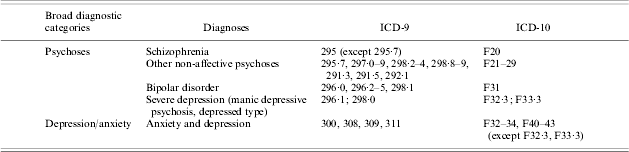
Ethical permission was given by the Privacy Advisory Committee of the National Health Service (NHS) Scotland Information Services to link the participants to their hospital discharge data from 1972. This is a computerized record of all hospital discharges in Scotland, known as the Scottish Morbidity Records (SMR) system, with mental health discharges known as SMR4s (Kendrick & Clarke, Reference Kendrick and Clarke1993). Discharges were available until the end of March 2004, and any occurring before screening were excluded. Data were available on dates of admission and discharge and the type of admission, coded with International Classification of Disease (ICD) codes. Diagnoses included on the discharge files will have been made and/or confirmed by relevant clinicians (hospital psychiatrists in the case of mental health admissions). The accuracy of the SMR system has been evaluated and found to be accurate for broad ICD categories (e.g. psychoses), but only moderately accurate for subcategories (e.g. there is likely to be error in distinguishing schizophrenia from other non-affective psychoses) (Kendrick & Clarke, Reference Kendrick and Clarke1993). In this study we used only broad categories. The codes used to define depression/anxiety and psychoses admissions are given in Table 1.
International classification of disease (ICD) codes used to categorize mental health admissions over follow-up period

The covariables considered in the analyses were social class and smoking habit, which may confound this association, and cholesterol, which may act as a mediating factor in any association. Social class at baseline was obtained from a question on occupation, with occupations classified according to the UK Registrar General's Classification (General Register Office, 1966). Women's social class was based on their own occupation, unless they reported being housewives, when their husband's social class was used. Smoking habit was reported at baseline, including number of cigarettes smoked per day for current and former smokers. Total cholesterol was measured on non-fasting blood samples as described previously (Hawthorne et al. Reference Hawthorne, Watt, Hart, Hole, Davey Smith and Gillis1995).
Subgroup analyses
For a subgroup of the participants we were able to examine the association of weight change over a short time-interval with future hospital admissions of mental health problems. In 1977–79, 3785 of the men and 4747 of the women in the cohort returned for a repeat screening. Measurements were undertaken using the same procedures as at the first screening. After excluding nine participants lost to later follow-up, eight and 19 with missing data on BMI at first and second screening respectively, the analyses on the subgroup with repeated BMI measurements during the follow-up period were performed on 3767 men and 4729 women.
In a different subgroup we were able to examine whether the presence of psychological distress at baseline influenced the associations (a further way of examining the direction of association by testing whether the association was driven by those with already present psychological distress who had a lower BMI as a result of this and were also more likely to be formally diagnosed and admitted to hospital with a mental health problem in the future). Psychological distress was only measured in participants from Paisley and assessment was started 7 months after the start of the baseline survey. Thus, it is available in 3782 of the men and 4680 women. The 30-item general health questionnaire (GHQ-30) was used to assess psychological distress (Goldberg, Reference Goldberg1972; Rasul et al. Reference Rasul, Stansfeld, Hart, Gillis and Davey Smith2002).
Data analyses
For the main analyses we use Cox proportional regression to examine the relative rate of hospital admissions for either depression/anxiety or psychoses by BMI categories (with the ‘normal’ category as the reference) and by BMI as a continuous variable (per standard deviation). Survival time in days was calculated to: the date of first hospital admission for the diagnosis being considered; end of March 2004; the date of death or the date of embarkation from the UK, whichever occurred first. Analyses were first adjusted for age and sex (for analyses in which both sexes were included together), and then additionally adjusted for social class and smoking. To see whether total cholesterol might mediate any association, we then additionally included total cholesterol into this confounder-adjusted model. To examine whether reverse causality (mental ill-health causing weight loss and being associated with hospital admissions over the follow-up period) explained the association, we repeated all analyses with the first 5 years of follow-up excluded. We further explored this possibility by examining whether psychological distress, assessed by GHQ-30 at baseline, resulted in reduced BMI and also led to future hospital admissions by examining the effect of adjustment for GHQ-30 on any associations in the subgroup with GHQ data.
We examined the association of weight change in the early years of the study follow-up with hospital admissions of health problems in the subgroup with repeat measures to determine whether the effect of any existing mental health problems or their treatment might have biased our main findings. Cox proportional hazard models, again with adjustment for age, sex, smoking and social class, were used to examine the association of change in weight (per standard deviation) between baseline and the second screening on risk of admission for depression/anxiety or psychosis during the follow-up period after the second screening. As the time between screenings was not the same for all participants, regression equations for men and women separately were run, with weight at second screening as the dependent variable, and weight at first screening, age and time between screening as independent variables. These equations were used to find the predicted weight at second screening, and the difference between the actual and predicted weights at second screening was used in the models.
As the total number of hospital admissions and number of bed-days may indicate the severity of the mental health problem and the association of BMI with severity may differ from its association with the risk of occurrence of mental health problems, we were also interested in the association with total number of hospital admissions and bed-days in hospital for depression/anxiety or psychoses over the follow-up period. Survival time and total number of admissions and bed-days were calculated for each BMI category. From these, the total admissions and bed-days per 1000 person-years for each BMI category were calculated. BMI at screening was related to mental health admissions and bed-days from screening to the end of March 2004. Observed admissions (or bed-days) were compared with expected [defined as the rate of admissions (or bed-days) assuming no difference between BMI categories], with 95% CIs calculated assuming a Poisson distribution for the observed (Altman et al. Reference Altman, Machin, Bryant and Hanley2000).
For the calculation of number of admissions per person, transfer admissions, where the participant was transferred to another specialty within the episode, were excluded. All other admissions were summed for each person. Bed-days were calculated by subtracting the date of admission from the date of discharge. In the case of transfer admissions, 1 was subtracted from this total to ensure no double counting. Total bed-days per person were calculated by summing the bed-days for each admission for each participant.
RESULTS
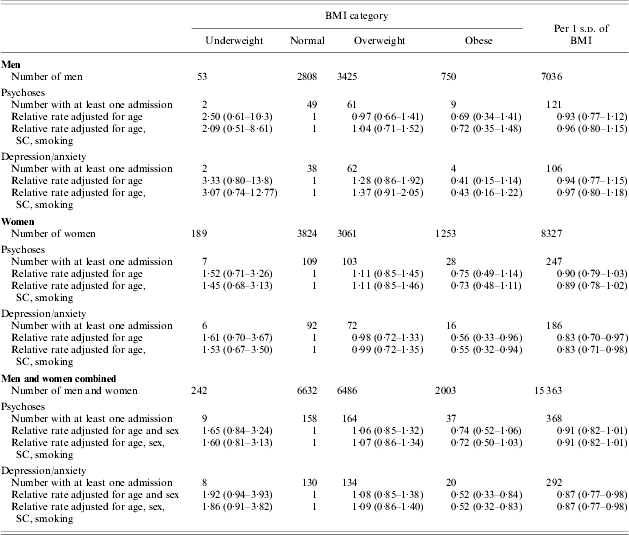
Among the 7036 men, 2808 (40%) were normal weight, 3425 (49%) were overweight and 750 (11%) were obese; less than 1% were underweight. Among the 8327 women, 3824 (46%) were normal weight, 3061 (37%) were overweight and 1253 (15%) were obese; 189 (2%) of women were underweight. Over the follow-up period (median 29 years), 121 (1·72%) of the men had at least one admission for a psychosis and 106 (1·51%) at least one admission for depression/anxiety. Equivalent figures for the women were 247 (2·97%) for psychosis and 186 (2·23%) for depression/anxiety. The greater rate of at least one hospital admission for psychoses in women was due to greater rates of admission for other non-affective psychoses (129 women v. 66 men), bipolar disorders (18 v. 9) and severe depression (86 v. 36); rates of schizophrenia were similar in women and men (14 v. 10).
Table 2 shows the relative risk of having at least one hospital admission by BMI category and per 1 standard deviation (s.d.) of BMI (3·4 kg/m2 for men, 4·48 kg/m2 for women, 4·02 kg/m2 for both). The results are presented separately for males and females and for both genders combined. It should be noted that there was no strong statistical evidence that the association of BMI with hospital admission for psychosis or depression/anxiety differed by gender (p=0·85 for interaction of gender with BMI categories in the association with hospital admission for psychoses and 0·56 for depression; p=0·97 for interaction of gender with BMI as a continuous variable for psychoses and 0·49 for depression). Therefore, our main conclusions are based on the analyses with women and men combined. There was an increase in risk of hospital admission for both psychosis and depression/anxiety among those who were underweight and a decrease in risk among those who were overweight. With adjustment for age, sex, smoking and social class, a 1 s.d. greater BMI at baseline was associated with a rate ratio of 0·91 (95% CI 0·82–1·01) for psychoses and 0·87 (95% CI 0·77–0·98) for depression/anxiety.
Relative rates of having at least one mental health admission by BMI in Renfrew/Paisley men (n=7036) and women (n=8327)

BMI, Body mass index; SC, social class.
95% Confidence intervals are given in parentheses.
1 standard deviation (s.d.) BMI in men=3·40 kg/m2; in women=4·48 kg/m2; in both=4·02 kg/m2.
When we repeated these analyses with the first 5 years of events excluded to reduce the possibility that associations were not being driven by reverse causality (weight loss occurring in the presence of occult disease), they were essentially the same as those presented in Table 2. For example, with adjustment for age, sex, smoking and social class and with the first 5 years of events removed, a 1 s.d. greater BMI at baseline was associated with a rate ratio of 0·89 (95% CI 0·79–1·00) for psychoses and 0·86 (95% CI 0·75–0·98) for depression/anxiety in analyses with both genders combined.
Additional adjustment for total cholesterol in this main analysis set had no further effect on the confounder-adjusted associations shown in Table 2 (full data not shown). In the subgroup of participants with data on GHQ-30 data at baseline, the age- and sex-adjusted and the full confounder-adjusted associations were similar to those presented in Table 2. When we additionally adjusted for GHQ-30 at baseline, these associations did not change (full data not shown).
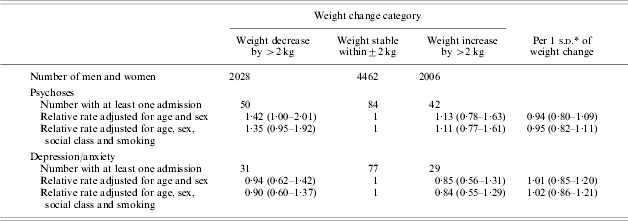
Because there was no evidence of a difference in the association of BMI with rates of having an admission for psychoses or depression/anxiety between women and men (our main analyses), all further analyses are presented with both genders combined. Table 3 shows the association of change in weight between baseline and second screening in the 8496 participants who had a repeat measure of weight. Change in weight was not strongly associated with either hospital admissions for psychosis or depression/anxiety in confounder-adjusted models.
Relative rates of psychoses and depression/anxiety by change in weight from baseline to second screening: n=8496 men and women

1 Standard deviation (s.d.) weight change=4·36 kg. This continuous measure of weight change is calculated as the actual weight at baseline minus the expected weight at second screening, which is estimated as described in the Method section.
95% Confidence intervals are given in parentheses.
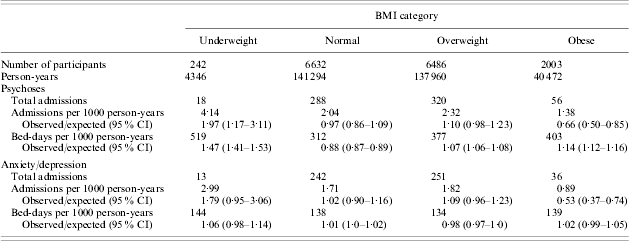
Table 4 shows the observed to expected ratios of total number of admissions and bed-days by BMI category. Those who were classified as underweight at baseline had a greater than expected total number of admissions for psychoses and also for depression/anxiety and those who were obese had a lower than expected total number of admissions for both psychoses and depression/anxiety. Total bed-days were greater than expected for those classified as underweight and obese for psychoses, but BMI was not related to bed-days for depression/anxiety.
Total admissions and bed-days for psychoses and depression/anxiety per 1000 person-years by BMI category in Renfrew/Paisley men and women (n=15 363)

BMI, Body mass index; CI, confidence interval.
DISCUSSION
In this large prospective cohort study we have found that obesity and greater BMI across the continuous range are associated with reduced risk of ever having a hospital admission for psychoses or depression/anxiety. These associations remained with adjustment for smoking and social class and were unchanged when the first 5 years of admissions were excluded from the analyses, suggesting that the associations were not driven by weight loss being part of the early symptoms of occult mental ill-health. Furthermore, adjustment for psychological distress at baseline did not attenuate the associations.
Study strengths and limitations
A major strength of this study is the large sample size and the ability to link study participants to hospital admissions. An important weakness is that we only had information on hospital admissions and therefore anyone with a diagnosis of psychoses or depression/anxiety over the follow-up period for whom this was not considered serious enough to warrant admission would not have been included as a case. The participants were aged 45–64 years at baseline assessment. The median age at first diagnosis of schizophrenia and other psychoses is in the range 20–35 years (Hafner & an der Heiden, Reference Hafner and an der Heiden1997), and it is possible that by the time they are middle-aged, patients with these conditions will be stable enough to no longer require in-patient treatment and therefore we may have wrongly classified some individuals with existing disease as disease free. Because it is not possible to link participants to their hospital admissions prior to 1972, we could not control for hospital admissions for mental health problems prior to the baseline assessment. It is also known that many antipsychotic medications lead to weight gain, as do some antidepressants, such as tricyclics (Newcomer, Reference Newcomer2004; Bergman & Ader, Reference Bergman and Ader2005; Citrome et al. Reference Citrome, Blonde and Damatarca2005), and so those with pre-existing disease may have a weight that is greater than pre-illness weight and this may have biased our results. As such an effect would tend to drive a positive association of BMI with psychoses, our association (which is in the opposite direction) may be an underestimate of the true inverse association between BMI and psychoses. Conversely, some treatments for depression, such as selective serotonin re-uptake inhibitors (SSRIs), may lead to weight loss. However, this is unlikely to have biased our results because very few, if any, individuals in the UK were treated with SSRIs in the 1970s (Middleton et al. Reference Middleton, Gunnell, Whitley, Dorling and Frankel2001), when BMI measurements were undertaken in this study. Furthermore, in a subgroup we had a repeat measure of weight assessed in the early years after the baseline assessment. In this subgroup we found no association between weight change in either direction and later admission for psychoses or depression/anxiety, suggesting that the associations seen in our main analyses are unlikely to have been driven by the effect of the disease itself or its treatment on weight change.
We were able to adjust for the potential confounding effect of socio-economic position, smoking and psychological distress at baseline and we found that these did not substantively alter the associations. However, as this is an observational study it is possible that residual confounding explains our findings. For our inverse association to be explained by residual confounding, a third characteristic (confounder) that is associated with both greater BMI and reduced risk of mental health problems and that is not on the causal pathway between these two must exist.
We adjusted for the potential mediating effect of total cholesterol, but this was based on non-fasting samples and we did not have measurements of other lipids. Non-fasting total cholesterol levels have been found to be slightly higher than fasting levels but with no clinically important difference (Craig et al. Reference Craig, Amin, Russell and Paradise2000). Levels of obesity have increased since the 1970s when these study participants were examined and there has also been an increase in managing mental health problems in the community (rather than in hospital) over recent decades and our results may not, therefore, be applicable to contemporary populations. Finally, the study population examined here was ethnically homogeneous (White Europeans) and our findings may not be generalizable to other ethnic groups.
Implications
Our findings add to the emerging evidence that suggests that greater BMI is associated with reduced risk of mental health problems (Wahlbeck et al. Reference Wahlbeck, Forsen, Osmond, Barker and Eriksson2001; Stunkard et al. Reference Stunkard, Faith and Allison2003; Weiser et al. Reference Weiser, Knobler, Lubin, Nahon, Kravitz, Caspi, Noy, Knobler and Davidson2004; Gunnell et al. Reference Gunnell, Harrison, Whitley, Lewis, Tynelius and Rasmussen2005; Magnusson et al. Reference Magnusson, Rasmussen, Lawlor, Tynelius and Gunnell2005). These earlier studies, like ours, rely on observational epidemiology, which is limited in its ability to determine causation. It would not be possible to randomize individuals to be overweight or not in an experiment to determine whether greater BMI is causally associated with reduced risk of depression and psychoses. However, there are randomized controlled trials of interventions that have demonstrated beneficial effects in terms of reduced weight in the short term and some benefits on vascular and metabolic risk factors (Avenell et al. Reference Avenell, Brown, McGee, Campbell, Grant, Broom, Jung and Smith2004a, Reference Avenell, Brown, McGee, Campbell, Grant, Broom and Smithb; O'Meara et al. Reference O'Meara, Riemsma, Shirran, Mather and ter Reit2004). In future randomized trials of interventions to reduce weight in the obese or to prevent the development of obesity in the general population, it would be useful to examine differences in mental health outcomes between the intervention groups. Interventions that successfully prevented obesity in the context of a randomized controlled trial would be expected to affect mental health outcomes if there is a causal association between obesity and these outcomes. However, trials would need to be very large and participants followed for a very long time to provide precise estimates of associations with these outcomes, particularly with outcomes such as the development of psychoses and suicide, which are relatively rare. There is increasing interest in using genetic variants that are associated with modifiable non-genetic risk factors to provide robust causal inferences of the effect of these risk factors with disease outcomes (Davey Smith & Ebrahim, Reference Davey Smith and Ebrahim2003; Davey Smith, Reference Davey Smith2006; Lawlor et al. Reference Lawlor, Harbord, Sterne and Davey Smithin press). Because alleles are randomly allocated from parents to offspring at conception, the association of a genotype, known to be functionally associated with obesity, with mental health outcomes would not be subject to the possibility of reverse causality and confounding that may have biased our study and others in this area (Davey Smith & Ebrahim, Reference Davey Smith and Ebrahim2003; Davey Smith, Reference Davey Smith2006; Lawlor et al. Reference Lawlor, Harbord, Sterne and Davey Smithin press). Thus, the association of genotype with obesity and the association of genotype with mental health outcomes could be combined to provide an estimate of the causal effect of obesity with mental health outcomes. As yet there are no reliable (consistently replicated in several large studies) candidate genetic variants for obesity to use this approach. However, with the rapid expansion in genomic understanding, this situation is likely to change in the short to medium term.
Studies, largely from the USA, suggest that overweight and obesity are associated with increased general hospital admissions and greater health-care costs (Quesenberry et al. Reference Quesenberry, Caan and Jacobson1998; Thompson et al. Reference Thompson, Edelsberg, Colditz, Bird and Oster1999; Luchsinger et al. Reference Luchsinger, Lee, Carrasquillo, Rabinowitz and Shea2003), findings that we have also replicated within this cohort of hospital use related to general health problems (Hart et al. Reference Hart, Hole, Lawlor and Davey Smith2007). While our findings suggest reduced overall numbers of admissions in those who were obese for mental health problems, the total number of bed-days for psychoses was greater than expected in those who were obese. These two findings are not contradictory because the pathways linking obesity to risk of having a mental health disorder are likely to be very different to those linking obesity to bed-days spent in hospital once someone is admitted because of a mental health problem. The lower risk of having a hospital admission for psychoses together with greater than expected hospital bed-days associated with this condition among those with greater BMI may reflect a greater need for health care due to more severe disease and/or co-morbidity in those who are obese and are admitted with a diagnosis of psychosis.
CONCLUSIONS
Our findings suggest that BMI measured in middle-age is inversely associated with the risk of subsequent hospital admissions for psychoses and depression/anxiety. However, our findings cannot prove causation. Long-term follow-up of participants in randomized controlled trials of interventions that effectively result in weight loss and the use of genetic variants that are functionally related to obesity as instrumental variables could help to elucidate whether these associations are causal.
ACKNOWLEDGEMENTS
Victor Hawthorne conducted the original Midspan studies and Pauline MacKinnon is the Midspan administrator. This study was supported by the Chief Scientist Office of the Scottish Executive. Debbie A. Lawlor is funded by a UK Career Scientist Award.
DECLARATION OF INTEREST
None.