INTRODUCTION
Word finding or “naming” is the retrieval of a specific word—a word that is known and understood—from the mental lexicon. As a core component of neuropsychological evaluation, accurate measurement of naming is important for valid characterization of cognitive functioning and development of comprehensive, individualized treatment plans. Naming assessment plays a central role in the pre-operative evaluation of individuals with pharmacologically refractory epilepsy, with poorer naming characteristic of left but not right hemisphere epilepsy patients (Hermann, Seidenberg, Haltiner, & Wyler, Reference Hermann, Seidenberg, Haltiner and Wyler1992).
In the context of the pre-surgical workup, naming performance is used to assist with lateralization and localization of dysfunction, presumably associated with epileptogenic brain regions (Hermann, Reference Hermann1992; Jones-Gotman, Harnadek, & Kubu, Reference Jones-Gotman, Harnadek and Kubu2000). A relative deficit on measures of verbal functioning typically implicates the language dominant hemisphere, and a deficit in naming specifically is often associated with dominant temporal lobe seizure onset (Hamberger, Reference Hamberger2015; Hermann, Wyler, Somes, & Clement, Reference Hermann, Wyler, Somes and Clement1994; Mayeux, Brandt, Rosen, & Benson, Reference Mayeux, Brand, Rosen and Benson1980). Inaccurate diagnosis of a naming impairment could potentially implicate the left temporal region as an area of seizure onset, falsely identifying areas of dysfunction beyond the actual epileptogenic zone. Thus, reliable and valid assessment of naming is critical in this clinical context.
Naming has traditionally been assessed via visual object naming (Rabin, Barr, & Burton, Reference Rabin, Barr and Burton2005; Raymer, Reference Raymer2011; Strauss, Sherman, & Spreen, Reference Strauss, Sherman and Spreen2006), although auditory description naming has been used as well (Bell, Seidenberg, Hermann, Douville, Reference Bell, Seidenberg, Hermann and Douville2003; Goodglass, Kaplan, & Barressi, Reference Goodglass, Kaplan and Barressi2000; Hamberger & Seidel, Reference Hamberger and Seidel2003). Because the goal of naming assessment is to test retrieval of known words, vocabulary demands can confound the assessment of naming (Hawkins & Bender, Reference Hawkins and Bender2002). This has been particularly relevant in the use of the Boston Naming Test (BNT; Kaplan, Goodglass, & Weintraub, Reference Kaplan, Goodglass and Weintraub1983), the most widely used measure of object naming, which contains several low frequency items (e.g., sphinx, yoke, abacus) that are likely unfamiliar to many examinees. However, the influence of vocabulary has been found even on naming tests that are comprised of more familiar, high frequency target words (Hamberger & Seidel, Reference Hamberger and Seidel2003).
Accordingly, when interpreting naming performance, it is important to simultaneously consider the vocabulary level of the examinee, and of the items used to assess naming (Hawkins et al., Reference Hawkins, Sledge, Orleans, Quinlan, Rakfeldt and Huffman1993; Killgore & Adams, Reference Killgore and Adams1999). Intuitively, this would seem particularly salient in interpreting naming performance in non-native English speakers. It would also seem reasonable to assume that standard interpretation would be justified in bilingual individuals who are, in fact, proficient in English, with demonstrated, intact expressive vocabulary knowledge. However, within the context of an epilepsy surgery program, we observed that many bilingual individuals who are colloquially fluent in English and obtain average range or higher scores on objective vocabulary measures, perform below expectation on standard measures of naming.
Several studies have demonstrated a significant influence of education level (e.g., see studies reviewed in Mitrushina, Boone, Razani, & D’Elia, Reference Mitrushina, Boone, Razani and D’Elia2005), age at which English was learned (Boone, Victor, Wen, Razani, & Ponton, Reference Boone, Victor, Wen, Razani and Ponton2007), verbal intelligence (Thompson & Heaton, Reference Thompson and Heaton1989), and self-rated English proficiency (Kohnert, Hernandez, & Bates, Reference Kohnert, Hernandez and Bates1998; Touradji, Manly, Jacobs, & Stern, Reference Touradji, Manly, Jacobs and Stern2001) on naming performance in non-native English speakers. Given our clinical observations, we sought to determine whether bilingual ESL and monolingual English speakers who were matched on these relevant variables and demonstrated intact, comparable vocabulary scores would perform similarly on measures of naming.
Drawing from a clinical sample of epilepsy patients, we compared naming performances in ESL and native English speakers who were matched for education, age, intelligence, and expressive vocabulary. We hypothesized that despite English proficiency in daily living and comparable performance on vocabulary and other objective verbal measures, ESL individuals would nevertheless perform below native English speakers on standardized measures of naming. We further hypothesized that, due to the negative influence of non-native English status on naming, ESL patients with unilateral epilepsy would fail to show the expected laterality effects of poorer naming in patients with left compared to right hemisphere epilepsy.
METHODS
Participants
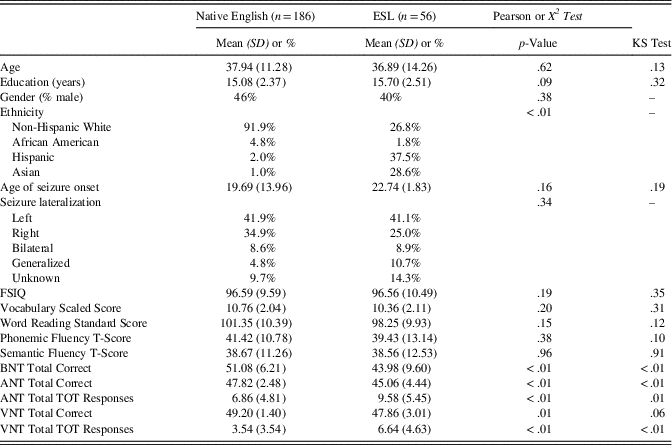
Permission to access archival data was obtained from the Institutional Review Board at Columbia University Medical Center. The sample was comprised of epilepsy surgery candidates who were referred for neuropsychological evaluation between the years 1994 and 2015. Only individuals who obtained normal range scores on the Wechsler Adult Intelligence Scale (WAIS-R/III/IV) Vocabulary subtest (scaled score≥8) with Full Scale IQ (FSIQ)≥70 were included. Among the resulting total sample of 242 patients, 186 were native English speakers and 56 learned English as a second language. Supplementary Table 1 lists the number of individuals per native language, and Table 1 provides demographic and clinical variables for both groups. The subgroup of lateralized epilepsy patients had unilateral seizure onset as determined via scalp video electroencephalography monitoring (VEEG) and exclusion of contralateral magnetic resonance imaging (MRI) findings.
Comparing demographic and clinical data for native English and ESL speakers

Note. K-S=Kolmogorov-Smirnov Test; ESL=English as a second language; FSIQ=Full Scale IQ; BNT=Boston Naming Test; ANT=Auditory Naming Test; TOT=tip of the tongue; VNT=Visual Naming Test.
Procedures
All participants completed a comprehensive neuropsychological test battery as part of their pre-surgical evaluation, which included assessment of the following language skills:
Vocabulary and FSIQ were assessed using the WAIS-R/III/IV (Wechsler, Reference Wechsler1981, Reference Wechsler1997, Reference Wechsler2008). Word Reading was assessed using the Wechsler Test of Adult Reading (WTAR; Wilkinson, Reference Wilkinson1993; Gladsjo, Heaton, Palmer, Taylor, & Jeste, Reference Gladsjo, Heaton, Palmer, Taylor and Jeste1999). Verbal Fluency was assessed using the Controlled Oral Word Association Test (COWAT; Benton & Hamsher, Reference Benton and Hamsher1976; Heaton, Grant, & Matthews, Reference Heaton, Grant and Matthews1991). More specifically, phonemic fluency was assessed using the letters “F,” “A,” and “S,” and semantic fluency was assessed using the category “animals.”
Naming was assessed using the BNT (Kaplan et al., Reference Kaplan, Goodglass and Weintraub1983) and the Auditory and Visual Naming Tests (AVNT; Hamberger & Seidel, Reference Hamberger and Seidel2003). The AVNT was developed specifically to assess comparable naming of equivalent-difficulty mid-to-high frequency target words via 50 pictured objects (VNT) and 50 auditory descriptions (ANT), whereas the BNT includes a total of 60 high-frequency (e.g., pencil, flower) and low-frequency (e.g., sphinx, yoke) items. Performance scores include the total number of correct responses on all three naming tests, as well as the total number of tip of the tongue responses (i.e., response latencies ≥2 s + providing a correct response only after provision of a phonemic cue, “TOT”) on the ANT and VNT.
Statistical Analysis
Independent samples t tests, chi-squared analyses, and two-sample Kolmogorov-Smirnov (KS) tests were used to compare groups on demographic and clinical variables. The KS test was used due to the non-normal distribution of naming scores, which is typical for naming assessment (Hamberger & Seidel, Reference Hamberger and Seidel2003). Pearson correlations assessed relations between naming performance and other variables. Bonferonni corrections were performed due to the multiple comparisons, and statistical significance was set at .01 for all five naming analyses, to ensure adequate statistical significance using multiple comparisons.
RESULTS
Comparison of ESL and Native English Speakers
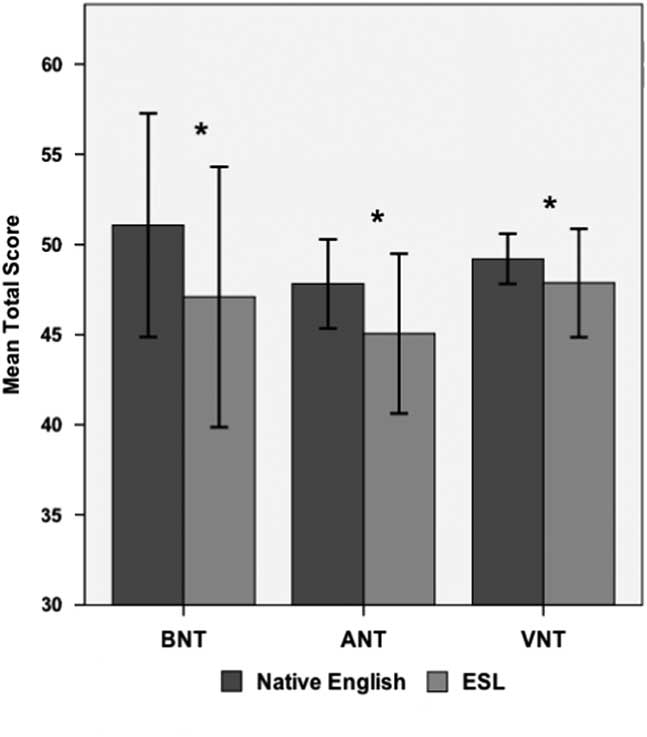
As shown in Table 1, groups did not differ with respect to age, education, gender, age of seizure onset, or seizure lateralization (all p’s >.05). Independent samples t tests and two-sample Kolmogorov-Smirnov tests also showed no differences between native English and ESL speakers on measures of FSIQ, expressive vocabulary, word reading, phonemic fluency, or semantic fluency (all p’s>.10). By contrast, ESL speakers performed more poorly for total number of correct responses than native English speakers on all three naming tests (see Figure 1). This same pattern was evident in TOT scores, which are provided for the ANT (English speakers mean=6.86, SD=4.81; ESL mean=9.58; SD=5.45) and VNT (English speakers mean=3.54; SD=3.54; ESL mean=6.64; SD=4.63).
Mean naming scores of native English and ESL speakers.

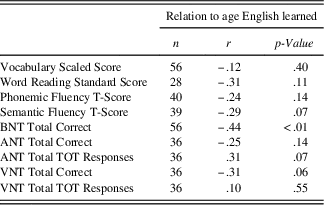
As shown in Table 2, among ESL participants, there was no significant correlation between age at which patients learned English and ANT total correct scores or VNT TOT scores, although age of learning English and VNT total correct and ANT TOT scores approached significance. Pearson correlations revealed a significant inverse relation between age at which patients learned English and BNT scores (r=−0.44; p<.01). Pearson correlations revealed no significant relation between age of seizure onset and any of the five naming scores in native English or ESL speakers (all p’s >.05).
Correlations between performance on language tests and age at which English was first learned in ESL participants

Note. ESL=English as a second language; BNT=Boston Naming Test; ANT=Auditory Naming Test; TOT=tip of the tongue; VNT=Visual Naming Test.
Naming Performance and Laterality of Seizure Onset
As naming deficits are typically associated with dominant (typically left) hemisphere seizure onset, we compared naming performances in left versus right hemisphere epilepsy patients in ESL and native English speakers. From our total sample of 242 epilepsy patients, 37 ESL and 143 native English speakers had well lateralized seizures. Cutoff scores were used to classify patients as “intact” or “impaired” on each naming measure. Published cutoff scores for the ANT and VNT represent performance below the 5th percentile of the normative sample (Hamberger & Seidel, Reference Hamberger and Seidel2003). Using this as a guide, we used a cutoff score of 50/60 for the BNT, which represents approximately the 5th percentile of normative performances as well (i.e., 1.6 SD below the means per Heaton, Miller, Taylor, & Grant, Reference Heaton, Miller, Taylor and Grant2004 and Tombaugh & Hubiey, Reference Tombaugh and Hubiey1997 for the age (35–40 years) and education range (13–15 years) that was comparable to our sample).
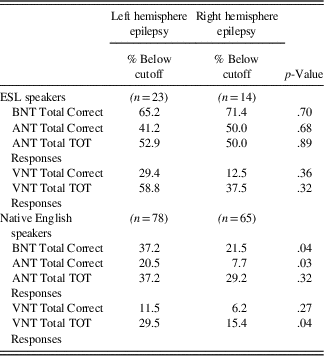
As shown in Table 3, as expected, among native English speakers, chi-squared analyses revealed a significant association between seizure laterality and naming performance, with a higher proportion of left hemisphere patients performing below cutoffs, and a higher proportion of right hemisphere patients scoring above cutoffs on all three naming tests (BNT total correct, ANT total correct, and VNT TOT responses). By contrast, among the ESL participants, there was no association between seizure laterality and naming performance, with comparable proportions of left and right seizure patients performing below and above cutoff scores on all three naming tests (all p’s>.10).
Relation between seizure laterality and rates of naming impairment

Note. ESL=English as a second language; BNT=Boston Naming Test; ANT=Auditory Naming Test; TOT=tip of the tongue; VNT=Visual Naming Test. P value based on result of chi-squared test.
Note. ESL=English as a second language; BNT=Boston Naming Test (maximum score=60); ANT=Auditory Naming Test (maximum score=50); VNT=Visual Naming Test (maximum score=50).
*p’s≤.01
Of note, language lateralization data (e.g., Wada testing, language fMRI) was available for only 36% of native English (n=67) and 21% of ESL (n=12) patients. Although most individuals are left hemisphere language dominant, even in the context of left hemisphere epilepsy (Rasmussen & Milner, Reference Rasmussen and Milner1977; Springer et al., Reference Springer, Binder, Hammeke, Swanson, Frost, Bellgowan and Mueller1999), more definitive language lateralization would have been desirable for the laterality analysis. However, it is noteworthy that, in this subset of participants who underwent Wada testing, all native English speakers and all but one ESL speaker (who had bilateral language representation), demonstrated left-hemisphere language dominance.
Furthermore, among patients with epilepsy, atypical (i.e., right-sided) language lateralization has consistently been most strongly associated with left-handedness and/or a left-sided seizure focus (Stewart et al., Reference Stewart, Swanson, Sabsevitz, Rozman, Janecek and Binder2014), and the number of participants meeting both of these two criteria was arguably small in our sample (i.e., four ESL and five native English speakers). Still, to be conservative in light of greater risk for atypical language lateralization, these nine participants were removed from the samples, and the analyses were repeated (thus including only participants without risk factors for atypical language laterality). These results also showed no association between seizure laterality and all naming performances in ESL speakers (all p’s>.10), and higher proportions of left than right hemisphere patients performing below cutoff on all naming measures (all p’s<.05)
DISCUSSION
Assessment of verbal skills in individuals who are not native to the language and culture of the measures at hand presents a challenge to the validity of the evaluation. When patients present as conversationally fluent, proficient in English by self-report, and demonstrate average or stronger expressive vocabulary on objective testing, it would appear reasonable and justified to conduct the evaluation in English, without significant caveats to interpretation. In this study, we tested ESL and native English speaking epilepsy patients with average range or higher expressive vocabulary scores, and found that overall, ESL patients performed comparably to native English speakers on most verbal measures, including semantic fluency, phonemic fluency, and word reading.
However, consistent with our clinical observations and hypotheses, naming scores were consistently lower in ESL individuals. Most striking and clinically relevant, was that although among native English speakers, left hemisphere epilepsy patients earned poorer naming scores than right hemisphere patients (which was consistent with established findings), this laterality effect was not found among ESL patients. Importantly, these results were not explained by clinical (e.g., seizure characteristics, FSIQ) or other demographic (e.g., age, education) variables.
These findings underscore the complexity of language assessment in bilinguals and support the position that naming is unique, and perhaps more sensitive than other verbal processes to differences related to language history. As it relates to the assessment of individuals with epilepsy, a substantial body of research supports the association between naming impairment and left (dominant) hemisphere seizures, thereby assisting in identifying areas of dysfunctional brain areas associated with the epileptogenic region in the pre-surgical work-up (Bell & Davies, Reference Bell and Davies1998; Busch, Frazier, Haggerty, & Kubu, Reference Busch, Frazier, Haggerty and Kubu2005; Hermann et al., Reference Hermann, Wyler, Somes and Clement1994; Raspall et al., Reference Raspall, Donate, Boget, Carreno, Donaire, Rolando and Salamero2005; Schefft, Testa, Dulay, Privitera, & Yeh, Reference Schefft, Testa, Dulay, Privitera and Yeh2003).
However, the current results raise caution in this application for ESL patients, even when these individuals appear fluent, report proficiency, and demonstrate a solid expressive vocabulary on formal testing. Perhaps most concerning, we found that a significant proportion of right hemisphere ESL epilepsy patients scored below cutoff for impairment, highlighting the risk of false positive errors. In the clinical context, this could potentially raise erroneous concerns regarding hemispheric language dominance or the functional integrity of brain areas beyond the epileptogenic region. This has crucial implications for patient care, as the goal of epilepsy surgery is to remove a sufficient amount of brain tissue to eliminate seizures. If the surgical team believes that language is at risk due to poor preoperative naming performance, suggesting that the epileptogenic hemisphere supports language, the resection might be unnecessarily limited, thereby reducing the likelihood of postoperative seizure freedom.
While neuropsychological evaluation is only one component of a comprehensive pre-surgical workup, these results are considered in determining the need for more invasive procedures (e.g., intracarotid sodium amobarbital procedures, language mapping via direct cortical stimulation, etc.).
Importantly, we found no differences between groups on language measures other than naming (i.e., vocabulary, word-reading, and phonemic and semantic fluency). It is reasonable to question why naming would present as more challenging to non-native speakers than other demanding verbal tasks. We speculate that the items to be named on an English naming task might not have the same cultural salience for non-native English speakers. However, naming is also unique in its cognitive demands; whereas verbal fluency and expressive vocabulary allow the speaker to use any of several acceptable words for successful task completion, naming requires the retrieval of only a single target word. It has been hypothesized that, in bilinguals, the parallel activation of both languages evokes inter-language interference, thereby contributing to slower processing and greater probability of errors, especially on challenging or time-dependent tasks (e.g., Bialystok, Craik, & Luk, Reference Bialystok, Craik and Luk2008). Alternatively, other evidence suggests that bilinguals may have a lexicon comprised of a greater proportion of lower frequency words relative to monolinguals (Gollan, Montoya, Fennema-Notestine, & Morris, Reference Gollan, Montoya, Fennema-Notestine and Morris2005).
Limitations
It is important to note that as retrospective analysis of an archival dataset, several potentially relevant variables were not available for analysis. In particular, details regarding acculturation status were not recorded. English fluency and neuropsychological test performance can be affected not only by age at which English was learned, but also by the method learned (e.g., formal classroom instruction vs. passive absorption on the radio, television, or socially), location learned (e.g., in the United States vs. abroad), the number of years educated and living in the United States, and the preferred language spoken in daily life (Arentoft et al., Reference Arentoft, Byrd, Robbins, Monzones, Miranda, Rosario and Rivera Mindt2012; Berry, Reference Berry2003; Boone et al., Reference Boone, Victor, Wen, Razani and Ponton2007). Similarly, antiepileptic medication information was not consistently available, and some medications have been shown to negatively affect cognitive performance (Aldenkamp, De Krom, & Reijs, Reference Aldenkamp, De Krom and Reijs2003; Tatum et al., Reference Tatum, French, Faught, Morris, Liporace, Kanner and Fix2001).
Clinical Implications
While previous studies have investigated naming in ESL individuals who are proficient in English by self-report (Bialystok et al., Reference Bialystok, Craik and Luk2008; Gollan, Fennema-Notestine, Montoya, & Jernigan, Reference Gollan, Fennema-Notestine, Montoya and Jernigan2007; Gollan et al., Reference Gollan, Montoya, Fennema-Notestine and Morris2005; Kohnert et al., Reference Kohnert, Hernandez and Bates1998; Roberts, Garcia, Desrochers, & Hernandez, Reference Roberts, Garcia, Desrochers and Hernandez2002; Sheppard, Kousaie, Monetta, & Taler, 2014), we used an objective measure of expressive vocabulary as well as other objective verbal measures to compare naming in ESL and native English speakers who were otherwise, verbally comparable.
Our findings caution that clinicians practicing in diverse areas should consider that truly balanced bilingualism (i.e., native-like proficiency in both languages) is uncommon not only in the face of self-reported proficiency (Grosjean, Reference Grosjean1997), but even in the context of a strong expressive vocabulary in the second language by objective measures. This is particularly salient in the evaluation of individuals with epilepsy, in light of the relatively high frequency of word finding complaints (Corcoran & Thompson, Reference Corcoran and Thompson1992, Reference Corcoran and Thompson1993) and the role of naming in the pre-surgical evaluation.
Our results suggest that naming performances by ESL individuals, even those considered proficient, should be interpreted with caution, and not by the same standards applied for native English speakers. Given these findings, it seems prudent for the field to continue focusing on the development of linguistically and culturally appropriate neuropsychological assessment instruments and/or normative datasets for ESL speakers to ensure accurate and valid assessment in routine clinical practice.
ACKNOWLEDGMENTS
All authors attest that there are no conflicts of interest with this work. This manuscript was supported by NIH R01 NS35140 (MH).
Supplementary materials
To view supplementary material for this article, please visit https://doi.org/10.1017/S1355617718000632