In the United States, 26% of children will experience a traumatic event before the age of 4 (Briggs-Gowan, Ford, Fraleigh, McCarthy, & Carter, Reference Briggs-Gowan, Ford, Fraleigh, McCarthy and Carter2010). Worldwide, 300 million 2- to 4-year-old children experience violent forms of discipline (UNICEF, 2017), and untold others experience other forms of stress and adversity ranging from parental dysfunction to peer social rejection. Hundreds of studies have established that early childhood adverse experiences predict the development of a wide array of maladaptive adult health and well-being outcomes from ischemic heart disease (Dong et al., Reference Dong, Giles, Felitti, Dube, Williams, Chapman and Anda2004) and mortality (Felitti et al., Reference Felitti, Anda, Nordenberg, Williamson, Spitz, Edwards and Marks1998) to impaired performance at work (Anda et al., Reference Anda, Fleisher, Felitti, Edwards, Whitfield, Dube and Williamson2004), suicide attempts (Dube et al., Reference Dube, Anda, Felitti, Chapman, Williamson and Giles2001), and externalizing behavior problems, including antisocial behavior and violence (Edwards, Holden, Felitti, & Anda, Reference Edwards, Holden, Felitti and Anda2003; Lansford et al., Reference Lansford, Miller-Johnson, Berlin, Dodge, Bates and Pettit2007).
Early adverse experiences can range from poverty to social rejection (Deater-Deckard, Dodge, Bates, & Pettit, Reference Deater-Deckard, Dodge, Bates and Pettit1998), but collectively, these can be grouped under the general term “cumulative adverse childhood experiences.” Continually clear from decades of research is that these negative experiences in childhood can have a deleterious effect later in life such as antisocial behavior in late adolescence and in adulthood (Baglivio, Wolff, Piquero, & Epps, Reference Baglivio, Wolff, Piquero and Epps2015; Lansford et al., Reference Lansford, Miller-Johnson, Berlin, Dodge, Bates and Pettit2007; Widom, Reference Widom1992). However, the developmental pathways connecting adversity to antisociality remain unclear. Independent of these behavioral links, multiple research groups have reported differences in neurocognitive functioning in those exposed to adversity (Biglan, Flay, Embry, & Sandler, Reference Biglan, Flay, Embry and Sandler2012; Gould et al., Reference Gould, Clarke, Heim, Harvey, Majer and Nemeroff2012). In service of elucidating mechanisms of risk and resilience, many past studies have focused on a single risk factor (e.g., physical abuse), tying a specific environmental experience to circumscribed psychiatric and neurocognitive alterations. However, multiple forms of early life stress might operate similarly to lead to altered development. Thus, models of cumulative risk have been advanced to capture broadly the impact of early life stress on later negative outcomes (Evans & Kim, Reference Evans and Kim2010, Reference Evans and Kim2012; Evans, Li, & Whipple, Reference Evans, Li and Whipple2013).
Here, we first review research connecting early childhood adversity to antisocial outcomes; we then detail studies examining neurocognitive functioning in adversity-exposed samples. We specifically focus on cumulative measures of sociocultural, parenting, and peer adverse experiences. Such models have several advantages over single risk factor approaches and may more quickly advance efforts to identify particularly vulnerable individuals. We next discuss connections between one neurocognitive process, passive avoidance learning, and later antisocial behavior. Connecting these different bodies of literature, we report on a powerful longitudinal study specifically probing whether an important neurocognitive process (namely, passive avoidance learning) is a viable mediating factor in a pathway between early childhood adversity and later antisocial behavior.
Early Childhood Adversity Predicts Antisocial Outcomes
Clear from prospective and retrospective studies is that antisocial behavior in late adolescence is a well-established developmental endpoint of early adverse experiences. Previous studies have examined pathways leading to antisocial outcomes by utilizing either one type of adverse event variable or a cumulative variable of several types of adverse events. For example, Baglivio et al. (Reference Baglivio, Wolff, Piquero and Epps2015) retrospectively reviewed records to find that among 64,000 adolescents, juvenile delinquents were four times more likely to have experienced four or more adverse childhood events than their nondelinquent peers. Although all adverse, these experiences ranged from living with a parent with mental illness and general household dysfunction to experiencing parental divorce, observing violence, and experiencing physical maltreatment. Similarly, Widom (Reference Widom1992) found that children who experienced abuse in early childhood were 38% more likely to commit a violent crime later in life than matched controls. Lansford et al. (Reference Lansford, Miller-Johnson, Berlin, Dodge, Bates and Pettit2007) found that children who had been physically abused in early childhood, even if not reported to government officials, are twice as likely as others to be arrested and to commit violent delinquent behaviors. These types of problems exert a profound interpersonal toll, as well as substantial financial costs to individuals involved and to the community (Belfer, Reference Belfer2008; Reef, Diamantopoulou, van Meurs, Verhulst, & van der Ende, Reference Reef, Diamantopoulou, van Meurs, Verhulst and van der Ende2011; Romeo, Knapp, & Scott, Reference Romeo, Knapp and Scott2006).
The link between adversity and antisocial outcomes is further reinforced when one considers research in life span development, as well as criminology. For example, Moffitt's (Reference Moffitt1993) well-known dual taxonomy of antisocial behavior argues for a life-course-persistent antisocial individual, versus an adolescent-limited subtype. In this framework, neurocognitive functioning interacts over development with environmental factors to predict (persistent) antisociality. This work does not center on early childhood adversity; however, building off Moffit's model, one can think about how early adverse experiences both interact cumulatively with and impact neurocognitive functioning to lead to greater negative outcomes. In contrast to the adolescent-limited subtype, the impacts of adversity are seen across development, often shortly after these types of stressful experiences, and not limited to one developmental epoch. This would suggest that early adversity may predispose individuals to this life-course-persistent phenotype. Looking at the well-known general strain theory (for review, see Agnew, Reference Agnew2001), criminologists would argue that four characteristics of strains are likely to increase antisociality and criminality; these include strains (or stressors) that are: unjust, high in magnitude, associated with social control, and that create some pressure or incentive to engage in criminal coping. Early childhood adversity connects to many of these characteristics, as these stressors likely feel unjust, and are not understood or perceived as controllable by youth.
Scholars have long debated whether to strive to understand the specific developmental pathways uniquely associated with each kind of adverse experience or to lump the array of adverse childhood experiences into a single continuous score of cumulative total adverse experiences. Because of the high intercorrelation among risk experience variables, an empirical challenge with the unique risk factor approach is to isolate risk factors while still preserving statistical integrity. Rutter (Reference Rutter1979) pioneered the cumulative risk approach when he first observed that many children are able to withstand the stress of a single adverse experience, but become psychiatrically disordered upon experiencing multiple adverse experiences. He hypothesized that it is less important which particular adverse experience is present but more the accumulation of adversity that increases risk; he created a cumulative adversity score and found it to be a general predictor of later psychiatric outcomes (Garmezy & Rutter, Reference Garmezy and Rutter1983; Rutter, Reference Rutter1985). Similarly, Douglas (Reference Douglas1975) tested cumulative risk not by counting diverse risks but by summing the number of times a child experienced a particular risk. He found a linear relation between the number of times a child had been admitted to a hospital during early life and later behavior problems. He also found that parental separation affects child outcomes by accumulating stress quantitatively.
Numerous other studies support the hypothesis that prediction of psychiatric outcomes is optimized by combining the frequency of diverse risk experiences into a single cumulative risk experience score rather than searching for a single best predictor (Kraemer, Stice, Kazdin, Offord, & Kupfer, Reference Kraemer, Stice, Kazdin, Offord and Kupfer2001; Sameroff, Reference Sameroff, Steinberg and Silverman1987). Trentacosta et al. (Reference Trentacosta, Hyde, Shaw, Dishion, Gardner and Wilson2008) found that a cumulative risk experience score predicted child behavior problems better than individual scores, and Trentacosta, Hyde, Goodlet, and Shaw (Reference Trentacosta, Hyde, Goodlett and Shaw2013), through multivariate analysis, found that multiple risk domains predicted disruptive behavior disorders in adolescent males, but a single cumulative score predicted outcomes just as well. Evans et al. (Reference Evans, Li and Whipple2013) argue that a cumulative risk composite score has advantages of reducing measurement error, avoiding statistical problems of collinearity in regression models that attempt to tease out unique prediction from intercorrelated variables, and simplifying models into one predictor variable.
Several models have been offered for how to score cumulative risk (Evans et al., Reference Evans, Li and Whipple2013). Because there is no assumption that items reflect an underlying construct, but instead tabulate experiences, there are no requirements of high internal consistency or intercorrelation among items. Instead, items are summed as in an index rather than a scale. A powerful example of this comes from the CDC–Kaiser Permanente Adverse Childhood Experiences (ACE) Study (Felitti et al., Reference Felitti, Anda, Nordenberg, Williamson, Spitz, Edwards and Marks1998). This project introduced the term ACEs to summarize seven categories of adverse exposure (psychological, physical, or sexual abuse; violence against mother; and residing with a substance-abusing adult, an adult with mental illness, or a criminal adult). Using this cumulative scoring approach, Felitti et al. (Reference Felitti, Anda, Nordenberg, Williamson, Spitz, Edwards and Marks1998) found that the number of different categories of adverse exposures during childhood best predicted later adult disease and mortality.
Building off the ACE study, Deater-Deckard et al. (Reference Deater-Deckard, Dodge, Bates and Pettit1998) generated a cumulative risk score by summing four kinds of risk factors: child risk (irritability, hyperactivity, poor temperament, etc.), sociocultural risk (poverty, single-parent household, stressful life events, etc.), parenting risk (harsh discipline, father absence, etc.), and peer risk (social rejection, victimization, etc.). They found low internal consistency of scores within each kind of risk, but very strong evidence that risk variables incremented each other in predicting externalizing behavior problem outcomes. They also found robust evidence that the single cumulative risk score predicts externalizing outcomes. Although there is arbitrariness of the scoring approach, different methods yield similar findings: more stressful experiences predict worse outcomes.
Cumulative Early Childhood Adversity Impacts Later Neurocognition
The mechanisms through which early adverse experiences affect the developing child are only beginning to be understood, but growing evidence points toward impact on cognitive–emotional processes including vigilance to threat, negative emotionality, cognitive appraisal of rewards, impulsivity, elements of learning, and the ability to sustain attention to a task. It appears that adverse experiences, especially if occurring early in life, may have an enduring impact on development of brain patterns that guide judgment, decision making, and self-regulation (e.g., Hanson, Albert, et al., Reference Hanson, Albert, Skinner, Shen, Dodge and Lansford2019; Hanson, Gillmore, et al., Reference Hanson, Gillmore, Yu, Holmes, Hallowell, Barton and Chen2019; for additional review, see Teicher, Samson, Anderson. & Ohashi, Reference Teicher, Samson, Anderson and Ohashi2016). One example is found in a pattern of hypervigilance to threat and hostile attributional bias that follows from the experience of child abuse and that mediates the link between experiencing early abuse and later aggressive behavior (Dodge, Reference Dodge2006; Dodge, Bates, & Pettit, Reference Dodge, Bates and Pettit1990; Dodge et al., Reference Dodge, Lansford, Burks, Bates, Pettit, Fontaine and Price2003; Dodge, Pettit, Bates, & Valente, Reference Dodge, Pettit, Bates and Valente1995). Other studies found similar outcomes with early childhood adversity disrupting later cognitive processes. For example, Wolff and Baglivio (Reference Wolff and Baglivio2016) found that nearly half of the total effect of ACEs on juvenile reoffending operated through negative emotionality, and Spann et al. (Reference Spann, Mayes, Kalmar, Guiney, Womer, Pittman and Blumberg2012) found that the experience of child abuse is associated with decreased cognitive flexibility on standard tasks. Similarly, Beers and De Bellis (Reference Beers and De Bellis2002) reported that children with posttraumatic stress disorder perform more poorly on neurocognitive measures of sustained attention, freedom from distractibility, and executive control on tasks such as the Stroop, the Wisconsin card sort, and digital vigilance.
Nurturing environments provide a way for young children to develop emotion control skills. Without these experiences, children may never develop the ability to control their emotions and restrain themselves from emotional overreactions, which, subsequently, may lead to behavior problems (Biglan et al., Reference Biglan, Flay, Embry and Sandler2012). With increased exposure to negative events in childhood, the ability to cope with negative feelings and to regulate emotions deteriorates (Bielas et al., Reference Bielas, Barra, Skrivanel, Aebi, Steinhausen, Bessler and Plattner2016). Furthermore, the poor self-regulation during irritating events and threatening situations is associated with many psychiatric disorders (Blair & Raver, Reference Blair and Raver2015; Palacios-Barrios & Hanson, Reference Palacios-Barrios and Hanson2019; Verona, Sprague, & Sadeh, Reference Verona, Sprague and Sadeh2012) and may mediate the relation between early adverse experiences and later delinquent behaviors (Bielas et al., Reference Bielas, Barra, Skrivanel, Aebi, Steinhausen, Bessler and Plattner2016). Felitti et al. (Reference Felitti, Anda, Nordenberg, Williamson, Spitz, Edwards and Marks1998) proposed that the experience of stress disrupts self-regulation, citing effects of adverse experiences on problems in self-regulation, including smoking, alcohol or drug abuse, overeating, and impulsive sexual behaviors. Using data from the original ACEs study, Anda et al. (Reference Anda, Fleisher, Felitti, Edwards, Whitfield, Dube and Williamson2004) found that the effect of a cumulative risk score of ACEs on adult employment failure was mediated by the development of emotional distress problems. Finkel, Dewall, Slotter, Oaten, and Foshee (Reference Finkel, Dewall, Slotter, Oaten and Foshee2009) similarly proposed that stress disrupts impulse control.
Belsky, Steinberg, and Draper (Reference Belsky, Steinberg and Draper1991) offer an evolutionary theory of behavioral and neurocognitive development in response to adversity. They argue that the human species has evolved so that a young child is predisposed to observe his/her early rearing environment, judge it as threatening or safe, and anticipate lifelong threat (or safety). If threat is anticipated, the optimal reproductive strategy would be to develop rapidly before death occurs (e.g., Ellis, McFadyen-Ketchum, Dodge, Pettit, & Bates, Reference Ellis, McFadyen-Ketchum, Dodge, Pettit and Bates1999). This strategy would be operationalized as biological precociousness and impulsive decision making to obtain rewards right away rather than to invest in long-term outcomes. This pattern of neurocognitive functioning would emphasize immediate rewards and hypervigilance to threat. In contrast, a child who experiences little early adversity would develop more slowly, make long-term investments, and develop neurocognitive patterns of slow long-term decision making. Related to these ideas, Gee et al. (Reference Gee, Bath, Johnson, Meyer, Murty, Bos and Hartley2018) find that neurocognitive development, particularly development of threat processing and impulse control, is disrupted by exposure to stressful life events. Ellis, Bianchi, Griskevicius, and Frankenhuis (Reference Ellis, Bianchi, Griskevicius and Frankenhuis2017) have extended this theory to describe the life course of a child growing up under chronic adversity who becomes neurocognitively oriented toward distractibility, shifting attention, and impulsivity as an adaptive strategy to cope with an uncertain environment and to take advantage of fleeting opportunities. Empirical evidence has accumulated to support this evolutionary hypothesis.
Numerous studies show that children exposed to early life adversity have problems with neurocognitive functioning later in development (Gould et al., Reference Gould, Clarke, Heim, Harvey, Majer and Nemeroff2012). Neurocognitive functioning encompasses many aspects of cognition including focused attention, reward sensitivity, learning, emotion processing, and inhibitory control. Scholars have studied numerous constructs that are overlapping theoretically, including emotion regulation and inhibitory control. Previous research indicates that early childhood adversity is related to challenges in impulsivity and inhibitory control (Bielas et al., Reference Bielas, Barra, Skrivanel, Aebi, Steinhausen, Bessler and Plattner2016; Biglan et al., Reference Biglan, Flay, Embry and Sandler2012) as well as to issues in learning and related cognitive processes (Beers & De Bellis, Reference Beers and De Bellis2002; Harms et al., Reference Harms, Bowen, Hanson and Pollak2018; Hanson et al., Reference Hanson, Chung, Avants, Rudolph, Shirtcliff, Gee and Pollak2012; Hanson et al., Reference Hanson, van den Bos, Roeber, Rudolph, Davidson and Pollak2017; Span et al., Reference Spann, Mayes, Kalmar, Guiney, Womer, Pittman and Blumberg2012). This includes reports of early childhood adverse experiences being linked to compromised executive functioning, inhibitory control, and learning in adolescents on standardized measures of neurocognitive functioning such as the Wisconsin card sorting task, a test of cognitive flexibility (Spann et al., Reference Spann, Mayes, Kalmar, Guiney, Womer, Pittman and Blumberg2012) and the go/no-go task (Fillmore, Reference Fillmore2003; Newman & Schmitt, Reference Newman and Schmitt1998; Yechiam et al., Reference Yechiam, Goodnight, Bates, Busemeyer, Dodge, Pettit and Newman2006).
Surveying these past reports, the integrated construct of passive avoidance may be particularly impacted by adversity, and important for understanding adversity-related negative outcomes. In brief, passive avoidance is closely related to constructs of impulsivity and inhibitory control, but involves a learning process in addition to preference for inherently positive stimuli. Few studies in adversity-exposed samples have examined passive avoidance, but given the past reports of poor inhibitory control, as well as impaired learning, passive avoidance may be particularly important to examine in these samples. This construct connects to both learning and emotion processing. Passive avoidance actively requires the individual to exhibit control and refrain from an act that will produce an undesirable and aversive outcome.
Impaired Neurocognition Increases Likelihood of Later Antisocial Behavior
Theory and empirical analyses indicate that impulsivity predicts increased risk for violent and delinquent behavior (Åkerlund, Golsteyn, Grönqvist, & Lindahl, Reference Åkerlund, Golsteyn, Grönqvist and Lindahl2016; Verona et al., Reference Verona, Sprague and Sadeh2012). For example, after controlling for parental income, Åkerlund et al. (Reference Åkerlund, Golsteyn, Grönqvist and Lindahl2016) found a significant longitudinal relation between the go/no-go task in adolescence and criminality in adulthood. Verona et al. (Reference Verona, Sprague and Sadeh2012) found that, compared to the control group, criminal offenders had deficits in emotional processing and inhibitory control, using the go/no-go task as a measure of inhibitory control and data from event-related brain potentials. When adolescents are more impulsive in their decisions and are confronted with a dangerous situation, they may be more likely to make rash decisions and get themselves into trouble.
Of note (and much like work in adversity-exposed samples), few groups have examined passive avoidance in relation to antisociality; this is a major limitation. One notable exception is work by Newman and colleagues. For example, in two different projects, Newman and his collaborators (Newman & Kosson, Reference Newman and Kosson1986; Newman, Widom, & Nathan, Reference Newman, Widom and Nathan1985) found that antisocial behavior was related to deficits in passive avoidance learning. This was noted for university students, middle-age adults, as well as for a group of male prisoners exhibiting psychopathy. This could again be tied to Moffitt's dual taxonomy model (Reference Moffitt1993) in support of the development of life-long persistent antisocial behavior in certain small populations. More recently, Vitale et al. (Reference Vitale, Newman, Bates, Goodnight, Dodge and Pettit2005) found significant differences in performance in a passive avoidance task in males with antisocial traits, and White et al. (Reference White, Tyler, Botkin, Erway, Thornton, Kolli and Blair2016) found youth with substance abuse histories and higher levels of antisocial behavior performed worse on a passive avoidance task. Given that passive avoidance involves both learning and emotion (valence) processing, it might be powerfully indexing risk for antisociality.
The Current Study
Considering the research reviewed above, previous studies have shown that individual relations between early childhood adversity and later cognitive and psychological outcomes exist; however, not many have shown a potential pathway in understanding the developmental trajectory from adverse events in childhood to antisocial outcomes. Passive avoidance is an integrated emotional learning construct that may be impacted by adversity, and is important for understanding adversity-related negative outcomes. We propose four hypotheses:
1. Individuals who experienced high rates of early childhood adversity will be more likely to display antisocial behavior in late adolescence.
2. Individuals who experienced high rates of early childhood adversity will show deficient passive avoidance.
3. Deficient passive avoidance will be related to higher likelihood of displaying antisocial behavior.
4. The link between exposure to early childhood adversity and later display of antisocial behavior will be mediated by deficient passive avoidance.
If the hypotheses are supported, this study would be one of the first to connect early adversity, passive avoidance, and antisocial behavior through a mediation analysis. Without probing potential mediating factors, understanding the development of later antisocial behaviors related to childhood adversity will be incomplete.
Method
Participants
Participants were children followed in the Child Development Project, a longitudinal study of a community sample of 585 participants (52% male, 48% female; 81% European American, 17% African American, and 2% other ethnic groups; 26% living in single-parent households). Of the 585 participants who initially enrolled in the study, 395 completed the go/no-go task, 430 provided parent reports regarding antisocial behavior, and all 585 participants were reviewed for arrest records at age 18.
Participants were recruited from three different cities (Knoxville and Nashville, Tennessee, and Bloomington, Indiana), when individuals were in kindergarten in 1987 and 1988 (Dodge et al., Reference Dodge, Bates and Pettit1990). Recruitment was stratified by site and school and occurred randomly during kindergarten preregistration and, for the sake of sampling late enrollees, early in the fall. Follow-up data were collected annually; the current study uses data through age 18.
Using the Hollingshead Four-Factor Index of Social Status (Hollingshead, Reference Hollingshead1979), all five status categories were represented: 9% in the lowest, 16% in the next lowest, 26% in the middle, 32% in the next highest, and 17% in the highest (M = 39.5, SD = 14.1).
The Child Development Project received institutional review board approval from all participating universities. Parents signed written consent forms, and children who were minors provided assent. When participants reached age 18, they provided their own written consent.
Procedure
Early childhood adversity
Mothers were interviewed in their homes during the summer prior to the child's kindergarten matriculation or in the early weeks of school. The assessment included a 90-min interview with the mother, as well as several self-report questionnaires. Interviewers asked about each of three eras in the child's life (birth to age 12 months, 12 months to a year ago, and in the past 12 months). Three domains of early adversity were measured: sociocultural, parenting/caregiving, and peer risks (see Table 1). Cumulative risk was scored from 17 adversity variables, reported and summarized in greater detail by Deater-Deckard et al. (Reference Deater-Deckard, Dodge, Bates and Pettit1998). Although some variables were measured continuously, a dichotomous score (0 = no adversity; 1 = adversity) was computed for each variable based on scaling properties of the variable and rational judgments of adversity. All interviewers were trained to interrater reliability of .80 or higher when compared with a criterion interviewer's scoring before beginning interviews, and 10% (n = 56) of interview protocols were independently checked for reliability during the study.
Individual early adverse experiences used in cumulative scoring

Seven sociocultural adversity variables included low socioeconomic status, measured by the Hollingshead Four-Factor Index (Hollingshead, Reference Hollingshead1979) of mother and father education and occupation, with a score of <29 designated as adversity; living with a single mother; more than two children to every adult in the household; mother <18 years of age at first pregnancy; mother's report that the pregnancy was “unplanned”; >11 stressful life events reported by mother from the Changes and Adjustments Scale (Dodge, Pettit, & Bates, Reference Dodge, Pettit and Bates1994), which included items such as residential move, child medical problems, death of parent, divorce, parent–child separation, financial instability, legal problems, family conflicts, job-related stress, and loss of job; and maternal social isolation, privately coded by the interviewer after open-ended interview about the mother's emotional and instrumental support from partners, family, and friends (1 = very isolated, 5 = very well supported) about each era in life. Independent coder agreement was r = .47 for Era 2 and r = .44 for Era 3. Ratings were averaged across eras, and a mean rating of 2 or less (“somewhat” to “very” isolated) was scored as adversity.
Eight parenting/caregiving adversity variables were scored: high level of out-of-home nonmaternal childcare, scored from reported hours per week of out-of-home care in the first year of life and then in each subsequent year (scores were summed across years and standardized, with scores >1 SD above the sample mean scored as adversity; see Bates et al., Reference Bates, Marvinney, Kelly, Dodge, Bennett and Pettit1994, for coding reliability); mother's report of noninvolvement by the biological father scored as adversity; high interparental conflict (for single-mother households, conflict was not coded), rated on a 5-point scale by the interviewer following questions about the child's exposure to violent conflict between adults in the home, with a score of 3 (“major verbal assault”) or higher scored as adversity (inter-rater agreement was .70); high exposure to violence outside the home, rated by the interviewer on a 5-point scale following interviewer questions about neighborhood violence (inter-rater agreement was .49 for Era 2 and .69 for Era 3, and adversity was scored for mean ratings of 3 or higher); high harsh discipline, rated by the interviewer on a 5-point scale (1 = nonrestrictive, 5 = severe, strict, physical) following questions about regular and most extreme discipline events (e.g., “How was the child disciplined?” “How was the child usually spanked by adults?”) for each era of life (independent coder agreement was r = .80 for Era 2 and .73 for Era 3; ratings were averaged, and adversity was scored for mean ratings of >3); presence of physical harm to the child, rated by the interviewer on a 5-point scale (1 = definitely not, 5 = authorities involved) following the questions described above for discipline (independent coder agreement was r = .97, and adversity was scored for mean ratings of >3); lack of positive parenting, rated from the mother's interview about discipline strategies in response to each of five vignettes about child misbehavior (from the Concerns and Constraints Questionnaire; Dodge et al., Reference Dodge, Pettit and Bates1994; mothers were asked what they could do to prevent child misbehavior, and interviewers rated the mother's positive parenting strategies on a 5-point scale from 1 = do nothing to 5 = anticipatory prevention by positive action; scores were averaged across 5 vignettes, internal consistency of responses was α = .63, and adversity was scored for mean ratings of 2 or less—nonpreventable, punish only); and mothers’ positive attitudes toward aggression, rated from the mother's responses to the Culture Questionnaire (Dodge et al., Reference Dodge, Pettit and Bates1994), in which mothers responded on a 7-point scale (1 = definitely disagree, 7 = definitely agree) to each of 15 items about endorsement of aggressing (e.g., “I wouldn't mind if my child got a reputation as the toughest kid in the school”; ratings were averaged across 15 items, with α = .55, and adversity was scored for mean ratings of 4 or higher).
There were 2 peer adverse experience variables. First is peer social rejection, coded from peer sociometric interviews in the kindergarten year, in which each classroom peer was asked to nominate children as most-liked and least-liked. Peer sociometric status was computed using the formula in Coie and Dodge (Reference Coie and Dodge1983), and adversity was scored for children designated as peer-rejected, that is, receiving standardized social preference scores (liking minus disliking) below –1. Second is lack of stability of the peer group, based on interviewer ratings (5-point scale, independent rater agreement r = .55 for Era 2 and .66 for Era 3) of mother reports of the child's degree of stability of peer contacts over the first 7 years of life. Adversity was scored for mean ratings of 3 or less.
A cumulative experience-of-adversity score was computed by summing across 17 binary factors. The grand mean number of adverse experiences was 3.21, with a SD of 2.40. Because this measure indexed risks from diverse sources that were not assumed to be correlated with each other, it was not necessary or desirable to assess internal reliability.
Neurocognition
At age 16, youth participants came to a laboratory session to complete several computer games. To test passive avoidance, we utilized the go/no-go task (Newman & Schmitt, Reference Newman and Schmitt1998), based on Newman's theory of passive avoidance learning in syndromes of disinhibition (Newman & Kosson, Reference Newman and Kosson1986; Newman, Widom, & Nathan, Reference Newman, Widom and Nathan1985); variations of this task have been used by numerous scholars (e.g., Epstein, Poythree, & Brandon, Reference Epstein, Poythress and Brandon2006; Farmer & Rucklidge, Reference Farmer and Rucklidge2006; Hartung, Milich, Lynam, & Martin, Reference Hartung, Milich, Lynam and Martin2002).
Participants were instructed to learn by experience regarding when to respond and not respond to certain stimuli by pressing a button after seeing a specific stimulus on the computer screen. Some stimuli had rewards associated with them, and others had losses. The participants were asked to respond to a series of two-digit numbers that flashed onto the screen for 2 s. During the task, the participants saw the same numbers multiple times. After each response, the computer signaled whether the participant won or lost 25 cents. For correct go responses, they received a 25-cent coin from the researcher and for incorrect go responses they had a 25-cent coin taken from the pile in front of them. Participants had the incentive to keep the money they won at the end of the task. They were not given any further instructions. We used the variable “correct rejection” to measure passive avoidance. This variable measured whether the participant identified a negative (nonwinning) stimulus correctly and avoided it. Participants completed a total of 90 experimental trials. We utilized “correct rejection” of stimuli because it represents strong passive avoidance. Passive avoidance involves avoiding a negative outcome through decision making, and passive avoidance deficits are correlated with poor inhibitory control (Yechiam et al., Reference Yechiam, Goodnight, Bates, Busemeyer, Dodge, Pettit and Newman2006). This variable has been shown to have strong psychometric properties, including high test–retest reliability (Weafer, Baggott, & de Wit, Reference Weafer, Baggott and de Wit2013).
Antisocial behavior
To assess late adolescent antisocial behavior, we used three measures. For mothers’ report of adolescents’ aggressive behavior at age 17, mothers completed the Child Behavior Checklist (Achenbach, Reference Achenbach1991) to report how frequently their child had engaged in each of 25 aggressive behaviors (e.g., physical aggression, disruption, and oppositional behaviors) in the last 12 months on a scale of not true (0), sometimes true (1), or often true (2). A raw sum-score was created. For participant self-report of arrest at age 18, participants were asked to self-disclose if they had been arrested up until the age of 18 (0 = no, 1 = yes). The third measure was official state court records of criminal offenses through age 18. Crimes documented in arrest records ranged from reckless driving and drug possession to assault, burglary, arson, murder, rape, and kidnapping. Arrest records were coded as a dichotomous variable (i.e., any arrest as “1”; no arrest as “0”). The mother report, self-report, and arrest record variables were standardized and averaged to create a single composite outcome variable of antisocial behavior, with internal consistency α = .55.
Results
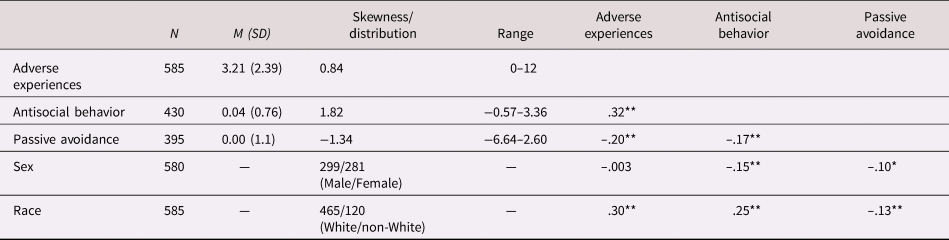
Table 2 displays the bivariate correlations between all variables as well as the means and standard deviations of each individual variable. Furthermore, 54% of participants experienced three or more adverse events in early childhood years. Twenty-two percent of participants self-reported arrest by age 18, and 5% of participants had criminal court records. Forty-three percent of mothers reported at least three events of child aggressive behavior in the past 12 months at age 17. Because gender and race were significantly correlated with cumulative risk, antisocial behavior, and deficient passive avoidance (except gender and risk were uncorrelated), gender and race were entered as covariates in all analyses.
Bivariate correlations with means and standard deviations

Note: Skewness values within range of –2 and +2 are considered acceptable for normal univariate distribution (George et al., Reference George and Mallery2010). *Correlation is significant at the .1 level (2-tailed). **Correlation is significant at the .05 level (2-tailed).
Statistical analyses
Path analyses, with confirmatory factor analysis (CFA), were used to test the associations among early childhood adversity, passive avoidance, and later antisocial behavior using the R package “lavaan” (Rosseel, Reference Rosseel2012). We defined acceptable model fit as a χ2-to-df ratio less than 3, comparative fit index greater than or equal to .90, Tucker–Lewis index greater than .90, root mean square error of approximation less than .08, and standardized root mean square residual less than or equal to .10 (Kline, Reference Kline2005).
Model statistics were as follows: χ2-to-df ratio = 2.89, comparative fit index = .931, Tucker–Lewis index = .911, root mean square error of approximation = .057, and standardized root mean square residual = .045. A latent variable of passive avoidance was identified through a CFA using a diagonally weighted least squares estimator with robust standard errors and a mean and variance adjusted test statistic. Blocks of go/no-go task performance were entered, specifically for 10 trial chunks measuring correct rejections for the task.
We tested associations between early childhood adversity and later antisocial behavior, early childhood adversity and neurocognitive impulsivity factor (from the CFA), and neurocognitive impulsivity and later antisocial behavior. Finally, we tested whether early adversity (X) was associated with later antisocial behavior (Y) and whether the observed association was mediated by individual differences in neurocognitive impulsivity (M). This test was done by computing the product of the indirect effects (a X b), as well as the total effect (c + a × b) using bootstrap confidence intervals (95% CIs) based on 5,000 draws with replacement; effects were deemed significant if the confidence interval does not include zero (Preacher & Hayes, Reference Preacher and Hayes2008).
Missing data
To evaluate whether data were missing completely at random (MCAR), we examined the patterns of missing data using Little's MCAR test (Little, Reference Little1988). Focusing on the critical variables of the work (e.g., cumulative risk, antisociality, and neurocognition), Little's MCAR test was significant χ2 (5) = 11.84, p = .037. This fact is perhaps not surprising given the long time scale of the work. Of the initial 585 subjects, 118 subjects were missing both measures of neurocognition and antisociality, 72 subjects were missing measures of neurocognition, and 37 were missing assessments of antisociality. As such, our results may actually underrepresent the true effects of cumulative adversity, as higher levels of adversity or antisociality may have influenced continued participation in the project (e.g., housing instability or incarceration).
Cumulative early childhood adversity and late adolescence antisocial behavior
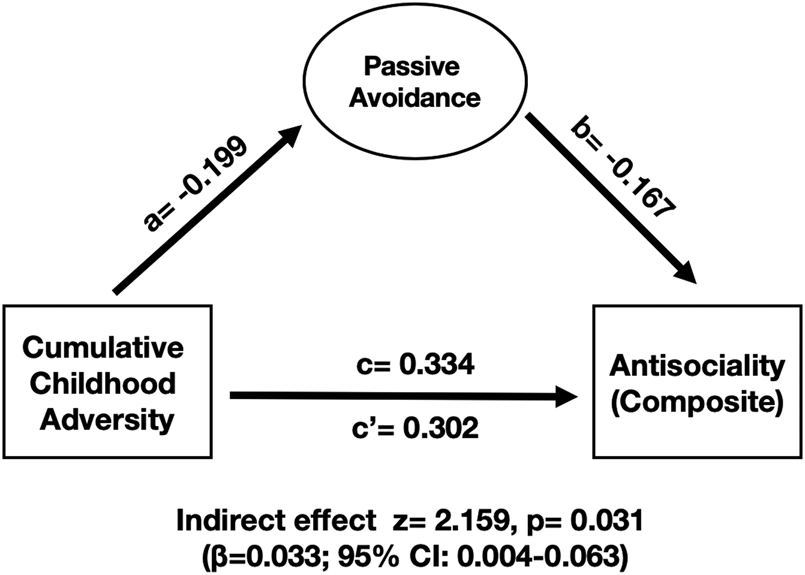
Regression analyses that tested early childhood adversity as a predictor of later antisocial behavior, controlling for child's gender and race, showed that the early childhood adversity score significantly predicted the late adolescence antisocial behavior composite (β = 0.302, p < .005), supporting the first hypothesis.
Cumulative early childhood adversity and adolescent neurocognition
Regression analyses indicated that higher early childhood adversity predicted deficient passive avoidance at age 16, controlling for child's gender and race (β = –0.199, p < .005), supporting the second hypothesis.
Neurocognition and late adolescent antisocial behavior
Regression analyses indicated that, controlling for gender and race, the passive avoidance score at age 16 significantly predicted the late adolescent antisocial behavior composite (β = –0.167, p < .005), supporting the third hypothesis.
Mediation analysis
Finally, we tested whether passive avoidance significantly mediated the pathway between cumulative early childhood adversity and later antisocial behavior, using nonparametric bootstrap mediation in R (and the “lavaan” package). In this model, we tested whether the indirect effect ([early childhood adversity -> neurocognition] × [neurocognition -> antisocial behavior]) significantly altered the direct effect of early childhood adversity -> antisocial behavior. We found that passive avoidance is a significant partial mediator of the relation between cumulative early childhood adversity and later antisocial behavior (z = 2.159, p = .031; see Figure 1).
The relation between cumulative early childhood adversity and later antisocial behavior and the mediation by neurocognition (passive avoidance) controlling for the gender and race of the target child.

In order to evaluate the consistency of this mediation effect across the three measures of antisocial behavior, we conducted analyses separately for each outcome variable. Findings were consistent across the three tests. The indirect effect of early childhood adversity on antisocial behavior as mediated by passive avoidance was marginally significant for all three outcome variables: mothers’ reports of aggressive behavior (p = .073), self-reports of any arrest (p = .069), and court records of arrest (p = .096).
Discussion
To our knowledge, this is the first long-term prospective study that has identified passive avoidance, operationalized as a behavioral pattern of privileging the pursuit of immediate rewards over restraint and a learning component, as a mediator of the developmental pathway between early childhood adverse experiences and late adolescent antisocial behavior. Our longitudinal analyses reveal that children who are exposed to numerous adversities during early childhood acquire a pattern of exhibiting poor passive avoidance during adolescence. The same children are more likely to be arrested and commit antisocial behaviors in late adolescence. Finally, our results show that passive avoidance partially mediates the pathway between early childhood adversity and later antisocial behavior. The robustness of these findings is enhanced by their replication across each of three diverse sources of information about antisocial behavior, including mother reports, self-reports, and official court records. These findings are exciting because of their potential for understanding how early adverse experiences leave an enduring mark on a child and for guiding prevention scientists to craft interventions that focus on improving inhibitory control and learning skills that are strongly related to passive avoidance among children who have many adverse early childhood experiences. To reiterate, we recognize the previous research in this field supporting the relation between early childhood adversity and later antisocial behavior. Yet, this study stands out as unique because it not only replicates previous findings on a longitudinal scale but also contributes the understanding of a pathway through a mediator, passive avoidance, that has not been previously associated with both childhood and adult variables at the same time, especially in a large longitudinal data set.
Collectively, these findings have important implications for the developmental sequelae of chronic stress exposure. Consistent with past studies (Beers & De Bellis, Reference Beers and De Bellis2002; Gould et al., Reference Gould, Clarke, Heim, Harvey, Majer and Nemeroff2012; Hanson et al., Reference Hanson, Adluru, Chung, Alexander, Davidson and Pollak2013; Spann et al., Reference Spann, Mayes, Kalmar, Guiney, Womer, Pittman and Blumberg2012), exposure to stressful experiences alters neurocognitive functions such as the ability to sustain attention to stimuli, make accurate judgments, and withhold impulsive responses. If a child grows up chronically exposed to adversity, he or she is less likely to control his or her impulses when encountering a confrontational situation; furthermore, individuals may be less likely to learn from these experiences and could become more likely to engage in violent or delinquent behavior over time. Stated in the opposite way, it may be that the encounter of consistent “nonadverse” experiences in early childhood facilitates development of typical neurocognitive functioning such as passive avoidance.
The connection between early adversity and later antisocial behavior has been widely researched and thought about especially in the realm of criminal and delinquent behavior development. For example, Agnew's (Reference Agnew2001) general strain theory proposes that exposure to adverse experiences may increase the development of negative and reactive emotions that create strain on the individual. In addition, he suggests that criminal behavior may be a way of reducing the strain, tying adverse experiences to antisocial behavior. Similarly, Moffitt (Reference Moffitt1993) proposes a theory around the dual taxonomy of antisocial behavior that argues for two types of pathways for antisocial behavior development: life-course persistent antisocial behavior in which neurocognitive developmental gaps may potentially drive the development of antisocial persons; and adolescent-limited antisocial behavior, which focuses on the maturity gap for adolescents who show antisocial behavior but shortly after adjust to the requirements of society. This framework shows the role of neurocognitive functioning in predicting persistent antisociality. In our study, we have used these theories to expand on our hypotheses and therefore tried to find the connection among all three variables of adversity, neurocognitive deficits, and antisociality.
The findings of our study are consistent with an emerging model of adverse childhood experiences that draws from research in evolution, neural development, and stress reactivity. The model posits a paradox in which the species has evolved to respond to a stressful early adverse environment with a pattern of attention shifting and lack of passive avoidance. This pattern might well be adaptive in the short run as a response to threat. The pattern continues across development through neurocognitive mechanisms that paradoxically and unfortunately become maladaptive when the child grows into an adolescent and displays antisocial outcomes. As Belsky et al. (Reference Belsky, Steinberg and Draper1991) proposed, early experiences shape the brain's “reproductive strategy” and correlated decision-making styles. If early experiences signal that future life is promising, brain development is entrained toward openness of interpretations and slower, fuller examination of rewards and punishments. Decision-making styles maximize ultimate outcomes even if a single experience is negative. In contrast, if early experiences signal chronic and severe threat to the point where the likelihood of living into old age is low, a child will adapt to the stressful and threatening environment by maximizing survival today without regard to tomorrow's consequences. This pattern is adaptive in adverse contexts. Brain development will skew toward hypervigilance to immediate threat and favoring of immediate rewards over delayed rewards that may never ensue.
Expanding on these ideas, Ellis et al. (Reference Ellis, Bianchi, Griskevicius and Frankenhuis2017) articulate the limited adaptive function of an impulsive decision-making strategy that grows out of early adversity as follows: “For example, an individual growing up in a chaotic/unpredictable environment may prioritize development of attention-shifting skills (to take advantage of fleeting opportunities and avoid unpredictable threats) at the cost of deprioritizing inhibitory control, whereas an individual growing up in a safe environment may make the opposite trade-offs” (p. 567). The trade-off in brain development is that the price of surviving today is poorer long-term development of effective cognitive strategies, and the consequences in behavioral outcomes may be less success. Blackwell, Chatham, Wiseheart, and Munakata (Reference Blackwell, Chatham, Wiseheart and Munakata2014) cite empirical findings of such trade-offs in children.
This model is supported by the four main findings of this study. A measure of cumulative adverse childhood experiences in the first 7 years of life was found to predict antisocial behavioral outcomes in late adolescence as indexed by mother reports, self-reports, and official court records of arrests. This same measure also predicted impulsive performance on a decision-making task in middle adolescence. In turn, passive avoidance predicted later antisocial behavior and mediated the relation between adverse childhood experiences and antisocial behavior.
An important strength of our research lies in the longitudinal nature of the study, where the participants were followed from early childhood to adolescence and adulthood. The last part of our study that focuses on mediation is where the most novel contribution to the field clearly lies. This is the first empirical test of the link between exposure to cumulative early childhood adversity, later display of antisocial behavior, and the mediation by changes in neurocognitive functioning, specifically passive avoidance, in a longitudinal manner.
One need not endorse an evolutionary theory to be interested in the findings of this study, which are also consistent with a stress-reactivity model of allostatic load (McEwen, Reference McEwen1998), and a parenting socialization model (Dodge et al., Reference Dodge, Pettit and Bates1994). Our results suggest that individuals who experience high rates of early childhood stress will be more likely to display antisocial behavior in late adolescence, consistent with previous research (e.g., Lansford et al., Reference Lansford, Miller-Johnson, Berlin, Dodge, Bates and Pettit2007). In this study, our main independent variable was a cumulative early adversity variable that encompassed several domains of potential stressors. Cumulative adversity was assumed to predict developmental outcomes better than individual risk factors. In studies that use multiple risk factors, there is more opportunity to look at several environmental, social, and circumstantial risks as a whole to predict development (Greenberg et al., Reference Greenberg, Lengua, Coie, Pinderhughes, Bierman, Dodge and McMahon1999). Therefore, we focused on the occurrence of having adverse experiences rather than pinpointing one specific risk variable. Our analysis for the composite variable of antisocial behavior involved three outcome variables: mother's report of adolescents’ aggressive behavior at age 17, participant self-report of arrest at age 18, and official court records of offenses up to age 18. These variables complemented each other, and all variables had specific advantages and disadvantages. Official court records of offenses up to age 18 had a low base rate in which around 5% of the sample was arrested. In addition, any court record or self-reported arrest by age 18 had a base rate of 22%. Mother's reports of adolescents’ aggressive behavior at age 17 had a higher base rate but were more subject to bias from the mother's point of view. In addition, official court records up to age 18 were more objective, compared to the self-report data of arrest or mother's reports of aggression. Although there are biases in the judicial system for certain populations (e.g., Black vs. White defendants; Burch, Reference Burch2015), we see complementary results in their characteristics covering self-report and parent-report measures, and official records, providing a comprehensive picture of the participants’ antisocial behavior profiles.
Also consistent with previous research (Beers & De Bellis, Reference Beers and De Bellis2002; Spann et al., Reference Spann, Mayes, Kalmar, Guiney, Womer, Pittman and Blumberg2012), we found that individuals who experienced high rates of early cumulative childhood adversity showed a pattern of neurocognitive functioning characterized by deficient passive avoidance. Furthermore, this pattern of neurocognitive functioning was found to be related to higher likelihood of displaying antisocial behavior (Åkerlund et al., Reference Åkerlund, Golsteyn, Grönqvist and Lindahl2016). Problems with passive avoidance may lead to the individual getting in trouble with the authorities. According to previous studies and our own results, it is also more likely for individuals with stronger impulsive tendencies to engage in antisocial behavior. Supporting evidence for the potential mediation of the pathway between early cumulative childhood adversity and later antisocial behavior by passive avoidance is a particular contribution to the field of child development. This work has identified an important domain where intervention can be applied.
This research has implications across several domains. The increasing prevalence of early childhood adversity in our society (or, at least, increasing recognition of its occurrence) creates a burden in the public health sector, especially with the identified relations to increased crime and antisocial behavior. Passive avoidance may be a mediator for the pathway from early childhood adversity to future antisocial behavior in which both the perpetrator and the victim of violence and aggression are disadvantaged. The pathway from early childhood adversity to later antisocial behavior and the identification of passive avoidance as a mediator can guide the formation of theories as to how antisocial behavior develops. Individuals exposed to early childhood adversity have increased risk for later antisocial behavior as they display poor passive avoidance. Future scientific studies would benefit from looking at alterations in brain development and dysfunctions in the brain regions known to be involved in passive avoidance.
Our research suggests two particular points of intervention: preventing exposure to early adversity, and improving neurocognitive functioning in response to the experience of early adversity. Early life adversity preventive interventions such as home visits by nurses have been associated with improvements in development such as in maternal mental health and fewer health-related emergencies in early childhood (Dodge et al., Reference Dodge, Goodman, Murphy, O'Donnell, Sato and Guptill2014). Neurocognitive interventions in response to early adversity have not been studied as extensively but are growing in numbers. Existing research suggests that interventions for strengthening inhibitory control and improving learning can alleviate the effects of adversity. For example, studies show that the Fast Track intervention reduced antisocial behavior by helping individuals work on regulation skills during early adolescence (Sorensen, Dodge, & the Conduct Problems Prevention Research Group, Reference Sorensen and Dodge2015). Piquero et al. (Piquero, Jennings, & Farrington, Reference Piquero, Jennings and Farrington2010; Piquero, Jenning, Farrington, Diamond, & Gonzalez, Reference Piquero, Jennings, Farrington, Diamond and Gonzalez2016) have developed interventions to improve self-control among predelinquents. Intervention not only provides help to those who have had problems in development but also provides an experimental method for the scientific world to understand the pathways leading to antisocial behavior. Even though these initial intervention studies are valuable, future research should aim to conduct stronger and more replicable studies.
This research is subject to important limitations. The magnitude of the relations identified, although statistically significant and replicated across independent measures, are modest, which might indicate that additional factors need to be considered. For example, some children might be more prone to being affected by adversity due to certain genetic factors, and further research in understanding this connection might lead to stronger effect sizes. Other mediators might be identified in future studies that are either stronger or complement the mediational path identified here. We also recognize that the design is correlational and the conclusions are subject to third-variable interpretations. It is plausible that unmeasured genetic or ecological variables are responsible for a child's experience of adverse events, neurocognitive patterns, and antisocial behavior, without these later variables being causally linked. However, the correlational relations are consistent with results from previous studies, increasing confidence in their robustness. Another limitation is that our study is restricted to the specific variables we chose to measure in three domains (early childhood adversity, passive avoidance, and later antisocial behavior). Further research can focus on outcome variables such as internalizing behaviors as well as other forms of externalizing behaviors, other than antisocial behavior. Finally, we point out that an unmeasured, inherent child characteristic such as temperament or behavioral predisposition could, in theory, lead to family adversity, child neurocognitive functioning, and child violent behavior and render the mediational relations as artifactual. However, there is no plausible way of measuring this hypothesized child characteristic at this time. We are left acknowledging this possibility and invite future studies to discover what the characteristic might be and how to measure it.
In conclusion, this study's findings suggest that a deficit in passive avoidance is a significant mediator of the relation between early childhood adversity and later antisocial behavior. Interventions to alter impulsive decision making should be considered for children who experience early adverse events.
Financial support
The Child Development Project has been funded by Grants MH56961, MH57024, and MH57095 from the National Institute of Mental Health, HD30572 from the Eunice Kennedy Shriver National Institute of Child Health and Human Development, and DA016903 from the National Institute on Drug Abuse. In addition, Dr. Hanson was supported by Eunice Kennedy Shriver National Institute of Child Health and Human Development Grant HD00736 and National Institute on Drug Abuse Grant DA023026.