Introduction
Gram-negative bacteria (GNB), including Pseudomonas aeruginosa, Klebsiella pneumoniae, and Acinetobacter baumannii, are responsible for approximately one-third of all hospital-acquired infections (HAIs) and are associated with high levels of antibiotic resistance. Reference Haque, Sartelli, McKimm and Bakar1,Reference McFee2 Several studies have identified the hospital water environment, particularly sink drains, as a significant reservoir for multidrug-resistant gram-negative bacteria (MDR-GNB). Reference Regev-Yochay, Margalit and Smollan3–Reference Kinsey, Koirala and Solomon6 Sink drains provide an ideal setting for bacterial colonization and biofilm formation due to the continuous availability of moisture, nutrients, and surface area. Reference Regev-Yochay, Margalit and Smollan3,Reference Kizny Gordon, Mathers and Cheong4 Biofilms, once established, serve as a protective environment for bacteria, shielding them from chemical disinfectants and enabling persistence despite regular cleaning. Reference Kizny Gordon, Mathers and Cheong4 Contaminated sink drains have been implicated in outbreaks of carbapenem-resistant Enterobacterales (CRE) and other MDR organisms, often through splash contamination or aerosolization during routine sink use. Reference Regev-Yochay, Margalit and Smollan3,Reference Kizny Gordon, Mathers and Cheong4,Reference Garvey, Williams and Gardiner7 Potential control measures aim to reduce the risk of exposure to organisms in sink drain biofilm by decreasing the likelihood of splash exposure from the sink drain to patient equipment, supplies, and healthcare personnel, and by sink drain disinfection. However, drains are challenging to disinfect and the optimal strategies for their disinfection are yet to be well established.
Although the utilization of a novel disinfection protocol consisting of hydrogen peroxide, peracetic acid, and octanoic acid (Virasept) (EcoLab Inc., St Paul, MN, USA) applied through a pump-up foaming applicator has shown promise in reducing bacterial colonization in sink drains, Reference Buchan, Arvan and Graham8,Reference Jones, Mana and Cadnum9 studies indicate that bacterial recolonization occurs rapidly, typically within a few days of disinfection. Reference Ramos-Castaneda, Faron and Hyke10 Other studies suggest that combining physical removal of biofilm with chemical disinfection may improve microbial control by disrupting protective biofilms that allow pathogens to persist. Reference Gomes, Lemos, Mathieu, Simões and Simões11,Reference Gomes, Lemos, Fernandes, Borges, Simões and Simões12 Additionally, mechanical barriers and structural modifications, such as disposable sink drain covers, have been proposed to reduce contamination and microbial dispersal, offering complementary strategies to chemical disinfection in high-risk settings. Reference Livingston, Cadnum, Gestrich, Jencson and Donskey13 However, the comparative efficacy of these approaches and the optimal frequency required to reduce GNB colonization remains insufficiently studied.
This study aims to assess the impact of a sink drain disinfection protocol using hydrogen peroxide-based foam application to reduce GNB colonization in hospital sink drains and associated environmental surfaces. The study specifically investigates three intervention scenarios, including the application of the foam disinfectant alone, the combined use of foam disinfectant and mechanical cleaning, and the integrated approach of foam disinfectant application, mechanical cleaning, and replacement of drain covers. This multifaceted approach is to allow for the assessment of the individual and synergistic effects of the interventions on controlling sink drain and associated environmental contamination.
Methods
Study design and setting
We conducted a prospective cohort study in the neonatal intensive care unit (NICU) at an academic medical center in Maryland (November 2023 to May 2024). The 37,612-square-foot Level IV unit comprises 52 single-patient rooms, organized into five neighborhoods and designed for individualized care. Each room has one in-room sink. Daily environmental services clean and disinfect the basin, faucet, and surrounding countertop using hydrogen peroxide-based, EPA-registered hospital-grade cleaner-disinfectant. However, no routine protocol exists for cleaning or disinfecting sink drains, leaving them potentially vulnerable to biofilm formation and bacterial colonization. Each drain sits directly below the faucet (no faucet-drain offset) and features a removable drain cover designed to reduce splashing. These covers fit tightly into the drain opening but can be loosened, replaced, or removed as needed.
Study interventions
We evaluated four intervention strategies for sink disinfection: (1) cleaning and disinfection with a hydrogen peroxide, peracetic acid, and octanoic acid disinfectant applied through a pump-up foaming applicator; (2) the foaming disinfectant combined with mechanical cleaning using a pipe brush to scrub the inner surfaces of drains to physically remove biofilm accumulation; (3) foaming disinfectant combined with sink drain cover replacement; and (4) a combined intervention involving foaming disinfectant, mechanical cleaning, and drain cover replacement. We thus sought to study the additive effect (if any) of two interventions aimed at physically removing or reducing the bioburden, i.e., cleaning the sink drain with a brush, and replacing the existing drain cover with a clean cover. Disinfection was performed by one of two trained members of the hospital Facilities Operations and Maintenance team, using a standard protocol. A control group received no cleaning or cover changes. Controls were selected from the same NICU neighborhood as intervention rooms to ensure comparable environmental conditions and were sampled on the same days; rooms that had previously undergone an intervention were excluded from serving as controls.
Environmental sampling
We collected five environmental samples per time point for each study group, targeting key sink locations: countertop, basin, faucet, cover, and drain. Sampling occurred pre-intervention at baseline (Day 0) and on Days 1, 3, 5, and 7 post-interventions to track changes in bacterial colonization over time. To ensure consistency, the same research staff conducted all sampling between 12:00 PM and 4:00 PM using a standardized protocol. We used cellulose sponge sticks (3M, St. Paul, Minnesota) for the sink countertop and basin, while polyester-tipped swab system with neutralizing buffer solution (ESK™ Environmental Sampling Kit) was used for the underside of the faucet and drain cover, as well as 2 inches below the sink drain. In total, 30 rooms were sampled during the study period. Samples were anonymized and transported to the laboratory within 30 minutes of collection.
Microbiological methods
Samples were serially diluted, plated on MacConkey II agar (Becton Dickinson and Company, Sparks, MD, USA), and incubated for 24 hours at 35 ± 2 °C. We assessed GNB contamination both qualitatively (growth or no growth) and quantitatively in five sampling locations in the NICU sinks (counter, basin, faucet, cover, and drain) across five time points (Days 0, 1, 3, 5, and 7). Quantitative GNB assessment was done by counting the total colony-forming-units (CFU) for all GNB (total CFU), Lactose Fermenting (LF) GNB, and non-lactose-fermenting (NLF) GNB. GNB were identified to the species level using matrix-assisted laser desorption/ionization-time of flight (MALDI-TOF) (Bruker, Billerica, MA).
Statistical methods
All bacterial counts were measured as CFU/swab and analyzed on the natural-log scale as ln(CFU + 1)/swab to handle zeroes and stabilize variances. We used boxplots to compare distribution (median, IQR) of ln(CFU + 1)/swab across time points and study groups. The primary outcome was the change in ln(CFU + 1)/swab for total GNB from baseline (Day 0) to each post-intervention time point. We fit a mixed-effect regression model to account for repeated measures over time on the same sinks, which considers the sink as a random effect and the interventions as fixed effects, with the control group as the reference. Additionally, we calculated microbial regrowth as a proportion of baseline counts at different time points. To understand the effect of the interventions on microbial composition over time, we calculated the proportions of the most common GNB recovered at each timepoint for controls and each intervention arm.
Results
Baseline characteristics and distribution of microbial burden
At baseline (Day 0), sink drains and drain covers had the highest burden of GNB (total GNB mean lnCFU: 15.4 and 16.4, respectively), predominantly contributed by non-lactose fermenters (NLF lnCFU: 14.6 and 14.9). Faucets exhibited minimal contamination (GNB mean lnCFU: 0.8), while basins (9.5) and counters (6.7) had intermediate levels with contributions from both lactose fermenting (LF) and NLF (Supplementary Table S1).
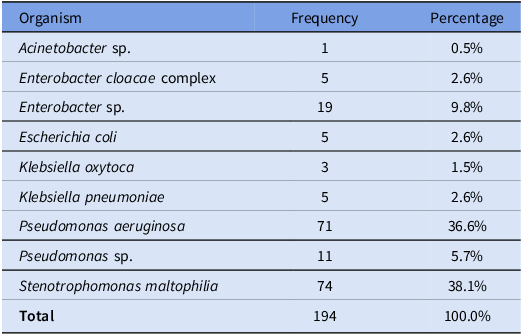
NLF GNB dominated the microbial burden across all sites—Stenotrophomonas maltophilia (38.1%) and P. aeruginosa (36.6%) were the most prevalent isolates, accounting for about three-fourths of all isolates at baseline (Table 1). Lesser contributions came from Enterobacter sp. (9.8%), K. pneumoniae (2.6%), and Acinetobacter sp. (0.5%) (Table 1).
Baseline frequency distribution of identified gram-negative organisms in the NICU sink environment

Intervention effectiveness on microbial burden
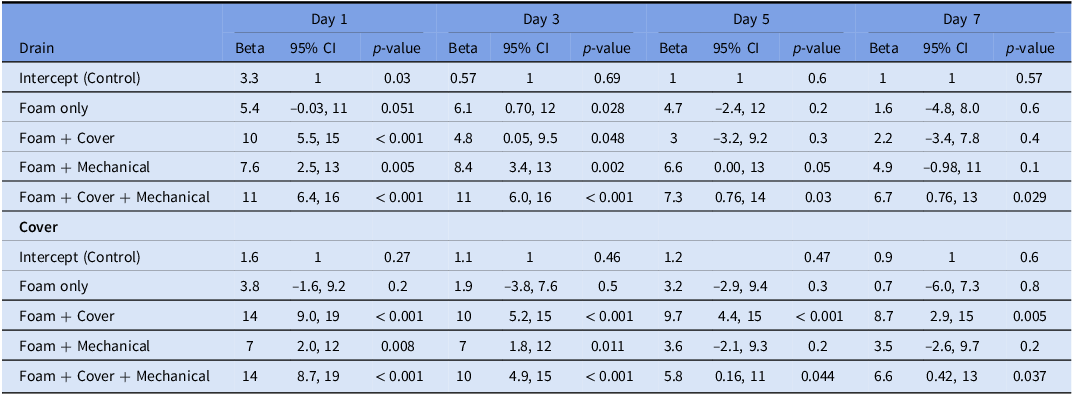
Following intervention, the combined strategy of foam, mechanical cleaning, and drain cover replacement consistently exhibited the greatest effect on sink drain GNB bioburden on Day 1 (mean reduction = 11.0 lnCFU (95% CI: 6.4, 16.0; p < 0.001) with the effect persisting through Day 7 (mean reduction = 6.7 lnCFU, 95% CI: 0.76, 13.0; p = 0.029) (Table 2). The foam-only intervention demonstrated transient effect, with a significant reduction observed on Day 3 (mean reduction = 6.1 lnCFU 95% CI: 0.70, 12.0; p = 0.028), which diminished by Day 7. Similar effects were observed on sink drain covers. Both interventions that included cover change yielded significant reductions in bioburden through Day 7 (foam plus mechanical cleaning plus cover change: mean reduction = 6.6 lnCFU, 95% CI: 0.42, 13.0; p = 0.037; foam plus cover change: mean reduction = 8.7 lnCFU, 95% CI: 2.9, 15.0; p = 0.005), while the foam-only showed limited impact (Table 2). Even with the best-performing combined intervention strategy, recolonization was evident by Day 5, reaching 48% and 52% of baseline by Day 5 and 7 respectively for sink drains, and 60% and 57% for drain covers. (Figure 1, and supplementary Figure 1). Assessment of sink-level bacterial composition shows that combinations of both NLF and LF GNB were most frequent at both Drain and Cover sites, reflecting co-colonization and between-sink heterogeneity. Among observations with a dominant organism, S. maltophilia and P. aeruginosa were most prevalent. Post-intervention patterns included both suppression (no isolates recovered) and shift in dominance, as detailed in Supplementary Tables S3, Supplementary Results.
Estimated changes in total gram-negative bacterial burden - mean ln(CFU + 1) in Sink drain and drain cover by intervention group and timepoint

Linear regression was used with the control as reference and intervention groups as predictors (Change in log-transformed total CFU ∼ β0 + β (Group).
Coefficients represent additional mean reduction compared to control.
Trend in total gram-negative bacterial burden (Mean ln(CFU + 1)) by intervention group and timepoint for sink drain and drain cover locations: (A) SINK DRAIN (B) DRAIN COVER.

Discussion
In this single-center study of NICU patient rooms, combining a foaming hydrogen peroxide drain cleaner with physical bioburden removal through mechanical cleaning and drain cover replacement resulted in the largest reductions in microbial burden in the sink drain and drain cover. However, reductions diminished over time, with recolonization apparent by Day 5. By this time point, mean ln(CFU + 1) values implied a rebound to about 48% of baseline in sink drains and 60% in drain covers, indicating the need for repeated or sustained intervention strategies.
These results align with studies by Buchan et al., Reference Buchan, Arvan and Graham8 who demonstrated hydrogen peroxide-based foam disinfectants effectively reduced bacterial load in hospital sink drains but also noted the reductions were transient, with recolonization occurring within 7 days and recommended shorter disinfection intervals to sustain efficacy. Similarly, Lucas et al. Reference Jones, Mana and Cadnum9 observed significant bioburden reductions between Days 1 and 3 after foam application, followed by a return to baseline by Day 7. Even with repeated applications every 3 days, the bacterial burden still rebounded, highlighting the limitations of chemical disinfection alone. Reference Jones, Mana and Cadnum9 These findings underscore the protective role of biofilms: as a primary driver of microbial resilience, biofilm architecture shields bacteria from disinfectants and enables rapid regrowth. Reference Kizny Gordon, Mathers and Cheong4–Reference Kinsey, Koirala and Solomon6 Our findings suggest that mechanical disruption and cover replacement enhance biofilm removal, providing an additive effect critical for more sustained reductions relative to foam alone. This aligns with experimental evidence from Gomes et al., Reference Gomes, Lemos, Mathieu, Simões and Simões11 who demonstrated that combining chemical treatment with benzyldimethyldodecylammonium chloride (BDMDAC), - a biocide/disinfectant used in industrial and healthcare settings for its antimicrobial activity against biofilms Reference Redondo, Pereira, Pereira and Melo14,Reference Hsu, Chen, Lo and Lee15 - with hydrodynamic shear stress more effectively removed biofilms than chemical disinfection alone. While BDMDAC alone removed only 12–16% of mature biofilm mass, combining it with mechanical shear stress nearly tripled removal rates. Reference Gomes, Lemos, Mathieu, Simões and Simões11
To reduce the risk of splash dispersal from contaminated sink drains, the use of drain covers has been recommended. In our setting, removable drain covers were key in providing access for mechanical cleaning of sink drains. It is possible that drain cover replacement provides an additional layer of biofilm control. The foam + cover intervention arm retained reductions through Day 7 even without mechanical scrubbing, suggesting that altering the colonization substrate can help sustain microbial suppression. However, drain covers can create additional issues. First, they can slow drainage of water by fostering bacterial growth in the basin and may be removed by healthcare workers seeking to improve flow, defeating their intended purpose. Lastly, as demonstrated in our study, the covers themselves can be quickly colonized, potentially becoming an additional source of contamination. Hajar et al. Reference Hajar, Mana, Cadnum and Donskey16 and Livingstone et al Reference Livingston, Cadnum, Gestrich, Jencson and Donskey13 similarly found that while drain covers reduced the dispersal of gram-negative bacilli, they did not eliminate it entirely.
While the sink drains and drain covers exhibited the highest microbial loads and responded significantly to multimodal interventions, surrounding surfaces such as counters, basins, and faucets showed consistently lower contamination. Due to the lower baseline microbial counts on these surfaces, as well as susceptibility to contamination from sources other than the sink drain, we were unable to estimate a clear effect of sink drain disinfection interventions on those surrounding surfaces.
In our study, non-lactose fermenters, particularly S. maltophilia and P. aeruginosa were the predominant contributors to the microbial burden across all sites. This finding aligns with multiple other reports highlighting the preponderance of these organisms in hospitals’ water systems with the potential to cause hospital-acquired infections. Low et al. reported moderate to heavy growth of P. aeruginosa and S. maltophilia in NICU sink drains post-occupancy, with colonization intensifying over time despite infection prevention efforts. Reference Low, Ko and Ong17 Hajar et al. similarly demonstrated that P. aeruginosa and other NLFs were frequently dispersed from contaminated sink drains even with drain covers in place. Reference Hajar, Mana, Cadnum and Donskey16 P. aeruginosa is a critical concern in neonatal units, as it has been implicated in numerous outbreaks in NICU linked to contaminated water systems, including sink drains. Reference Kinsey, Koirala and Solomon6,Reference Walker, Jhutty and Parks18,Reference Catho, Martischang and Boroli19 Its ability to persist in moist environments, form biofilm, and resist disinfection makes it a formidable pathogen in critical care settings. Collectively, our finding underscores the need for an effective intervention targeting these high-risk sources of bioburden in the NICU.
Strengths of our study include simultaneous assessment of single and multimodal interventions, generating insights into their comparative efficacy. This study also demonstrated significant colonization of sink covers creating another potential reservoir for GNB in sinks. We also acknowledge some limitations particularly the absence of mechanical-only comparison arms, which limit attribution of effects specifically to foam versus mechanical action. Other limitations include a focus on environmental contamination rather than clinical outcomes, a short (7-day) follow-up, and that the study was conducted in a single NICU, limiting generalizability. Future research should include intervention arms with only mechanical cleaning and only foam, extended follow-up periods, and assessment of clinical outcomes if adequately powered to do so.
In summary, a combined intervention of a foaming disinfectant, mechanical cleaning, and drain cover replacement was superior to chemical disinfection in reducing GNB bioburden in sink drains up to 7 days. However, the transient nature of bioburden reduction underscores the need for frequent reapplication and tailored cleaning strategies.
Supplementary material
To view supplementary material for this article, please visit https://doi.org/10.1017/ice.2025.10354.
Financial support
This research did not receive any specific grant from funding agencies in the public, commercial, or not-for-profit sectors. The study was supported by internal departmental resources with no external funding.
Competing interests
All authors declare no competing interests related to this work. Each author confirmed has no financial or personal relationship that could inappropriately influence or bias the content of this manuscript.