Reasons given for the traditional popularity of consanguineous marriage in Pakistan and many other countries of South Asia usually focus on their perceived social and economic advantages, including simplified premarital negotiations, the assurance of marrying within the family, strengthening of family bonds and minimal dowry requirements or demands resulting in the maintenance of family wealth (Bittles, Reference Bittles1994; Hussain & Bittles, Reference Hussain and Bittles1998; Hussain, Reference Hussain1999; Bittles & Black, Reference Bittles and Black2010). It also has been proposed that female status is protected in a consanguineous union, because of the pre-existing family relationship between a bride and her in-laws (Bittles, Reference Bittles2012).
Malakand Protected Area is located in the north-west region of Pakistan. As a Provincially Administered Tribal Area (PATA), Malakand is under the authority of the Government of Khyber Pakhtunkhwa Province (KPK), which until 2010 was known as the North-West Frontier Province (NWFP). Malakand has an area of 952 km2 and according to the 1998 District Census Report (Population Census Organisation, 2000) it had a population of 452,000, an average household size of 9.1, a male:female sex ratio of 107, and an overall literacy rate of 39.5%. A more recent estimate suggested a population of 647,000 in 2008–09, but since 1998 no organized population surveys have been possible due to the high levels of violence in Malakand and surrounding areas, which include the Federal Administrative Tribal Areas (FATA) of North and South Waziristan that are under the direct rule of the Government of Pakistan. Some 90.5% of the population of Malakand is rural, with just a single urban municipality (Batkhela). A large majority of the population are of Pathan ethnicity and speak the Pashto form of the Pathan language.
As part of a programme to assess the prevalence of childhood hearing impairment in Malakand District, parents were invited to bring their children, male and female and aged from 4–15 years, for a hearing examination. The programme was conducted between January 2011 and February 2013 in rural areas of Malakand with a total of 1192 sets of parents recruited into the study. Literate respondents, most of whom were male, were invited to complete the questionnaires themselves. Where the information was provided orally the questions and answers were conducted in the local Pashto language. Family pedigrees also were constructed in cases where the spousal relationship was unclear. The practice of Purdah, i.e. the seclusion of women, is strictly observed in Malakand. For this reason, interviews with male and female parents were separately conducted by male and female members of the project team, respectively.
Permission to conduct the study was granted by the Assistant Commissioner Malakand on behalf of Deputy Commissioner Malakand. Because of the uncertain security situation in Malakand and surrounding districts, armed security personnel were provided for the protection of the study team by the Assistant Commissioner Malakand, acting on behalf of the Deputy Provincial Commissioner Malakand. All participants were advised of the reason for the study and assured of the confidentiality of their data. Prior to inclusion in the study oral consent was obtained from each individual parent.
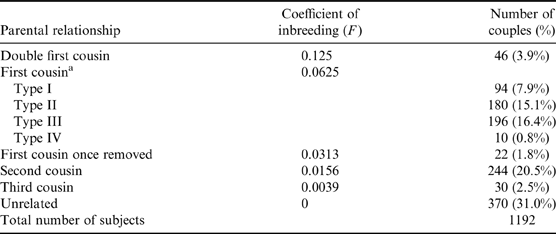
Data on the current profile of consanguineous marriages in Malakand District are presented in Table 1. Of the 1192 couples surveyed 66.4% were related as second cousins or closer (F≥0.0156), equivalent to a mean coefficient of inbreeding (α) of 0.0338. Similar, and in some cases even higher, levels of consanguineous marriage have been reported in other regions of Pakistan, e.g. in the provinces of Punjab, Sindh and Balochistan (Ahmed et al., Reference Ahmed, Ali, Aliaga, Arnold, Ayub and Bhatti1992; Bittles et al., Reference Bittles, Grant and Shami1993; Yaqoob et al., 1993), and in neighbouring countries, such as Afghanistan (Saify & Saadat, Reference Saify and Saadat2012) and the Iranian province of Sistan and Baluchistan (Saadat et al., Reference Saadat, Ansari-Lari and Farhud2004; Abbasi-Shavazi et al., Reference Abbasi-Shavazi, McDonald and Hosseini-Chavoshi2008). The current level of consanguinity in Malakand is, however, significantly higher than reported in an earlier survey undertaken across the North-West Frontier Province (51.1%, α=0.0259) (Ahmed et al., Reference Ahmed, Ali, Aliaga, Arnold, Ayub and Bhatti1992) and in rural parts of the neighbouring Swat Valley (37.1%, α=0.0166) (Wahab & Ahmad, Reference Wahab and Ahmad1996).
Parental relationships in the Malakand study cohort

a Type I: father's brother's daughter. Type II: mother's sister daughter. Type III: father's sister daughter. Type IV: mother's brother daughter.
As in many other societies (Bittles, Reference Bittles2012), first cousin marriages were the most popular form of consanguineous union in Malakand, accounting for 40.3% of all marriages, with type II parallel-cousin marriages between a man and his mother's sister's daughter (15.1%) and type III cross-cousin marriages between and a man and his father's sister daughter (16.4%) being the most common. Only 0.8% of marriages in Malakand were type IV cross-cousin unions between a man and his mother's brother's daughter, which is in marked contrast with the 12.3% type IV first cousin marriages reported in rural Punjab (Yaqoob et al., 1993), and the 6.8% type IV marriages in rural Swat (Wahab & Ahmad, Reference Wahab and Ahmad1996).
Detailed historical accounts have been published on the social structure and marriage practices of the Pathan tribes of the former North-West Frontier Province (Rose, Reference Rose1911; Ibbetson, Reference Ibbetson1916; Caroe, Reference Caroe1958), all confirming tribal endogamy and a strong preference for consanguineous unions. These sources also detail the frequent local and occasionally more widespread inter-tribal unrest and violence, and open warfare between tribes and the government of the period (Churchill, Reference Churchill1898). During the last decade, and more especially the last 3–5 years, armed conflict in Khyber Pakhtunkhwa has escalated dramatically, in some instances requiring large-scale intervention by the Pakistan armed forces. The worsening security situation has made population-based surveys in Malakand Protected Area and adjoining areas a difficult and potentially dangerous undertaking with armed guards a necessity.
The results of the present study clearly indicate that consanguineous marriage remains strongly preferential in Malakand. Indeed, when compared with the results of the Pakistan Demographic Health Survey conducted in the then North-West Frontier Province in 1990–91 (Ahmed et al., Reference Ahmed, Ali, Aliaga, Arnold, Ayub and Bhatti1992), and a local study in the neighbouring Swat Valley (Wahab & Ahmad, Reference Wahab and Ahmad1996), with which Malakand is connected via the strategic Malakand Pass, the prevalence of consanguineous marriage appears to have increased significantly during the last generation. It has been hypothesized that in times of civil strife intra-familial marriage is an advantageous strategy to optimize the security of couples, families and their communities (Bittles, Reference Bittles2012), a strategy which appears to be currently favoured by the peoples of Malakand.
Acknowledgment
The authors acknowledge with gratitude the invaluable support and assistance provided by the Assistant Commissioner Malakand.