INTRODUCTION
Seed dispersal is the first stage in colonization and the first filter for seedling recruitment (Foster & Tilman Reference FOSTER and TILMAN2003, Wright et al. Reference WRIGHT, MULLER-LANDAU, CALDERÓN and HERNÁNDEZ2005). In low-land tropical forests, it is commonly recognized that seed dispersal is limited and constrains forest regeneration (Guariguata & Ostertag Reference GUARIGUATA and OSTERTAG2001, Lawrence Reference LAWRENCE2004, Martínez-Garza & González-Montagut Reference MARTÍNEZ-GARZA and GONZÁLEZ-MONTAGUT1999, Mesquita et al. Reference MESQUITA, ICKES, GANADE and WILLIAMSON2001). It is unknown if this is true for other kinds of tropical forests and at which spatial scale such limitation, if any, starts to be noticeable. This can provide a clue of the ecosystem vulnerability before the common increases in fragmentation detected in tropical areas (Cayuela et al. Reference CAYUELA, REY BENAYAS and ECHEVERRIA2006; Velázquez et al. Reference VELÁZQUEZ, MAS and PALACIO2002).
Habitat loss and fragmentation appear to alter unevenly colonization opportunities among species with different dispersal modes. The majority of tropical forest seeds have adaptations for animal dispersal (Howe & Smallwood Reference HOWE and SMALLWOOD1982). Therefore, habitat changes affecting abundance and movements of dispersers may induce changes in abundance and distribution of plant species. Indeed, many dispersers prefer forest interiors over edges or open areas (Cardoso da Silva & Tabarelli Reference CARDOSO DA SILVA and TABARELLI2000; Pimentel Lopes de Melo et al. Reference PIMENTEL LOPES DE MELO, DIRZO and TABARELLI2006). Contrastingly, wind dispersal depends on wind speed, which is modified by vegetation structure and density. Wind flow models predict that forest drag reduces considerably wind speed (Greene & Johnson Reference GREENE and JOHNSON1996). Therefore, wind-dispersed seeds may reach longer distances in clearings and in low-stature young stands than in well-developed forests. On the other hand, pioneer plants are identified as producers of more seeds than late-successional species, which must translate into reaching more areas (Bullock et al. Reference BULLOCK, MOY, PYWELL, COULSON, NOLAN, CASWELL, Bullock, Kenward and Hails2002).
Tropical montane cloud forest (TMCF) are among the most endangered in the world, have a distinctive floristic composition, are very fragmented (Aldrich & Hostettler Reference ALDRICH and HOSTETTLER2000, Churchill et al. Reference CHURCHILL, BALSLEV, FORERO and LUTEYN1995, Rzedowski Reference RZEDOWSKI1996), and operate important environment services (Bautista-Cruz & del Castillo Reference BAUTISTA-CRUZ and DEL CASTILLO2005, Bruijnzeel & Proctor Reference BRUIJNZEEL, PROCTOR, Hamilton, Jurick and Scatena1995, Cavelier et al. Reference CAVELIER, SOLIS and JARAMILLO1996). Therefore, conservation and restoration practices are urgently needed. For such tasks we need to know whether the development of the desired vegetation is limited by seed dispersal.
Shifting cultivation has dramatically changed TMCF areas in El Rincon, Oaxaca, southern Mexico. The first forest to appear after croplands are abandoned is dominated by Pinus chiapensis. An emergent stratum of shade-tolerant broadleaved species develops and eventually replaces the pine trees, many of which perished 45–75 y after abandonment. Indeed old growth stands, ≥100 y old are composed by a diverse suite of broadleaved species, similar to a primary forest. Apparently, pine colonization and the relative fast replacement of pines by broadleaved species are facilitated by the proximity of forests of different ages as seed suppliers (del Castillo & Blanco-Macias Reference DEL CASTILLO, BLANCO MACÍAS and Newton2007). Thus, an increase in fragmentation may reduce the chances of forest recovery if dispersal is limited. Nevertheless, detailed seed rain surveys have not been undertaken.
This study documents seed rain in neighbouring stands of different age after abandonment in a TMCF area in El Rincon. We test the general hypothesis that seed rain is limited even at the scale of neighbouring fragments and that such limitation differs among plants with different dispersal modes and successional origin. In particular, we hypothesize that: (1) seeds from local sources will be more abundant in terms of seed numbers and diversity in the seed rain than seeds from plants of other neighbouring habitats; (2) animal-dispersed seeds will be more abundant in late-successional than in early-successional stands, relative to abiotically dispersed seeds; and (3) seeds from pioneer plants will be more common in the seed rain than those from late-successional species.
STUDY AREA
This study was carried out in the municipalities of Tanetze de Zaragoza and San Juan Juquila Vijanos, El Rincon, Sierra Madre de Oaxaca, Mexico (17°19′ 17°23′N, 95°16′–96°22′W, 2100–2300 m elevation). Topography is steep (15–100%). Average annual rainfall at the nearest meteorological station is 1719 mm y−1. Mean annual temperature ranges between 20 and 22 °C (Anonymous 1999). Soils are Typic Dystrudepts (young forest) or Humic Dystrudepts (old-growth forests) in the Inceptsol order, acidic, with low content of phosphate and bases, and a high content of organic matter (Bautista-Cruz & del Castillo Reference BAUTISTA-CRUZ and DEL CASTILLO2005, Bautista-Cruz et al. Reference BAUTISTA-CRUZ, GUTIÉRREZ, DEL CASTILLO and ETCHEVERS2005). Due to the abundance of temperate elements and diagnostic families such as Actinidiaceae, Clethraceae, Chloranthaceae, Hamamelidaceae, Symplocaceae, Theaceae and Winteraceae, the original vegetation is an upper TMCF sensu Webster (Reference WEBSTER, Churchill, Balslev, Forero and Luteyn1995). The landscape is a mosaic of crop fields, secondary forests of different development stages resulting from the abandonment of agricultural lands and primary forest.
METHODS
Study sites
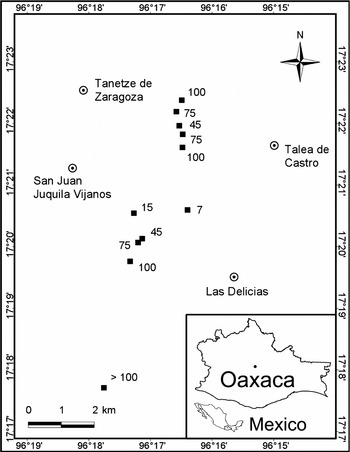
We selected 11 sites for seed rain evaluation at the study area: 10 sites of secondary vegetation, and one primary forest site. The sites were classified as: (1) ≈7 y (1 site), (2) ≈15 y (1 site), (3) ≈45 y (2 sites), (4) ≈75 y (3 sites), ≈100 y (3 sites); and (6) primary forest (1 site, Figure 1). The ≈7 and ≈15 y stands are composed of young, usually non-reproductive trees, in addition to shrubs and other low-stature plants. Each site is a homogeneous patch of vegetation of the same age of at least 3 ha, or 1 ha in incipient forests (Figure 1). All secondary forest sites were the result of natural vegetation recovery after the land was used for growing maize with beans and squash. The primary forest site was the closest to the secondary sites studied. Sites were selected based on the following criteria: (1) absence of domestic animals; (2) lack of current human activities, such as firewood extraction, and (3) topography gentle enough as to allow the stability of the seed traps and a safe collection of the trapped material without special equipment. Following a similar procedure as that described in Bautista-Cruz & del Castillo (Reference BAUTISTA-CRUZ and DEL CASTILLO2005), the age of the sites was estimated based on: (1) the approximate age of the pioneer and shade-intolerant Pinus chiapensis; (2) the floristic composition and vegetation structure of the stand; and (3) information provided by local people or kept at the books of the neighbouring municipalities. For instance, we classified site 11 as primary forest, based on the absence of the pioneer P. chiapensis, the large size and height of species typical of primary TMCF such as: Dendropanax populifolius, Drymis granadensis, Oreopanax xalapensis, Weinmannia pinnata and Quercus salicifolia, and the acquaintance of local people confirming that the site has never been cleared.
Map of El Rincon, Oaxaca, Mexico showing the position and the approximate age (y) of the stands used for seed rain evaluations. Towns and villages are also shown.

Seed rain assessment
Seed rain was measured from January 2005 to January 2006 using a total of 66 seed traps, which were placed in the forest interior at least 15 m away from each other and from forest edges, trails or roads. Seed traps consisted of a fine plastic net bag (0.8-mm mesh) suspended 30 cm above the ground by a circular wire frame covering 0.9 m2 of sampling area. We placed four traps at each site except at incipient forest I (10 traps) and the primary forest site (20 traps). We increased the number of traps in such stands owing to their extreme ages and lack of replicates. Traps were emptied once a month and the collected material was brought to the laboratory where seeds were separated from leaves, twigs and other debris. The probability that the seeds collected in the traps were lost before collection was probably negligible. The trap netting was set as a bag hanging from the wire frame facilitating the deposition of the seeds mostly at the bottom of the trap. Furthermore, owing to the high humidity, seeds usually adhered to the collected debris, and were eventually buried in the trap by the subsequent fall of more debris. We defined seed as the dispersal unit containing the embryo that separates from the maternal plant for dissemination. Seeds were counted, classified into distinct morphospecies and identified to the finest possible taxonomic level by (1) using seed identification manuals (Gunn & Ritchie Reference GUNN and RITCHIE1988, Lentz & Dickau Reference LENTZ and DICKAU2005, Martín & Barkley Reference MARTÍN and BARKLEY1961, Niembro-Rocas Reference NIEMBRO ROCAS1989, USDA 1980); (2) comparing the collected seeds to those from specimens collected at the study area and deposited at CIIDIR Oaxaca (OAX), and Universidad Nacional Autónoma de México (MEXU) herbaria; and (3) consulting specialists from MEXU and Colegio de la Frontera Sur (ECOSUR).
Seeds were classified into two categories of primary dispersal mode: (1) zoochorous, which are mostly seeds from fleshy fruits, dispersed predominantly by vertebrates either by ingestion and subsequent defecation or regurgitation, or with sticky surfaces which adhere to the skin; and (2) abiotically dispersed seeds if presenting dispersal devices that slow down the rate of seed fall, such as wings and plumes, or are ballistically dispersed. Classification of seed species into dispersal modes was based on (1) our own inspection of seed and fruit morphology; (2) evidence that seeds were handled by animals, e.g. seeds chewed, partially eaten; and (3) detailed accounts of species life history traits available in the literature (Granados-Sánchez Reference GRANADOS-SÁNCHEZ1994, Lentz & Dickau Reference LENTZ and DICKAU2005, Martín & Barkley Reference MARTÍN and BARKLEY1961, Niembro-Rocas Reference NIEMBRO ROCAS1989). Seeds that could be taxonomically identified were classified depending on the successional stage at which adult plants were more common, into pioneer (<45 y), mid- (45–75 y or without significant differences in abundance among stands of different age), and late-successional (>75 y) species following Blanco-Macias (Reference BLANCO-MACÍAS2001), Cordova & del Castillo (Reference CORDOVA, DEL CASTILLO, Gottsberger and Liede2001), del Castillo & Blanco-Macias (Reference DEL CASTILLO, BLANCO MACÍAS and Newton2007), Puig (Reference PUIG1976), Puig et al. (Reference PUIG, BRACHO, SOSA, Puig and Bracho1987) and Rzedowski (Reference RZEDOWSKI1978).
Data analyses
We examined the relationship between the age of the stand and seed rain density and species richness of seeds per unit trap area through a mixed-model analyses of variance and the mixed procedure of the Statistical Analysis System (SAS, v. 9.1.2). Seed traps were clustered within sampling plots. We treated sampling plots (sites) as a random effect. We constructed orthogonal contrasts to explore in more detail the nature of the relationship detected. Seed densities and species richness were logarithmically and square-root transformed prior to analyses to improve normality.
To examine the possible associations between the fraction of seeds or species of different dispersal mode or successional origin in the seed rain with the age of the stand we used generalized linear mixed effects models for categorical responses with the logit link, as described by Agresti (Reference AGRESTI2002). Stand age effect was dummy-coded −3, −2, −1,+1,+2, +3 for stages ≈7, ≈15, ≈45, ≈75, ≈100 and >100 y after abandonment. We also included an orthogonal quadratic component of stage to explore non-linear relationships. We treated sampling plots (sites) as a random effect. The conditional distribution of the data given the random effects was assumed to follow a binomial distribution with n independent events. Seed-rain studies traditionally identify the total number of seeds in a trap as n, in analyses assuming binomial distributions. However, the arrival of each seed on a trap can hardly be considered an independent event, particularly in the case of seeds with restricted dispersal capabilities or dispersed in multiseeded fruits. Therefore, this procedure likely overestimates the true number of independent events giving unrealistic low P values. We therefore adopted a conservative approach assuming that each event is independent only if the seeds arriving to a given trap were from different species. Hence, we used the total number of species found in each trap as n for the analyses of proportions of seed numbers and seed species. The models were fit to the data using the procedure NLMIXED with adaptive quadrature of SAS.
RESULTS
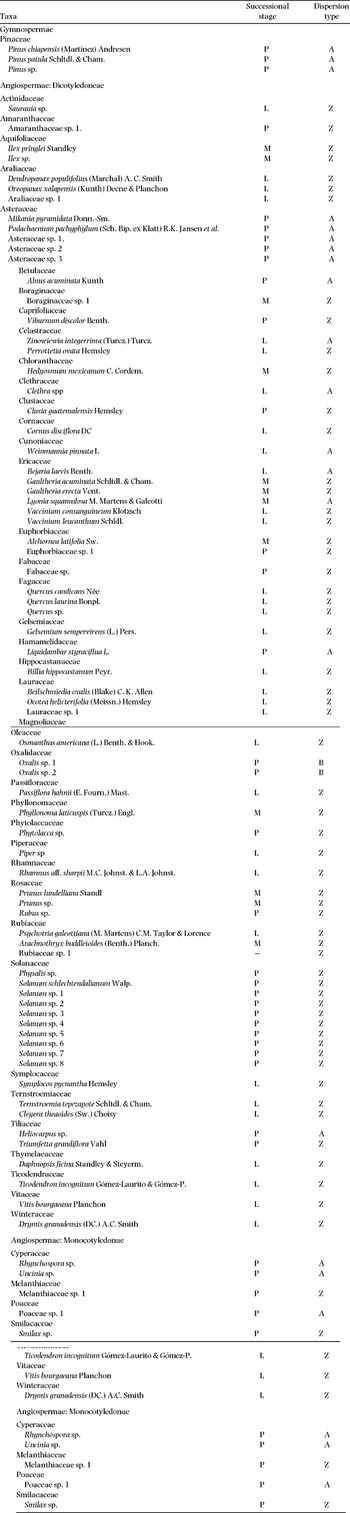
A total of 58 725 seeds was collected in the 66 traps used during the 1-y period studied, representing an average seed input of 1027 seeds m−2 y−1 (total trap area = 59 m2). Seeds were identified as belonging to 142 morphospecies of which 65% could be identified to family, genus or species (Appendix 1). Identified seeds belonged to 53 families, of which Melastomataceae, Ericaceae, Asteraceae, Aquifoliaceae, Lauraceae, Cunoniaceae (Weinmannia pinnata), Tiliaceae, Vitaceae, Araliaceae and Pinaceae, in that order, were the ten most abundant in terms of numbers of seeds trapped. Mikania pyramidata (74%), Pinus chiapensis (71%), Rapanea sp. (59%), Rubus sp. (56%), Dendropanax populifolius (42%), Zinowiewia integerrima (42%) and Viburnum discolor (39%) were the most frequent species collected in the seed traps.
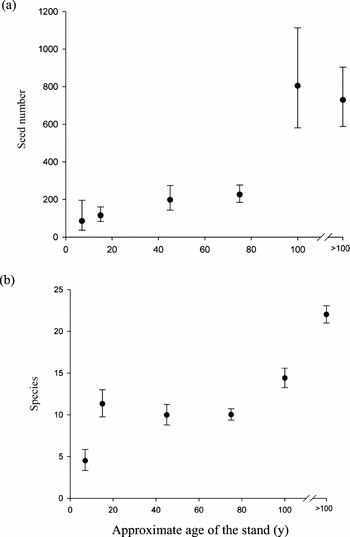
Annual seed rain abundance per unit trap area increased significantly and approximately in linear fashion with the age of the stand, as indicated by the significant linear contrast (t = 3.9, P = 0.011, Figure 2a). The ≈100 y and primary forest stands had the highest seed inputs and received on average nearly five times the number of seeds than did the other stands. Seed traps received seeds of 11.4 ± 0.5 species per year (mean ± 1 SE). Species richness of seeds per unit trap area also increased significantly and linearly with the age of the stand (t = 8.7, P = 0.0003, Figure 2b). The primary forest site received the highest diversity of seeds per unit trap area: nearly five times more species than did the ≈7 y stand, which was the poorest in species.
Changes in mean annual number of seeds (back transformed for the log scale) (a) and mean annual number of morphospecies (back-transformed from the square-root transformation) (b) in 0.9-m2 seed traps set in forests of different ages after abandonment and a primary forest at El Rincon, Oaxaca, Mexico. Error bars are 1 SE.

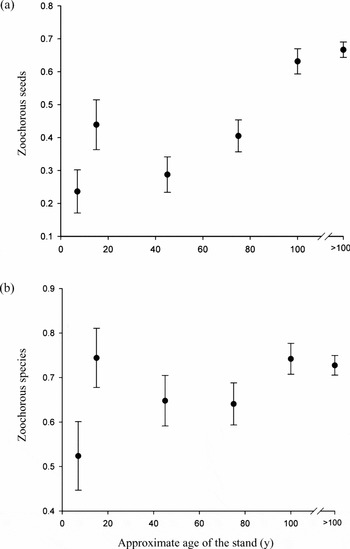
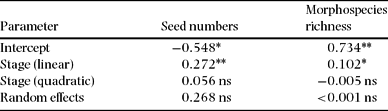
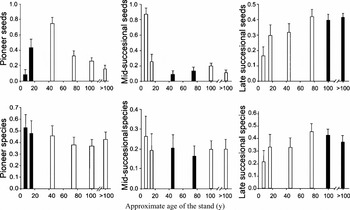
Most of the seeds and species that arrived at the seed traps were dispersed by animals (zoochorous). With few exceptions, non-zoochorous seeds were wind dispersed (anemochorous, Appendix 1). The fraction of zoochorous seeds in the seed rain increased significantly with the age of the stand. Indeed, the old-growth forest surveyed received on average nearly three times more animal-dispersed seeds than the 7-y-old stand (Figure 3, Table 1). Also, zoochororous species in the seed rain were more common in older stands, in particular, in stands older than 7 y. The proportion of seeds from different successional origins varied significantly among stands of different age, and showed different trends during succession (Figure 4, Table 2). Seed rain density of pioneer plants peaked at intermediate successional stands, particularly ≈45-y-old stands, as revealed by the significant linear and quadratic terms of the stage effect of the generalized mixed linear model. Mid-successional species dominated the seed rain of the youngest stand analysed and showed a large and significant decline in stands ≈15-y-old or older. Finally, late-successional seeds increased significantly towards older stands. The morphospecies composition of the seed rain per unit trap area regarding the successional origin of the seeds also changed significantly among stands of different age. Pioneer species dominated the seed rain of early-successional stands and declined significantly with the age of the stand. The fraction of mid-successional species did not change significantly with the age of the stand. Finally, late-successional species increased in diversity as the age of the stand increased (Figure 4, Table 2).
Proportion (mean ± SE) of zoochorous seeds (a) and zoochorous species (b) in the seed rain in 0.9-m2 seed traps measured over 1 y in successional stands of different age after abandonment and one primary forest stand (>100 y) in a tropical montane cloud forest area at El Rincon, Oaxaca, Mexico.

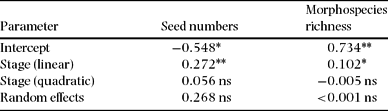
Maximum likelihood parameter estimates and significance of the generalized non-linear mixed models analysing the changes in proportions of biotically dispersed seeds (vs. abiotically dispersed seeds) and species across nearby stands of different age after abandonment at El Rincón, Oaxaca, Mexico. ns,*P < 0.05,**P < 0.01.
Proportion (mean ± SE) of pioneer, mid- and late-successional seeds and species in the seed rain in 0.9-m2 seed traps measured over 1 y in successional stands of different age after abandonment and one primary forest stand (>100 y) in a tropical montane cloud forest area at El Rincon, Oaxaca, Mexico. Black bars stand for the habitats where adult plants typically occur.

Maximum likelihood parameter estimates and significance of the generalized non-linear mixed models analysing the changes in proportions of seeds and species of pioneer, mid-successional and late-successional origin across nearby stands of different age at El Rincón, Alto, Oaxaca, Mexico.*P < 0.05, **P < 0.01, ***P < 0.001, ****P < 0.0001.

DISCUSSION
This study shows that the abundance and species composition of the annual seed rain per unit trap area in nearby stands of different age in a TMCF area in southern Mexico is heterogeneous and part of such heterogeneity can be explained by limited seed dispersal, dispersal mode, and the age of the stand. Indeed most of the seed rain appears to be of local origin. This can explain why the youngest stand sampled, ≈7-y-old, where most of the plants, particularly trees, are too young to produce seeds, showed the lowest annual input of seeds and species in the seed rain. Pinus chiapensis, for instance, starts producing seed approximately after 20 y age (del Castillo, unpubl. data). Indeed, in this stand, most seeds were derived from mid-successional plants and not from pioneer plants. The peak of pioneer seeds at ≈45-y-old stands and the subsequent decline at older stands in the seed rain can be explained by increases in seed production by local pioneer plants, mostly trees, at early stages of forest development and their subsequent demise at later stages. Indeed, tree density also peaked at ≈45-y-old stands, after which time density decreases due to thinning of pioneer trees (del Castillo & Blanco Macías Reference DEL CASTILLO, BLANCO MACÍAS and Newton2007). Similarly, the observed increases in late-successional seeds and species in the seed rain after ≈45 y can be explained by increases in abundance, seed production, and diversity of local reproductive late-successional plants during that episode of forest development. These results point to the importance of local seed sources to the seed rain in TMCF areas, and support the findings of other studies in distinct tropical ecosystems suggesting that in general most seeds are dispersed short distances (Duncan & Chapman Reference DUNCAN and CHAPMAN1999, Holl Reference HOLL1999, Ingle Reference INGLE2003, Mesquita et al. Reference MESQUITA, ICKES, GANADE and WILLIAMSON2001).
Despite the floristic differences among tropical montane forest for which studies of seed rain are available some patterns are common. For instance, Melastomataceae, Ericaceae, Asteraceae and Araliaceae are among the best represented families in the seed rain at the study site and in a Philippine montane forest (Ingle Reference INGLE2003). Moreover, some common genera are among the best represented in the seed rain in both forests: Rubus and Weinmannia. Rubus seeds were also abundant in secondary patches adjacent to a seasonal montane wet forest in Costa Rica (Holl Reference HOLL2002). More studies are needed to explore the possible connection between taxonomy and dispersal in TMCFs areas. However, these preliminary results lead to the suggestion that the abundance and frequency of species in the seed rain during revegetation can be predicted in part by taxonomic affinities.
If seed dispersal affects recruitment, then it should influence the spatial distribution of the individuals (Hubbell Reference HUBBELL1979). Therefore, limited dispersal may help explain the patchy distribution of species detected in TMCF at local scale (Sosa & Puig Reference SOSA, PUIG, Puig and Bracho1987) and the high beta diversity observed in TMCFs (Acosta Reference ACOSTA2004, Puig Reference PUIG1976, Ruíz-Jiménez et al. Reference RUÍZ-JIMÉNEZ, MEAVE and CONTRERAS JIMÉNEZ1999, Rzedowki Reference RZEDOWSKI1978) at regional scale.
Dispersal limitation was detected for both early and late-successional species. However, with some exceptions (e.g. Dendropanax populifolius), seeds of late-successional species appear to travel shorter distances than those of early successional species, which were roughly twice as well represented in late-successional stands as late-successional species in young stands. Thus, we can explain the high numbers of seeds and species found in the seed rain in late-successional stands on two grounds. First, the highest joint contribution of both late- and early successional plants to the seed rain in late-successional stands relative to early successional stands; and, second, the likely increase of mature plants in the late-successional stands, which should augment local seed yield. Evidence of limitation of seed dispersal appears to be common in other TMCF areas, particularly for late-successional species (Muñiz-Castro et al. Reference MUÑIZ-CASTRO, WILLIAMS-LINERA and REY BENAYAS2006, Shields & Walker Reference SHIELDS and WALKER2003).
As predicted, wind-dispersed seeds were more common in early successional stands, where wind flow is probably less restricted owing to the shorter stature of the vegetation and its simpler stratification compared to late-successional stands. Thus, pioneer species such as Pinus chiapensis and Liquidambar styraciflua, may succeed in early successional stands by both ecophysiological (heliophily) and dispersal (anemophily) reasons. Similar results were found in a Philippine montane rain forest (Ingle Reference INGLE2003) and in secondary humid pine-oak forests associated with TMCF in Chiapas, Mexico (Ramírez-Marcial et al. Reference RAMÍREZ-MARCIAL, GONZÁLEZ-ESPINOSA and QUINTANA-ASCENCIO1992), where wind-dispersed forest seeds outnumber animal-dispersed forest seed in early-successional fields.
Animal-dispersed species were most common in late-successional stands which probably offer more rewards to seed-dispersing animals. These results also suggest that seed dispersers may restrict most of their movements within the forest areas they inhabit, as has been detected in other TMCF forests (Shields & Walker Reference SHIELDS and WALKER2003). Increases in fragmentation and habitat destruction certainly will increase the chances of extinction of zoochorous species more than those of anemochorous species, as has been observed in lowland tropical forests (Cardoso da Silva & Tabarelli Reference CARDOSO DA SILVA and TABARELLI2000). At our study site, the two most frequent species found in the seed traps were wind dispersed (Mikania pyramidata and Pinus chiapensis).
Slash-and-burn practices, when moderate in space and time, can promote the diversity and stability of the landscape in TMCF areas by allowing the coexistence of forests of diverse ages, which facilitate forest regeneration. Indeed, the relative fast recovery of vegetation during fallow periods observed at El Rincon can be explained by the presence of nearby forest patches of different ages, as seed sources for abandoned lands (del Castillo & Blanco Macías Reference DEL CASTILLO, BLANCO MACÍAS and Newton2007). Nonetheless, the dispersal limitation detected in the present study suggests that forest regeneration can be severely constrained if the intensity of slash-and-burn practices increase in such a way that the proximity or the size of adjacent forests decline. According to our results, the forests more affected by increases in intensity of cultivation practices would be old-growth forests, not only because of their longer periods of time for regeneration but because seeds appear to be dispersed shorter distances in these forests.
In conclusion, seed dispersal appears to constrain forest regeneration and to influence fragment species composition as a function of the distance from the source forests in TMCF areas. Conservation efforts should focus on preserving primary and secondary forests of different ages with enough extension and proximity to regeneration sites as to minimize seed dispersal restriction and to provide symbiotic organisms necessary for the survival of the forest plants. Late-successional stands and primary forests deserve particular attention in conservation given their low capability to disperse at long distances.
ACKNOWLEDGEMENTS
We are grateful to Demetria Mondragón Chaparro, Neptali Ramírez Marcial and Guadalupe Williams-Linera and an anonymous reviewer for helpful suggestions; to Raul Rivera, Eder Gil Mendez and Sandra Reyes Macedo for field assistance and constructing the seed traps; to Ruth Jael Bautista for sorting seeds from the litter collected in the seed traps and to Martha Olvera (UNAM, México DF) and Angélica Camacho (ECOSUR, San Cristóbal de las Casas, Chiapas) for seed identification. Remedios Aguilar helped with taxonomic nomenclature. We acknowledge the support of CONACyT (through student scholarship to MAPR). Research funding was provided by Instituto Politécnico Nacional, and the European Commission INCO V program (REFORLAN FP6-2004-INCO-DEV-3 032132).
Taxa identified presented in the seed rain in successional stages at el Rincon, Oaxaca, Mexico, successional stage (P = pioneer, M = mid-successional and L = late-successional) at which adult plants were observed or more abundant and dispersal type (Z = zoochorous, A = anemochorous, B= ballistically dispersed seeds). Angiosperm families were arranged as in Smith et al. (Reference SMITH, MORI, HENDERSON, STEVENSON and HEALD2004).