INTRODUCTION
Globe artichoke (Cynara cardunculus L. var. scolymus (L.) Fiori), a diploid (2n=2x=34), outbreeding, herbaceous, perennial Asteraceae species, is grown largely for its immature inflorescences (hereafter referred to as heads), which represent a popular component of the Mediterranean diet (Bianco Reference Bianco2011). In 2011, the global production of c. 1449 kilotonnes (kt) of heads (Faostat 2011) was achieved from about 125 000 ha of land, sited predominantly within the Mediterranean Basin. Production of the crop is on an upward trend, because of its perceived value as a functional food (Lanteri & Portis Reference Lanteri, Portis, Prohens and Nuez2008; Lattanzio et al. Reference Lattanzio, Kroon, Linsalata and Cardinali2009; Lombardo et al. Reference Lombardo, Pandino, Mauro and Mauromicale2009; Pandino et al. Reference Pandino, Lombardo, Mauro and Mauromicale2012). The most important primary gene pool of globe artichoke is in the Mediterranean area (Mauro et al. Reference Mauro, Ierna, Portis, Lanteri and Mauromicale2007; Ciancolini et al. Reference Ciancolini, Rey, Pagnotta and Crinò2012). It is endemic in Italy and more specifically in the Island of Sicily, which is considered the probable geographic site of its domestication from the species C. cardunculus L. var. sylvestris Lamk (Portis et al. Reference Portis, Mauromicale, Barchi, Mauro and Lanteri2005; Mauro et al. Reference Mauro, Portis, Acquadro, Lombardo, Mauromicale and Lanteri2009).
Over 120 clonally propagated types exist worldwide, and their heterozygosity ensures that attempts to propagate them by sexual reproduction lead to major segregation for most agronomic traits (Basnizki & Zohary Reference Basnizki and Zohary1994; Portis et al. Reference Portis, Mauromicale, Mauro, Acquadro, Scaglione and Lanteri2009, Reference Portis, Scaglione, Acquadro, Mauromicale, Mauro, Knapp and Lanteri2012; Lanteri et al. Reference Lanteri, Portis, Acquadro, Mauro and Mauromicale2012). For this reason, vegetative propagation has been applied over centuries to ensure the predictability of the phenotype (Lanteri & Portis Reference Lanteri, Portis, Prohens and Nuez2008). According to Porceddu et al. (Reference Porceddu, Dellacecca and Bianco1976), globe artichoke germplasm was classified into four major morphological types, namely Spinosi, Violetti, Romaneschi and Catanesi. More recently, the application of DNA fingerprinting through amplified fragment length polymorphism (AFLP) markers has shown that direct selection of specific production traits has been an important tool to determine the variation within the cultivated gene pool (Lanteri et al. Reference Lanteri, Saba, Cadinu, Mallica, Baghino and Portis2004).
Landraces have been recognized as an important source of genetic variation for crop improvement (Gepts Reference Gepts2006; Hajjar et al. Reference Hajjar, Jarvis and Gemmill-Herren2008; Mercer & Perales Reference Mercer and Perales2010), but many of them are increasingly being threatened by the diffusion of elite breeding cultivars (Hammer & Teklu Reference Hammer and Teklu2008). In Southern Italy, where ancient, autochthonous landraces have traditionally dominated globe artichoke production, there is a growing spread of both allochthonous landraces and modern, highly productive seed-propagated F1 hybrids (Mauromicale & Ierna Reference Mauromicale and Ierna2000). As a result, the area devoted to the cultivation of autochthonous landraces is gradually decreasing. The reflowering landrace ‘Spinoso di Palermo’ has been an important component of the Southern Italian rural economy for many years (Pandino et al. Reference Pandino, Lombardo, Mauro and Mauromicale2012) and is genetically highly heterogeneous (Portis et al. Reference Portis, Mauromicale, Barchi, Mauro and Lanteri2005).
In the current study, a clonal propagation programme was applied, aiming to identify elite globe artichoke genotypes from landrace Spinoso di Palermo that would be suitable for cultivation in specific areas of Sicily. Both phenotypic and AFLP-based molecular characterizations of the selected clones were performed.
MATERIALS AND METHODS
Plant material and research site
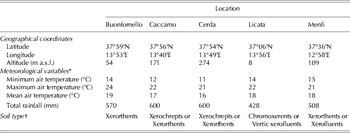
A programme of germplasm collection was carried out in five locations of Western Sicily, representative for the cultivation area of the Spinoso di Palermo landrace: Buonfornello, Caccamo, Cerda, Licata and Menfi. The geographical coordinates, soil type and meteorological information of each sampling area are listed in Table 1. At each site, a sample of three to eight plants was selected and labelled in late winter 2007 (30 clones in total), on the basis of the following traits: floral stem ramifications (an index of yield potential), earliness and colour, firmness and size of the heads. In August 2008, eight top ten semi-dormant offshoots (‘ovoli’) were obtained from each clone for planting in the field at the experimental station South of Siracusa (37°03′N, 15°18′E, 10 m a.s.l.). The local climate is semi-arid Mediterranean, characterized by mild and wet winters (frosts are virtually absent) and warm, dry summers. The soil was a moderately deep Calcixerollic Xerochrepts (USDA 1975), having the following characteristics: 15·5% clay, 29·1% silt, 55·4% sand (% by volume), pH 7·6, organic matter 2·0%, total nitrogen (N) content 170 mg/kg, available phosphorus (P) 100 mg/kg and exchangeable potassium (K) 580 mg/kg.
Geographical, meteorological variables (long-term 1971–2000) and soil type of the five areas selected for the globe artichoke clonal collection programme

* Average per year.
† According to USDA Soil Taxonomy. The soil texture in mainly clay for all the locations.
During the 2007/08 growing season, 25 clones were discarded and five (labelled A1, A4, A6, E3 and E7) were chosen on the basis of their higher floral stem ramification and marked violet pigmentation of the heads (as previously reported by Mauro et al. Reference Mauro, Portis, Lanteri and Mauromicale2012). The number of plants per selected clone was then increased to 54 (for a total of 270 plants) by transplanting their lateral offshoots, in order to perform a more reliable morphological characterization during the two subsequent growing seasons I (2008/09) and II (2009/10). To this end, ovoli from each clone were collected in early August 2008 and planted in rows separated from one another by 0·80 m. The inter-row spacing was set at 1·25 m (planting density 1 plant/m2). For the bio-agronomical characterization, 54 plants of the allochthonous varietal type ‘Violet de Provence’ were also included as reference material. This varietal type is spreading in southern Italy because of its earliness, high yields and long productive cycle, and it is endangering native local landraces. The plots were arranged in a randomized block design with three replications, each including 18 plants of each genotype, for a total of 108 plants per plot (net of border plants). Fertilization was applied before planting (season I) or crop regrowth (season II) with 80, 180 and 150 kg/ha of N, P2O5 and K2O, respectively. In both seasons, two further N applications (as ammonium nitrate) were applied at a rate of 80 kg/ha in early November and late February, respectively, shortly after removal of lateral offshoots. Drip irrigation was supplied from August to mid-October and in early April, by restituting 100% of maximum evapotranspiration (ETm), when accumulated daily evaporation, net of rain (measured from an unscreened class A-Pan evaporimeter near the crop) reached 40 mm (corresponding to c. 0·50 of available soil water content at a depth of 0·30 m). Plant regrowth in season II was induced by applying drip irrigation to field capacity in early August 2009. All the experimental plots were kept weed- and insect-free by spraying oxyfluorfen and imidachloprid, respectively, when required. Air temperature, rainfall and evaporation were recorded every 30 min from a meteorological station (Multirecorder 2·40; ETG, Florence, Italy) sited c. 500 m from the experimental field.
Bio-agronomical and morphological characterization
The bio-agronomical characterization was performed on 54 plants of each genotype (for a total of 324 plants) over two growing seasons. Heads were collected at their marketable dimension before bract divergence (stage D) (Foury Reference Foury1967) and separated from floral stems in order to determine their fresh weight. A subsample of collected heads were reweighed after drying in a thermoventilated oven at 105 °C for 72 h. The following variables were calculated: days to first harvest (DFH) as the number of days elapsed from transplanting (season I) or regrowth (season II) and the harvest of the main head; duration of harvest period (DHP) as the number of days elapsed from first to last harvest; yield (Y) expressed as kg heads/plant; number of heads/plant (NH); rate of yield (RY) as an index of yield synchronicity, expressed as the ratio between Y (expressed on a dry weight basis) and DHP; weight of main heads (WM) and weight of lateral heads (WL).
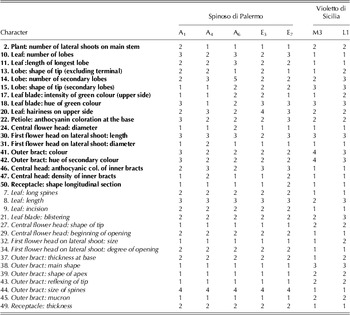
The morphological characterization was performed on five randomly selected plants of each Spinoso di Palermo selected genotype. Two clones of the landrace Violetto di Sicilia (labelled L1 and M3) were also characterized as reference materials. Fifty-one traits were scored (Supplementary Table 1, Table 2) according to the guidelines provided by the International Union for the Protection of New Varieties of Plants (UPOV 2011: TG/184/3 globe artichoke) for distinctness, uniformity and stability (DUS) and adopting a metric scale according to the descriptor list (Supplementary Table 1). Both qualitative and quantitative traits in UPOV's descriptor list were expressed as discontinuous, the latter having been divided into a number of discrete states for the purposes of description.
Phenotypic variation in the 33 polymorphic UPOV descriptors. Eighteen descriptors (in bold) are polymorphic within the five globe artichoke clones selected from landrace Spinoso di Palermo; 15 descriptors (in italics) are polymorphic between Spinoso di Palermo and Violetto di Sicilia genotypes. Character numbers and state score are reported in Supplementary Table 1

DNA extraction and amplified fragment length polymorphism genotyping
For molecular analyses, DNA was extracted from 2 g of young leaves from two plants of each selected clone on the basis of the protocol described by Lanteri et al. (Reference Lanteri, Saba, Cadinu, Mallica, Baghino and Portis2004); the two DNA samples were analysed separately, in order to confirm the reliability of the AFLP fingerprinting. The latter was also performed on DNA from 12 genotypes, previously identified as representative of genetic variation within Spinoso di Palermo (Portis et al. Reference Portis, Mauromicale, Barchi, Mauro and Lanteri2005), as well as from two genotypes of Violetto di Sicilia (labelled L1, and M3), used as a reference. The AFLP profiling method was based on that described by Vos et al. (Reference Vos, Hogers, Bleeker, Reijans, Van de Lee, Hornes, Frijters, Pot, Peleman, Kuiper and Zabeau1995) as modified by Lanteri et al. (Reference Lanteri, Saba, Cadinu, Mallica, Baghino and Portis2004). The template was digested with EcoRI/TaqI and the seven following primer combinations (PCs), applied in a previous study (Mauro et al. Reference Mauro, Portis, Lanteri and Mauromicale2012), were used: E35/T79 (ACA/TAA), E35/T81 (ACA/TAG), E35/T82 (ACA/TAT), E35/T84 (ACA/TCC), E38/T81 (ACT/TAG), E38/T82 (ACT/TAT) and E38/T84 (ACT/TCC). The final amplicons were electrophoresed on a DNA analyser Gene ReadIR 4200 (LI-COR) device using a 6·5% polyacrylamide gel, as described by Jackson & Matthews (Reference Jackson and Matthews2000). Each variable fragment, which ranged in size from 60 to 650 base pairs (bp), was assumed to represent a single biallelic locus, allowing the data to be scored in binary form (1=presence and 0=absence) for the same-sized DNA bands.
Statistical analysis
Bio-agronomic data were first subjected to Levene's test for checking the homoscedasticity, then to a two-way (clone×season) analysis of variance (ANOVA) related to the experimental layout. Provided that the F-test was significant, means were separated on the basis of Fisher's protected least significant difference (LSD) test. For each trait studied in the Spinoso di Palermo selected clones, the broad sense heritability was evaluated as follows: the phenotypic variance for each trait (σ 2 p ) was considered to be the sum of the genotypic (σ 2 g ) and environmental (σ 2 e ) components. Since σ 2 e can be equated to the error expected mean square (EMS), then σ 2 p =σ 2 g +EMSerror. The genotypic component was estimated from the expression 1/ry (EMSclones−EMSclones×season), equivalent to 1/ry [(σ 2 e +rσ 2 gy +ryσ 2 g )−(σ 2 e +yσ 2 gy )], where r represents the number of replicates (three), and y the number of seasons (two). The broad sense heritability (h 2 B ) for each trait was evaluated by the ratio σ 2 g /σ 2 p . Genotypic (g cv ) and phenotypic (p cv ) coefficients of variation of each trait were calculated as follows: g cv =(√σ 2 g/x) 100 and p cv =(√σ 2 p/x) 100 (where x is the mean of each trait). With the goal of defining the relationships among bio-agronomical variables, a correlation analysis was performed for all the genotypes in the study.
Phenotypic similarity between pairs of genotypes was calculated using the proportion of shared alleles. As each genotype can have only one state for a given trait, the results obtained by using the proportion of shared alleles similarity formula were identical to those obtained by simple matching coefficient (SM) 1–(m/n), following Sneath & Sokal (Reference Sneath and Sokal1973), where m is the number of morphological traits shared between a pair of genotypes and n is the total number of traits.
The AFLP data were first evaluated by means of polymorphic information content (PIC), calculated by setting the expected heterozygosity to 2f(1–f), following Anderson et al. (Reference Anderson, Churchill, Autrique, Sorells and Tanksley1993), where f represents the proportion of individuals carrying a particular AFLP locus. A similarity matrix was then generated by means of the SM coefficient previously described, where m is the number of AFLP fragments shared between a pair of genotypes and n is the total number of fragments detected.
The Mantel test (Mantel Reference Mantel1967) was used to establish correspondence between the molecular and morphological similarity matrices; this test provides a correlation index (r), which is a measure of the relatedness between them. Cluster analyses based on both similarity matrices were performed using the unweighted pair-group method (UPGMA; Sneath & Sokal Reference Sneath and Sokal1973) as implemented in NTSYS-pc ver. 2.1 (Rohlf Reference Rohlf2000).
RESULTS
Research site and meteorological data
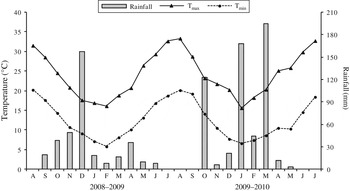
The total rainfall in season I was low (360 mm) with the 85% of the total (307 mm) fell between October and March (Fig. 1). In season II, total rainfall was 572 mm, mainly concentrated in October (123 mm), January (168 mm) and March (195 mm). Both seasons were characterized by a decreasing mean monthly temperature from August to January (from 26·3 to 11·6 °C, on average), followed by a progressive increase up to July (25·7 °C). The higher mean maxima temperature was recorded in season II as compared with season I (Fig. 1).
Meteorological data for temperature (minimum and maximum) and monthly rainfall at the experimental area for the two growing seasons.

Bio-agronomical characterization
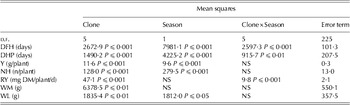
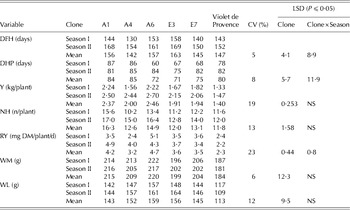
Significant variation was observed in most of the examined traits among globe artichoke clones. Three of the traits (DFH, DHP and RY) were significantly affected by the clone×season interaction, while WM proved to be the most stable (Table 3). In the two growing seasons, the highest variability among genotypes (highest coefficient of variation) was detected for traits related to yield, namely Y, NH and RY (Table 4). As regards DFH, the clones A4 and E7, were very similar to Violet de Provence, since the period elapsing from transplantation/regrowth to the day of main head production was on average 143 days, 20 days earlier than the latest clone, E3 (Table 4). During the two seasons, clones A1 and A4 showed the longest delay (24 days) in producing the first head (Table 4) but both showed a significantly (P⩽0·001) longer productive period (DHP=85 days, on average) in comparison with the other genotypes (Table 4). Going from season I to season II, clones A6 and E7 consistently increased their DHP (from 60 to 84 days and from 68 to 82 days, respectively) (Table 4). The average production was 2·01 kg/plant, with all the selected clones being more productive than Violet de Provence; A1 and A6 were the best performing clones (2·42 kg/plant, on average), thus exceeding the yield of Violet de Provence by c. 1 kg/plant (Table 4). This result appeared to be consistent with both NH and RY, as both variables showed the highest values in clones A1 and A6 (Table 4). In season II, a significant (P⩽0·001) increase in RY was observed for clones A1 and A4 (by 1·4 and 1·6 mg DM/plant/day, respectively) (Table 4). The average WM of the studied genotypes across seasons was 205 g and ranged from 220 (A6) to 184 g (Violet de Provence). As expected, the weight of secondary heads (WL) was lower (averaging 145 g), ranging from 143 g (clone A1) to 113 (Violet de Provence) (Table 4).
Mean square values of the main factors and their interaction, according to ANOVA

DFH, days to first harvest; DHP, duration of harvest period; Y, yield; NH, number of heads per plant; RY, rate of yield; WM, weight of main heads; WL, weight of lateral heads; NS, not significant.
Bio-agronomical characterization of the selected globe artichoke genotypes

DFH, days to first harvest; DHP, duration of harvest period; Y, yield; NH, number of heads per plant; RY, rate of yield; WM, weight of main heads; WL, weight of lateral heads; NS, not significant.
Components of variance, trait heritability and phenotypic correlations
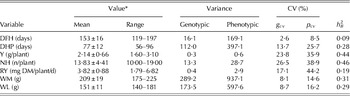
The estimated components of variance, the genotypic (g cv ) and phenotypic (p cv ) coefficients of variation, along with the broad sense heritability of traits (h 2 B ) are reported in Table 5. The genotypic and phenotypic variances and their associated coefficients of variation differed greatly from trait to trait, with g cv being particularly high for Y (23·8%) and NH (26·5%). Accordingly, these two traits showed the highest h 2 B values (0·44 and 0·46, respectively), followed by WM (0·31), WL (0·29) and DHP (0·28). A low h 2 B value was recorded for DFH (0·09).
Genotypic and phenotypic components of variance of the traits in the present study

DFH, days to first harvest; DHP, duration of harvest period; Y, yield; NH, number of heads per plant; RY, rate of yield; WM, weight of main heads; WL, weight of lateral heads.
* Values relate to the whole two seasons of the experiment.
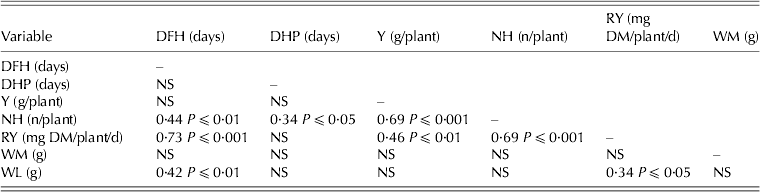
According to the trait correlation matrix (Table 6), DFH was significantly correlated with RY (0·73, P⩽0·001) and, to a lesser extent, with NH (0·44, P⩽0·01) and WL (0·42, P⩽0·01). A strong correlation was also found between Y and both NH (0·69, P⩽0·001) and RY (0·46, P⩽0·01) (Table 6). Significant but weaker correlations were recorded between DHP and NH (0·34, P⩽0·05) as well as RY and WL (0·34, P⩽0·05).
Coefficients of correlation among the studied traits (n=40)

NS, not significant.
Morphological characterization
Eighteen out of the 51 scored morphological traits were uninformative, as they were not able to detect polymorphisms among the set of globe artichoke genotypes used in the current study. Thirty-three traits were polymorphic, of which 15 were found between Spinoso di Palermo and Violetto di Sicilia genotypes (underlined in Table 2), while 18 were found within the Spinoso di Palermo clones (bold in Table 2). On the basis of the latter it was possible to identify all the selected clones; for some characteristics discrimination was based on just two states, while for others (i.e. number of secondary lobes, hue of green colour of the leaf blade and leaf hairiness on upper side) three states were identifiable (Table 2).
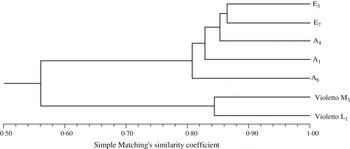
Average phenotypic similarity among the whole globe artichoke genotypes in the current study, evaluated on the proportion of shared alleles, was 0·702, and ranged from 0·515 (between A4 and M3) to 0·864 (between E3 and E7). Within the Spinoso di Palermo clones, the average phenotypic similarity was 0·829, ranging from 0·764 (between A4 and A6) to 0·864. The UPGMA analysis highlighted a marked morphological differentiation between the two landraces Violetto di Sicilia and Spinoso di Palermo (Fig. 2). Furthermore, as within the landrace Spinoso di Palermo, three clones (A4, E3, E7) showed a mean genetic similarity of c. 0·85, while clone A6 was the most genetically differentiated from all the others.
UPGMA dendrogam based on 33 morphological traits from UPOV descriptors in five globe artichoke clones, selected from Spinoso di Palermo (A1, A4, A6, E3 and E7) and two selected from Violetto di Sicilia (Violetto M3 and Violetto L1).

Genetic relationships
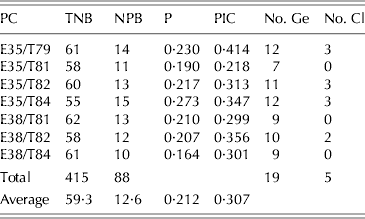
The seven PCs amplified 415 fragments of which 88 (21·2%) were polymorphic across the whole set of 19 genotypes used in the current study (12 reference genotypes and five selected clones of Spinoso di Palermo and two genotypes from Violetto di Sicilia) (Table 7). The mean number of polymorphic fragments per PC was 12·6 (range 10–15). The PC E35/T79 was associated with the highest PIC, while E35/T84 generated the greatest number of polymorphisms, both PCs being able to discriminate between 12 of the 19 templates, including three of the five clonal selections. The lowest PIC was generated by E35/T81, which only discriminated seven of the templates and was not able to discriminate between the selected clones.
Variation in the performance according to AFLP fingerprinting, based on: TNB, total number of fragments amplified; NPB, number of polymorphic fragments amplified; P, proportion of variable fragments; PIC, polymorphism information content; No. Ge, number of genotypes fingerprinted, No. Cl, number of new clones fingerprinted

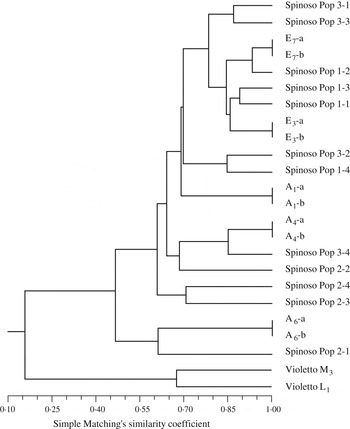
As expected, no intra-clonal variation was detected because no AFLP polymorphism was recorded between two randomly chosen plants belonging to the same clone (-a and -b in Fig. 3). All 19 genotypes could be discriminated from one another on the basis of three PCs, i.e. E35/T79, E35/T82 and E35/T84. The most similar pair of selected clones was E3 and E7 (SM=0·92), and the most dissimilar (SM=0·71) A4 and A6.
UPGMA-based phylogeny of the five selected clones (A1, A4, A6, E3 and E7) together with 12 genotypes of Spinoso di Palermo and two of Violetto di Sicilia (Violetto M3 and Violetto L1) included as reference individuals, as derived from AFLP fingerprinting.

The AFLP-based UPGMA dendrogram is shown in Fig. 3. As expected, the two varietal types formed two clearly separated clusters, with an average low similarity of 0·15 between them. Within the Spinoso di Palermo cluster, clones E3, E7 and A1 were grouped together with seven reference templates, with a mean genetic similarity of c. 0·70. The clone A6 together with one reference Spinoso di Palermo genotype showed the highest genetic differentiation from all the others. To objectively assess the degree of agreement between the morphological and molecular classification of entries, the correlation between the derived UPOV traits and AFLP molecular similarity matrices was evaluated (by considering only the genotypes in common between the two evaluation system). The correlation coefficient was 0·913, implying a high degree of fitness between the two methods; in spite of some differences, regarding distances and topologies, both classifications agreed in terms of grouping clones E3 and E7 and in identifying A6 as the most divergent one.
DISCUSSION
The need to conserve crop landraces in situ has been widely recognized. Landraces are not only highly heterogeneous, but are also dynamic and evolving entities. Globe artichoke is a significant component of the agricultural economy in the Mediterranean Basin, especially for southern Italy (Portis et al. Reference Portis, Mauromicale, Barchi, Mauro and Lanteri2005). The Sicilian globe artichoke landraces, maintained over centuries by local farmers via vegetative propagation (Mauro et al. Reference Mauro, Lombardo, Longo, Pandino and Mauromicale2011), have been favoured by consumers for their culinary value and by farmers for their adaptability to local climatic conditions. Spinoso di Palermo has long been grown throughout the western part of Sicily, but the area cultivated with this landrace is declining as a result of its poor productivity. Genetic variation within the landrace, built up over many generations of vegetative propagation via the accumulation of mutations, is theorized to be the major cause of this unreliable yield performance. In principle, the identification and clonal propagation of elite individuals within the landrace should reverse the yield decline, while at the same time retaining the desirable characteristics of the landrace. An attempt was made in the current paper to characterize five selected Spinoso di Palermo clones both by phenotype characteristics and molecular profile. It has been possible to demonstrate the feasibility of using clonal selection to provide producers with material which is competitive with the more productive allochthonous germplasm increasingly being adopted.
Heisey & Brennan (Reference Heisey and Brennan1991) have suggested that yield potential is the most important factor for the farmers’ choice of variety, and thus is largely responsible for the substitution of autochthonous landraces by true-breeding or allochthonous cultivars. In the current paper, all the selected Spinoso di Palermo clones yielded more than the genotypes of Violet de Provence, thus they represent promising material for improving globe artichoke cultivation in South Italy. In particular, the two clones A6 and A1 yielded 70% more (c. 2·4 kg/plant) than common populations of Violet de Provence (1·4 kg/plant). When compared to other traits, the higher broad sense heritability values observed for yield (0·44) and number of heads per plant (0·46) were encouraging, and these could possibly be suitable traits for profitable clonal selection in Spinoso di Palermo. Since there was no correlation between yield and head weight (as was also the case among clones selected from the Violetto di Sicilia landrace, Mauro et al. (Reference Mauro, Portis, Lanteri and Mauromicale2012)), the yield potential of Spinoso di Palermo appears to be most strongly determined by the number of heads per plant. There was a significant correlation between number of heads per plant and the harvest period duration, the latter being particularly important for ensuring a stable income for the globe artichoke producer (Mauro et al. Reference Mauro, Lombardo, Longo, Pandino and Mauromicale2011). Clone A1 was associated with the best combination of yield and harvest period duration. The clone×season interaction was particularly strong for both the DFH and the yield rate, so any selection pressure imposed on either of these two traits is unlikely to be effective. As evidence of this, none of the clones were as early as Violet de Provence. In contrast, all selected clones performed better than Violet de Provence in terms of weight of heads. Two clones, namely A4 and A6, performed outstandingly in terms of both main and lateral heads, traits which rank highly in the preferences of consumers of the fresh product. Clone E3 produced rather smaller main heads than the other clones, although its lateral heads developed to a larger than average size and its harvest period duration was particularly distinct.
In all, 18 traits included on the UPOV descriptor list were variable among the set of five clones, but just six easily quantifiable ones were sufficient to allow unambiguous discrimination between all the clones. These were: the number of leaf lobes, the shape of the lobe tip, the number and shape of the secondary lobes, hairiness on the adaxial surface of the leaf, anthocyanin pigmentation at the petiole base and the colour of the outer bract. Nevertheless, it has been suggested that DNA fingerprinting is a valuable adjunct to morphological characterization for the purpose of varietal identification (Singh et al. Reference Singh, Gutierrez, Molina, Urrea and Gepts1991; Tatineni et al. Reference Tatineni, Cantrell and Davis1996; Acquadro et al. Reference Acquadro, Papanice, Lanteri, Bottalico, Portis, Campanale, Finetti-Sialer, Mascia, Sumerano and Gallitelli2010). Amplified fragment length polymorphism fingerprinting required the application of only three PCs to fully discriminate between the clones. Furthermore, when their molecular characterization was compared with the one performed in representatives of the genetic variation currently in cultivation, they were all included in the clusters defined by the references genotypes. In the current study, morphological and molecular similarities between pairs of accessions were calculated and the corresponding UPGMA dendrogram was constructed; encouragingly, the grouping of entries generated by AFLP analysis was consistent with the grouping based on morphological variation. The two data sets were compared via a SM coefficient (Sneath & Sokal Reference Sneath and Sokal1973), for making the data more comparable. Their evaluation through the SMC appears appropriate for the latter but ignores the ordering pattern present in the former, although the intrinsic structure of covariation between the variables is somehow maintained. However, the present results revealed a certain degree of correspondence between morphological and molecular data among clones. Expressing morphological variation in ordinal form can help reduce interference caused by environmental variation, and so improve both its utility for estimating genetic distances and the extent of the correlation between classifications based on phenotypic and genotypic characterization (Babic et al. Reference Babic, Babic, Prodanovic, Filipovic and Andelkovic2012).
CONCLUSIONS
The current paper demonstrates the feasibility of applying clonal selection for the improvement of key traits in the globe artichoke landrace Spinoso di Palermo. The five traits Y, NH, DHP, WM and WL were identified as potential targets for a successful clonal selection programme. A subset of the UPOV descriptors was effective for clonal discrimination in globe artichoke, and the outcome of AFLP fingerprinting was consistent and related to morphological pattern. The data showed that a clonal selection program would be effective for increasing productivity of the vegetatively propagated globe artichoke landrace. At the same time, intra-selection within a landrace provided the opportunity to identify specific clones that would be more suitable in order to at least partially preserve the genetic variation harboured by the originating landrace, and reduce the risk of genetic erosion.
The supplementary material for this article can be found at http://www.journals.cambridge.org/AGS
The research was supported by MIPAAF (Ministero delle Politiche Agricole, Alimentari e Forestali – Italy) through the CARVARVI (‘Valorizzazione di germoplasma di carciofo attraverso la costituzione varietale ed il risanamento da virus’) project.