Introduction
People experiencing homelessness and poverty, racism, criminalization of illicit drug use, and stigma associated with mental health experience a disproportionate burden of ill-health and social suffering, while at the same time, significant barriers in accessing health care (Hwang, Reference Hwang2001; Wen et al., Reference Wen, Hudak and Hwang2007; Bagget et al., Reference Bagget, O'Connell and Singer2010; Khandor et al., Reference Khandor, Mason and Chamgers2011; Moller, Reference Moller2012; Palepu et al., Reference Palepu, Gadermann and Hubley2013; Pauly, Reference Pauly, Hwang and Younger2014; Moller Reference Moller2019). Viewed through the critical lens of “structural vulnerability,” the social hierarchical positioning of these populations, and resulting negative health impacts, is the result of various processes of oppression (e.g., racism, classism, and colonialism) and inequities that limit peoples’ freedom and opportunities, including the ability to achieve and maintain adequate health and well-being, and access to meaningful and timely health care (Bourgois, Reference Bourgois1998; Commission on Social Determinants of Health, 2008; Reimer-Kirkham et al., Reference Reimer-Kirkham, Stajduhar and Pauly2016).
Nearing the end of life, one's vulnerability and need for care increases, yet for structurally vulnerable populations, access to care remains inaccessible (Cagle, Reference Cagle2009; Collier, Reference Collier2011a; Moller, Reference Moller2012; Krakowsky et al., Reference Krakowsky, Gofine and Brown2013; Huynh et al., Reference Huynh, Henry and Dosani2015; Hudson et al., Reference Hudson, Flemming and Shulman2016; Centre for Urban Health Solutions Survey Research Unit, 2017; Henry et al., Reference Henry, Dosani and Huynh2017; Schulman et al., Reference Schulman, Hudson and Low2018; Moller Reference Moller2019; Stajduhar et al., Reference Stajduhar, Mollison and Giesbrecht2019). In Canada, this inaccessibility is largely due to the design of the palliative care system, which is primarily focused on meeting the needs of a relatively homogenous, normative population with predictable disease/illness trajectories (e.g., those living with cancer, from dominant social groups, who are socially connected, educated, and stably housed) (Hankivksy et al., Reference Hankivksy, Grace and Hunting2014; Reimer-Kirkham et al., Reference Reimer-Kirkham, Stajduhar and Pauly2016). The result is that people experiencing structural vulnerability fall through the cracks, receiving care either too late, or not at all, and typically experience less than ideal deaths (Song et al., Reference Song, Bartels and Ratner2007; Cagle, Reference Cagle2009; McNeil et al., Reference McNeil, Guirguis-Younger and Dilley2012). For many, their only experience receiving support at the end of life is from inner-city workers (ICWs), who are defined here as those professionals employed to support homeless and vulnerably housed people who may be living with addictions and/or mental health issues, including housing and shelter, outreach, peer support, and mental health and harm reduction workers (Stajduhar et al., Reference Stajduhar, Mollison and Giesbrecht2019).
Emerging research has offered suggestions for enhancing access to palliative care for structurally vulnerable populations. For example, policies and practices that draw upon harm reduction strategies are suggested as critical in order to reach these populations “where they are at” (Cagle, Reference Cagle2009; Collier, Reference Collier2011b; McNeil et al., Reference McNeil, Guirguis-Younger and Dilley2012; Ferrell et al., Reference Ferrell, Twaddle and Melnick2018). This would include moving the site of care out of traditional settings (e.g., hospice and hospital) and into the community, including in shelters and onto the street (Song et al., Reference Song, Bartels and Ratner2007; Krakowsky et al., Reference Krakowsky, Gofine and Brown2013; Ko et al., Reference Ko, Kwak and Nelson-Becker2015; Håkanson et al., Reference Håkanson, Sandberg and Ekstedt2016; Ferrell et al., Reference Ferrell, Twaddle and Melnick2018). It would also require greater integration and collaboration between housing, health, and social care services, three systems in Canada that tend to operate independently, with little cross over or coordination of services (Reimer-Kirkham et al., Reference Reimer-Kirkham, Stajduhar and Pauly2016; Henry et al., Reference Henry, Dosani and Huynh2017; Stajduhar et al., Reference Stajduhar, Mollison and Giesbrecht2019). Considering this, ICWs have the potential to play pivotal roles in enhancing access to, and quality of, care at the end of life for those experiencing structural vulnerability by integrating a palliative approach to care where these populations live and die. Integrating a palliative approach would involve ICWs taking the principles of palliative care and adopting them early in the course of a person's life-limiting condition, adapting strategies to meet patient and family needs, and embedding practices into care settings not specialized in palliative care (Stajduhar, Reference Stajduhar2011; Sawatsky et al., Reference Sawatsky, Porterfield and Lee2016). However, little research has acknowledged ICWs’ experiences caring for dying clients or considered their perspectives regarding the facilitators and limitations that exist in integrating a palliative approach to care in their work.
This secondary analysis draws upon data collected for a larger critical ethnographic study (Stajduhar et al., Reference Stajduhar, Mollison and Giesbrecht2019) that aimed to explore access to care for structurally vulnerable populations on palliative trajectories. In this primary study, ICWs played a significant role in the support and care of dying structurally vulnerable participants. As such, this secondary analysis focuses on the perspectives of our ICW participants (n = 31) with the aim to explore their experiences providing care for dying clients and to garner their perspectives regarding the constraints and/or facilitators to successfully integrating a palliative approach to care in their work. The purpose is to report on ICWs experiential knowledge and contribute findings that can help inform decision-makers on the most effective ways to enhance equitable access to palliative care.
Methods
A critical ethnographic methodology was employed in the primary study (Stajduhar et al., Reference Stajduhar, Mollison and Giesbrecht2019) to qualitatively explore the nature of specific social phenomena within the environments that they occur (Savage, Reference Savage2000). Ethics approval for this study was obtained by the local University and Health Authority Research Ethics Sub-Committee.
Data collection
Taking place in a western urban center in British Columbia, Canada, the larger study consisted of three participant groups: (1) people experiencing structurally vulnerability who were on a palliative trajectory; (2) their service providers (e.g., social workers, housing workers, etc.); and (3) their chosen supporters/family caregivers. Recruitment involved inviting local health, housing, and social care service providers to participate [for more details, see Stajduhar et al. (Reference Stajduhar, Mollison and Giesbrecht2019)]. Those who consented then assisted with the recruitment of participants experiencing structural vulnerabilities who were on a palliative trajectory, and if available, chosen supporters (e.g., street family). Written consent was obtained from all participants, with verbal consent continually confirmed throughout the data collection process.
Data collection involved longitudinal participant observations with structurally vulnerable participants (n = 25), including interactions with service providers (n = 69), over a 30-month time span, resulting in approximately 300 h of fieldwork. Observations were conducted around-the-clock, throughout the week, across a variety of settings (e.g., homes, shelters, transitional housing units, clinics, hospitals, palliative care units, community-based service centers, parks, and street). To enhance observations, repeated in-depth interviews were also conducted (n = 23 service providers) and digitally recorded, transcribed verbatim, and together with observational field notes, entered into NVivo™ for analysis.
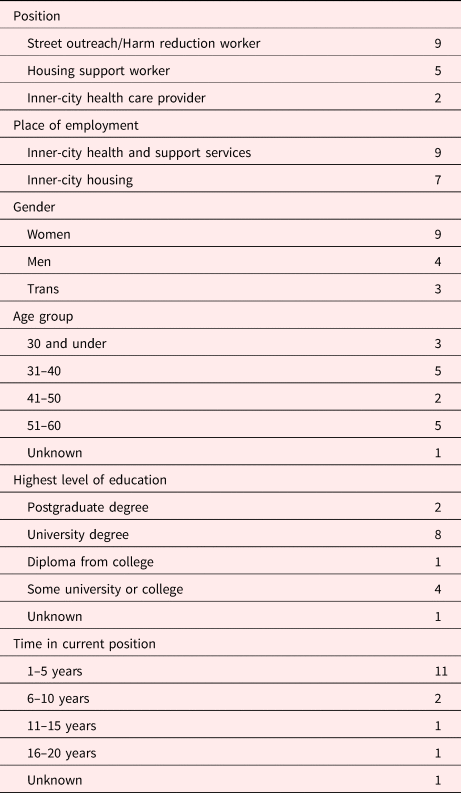
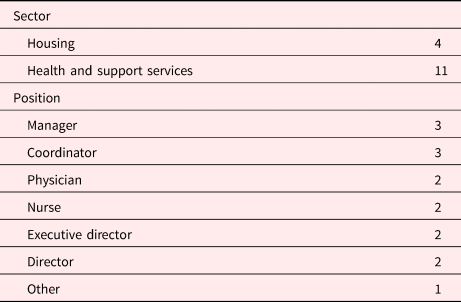
For the purpose of this analysis, observational and interview data involving ICWs (n = 31), a subset of the larger service provider participant group (e.g., people working in inner-city housing/shelter, health, and social services) (n = 16) and inner-city key informants (e.g., executive directors and managers in health and social services) (n = 15) were examined. For more details on the characteristics of these participants, see Tables 1 and 2.
ICW demographic characteristics (n = 16)

Key informant participant occupational grouping (n = 15)

Analysis
The constant comparative method was used, which entails data collection and analysis occurring concurrently (Stern, Reference Stern and Given2008). Thematic analysis began with a process of open coding to develop broad categories/themes (i.e., codes), which were then refined and recoded (Stern, Reference Stern and Given2008). Example codes of the final scheme include themes such as “staff confidence,” “training in palliative care,” and “need for support.” Multiple team meetings were held throughout the analytic process, which, through investigator triangulation, enhances rigor (Fereday and Muir-Cochrane, Reference Fereday and Muir-Cochrane2006). To ensure anonymity, participant pseudonyms have been used.
Results
Research demonstrates that the majority of end-of-life care is provided by biological family members (Canadian Hospice Palliative Care Association, 2012; Statistics Canada, 2014), but our observations and interviews with people experiencing structural vulnerability (Stajduhar et al., Reference Stajduhar, Mollison and Giesbrecht2019) found that care, in its many forms, is often provided by ICWs. Indeed, ICWs often found themselves uniquely positioned as both paid service providers and informal caregivers to those experiencing structural vulnerability at the end of life. Data analysis revealed details of these experiences and shed light on ICWs’ perceived capacity to integrate a palliative approach to care in their work. More specifically, three broad themes regarding the facilitators and constraints to successfully integrating a palliative approach to care in ICWs work were found to include: (1) Approaches, awareness, and training; (2) Workplace policies and filling in the gaps; and (3) Grief, bereavement, and access to supports.
Approaches, awareness, and training
Participants who work in inner-city settings reported that they often care for people who are dying. Many of their clients live in poverty, have experienced trauma, and lived a life of hardship, often with mental health and addictions issues. Participants explained that obtaining and sustaining stable housing and a source of income to meet daily needs were a central feature in the lives of their clients. Often with few sources of social support, ICWs fill a gap in their lives. As an alternative to biological family, ICWs were often placed in positions to provide palliative care; yet, most explained that they had little educational background to do so. Instead, they drew upon harm reduction approaches, aimed at minimizing negative health, social, and legal impacts associated with drug use, policies, and laws. Similar to a palliative approach to care, harm reduction focuses on respecting the client and their wishes, while listening to them without coercion, judgement, or discrimination. As such, the current approach to care provided by ICWs in our study is closely aligned with the principles of a palliative approach to care. At the end of life, even though many were not familiar with palliative care, a few ICWs recognized the interconnection between harm reduction and palliative approaches to care: “John” shared that
We quickly realized that a lot of the time we were doing what we call palliative care with our people around their addictions because likely they will die from something related to their substance use if not in the short term, definitely in the long term. I think we have to work with them around the mindset that we're not going to get them to stop drinking or using substances. And that will probably be a cause of their death sooner rather than later.
Despite some ICWs recognizing the need and desire to integrate a palliative approach to care in their work, most ICWs were not familiar with palliative care and indicated that they felt limited in their capacity as they lacked confidence, training, and knowledge to be providers. Specifically, ICWs expressed a perceived lack of knowledge regarding the palliative care system and what a palliative approach could offer their clients. They also expressed a lack of training in recognizing changes in clients’ health and associating changes with decline, having end-of-life conversations, aging in the context of structural vulnerability, and supporting indigenous people in culturally safe ways at the end of life. A housing support worker, “Cecily,” described gaps in her training and her perceived capacity to integrate a palliative approach to care. When asked if her client understood their palliative prognosis, “Cecily” replied
I can't say for sure. And part of that is because, you know, like I'm not trained. I'm not trained to talk to somebody about, ‘You're dying. Do you know what that means?’
Although many ICWs witness deaths of their clients regularly, providing care at the end of life is not formally recognized as part of their job description. “Noah,” a manager of a supportive housing unit, mentioned that staff orientation and training does not typically include education related to end-of-life issues. In part, this is because decision-makers/managers are forced to operate their organizations within already limited resources to simply provide care that is directly associated with their mandates (e.g., housing, community support, substance use support, etc.). As a result, many of the managers interviewed reported that they do not (or do not wish to) recognize palliative care as part of their purview. “Noah” described limits of staff training and perceived staff burdens associated with end-of-life care:
Staff are not expecting people to go through death … the job they signed up for is, you know, caring for people that are … vulnerable in many ways, but that end-of-life piece is not something that the staff are trained to attend to, like physically, and to people's medical needs. But also emotionally and to the toll that that takes and the stress that that causes when they are anticipating finding someone dead in a room because they do their room checks every three days.
“Noah” continued to say “I feel that staff should never have to have a tenant pass away in their arms. That is not something that we are equipped to deal with.” At the same time, “Noah” recognized that many of their clients who are declining wish to be cared for and die where they are living, whether that is in supportive housing, shelters, or on the street, surrounded by people that they know and trust. Key informant participants reported, however, that these wishes often cannot be met either because of the lack of resources and support inner-city agencies have to provide end-of-life care, or because of a perception that dying in place is not a possibility.
Workplace policies and filling in the gaps
Facilitating the potential integration of a palliative approach to care is the nature of ICWs employment. ICWs are in continual contact with structurally vulnerable populations through repeated interactions over time, allowing them the opportunity to build trusting relationships. Many structurally vulnerable participants in the primary study shared how they experienced stigmatizing and discriminatory health care interactions from within the formal health care system, and as a result, did not feel “safe” in institutional settings, like hospitals [for more details, see Giesbrecht et al. (Reference Giesbrecht, Stajduhar and Mollison2018)]. Resultantly, when in need, they sought care from those trusted individuals around them, who often were ICWs. “Julie,” a case manager, shared how she was the only person who one of her clients would call when in need of help:
He [the client] called me in tears, that he was in a lot of pain and had run out of his pills and obviously wasn't in any state to get down to [clinic] to get them. And he had to wait for me for an hour and a half because I couldn't get there … It was so awful and even the whole time that he had Home Care services in place and access to palliative outreach, he wouldn't access them. He would never call the nurses, he would never call palliative outreach. He would call me.
ICW participants described how they often “become their [structurally vulnerable clients’] family” as they are often the most consistent and reliable people in their clients’ lives. Because of the quality of the relationship built, ICWs often had conversations with clients about their end-of-life wishes and goals of care, which, in some cases, led to positive death experiences.
Although the occupational role of ICWs places them in ideal positions to improve access to palliative care for structurally vulnerable populations, many constraints associated with organizational/employer policies exist. These policies and protocols define appropriate levels of provider/client engagement with the aim to manage client expectations, organizational resources, and prevent boundary crossing and provider burnout. However, many ICWs explained how they saw their clients falling through the cracks of fractured housing, health, and social care systems, and as a result, felt morally compelled to “fill the gaps” by providing needed care. At the same time, filling the gaps also meant that ICWs often acted against their organizations’/employers’ policies and protocols. ICWs experienced stress when weighing their own personal moral imperative to provide needed care to their clients against their employers’/organizations’ policies that paradoxically, are in place to protect ICWs from stress and burnout. This needed care often included personal care (e.g., toileting, lifting, and dressing), dispensing medication, and facilitating the use of medical equipment. For example, a housing support worker, “Sandra,” described how she routinely went against policy: “You know, [client] ‘s there, she's soiled herself, she can't clean herself… Like, I just couldn't leave her like that cause… she's in trouble, she needs some help.” Many ICWs described the stress that this “dual role” of being both a formal and an informal caregiver created for them. Out of fear of professional repercussions, such work often remains “under the radar.” However, this also means that ICWs are constantly going beyond their formal job descriptions to provide needed care informally and are receiving little recognition or access to supports and/or resources to assist them in fulfilling this role.
Grief, bereavement, and access to supports
ICWs described feeling deeply impacted by supporting people experiencing structural vulnerability in general, but especially those living with life-limiting conditions and approaching end of life. Bearing witness to and caring for people who they perceive to be suffering or living with unmet health and social care needs was found to evoke negative emotions. Frequently, ICWs reported “sadness,” “torment,” “anger,” “frustration,” “guilt,” and “worry.” These emotions were particularly fueled by having to witness escalating deaths due to spikes in drug overdoses and a perception of government inaction. Although some participants acknowledged that death as a result of the overdose crisis (occurring in much of North America during the course of this study, and currently) may not be within the scope of traditional palliative care services, they explained that the emotional burden of this crisis is heavily compounding the grief they regularly experience and complicates ICWs ability to identify who is at risk of death. The continual injustices that ICWs witness are perceived to result from the “system,” which is failing to acknowledge and meet the social determinants of health needs of their clients. One support worker, “Sophia,” shared how this context is leading her (and other ICWs) toward burnout:
I'm coming at a point where I'm potentially looking at doing some different work. So, a lot of it is frustrations with … I'm burnt out because of the bureaucracy and the lack of action. I'm burnt out. Think about how our people [clients] feel. I've been doing this for six years; they've been doing it for most of their lives, you know?
In general, ICWs shared that the emotional distress they experience by witnessing unjust, negative, undignified deaths is draining and results in a sense of hopelessness regarding their capacity to make a difference in the lives, and deaths, of their clients. Such impacts weigh heavily on the shoulders of ICWs, and the multitude of negative experiences were found to shape their perceived capacity to provide a palliative approach to care.
While many ICWs felt overwhelmed with the consistent systemic injustices they witness daily, they also displayed significant strength and resilience. Many ICWs explained how they personally made efforts to reframe negative experiences by focussing on the rewarding aspects of their work. Others described the need to recognize, and take time to provide, their own self-care by finding ways to “de-stress.” Some ICWs expressed that talking to their coworkers and peers (the people that “know what it's like”) was the most helpful source of support. Some organizations where ICWs were employed also created space for grieving and addressed the importance of bereavement support for staff during work hours. “Emma,” an educator shared that
I'm glad that we do memorials [ … ] In part because, you know, sometimes we just have to keep everything in because we have to keep going for whatever reason. But also ‘cause we're kind of role modelling to each other that it's okay to grieve and it's okay to cry and it's okay to be pissed off or whatever it is we feel.
Discussion
Taken together, our findings demonstrate that ICWs are well-positioned to improve access to meaningful palliative care for structurally vulnerable people by integrating a palliative approach to care in their work; however, factors limiting their capacity to do so were found. In brief, findings indicate that facilitators encompassed the approaches to care current being applied by many ICWs as well as the very nature of their employment. The alignment of harm reduction and palliative approaches to care extends into the norms and values shared by many ICWs and the foundational and driving concepts of palliative care. For example, palliative care and ICWs respect and work to honor the dignity of a person and to acknowledge individuals as “whole” people, which includes appreciation of person's history, social and emotional experience, spiritual self, and physical needs. A palliative approach recognizes that chosen supporters are integral to the system of care in the dying experience. This perspective aligns with ICWs’ recognition of chosen family, biological family, and the street community as a whole. Some ICWs expressed their recognition of this interconnection and emphasized that due to substance use and lifestyles, all their clients were at risk of dying. Recent research suggests that to improve access to palliative care for structurally vulnerable populations, harm reduction strategies must be integrated into the health care system (e.g., supervised drug consumption in health care settings) (McNeil et al., Reference McNeil, Guirguis-Younger and Dilley2012; Huynh et al., Reference Huynh, Henry and Dosani2015). Simultaneously, a palliative approach to care should also be integrated into the social care system. Particularly, considering the significance of trust for structurally vulnerable populations when seeking out/accessing care and support and the quality of relationships that ICWs have built with their clients (Klop et al., Reference Klop, Evenblij and Gootjes2018). The nature of ICWs employment allows them continuous contact with clients over time and the opportunity to build these trusting, familial relationships, making them well-positioned to identify those in need and to assist in the provision of palliative support. Thus, caring communities can be created from the supports that are currently in place, including ICWs who are employed by shelters, needle exchanges, community care centers, street-involved agencies, Indigenous centers, and religious groups (McNeil et al., Reference McNeil, Guirguis-Younger and Dilley2012). Palliative care integration into the places where structurally vulnerable populations feel most comfortable, in their home communities — defined by them — is crucial to enhancing access (McNeil et al., Reference McNeil, Guirguis-Younger and Dilley2012).
Despite the above-mentioned facilitators, some barriers were also found to limit ICW's capacity to integrate a palliative approach to care. Many ICWs expressed their lack of knowledge on and confidence in providing a palliative approach to care, including their awareness regarding what services exist. To address this, employers must begin formally acknowledging that such care is needed, and, to some degree, is already being provided albeit in an unrecognized and unsupported way. The creation of accessible, non-medicalized educational resources for ICWs that include palliative approaches to care, supporting health and social care needs, navigating the palliative care system, and the legal and financial resources available is required and must be incorporated into job training. Employers must also recognize the emotional turmoil, distress, and grief ICWs experience daily from bearing witness to the severe injustices their clients face, particularly at the end of life. Researchers are beginning to point to the strong connections that exist between the helping professions and issues, such as secondary traumatic stress, vicarious trauma, burnout, and compassion fatigue, which are resulting in high turnover rates in employment, negative health impacts, and disruptions to workers’ personal lives (Nolte et al., Reference Nolte, Downing and Temane2017). Our findings confirm this connection as many ICWs described their work environment as a world of unmet needs, multiple losses, and persistent grief, while also lacking formal recognition of the emotional labor they endure daily and access to support that would facilitate their resilience. ICWs need greater access to such supports to ensure they are able to continue fulfilling their valuable role of supporting and caring for societies most vulnerable populations across the life course, including the end of life.
Conclusion
Providing adequate support for structurally vulnerable populations as they approach death is complicated and requires an integrated approach between health, housing, and social care. ICWs have the potential to play pivotal roles by integrating a palliative approach to care in their everyday social care work. Building their capacity, however, requires valuing their perspectives and expertise, while formally recognizing and reframing the jobs that ICWs are already doing. Employers and organizations must acknowledge the array of care that ICWs provide for clients, including at the end of life, and create policies that will support them in fulfilling this role. Simultaneously, the health care system must also work to integrate harm reduction approaches and revisit current palliative care policy directives (e.g., focus on home care) in order to move toward more equitable care at the end of life, and ultimately, dignified deaths for all.
Funding
This research is supported by funds from the Canadian Institutes of Health Research (MOP 133578).