Introduction
Insect larval growth rate and number of instars have been the focus of many studies documenting the life history of economically important species (e.g., Leonard Reference Leonard1970a; Berthiaume et al. Reference Berthiaume, Bauce, Hébert and Brodeur2007; Esperk et al. Reference Esperk, Tammaru and Nylin2007). Larval growth rate and instar stage are commonly characterised by larval weight and/or by the size of specific body parts of the larvae (Dyar Reference Dyar1890). This is possible because insect growth is discontinuous, with sclerotised body parts such as the head capsule remaining the same dimension during a given developmental stage (Dyar Reference Dyar1890; Wigglesworth Reference Wigglesworth1972). As a result, many studies have documented the head capsule width intervals corresponding to the instars of different species by rearing larvae under laboratory conditions (e.g., Ghent Reference Ghent1956; Finnegan Reference Finnegan1958; Nealis Reference Nealis1987).
In field populations, however, abnormal head capsule widths (i.e., capsules with dimensions located outside the intervals documented under laboratory conditions) can occur because of genotypic differences between populations or because of phenotypic differences caused by unfavourable ecological factors affecting the growth rate (Wigglesworth Reference Wigglesworth1972; Esperk et al. Reference Esperk, Tammaru and Nylin2007). The larval growth rate can be reduced by biotic factors such as top-down (Iwantsch and Smilowitz Reference Iwantsch and Smilowitz1975; Nealis Reference Nealis1987; Moreau and Bauce Reference Moreau and Bauce2001) and bottom-up (Hatcher et al. Reference Hatcher, Paul, Ayres and Whittaker1994; Wise and Weinberg Reference Wise and Weinberg2002; Morales-Ramos et al. Reference Morales-Ramos, Rojas, Shapiro-Ilan and Tedders2010) effects, as well as by intraspecific and interspecific competition (Leonard Reference Leonard1968; Hunter and Willmer Reference Hunter and Willmer1989; Wise and Weinberg Reference Wise and Weinberg2002). Larval growth rate can also be affected by abiotic factors such as high and low temperatures (Howe Reference Howe1956; Wigglesworth Reference Wigglesworth1972). In several instances, the growth rate is reduced to the point where larvae need to undertake one or several supplementary instars before metamorphosing into a pupa; this phenomenon is known as developmental polymorphism (Schmidt and Lauer Reference Schmidt and Lauer1977). Abnormal head capsule widths or the occurrence of developmental polymorphism can make it almost impossible to identify larval instars in field populations using head capsule width intervals determined under laboratory conditions (Iwantsch and Smilowitz Reference Iwantsch and Smilowitz1975).
A previous study (Ouellette Reference Ouellette1998) documented the head capsule widths of Altica sylvia Malloch (the blueberry flea beetle; Coleoptera: Chrysomelidae) larvae collected over a 2-year period in a single field of northeastern New Brunswick, Canada. Altica sylvia is a herbivore that feeds on the leaves of Vaccinium angustifolium Aiton (lowbush blueberry; Ericaceae) in the eastern provinces and states of North America. Defoliation caused by A. sylvia can lead to significant losses in blueberry fruit yield (Woods Reference Woods1918; Neilson and Crozier Reference Neilson and Crozier1989). The study of Ouellette (Reference Ouellette1998) produced a histogram of head capsule widths exhibiting three distinct modes that corresponded to the three larval instars of this insect. To this day, it remains the only peer-reviewed document that describes head capsule width intervals for A. sylvia. As a consequence, it is currently used to determine the development stage of A. sylvia larvae in population surveys. Here, we collected larvae from different field populations to verify whether measures of head capsule width are adequate for the instar identification of larvae collected during population surveys, and to determine whether changes in ecological conditions or geographic locations can cause variability in the head capsule width of this insect. Based on the literature, we predict that geographic locations and between-field variations in ecological conditions will affect larval development rates, thus influencing the distributions of larval head capsule widths.
Material and methods
Larval sampling
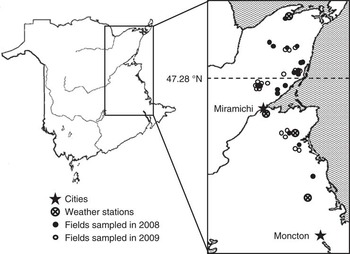
Thirty-five blueberry fields of eastern New Brunswick, Canada that were in the second year (fruiting or crop year) of their 2-year management cycle were sampled for A. sylvia larvae (Fig. 1). Sampling sites consisted of 1-ha field sections, the larger fields having multiple sampling sites to account for potential within-field variability. The latitude, longitude, altitude, and slope of each field were obtained using a GPS (eTrex Legend®, Garmin Ltd., Olathe, Kansas, United States of America). In both years, fields were sampled between the first detection of A. sylvia larvae (late-May; 136 accumulated degree-days over 5°C [ACCDD]) and the onset of the pupal stage (mid-June according to Ouellette Reference Ouellette1998; 275 ACCDD). ACCDD values were calculated using meteorological data gathered from the weather stations of Environment Canada located in Bouctouche, Kouchibouguac, Miramichi, and Bertrand, New Brunswick, Canada. The ACCDD values of fields located between two weather stations were calculated using the following formula:
 $$\left( {\frac{{ACCD{{D}_a}\,\times \,{{D}_b}}}{{{{D}_a}\, + \,{{D}_b}}}} \right)\, + \,\left( {\frac{{ACCD{{D}_b}\,\times \,{{D}_a}}}{{{{D}_a}\, + \,{{D}_b}}}} \right)$$
where ACCDDa and ACCDDb are the ACCDD values at the weather stations a and b, respectively, while Da and Db are the distances between the field and the weather stations a and b, respectively. Degree-days accumulated faster in 2009 than 2008, thus increasing the development rate of larvae and shortening the larval period. As a consequence, fields were sampled twice in 2008 but only once in 2009.
Vaccinium angustifolium Aiton (lowbush blueberry) fields sampled in 2008 and 2009 in eastern New Brunswick, Canada to recover Altica sylvia Malloch larvae. The locations of the nearest cities and weather stations are indicated.

The sweep net sampling protocol of this study was based on the methods used during surveys for A. sylvia conducted in New Brunswick, Canada (Maund and Chiasson Reference Maund and Chiasson1997), Nova Scotia, Canada (Crozier Reference Crozier2001), and Maine, United States of America (Yarborough and Drummond Reference Yarborough and Drummond2001). Three samples of 25 sweeps were taken haphazardly in each 1-ha section. The sweep net was made of a fine mesh material that did not allow larvae to pass through. The sweep samples were sorted in the laboratory to retrieve A. sylvia larvae and Lepidoptera caterpillars. All A. sylvia larvae and caterpillars from a given section and collection date were counted and transferred into a vial filled with 70% ethanol for preservation. A subsample of 10 A. sylvia larvae was randomly selected from each vial to measure head capsule widths using a stereomicroscope (Leica MS5, Leica Microsystems, Wetzlar, Germany). This subsampling approach was used to avoid giving more weight in the analysis to the fields supporting high densities of A. sylvia larvae. In those few cases when a vial included 10 A. sylvia larvae or less, the capsules of all the larvae in the vial were measured. The head capsules of a total of 2555 larvae were measured during this study.
Field characteristics
After 430 ACCDD, when A. sylvia larval development was completed, the field characteristics of each 1-ha section were evaluated using a random sample of five quadrats of 25 × 25 cm (625 cm2). Within each quadrat, V. angustifolium flowers were counted and the average height of V. angustifolium plants was measured. The cover of each quadrat in V. angustifolium, hereinafter referred to as V. angustifolium cover, was visually estimated using the following percentage classes: 0%–0.99%, 1%–5%, 6%–10%, 11%–20%, 21%–40%, 41%–60%, 61%–80%, 81%–90%, 91%–95%, 96%–99%, and 99.01%–100%. Uneven classes were used because the visual estimation of high or low percentage values is more precise than that of intermediate values (Piene Reference Piene1983; Parsons et al. Reference Parsons, Quiring, Piene and Moreau2005).
Statistical analyses
For each field and sampling date, we generated histograms of head capsule widths and identified the underlying trend of each histogram using normal kernel density estimate functions in SAS (SAS Institute 2009). Kernel density estimate functions are more effective than parametric functions when multimodal distributions are expected (SAS Institute 2009). A matrix containing the Kernel estimates of frequency for each field at each measure of head capsule width was built. To (i) partition the variance in this matrix between the ecological and geographic factors measured in this study, (ii) identify the values at which the effect of those factors were observed, and (iii) identify the head capsule width classes explaining more than 10% of the variance associated with the effect of a factor, we computed a multivariate regression tree (De'ath Reference De'ath2002) in R version 2.10.1 (R Development Core Team 2010). The factors included in the multivariate regression tree were the average values for each field of the density of A. sylvia larvae, the density of Lepidoptera caterpillars, the number of V. angustifolium flowers, the V. angustifolium plant height, the V. angustifolium cover, the latitude, the longitude, the altitude, and the slope.
Results
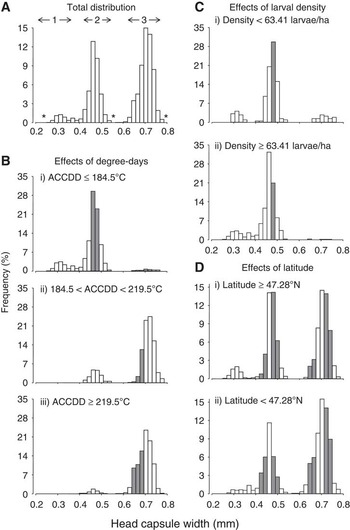
The head capsule width distribution for all of the measured larvae is shown in Figure 2A. Few first-instar larvae were recovered throughout the study (Fig. 2A). An overlap occurred between head capsule widths taken from first-instar and second-instar larvae, but a distinct mode corresponding to third-instar larvae occurred at measurements greater than 0.555 mm. Except for small first-instar larvae, the head capsule width intervals observed in this study were always wider than those that have previously been documented (Fig. 2A).
Histograms of (A) the head capsule width of all the measured larvae of Altica sylvia Malloch, (B) the effect of accumulated degree-days (ACCDD) over 5°C on head capsule width distributions, (C) the effect of A. sylvia larval density on head capsule width distributions in early development larvae, and (D) the effect of latitude on head capsule width distributions. The asterisks in (A) indicate classes with a frequency of 0 and the arrows represent the head capsule width intervals identified by Ouellette (Reference Ouellette1998). The grey coloured bars show the head capsule width classes responsible for at least 10% of the variance in the effect of an ecological or geographic factor.

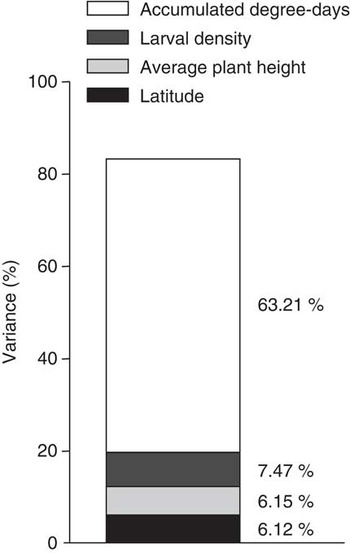
Variance partitioning indicated that most of the variability in the distribution of head capsule widths was explained by the time available for larval development (i.e., ACCDD); three other factors, namely A. sylvia larval density, V. angustifolium plant height, and latitude explained a similar but relatively low amount of the variance (Fig. 3). About 17% of the variance was unexplained. The longitude, altitude, slope, V. angustifolium cover, and number of V. angustifolium flowers did not contribute to the variability in the distribution of head capsule widths. Effects of ACCDD over 5°C were observed at values of 184.5°C and 219.5°C, thus dividing the fields into three distributions of head capsule widths. The first distribution contained larvae from all three instars (Fig. 2B, i), the second contained second-instar and third-instar larvae only (Fig. 2B, ii), and the third contained mostly third-instar larvae and a few second-instar larvae (Fig. 2B, iii). Within early development larvae (Fig. 2B, i), variance partitioning detected differences between the distributions of head capsule widths of fields supporting low (Fig. 2C, i) and high (Fig. 2C, ii) densities of A. sylvia larvae. The larvae with head capsules of intermediate width between the first and second instars were all recovered from fields supporting high densities (Fig. 2C, ii). Differences in the distributions of head capsule widths were also observed between fields located at higher (Fig. 2D, i) and lower (Fig. 2D, ii) latitudes, but this time larvae with head capsules of intermediate width were found in both distributions. Although variance partitioning identified V. angustifolium plant height as a factor contributing to variability in head capsules, the examination of raw data revealed that this was an artifact caused by two fields with plants of intermediate height where larval development was slightly more advanced than in fields supporting smaller or larger plants.
Partition of the variance in the distribution of measures of head capsule width in larvae of Altica sylvia Malloch.

Discussion
This study supports the prediction that shifts in ecological conditions and geographic locations will affect larval development rates and, consequently, the distribution of larval head capsule widths. The conditions observed during this field study made it impossible (i) to use the head capsule width intervals documented by Ouellette (Reference Ouellette1998) for the identification of larval instars and (ii) to establish our own intervals of head capsule widths that corresponded to the three larval instars of A. sylvia. Only third-instar larvae could be distinguished from the other stages as the cut-off point between the first and second modes was blurred by larvae with head capsules of intermediate width. We expect that if our samples included a greater number of early development larvae, the peak corresponding to first-instar larvae could be better defined. However, the sweep net sampling used in this study and in provincial surveys appears to perform poorly in recovering early development larvae. This is consistent with results from Ouellette (Reference Ouellette1998) that previously documented that sweep net sampling was four times less efficient in recovering early development than late-development A. sylvia larvae, possibly because small larvae are thrown off the plants when struck by a sweep net instead of falling into the netting.
The occurrence of head capsules of intermediate width between the first and second instars indicated that reduced growth rates can result in abnormal head capsule distributions in field populations. Such distributions could be the first indication in the literature that developmental polymorphism is occurring in A. sylvia but laboratory or controlled field studies will be required to confirm that this mechanism is taking place. Although developmental polymorphism has been observed among all insect taxa (reviewed in Esperk et al. Reference Esperk, Tammaru and Nylin2007), few studies have documented this phenomenon in Coleoptera as compared with Lepidoptera (e.g., Leonard Reference Leonard1970b; Schmidt and Lauer Reference Schmidt and Lauer1977; Nealis Reference Nealis1987) or Hymenoptera (e.g., Ghent Reference Ghent1956; Retnakaran Reference Retnakaran1973).
Developmental polymorphism occurs mostly when larvae are under stress from unsuitable environmental conditions (Moreau and Bauce Reference Moreau and Bauce2001; Esperk et al. Reference Esperk, Tammaru and Nylin2007; Frago et al. Reference Frago, Selfa, Pujade-Villar, Guara and Bauce2009). Accordingly, we observed that fields supporting high densities of A. sylvia larvae contained all the individuals with a head capsule width falling in-between the first-instar and second-instar intervals. In addition, fields supporting high densities of A. sylvia larvae had fewer third-instar larvae than fields supporting low densities. This suggests that intraspecific competition caused a reduction in larval growth rate, affected head capsule development, and may have induced developmental polymorphism in A. sylvia. Leonard (Reference Leonard1968) also documented the occurrence of a higher percentage of first-instar larvae with additional moults when these were subjected to crowding.
The geographic location also had an impact on A. sylvia larval development. This might be due to a potential reproductive isolation of populations from each region, which in time can cause a difference in genotype (Berthiaume et al. Reference Berthiaume, Bauce, Hébert and Brodeur2007; Esperk et al. Reference Esperk, Tammaru and Nylin2007). Alternatively, this might be due to abiotic factors not examined, such as differences in climate due to the geographic location. New Brunswick has two climatic zones, its northern half experiencing continental conditions while its southern half is subjected to maritime conditions. Even though head capsules of intermediate width between the first and second instar occurred more frequently in the southern fields of the study area, latitude itself cannot be responsible for this phenomenon because intermediate-sized larvae were also collected at high latitudes.
Although previous studies have shown that poor host-plant quality can slow the growth rate of insects (Hatcher et al. Reference Hatcher, Paul, Ayres and Whittaker1994; Wise and Weinberg Reference Wise and Weinberg2002), we could not detect such effects here using V. angustifolium plant cover, plant height, or flower counts as indicators of plant quality. Moreover, the densities of Lepidoptera larvae were not associated with A. sylvia larval development, possibly because densities were too low in this study to result in interspecific competition. Top-down factors have been shown to decrease larval growth rates and cause developmental polymorphism in previous studies (e.g., Iwantsch and Smilowitz Reference Iwantsch and Smilowitz1975; Nealis Reference Nealis1987; Moreau and Bauce Reference Moreau and Bauce2001) but were not examined here. On the other hand, it has been documented that, in general, Altica species are not subject to a high incidence of parasitism (LeSage Reference LeSage1995).
In conclusion, our study suggests that the measurement of head capsule width may not be an adequate approach to determine the instar of A. sylvia larvae collected from field populations. Other attributes such as differences in colour patterns throughout larval development (Scott Reference Scott1986) could be used to complement the measures of head capsule width. However, this approach could not be tested here because the preservation of larvae in alcohol can result in the discoloration of their exoskeleton (Borror and White Reference Borror and White1991). Based on our observation that phenotypic and potential genotypic differences in head capsule width can occur, we stress that the sampling protocol of studies conducted to determine head capsule width intervals in a species should include diverse ecological settings as well as several geographic locations within the range of the species.
Acknowledgements
We would like to thank two anonymous reviewers for comments on a previous version of this manuscript; G. Chiasson, K. Mackenzie, and M. Melanson for their contribution to this research project; M. Robichaud, É. Thériault, M. Reekie, E. Collins, C. Comeau, G. Lapointe, and A. Mackay for help with sample collection and processing; lowbush blueberry growers who have participated in this research project; and the New Brunswick Innovation Foundation, Bleuets NB Blueberries, and the Natural Sciences and Engineering Research Council of Canada for funding.