Introduction
Trauma is widely known to be a global public health issue. In the European Union, more than 250,000 people are killed every year as a result of an injury, and more than three million persons are permanently disabled after an injury.Reference Nordberg, Castrén and Lindström 1 Advanced clinical interventions early in the chain of care, in addition to transportation to hospital for definitive care, have been shown to provide benefits to patients with severe injuries.Reference Bauer and Steiner 2 To reduce the mortality rate of severely injured patients, specialist resources are commonly used in the Emergency Medical Services (EMS). The specialist resources can provide advanced clinical interventions directly at the scene of an accident.Reference Galvagno, Thomas and Stephens 3 However, to activate the EMS, an emergency call to the Emergency Medical Communication Centre (EMCC) is needed.Reference Butler, Anwar and Willett 4 Precise assessment of the call and exact dispatching of rescue units by the emergency medical dispatchers (EMDs) are essential to ensure early treatment of patients with time-critical injuries.Reference Castren, Karlsten and Lippert 5 Despite the importance of dispatching the optimal resources to the severely injured patients, the literature shows that specialist resources are not always dispatched to the scene of an accident.Reference Kuisma, Holmstrom, Repo, Maatta, Nousila-Wiik and Boyd 6 There may be several reasons for not dispatching the specialist resources.Reference Kuisma, Holmstrom, Repo, Maatta, Nousila-Wiik and Boyd 6 However, it is known that there are difficulties for the EMDs in identifying a patient’s medical condition based on a phone call, with no visual contact.Reference Ringburg, Frissen, Spanjersberg, Jel, Frankema and Schipper 7 - Reference Beillon, Suserud, Karlberg and Herlitz 9 The caller or bystanders may lack information, or may not be able to describe the problem,Reference Ringburg, Frissen, Spanjersberg, Jel, Frankema and Schipper 7 or there can be other communication barriers during the emergency call.Reference Buck, Starkman and Eckstein 10 Bystander help is known to increase survival after an out-of-hospital cardiac arrest.Reference Wahlberg, Cedersund and Wredling 11 Could it be possible for the bystander at the scene of an accident to conduct a primary triage to support the EMDs in prioritizing specialist resources to the scene? In a large-scale event when the capacity of the EMS can be overwhelmed, and when the patient volume outweighs the number of available resources in the EMS, bystanders could be helpful by giving the EMDs available information from the scene. At present, there is sparse knowledge of bystanders’ knowledge of using triage instruments. Therefore, the aim of this study was to evaluate whether bystanders with no training in triage could prioritize three paper-based injured patients by using a simple triage instrument.
Materials and Methods
An observational study was conducted. The participants performed primary triage on three paper-based patient cases and answered 11 questions during a public event in the center of Stockholm, Sweden in 2010.
Study Setting
Stockholm is the capital of Sweden and the population is approximately 850,000. In the city, 14.3 percent of the residents are older than 65 years of age and 18 percent are under 15 years. Residents with foreign backgrounds represent 31 percent. Life expectancy for men is 81 years and for women is 84 years. The education in Sweden is mandatory for all children aged between seven and 16 years (primary school), and education is financed by taxes. In 2008, 46 percent of all Swedes aged 25-64 had completed three years of secondary school. Women are more educated compared to men; 26 percent of women compared to 19 percent of men have post-secondary education of three years or more. The level of education in the Swedish population is highest among people aged 25-34 years, and it decreases with age.Reference Nordberg, Hollenberg, Herlitz, Rosenqvist and Svensson 12 The County Council is responsible for the EMS, and the service is provided by the organizations within the county and private companies contracted by the County Council. The health care system in Sweden is financed by taxes.
Participants
During a public event in the center of Stockholm in 2010, participants were recruited to participate in the study when passing a tent where data collection was conducted. If they agreed, they received written information about the study and a consent form to sign. The event was arranged by the EMS, the police, and the fire brigade of the county. Other participants in the event were salespersons from different fields.
Scenario and Patient Cases Presented to the Participants
A scenario with three patient cases was used to collect data. The cases were developed among the three authors, who all had extensive knowledge of emergency medicine and prehospital care. The scenario presented to the participants was:
You are the first bystander at the scene of the accident, a highway with a speed limit of 110 km/hour. Two cars have had a head-on collision. Both cars have been damaged by the collision and the engine covers are crumpled in both cars. In one of the cars, there are two persons, and in the other car, there is one person.
Case 1
In car one, on the passenger side, is a man aged approximately 40 years. He has blood around the mouth, and when you place your hand on his belly you feel that he is breathing rapidly. He has closed eyes, but opens them when you talk to him. You count his heart rate at 108 beats/min and the respiratory rate at 28 breaths/minute. When you ask how he is doing, he answers all your questions without any delay. He tells you he has pain in the stomach, so you look under his shirt and you see a large bruise that runs diagonally over the stomach.
Case 2
Outside car one, on the driver’s side, stands a woman who also seems to be around 40 years old. She is screaming and is crying out that she is in severe pain. You notice that her left arm looks broken, and blood is slowly dripping from her left hand. The woman is constantly trying to get your attention and is obviously very scared. You say you have to measure her pulse rate and grab her healthy right wrist and measure a pulse of 90 beats/min and count the respiratory rate at 17 breaths/minute.
Case 3
In the second car, in the driver’s seat, you see a man. He does not respond at all when you try to talk to him. His head is hanging down to his chest. You hear a wheezing sound every time he takes a breath. You count his respiratory rate at seven breaths/minute. When you measure his pulse, you count it at 80 beats/minute. You try to wake him up by shaking his hand and pinching his skin as much as you dare, but he gives no answer, and he does not look up.
Data Collection
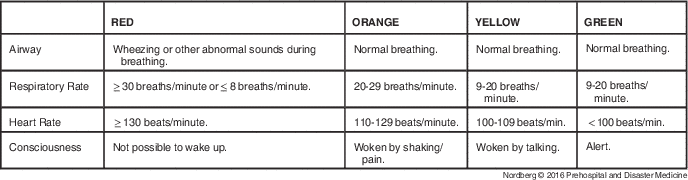
After presenting the scenario and patient cases verbally to the participants, a written paper was handed over with the triage instrument to be used when performing the triage (Table 1).
Triage Instrument

The triage instrument was developed by the authors, inspired by a triage system named Rapid Emergency Triage and Treatment System (RETTS), and used in the EMS system of Stockholm; RETTS consists of five different priorities: red, orange, yellow, green, and blue. Blue is for patients who do not need to be prioritized and was not used in this study. The red priority is the most serious condition and needs immediate medical attention; orange needs medical attention as soon as possible; green is the least serious condition. 13 The participants received brief verbal instructions on how to use the triage instrument: “From the given patient cases, extract information concerning the Airway, Respiratory Rate, Heart Rate, and Consciousness. Red is the most severely injured patient.” The participants also received brief information/education on how to calculate the respiratory and heart rates if they did not have the knowledge. The instructions were given as a dispatcher could have done via the phone. The questionnaire used for data collection consisted of 11 questions describing: the demographic of the participants (n=6); the triage of the cases in the scenario (n=3); and the experience of the exercise (n=2).
Ethical Considerations
This study was designed to meet the ethical principles for research described by the International Council of Nurses (Geneva, Switzerland), ensuring anonymity, integrity, and confidentiality for the participants.Reference Perez, Nissen, Nielsen, Petersen and Biering 14 All participants signed a consent form before participating in the study. By doing so, according to Swedish regulations on questionnaire studies, ethical committee approval was not needed. 15
Analysis
Descriptive statistics were used to present the results and all statistical procedures were computed using Microsoft Office Excel 2010 (Microsoft Corporation; Redmond, Washington USA).
Results
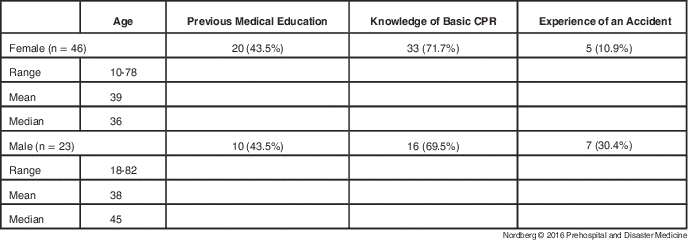
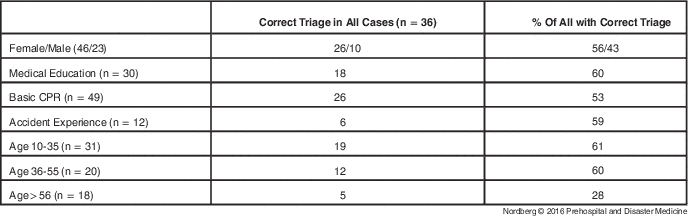
A total of 69 persons participated in the study. The majority were woman (n=46), and the age of the participants ranged from 10 to 82 years. Of the participants, 71 percent answered that they had knowledge of basic cardiopulmonary resuscitation (CPR), as shown in Table 2. The success rate among all the participants for correct triage of the three patient cases was 52 percent (n=36). The female participants and younger participants (<55 years of age) performed correct triage to a greater extent, as shown in Table 3. Of the participants without previous medical education (n=39), nearly one-half of the group (46%) performed correct triage in all cases. Of the participants without experience of an accident (n=57), more than one-half of the group (52%) triaged all cases correctly. The overall over-triage was 12.5 percent and under-triage was 6.3 percent.
Description of Participants

Abbreviation: CPR, cardiopulmonary resuscitation.
Description of Participants with Correct Triage in All Cases (n=of the 69 participants)
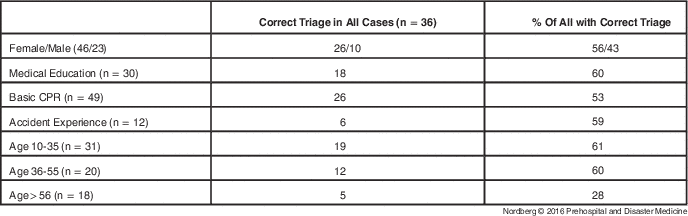
Abbreviation: CPR, cardiopulmonary resuscitation.
Case 1 was correctly identified as orange by 52 participants (75%), 12 participants under-triaged the patient (green, yellow), and five participants’ over-triaged (red) Case 1. Case 2 was correctly identified as green by 48 participants; the rest of the participants over-triaged the patient. The most severely injured patient, Case 3, was correctly identified by 68 of the 69 participants.
Of the participants, 78 percent (n=54) experienced the triage instrument as easy to use, and of these participants, 63 percent (n=34) triaged all cases correctly. Of those participants (n=15) that experienced the triage instrument as difficult to use, 33 percent triaged all cases correctly. Only three participants said that they would never use this triage instrument in reality.
Discussion
The results show that 52 percent of the participants with no previous knowledge of a triage instrument were capable of correctly triaging the three patient cases, and nearly all (98.5%) of the participants identified the most severely injured patient. An assumption is that if the participants had had formal training in how to use the triage instrument, the success rate could have been better. This assumption is supported by previous knowledge about performance on bystander CPR showing that formal training results in better performance. 16 However, the success rate in the triage performed by the participants may also have been affected by the triage instrument used in this study. The developed triage instrument may have similar weaknesses as other triage instruments used by EMS professionals.Reference Beard, Swain, Dunning, Baine and Burrowes 17 Overall, the over-triage was 12.5 percent and under-triage was 6.3 percent in this study. This may indicate that the developed instrument is relatively safe for the injured patient, but it may also indicate that most bystanders can identify a severely injured patient. However, there is no consensus on what is acceptable concerning over- and under-triage. Optimally, the triage should match the level of care needed.Reference Smith, Snyder, Hollen, Anderson and Caterino 18 There were no statistically significant results in the study, but there was a trend that younger people triaged correctly to a higher extent. The reason for that is not known, but it may indicate that the information given to the participants needs to be adjusted for age. As Sapp et al conclude, future research is needed to further evaluate triage by non-medical bystanders.Reference Cone, Schmidt, Mann and Brown 19 In the daily work of the EMD at the EMCC, when enough resources are available in the EMS system, the bystander triage may not be as useful as in a large-scale event when the capacity of the EMS could be overwhelmed and when the patient volume outweighs the quantity of available resources. Bystander triage may be useful when deciding on dispatching the specialist resources used by the EMS. At present, the specialist resources are not always dispatched to the scene,Reference Kuisma, Holmstrom, Repo, Maatta, Nousila-Wiik and Boyd 6 and this may cause increased mortality and suffering for the individual patient.Reference Bauer and Steiner 2 By using a Smartphone application, it may be possible for a bystander to use the triage instrument. The EMD could send the application to the caller when the EMD needs support with the prioritization of available resources.
Limitations
There are some limitations that have to be considered in this study. First, the paper triage exercise cannot be expected to reflect a real triage situation in a scenario with severely injured persons. The stress and fear that may occur during a real situation is impossible to simulate using a paper exercise. A few (n=3) of the participants answered that they would hesitate to use the triage instrument in a real situation. The convenient enrolment of participants on an event day arranged by the County Council and the EMS is a limitation. A convenient data collection reduces the credibility of the results, and in this case, people visiting the event may have had a special interest in the blue light and siren organizations. Nearly one-half (43.5%) of the participants had some kind of medical education but had not worked with triage or trauma. However, the participants were both women and men, and the ages varied between 10-82 years. Whether there were participants with foreign backgrounds is not known since information on that variable was not collected. Altogether, the convenient data collection reduces the possibility to generalize the results to a wider context, but the results may instead be used as hypothesis-generating for other studies regarding bystanders’ ability to triage patients. To determine whether a bystander could support the EMD by triaging injured patients, bystanders could be invited to a simulation exercise conducted by the EMS. There were no statistically significant results in this study, although there was a tendency that participants >55 years of age were less able to triage. The results could also have been affected by the relatively small sample size or the impact of external factors such as the participants’ previous medical knowledge.
Conclusion
Participants with no prior knowledge of triage instruments may be capable of triaging injured patients with the help of an easy triage instrument. The over- and under-triage was relatively low, which may indicate that the developed triage instrument is relatively safe for the injured patient. It may also indicate that bystanders can identify a severely injured patient.
Acknowledgements
The authors wish to thank Malin Kling, Ojet Ringbom, and Annika Thelin, prehospital emergency care nurses working in the ambulance services, for participating in the data collection.