Introduction
Among the organotin compounds (OTs), tributyltin (TBT) and triphenyltin (TPT) – which were used as antifouling biocides, agricultural pesticides and wood preservatives – have been of great concern due to their deleterious effects on non-target organisms (Beaumont & Budd, Reference Beaumont and Budd1984; Alzieu et al., Reference Alzieu, Sanjuan, Deltreil and Borel1986; Bryan et al., Reference Bryan, Gibbs, Hummerstone and Burt1986; Alzieu, Reference Alzieu1991; Salazar & Salazar, Reference Salazar and Salazar1991; Ohji et al., Reference Ohji, Arai and Miyazaki2002, Reference Ohji, Arai and Miyazaki2003). In October 2001, the International Maritime Organization (IMO) adopted the International Convention on the Control of Harmful Antifouling Systems (the AFS Convention), and the Convention was globally ratified in September 2008. Even after the enforcement of the Convention's regulations, OTs were detected in coastal waters at concentrations that caused adverse effects to susceptible organisms, such as gastropods (Gibbs et al., Reference Gibbs, Pascoe and Bryan1991) and small crustaceans (Ohji et al., Reference Ohji, Arai and Miyazaki2002). Unfortunately, OTs are still detected in many countries, especially in developing countries (Harino et al., Reference Harino, Arifin, Rumengan, Arai, Ohji and Miyazaki2012). The OTs might affect coastal ecosystems, such as mangroves, in developing countries.
Mangroves are woody trees and shrubs that grow in saline coastal sediment habitats of intertidal zones in the tropical and subtropical regions of the world (Hogarth, Reference Hogarth2007). True mangroves comprise some 54 species in 20 genera, belonging to 16 families. The mangroves provide habitats for many aquatic organisms (Sato et al., Reference Sato, Fisseha, Gebrekiros, Karim, Negassi, Fischer, Yemane, Teclemariam and Riley2005), protect coastal areas from erosion (Mazda et al., Reference Mazda, Kobashi and Okada2005) and are considered to be sinks for carbon (Kitaya, Reference Kitaya and Tateda2007). Mangroves thus play important roles in coastal water ecosystems. Although many investigations of OT contamination in the coastal areas have been conducted worldwide, there is no information regarding the OT contamination status of mangrove plants.
To elucidate the contamination status of OTs in mangroves, it is necessary to conduct OTs analyses not only on mangrove leaves but also on the sediments of their habitat in the same area at the same time. In the present study, we determined the accumulation of butyltin compounds (BTs) and phenyltin compounds (PTs) in sediment and mangrove leaves collected from two sites in Malaysia. The data of OT contamination in the present study is valuable to understand the pollution status of the mangrove ecosystems.
Materials and methods
Sample collection
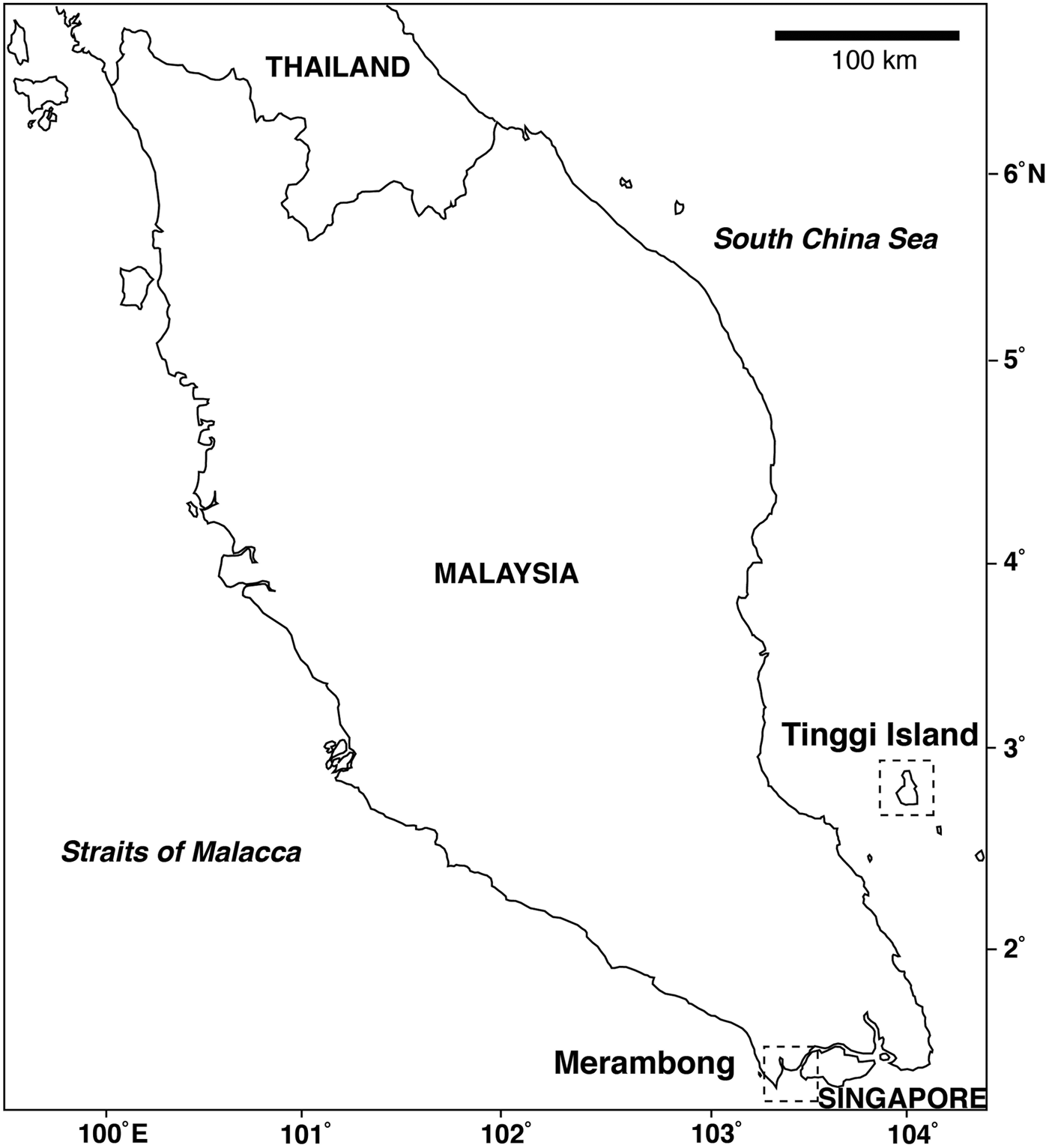
Malaysia consists of two geographic regions: Peninsular Malaysia and Malaysian Borneo. We selected two sites in Peninsular Malaysia for this study: Merambong and Tinggi Island (Figure 1). Merambong faces the Johor Strait, a busy strait between Malaysia and Singapore. This area is dominated by mangrove swamps and seagrass beds but is adjacent to an urbanized area. Tinggi Island is located off the east coast of Malaysia, facing the East China Sea, and is used as a resort area because there are coral reefs, mangroves, seagrass beds and fishing ports in the sea area around the island. Tinggi Island is recognized as a relatively pristine area compared with Merambong.
The sampling sites of sediment and mangrove leaves collected from Merambong and Tinggi Island, Malaysia.

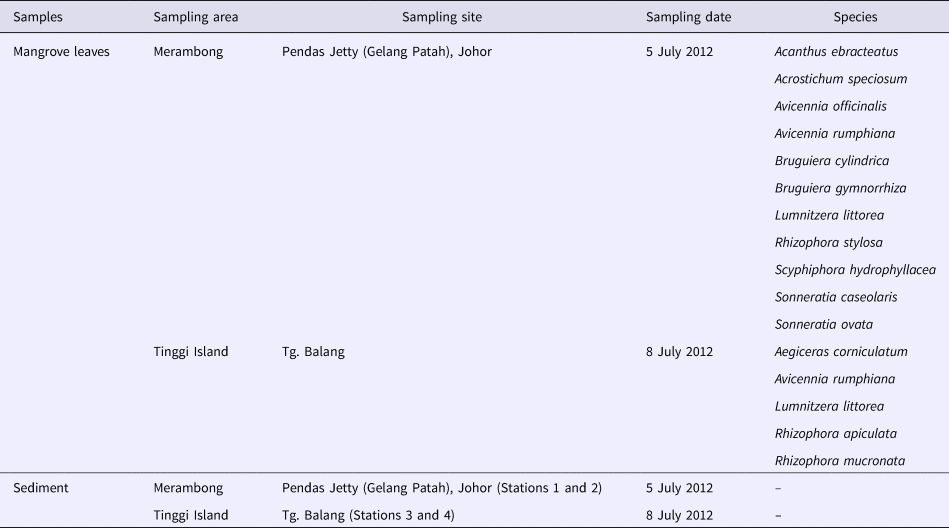
We collected sediment samples (N = 1 per site) from the surface layer in two sites at both Merambong and Tinggi Island on 5 and 8 July 2012 (Table 1), and stored them at −20°C until the chemical analysis. Mangrove leaves (11 species from Merambong and five species from Tinggi Island) were collected (N = 1 per plant) at the same time and at the same sites as the sediment (Table 1) and stored in a freezer at −20°C until the chemical analysis.
Mangrove leaves (n = 1 per plant) and sediment (n = 1 per site) collected from Merambong and Tinggi Island, Malaysia.

Chemical analysis
The chemical analysis of OTs in the sediment and mangrove leaf samples was based on the method of Harino et al. (Reference Harino, Arifin, Rumengan, Arai, Ohji and Miyazaki2012) with some modification.
A gram of sediment or leaf sample was placed in a centrifuge tube, and 100 µl of mixed acetone solution including 1 mg l−1 each of monobutyltin trichloride (MBTCl)-d9, dibutyltin dichloride (DBTCl)-d18, tributyltin monochloride (TBTCl)-d27, monophenyltin trichloride (MPTCl)-d5, diphenyltin dichloride (DPTCl)-d10, and triphenyltin monochloride (TPTCl)-d15 was added to the centrifuge tube as a surrogate standard. The mixture was extracted by shaking for 10 min with 10 ml of 1 M HCl-methanol/ethyl acetate (1/1).
After centrifugation, the supernatant was transferred to a separating funnel, and the residue was extracted and centrifuged again in the same way. Thirty ml of saturated NaCl solution was added to a separating funnel containing the combined supernatants. The analytes were extracted twice with 15 ml of ethyl acetate/hexane (3/2) solution, and the organic layer was combined. Fifty ml of hexane was mixed into the organic layer and left to stand for 20 min. After removal of the aqueous layer, the organic layer was dried with anhydrous Na2SO4 and then concentrated by a rotary evaporator up to the trace level. The analytes were diluted with 5 ml of ethanol, 5 ml of acetic acid-sodium acetate buffer (pH 5.0), and 10 ml of distilled water, and they were then ethylated by shaking with 1 ml of 5% NaBEt4 for 30 min.
The solution containing ethylated OTs was saponified with 10 ml of 1 M KOH-ethanol solution by shaking for 1 h. Forty millilitres of distilled water and 10 ml of hexane were added to the solution, and the mixture was shaken for 10 min. The ethylated OT residue in the aqueous layer was extracted again by shaking for 10 min with 10 ml of hexane. The combined organic layer was dried with anhydrous Na2SO4. After being concentrated up to 1 ml, the solution was cleaned with a Florisil Sep-Pak column (Waters, Milford, MA) which was conditioned with 10 ml of hexane. The analytes were eluted with 5% diethyl ether/hexane. The final solution was concentrated up to 0.5 ml after the addition of 100 µl of mixed hexane solution including 1 mg l−1 tetrabutyltin chloride (TeBT-d36) and tetraphenyltin chloride (TePT-d20) as an internal standard.
A gas chromatograph (6890A series, Agilent Technologies, Santa Clara, CA) equipped with a mass spectrometer (5973N, Agilent) was used for the analysis of OTs with selected ion monitoring. The separation was carried out in a capillary column coated with 5% phenyl methyl silicone (30 m length × 0.25 mm i.d., 0.25 µm film thickness; J&W Scientific, Folsom, CA). The column temperature was held at 60°C for the first 2 min, then increased to 130°C at 20 °C min−1, to 210°C at 10 °C min−1, to 260°C at 5 °C min−1, and to 300°C at 10 °C min−1. Finally, the column temperature was held at 300°C for 2 min. The interface temperature, ion source temperature and ion energy were 280°C, 230°C and 70 eV, respectively. Selected ion monitoring was operated under this programme, and a splitless injection (1 µl) of the sample was employed. The concentrations of OTs in this study are expressed as Sn4+.
Evaluation of the analytical procedure
To examine the quality of the data obtained by the analytical procedure, we spiked 0.5 µg of BTs and PTs to 1 g of sediments. The recoveries of BTs and PTs were in the range of 98–108% and 95–105%, respectively, and their relative standard deviations (RSDs) were under 11%. To calculate the recovery rates of OTs in mangrove leaf, we spiked 0.5 µg of BTs and PTs to 1 g of the mangrove leaves. The recoveries of BTs and PTs were in the range of 81–101% and 56–67%, respectively. The RSDs of these compounds were under 9.6%. The detection limits of each OT for a signal-to-noise ratio of 3 were 0.1 ng g−1 dry wt for the sediment and 0.1 ng g−1 wet wt for the leaf sample.
Statistics
Differences between data were analysed using the Mann–Whitney U-test (Sokal & Rohlf, Reference Sokal and Rohlf2003). The comparison of data regarding sediments between two regions could not be conducted because the sample size was too small to analyse statistically in the present study.
Results and discussion
The concentrations and compositions of the OTs in the sediment
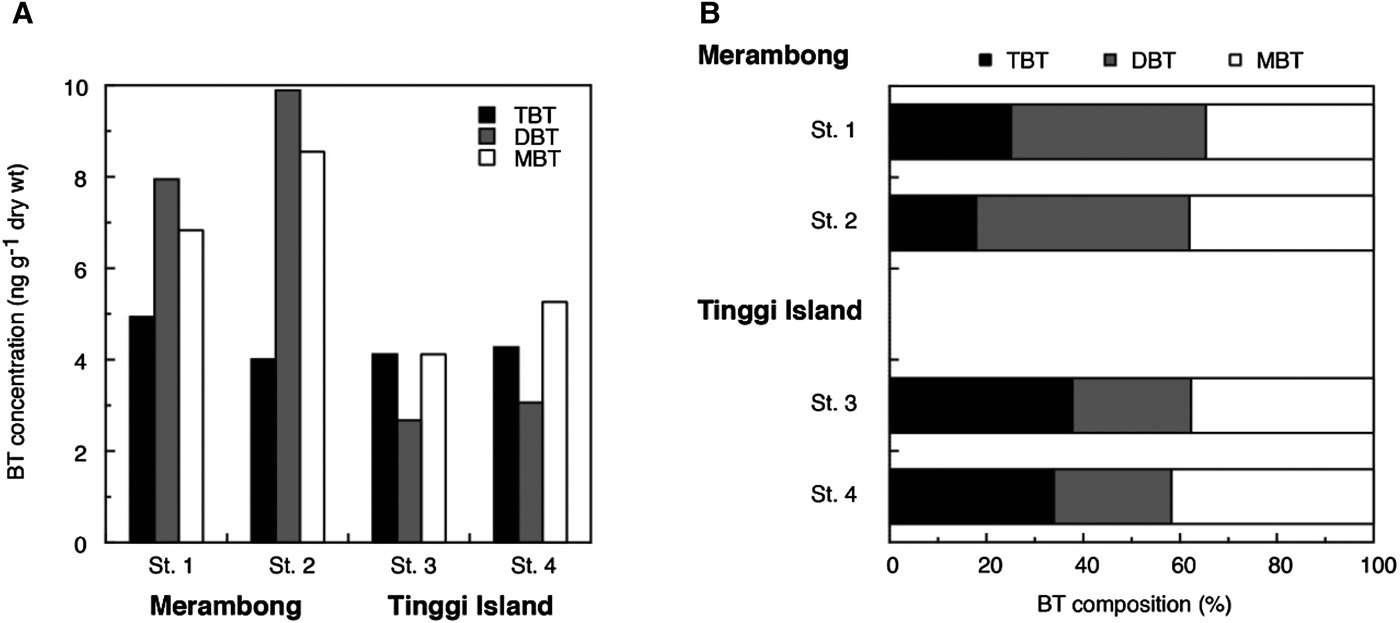
Butyltin compounds were detected in all sediment samples collected from both Merambong and Tinggi Island (Figure 2). The concentrations of total BTs in Merambong and Tinggi Island were 21.1 ± 1.9 ng g−1 dry wt and 11.8 ± 1.2 ng g−1 dry wt, respectively. The BT concentrations in the sediment from Merambong, facing the busy strait, tended to be higher than those from Tinggi Island. The BTs levels were lower than those reported for the sites around Johor Strait in 2006 (Harino et al., Reference Harino, Arai, Ohji, Ismail and Miyazaki2009), in which the BTs concentration was detected at up to 228 ng g−1 dry wt, indicating that the effect of the restriction of TBT usage in Malaysia has emerged gradually.
The concentrations (A) and compositions (B) of butyltin compounds (BTs) in sediment collected from Merambong and Tinggi Island.

The concentrations of TBT in sediment from Merambong and Tinggi Island were similar at 4.5 ± 0.7 and 4.2 ± 0.1 ng g−1 dry wt, respectively (Figure 2A). The average concentration of TBT in Malaysia in 2006 was 41.0 ng g−1 dry wt (Harino et al., Reference Harino, Arai, Ohji, Ismail and Miyazaki2009). TBT concentrations in Malaysia are presumed to have decreased over the 6-year period from 2006 to 2012. The concentrations of TBT in sediment in various South-east Asian countries have been reported. For example, the TBT concentrations were 0.9–34 ng g−1 dry wt in Vietnam (Midorikawa et al., Reference Midorikawa, Arai, Harino, Ohji, Cu and Miyazaki2004), 2.0–1246 ng g−1 dry wt in Thailand (Harino et al., Reference Harino, Ohji, Wattayakorn, Arai, Rungsupa and Miyazaki2006), and 0.4–350 ng g−1 dry wt in Indonesia (Harino et al., Reference Harino, Arifin, Rumengan, Arai, Ohji and Miyazaki2012). The TBT concentrations in the present study were generally lower than these values from other South-east Asian countries. However, the present TBT levels have the potential to still affect sediment-dwelling organisms, as little information is available about the toxicity of TBT for such organisms. Further studies are needed to clarify the toxicity of TBT to such organisms.
Duft et al. (Reference Duft, Schulte-Oehlmann, Tillmann, Markert and Oehlmann2003) reported that they observed reduced fecundity in the gastropod Potamopyrgus antipodum at TBT concentrations below 10 ng g−1 dry wt. Growth inhibition was reported at 12 and 42 ng g−1 dry wt of TBT in the amphipod Eohaustorius washingtonianus and the polychaete Armandia brevis (Meador, Reference Meador2000). It was suggested that the susceptibility of molluscs to TBT might be connected to their low detoxifying activity due to a low cytochrome P-450 content and mixed function oxygenase activity, which play major roles in TBT metabolism (Lee, Reference Lee1986, Reference Lee, Champ and Seligman1996). Tributyltin in sediment under the mangrove plants in Malaysia has the potential to affect the sediment-dwelling organisms, leading to disturbances in the dynamics of the populations in the mangrove ecosystems. However, since the effects of OTs on organisms that inhabit sediment are still not well known, toxicity experiments for these organisms should be conducted to preserve their coastal environments.
The percentages of TBT, DBT and MBT of the total BTs in sediment from Merambong averaged 22, 42 and 36%, respectively (Figure 2B), and those from Tinggi Island averaged 36, 24 and 40%, respectively (Figure 2B). In both regions, degradation compounds of TBT were the predominant compounds. The half-life of TBT in sediments has been reported to be tens of years (Langston et al., Reference Langston, Pope, Davey, Langston, O’ Hara, Gibbs and Pascoe2015). It was also reported that TBT-based paint chips that are present in sediment degrade more slowly than TBT adsorbed by sediment particles (Stang et al., Reference Stang, Lee and Seligman1992). Despite the slow degradation of TBT in sediment, we observed that the proportion of TBT was low in sediment from Merambong and Tinggi Island. This result suggests that the input of TBT has decreased.
We also found that the PTs levels were under the detection limit in the sediment samples from both sites, although TPT was detected at 0.1–34 ng g−1 dry wt in Malaysia in 2006 (Harino et al., Reference Harino, Ohji, Wattayakorn, Arai, Rungsupa and Miyazaki2006). The reported TPT concentration in Vietnam was 0.1–0.4 ng g−1 dry wt (Midorikawa et al., Reference Midorikawa, Arai, Harino, Ohji, Cu and Miyazaki2004); that in Thailand was 0.3–29 ng g−1 dry wt (Harino et al., Reference Harino, Ohji, Wattayakorn, Arai, Rungsupa and Miyazaki2006) and that in Indonesia was 0.1–19 ng g−1 dry wt (Harino et al., Reference Harino, Arifin, Rumengan, Arai, Ohji and Miyazaki2012). Our present findings are likely to reflect the restriction of TPT usage in the antifouling paint in Malaysia, suggesting that the effect of TPT on marine ecosystems has been lower in Malaysia than in other Asian countries.
The concentrations and compositions of the OTs in the mangrove leaves
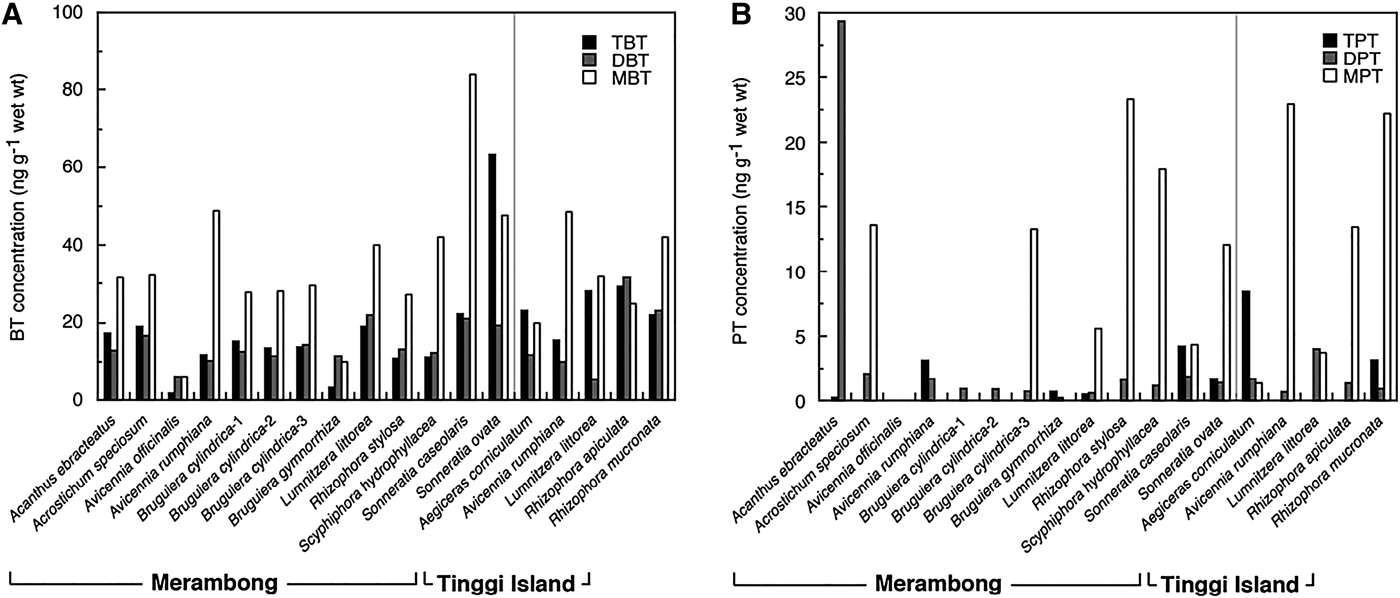
The concentrations of BTs in the mangrove leaf samples collected from Merambong and Tinggi Island are shown in Figure 3A. The average concentrations of total BTs at Merambong and Tinggi Island were 66 and 73 ng g−1 wet wt, respectively. No significant differences were observed in levels of total BTs between two regions (P > 0.05).
The concentrations of BTs (A) and phenyltin compounds (PTs) (B) in mangrove leaves collected from Merambong and Tinggi Island.

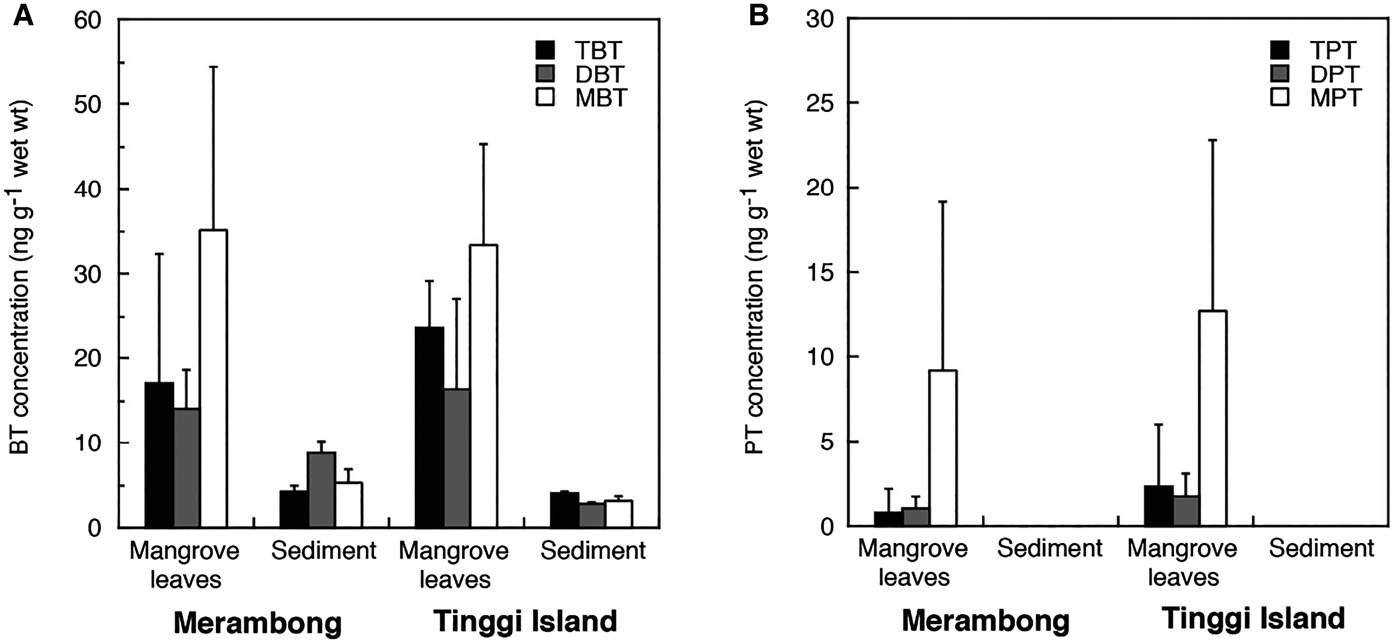
The concentrations of TBT in the mangrove leaves from Merambong and Tinggi Island were 17 ± 15 ng g−1 wet wt and 24 ± 5.6 ng g−1 wet wt, respectively (Figure 4A). The concentrations of TBT in the leaves from Tinggi Island were significantly higher than those from Merambong (P < 0.05). The mangrove leaves from Tinggi Island were more heavily contaminated by TBT than the leaves from Merambong. Despite the importance of the role of mangroves in coastal water ecosystems, there is no prior study regarding the contamination status of mangrove plants that could be compared with our present data.
The concentrations of BTs (A) and PTs (B) in mangrove leaves and sediment collected from Merambong and Tinggi Island. PTs were not detected in the sediment samples from both regions.

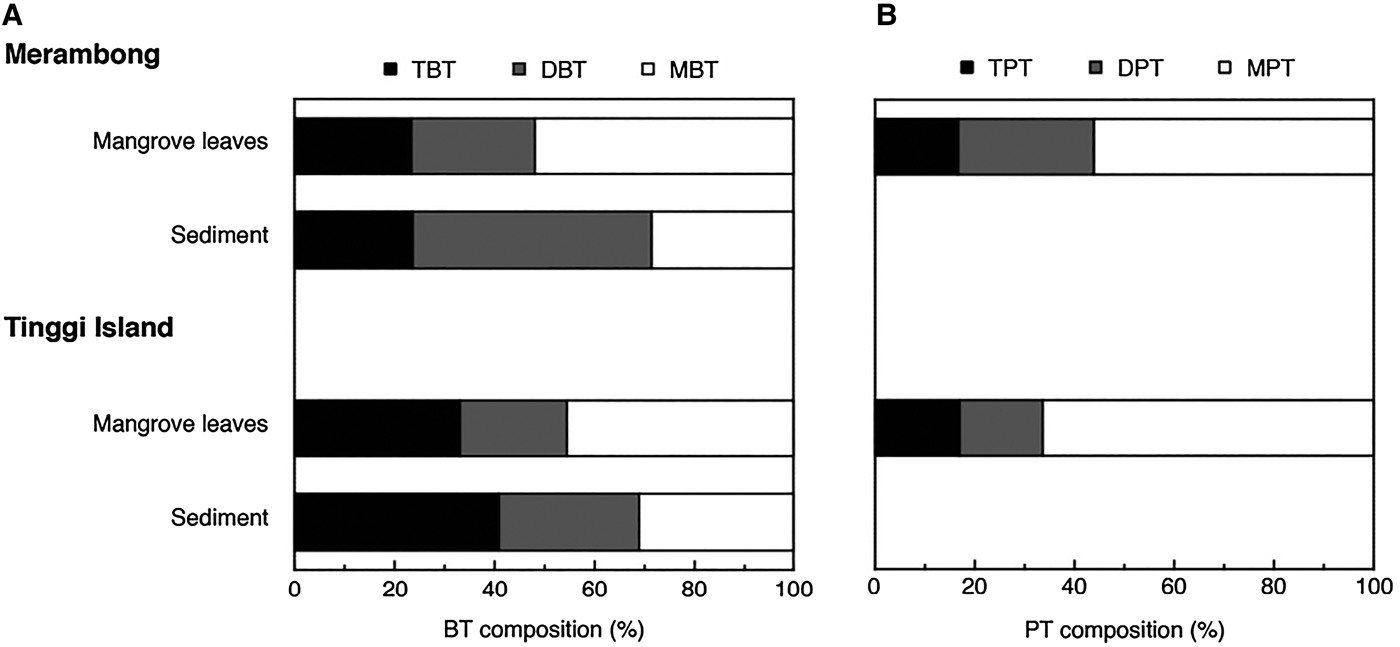
The percentages of TBT, DBT and MBT of the total BTs in the mangrove leaves from Merambong averaged 23, 25 and 52%, respectively, and those from Tinggi Island averaged 33, 21 and 46% (Figure 5A). In both regions, MBT was the predominant compound, and in Merambong the average proportion of DBT was higher than that of TBT.
The composition of BTs (A) and PTs (B) in mangrove leaves and sediment collected from Merambong and Tinggi Island.

Significantly high levels of MBT in mangrove leaves were identified by our investigation, and the highest concentration in mangrove leaves was 84 ng g−1 wet wt. Among the BTs compounds, most studies have focused on TBT because it is far more toxic to aquatic organisms compared with DBT and MBT (Vighi & Calamari, Reference Vighi and Calamari1985; Maguire, Reference Maguire and de Mora1996). However, some information is available about the toxicity of DBT and MBT to marine plants; e.g. DBT and MBT cause the inhibition of primary productivity (Wong & Chau, Reference Wong and Chau1992), and MBT causes an inhibition of growth (Huang et al., Reference Huang, Bai and Xie1993). Further studies are needed to examine the biological effects of degradation compounds of TBT on mangrove plants.
We also detected PTs in most of the mangrove leaf samples except for Avicennia officinalis from Merambong (Figure 3B). The total PTs concentrations in mangrove leaves from Merambong and Tinggi Island were 11 ± 9.7 and 17 ± 7.9 ng g−1 wet wt, respectively. No significant differences were observed in PT levels between the two regions (P > 0.05).
The TPT, DPT and MPT concentrations in the mangrove leaves in Merambong were 0.8 ± 1.4, 1.0 ± 0.7 and 9.2 ± 9.9 ng g−1 wet wt, respectively (Figure 4B). The concentrations of TPT, DPT and MPT in the mangrove leaves from Tinggi Island were 2.3 ± 3.7, 1.7 ± 1.3 and 13 ± 10 ng g−1 wet wt, respectively (Figure 4B). No significant differences were observed in PT levels between the two regions (P > 0.05).
The percentage of TPT, DPT and MPT of the total PTs in mangrove leaves from Merambong averaged 17, 27 and 56%, respectively, and those from Tinggi Island averaged 17, 16 and 67% (Figure 5B). The levels and proportions of MPT were significantly higher than those of TPT and DPT in both regions, suggesting the degradation of TPT and DPT to MPT.
The ratio of each BT concentration between mangrove leaves and sediment
The ratios of the BTs burden in mangrove leaves to the BTs concentration in sediment were calculated. The ratio of total BTs at Merambong and Tinggi Island were 3.1 and 6.2, respectively. The ratios of TBT, DBT and MBT at Merambong were 3.8, 1.6 and 4.6, respectively, and those at Tinggi Island were 5.6, 5.7 and 7.1. The ratio of MBT was the highest among total BTs in both regions, and the highest values of MBT at Merambong and Tinggi Island were 11 and 10, respectively. The ratios of MBT at Tinggi Island were higher than those at Merambong.
We have two hypotheses regarding these results. The first hypothesis is that MBT (and/or DBT) that was used as a heat and light stabilizer in polyvinyl chloride (PVC) processing was eluted from plastic and input into seawater and deposited into sediments, and was taken up by mangrove plants, resulting in high concentrations of MBT in the mangrove leaves. However, our present analyses revealed that the concentration and the proportion of MBT in the sediment under the mangrove plants were the same as or lower than those in the mangrove leaves. Therefore, this hypothesis was contradicted unless mangroves have special mechanisms to uptake MBT selectively.
The second hypothesis is that TBT in seawater or sediment was taken up by the mangrove leaves, and the plants' high metabolic capacity to degrade TBT into MBT, but low capacity to degrade MBT to inorganic Sn resulted in high concentrations of MBT in their leaves. There are plants called ‘hyper-accumulators’ that accumulate extremely high concentrations of metal compounds (Krämer, Reference Krämer2010). Further investigation is needed to clarify the mechanisms regarding the uptake of OTs by mangroves.
Conclusion
We conducted OT monitoring using sediment and mangrove leaves in Malaysia, and our findings clarified the contamination status of OTs in mangrove plants. This study is the first to describe the accumulation of OT compounds in mangrove plants. Although our data revealed that the OT levels in sediment in Malaysia have decreased in recent years, the BT concentrations that we detected have potential to affect sediment-dwelling organisms. The BT concentrations observed in the mangrove leaves were far higher than those in the sediment. MBT was the dominant species among the BTs in the mangrove leaves. In contrast, the proportions of each BT were similar in the sediment under the mangroves. The mangrove plants that we examined might thus have the ability to accumulate extremely high concentrations of BTs.
Our present findings suggest that mangroves could be useful to purify the OT pollution in coastal waters, because degradation products of TBT, which are less toxic than TBT, would be released back to the intertidal/marine ecosystems after the mangroves take up TBT from their surrounding seawater and/or sediments and degrade TBT. It is necessary to monitor OT concentrations continuously in ecologically important regions such as mangrove forests and swamps to assess the precise contamination status, and to clarify the mechanisms of the uptake and metabolism of OTs in mangrove plants. The toxicity of OTs for the organisms that inhabit sediment should be clarified to protect the entire mangrove ecosystem.
Acknowledgements
We thank the staff of Universiti Putra Malaysia for their tremendous support during the field sampling.
Financial support
This study was supported in part by a grant from the Asian CORE and Core-to-Core programs of the Japan Society for the Promotion of Science (JSPS), and by a Grant-in-Aid from the Ministry of Education, Culture, Sports, Science and Technology, Japan (No. 20688008).