In one of the imaginary conversations reproduced in his first book, The Joy of Music, Leonard Bernstein wonders why his Professional Manager has invited him on a lunch date. The reason is quickly revealed: The Professional Manager has some concerns about Bernstein's latest show, which, says the Manager, has had a successful run but does not include a single hit. His observation clearly strikes a nerve in Bernstein, who responds: “It's just that it would be nice to hear someone accidentally whistle something of mine, somewhere, just once. . . . I thought there were at least three natural hits in the show. [But] you never hear the songs on the radio or on TV.” Needless to say, the Manager knows the reason: “Your songs are simply too arty, that's all. You try too hard to make them what you would call ‘interesting.’ That's not for the public, you know. A special little dissonant effect in the bass may make you happy, and maybe some of your highbrow friends, but it doesn't help to make a hit. You're too wrapped up in unusual chords and odd skips in the tune and screwy forms.”Footnote 1
As a model, the Manager suggests the songs of George Gershwin, who, he believes, wrote for the people, rather than for the critics. Bernstein, who greatly admires Gershwin's tunes, agrees but begins to direct the conversation away from the topic of a good tune to the topic of a good composition, which in his aesthetic is something entirely different. Rather than being concerned with writing melodies for the masses, Bernstein is concerned with the art of “composition.” For him, Gershwin's Rhapsody in Blue and An American in Paris, although full of fascinating melodies, cannot be considered actual compositions, because these works consist of loosely chained-together melodies and lack developmental logic.Footnote 2
In another imaginary conversation, Bernstein indicates that his model is not Gershwin but Beethoven, whose true genius lies not in melody, harmony, rhythm, counterpoint, or orchestration, but in form, and who “turned out pieces of breath-taking rightness.”Footnote 3 Obsessed with the ideal of compositional logic, Bernstein returns to it in the chapter on Beethoven's Fifth Symphony, admiring the kind of symphonic writing in which every note follows the previous one inevitably and sounds “as right as rain”: “[Imagine Beethoven] always probing and rejecting in his dedication to perfection, to the principle of inevitability. This somehow is the key to the mystery of a great artist: that for reasons unknown to him or to anyone else, he will give away his energies and his life just to make sure that one note follows another inevitably. It seems rather an odd way to spend one's life; but it isn't so odd when we think that the composer, by doing this, leaves us at the finish with the feeling that something is right in the world, that something checks throughout, something that follows its own laws consistently, something we can trust, that will never let us down.”Footnote 4
Compositional logic—building rather than chaining—is manifest on every level of Bernstein's best compositions, whether in a large-scale symphony or a small-scale song, but it is by no means the only significant aspect of his aesthetic. The Joy of Music is full of observations that, although conceived for the purpose of educating lay audiences, reveal the composer's musical preferences. Bernstein's educational approach has been described and analyzed repeatedly; its aesthetic dimension, in contrast, has gone virtually unnoticed.Footnote 5 To compensate for this lacuna, my aim in the present essay is to explore this aesthetic in connection with some of Bernstein's best compositions—his Third Symphony (Kaddish; 1963, rev. 1977) and two songs (“Lonely Town,” from On the Town [1944]; and “Maria,” from West Side Story [1957])—and offer some observations on his idea of the ultimate “American” musical stage work, that is, a work that is as sophisticated as opera but rooted in the musical.
The Joy of Music consists primarily of seven television scripts for Robert Saudek's Omnibus series, the culture magazine show funded by the Ford Foundation. The telecasts, which included a wide variety of topics from an individual work (“Beethoven's Fifth Symphony” [1954]) to practical aspects of music making (“The Art of Conducting” [1955]), opened up a new field in televisionFootnote 6 and made Bernstein a TV star.Footnote 7 When The Joy of Music appeared in print in 1959, it received largely favorable reviews; the occasional criticism was not concerned with the accuracy of the information but with the somewhat lesser effect of the television scripts compared to the original live broadcasts.Footnote 8 Only Abram Chasins, who had initiated the “Master Classes of the Air” on CBS in 1932, referred to “occasional lapses of scholarship,” without, however, mentioning specific instances;Footnote 9 the other reviewers generally commended Bernstein for his “mastery of the material.”Footnote 10
On later occasions, too, although usually overshadowed by the Young People's Concerts, the Omnibus television scripts received praise for their communicative force, variety of approach and subject matter, and high level of sophistication. Even musicologists have praised them, and I hardly intend to change this general assessment.Footnote 11 At the same time, however, the pedagogy represents but one side of Bernstein's lectures; it seems only natural that a gifted teacher who at the same time is an established composer would reveal in his teachings—consciously or subconsciously—his aesthetic preferences, thus trying to legitimize his own work. Bernstein comes close to admitting just that: “The great benefit, for me, is the educational value, not only in the pedagogical sense but in the best sense of acquainting people with new stuff they can come to love (which is what I mean by education, rather than having to memorize the conjugation of an irregular verb). Bringing music close to people: as you know that has always been my lifelong desire and goal even in writing my own music. And I think there is nothing that comes near to television for this purpose. This is the best communicative means, and, after all, communication is what television is about.”Footnote 12 In other words, Bernstein intends to instill in his audience (whether through his lectures or compositions) a sense of what he considers to be good music and what, in turn, his audience will “come to love.” On occasion, however, his statements misrepresent history. Some of these missteps can be explained by the state of musicological knowledge at the time his scripts were written; others are more likely rooted in his attempt to concomitantly position himself as the one who will eventually compose the Great American Symphony or the quintessential American work for the theater.
The Real American Symphonic Form
In his chapter on modern music, Bernstein divides twentieth-century compositions into tonal ones (representing Stravinsky's stance that tonality is not dead but can be kept fresh) and atonal ones (representing Schoenberg's stance that the twelve-tone method, which in The Joy of Music is equivalent to atonality, will dominate composition for years to come).Footnote 13 Although Bernstein admits that the twelve-tone method emerged with a certain historical logic, he rejects it as contrary to nature (that is, contrary to a tonal system firmly rooted in the nature of the overtone series). He not only characterizes the twelve-tone method as a “nightmare” but also claims that the notes in the series are arranged in an “arbitrary order, at will.”Footnote 14 On the other hand, Bernstein enthusiastically leads his audience through the parameters that can keep tonality fresh: the creation of innovative sounds or colors through original instrumental combinations, new textures (such as polyrhythms and polymeters), and new uses of dissonance.Footnote 15 In Bernstein's aesthetic, only composers working in the tradition of Stravinsky show originality and have something to say: “So you see how, with new sounds, new sonorities, new textures, dissonances, harmonies, rhythms, and that new objective approach, a great modern composer can use the same old-fashioned notes that music has always used, and use them in a fresh way. And I guess that's what people mean by a composer's ‘having something to say.’ If he has something to say, then perhaps he doesn't have to resort to the twelve-tone system of Schoenberg for guaranteed originality. Perhaps there's life in the old tonal boy yet.”Footnote 16
Of course, Bernstein noticed that his hero Stravinsky had just recently turned to serialism (including the twelve-tone method), and that, as a consequence, the association of the twelve-tone method with “nightmare” had become problematic. Instead of acknowledging that some tonal composers had turned to atonality while some atonal composers had turned to tonality, however, Bernstein describes these trends as a rapprochement of composers who are “becoming” interested in the twelve-tone method and those who are “becoming” more tonal: “In the last few years, we have been surprised to find that the two camps [tonalists and atonalists] have been coming closer together. Stravinsky has become deeply interested in the twelve-tone technique, and his latest music shows it. This is also true of many other tonal composers. On the other hand, many atonal composers are becoming more tonal.”Footnote 17
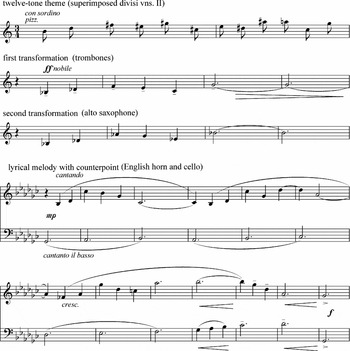
It is as if Bernstein were preparing his audience for a work he would compose only a few years later, his last symphony, Kaddish.Footnote 18 Although successful with his first symphony (Jeremiah, 1942), he had not yet found that “real American symphonic form” or “real American style” conjured up but not defined by the imaginary Broadway Producer in the chapter “Whatever Happened to That Great American Symphony?”Footnote 19 The second symphony (The Age of Anxiety, 1949) was somewhat less successful. Critics were not convinced of the formal experiment and were reminded, apart from the jazzy movement “The Masque,” of European music, including that of Brahms, Britten, Hindemith, Rachmaninov, and Shostakovich.Footnote 20 Bernstein himself was unhappy with the last movement “The Epilogue,” and revised it sixteen years later. Kaddish, on the other hand, reflects the aesthetic of the Joy of Music perfectly. More than in his earlier symphonies, Bernstein tried to be modern but in a way his audience could understand.Footnote 21 Thus he combined tonal and atonal procedures within the same work, conveying the story of a religious journey from confrontation to alienation to rebuilt faith.Footnote 22 In light of Bernstein's association of twelve-tone music with “nightmare,” it is not surprising that confrontation and alienation are captured by twelve-tone themes, rebuilding of faith by a transformation of the first twelve-tone theme into a purely tonal melody (Example 1).Footnote 23
Bernstein, Symphony No. 3, Kaddish,“Scherzo,” mm. 3–4, reh. S, reh. T, and reh. V. © 1963, 1965, 1977, 1980. Copyright assigned 1999 to Amberson Holdings LLC. Leonard Bernstein Music Publishing Company LLC, publisher. Boosey & Hawkes, Inc., sole agent. All rights reserved. International copyright secured. Reprinted by permission.

The texts in The Joy of Music highlight other stylistic aspects dear to Bernstein's heart, and they, too, turn out to play a more significant role in Kaddish than in his earlier symphonies: exhaustive development of related themes without dramatic contrast (including counterpoint, especially fugue) and jazz. The former, according to Bernstein, is both necessary and problematic: necessary because it is intellectually stimulating and thus a sign of high art, problematic because general audiences find it boring. It is this dichotomy that prompted the chapter on the music of Johann Sebastian Bach, as the highly effective opening observation reveals: “BACH! A colossal syllable, one which makes composers tremble, brings performers to their knees, beatifies the Bach-lover, and apparently bores the daylights out of everyone else.”Footnote 24 Bernstein is clearly in awe of Bach's ability to develop material, comparing it to a thorough investigation of an argument: “We have [with Bach] music based on one chain of related themes, which are treated, developed, and investigated to the hilt. This is known as the argumentative technique, the technique of taking one subject and discussing it fully, which sounds, offhand, rather intellectual—and I suppose it is. But whoever said that music had to be easy to be beautiful?”Footnote 25
Development “to the hilt” seems particularly appropriate in Kaddish, a work constituting a big argument between the speaker and God. The “Scherzo” movement, for instance, exhaustively develops a few related motives, both contrapuntally and horizontally, with hardly any dramatic contrast, and fugue appears in two of the symphony's most climactic moments: in “Kaddish 3” (based on the cello counter-point of Example 1 and performed by the boys’ choir) and in the Finale (based on the inversion and tonal transformation of the second twelve-tone melody, first heard in the movement titled “Din-Torah”). The arrival at the first of these fugues shows perhaps better than any other section of the symphony Bernstein's interest in developmental logic, that is, in building: from the twelve-tone row at the end of the “Scherzo,” Bernstein gradually derives the lyrical melody over a somewhat dissonant and open counterpoint (Example 1), which in turn leads to the consonant and full five-part fugue of the boys’ choir at the end of “Kaddish 3.”Footnote 26
In addition to development, jazz plays an enormously important role in The Joy of Music, not only in the chapter dedicated to the topic but also in other chapters. For Bernstein, jazz is the most typical kind of “American” music and, with bebop, begins to “border on serious concert music.”Footnote 27 Even though he accepts jazz as serious art music, Bernstein somehow feels compelled to legitimize it by relating its “linearity” to Bach's counterpoint: “Present-day jazz is also primarily involved with line. That's why jazzmen idolize Bach. For them, he is the great model for the continuously running melody, and this is natural, because Bach and the jazz player both feel music in terms of line—that is, horizontally.”Footnote 28
Bernstein, of course, is trying to make Bach accessible to an audience more familiar with jazz, but the significance in his own compositions—past and future—of jazz and Bach suggests that Bernstein once again is explaining his own work and preparing his audience for his most “American” symphony, yet to be composed. Implicitly, he even dismisses all concert music composed in the United States “up to now” as imitations of European music: “There are those who conclude from all this that here, in [bebop], is the real beginning of serious American music, that at last the American composer has his own expression. Of course when they say this they are intimating that all American symphonic works up to now are nothing but personalized imitations of the European symphonic tradition from Mozart to Mahler. Sometimes, I must say, I think they have a point. At any rate, we can be sure of one thing: that the line between serious music and jazz grows less and less clear. We have serious composers writing in the jazz idiom, and we have jazz musicians becoming serious composers. Perhaps we've stumbled on a theory.”Footnote 29
Thus it seems that with Kaddish Bernstein made one final attempt at finding that “real American symphonic form,” always striving for “that new . . . twentieth-century sound,” in which “the trick is to get away from the standard symphony-orchestra sound that the Germans had built into such a great monument.”Footnote 30 Any evaluation of Bernstein's success in this regard naturally depends on our understanding of jazz. In The Joy of Music, Bernstein casts a wide net, maintaining that much of the rhythmic interest of twentieth-century music “arises from the fascination with jazz” and that “jazz has not only bequeathed new rhythms to music, but . . . taught composers the handling of cross-rhythms.”Footnote 31 Even Stravinsky's famous chords in the “Danse des adolescentes” (Sacre du printemps, part I) and, by implication, many of Bernstein's own rhythmic artifices are taken to be rooted in jazz, even if the Russian tradition or Caribbean dance music present more likely sources. In this light Kaddish, with its rhythms of 3+2+3, asymmetric meters (such as 5/8 and 7/8), frequent changes of meter, and displaced accents, emerges as the most “American” of Bernstein's symphonies. Even instrumentation and melody appear to derive from jazz: Kaddish includes an enormous apparatus of percussion instruments—several of which are singled out in the chapter on jazzFootnote 32 —and the introduction of the “Kaddish tune,” a melody vaguely characterized by blue notes and itself reminiscent of Darius Milhaud's jazzy La création du monde, is introduced by the saxophone (Example 2).Footnote 33
Bernstein, Symphony No. 3, Kaddish, “Invocation,” 3 measures after reh. C. © 1963, 1965, 1977, 1980. Copyright assigned 1999 to Amberson Holdings LLC. Leonard Bernstein Music Publishing Company LLC, publisher. Boosey & Hawkes, Inc., sole agent. All rights reserved. International copyright secured. Reprinted by permission.

Kaddish was “extravagantly praised” after its premiere in Tel Aviv in 1963, and U.S. reviews were often positive too.Footnote 34 Nevertheless, it has turned out to be Bernstein's least performed symphony, the reasons for which surely lie in the highly personal spoken text and the huge performing forces, rather than in the quality of the music.
The Ultimate Work for the Theater
One aspect emphasized in The Joy of Music, the compositional logic Bernstein so admired in Beethoven, is easier to illustrate in the musicals than in the symphonies, because in the musicals Bernstein worked within the context of a relatively clear formal tradition. When he wrote his first musical in 1944, compositional logic, an ideal of Western art music since Beethoven, did not yet have the same status in musical theater, where variety, star power and charisma of the performer, cleverness of the lyrics, and memorability of the tune took precedence.Footnote 35 Aware of this hierarchy, Bernstein saw in compositional sophistication an element he could contribute to the genre, thus transforming and transcending it.
Although West Side Story (1957) is universally acknowledged as one of the most successful contributions to the genre, Bernstein's earlier efforts, On the Town (1944) and Wonderful Town (1953), have rarely received the recognition they deserve.Footnote 36 Compositional sophistication in the service of building an effective song, however, is already evident in On the Town, as a comparison between Bernstein's “Lonely Town” and Richard Rodgers's “If I Loved You” from Carousel (1945) illustrates. Both numbers are part of a longer scene, deal with love and loneliness, and include a chorus modeled on Tin Pan Alley song form (AA′BA″).Footnote 37 Henry Kane's handy guide to writing popular songs (Reference Kane1962) provides the following instructions for the chorus: “State your theme in the first eight bars—which should include the title. Then amplify in the next eight bars. Then build further in your next eight bars. And then come in strong with the punch line and title again. These are the fundamental rules, as a study of the standards will disclose.”Footnote 38
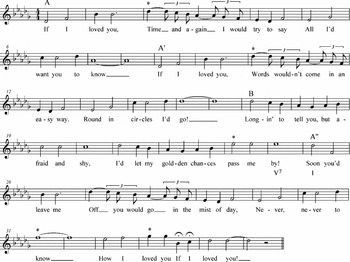
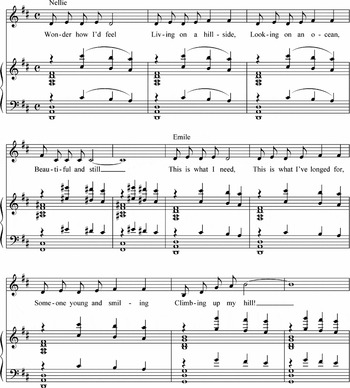
The chorus of “If I Loved You” consists of parallel statements by Julie Jordan and Billy Bigelow that frame a freer middle section. Each character's statement follows the standard AA′BA″ form, and each formal section comprises eight measures; only the final A″ is extended to twelve (Example 3 shows Julie's statement of the chorus).
Rodgers and Hammerstein, Carousel, “If I Loved You” (chorus, vocal part only). © 1945 by Williamson Music. Copyright renewed. This arrangement © 2008 by Williamson Music. International copyright secured. All rights reserved.

In spite of its apparent simplicity, the chorus is carefully constructed. Rodgers creates harmonic tension both within a section, and from one section to the next, building it up by withholding a strong resolution throughout the first two A sections and the harmonically more adventurous B section, suspending it on a climactic dominant seventh, and finally resolving it on a root-position tonic and in perfect synchronization with the beginning of the concluding A″ section. He reinforces this careful harmonic plan with a gradual rise in pitch from D-flats in sections A and A′, to E-flats in section B, and then to Fs and G-flats in section A″ (see asterisks in the example).
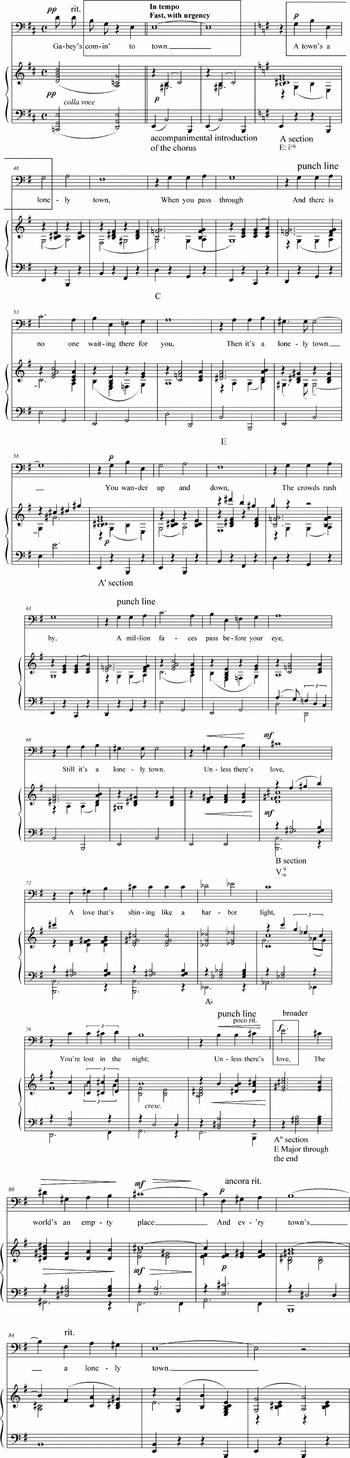
“Lonely Town” draws on similar techniques but greatly exceeds them in sophistication. First of all, it obscures the Tin Pan Alley song form in several ways.Footnote 39 The chorus begins unobtrusively, with the A section gradually emerging from the verse. The opening three pitches of the A section—G, B, and E—are the same pitches that conclude the verse, and in both instances they are associated with the word “town” (Example 4).
Bernstein, On the Town, “Lonely Town,” mm. 44–86. © 1977 by Warner Brothers, Inc. Leonard Bernstein Music Publishing Company LLC, publisher. Boosey & Hawkes, Inc., sole agent. All rights reserved. International copyright secured. Reprinted by permission.

The beginning of the chorus is furthermore obscured by harmonic instability. The accompanimental introduction of mm. 45–46, which belongs to the verse as much as it belongs to the chorus, is clearly in E major, but the tune begins on an E-minor chord with an added sixth. This unobtrusive beginning of the chorus provides the perfect foundation for Bernstein's musical architecture. At “when you pass through,” in mm. 50–51, the harmony sidesteps down to C major, an unexpected, third-related harmony functioning as a tonicized flat-sixth scale degree, only to revert to E, once again on the word “town.”
These twelve measures correspond to the formal A section of the song form. They also introduce the unstable harmonic beginning and the third-related harmonic progression as the seeds from which the rest of the chorus organically grows. The most memorable phrase, the punch line mentioned earlier in Kane's guide to writing songs, does not sound at the beginning of the A section but halfway through, at m. 52. At this point, however, we are in C major and not in the main key of E major, and the return to E major aborts the punch line, leaving the listener harmonically and melodically dissatisfied. The A′ section, which spans mm. 60–70, reinforces the sequence of events of the A section. This time, however, the ending is truncated by one measure to usher in the B section more forcefully. Just like the A sections, the B section begins on an unstable harmony, here a minor dominant harmony with an added sixth and ninth. Now, however, instead of sidestepping down a major third, from E to C, Bernstein sidesteps up an enharmonically altered major third, from E to A-flat. Continuing the rhythmic accelerando initiated by the shortened A′ section, the B section spans only eight measures, the standard length in the song form. By now Bernstein has prepared his song for the perfect climax. By omitting the unobtrusive, harmonically ambiguous first measures of the A and A′ sections and by reverting from A-flat to E, the punch line for the first time sounds in the tonic and comes to a harmonically and melodically satisfying conclusion. In addition, it sounds in a higher, more brilliant register and reaches the highest note of the chorus, the E4 in m. 79. At this point, the punch line, the return to E major, and the highest pitch coincide to create the climax. Although the punch line is certainly memorable, the beginning of the song is not. Bernstein sacrificed a memorable beginning—the sort of beginning people might whistle when leaving the theater—for a musical architecture worthy of Beethoven.
It may be difficult today to understand why “Lonely Town” would not have been considered a “hit.”Footnote 40 Whereas Rodgers's tune, like many of Gershwin's, could stand without the support of the harmony, Bernstein's would lose its essence.Footnote 41 The tonicizations of third-related keys, which provide the building blocks for the climax and so effectively tickle our senses, are almost all effected by the orchestra while the singer is silent.
Why would Bernstein sacrifice “a hit” and maintain such a high level of musical sophistication, even though it clearly bothered him that no one whistled his tunes and neither radio nor television programmed them? The reason lies in his ambition to become an acknowledged composer of serious music. He was torn between conducting, which earned him tremendous success, and composing, which also earned him success but mostly in lighter genres: the ballet Fancy Free and the musicals On the Town, Wonderful Town, and West Side Story, the kind of music his mentor Serge Koussevitzky despised. Although Bernstein surprised the music world with his first symphony, Jeremiah, a work Paul Bowles felt “outrank[ed] every other symphonic product by any American composer of the younger generation,”Footnote 42 his later efforts, The Age of Anxiety and Kaddish, were somewhat less successful, and his only full-length opera, A Quiet Place (1983), was an outright failure.Footnote 43
In the chapter “American Musical Comedy,” Bernstein compares the American musical in 1956 (the year his lecture on the musical aired on television) with the singspiel in Germany before the Magic Flute, that is, before the composition of the genre's quintessential work. With Candide going into production and West Side Story virtually completed, nobody could have doubted that his reference to Mozart was setting the stage for his latest two works: “We are in the same position; all we need is for our Mozart to come along. If and when he does, we surely won't get any Magic Flute; what we'll get will be in a new form, and perhaps ‘opera’ will be the wrong word for it. There must be a more exciting word for such an exciting event. And this event can happen any second. It's almost as though it is our moment in history, as if there is a historical necessity that gives us such a wealth of creative talent at this precise time.”Footnote 44
So obsessed was Bernstein with the idea of the impending arrival of an “American” Mozart that he also mentioned it in his chapter “Whatever Happened to That Great American Symphony?” although here we find ourselves first in the seventeenth century, then fifty years before Mozart, and then immediately before Mozart. In this imaginary conversation (here in letters), where Bernstein lets himself be persuaded by the Broadway Producer to abandon his new symphony for a Broadway musical, the Producer comes “to the meat of [his] theory,” writing to Bernstein:
The point I want to make with all my might is that America right now seems to me to be, musically, just about where Germany was around the seventeenth century. Deep in the singspiel. But our secular music is just about where German music was fifty years before Mozart. Only our singspiels are called Oklahoma! and Can-Can. This is a period we must pass through before we can arrive at a real American symphonic form, or a real American style of whatever kind of concert music. It may not be the symphony as we have known it: we may produce something very different. But the musical language it will speak must first be created in our theater; then one day it can be divorced from “meaning” and stand alone, abstract. . . .
And here we are at the point of building that singspiel into real opera—or, in our terms, developing Pal Joey into whatever American music is going to become. We are all ready and waiting for the Mozart to come along and just simply do it. That's why I'm in the producing business: I want to be there when it happens, if I live that long. I'm taking bids on the new Mozart. Any comers?Footnote 45
Two well-known essays, by Larry Stempel and Karl Dietrich Gräwe, have discussed Bernstein's anticipation of an “American genius” in relation to West Side Story. But with his curiously narrow definition of “composition,” discussed earlier, and an equally curious distortion of the history of the musical in the United States, to be discussed next, Bernstein's efforts to establish himself as a serious musician go considerably further than Stempel and Gräwe suggest.Footnote 47
In “American Musical Comedy,” Bernstein outlines a generally convincing although brief, history of the genre, beginning with The Black Crook (1866) and ending with South Pacific (1949). Laying out his aesthetic, he maintains that a mature American musical needs a coherent American plot, songs motivated by this plot, natural American speech, “unified variety,” and a musical style imbued with jazz. This fairly narrow and decidedly personal definition allowed Bernstein to exclude from the canon of American musicals works with a historical significance that might have rivaled his own. First and foremost among them is Jerome Kern and Oscar Hammerstein's Show Boat, which Bernstein disqualifies as a musical and assigns to the genre of the operetta:
So the question of musical comedy versus operetta is a more complex one than you perhaps imagined. For example, Show Boat is an operetta. Here you have a beloved work by Kern and Hammerstein which has as American a theme as we've ever had, but deals with an aspect of America which is far from the experience of the very Broadway public for whom it was created. Remember that New York is the garden in which this whole history grew, so what we mean by an American theme is one which does not seem foreign to that New York public. Show Boat, being about flavorsome life on the old Mississippi, is in that sense a true operetta.
Besides, it employs highly regional language, not what we mean by “the vernacular.” Don't mistake me: by vernacular I don't mean only tough Broadway lingo; I mean a familiar, easy American speech pattern, not thick Southern dialect. So by this standard as well, Show Boat is basically an operetta. So is The King and I, which is usually called a musical comedy, and so are Fanny and Carousel too—all operettas. They are written, it is true, in the most up-to-date Broadway manner, utilizing all the advances in taste and technique, but operettas none the less.
Musically, too, they are operettas in that they don't employ the musical vernacular of Broadway. In other words, they don't use jazz—urban jazz, which is the essence of American popular music. The songs of these shows are closer to art songs than they are to Tin Pan Alley.Footnote 48
It was more common during the 1920s and 1930s than it is today to distinguish between operetta and musical, but the criteria used for this distinction are anything but clear. Geoffrey Block suggests that both genres included romantic ballads, but whereas operettas preferred exotic locations and the contrapuntal style and voice types of opera, the musical preferred urban settings and, in addition to the romantic ballads, drew on “vernacularly inflected rhythms and melody” derived from ragtime, blues, and (after 1930) swing.Footnote 49 This distinction, compatible with Bernstein's, cannot have been one that was generally acknowledged, because Show Boat was and continued to be categorized variously as an operetta, a musical, or even an opera.Footnote 50 When, at the out-of-town tryout of Show Boat in Washington, D.C., the performance had to be delayed, for instance, Charles Winninger, who played Cap'n Andy Hawks, appeared before the curtain, asking the audience for patience “on behalf of the new opera about to begin,” and playbills and magazines repeatedly called Show Boat an operetta.Footnote 51 On the other hand, Richard Rodgers understood that Kern had gone beyond operetta, recognizing that he “amalgamated it with everything that was fresh in the American scene to give us something wonderfully new and clear in music writing.”Footnote 52 Commentators predominantly called Show Boat a musical, not least the original producer of the show, Florenz Ziegfeld, who for the New York premiere in 1927 advertised it as “An All American Musical Comedy.”Footnote 53
It seems that associations of Show Boat with light opera or operetta stemmed from traditional conceptions of genre rather than from intrinsic musical or dramatic qualities. At a time when unified plots were characteristic of operetta rather than musical, it is not surprising that Show Boat was sometimes placed in that category.Footnote 54 By the time of Bernstein's telecast, however, both designations of genre were common, with musical outweighing operetta.Footnote 55 In 1954 New Yorker critic Winthrop Sargeant, reviewing a revival of Show Boat at the New York City Opera, called the work a “masterpiece of its kind, and a much more genuine example of American musical theatre than most self-consciously American operas that I can recall.”Footnote 56
Bernstein, of course, justifies the designation “operetta” through the use of regional language and the absence of jazz. Regional language appears prominently in Oklahoma! (a work Bernstein counts as a musical), however, and jazz, contrary to Bernstein's assertion, does characterize portions of Show Boat. As Arthur B. Waters noticed in his 1927 review for the Philadelphia Public Ledger, “[Kern] has blended the Negro spirituals of the Southland with jazz of today.”Footnote 57 For some reason, the jazziest number, “It's Getting Hotter in the North” (act II, scene 9), was replaced after the Washington tryout, but other numbers also include elements of jazz, especially syncopation, blue notes, and jazz instrumentation (e.g., Queenie's “Hey Feller!”).Footnote 58 True, jazz of the 1920s was not necessarily recognized as jazz in the 1950s, when bebop was hailed as the epitome of the genre, an autonomous art free of ties to folk music, dance, or commercialism.Footnote 59 Not only was Bernstein aware of this history, but he also outlined it in “The World of Jazz” (another chapter in The Joy of Music),Footnote 60 and most of the elements of jazz he discussed do appear in Show Boat. Only improvisation is missing, but improvisation surely does not constitute a defining element of the musical; not even Bernstein's own contributions to the genre include improvisation to any significant degree.Footnote 61
As Geoffrey Block has pointed out, Show Boat succeeded in entering the repertory of the New York City Opera, thus becoming the first musical to “attain operatic stature.”Footnote 62 Such an achievement was in direct competition with Bernstein's goals for his own musicals, which (with the exception of Candide) feature natural American speech and jazz elements prominently and in their sophistication and seriousness often border on opera. It is as if Bernstein downplayed the historical significance of Show Boat, an icon of the musical, for the benefit of his own works.Footnote 63
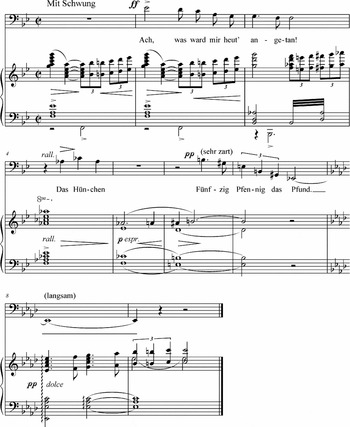
Having defined the musical as an inherently “American” genre, Bernstein concludes that the true American stage work will have to come in the form of a sophisticated musical that would be close to opera without actually being opera, because, he claims, opera is too “fancy” and thus is remote from the experience of American audiences.Footnote 64 He begins his survey with a list of genres ranging from the variety show to Wagnerian music drama and organizes it by artistic intention (that is, entertainment at the low end and ennoblement of the audience at the high end) and plot development (no plot at the low end and a coherent plot furthered through music at the high end). The issue of plot development through music quickly leads Bernstein to an illustration of operatic recitative, which, he explains, “sets up the situation for the song.” He then illustrates how—in the styles of Mozart, Verdi, and Wagner—a husband would convey to his wife that the price of chicken has gone up three cents a pound. As so often in Bernstein's television programs, such illustrations are meant to “disarm the audience,” to introduce a potentially difficult concept in a humorous way and thus to make it less intimidating.Footnote 65 His illustrations of recitative are highly entertaining and impressive as stylistic imitations, but their entertainment value outweighs their ability to explain recitative, especially because the Wagnerian example, with its opening melodic parallelism in the orchestra and the resulting constriction of the vocal part to a strict beat, cannot possibly pass for recitative (Example 5).Footnote 66 Bernstein then rejects recitative as a viable option for the musical, calling it “so fancy and operatic, the very opposite of what we think of as the Broadway spirit,”Footnote 67 and the audience eagerly awaits what “American” solution the musical might have to offer.
Bernstein, The Joy of Music, “American Musical Comedy,” example of a Wagnerian recitative. © 1954, 1955, 1956, 1957, 1958, 1959 by Leonard Bernstein. © 2004 by the Leonard Bernstein Office, Inc.

Recitative then disappears as a subject until the discussion of South Pacific, in particular the “Twin Soliloquies” bridging “A Cockeyed Optimist” and “Some Enchanted Evening.” Whereas Bernstein presents the operatic examples at the beginning of the chapter as typical recitatives, he characterizes the “Twin Soliloquies” as “neither a song . . . nor a recitative.”Footnote 68 The passage from Rodgers's musical (for which Bernstein provides only the lyrics) does indeed mix elements of song and recitative: the accompanimental pattern and the clearly structured phrases belong to song; the static harmonic underpinning, the perfect agreement of textual and musical accents, and the relatively low degree of lyricism in the melodic line belong to recitative (Example 6). Opera, however, had long blurred the distinction between recitative and aria, and it would be hard to argue that the style of the “Twin Soliloquies” constitutes a more unique blend than the Wagnerian passage presented earlier.
Rodgers and Hammerstein, South Pacific, “Twin Soliloquies,” mm. 3–12. © 1949 by Richard Rodgers and Oscar Hammerstein II. Copyright renewed. This arrangement © 2008 by Williamson Music. Williamson Music owner of publication and allied rights throughout the world. International copyright secured. All rights reserved.

The most meaningful explanation of Bernstein's detour through operatic recitative lies once again in his ulterior motive: even though he presents opera as the most lofty form of musical theater, he subtly characterizes it as fancy and implicitly “un-American.” On the other hand, the arioso of the “Twin Soliloquies” in South Pacific is presented as one of the greatest achievements of the American musical, as “standing firmly on operatic ground” without “seeming ridiculously operatic.” Bernstein concludes that “again, our musical comedy has moved toward opera but in our own way.”Footnote 69 In fact, Bernstein loved opera; he talked about it with great passion (as in “What Makes Opera Grand?” the final chapter in The Joy of Music), recorded it, and conducted it more frequently than the musical.Footnote 70 In the chapter on the musical, however, he intended to promote the quality of his most recent work. Now only genius was needed, the genius of a Mozart, who might transform the musical and create the ultimate “American” musical stage work. West Side Story, in Bernstein's mind, must have had the potential to become that work.
During the gestation of West Side Story, the question of genre—especially its relationship to opera—was much discussed. Although the creators of the show—Bernstein, Arthur Laurents, and Jerome Robbins—intended to steer clear of opera, they saw that West Side Story was in constant danger of becoming too operatic. The issue already emerged when Robbins first proposed the project, as Bernstein recorded in his “log”: “But it's all much less important than the bigger idea of making a musical that tells a tragic story in musical-comedy terms, using only musical-comedy techniques, never falling into the ‘operatic’ trap.” Four days later, the entry reads: “Met Arthur at Jerry's tonight. Long talk about opera versus whatever this should be. Fascinating.”Footnote 71
For 17 March 1956 of the same “log,” about half a year before the telecast of the lecture concerning the American musical, Bernstein recorded: “It's such a problematical work. . . . Chief problem: to tread the fine line between opera and Broadway,” and during the rehearsals in July 1957: “I can't believe it: forty kids are actually doing it up there on the stage! Forty kids singing five-part counterpoint who never sang before—and sounding like heaven. I guess we were right not to cast ‘singers’: anything that sounded more professional would inevitably sound more experienced, and then the ‘kid’ quality would be gone. A perfect example of a disadvantage turned into a virtue.”Footnote 72
Although this sequence of events may be correct, Bernstein is not exactly truthful in calling the document a “log.” Most probably it was not written during the gestation of the show but rather devised after the premiere as an article for the 25 September issue of Playbill.Footnote 73 Whether accurate or not, Bernstein was obviously interested in publicizing a history of West Side Story that painted the work as a fascinating hybrid of opera and musical.
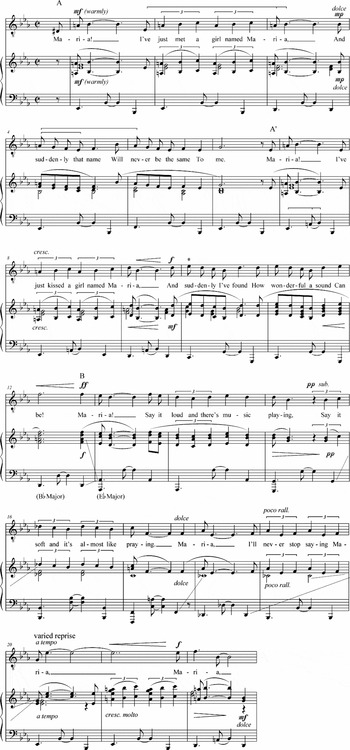
Although Bernstein was intent on writing a musical, he consciously included the operatic elements mentioned in his lecture: “a tragic story . . ., ‘serious’ music and complicated balletics.”Footnote 74 Even more than the numbers of On the Town, those of West Side Story are characterized by a level of sophistication that show Bernstein's ambitions as a serious composer. “Maria” (no. 5), the number most closely related to “Lonely Town,” exemplifies this trend. The melodic theme of the piece is a transformation of the “Cha cha” heard in the preceding “Dance at the Gym” (no. 4), but “Maria” can easily be understood as a self-contained song in a modified Tin Pan Alley format.Footnote 75 After a short verse, there is a chorus in AA′B form, a varied reprise of the chorus, and a brief coda.Footnote 76 The reprise turns out to be much more than a varied repetition of the chorus, however, because it functions both as an emotional culmination and a harmonic conclusion of a process Bernstein set in motion at the very beginning of the song. As in “Lonely Town,” he logically builds the entire piece from the opening materials, here the first two intervals.
Virtually every analysis of “Maria” mentions the unusual initial melodic progression of an ascending tritone followed by an ascending minor second, but none has yet explored the extent to which Bernstein builds on these intervals to construct his musical edifice (see Example 7). He first repeats the opening cell (D-sharp/E-flat–A-natural–B-flat) by interpolating after the first note a set of repeated triplets (m. 2) and then changes melodic direction, filling the space of the opening cell by passing first through A-natural (thus elaborating on the tritone [m. 4]) and then through A-flat (thus elaborating on the minor second A-natural–A-flat [m. 5]). Section A′ begins the same way as section A, but in the second half Bernstein transposes the descending figure so as to place the highest note (E-flat, the asterisk in m. 10) a tritone higher than its corresponding note in section A (m. 4). At the same time, the syncopated bass figure of the beginning is now expanded (again by interpolation) to imitate the opening cell of the vocal line (mm. 7–9).
Bernstein, West Side Story, “Maria,” mm. 1–22. © 1956, 1957, 1958, 1959 by Amberson Holdings LLC and Stephen Sondheim. Leonard Bernstein Music Publishing Company LLC, publisher. Boosey & Hawkes, Inc., sole agent. All rights reserved. International copyright secured. Reprinted by permission.

At the end of section A′, the harmony touches on B-flat major and in m. 13 returns to the home key of E-flat major, once again juxtaposing the A-natural (of B-flat major) and A-flat (of E-flat major). In the bass this return to the tonic is highlighted by the tritone D–A-flat. Thus, just as Tony, now fortissimo and full of abandon, repeats the name of his beloved, Bernstein superimposes in a cross-relation melodic progressions by the two most important thematic intervals, the tritone and the minor second.
As the melody of the B section gradually descends through the octave, the tritone continues to control the harmonic language but in tandem with the decreasing tension appears in less and less prominent positions: first, as mentioned, in the bottom voice (D to A-flat; mm. 12–13), then between the bottom and top voices (G to D-flat; mm. 15–16), then hidden between bottom and inner voices (F to C-flat; mm. 17–18), and finally between bottom and top voices but separated by a measure (D-flat to G; mm. 18 and 20). In the last case, D-flat is heard as the root of the dominant of G-flat major (D-flat–F–A-flat–C-flat), which, through a subtly introduced low B-flat in m. 19, is resolved not as expected to G-flat major but, through a  progression in the bass, to the home key of E-flat major. As with the climax in m. 13, the harmonic resolution in m. 20 once again involves a cross-relation (C-flat to C).
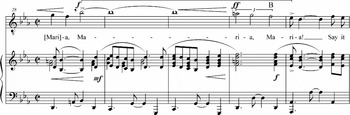
Bernstein's sophisticated edifice is not yet complete. Halfway through the reprise of the chorus, he raises the descending scalar passage of mm. 3–4 (B-flat–A-natural–G–F–E-flat) by an octave, stretches the note values, superimposes the resulting vocal line fortissimo on the melody in the orchestra, and merges the two exactly at the climactic transition from A′ to B (Example 8).
Bernstein, West Side Story, “Maria,” mm. 28–32. © 1956, 1957, 1958, 1959 by Amberson Holdings LLC and Stephen Sondheim. Leonard Bernstein Music Publishing Company LLC, publisher. Boosey & Hawkes, Inc., sole agent. All rights reserved. International copyright secured. Reprinted by permission.

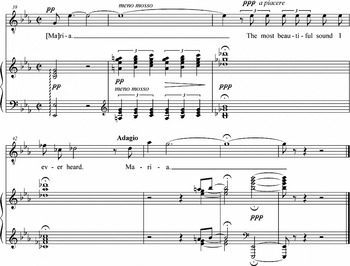
At the end of the B section, Bernstein finally resolves, albeit with an added sixth in the vocal part, the dominant-seventh chord of G-flat from m. 18, then wrenches the harmony, through a permutated transposition (D-flat–A-flat–G) of the opening melodic cell, back to E-flat major and punctuates the arrival not with a V–I cadence but with a harmonic version of the tritone (E-flat–A-natural) resolving to the fifth (E-flat–B-flat; Example 9). This kind of integration of melodic, harmonic, and formal elements surpasses even “Lonely Town” in sophistication and once again shows Bernstein's compositional logic and his ability “to build.”
Bernstein, West Side Story, “Maria,” mm. 39–45. © 1956, 1957, 1958, 1959 by Amberson Holdings LLC and Stephen Sondheim. Leonard Bernstein Music Publishing Company LLC, publisher. Boosey & Hawkes, Inc., sole agent. All rights reserved. International copyright secured. Reprinted by permission.

When it came to recording this sophisticated score for Deutsche Grammophon in 1985, Bernstein chose operatic voices: Kiri te Kanawa as Maria, José Carreras as Tony, Tatyana Troyanos as Anita, and Kurt Ollman as Riff. Casting “kids” may have been appropriate to the drama, but it did not do justice to the score. In this 1985 recording, the only recording of the work he conducted himself, Bernstein could finally take the tempos he wished because the singers were able to sustain the lines. Whereas Carol Lawrence, the first Maria, felt that the casting of Carreras “defied the truth of the character”Footnote 77 and David Schiff lamented that “a decade of this kind of high-class performance will kill off the [Broadway musical] for good,”Footnote 78 Bernstein saw in it “a fresh element” only Carreras could bring to the part.Footnote 79 Most importantly, though, Bernstein moved West Side Story even closer to opera than Rodgers and Hammerstein had done with South Pacific.
Bernstein had always wanted to succeed with a truly “American” opera,Footnote 80 but he also wanted to create that ultimate American work close to opera, rooted in the musical. The prospects of writing that ultimate American stage work seemed more promising, however, as Olin Downes suggested in his review of the original production of Wonderful Town: “[It] is utterly American in conception and execution, from crown to toe, in a way that is current and characteristic of our people, and not paralleled by any other musical theatre, for better or worse, of the contemporaneous world. . . . Indeed we are coming to believe that when the American opera created by a composer of the stature of the Wagners and Verdis of yore does materialize, it will owe much more to the robust spirit and the raciness of accent of our popular theatre than to the efforts of our prideful emulators, in the upper esthetic brackets, of the tonal art of Bartók, Hindemith and Stravinsky.”Footnote 81 In the end, though, both goals eluded Bernstein, at least in the public's mind. The operas never enjoyed the necessary success, and the musicals, although successful, were never seen as anything other than musicals.
The ultimate American musical stage work had not yet materialized by the time Bernstein recorded West Side Story in the 1980s, but the ostensibly educational essays and lectures of The Joy of Music had paved the way by outlining the essential requirements, most notably perfect songs (those that build) and the perfect genre (one that matches opera in sophistication but grows from the tradition of the musical). West Side Story, always problematic as a genre in Bernstein's mind, was marked by all the characteristics associated both with the sophistication of opera and with the new kind of American musical he had envisioned. Making one last effort, Bernstein returned to this work to record it with operatic voices and hoped that, at least in the form of a recording, he might finally fulfill his long-held wish to create a true “American” stage work that would be close to opera without actually being opera.