Costello syndrome is a complex developmental disorder involving characteristic craniofacial features, neurocognitive delay, failure to thrive, cardiac abnormalities, endocrine and skeletal anomalies and a predisposition to develop neoplasia, both benign and malignant.Reference van Eeghen, van Gelderen and Hennekam1 The use of the growth hormone in Costello syndrome remains controversial because of two important risks: the exacerbation of hypertrophic cardiomyopathy and the development of malignancy.Reference Kerr, Einaudi and Clayton2 We describe a 6-year-old boy with Costello syndrome who developed hypertrophic cardiomyopathy while receiving growth hormone therapy.
Case report
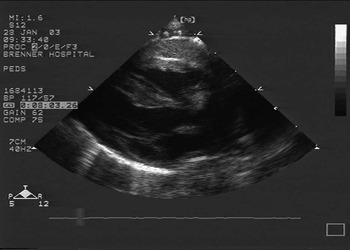
The male infant was born at 37 weeks gestation via caesarean section to a 32-year-old Hispanic mother. Pregnancy was complicated with polyhydramnios. Delivery was complicated by thick meconium in the amniotic fluid. Apgar scores were 2 and 3 at 1 and 5 minutes, respectively. Physical examination revealed redundant skin around the neck, back and extremities, overlapping digits, and global hypotonia. Cardiac examination was normal. Echocardiography showed left-sided asymmetric septal hypertrophy with right ventricular hypertrophy (Fig 1). Family history was negative for congenital anomalies and genetic syndromes. Echocardiography at 3 months of age revealed mild concentric left ventricular hypertrophy with no left ventricular outflow obstruction and at 9 months showed spontaneous resolution of the asymmetric septal and concentric ventricular hypertrophy.
Echocardiography at birth – long-axis view showing asymmetric left ventricular septal hypertrophy.

Re-evaluation, secondary to a cardiac murmur, at 3 years of age revealed a systolic ejection murmur – grade 1 out of 6 – at the left lower sternal border. We made a diagnosis of an innocent murmur, but an echocardiogram was not available.
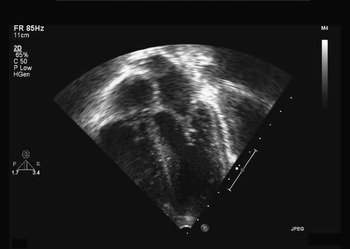
Repeat evaluation for an increasingly harsh cardiac murmur occurred at 6.5 years of age. Physical examination revealed a systolic ejection murmur – grade 3 out of 6 – at the left lower sternal border. In addition, we found coarse facial features, short stature, and developmental delay in the patient. Repeat echocardiography revealed moderate concentric left ventricular hypertrophy with dynamic left ventricular outflow tract obstruction with a peak instantaneous pressure gradient of 144 millimetres of mercury (Fig 2). He started to receive a dose of propranolol of 1 milligram per kilogram per day. We consulted a geneticist after these findings.
Echocardiography at 6.5 years of age – a four-chamber view showing asymmetric left ventricular hypertrophy with dynamic left ventricular outflow tract obstruction.

Historically, we evaluated the patient genetically at birth, 5, 12, and 19 months of age and found him to have coarse facial features, developmental delay, feeding difficulty, cerebral palsy, relative macrocephaly, short stature, and loose skin and horizontal nystagmus. However, he did not undergo any unifying diagnosis. The karyotype was normal and fluorescent in situ hybridisation for Williams syndrome was negative. We re-evaluated him genetically at 6 years of age, after the recurrent diagnosis of hypertrophic cardiomyopathy and found him to have Costello syndrome at diagnosis. Testing of the HRAS gene mutation was positive.
Furthermore, he received the attention of a paediatric endocrinologist for short stature. He was diagnosed with growth hormone deficiency secondary to hypopituitarism and received growth hormone therapy at 4 years of age. His growth hormone therapy was discontinued on account of the concern for growth hormone-induced hypertrophic cardiomyopathy.
Discussion
The major manifestations of Costello syndrome are postnatal growth deficiency, developmental delay, relative macrocephaly, coarse face, thick ears, thick lips, depressed nasal bridge with anteverted nares, excess skin, thick palms and soles, short neck, curly hair, nasal papillomata, and sociable personality.Reference van Eeghen, van Gelderen and Hennekam1 Mutations in HRAS are considered to be responsible for Costello syndrome.Reference Aoki, Niihori and Kawame3 The resulting increased activation of the abnormal HRAS gene product has been documented as an oncogenic mechanism, leading to tumour predisposition in Costello syndrome.Reference Giehl4
Phenotypical overlap of Costello syndrome with Noonan syndrome and cardiofaciocutaneous syndrome is well known, and therefore, the diagnosis in a young infant can be challenging.Reference Quezada and Gripp5 Diagnostic features useful for recognition of Costello syndrome in the first year of age were proposed as the following: foetal and neonatal macrosomia with subsequent slow growth due to severe feeding difficulties; developmental delay; particularly coarse facial dysmorphisms and gingival hyperplasia; skeletal anomalies as osteoporosis and metaphyseal enlargement; hypertrophic cardiomyopathy with asymmetric septal thickening and systolic anterior motion of the mitral valve; and specific atrial arrythmias.Reference Digilio, Sarkozy and Capolino6 Testing of HRAS gene mutation can facilitate the early recognition of Costello syndrome if clinically suspected.
Detailed delineation of cardiac abnormalities in Costello syndrome was reported in 94 patients.Reference Lin, Grossfeld and Hamilton7 Cardiovascular malformation was noted in 30% of young infants, typically pulmonic stenosis. Cardiac hypertrophy was reported in 34%, which involved the left ventricle in 50%, and was usually consistent with classic hypertrophic cardiomyopathy. Arrhythmia was reported in 33%. Most of them (74%) had atrial tachycardia, which was reported as supraventricular, chaotic, multi-focal, or ectopic. Natural history of cardiac abnormalities was reported in 122 patients with Costello syndrome.Reference Rauen, Hefner and Carrillo8 Pulmonic stenosis rarely progressed. Hypertrophic cardiomyopathy could change over time. Interestingly, in some patients (5%) the condition of hypertrophic cardiomyopathy resolved. In our case, asymmetric cardiomyopathy was noted at birth, but had resolved by 9 months of age. At present, there are no symptomatic arrhythmias.
The possible effects of growth hormone in causing progression of hypertrophic cardiomyopathy in Costello syndrome have been emphasised.Reference Kerr, Einaudi and Clayton2 The effects of growth hormone on hypertrophic cardiomyopathy have been reported in 48 patients with Costello syndrome.Reference Rauen, Hefner and Carrillo8 A growth hormone was used in 15 (31%) out of 48 patients and hypertrophic cardiomyopathy severity increased in 3 (20%) out of 15 patients. Among 33 out of 48 patients who did not use a growth hormone, 22% with moderate-to-severe hypertrophic cardiomyopathy had an increase in severity. There was no significant difference between the groups. In our case, asymmetric septal hypertrophy noted at birth resolved at 9 months of age. However, moderate concentric left ventricular hypertrophy with significant left ventricular outflow tract obstruction developed while on growth hormone therapy. Therefore, the use of a growth hormone in Costello syndrome should be undertaken only after a thorough examination of the possible risks and close monitoring. In addition, discontinuation of the growth hormone should be a primary consideration at the first sign of hypertrophic cardiomyopathy.
In the case of our patient, the reappearance of hypertrophic cardiomyopathy led to the diagnosis of Costello syndrome. If this diagnosis had been reached in the neonatal period through genetic testing, it might have prevented the severe cardiomyopathy induced by growth hormone therapy. Genetic testing, including that of the HRAS gene mutation, should be considered in neonates with hypertrophic cardiomyopathy.