Introduction
Endospermum Benth. (Euphorbiaceae) is a small genus of dioecious (rarely monoecious) trees comprising 10 species (Webster, Reference Webster1994; Radcliffe-Smith, Reference Radcliffe-Smith2001). The genus has a palaeotropical distribution, ranging from continental Southeast Asia and throughout Malesia to the west Pacific and northeastern Australia. In the Malesian region, eight species are recognised. They can be found in primary and secondary forests, disturbed areas, along streams and along roadsides on a large variety of soils at altitudes ranging from sea level to 2500 m.
Bentham (Reference Bentham1861) described the genus based on a single species, Endospermum chinense Benth. from Hong Kong. He classified Endospermum in the tribe Crotoneae. The generic name Endospermum is a combination of the Greek words ‘endos’ (within) and ‘sperma’ (seed), indicating that the seed remains locked up in the fruit (Backer, Reference Backer1936). The fruits of Endospermum are baccate (berry-like) and indehiscent with the seed or seeds immersed in a fleshy pulp. Independently, Teijsmann & Binnendijk (Reference Teijsmann and Binnendijk1867) proposed a new monotypic genus, Capellenia Teijsm. & Binn., based on specimens from the Moluccas and called the species C. moluccana Teijsm. & Binn. However, Kurz (Reference Kurz1867) noticed the similarity with Endospermum and renamed the species Endospermum moluccanum (Teijsm. & Binn.) Kurz. The first revision of the genus was undertaken by Pax and Hoffmann in Reference Pax, Hoffmann and Engler1912. They recognised 10 species based on variable characters such as hairiness, leaf shape and venation and placed Endospermum in tribe Gelonieae. They also proposed a subgeneric classification and distinguished two subgenera: Euendospermum Pax, an invalid name for the autonym Endospermum, with non-peltate leaves and 2-locular ovaries, and Capellenia (Teijsm. & Binn.) Pax with peltate leaves and 4–6-locular ovaries. The peltate or non-peltate condition of the blade is an unreliable character because of its variability and, consequently, when more species were described, the classification became unworkable. The latest taxonomic revision of the whole genus was undertaken by Schaeffer (Reference Schaeffer1971). He described two new species, synonymised seven names and recognised 12 species in total.
Webster (Reference Webster1994) and Radcliffe-Smith (Reference Radcliffe-Smith2001) classified Endospermum in the uniovulate subfamily Crotonoideae (Euphorbiaceae s.str.), tribe Adenoclineae (based on the colporate pollen, non-articulate laticifers, absence of petals, axillary inflorescences) and monogeneric subtribe Endosperminae (based on the stellate indumentum, connate stamens, 1–7-locular ovaries, indistinct style, discoid stigma). Wurdack et al. (Reference Wurdack, Hoffmann and Chase2005) showed in their phylogeny, based on the plastid molecular markers rbcL and trnL-F, that Endospermum is related to genera like Ditta Griseb., Omphalea L. and Tetrorchidium Poepp. and together they are the sister group of the clade Adenocline Turcz. and Klaineanthus Pierre ex Prain; all these genera are called Adenoclineae s.l. by Wurdack et al. and they are part of the subfamily Crotonoideae s.l.
There is enormous variability in some vegetative morphological characters such as leaf shape, venation and density of hairs in most species of Endospermum. This makes the recognition of species difficult, especially when they are sterile. Therefore, they can only be identified by a combination of characters.
Morphological and Ecologically Important Characters
Myrmecophily
Two New Guinean species, Endospermum moluccanum (Fig. 9a) and E. myrmecophilum L.S.Sm., have hollow branches with pores and they are inhabited by ants. These characters are invariable except for the specimens of Endospermum moluccanum cultivated in the Botanical Garden of Bogor (Java), which still have stems filled with a soft, wide pith due to the absence of the specific ant, Camponotus quadriceps. Note that the species without ants have a narrow, harder pith, which means that the myrmecophytic plants are still recognisable, even in the absence of hollow twigs. The species do not have hollow twigs when young; the twigs have to be hollowed out by ants as was observed by Docters van Leeuwen (Reference Docters van Leeuwen1929) for Endospermum moluccanum. The ants chew away and remove the pith from the inside of the plant. Endospermum moluccanum not only provides the black ants with a shelter for their colony; it also grows food bodies (extrafloral nectaries) on which the ants feed. Endospermum moluccanum benefits because the ants offer protection from herbivory. Queens of Camponotus quadriceps bore a hole in the stem and start to colonise the plant. As the colony develops, worker ants hollow the stem, leaving a smooth-walled inner stem as a domicile. Camponotus quadriceps ants are nocturnal, and only occasionally emerge from the stem during the day to visit and feed on the extrafloral nectaries located near the leaf insertion. However, when the plant is disturbed, the ants swarm out by the hundreds, irrespective of the time of day, and attack the intruders (Letourneau, Reference Letourneau1999). The presence of Camponotus quadriceps colonies in Endospermum moluccanum enhances the fitness of the plants not only by protecting them from exophagous herbivores such as caterpillars, but also by defending them from attacks by endophagous herbivores such as stem borers and stem miners (dipteran and coleopteran borers), which live in and damage the vascular tissue of the host plants. Studies on Endospermum moluccanum saplings (Letourneau, Reference Letourneau1999) showed that stem boring and stem miner damage were significantly more common in plants lacking Camponotus quadriceps colonies than in plants with established colonies.
Other studies on myrmecophilic species of Macaranga Thouars (Euphorbiaceae) in Southeast Asia (Fiala et al., Reference Fiala, Maschwitz, Pong and Helbig1989) also showed the important role of the mutualistic ant Crematogaster borneensis for protection against herbivory and plant competition. These ants also hollow the stems and bite off any foreign plant, especially vines, that come in contact with their host plant. This allows the pioneer Macaranga species to colonise places in spite of strong competition.
Extrafloral nectaries and glands
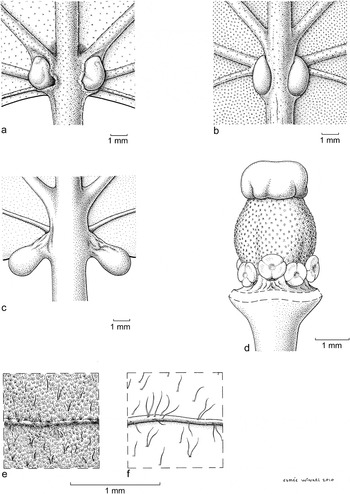
Extrafloral nectaries are glands that produce nectar but which are found outside the flowers. They are thus not involved in pollination when present on leaves but serve to attract and feed the ants (So, Reference So2004). All the Malesian Endospermum species usually have two extrafloral nectaries (Figs 1a–c, 5c, 9b), visible to the naked eye, on the lower leaf surface near the leaf insertion or occasionally on the petiole apex. The shape varies depending on the species, although within the same species there is also some variability. The shape varies from round (e.g. Endospermum domatiophorum J.Schaeff., Fig. 1a) to cylindrical (e.g. E. quadriloculare Pax & K.Hoffm., Fig. 1c, and E. peltatum Merr.), to flattened elliptical (e.g. E. myrmecophilum, Fig. 1b).
Important morphological characters in Endospermum. – Extrafloral nectaries: a, E. domatiophorum J.Schaeff.; b, E. myrmecophilum L.S.Sm.; c, E. quadriloculare Pax & K.Hoffm. – d, ‘hermaphrodite flower’: E. quadriloculare Pax & K.Hoffm. (formerly E. banghamii Merr.). – Hair types: e, short, stellately bundled hairs with longer simple hairs, E. medullosum L.S.Sm.; f, long stellately bundled hairs, E. peltatum Merr. a from Pullen 6401; b from NGF (Eddowes & Kumul) 38116 (L); c from KEP FRI (Whitmore) 849 (L); d from Bangham & Bangham 739 (K); e from NGF (Frodin) 26677 (L); f from SAN (Krispinus) 94828 (L). Drawn by Esmée Winkel, 2010.

Other types of glands can also be found. There are glands in the first and second bifurcation of the nerves on the lower leaf surface (Fig. 5a, right leaf). Rounded, minute glands along the margin of the upper leaf surface are less conspicuous. These are numerous and always present in species like Endospermum diadenum (Miq.) Airy Shaw (Fig. 5b), E. medullosum L.S.Sm. and E. peltatum but are absent or rarely present in other species (e.g. E. ovatum Merr. and E. quadriloculare). Furthermore, only Endospermum medullosum, E. moluccanum, E. peltatum and E. quadriloculare have round glands on the base of the bracts.
A rather obscure and rarely discussed character is the presence of triangular bract-like organs at the top of the twigs of Endospermum moluccanum (Fig. 9a). These may be derived from extrafloral nectaries and they certainly serve as food bodies for the ants. Normally only scars (Fig. 9c) are visible and only a few intact structures are left on the very apex of the twigs (Fig. 9a).
Indumentum
Typical for the genus is the presence of so-called stellate hairs. These are not real stellate hairs (stalk cells lacking) but minute, stellately bundled simple hairs. However, for simplicity (and thus in accordance with the literature) we will continue the use of the term stellate hairs. In some species, such as Endospermum peltatum and E. diadenum, there is a combination of long, stellately bundled hairs and simple hairs (Fig. 1e). The indumentum is present on different parts of the plant such as branches, leaves, inflorescences, flowers and fruits. The number of rays differs from many (Fig. 1e) to a few (Fig. 1f); also the density of the hairs varies greatly, even within the same species, which shows it to be an unreliable character for species distinction. The only exception is the distinction between the New Guinean species, Endospermum medullosum (Fig. 1e) and E. domatiophorum, where the abaxial leaf surfaces are tomentose or glabrous, respectively.
Leaf morphology
Most species of Endospermum show a remarkable degree of variation in leaf form; for example, both peltate and non-peltate leaves can even be found on the same branch. This variability in leaf shape complicates the identification of some species of Endospermum such as the distinction between E. diadenum and E. peltatum. Endospermum moluccanum is the only species which invariably has peltate leaves. Even though Endospermum diadenum varies greatly in leaf shape, it always has non-peltate leaves, as do E. domatiophorum and E. ovatum. All other species have both peltate and non-peltate leaves.
Inflorescences
The inflorescences are always axillary and probably of cymose origin (thyrsoid), but reduced. The staminate inflorescences are always panicles with a group of up to three flowers per bract per node (Figs 5b, 9c). The only exception is Endospermum diadenum, a widespread species of west Malesia, which has unbranched (raceme-like) staminate inflorescences. Pistillate inflorescences are generally also paniculiform, with the pistillate flowers usually solitary per bract per node. However, in two species, Endospermum diadenum and E. myrmecophilum, groups of up to three flowers per bract are present. Endospermum diadenum (Fig. 5a) and E. moluccanum (Fig. 9a) are the only species with racemose pistillate inflorescences, perhaps derived from the side branches of the panicles reducing to small groups of flowers per node.
Flowers
The genus has actinomorphic, small, apetalous flowers. The flowers are unisexual, as is typical for the Euphorbiaceae, and the plants are generally dioecious. However, the type specimens of Endospermum banghamii Merr. and E. ronaldii J.Schaeff., now recognised as synonyms of E. quadriloculare, have bisexual flowers, although in one specimen (E. banghamii; Fig. 1d) the anthers do not have fully developed pollen (Van der Ham, pers. comm.). These plants are recorded as monoecious (but perhaps functionally still dioecious). The flowers consist of a calyx with stamens or a pistil (Figs 5e,f,g, 9d,f). Petals are lacking and the disc is indistinct.
Staminate flowers
The staminate flowers have a cupular calyx with 5–12 stamens connected in one or two whorls above each other to a broad cylindrical androphore with a small pistillode on top (Figs 5e,f, 9d,e). An indistinct disc is present around the androphore, but in Endospermum diadenum it may be the toothed circular structure present on the androphore (Fig. 5f). The number of thecae varies between the different species. Endospermum diadenum, E. moluccanum and E. myrmecophilum have 4-thecate anthers, while E. ovatum, E. peltatum and E. quadriloculare have 3-thecate anthers, and E. domatiophorum and E. medullosum have both 3- and 4-thecate anthers.
Pistillate flowers and fruits
The absence of a style and a sessile discoid stigma on top of a globose ovary (Figs 5g, 9f) is typical for the genus. The fruits are baccate (berry-like). The number of locules varies per species and is one of the best characters to identify species (unfortunately Endospermum is dioecious and not all specimens have pistillate flowers or fruits). Three New Guinean species, Endospermum domatiophorum, E. medullosum and E. myrmecophilum, always have a 1-locular ovary, while the other New Guinean species, E. moluccanum, has 4–6 locules. The west Malesian species, Endospermum diadenum and E. peltatum, have 2- or 3-locular ovaries, the 2-locular condition being more common in E. diadenum than in E. peltatum. Finally, Endospermum quadriloculare has ovaries with 4 or 5 locules.
Materials and Methods
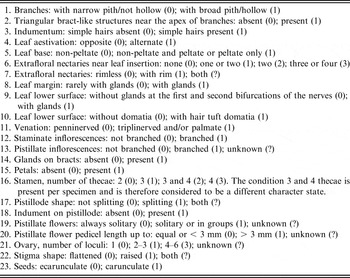
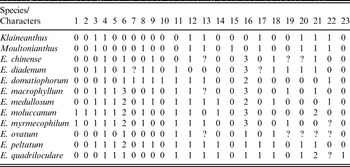
All species of the genus Endospermum were included in a phylogenetic parsimony analysis based on morphological data, including the species from India to China and Fiji, E. chinense Benth. and E. macrophyllum Pax & K.Hoffm., respectively. Klaineanthus gaboniae Pierre ex Prain and Moultonianthus leembruggianus (Boerl. & Koord.) Steenis were chosen as outgroups based on molecular phylogenetic studies of Euphorbiaceae s.str. using plastid rbcL and trnL-F DNA sequences (Wurdack et al., Reference Wurdack, Hoffmann and Chase2005). The matrix (Table 1) contains a total of 23 morphological characters, 11 vegetative and 12 reproductive. Only characters which could relatively easily be divided into discrete, non-overlapping character states were used (Table 2). The parsimony analysis was performed with PAUP version 4.0b10 (Swofford, Reference Swofford2003). All characters were considered independent, unordered and of equal weight. A branch-and-bound search was used to find the most parsimonious cladogram(s). The statistical robustness of the clades found was determined by using bootstrap values (Felsenstein, Reference Felsenstein1985) based on 1000 bootstrap replicates under the same settings as the phylogenetic analysis and also performed with PAUP. Bootstrap values are described as high (85–100%), moderate (75–84%) or low (50–74%). The character state changes were traced with MacClade version 4.06 (Maddison & Maddison, Reference Maddison and Maddison2001).
Characters and their character states used for the phylogenetic analysis of 12 species of Endospermum. The character numbers used in the first column correspond to the numbers used in Table 2

Data matrix used for the phylogenetic analysis of the genus Endospermum with Klaineanthus gaboniae and Moultonianthus leembruggianus as outgroups. The character numbers in the first row correspond to those given in Table 1. Missing data are indicated with ‘?’

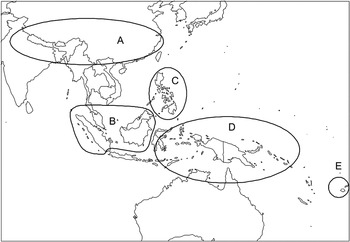
A historical biogeographic analysis was performed to appraise the morphological cladogram independently from the bootstrap values. Several species of Endospermum are sympatric to a high degree. Therefore, the areas selected for the analysis are the sum of all areas in which the sympatric species occur (Fig. 2). The only exception is the Philippines, because Endospermum ovatum is endemic on these islands.
The five areas used in the historical biogeographic analysis.

• Area A: North India to SE China. Endospermum chinense is the only species in this area.
• Area B: Peninsular Thailand, Malay Peninsula, Sumatra and Borneo. Endospermum quadriloculare (Fig. 12), E. diadenum (Fig. 6) and E. peltatum (Fig. 13) are largely sympatric in this area. Endospermum quadriloculare has the most western distribution and is absent from Borneo, while E. peltatum has the most eastern distribution (absent in Thailand), but continuing in the Philippines (area C); E. diadenum is in between.
• Area C: The Philippines. Endospermum ovatum (Fig. 12) is endemic and the Philippines are the most eastern part of the distribution of E. peltatum.
• Area D: New Guinea (with Sulawesi, Moluccas, Solomon Islands, Vanuatu and NE Australia). Endospermum domatiophorum (Fig. 7), E. medullosum (Fig. 8), E. moluccanum (Fig. 10) and E. myrmecophilum (Fig. 11) are sympatric on New Guinea. Of these four E. domatiophorum is the only endemic species. Endospermum medullosum also occurs in the Moluccas west of New Guinea and in the Solomon Islands and Vanuatu east of New Guinea. Endospermum moluccanum shows a similar distribution as E. medullosum, but is present in Sulawesi and absent from Vanuatu. Endospermum myrmecophilum is the only species also present in Queensland (Australia).
• Area E: Fiji, with only the endemic Endospermum macrophyllum present on these islands.
S-Diva 1.9 beta version (Yu et al., Reference Yu, Harris and He2010) was used to analyse the data. This package is based on the dispersal-vicariance analysis of Ronquist (Reference Ronquist1997) and uses Ronquist’s Diva 1.2 (Ronquist, Reference Ronquist2001) in the background. S-Diva not only provides a user-friendly interface, but also applies Bayesian techniques to determine the distributions on the internal (‘ancestral’) nodes. The latter was not applicable to our data because we only had a single cladogram as input. The data were analysed four times in S-Diva and in Diva with as maximum two to five areas per internal node. The distribution of Moultonianthus leembruggianus was added as outgroup (area) and this equals area B.
Results
Phylogenetic results
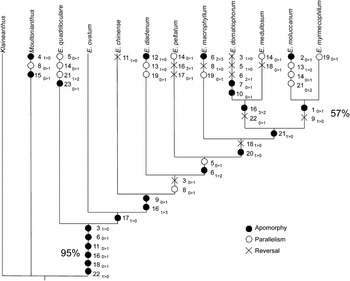
The cladistic analysis resulted in one cladogram (Fig. 3) with a length of 49 steps, a consistency index of 0.5714 and a retention index of 0.5962. Only the basal node of Endospermum has a high bootstrap value (95%, Fig. 3), indicating that the genus is monophyletic. The myrmecophilic group composed of Endospermum moluccanum and E. myrmecophilum is the only other group with a bootstrap higher than 50%, a low value of 57% (Fig. 3). Endospermum is certainly a monophyletic group, with the presence of extrafloral nectaries near the leaf insertion and stamens with more than two thecae as the most important synapomorphies. All other groups found must be viewed with caution due to the low or insignificant bootstrap values. The monophyletic group comprising the two New Guinean ant-harbouring species, Endospermum moluccanum and E. myrmecophilum, has a broad pith/hollow branches as a unique apomorphy and the absence of glands on the first and second bifurcation of the nerves as a reversal. Endospermum moluccanum has a few autapomorphies, one of which is the presence of triangular bract-like organs at the apex of the branches (a good diagnostic character in the identification key), and another of which is that it is the only species in Endospermum with consistently peltate leaves. The group formed by the other two New Guinean species, Endospermum domatiophorum and E. medullosum, has 3- or 4-thecate anthers as an apomorphy and the raised stigma as a reversal. All the New Guinean species are grouped in one clade (‘New Guinean group’) based on 1-locular ovaries, except for Endospermum moluccanum which has 4–6-locular ovaries, a derived character from 1-locular. The tree suggests that the ‘New Guinean group’ is a sister group of the Fiji species, Endospermum macrophyllum, with a short (up to 3 mm) pistillate pedicel as a unique apomorphy. All west Malesian species split off one at a time at the base of the cladogram.
Cladogram of the genus Endospermum. The two bootstrap values of > 50% are highlighted.

Historical biogeographic results
In order to understand the interpretation of the results, a short geological overview of Malesia and the Pacific areas is useful. Fifty million years ago western Malesia (Peninsular Malaysia through to Java and Borneo, with a small part of Sulawesi and the Philippines) was already more or less in its present position. At the same time the eastern Malesian areas were breaking away from the Australian plate and colliding with each other to form Sulawesi (made up of various fragments), the southern and northern Moluccas, the Philippines (in part of Palawan and nearby islands broke away from China) and New Guinea (of which the southern part was always the northern craton edge of the Australian plate). The boundary between western and eastern Malesia more or less coincides with Wallace’s Line. Fiji is a separate island arc in the Pacific, close to the Australian plate but never united with it.
Following the recommendations of Kodandaramaiah (Reference Kodandaramaiah2010) we utilised an outgroup for an improved understanding of the area of origin of Endospermum and we used optimisations of various numbers of areas per node to obtain a better insight into the historical biogeographic developments within Endospermum.
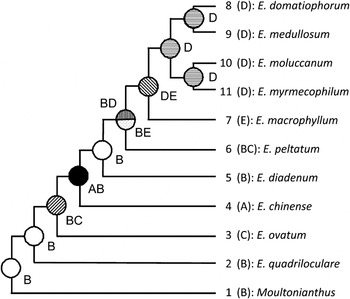
The Diva/S-Diva analysis allowing for five areas per internal node takes the lowest number of steps in Diva (four steps; each step indicates dispersal or extinction) but places area ABCDE (all areas united) as the ancestral area at the base of the area cladogram. Geologically this is impossible; ABCDE never formed a continuous area.
All other analyses with maximal four, three and two areas per internal node needed five steps in Diva. With four areas similar problems occur as with five areas per node – the highest probabilities occur for widespread areas basal in the area cladogram. Three and two areas per node provide geologically more realistic scenarios, though some choices with three areas invoke quite a number of extinctions as explanation (more than the five dispersal steps). Therefore, we prefer the results of the analysis with maximal two areas per node (Fig. 3).
The historical biogeographic scenario places area B (southern Thailand, Malay Peninsula, Sumatra, Borneo) as ancestral at the base of the cladogram, with Endospermum quadriloculare still present in this area. Next there is a dispersal to the Philippines (area C), resulting in Endospermum ovatum after speciation, and dispersal to the area north of B (area A) again followed by speciation resulting in E. chinense. On the next nodes Endospermum diadenum and E. peltatum are present only in area B with E. peltatum again dispersing to the Philippines (area C). Finally, there is long-distance dispersal to Fiji (area E, Endospermum macrophyllum) and New Guinea (area D), where four species evolve more or less sympatrically.
Discussion
Species with polymorphism were coded with a question mark for the characters concerned. The only exception we made is the number of thecae in the stamens; we left the presence of three and four thecae as a separate character state, because both are present in the same specimens and they are unique for the sister species Endospermum domatiophorum and E. medullosum.
Phylogenies based on morphological characters alone are mistrusted nowadays because the use of molecular data often results in different topologies. A good example is the phylogeny of Macaranga and Mallotus Lour. (both also Euphorbiaceae), which, based on morphology, shows Macaranga to be part of the Mallotus clade (Slik & Van Welzen, Reference Slik and Van Welzen2001), while a phylogeny based on molecular data shows the genera to be sister groups (Kulju et al., Reference Kulju, Sierra, Draisma, Samuel and Van Welzen2007). However, the phylogeny by Slik & Van Welzen (Reference Slik and Van Welzen2001) contains the same monophyletic, paraphyletic and polyphyletic groups as found by Sierra et al. (Reference Sierra, Kulju, Fišer, Aparicio and Van Welzen2010) for Mallotus based on molecular data (providing the backbone of the phylogeny) and morphological data (adding extra resolution at the end of the clades). Thus the message is to be careful with morphological data in a phylogenetic reconstruction. Unfortunately, molecular data of Endospermum are lacking except for E. moluccanum (20 gene fragments in Genbank; www.ncbi.nlm.nih.gov/genbank/, last checked June 2011). The leaves of the dried specimens in the Leiden herbarium are thick (slow drying) and old, thus genetic degradation prevents a molecular phylogenetic approach. However, to provide an indication of the reliability of the morphology-based phylogeny we use the results of the historical biogeography as a test. The fruits of Endospermum are fleshy and relatively heavy, which means that they are eaten mainly by larger animals like monkeys, crown pigeons and cassowaries, thus animals with a limited dispersal capacity. Therefore, we do not expect long-distance dispersal. The base of the area cladogram shows area B to be the ancestral area (Figs 2, 4). The species with this distribution show a gradual move from the west (Endospermum quadriloculare) to the east (E. diadenum and E. peltatum), with E. peltatum even dispersing to the Philippines. The dispersal from the western distribution (area B) to an area north of it (E. chinense) seems logical as it only entails dispersal to a neighbouring area. Only the basal position of Endospermum ovatum (Philippines) seems strange, though not impossible. Morphologically, Endospermum ovatum is only known from two specimens and data about the pistillate flowers and fruits are missing. Thus, it is very possible that molecular data will show a closer relationship for E. ovatum with E. diadenum and/or E. peltatum (or ancestral species of these).
Historical biogeographic analysis with S-Diva showing different possible distributions for ancestral species with different shadings.

Within the context of this study the long-distance dispersal to Fiji by Endospermum macrophyllum is unexpected. We predict that it is most likely that this species is related to Endospermum medullosum or E. moluccanum as these are the most widespread species in the Pacific, especially E. medullosum which reaches Vanuatu. The dispersal over Wallace’s Line to New Guinea may not have involved dispersal over great distances because Endospermum moluccanum and E. medullosum are already present in Sulawesi and the Moluccas.
Thus, from the point of view of biogeography the morphological cladogram seems to make sense, with only the positions of Endospermum macrophyllum and to a lesser extent E. ovatum appearing anomalous. A low degree of long-distance dispersal and closer geographical areas being neighbours in a generalised area cladogram were also found by Van Welzen et al. (Reference Van Welzen, Turner and Hovenkamp2003) based on an analysis of many taxa. Still, molecular analyses would be a welcome addition to provide more evidence on the phylogeny of this group.
Taxonomic Treatment
Endospermum Benth., Fl. Hongkong. 304 (1861), nom. cons., non Blume (‘Endespermum’, 1823 = Dalbergia, Fabaceae), nom. rej.; Müll.Arg. in A.DC., Prodr. 15(2): 1131 (1866); Benth. in Benth. & Hook.f., Gen. Pl. 3: 322 (1880); Hook.f., Fl. Brit. India 5: 458 (1887); Pax in Engl. & Prantl, Pflanzenfam. 3(5): 90 (1890); Pax & K.Hoffm. in Engl., Pflanzenr. IV.147.iv: 33 (1912); Ridl., Fl. Malay Penin. 3: 305 (1924); Gagnep. in Lecomte, Fl. Indo-Chine 5: 452 (1926); L.S.Sm., Proc. Roy. Soc. Queensland 58: 52 (1947); J.Schaeff., Blumea 19: 177 (1971); Airy Shaw, Kew Bull. 26: 258 (1972); Whitmore, Tree Fl. Malaya 2: 93 (1973); Airy Shaw, Kew Bull., Addit. Ser. 4: 109 (1975); Airy Shaw, Kew Bull., Addit. Ser. 8: 78 (1980); Airy Shaw, Kew Bull. 36: 293 (1981); Airy Shaw, Kew Bull. 37: 18 (1982); Airy Shaw, Alphab. Enum. Euphorb. Philipp. Isl. 24 (1983); G.L.Webster, Ann. Missouri Bot. Gard. 81: 101 (1994); Radcl.-Sm., Gen. Euphorb. 281 (2001); Chantharaprasong in Chayam. & Welzen, Fl. Thailand 8: 255 (2005). – Endospermum Subgen. Euendospermum Pax & K.Hoffm. in Engl., Pflanzenr. IV.147.iv: 34, nom. inval. (1912); L.S.Sm., Proc. Roy. Soc. Queensland 58: 53 (1947). – Type: Endospermum chinense Benth.
Capellenia Teijsm. & Binn., Natuurk. Tijdschr. Ned.-Indië 29: 238, fig. (1867). – Endospermum Subgen. Capellenia (Teijsm. & Binn.) Pax & K.Hoffm. in Engl., Pflanzenr. IV.147.iv: 36 (1912); L.S.Sm., Proc. Roy. Soc. Queensland 58: 52 (1947). – Type: Capellenia moluccana Teijsm. & Binn. [= E. moluccanum (Teijsm. & Binn.) Kurz].
Trees, dioecious, rarely monoecious; branches with pith or hollow, when hollow then with pores and inhabited by ants. Indumentum consisting of simple hairs, solitary and/or stellately bundled. Stipules triangular, caducous. Leaves spirally arranged, present at the top of the branches, simple; petiole long, in transverse section channelled above at the base and/or the apex, otherwise round; blade (orbicular to) ovate to obovate, symmetric, usually coriaceous, rarely papyraceous, base peltate or not, very often with 1 or 2 large extrafloral nectaries near the insertion, margin entire or somewhat undulate, often with minute glands, lower surface often with glands or hair tuft domatia in the first and second bifurcations of the nerves; venation indistinct above, distinct underneath, basally triplinerved or palmate, upper part pinnate, veins scalariform, veinlets reticulate. Inflorescences axillary (thyrsoid panicles or racemes); bracts triangular, apex acute to acuminate. Flowers regular, unisexual, exceptionally bisexual (only some specimens in one species); sessile or with a short pedicel; calyx lobes basally or completely connate; petals absent; disc annular, indistinct but perhaps toothed and on the androphore in E. diadenum. Staminate flowers in groups of up to 3 flowers per node; calyx cupular, indistinctly lobed or 4-lobed, rarely 4-toothed; stamens 5–12, androphore cylindrical or obovate, filaments short, anthers dorsifixed, 3- or 4-thecate, thecae separate from each other, reniform, opening extrorse with lengthwise slits; pistillode on top of androphore, knob-like or cylindrical. Pistillate flowers single per node, rarely in groups of up to 3; calyx indistinct or 4- or 5-lobed or toothed; ovary globose, 1–6(or 7)-locular, densely covered with minute hairs; ovules 1 per locule; style absent, stigma discoid or lobed. Fruits indehiscent, baccate, rugose, stigma persistent, columella absent. Seeds ellipsoid or globose, ecarunculate or with a slender caruncle, ribbed.
Distribution. The genus comprises 10 species with a palaeotropical distribution, mainly ranging from continental Southeast Asia through the Malesian region (except for Java and the Lesser Sunda Islands) to northern Queensland (Australia) and the western Pacific (Solomon Islands, Vanuatu and Fiji Islands). In the Malesian region eight species are recognised.
Note. The genus description is based on the eight species that occur in the Malesian region.
Key to the species
1a. Branches hollow with pores and ant inhabited (but in cultivated specimens branches with a soft pith and without pores and ants) 2
1b. Branches with a hard pith 3
2a. Triangular bract-like structures (or their scars) present at the apex of the branches, 1.5–1.6 × 1.4–1.9 mm. Extrafloral nectaries cylindrical, depressed in the middle. Leaves always peltate, papyraceous or rarely coriaceous. Pistillate inflorescences racemes. Stamens 9–12. Pistillate flowers single and sessile. Ovary and fruit (3–)4–6-locular. – Sulawesi, the Moluccas, New Guinea and the Solomon Islands 4. E. moluccanum
2b. Triangular bract-like structures and their scars absent. Extrafloral nectaries elliptic, flat. Leaves peltate or not, coriaceous, rarely papyraceous. Pistillate inflorescences panicles. Stamens c.5. Pistillate flowers single or in groups of up to three, sessile or with a pedicel up to 3 mm long. Ovary and fruit 1-locular. – New Guinea (Papua) and Australia (North Queensland) 5. E. myrmecophilum
3a. Leaf base never peltate, lower surface with hair tuft domatia in the first and second bifurcation of the nerves, extrafloral nectaries basally with a rim around the glandular part. Inflorescences panicles. Ovary and fruit 1-locular. – New Guinea (Papua) 2. E. domatiophorum
3b. Leaf base peltate or not, lower surface mostly without domatia, extrafloral nectaries rimless or rarely with a rim. Inflorescences panicles or racemes. Ovary and fruit 1–5-locular 4
4a. Branches pilose to densely hairy. Indumentum consisting of stellately bundled and/or simple hairs. Leaf margin with numerous minute glands 5
4b. Branches glabrous to sparsely hairy. Indumentum consisting of only stellately bundled hairs. Leaf margin rarely with minute glands 7
5a. Abaxial extrafloral nectaries knob-like, 0.4–0.5 × 1.5–2.2 mm, without or rarely with a rim. Leaf base never peltate. Venation in upper part with 4 or 5 pairs of nerves. Inflorescences racemes. Glands on bracts absent. Anthers 4-thecate. Pistillate flowers solitary or in groups of up to three. Ovary and fruit 2- or 3-locular. – Thailand, Malay Peninsula, Sumatra and Borneo 1. E. diadenum
5b. Abaxial extrafloral nectaries cylindrical, 1.3–1.9 × 1.1–1.8 mm, without a rim. Leaf base peltate or not. Venation in upper part pinnate with 5–8 pairs of nerves. Inflorescences always panicles. Glands on bracts often present. Anthers 3- or 4-thecate. Pistillate flowers solitary per node. Ovary and fruit 1–4-locular 6
6a. Blade ovate to elliptic, length/width ratio 1.2–1.6, base not or rarely peltate, apex acute; lower surface densely hairy, consisting of stellately bundled hairs with many (> 10) short, flat branches and one longer erect one and/or simple hairs, lamina completely covered. Staminate flowers: pedicels 0–0.3 mm long, calyx glabrous inside, stamens 5–8, anthers 3- or 4-thecate. Ovary and fruit 1-locular. – Moluccas, New Guinea, Solomon Islands and Vanuatu 3. E. medullosum
6b. Blade narrowly to broadly ovate, length/width ratio 1.2–1.3, base peltate or not, apex acute to acuminate; lower surface pilose to densely hairy, consisting of stellately bundled at most 5 equal hairs and/or simple hairs, lamina visible. Staminate flowers: pedicels 0–1.5 mm long, calyx pilose inside, stamens 9 or 10, anthers 3-thecate. Ovary and fruit 2- or 3(–4)-locular. – Malay Peninsula, Borneo and Philippines 7. E. peltatum
7a. Extrafloral nectaries short, 1.2–1.6 × 0.8–0.9 mm. Blades coriaceous, base not peltate, round to acute, margin flat. Venation basally triplinerved, upper part pinnate with 4 or 5 pairs of nerves. Stamens 8 or 9. Seeds globose, ecarunculate. – Philippines (Mindanao) 6. E. ovatum
7b. Extrafloral nectaries large, 1.1–3 × 1–1.4 mm. Blades papyraceous to rarely coriaceous, base peltate or not, emarginate to acute, margin somewhat undulate. Venation basally triplinerved or palmate, upper part pinnate with 4–6 pairs of nerves. Stamens c.12 (in staminate flowers, 8–10 in the rare bisexual flowers). Seeds ellipsoid, with a slender caruncle, 1–1.5 mm long. – Thailand, Malay Peninsula, Sumatra 8. E. quadriloculare
1. Endospermum diadenum (Miq.) Airy Shaw, Kew Bull. 14: 395 (1960); J.Schaeff., Blumea 19: 186, map 2 (1971); Airy Shaw, Kew Bull. 26: 258 (1972); Airy Shaw, Kew Bull., Addit. Ser. 4: 109 (1975); Airy Shaw, Kew Bull. 36: 293 (1981); Chantharaprasong in Chayam. & Welzen, Fl. Thailand 8: 256, pl. XV: 3 (2005). – Melanolepis ? diadena Miq., Fl. Ned. Ind. Eerste Bijv. 455 (1860). – Mallotus diadenus (Miq.) Müll.Arg. in A.DC., Prodr. 15(2): 959 (1866). – Rottlera diadena (Miq.) Scheff., Ann. Mus. Bot. Lugd.-Bat. 4: 125 (1869). – Type: Indonesia, Sumatra, Lubu-alang, Teijsmann HB 3807 (holo L). Figs 5,6.
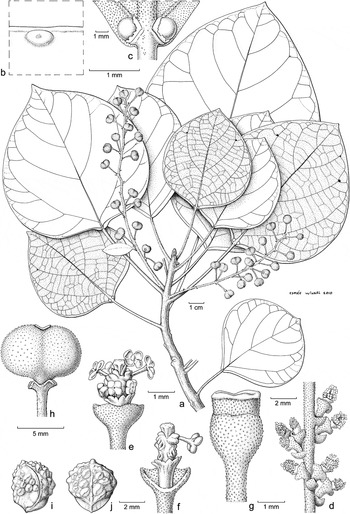
Fig. 5.Endospermum diadenum (Miq.) Airy Shaw. a, habit; b, marginal gland on upper surface of leaf blade; c, extrafloral nectaries on lower surface; d, part of staminate inflorescence; e, staminate flower; f, idem with part of calyx removed, showing androphore with apically a pistillode; g, pistillate flower; h, fruit; i, seed in lateral view; j, seed in frontal view. a, c from Kessler et al. PK 2653; b, g from Arifin & Ambriansyah B 1536; d–f from Kessler et al. PK 1518; h–j from Campbell 338 (all L). Drawn by Esmée Winkel, 2010.
 Fig. 6.
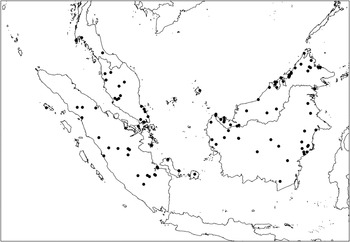
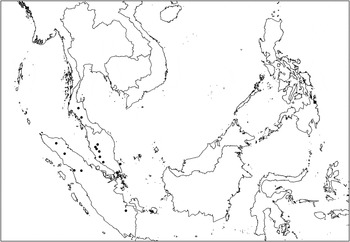
Distribution of Endospermum diadenum (Miq.) Airy Shaw.
Endospermum borneense Benth. ex Müll.Arg., Flora 47: 469 (1864); Müll.Arg. in A.DC., Prodr. 15(2): 1132 (1866); Pax & K.Hoffm. in Engl., Pflanzenr. IV.147.iv: 35 (1912); Merr., J. Straits Branch Roy. Asiat. Soc., Special no. 346 (1921); Corner, Gard. Bull. Straits Settlem. 10: 298 (1939). – Type: Indonesia, Borneo, prope Banjarmassing, J. Motley 1126 (holo K).
Endospermum malaccense Benth. ex Müll.Arg., Flora 47: 469 (1864); Müll.Arg. in A.DC., Prodr. 15(2): 1132 (1866); Hook.f., Fl. Brit. India 5: 458 (1887); Pax & K.Hoffm. in Engl., Pflanzenr. IV.147.iv: 34 (1912); Ridl., Fl. Malay Penin. 3: 305 (1924); K.Heyne, Nutt. Pl. Ned.-Ind. 2nd ed., 2: 956 (1927); Corner, Gard. Bull. Straits Settlem. 10: 296 (1939); Whitmore, Tree Fl. Malaya 2: 93, fig. 7 (1973). – Type: Peninsular Malaysia, Griffith KD 4721 (holo K; iso P).
Endospermum ovalifolium Pax & K.Hoffm. in Engl., Pflanzenr. IV.147.iv: 34 (1912); Ridl., Fl. Malay Penin. 3: 305 (1924); K.Heyne, Nutt. Pl. Ned.-Ind. 2nd ed., 2: 956 (1927); Corner, Gard. Bull. Straits Settlem. 10: 297 (1939). – Type: Singapore, Bukit Timah, Unknown s.n. (holo B, lost). Synonymy follows Schaeffer (Reference Schaeffer1971).
Endospermum borneense auct. non Benth. ex Müll.Arg.: Becc., Malesia 2: 45 (1884). – Endospermum beccarianum Pax & K.Hoffm. in Engl., Pflanzenr. IV.147.iv: 35 (1912); Merr., J. Straits Branch Roy. Asiat. Soc., Special no. 346 (1921); Corner, Gard. Bull. Straits Settlem. 10: 298 (1939). – Endospermum beccarianum Pax & K.Hoffm. var. crassirameum Pax & K.Hoffm. in Engl., Pflanzenr. IV.147.iv: 35 (1912), nom. inval. (should have been autonym). – Type: Malaysia, Sarawak, Beccari PB 3137 (holo B, lost; iso FI n.v., P). See note 1.
Endospermum beccarianum Pax & K.Hoffm. var. tenuirameum Pax & K.Hoffm. in Engl., Pflanzenr. IV.147.iv: 35 (1912). – Type: Malaysia, Sarawak, Beccari PB 819 (holo B, lost; iso FI n.v., NY, P).
Endospermum chinense Benth. var. malayanum Pax & K.Hoffm. in Engl., Pflanzenr. IV.147.iv: 36 (1912). – Endospermum malayanum (Pax & K.Hoffm.) Chatterjee, Kew Bull. 1949: 564 (1950). – Type: Indonesia, Sumatra, Palembang, Forbes 2779 (holo B, lost; iso BM, L, P).


Trees, dioecious, up to 36 m high, bole straight up to 25 m high, diameter 13–60 cm; without or with buttresses up to 2 m high; branches with a hard pith, flowering ones 6–8 mm thick, pilose, containing white to yellow latex. Outer bark grey to green to red to brown, smooth, hooped and/or with white lenticels; inner bark pale yellow to orange to brown to grey, sap clear; sapwood white to yellow; heartwood yellow to light brown. Indumentum consisting of stellately bundled and simple hairs. Stipules 3.1–5 × 1.2–2 mm, densely hairy on both sides. Leaves: petiole 5.5–15 cm long, channelled above at the base, otherwise round; blade ovate to obovate, 10.5–23.5 × 7.7–19 cm, length/width ratio 1.2–1.4, coriaceous, rarely papyraceous, base never peltate, (cordate to) truncate to cuneate, abaxially with or without 1 or 2 knob-like, green extrafloral nectaries near the insertion, 0.4–0.5 × 1.5–2.2 mm, basally without or rarely with a rim around the glandular part, margin entire or somewhat undulate, with numerous minute glands, apex round to acuminate, upper surface glabrous to sparsely covered with minute stellately bundled hairs and/or simple hairs, dark green, glossy, lower surface sparsely to densely covered with minute stellately bundled hairs and/or simple hairs (see notes 2 and 3), pale green to yellow and often with glands at the more marginal bifurcations of the nerves, hair tuft domatia lacking; venation basally triplinerved or palmate with 7 nerves of which the 2 outer ones less distinct, upper part pinnate with 4 or 5 pairs of nerves. Inflorescences racemes, pilose, up to 20 cm long; bracts triangular, 1.4–2.5 × 0.8–2.2 mm, apex acute, densely hairy on both sides, glandless. Staminate flowers white to yellow to green, sessile or with a pedicel up to 0.6 mm long; calyx indistinctly lobed or 4-toothed, 0.7–1.4 × 1.2–1.6 mm, pilose outside, glabrous inside, pale green; stamens c.9, yellow to ochre, dull; androphore cylindrical, 1.4–2.4 × 0.4–0.8 mm, free part of filaments 0.4–0.7 mm long; anthers 4-thecate, 0.4–0.6 × 0.5–0.6 mm; pistillode knob-like or split in 2 parts, c.0.2 × 0.2 mm, pilose or sparsely hairy on top. Pistillate flowers single or in groups of up to 3, greenish to yellow, with a pedicel up to 3.1 mm long; calyx indistinctly lobed or 5-toothed, 1.2–2.3 × 1.8–2.6 mm, densely hairy outside, pilose inside; ovary cylindrical, more often 2- than 3-locular, 1.4–2.4 × 1.1–1.7 mm; stigma indistinctly lobed, flattened, 0.2–0.6 × 1.2–1.8 mm, glabrous, stigma discoid, 0.9–2 mm wide. Fruits blue to green to yellow, globose, 4.8–7 × 5.2–9 mm, pilose. Seeds globose, 3.8–4.2 × 3.1–4.1 mm, white, ecarunculate.
Distribution. Thailand, Malay Peninsula, Sumatra and Borneo.
Habitat and ecology. In primary, secondary, swampy, mossy, lowland mixed dipterocarp forests, kerangas forests and disturbed (logged) areas; along rivers and roads, open spaces, on hills, ridges and steep slopes. An opportunist species which grows well and is characteristic of gaps in the high forest, hence common in areas of old shifting cultivation (Whitmore, Reference Whitmore1973). Soil: granitic sand, sandy soil, sandy loam, sandy clay, yellow and red clay soil and ultramafic soil. Altitude: up to 1375 m. Flowering and fruiting throughout the year; ripe fruits eaten by birds.
Uses. The wood is used for construction (Kalimantan, Borneo), though the timber is in general soft, light, and suitable for matchboxes, splints, drawing boards, blackboards, toys (Whitmore, Reference Whitmore1973), planks and clogs (Burkill, Reference Burkill1935).
Vernacular names. Peninsular Malaysia: Bebaru bukit, Kuyu sendok, Membulan, Poko susundo, Sendok sendok, Sindor sindor. Sumatra: Alifambang, Alifambang bungo, Alifambang uding, Djelanding, Indragiri, Kaju labuh Kundui, Labu, Libut, Madag tapak kudu, Mara bulan, Modang kombiri, Njelanding, Ogan ulu, Simar antipa, Sonduk, Terbulan. Borneo: Sarawak & Brunei: Entabulan, Sendok sendok. Sabah: Dalam mata, Katimahar, Melokan. Kalimantan: Garung, Lempaung, Nangair, Pajaug gunung, Parupaek, Pempiring (Schaeffer, Reference Schaeffer1971).
Notes. 1. Endospermum beccarianum var. crassirameum was selected by us as the typical variety (containing the type specimen) of E. beccarianum, therefore the name is invalid as the autonym rule applies.2. This species is very variable in leaf shape and indumentum throughout its distribution range, making especially the identification of sterile specimens difficult. The leaf shape varies from ovate with a cordate to truncate base to obovate with a cuneate base. This variation in leaf shape can even be observed on the same branch. The indumentum on the lower leaf surface also varies considerably. Corner (Reference Corner1939) studied dry specimens and many living trees and he concluded that this variability depended on the age of the trees. Sapling leaves have only long simple hairs, while in mature trees minute, stellately bundled hairs are formed between the simple hairs, covering all of the lamina. When the leaves wither, the long simple hairs disappear, and only the flattened, minute, stellately bundled hairs remain visible.
3. The majority of specimens studied have a lower undersurface that is densely covered by minute, stellately bundled hairs and the presence of simple hairs is less common. Specimens of Endospermum diadenum with a combination of stellately bundled and simple hairs can easily be confused with E. peltatum. It is for this reason that reproductive characters are necessary for identification. The following list of characters may be helpful with identification:

4. Endospermum diadenum also closely resembles E. quadriloculare (see note 2 under E. quadriloculare).
2. Endospermum domatiophorum J.Schaeff., Blumea 19: 190, map 4 (‘domatiphorum’) (1971); Airy Shaw, Kew Bull., Addit. Ser. 8: 79 (1980). – Type: Papua New Guinea, Northern Division, Bariji-Managalase area, S of Toma, Pullen 5922 (holo CANB). Figs 1a,7.
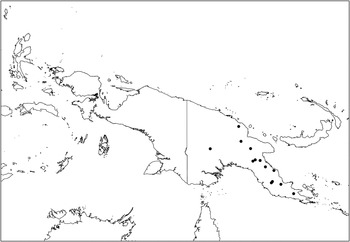
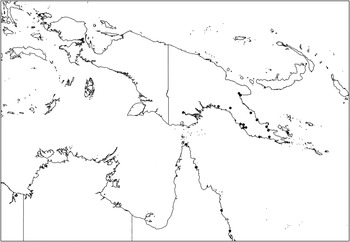
Distribution of Endospermum domatiophorum J.Schaeff.

Trees, dioecious, up to 40 m high, bole straight, up to 30 m high, diameter 10–60 cm; branches with hard pith, flowering ones 3–6 mm thick, glabrous to pilose, with a reddish watery exudate. Outer bark grey to brown; inner bark yellow to orange; sapwood cream; heartwood deeper cream. Indumentum consisting of minute stellately bundled hairs. Stipules 3–3.4 × 1–1.3 mm, pilose outside and inside. Leaves: petiole 2–9 cm long, channelled above basally and apically, pilose; blade ovate to obovate, 5–20 × 3.9–16.6 cm, length/width ratio 1.2–1.3, coriaceous, base never peltate, truncate to cuneate, abaxially with or without 1 or 2 round large, yellow extrafloral nectaries near the insertion, 1.3–2.5 × 1–2.2 mm, basally with a rim around the glandular part, margin entire, with minute glands, apex round to acute, drying brown, upper surface glabrous or sparsely hairy, dark green, glossy, lower surface glabrous to sparsely hairy, duller and paler than above, hair tuft domatia in the first and second order bifurcations of the nerves, rarely with glands in the more marginal bifurcations; venation triplinerved or palmate with 5 or 7 nerves of which the 2 outer ones less distinct, upper part pinnate with 4–6 pairs of nerves. Inflorescences panicles, up to 13 cm long, pilose, first branches up to 2 cm long; bracts triangular, 1.5–3 × 1–3 mm, apex acute, pilose outside and inside. Staminate flowers white to yellow, sessile or with a pedicel up to 1 mm long, pilose; calyx completely or basally connate, indistinctly lobed or 4-lobed, 1.1–1.9 × 2.1–2.3 mm, pilose outside, glabrous inside; stamens 6–8; androphore cylindrical, 2.2–2.3 × 0.6–0.8 mm, free part of filaments 0.4–0.6 mm long, anthers 3- or 4-thecate, 0.6–1 × 0.5–0.8 mm; pistillode somewhat pyramidal, 0.5–0.8 mm long, glabrous. Pistillate flowers single per node, white to cream, sessile or with a pedicel up to 1 mm long, pilose; calyx completely connate, indistinctly lobed, 1.6–2.1 × 1.9–2.7 mm, pilose outside, glabrous inside, green; ovary ovoid to globose, 2.3–2.5 × 1.1–1.5 mm, 1-locular, green; stigma somewhat conical to pyramidal, 0.3–1 × 1.1–1.3 mm, glabrous, light yellow. Fruits ovoid, 6–8 × 3–5 mm, sparsely hairy to pilose, yellow to green, dull. Seeds ellipsoid, somewhat flattened, 4.3–4.5 × 2.2–2.9 mm, ecarunculate, black.
Distribution. Papua New Guinea.
Habitat and ecology. In primary, montane and disturbed forest, associated with Araucaria, Anisoptera and Nothofagus forests; on hills, ridges, in gullies, margins of forest and open areas. Soil: old well-drained volcanic and ultrabasic soil. Altitude: up to 2620 m. Flowering throughout the year; fruiting: from April to December.
Vernacular names. Boroboro (Schaeffer, Reference Schaeffer1971), Devarip (Daga), Mayak (Bariji-Managalese).
Note. Endospermum domatiophorum resembles E. medullosum and can be distinguished from the latter by the presence of hair tuft domatia on the lower leaf surface in the first and second bifurcations of the nerves. Moreover, in Endospermum domatiophorum the lower leaf surface is usually glabrous to sparsely covered with flattened, minute, stellately bundled hairs (only visible with a hand lens), while in E. medullosum the indumentum is tomentose and visible to the naked eye. A diagnostic character for the identification of the species is the presence of a rim around the basal part of the round extrafloral nectaries near the leaf insertion.
3. Endospermum medullosum L.S.Sm., Proc. Roy. Soc. Queensland 58: 53, pl. I (1947); J.Schaeff., Blumea 19: 181, map 5 (1971); Airy Shaw, Kew Bull., Addit. Ser. 8: 79 (1980). – Type: Papua New Guinea, Lae, C.T. White, Dadswell & L.S. Smith NGF 1738 (holo BRI n.v.; iso L). Figs 1e,8.
Macaranga sp.: Lane-Poole, For. Resources Terr. Papua & New Guinea 105 (1925).
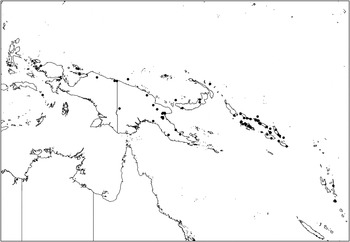
Distribution of Endospermum medullosum L.S.Sm.

Trees, dioecious, up to 54.8 m high, bole straight, up to 36.6 m high, diameter 30–120 cm; without or with buttresses up to c.4 m high and 2 m long; branches with a hard pith, flowering ones 7–12.5 mm thick, pilose to densely hairy. Outer bark yellow to pale brown to grey, 5–12.7 mm thick, smooth or with longitudinal fissures and transverse cracks; inner bark cream to yellow to brown, with fragrance of roasted nuts; sapwood undefined or white to cream; heartwood white to straw, soft. Indumentum consisting of stellately bundled and simple hairs. Stipules 5–10 × 1.8–3 mm, densely hairy on both sides. Leaves: petiole 6.4–14.3 cm long, channelled above at the base, pilose to densely hairy, with orange white sap; blade ovate to elliptic, 10.1–27.5 × 8.7–17.5 cm, length/width ratio 1.2–1.6, coriaceous, base not or rarely peltate, emarginate to rounded, abaxially with 2 short, cylindrical extrafloral nectaries near the insertion, 1.5–1.8 × 1.2–1.6 mm, rimless, at first green and smooth, then orange and finally red with cracked or warty surface, margin entire or somewhat undulate, with numerous minute glands, apex acute, upper surface glabrous or sparsely covered with stellately bundled hairs and/or hirsute simple hairs, dark green, glossy, lower surface densely hairy with minute stellately bundled hairs with many (> 10) short flat branches and one longer erect branch and/or simple hairs, lamina completely covered, white to grey to pale green, glands in the more marginal bifurcations of the nerves, hair tuft domatia generally lacking; venation yellowish, basally triplinerved or palmate with 5–8 nerves of which the 2 outer ones less distinct, upper part pinnate with 5–7 pairs of nerves. Inflorescences panicles, pilose or densely hairy, up to 16.7 cm long, with the first branches up to 4.5 cm long; bracts triangular, 3.5–4.2 × 1.9–2.8 mm, apex acuminate, densely hairy on both sides, often with 2 round glands near the base, c.0.8 mm in diameter. Staminate flowers whitish to greenish yellow to yellowish, fragrant, sessile or with a pedicel up to 0.3 mm long, pilose; calyx indistinctly lobed or 4-lobed, 1.8–2.1 × 1.4–2 mm, basally connate, densely hairy outside, glabrous inside; lobes triangular, c.0.3 × 0.6 mm, apex acute; stamens 5–8, yellow, androphore obovate, 1.7–2.2 × 0.6–1.2 mm, free part of filaments c.0.4 mm long, anthers 3- or 4-thecate, 0.7–0.9 × 0.6–1 mm; pistillode cylindrical, c.0.4 mm long, sparsely hairy beneath. Pistillate flowers single per node, sessile or with a pedicel up to 0.3 mm long; calyx completely connate, indistinctly lobed, 2.1–2.4 × 1.7–1.9 mm, densely hairy outside, glabrous inside; ovary obovoid, 1.5–1.9 × 1.2–1.4 mm, green, 1-locular; stigma somewhat pyramidal, 0.5–0.9 × 0.9–1.4 mm, glabrous. Fruits pale green to yellow, dull, ovoid to globose, 5–7 × 5–5.4 mm, sparsely hairy. Seeds globose, 4.6–4.8 × 3.5–3.7 mm, ecarunculate.
Distribution. The Moluccas, New Guinea, Solomon Islands and Vanuatu.
Habitat and ecology. In primary or late secondary forest, alluvial forest, on ridges, along creeks, on hills, steep slopes and floodplains; associated with Pometia (Sapindaceae), Celtis (Ulmaceae), Fagaceae, Myrtaceae, Annesijoa (Euphorbiaceae) and Pimelodendron (Euphorbiaceae). Soil: clay, sandy clay, gravel and deep well-drained volcanic scoria. Altitude: up to 1070 m. Flowering and fruiting throughout the year.
Uses. The wood is used for making canoes. Young leaves are sometimes eaten as a vegetable (Schaeffer, Reference Schaeffer1971).
Vernacular names. New Guinea: Adokko (Manikiong), A’ugo (Koropa; Onjob), Joemkejoe (Kemtoek), Joerasan (Asmat), Karubu (Bembi), Kirikendita (Madang), Koindza (Jal), Moenabore (Biak), Nakau (Talasea), Rikwa (Nemo), Saimena (Mooi), Sajoemena, Sisibkoiru (Wanigela), Teppateh (Rawa). Solomon Islands (Schaeffer, Reference Schaeffer1971): A’sa, Kandiki, Manogo.
Notes. 1. The specific epithet is derived from the Latin word ‘medulla’ meaning pith and refers to the branchlets containing pith in this species as opposed to other New Guinean species (Endospermum moluccanum and E. myrmecophilum) that are hollow (Smith, Reference Smith1947).
2. Endospermum medullosum resembles E. domatiophorum (see note under latter) and E. myrmecophilum. Endospermum medullosum can be distinguished from E. myrmecophilum by the presence of pith in the branches, the leaf base mostly not peltate, and a tomentose indumentum visible to the naked eye.
3. The short, cylindrical extrafloral nectaries near the leaf insertion have a lateral position, and they are sometimes found at the petiole apex and can be seen from above.
4. The specimens NGF 1783, NGF 25932 and NGF 29307 differ from other material studied by having hair tuft domatia in the first and second bifurcation of the nerves and the extrafloral nectaries near the insertion are round and have a rim around the basal part.
4. Endospermum moluccanum (Teijsm. & Binn.) Kurz, J. Bot. 5: 23 (1867); Becc., Malesia 2: 38 (1884); Merr., Interpr. Herb. Amboin. 326 (1917); K.Heyne, Nutt. Pl. Ned.-Ind. 2nd ed., 2: 956 (1927); Rant, Natuurk. Tijdschr. Ned.-Indië 94: 113 (1934); Rant, Ann. Jard. Bot. Buitenzorg 48: 123 (1938); Schodde, Blumea 15: 401, in obs. (1967); J.Schaeff., Blumea 19: 182, map 2 (1971); Airy Shaw, Kew Bull., Addit. Ser. 8: 80 (1980); Airy Shaw, Kew Bull. 37: 18 (1982). – Capellenia moluccana Teijsm. & Binn., Natuurk. Tijdschr. Ned.-Indië 29: 239, fig. (1867). – Type: Indonesia, Moluccas, Teijsmann & Binnendijk s.n. (holo BO). See note 1. Figs 9,10.
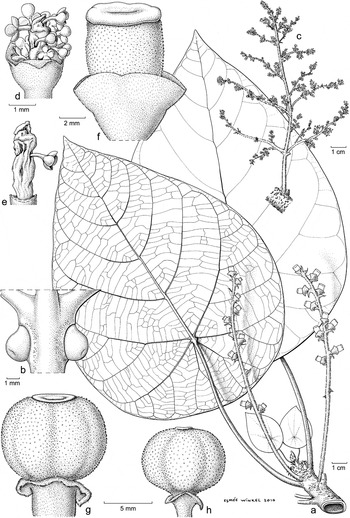
Fig. 9.Endospermum moluccanum (Teijsm. & Binn.) Kurz. a, habit; b, extrafloral nectaries on lower leaf surface; c, staminate inflorescence; d, staminate flower; e, staminate flower with calyx and part of stamens removed; f, pistillate flower; g, h, fruit. a, b, f from Brass 32607 (CANB); c–e from Hoogland 4920 (L); g from LAE (Essig & Lelean) 55036 (L); h from BW (Vink) 12061 (L). Drawn by Esmée Winkel, 2010.
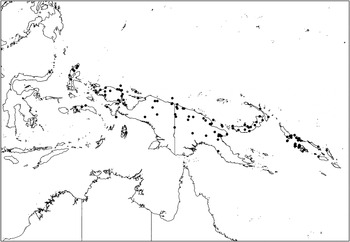
Fig. 10.Distribution of Endospermum moluccanum (Teijsm. & Binn.) Kurz.
[Arbor regis Rumph., Herb. Ambon. 2: 257, t. 85, nom. inval. (1741). – Hernandia sonora auct. non L.: Stickman in L., Amoen. Acad. 4: 117, 122, 141 (1759).]
Endospermum formicarum Becc., Malesia 2: 44 (1884); Schum. & Hollrung, Fl. Kais. Wilh. Land 804 (1889); Warb., Bot. Jahrb. 13: 348 (1891); Schum. & Lauterb., Fl. Schutzgeb. Südsee 406 (1900); Pax & K.Hoffm. in Engl., Pflanzenr. IV.147.iv: 36, fig. 11 (1912); Docters van Leeuwen, Treubia 10: 431 (1929); L.S.Sm., Proc. Roy. Soc. Queensland 58: 58 (1947); Schodde, Blumea 15: 401, in obs. (1967). – Type: Nuova Guinea [= Indonesian Papua], Andai, Beccari PP 648 (holo FI n.v.), synonymy based on Schaeffer (Reference Schaeffer1971).
Endospermum labios Schodde, Blumea 15: 397 (1967); Airy Shaw, Kew Bull., Addit. Ser. 8: 79 (1980). – Endospermum labios Schodde subsp. labios: Schodde, Blumea 15: 399, fig. 1 (1967). – Type: Papua New Guinea, Markham Valley, Umi River, Brass 32607 (holo CANB; iso US).
Endospermum labios Schodde subsp. gracilipes Schodde, Blumea 15: 400 (1967). – Type: Solomon Islands, SE Choiseul Island, ridge NE from harbour at Ruruvai, Whitmore BSIP 3979 (holo LAE; iso US).


Trees, dioecious, up to 33.4 m high, bole up to 18.4 m high, diameter 12–40 cm; without or with buttresses up to 1.4 m high, extending 0.6 m over the ground; branches hollow, flowering ones 10–16.2 mm thick, conical at the apex, glabrous to sparsely hairy, with exit pores for nesting ants; latter round, 1.8–3 mm in diameter; apex of shoots with triangular bract-like structures (or their scars), 1.5–1.6 × 1.4–1.9 mm (see note 1). Outer bark greyish, mottled with white, pink or green patches, smooth except for some shallow longitudinal and transverse cracks; inner bark green, turning light orange to white, sap whitish to yellow, milky or watery; sapwood pale yellow; heartwood white to pale yellow. Indumentum consisting of stellately bundled and simple hairs. Stipules unknown. Leaves: petiole 8.4–23.5 cm long, basally and apically channelled above, otherwise terete, sparsely hairy to pilose; blade ovate to orbicular, 15.7–35 × 12.3–25.5 cm, length/width ratio 1.2–1.4, papyraceous or rarely coriaceous, base peltate, truncate, abaxially with 2 extrafloral nectaries near the insertion, cylindrical, 0.9–2.6 × 1.5–2.1 mm, depressed in the middle, margin entire or somewhat undulate, with minute glands, apex acuminate to cuspidate, upper surface glabrous to sparsely covered with stellately bundled hairs and/or simple hairs, dark green, shiny, lower surface glabrous to pilose covered with hirsute hairs, duller and paler than above; venation palmate with (7–)8–10 nerves, upper part pinnate with 5 or 6 pairs of nerves. Staminate inflorescences panicles, pistillate ones racemes, pilose to densely hairy, up to 33.7 cm long, first branches up to 12.5 cm long; bracts either leaf-like in basal parts of inflorescence, ovate, c.13.5 × 10.2 mm, sessile or with a petiole up to 3 mm, with 2 round glands at the base, c.1.1 × 1 mm, base rounded, apex acuminate, pilose outside and inside or bracts triangular in higher parts of inflorescence, 6–8 × 2.2–4.2 mm, apex acuminate to cuspidate, curved, pilose outside, glabrous to sparsely hairy inside, often with 2 glands underneath at the base, c.1.2 mm in diameter. Staminate flowers pale yellow, fragrant, sessile; calyx 4-lobed, 2.3–4 × 2.2–3.2 mm; lobes triangular, 0.9–2 × 1.2–1.7 mm, basally connate, apex acute, sparsely hairy outside, glabrous inside; stamens 9–12, androphore cylindrical, 4.6–5.5 × 1.4–2.8 mm, free part of filaments 0.4–0.8 mm long, anthers yellow, 4-thecate, 0.7–1 × 0.7–1.2 mm; pistillode cylindrical, 0.7–1 × 0.4–0.5 mm, glabrous. Pistillate flowers single per node, light green to whitish, sessile; calyx indistinctly lobed, 3.8–6.2 × 4.8–11.3 mm, green, sparsely hairy outside, glabrous inside; ovary cylindrical to obovoid, 2.1–7.4 × 1.8–7.8 mm, (3–)4–6-locular; stigma yellow, indistinctly lobed, concave, 0.5–1.5 × 3–6.6 mm, glabrous. Fruits light green, globose, 5–23.8 × 5.5–18 mm, sparsely covered with minute hairs. Seeds ellipsoid or globose, 4.8–6.3 × 3–4.1 mm, ecarunculate.
Distribution. Sulawesi, the Moluccas, New Guinea and the Solomon Islands.
Habitat and ecology. In primary and secondary forest, swampy and alluvial forest, disturbed (logged) areas, along rivers and roads. Soil: clay, sandy clay, limestone, gravel, loose volcanic soil. Altitude: up to 900 m. Flowering and fruiting throughout the year.
Uses. In the Moluccas the tree is used for constructing semi-permanent houses. On New Guinea the bark is considered to have anti-fertility properties, and the leaves are used as treatment for infections and aches.
Vernacular names. Moluccas: Kaju radja, Pea-pea, Ofo. New Guinea: Bondoa (Waskuk), Kidikendi (Madang), Koin (Jal), Kobaguno (Kutubu), Kornu, Kungum (Orme), Lalaul, Luki, Mangoeriw (Biak), Mawr (Mawan), Munampun (Kaigorin), Nauwauwa, Nakok malu (Nakanai), Ngebbie, Njebbie (Manikiong), Pehpi (Bembi), Poteh (Rawa), Sajon (Tehid), Sejoem (Mooi), Seraida (Tehid), Taingino (Wapi), Taraparo (Wandammen), Wakopak (Amberbaken), Wakpak (Andjai), Wapaap (Kebar).
Notes. 1. Teijsmann & Binnendijk published Capellenia moluccana in the same year as Kurz published Endospermum moluccanum (1867). We could not trace the exact dates of publication of the journals, but from Kurz’s short article it is obvious that he used Teijsmann & Binnendijk’s publication and that he interpreted the figure correctly as an Endospermum. This means that Teijsmann & Binnendijk published their paper before Kurz published his.
2. The triangular bract-like structures found near the apex of the branchlets may serve as food bodies for the ants. They are only present near the branch apex, but many scars are present on lower parts of the branches as if the ‘bracts’ were eaten away and had served as food bodies for the ants living in the hollow pith.
3. Specimens from the Moluccas have smaller fruits in comparison with specimens from New Guinea.
4. Airy Shaw (Reference Airy Shaw1980) recognised two different species, Endospermum moluccanum (Teijsm. & Binn.) Kurz and E. labios Schodde. The characters that Airy Shaw used to distinguish the species, such as the indumentum on the lower leaf surface and inflorescence and the shape of the stigma and bracts, are too variable to be used in species delimitation. However, there is a considerable difference in fruit size, whereby Endospermum moluccanum (in the strict sense) has smaller fruits than E. labios. This difference may be explained by differences in climatological conditions. Endospermum moluccanum occurs in Sulawesi and the Moluccas, areas with a drier climate than where the E. labios form is found. The latter occurs in the wetter parts of New Guinea and the Solomon Islands. Both forms have hollowed branches, triangular bract-like structures near the apex of the branchlets (an autapomorphy), two cylindrical extrafloral nectaries near the leaf insertion and the leaf base always peltate. For these reasons we follow Schaeffer (Reference Schaeffer1971) rather than Airy Shaw (Reference Airy Shaw1980) and consider the names to be synonyms, with Endospermum moluccanum having priority.
5. Endospermum myrmecophilum L.S.Sm., Proc. Roy. Soc. Queensland 58: 56, pl. II (1947); J.Schaeff., Blumea 19: 181, map 3 (1971); Airy Shaw, Kew Bull., Addit. Ser. 8: 80 (1980). – Type: Papua New Guinea, Morobe Prov., Yalu, C.T. White, Dadswell & L.S. Smith NGF 1640 (holo BRI n.v.; iso L). Figs 1b,11.
Distribution of Endospermum myrmecophilum L.S.Sm.

Trees, dioecious, up to 36.5 m high, bole up to 23 m high, diameter 20–90 cm; without or with buttresses up to c.1 m high; branches hollow, flowering ones 10–17 mm thick, conical at the apex, glabrous to sparsely hairy, with a watery whitish sap, with exit pores for nesting ants; latter round, 2.4–2.8 mm wide. Outer bark white to grey to light brown, fairly smooth, longitudinally fissured and covered with insignificant lenticels, c.4 mm thick; inner bark white to orange to light brown; sapwood straw to yellow to light brown, soft; heartwood cream. Indumentum consisting of stellately bundled and simple hairs. Stipules 2–8.7 × 1.4–2.2 mm, densely hairy on both sides. Leaves: petiole 5.2–16.3 cm long, channelled above at the base, sparsely hairy; blade ovate to orbicular, 8.5–27.4 × 9.7–22 cm, length/width ratio 0.9–1.2, coriaceous, rarely papyraceous, base peltate or not, emarginate to truncate (to rounded), abaxially with 2 flat, elliptic, yellowish to green extrafloral nectaries near the insertion, 1–2.4 × 1.3–4 mm, margin somewhat undulate, often with minute glands, apex round to acute, upper surface glabrous, dark green, glossy, lower surface densely covered with minute stellately bundled hairs and/or simple hairs, rarely with glands in the more marginal bifurcations of the nerves, paler and duller than above; venation amber to yellow, palmate with 7–9 nerves, upper part pinnate with 4 or 5 pairs of nerves. Inflorescences panicles, up to 23.3 cm long, pilose to densely hairy, first branches up to 4.5 cm long; bracts triangular, 1.9–3.2 × 1.1–1.5 mm, apex acuminate, densely hairy on both sides. Staminate flowers cream to yellow to pale green, sessile or with a pedicel up to 1.2 mm, pilose; calyx indistinctly lobed or 4-lobed, 1–1.3 × 0.8–1.8 mm, basally connate, hairy outside, glabrous inside; lobes triangular, c.0.3 × 0.4 mm, apex acute; stamens c.5, androphore obovate, 2–2.5 × 1.2–1.5 mm, free part of filaments c.0.3 mm long, anthers 4-thecate, 0.7–0.8 × 0.8–0.9 mm; pistillode cylindrical, c.0.4 × 0.2 mm, glabrous. Pistillate flowers single or in groups of up to 3 flowers per node, green, sessile or with a pedicel up to 3 mm long, pilose; calyx indistinctly lobed or 4-toothed, 1.1–1.4 × 1.3–1.9 mm, densely hairy outside, glabrous inside; ovary obovate, 1.2–1.8 × 1.1–1.4 mm, 1-locular; stigma flattened or somewhat pyramidal, indistinctly lobed, c.0.4 × 0.9–1.4 mm, glabrous. Fruits pale green, globose, 5–6.5 × 4.8–6.1 mm, pilose to densely hairy. Seeds globose, 3.7–4.6 × 4–4.5 mm, ecarunculate.
Distribution. New Guinea (Papua) and Australia (North Queensland).
Habitat and ecology. In lowland primary rain forest, swamps and alluvial forests, and logged areas; along streams, on ridges, hills, margins of forests and floodplains. Soil: brown sandy loam. Altitude: up to 457 m. Flowering: from February until July; fruiting: from February to November.
Vernacular names. New Guinea: Eladina (Koriari), Sisib-koiru (Wanigela).
Notes. 1. Endospermum moluccanum and E. myrmecophilum are the only two myrmecophilic species within Endospermum and are therefore probably closely related. Both have hollow branches with exit pores for the ants. Endospermum myrmecophilum differs from E. moluccanum by the absence of the triangular bract-like structures at the apex of the branches and the extrafloral nectaries near the leaf insertion are flat and elliptic and not cylindrical. Moreover, the fruits are always 1-locular in comparison with the (3–)4–6-locular fruits of Endospermum moluccanum.
2. See also note 2 under Endospermum medullosum.
3. The specimens LAE 68860 and NGF 19645 differ from other material studied in having branches with pith.
6. Endospermum ovatum Merr., Philipp. J. Sci. Bot. 9: 481 (1914); Merr., Enum. Philipp. Fl. Pl. 2: 457 (1923); J.Schaeff., Blumea 19: 190, map 4 (1971); Airy Shaw, Alphab. Enum. Euphorb. Philippine Isl. 24 (1983). – Type: Philippines, Mindanao, Butuan Subprov., near Sumulao, Fénix BS 15921 (lecto US, designated here; iso BM). Fig. 12.
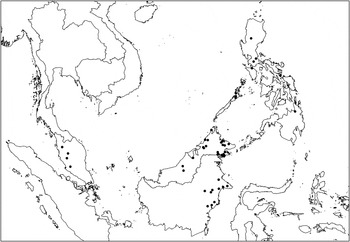
Distributions of ▪ = Endospermum ovatum Merr.; • = E. quadriloculare Pax & K.Hoffm.

Trees, dioecious, up to 30 m high, diameter c.30 cm; branches with a hard pith, flowering ones 5–5.2 mm thick, glabrous to sparsely hairy. Outer bark white, smooth; sapwood yellow; heartwood yellow. Indumentum consisting of minute stellately bundled hairs. Stipules c.1.5 × 0.5 mm, densely hairy outside, glabrous inside. Leaves: petiole 4–9.3 mm long, channelled above basally and apically, otherwise round, sparsely hairy to pilose; blade ovate to elliptic, 8.2–13.2 × 5.4–10.2 cm, length/width ratio 1.3–1.5, coriaceous, base not peltate, round to acute, abaxially with or without 1 or 2 short cylindrical extrafloral nectaries near the insertion, 1.2–1.6 × 0.8–0.9 mm, rimless, margin entire, rarely with minute glands, flat, apex acuminate, upper surface glabrous, lower surface sparsely hairy to pilose with minute stellately bundled hairs, domatia absent; venation triplinerved, upper part pinnate with 4 or 5 pairs of nerves. Inflorescences panicles, up to 17.5 cm long, pilose to densely hairy, first branches up to 3.5 cm long; bracts triangular, c.2.3 × 1.5 mm, apex acute, densely hairy on both sides. Staminate flowers cream, with a pedicel up to 1 mm long; calyx indistinctly lobed, 1.1–1.4 × 1.7–1.9 mm, completely connate, densely hairy outside, sparsely hairy inside; stamens 8 or 9, androphore cylindrical, 1.8–1.9 × c.0.9 mm, free part of filaments 0.3–1 mm long, anthers 3-thecate, 0.4–0.5 × 0.5–0.7 mm; pistillode cylindrical, c.0.4 × 0.2 mm, sparsely hairy. Pistillate flowers unknown. Fruits disintegrated, unknown. Seeds globose, c.3.1 × 3.2 mm, ecarunculate.
Distribution. Philippines (Mindanao).
Habitat and ecology. In logged areas. Flowering: April; fruiting: August.
Uses. For making toothpicks and matchsticks.
Vernacular name. Gubas.
Note. This description is based on two specimens only. More material is needed, especially specimens with pistillate flowers and/or fruits.
7. Endospermum peltatum Merr., Publ. Bur. Sci. Gov. Lab. 35: 35 (1906); Merr., Philipp. J. Sci. 1, Suppl. 1: 82 (1906); Pax & K.Hoffm. in Engl., Pflanzenr. IV.147.iv: 37 (1912); Chatterjee, Kew Bull. 1949: 564 (1950); Merr., Enum. Philipp. Fl. Pl. 2: 457 (1923); J.Schaeff., Blumea 19: 188, map 3 (1971); Airy Shaw, Kew Bull. 26: 259 (1972); Airy Shaw, Kew Bull., Addit. Ser. 5: 109 (1975); Airy Shaw, Kew Bull. 37: 18 (1982); Airy Shaw, Alphab. Enum. Euphorb. Philippine Isl. 24 (1983); Chantharaprasong in Chayam. & Welzen, Fl. Thailand 8, 1: 257 (2005). – Type: Philippines, Luzon, Tayabas Prov., Pagbilao, Merrill 2603 (lecto K, designated by Schaeffer (Reference Schaeffer1971)). Figs 1f,13.
Fig. 13.Distribution of Endospermum peltatum Merr.
[Endospermum philippinense Elmer ex Merr., Enum. Philipp. Fl. Pl. 2: 457, nom. nud., in synon. (1923).]

Trees, dioecious, up to 50 m high, bole up to 29 m high, diameter 16–90 cm, without or with buttresses up to 3 m high, extending c.2 m over the ground; branches with a hard pith, flowering ones 8–11 mm thick, pilose. Outer bark white to yellow to green to brown to grey, 0.5–13 mm thick, smooth; inner bark pale yellow to orange to brown; sapwood white to pale yellow to straw-coloured; heartwood straw-coloured, soft. Indumentum consisting of stellately bundled and simple hairs. Stipules 4.8–5.8 × 1.7–2.5 mm, densely hairy on both sides. Leaves: petiole 7.5–26 cm long, channelled above at the base, densely hairy to pilose; blade narrowly to broadly ovate, 11–29.8 × 8.7–23.5 cm, length/width ratio 1.2–1.3, coriaceous, base peltate or not, cordate to rounded (to acute), abaxially with 2 cylindrical large extrafloral nectaries near the insertion, 1.3–1.9 × 1.1–1.8 mm, rimless, margin entire with numerous minute glands, apex acute to acuminate, upper surface glabrous or sparsely covered with strigose simple hairs and/or stellately bundled hairs, lower surface densely hairy to pilose with stellately bundled hairs, with at most 5 equal hairs in a bundle, and/or simple hairs, lamina visible, greyish green to pale green, dull and with glands in the more marginal bifurcations of the nerves, domatia absent; venation yellow beneath, basally triplinerved or palmate with 5–9 basal nerves, upper part pinnate with 5–8 pairs of nerves. Inflorescences panicles, densely hairy, up to 42 cm long with the first branches up to 13 cm long; bracts triangular, 1.8–3.2 × 1.8–1.9 mm, apex acuminate, pilose both sides, often with 2 flat round glands near the base, c.0.5 mm wide. Staminate flowers white to yellow to pale green, sessile or with a pedicel up to 1.5 mm long, pilose; calyx 4-lobed, 1.5–1.7 × 1.7–2.1 mm, basally connate, densely hairy outside, pilose inside; stamens 9 or 10, androphore obovate, 1.8–2.2 × 0.9–1.1 mm, free part of filaments 0.8–1.5 mm long, anthers 3-thecate, 0.4–0.5 × 0.8–1 mm; pistillode cylindrical, splitting into 2 or 3 parts, 0.5–0.6 × 0.4–0.8 mm, sparsely hairy on the top. Pistillate flowers single per node, green to yellow, sessile or with a pedicel up to 3.2 mm long; calyx 4-lobed or toothed, 1–1.4 × 2–2.6 mm, basally connate, densely hairy outside, pilose inside; ovary globose, 2- or 3(–4)-locular, 1.5–2.8 × 1–2 mm; stigma flattened, 1.5–1.9 × 0.3–0.6 mm, glabrous. Fruits brown to green to yellow, globose, 5–8.2 × 6–9 mm with or without 3 triangular lobes on top, 0.4–1 mm long, lobes on inside often with a groove. Seeds globose, 3.4–5 × 3.2–3.8 mm, ecarunculate.
Distribution. Peninsular Thailand, Andaman Islands (Schaeffer, Reference Schaeffer1971), Malay Peninsula, Borneo and the Philippines.
Habitat and ecology. In primary (mixed dipterocarp) forest, secondary forest, and disturbed areas; along streams and roads, on hills, ridges and steep valley slopes. Soil: sandy, sandstone, loam soil on limestone, silty clay loam, alluvium and periodically inundated soil. Altitude: up to 640 m. Flowering: from April to November; fruiting: from February to November.
Uses. Seeds contain edible oil. In the Philippines the wood is used for making wooden shoes and matches.
Vernacular names. Borneo: Buah icras, Kemiri (Malay), Kedjó luk long, Marampangi (Dusun), Peridja buaja, Sedok-sedok, Seduk-seduk (Malay). Philippines: Gubas.
Notes. 1. The epithet ‘peltatum’ indicates that the leaf base is peltate. However, this character is variable and non-peltate leaves, even together with peltate ones, are found.
2. The specimens from the Philippines more often have cordate leaves than specimens from Borneo and the Malay Peninsula.
3. SMHI 479, SMHI 881, SMHI 963 and Soejarto 7682, which were collected on Palawan Island, differ from the other specimens studied by having a less dense indumentum on the lower leaf surface.
8. Endospermum quadriloculare Pax & K.Hoffm. in Engl., Pflanzenr. IV.147.iv: 36, fig. 10 (1912); S.Moore, J. Bot. 63, Suppl.: 104 (1926); J.Schaeff., Blumea 19: 190, map 3 (1971); Airy Shaw, Kew Bull. 36: 294 (1981). – Type: Indonesia, Sumatra, Palembang, Forbes 2751 (lecto L, designated here; iso BM n.v., GH, P). Figs 1d,12.
Endospermum banghamii Merr., Contr. Arnold Arbor. 8: 89 (1934); J.Schaeff., Blumea 19: 185, map 5 (1971); Airy Shaw, Kew Bull. 36: 293 (1981). – Type: Indonesia, Sumatra, Atjeh, Takengön, W.N. & C.M. Bangham 739 (holo A; iso NY).
Endospermum ronaldii J.Schaeff., Blumea 19: 185, map 4 (1971). – Type: Malaysia, Pahang, Pulau Tioman, Sedagong, M.R. Henderson SF 18396 (holo SING n.v.; iso K n.v., L).
Trees, probably dioecious, but rarely monoecious because of bisexual flowers, up to 40 m high, bole clear, diameter c.60 cm; without or with buttresses up to 2.45 m; branches with a hard pith, flowering ones 5.2–7 mm thick, glabrous to sparsely hairy. Outer bark whitish, smooth, with circular rings; inner bark yellow; wood white to yellow. Indumentum consisting of minute, stellately bundled hairs. Stipules 4.2–4.7 × 1.4–1.5 mm, pilose. Leaves: petiole 4.9–15.3 cm long, channelled above at the base, glabrous to sparsely hairy; blade elliptic to ovate, 9.2–25 × 6.3–14.1 cm, length/width ratio 1.5–1.8, papyraceous to rarely coriaceous, base peltate or not, emarginate to acute, abaxially with or without 1 or 2 lateral cylindrical, large extrafloral nectaries near the insertion, 1.1–3 × 1–1.4 mm, rimless, margin somewhat undulate, rarely with minute glands, apex acute to cuspidate, upper surface glabrous, dark green, glossy, lower surface glabrous to densely covered with minute stellately bundled hairs, duller and paler than above, without domatia; venation basally triplinerved or palmate with 5–7 basal nerves of which the 2 outer ones less distinct, upper part pinnate with 4–6 pairs of nerves. Inflorescences panicles, densely hairy, up to 18 cm long with the first branches up to 6 cm long; bracts triangular, 1.8–2.4 × 1.5–1.6 mm, apex acuminate, densely hairy both sides, often with 2 round glands near the base, c.1 mm wide. Staminate flowers pale yellow, with a pedicel up to 1.2 mm long; calyx indistinctly lobed, 1.1–1.2 × c.1.8 mm, pilose outside, sparsely hairy inside; stamens c.12, yellow to brown, androphore obovate, 2–2.1 × 1.2–1.3 mm, free part of filaments c.0.5 mm long, anthers 3-thecate, 0.6–0.8 × 0.8–0.9 mm; pistillode 3- or 4-lobed, 0.4–0.5 × c.0.6 mm, sparsely hairy beneath. Pistillate or bisexual flowers single per node, with a pedicel up to 4 mm long, pilose; calyx indistinctly lobed, 1.3–2.4 × 1.8–3.8 mm, pilose outside and inside; bisexual ones with or without a cylindrical androgynophore of c.2.2 × 0.8 mm, with 8–10 stamens at base of ovary, comparable to those of staminate flowers, persistent in fruit; ovary globose (unisexual) to cylindrical (bisexual), (3–)4- or 5-locular, 1.3–3 × 0.8–2.4 mm; stigma lobed or not, 2–2.2 × 0.9–1.4 mm, glabrous, with or without raised triangular lobes on top, c.1 mm long, up to 2 mm in fruit, lobes on the inside with a groove. Fruits pale blue to green to brown, globose or ellipsoid, 7.8–13 × 6–11 mm, pilose; stigma somewhat enlarged, 1.8–2.1 × 2.5–3.2 mm. Seeds ellipsoid, 5.6–5.9 × 2.5–3.2 mm, with a slender caruncle, 1–1.5 mm long.
Distribution. Thailand, Malay Peninsula and Sumatra.
Habitat and ecology. In primary and evergreen forests, along roads, on hills and ridges. Altitude: up to 1220 m. Flowering: from April to May; fruiting: from May to August.
Vernacular names. Malay Peninsula: Sesendok.
Notes. 1. Bisexual flowers are only known from the type specimens of Endospermum banghamii and E. ronaldii. The flowers of Endospermum banghamii have dehisced anthers that contain pollen that may be fertile. The anthers are located at the base of the ovary. Endospermum ronaldii has branched inflorescences with solitary flowers and the anthers are arranged on an androgynophore, basal to the ovary. Both names are placed in synonymy because the types do not differ in any other characters from Endospermum quadriloculare and both specimens are unique (though collected in well-sampled areas), which indicates that they are more likely to be exceptional forms than good species. Bisexual flowers are rare in Euphorbiaceae and seldom occur in Malesia; for example, seemingly bisexual flowers with staminodes are found in Agrostistachys staminodiatus Sevilla (Sevilla & Van Welzen, Reference Sevilla and Van Welzen2001) and real bisexual flowers occur in several New Guinean species of Aporosa Blume (Schot, Reference Schot2004).
2. Endospermum quadriloculare and E. diadenum are sympatric species and some sterile specimens may easily be confused. In general, Endospermum quadriloculare differs from E. diadenum in having a sparser indumentum (most specimens that we studied have a glabrous to sparsely hairy lower leaf surface), leaf base peltate or not, papyraceous leaves rarely with glands around the margin, and the extrafloral nectaries near the leaf insertion are longer (1.1–3 × 1–1.4 mm) than those of E. diadenum (0.4–0.5 × 1.5–2.2 mm).
Excluded Name
Endospermum eglandulosum Pax & K.Hoffm. in Engl., Pflanzenr. IV.147.vii: 418 (1914). – Type: Borneo, Sarawak, Beccari PB 1347 (isotype: BM000645755) = Sterculia macrophylla Vent. (Sterculiaceae); for example see Govaerts et al. (Reference Govaerts, Frodin and Radcliffe-Smith2000).
Acknowledgements
We thank the directors and curatorial staff of the following institutions for loans or photographs of their material: A, BM, BO, CANB, CGE, K, L, P and US. We also thank Raymond van der Ham for helping to check the pollen grains in the seemingly bisexual flowers and Esmée Winkel for the drawings.
Identification List
The list contains all specimens from L with collector names and collector numbers. The number after the colon refers to the following species:
1 = E. diadenum (Miq.) Airy Shaw
2 = E. domatiophorum J.Schaeff.
3 = E. medullosum L.S.Sm.
4 = E. moluccanum (Teijsm. & Binn.) Kurz
5 = E. myrmecophilum L.S.Sm.
6 = E. ovatum Merr.
7 = E. peltatum Merr.
8 = E. quadriloculare Pax & K.Hoffm.
A series 3128: 1; 4798: 7. – Abdullah 55: 1. – Achmad 338: 1; 992: 1; 1804: 1. – Aet 1941/552: 3. – Aet & Idjan 1939/234: 4; 1939/915: 3. – Ahad Amat 2: 1. – Alston 17125: 4. – Ambriansyah & Arbainsyah AA 1674: 7. – Ambriansyah & Arifin AA 259: 1; AA 1689: 1; W 1004: 1. – Ambriansyah et al. AA 2060: 1. – Argent et al. 93179: 1. – Arifin & Ambriansyah Berau 1536: 1. – Arifin & Arbainsyah AA 1821: 1.
van Balgooy & Mamesah 6445: 4. – W.N. & C.M. Bangham 739: 8. – Bartlett 6926: 1. – bb series 3134: 1; 3953: 1; 3983: 1; 3997: 1; 4103: 1; 5276: 8; 6444: 8; 7059: 1; 8089: 1; 8429: 1; 8606: 8; 9084: 1; 10390: 1; 15356: 1; 18440: 7; 21301: 1; 21520: 1; 22361: 8; 22538: 4; 23726: 4; 23861: 1; 23930: 1; 24880: 4; 25754: 4; 25946: 4; 27489: 1; 28428: 1; 28550: 1; 28705: 1; 30038: 1; 30854: 3; 30856: 3; 31704: 1; 31786: 1; 31951: 1; 31965: 1; 32222: 1; 32347: 1; 32666: 4; 33274: 4; 33322: 4; 33465: 4; 33779: 4; 33928: 4; 33941: 1; 35378: 1. – Beccari PB 819: 1; PB 3137: 1; PP 648: 4. – Béguin 1858: 4; 1964: 4; 2244: 4; 2306: 4. – van Beusekom & Phengkhlai 624: 1. – Hb. Biliton 63: 1. – Bogor Botanical Garden IX.C.85: 4; IX.C.85a: 4; IX.C.86: 4; IX.C.86a: 4. – Brass 8235: 5; 8998: 4; 29596: 2; 29722: 2; 32562: 4; 32607: 4. – Brass & Versteegh 14009: 3. – BRUN series 5585: 1; 5049: 1; 5161: 1; 15275: 1. – BS series 13547: 7; 15921: 6. – BSIP series 304: 3; 1169: 3; 1481: 3; 1503: 4; 1978: 3; 2206: 3; 2348: 4; 2543: 3; 2724: 3; 2850: 4; 3299: 4; 3451: 3; 3979: 4; 4174: 4; 4509: 3; 4518: 3; 4527: 3; 4532: 3; 4554: 3; 4881: 3; 5069: 3; 5470: 3; 5744: 3; 5843: 4; 5966: 3; 6085: 4; 6644: 3; 6687: 3; 7125: 4; 7148: 3; 7352: 3; 7471: 3; 7545: 4; 8195: 3; 8443: 4; 8730: 4; 8817: 4; 8839: 3; 8954: 4; 9491: 3; 9574: 4; 9898: 3; 10578: 4; 10617: 3; 10965: 3; 11178: 3; 11340: 4; 11366: 4; 11596: 4; 11732: 3; 12393: 4; 12859: 3; 13681: 3; 13761: 4; 13892: 4; 13980: 4; 14056: 4; 14150: 4; 14260: 4; 14317: 4; 14442: 4; 14646: 3; 15640: 4; 15759: 4; 15991: 4; 16072: 3; 16410: 3; 16578: 3; 16775: 3; 16782: 3; 16913: 3; 17582: 4; 18213: 3; 18242: 3; 18321: 4; 18428: 3; 18788: 4; 18875: 3; 18903: 4; 18985: 4; 19201: 3. – Burley et al. 1450: 1. – BW series 289: 4; 411: 4; 418: 4; 466: 4; 474: 4; 749: 4; 1278: 4; 1363: 4; 1734: 4; 2145: 4; 2616: 4; 3475: 3; 4206: 3; 4495: 4; 4624: 4; 5696: 3; 6004: 4; 6016: 4; 6598: 3; 7122: 4; 7148: 4; 9159: 3; 9682: 3; 9698: 3; 9880: 4; 9997: 4; 10884: 4; 11224: 3; 11236: 3; 11568: 4; 11694: 3; 11866: 4; 12061: 4; 12117: 4; 13283: 4; 13488: 4; 14977: 4.
Campbell Gasis 338: 1. – Carr 12055: 5; 12548: 3; 13523: 2; 13886: 2; 15250: 2. – Chongko & Boonkongchart 276: 1. – Church 586: 1. – J. Clemens & M.S. Clemens 967: 4; 50339: 1. – M.S. Clemens 1174: 4; 1294: 4; 7580: 2. – Coode 8014: 4. – Craven & Schodde 240: 3; 482: 4; 850: 5; 952: 5.
Darbyshire & Hoogland 7942: 4; 8024: 4. – Docters van Leeuwen 10174: 4. – Dorst 124.E.1P.929: 1.
Elmer 16188: 7. – Endert 344: 1; 2236: 1; 2262a: 7; 124.E.1P.791: 1. – ETH series 96/6: 4; 9617: 3.
Fénix 479: 7. – Forbes 2751: 8; 2779: 1; 2859: 8. – Forman 607: 4.
Gianno 323: 1. – Gjellerup 311: 4. – Grashoff 103: 1; 126: 1; 655: 1. – Gray 3306: 5. – Griffith KD 4721: 1.
Hartley 10046: 3; 10329: 5; 10490: 3; 11008: 4; 11515: 3; 12079: 2; 13216: 2. – Haviland & Hose 1541: 1. – van Heel 45: 4; 341: 4. – Hoogland 4150: 5; 4615: 3; 4920: 4; 5064: 3. – Hoogland & Craven 10330: 4. – Hou 325: 1. – Hyland 2050: 5; 3101: 5; 3899RFK: 5.
Jacobs 8457: 8; 8816: 2. – Johns 7872: 4. – de Jong 525: 1.
Kadim & Noor 346: 1; 347: 1. – Kairo 708: 2. – Kamis 3016: 7. – Kanis 1037: 5. – Kartawinata & Soepadmo 10: 4. – Keith 7: 1. – KEP series 95041: 1; 98546: 7; 105102: 1; 105150: 1; 115652: 7; 115660: 1. – KEP FRI series 768: 7; 770: 7; 849: 8; 864: 7; 1363: 8; 3106: 1; 4791: 1; 7678: 1; 9388: 8; 12205: 8; 14142: 1; 14744: 1; 15137: 1; 17524: 1; 27655: 8; 27656: 8; 27661: 1; 30698: 8. – Kerr 13300: 8; 18624: 1; 18979: 1. – Kessler et al. 886: 7; 971: 1; 1334: 1; 1518: 1; 2653: 1; 2706: 1. – King’s collector 6392: 1; 8091: 1. – Kirkup 714: 1. – KL series 2921: 1. – Kokawa & Hotta 4792: 7. – Kornassi 462: 4. – Kostermans 618: 4; 4469: 1; 4830: 7; 5204: 7; 5854: 7; 6916: 7; 7512: 7; 9177: 1; 9324: 1; 9568: 7; 10626: 7; 12031: 1; 13641: 7; 21138: 7; K 134: 4. – Kostermans & Anta 290: 1; 1234: 1. – Kostermans & Soegeng-Reksodihardjo 14: 4; 938: 3. – Koyama & Noma K 3843: 1.
LAE series 51194: 3; 51208: 4; 52364: 3; 53982: 2; 54358: 2; 55036: 4; 58585: 3; 68860: 5; 75390: 4; 77188: 3. – Lam 1029: 4; 3495: 4. – Lambach 1206: 1; 1206b: 1.
Maingay KD 1392: 1. – Maxwell 76-821: 8; 77-119: 1; 85-430: 1. – McDonald & Ismai 3695: 4. – Merrill 2603: 7. – Motley 1126: 1.
Nangkat 1: 1. – Nedi 743: 1. – NGF series 215: 3; 274: 5; 697: 3; 1204: 3; 1415: 3; 1639: 4; 1640: 5; 1641: 4; 1703: 3; 1738: 3; 2075: 3; 2411: 5; 3452: 4; 3788: 4; 3805: 4; 4572: 5; 7372: 4; 7474: 3; 9200: 4; 14988: 4; 15409: 4; 15654: 4; 17083: 3; 19645: 5; 19719: 4; 21666: 5; 21761: 4; 24773: 3; 25932: 3; 26232: 4; 26507: 4; 26568: 4; 26616: 4; 26677: 3; 27220: 3; 27443: 4; 27961: 3; 28991: 2; 29307: 3; 29407: 4; 29769: 4; 31725: 2; 31763: 5; 31901: 4; 32608: 4; 33455: 3; 34298: 4; 36013: 4; 38116: 5; 38549: 5; 39268: 4; 42393: 4; 43397: 4; 43988: 5; 45014: 2; 46053: 4; 46704: 4; 48187: 4. – van Niel 4442: 1. – Novotny et al. 17: 4; 23: 4; 65: 4.
Ogata 10788: 7; 11794: 4.
PBU series 120: 1. – Phusomsaeng 1969/212: 8. – Platenkamp 14: 4. – Pleyte 742: 4. – PNH series 22900: 7; 42125: 7. – Pulle 230a: 4. – Pullen 910: 3; 918: 4; 3316: 5; 5922: 2; 6401: 2; 7931: 2. – Purseglove & Shah 4414: 1.
Regalado Jr. & Katik 1187: 4. – Reksodihardjo 121: 1. – Ridsdale 1133: 7; 2253: 4. – Rojo 268: 7; 299: 6.
S series 4627: 7; 5310: 1; 12517: 1; 17710: 7; 18291: 7; 24580: 1; 26178: 1; 26876: 1; 34280: 1; 35291: 1; 37245: 1; 37485: 1; 37746: 1; 38686: 1; 40294: 1; 41917: 1; 51519: 1; 56625: 1; 57219: 1; 59693: 1; 61366: 1; 64319: 1; 74585: 1; 80601: 1. – SAN series 16256: 1; 21107: 1; 24958: 7; 26375: 1; 29972: 7; 30218: 1; 30282: 1; 30962: 1; 32449: 7; 35703: 1; 36420: 7; 41339: 7; 41649: 7; 42089: 7; 42943: 1; 43898: 7; 50061: 1; 55783: 7; 75908: 1; 76355: 7; 77916: 1; 79831: 7; 94828: 7; 95146: 1; 96474: 7; 99872: 1; 103341: 7; 103374: 1; 120986: 7; 126717: 1; 133128: 7; 133472: 1; 135099: 1; 138999: 7. – Sauveur 67: 1. – Schodde 2225: 4; 2609: 5; 2665: 5. – Schodde & Craven 4345: 3; 4993: 2. – SFN series 18396: 8; 32820: 8. – Shah 226: 1. – Shah & Noor 930: 8. – Sidiyasa & Arifin 2017: 1. – Sinbumroong & Davies 31: 8. – SMHI series 479: 7; 881: 7; 963: 7. – Soejarto 7682: 7. – Soejarto et al. 5943: 1; 6657: 7. – van Steenis 1283: 1. – Streimann 8487: 2. – Sudo 134: 4. – Susanto & Peters 1168: 1.
Takeuchi 6729: 4; 7201: 5; 11048: 4; 11803: 4. – Takeuchi, Gideon & Wiakabu 4302: 4. – Takeuchi & Towati 15255: 4. – Takeuchi et al. 13980: 4. – Tandom 8813: 7. – Tawan & Bojo 105: 1. – Teijsmann HB 3807: 1; HB 8282: 1. – Thorenaar 124.E.1P.939: 1; 124.E.1P.1009: 1. – TWTw series 11574: 4.
van Valkenburg 280: 2. – Veldkamp 8261: 1. – de Vogel 1067: 1; 3444: 4; 3465: 4; 3631: 3; 4426: 4.
Wiriadinata 3412: 1.
Zippelius 213: 4.