Healthcare personnel caring for patients with Clostridium difficile infection (CDI) are at risk of acquiring spores on their hands and clothing.Reference Kundrapu, Sunkesula, Jury, Sitzlar and Donskey 1 , Reference Landelle, Verachten, Legrand, Girou, Barbut and Brun-Buisson 2 Such contamination may contribute to transmission and place personnel at risk of acquiring CDI if they receive antibiotics.Reference Arfons, Ray and Donskey 3 Personal protective equipment reduces but does not eliminate the risk of contamination.Reference Landelle, Verachten, Legrand, Girou, Barbut and Brun-Buisson 2 , Reference Hayden, Blom, Lyle, Moore and Weinstein 4 , Reference Morgan, Liang and Smith 5 In fact, Landelle et alReference Landelle, Verachten, Legrand, Girou, Barbut and Brun-Buisson 2 found that 24% of personnel caring for CDI patients had spore contamination on their hands after glove removal. Acquisition of C. difficile on hands is particularly concerning because alcohol-based hand sanitizers are ineffective in removing spores, and soap and water hand washing is only moderately effective.Reference Kundrapu, Sunkesula, Jury, Deshpande and Donskey 6
In a recent study, we demonstrated that healthcare personnel frequently contaminate their hands and wrists during removal of contaminated gloves.Reference Tomas, Kundrapu and Thota 7 Thus, we hypothesized that decontamination of gloves before removal after care of CDI patients might reduce the risk of skin contamination with spores. Bleach wipes were effective in reducing spore contamination on gloves, but discoloration of clothing due to inadvertent spills and aversion to the odor of bleach were common complaints by personnel.Reference Tomas, Sunkesula, Kundrapu, Wilson and Donskey 8 Here, we tested the hypothesis that a novel, sporicidal formulation of ethanol would be effective for rapid decontamination of C. difficile spores on gloves without damaging clothing or causing respiratory irritation. The sporicidal formulation of ethanol is based on the demonstration that acidification of ethanol induces rapid sporicidal activity against C. difficile, resulting in preparations that are as effective as soap and water hand washing for removal of spores from hands. Reference Nerandzic, Sunkesula, Sankar, Setlow and Donskey 9
METHODS
The Cleveland Veterans Affairs Medical Center’s Institutional Review Board approved the study protocol. Initial experiments were conducted to evaluate the efficacy of sporicidal ethanol formulations versus bleach for decontaminating artificially contaminated gloves. Two clinical C. difficile strains were used, including American Type Culture Collection (ATCC) strain 43593, a nontoxigenic strain, and VA-17, an epidemic restriction endonuclease analysis BI strain. Spores were prepared as previously described.Reference Nerandzic, Sunkesula, Sankar, Setlow and Donskey 9 The amount of 0.5 mL containing 1×10⁴ log spores was inoculated onto the gloved hands of each volunteer and rubbed to cover the entire surface of the gloves until dry. Test solutions included sporicidal ethanol formulation (70% ethanol adjusted to pH 1.3 with hydrochloric acid), 1:10 and 1:100 dilutions of household bleach, and 70% ethanol with no pH adjustment. Volunteers were randomly assigned to different test solutions, which were applied either as 3 mL liquid solutions or as moistened wipes (Kimtech Prep Wipers; Kimberly Clark Professional) soaked in 25 mL test solution, with each applied for 30 seconds. After application, gloves were carefully removed, inverted, filled with 10 mL of Dey Engley Neutralizing Broth (Sigma Aldrich), and massaged to thoroughly rinse the entire glove surface. The eluent was serially diluted and cultured on C. difficile selective media as previously described.Reference Nerandzic, Sunkesula, Sankar, Setlow and Donskey 9 The log10 colony-forming unit reduction of spores was calculated by subtracting spore counts recovered from treated gloves from the counts recovered from untreated control gloves not exposed to any solution before being cultured. Experiments were performed in triplicate. One-way analysis of variance with Tukey correction was used to compare log reductions.
To assess the potential for adverse effects on clothing, samples (0.5 mL) of the test solutions were applied to 2 cm2 sections of black fabric and allowed to dry. The effect of the solutions was assessed visually immediately and 1 day after application.
Studies were conducted testing the efficacy of sporicidal ethanol applied as a liquid formulation without the use of a wipe in reducing spore contamination acquired on gloves during care of CDI patients. After patient care, personnel were randomized to perform glove disinfection with 3 mL of sporicidal ethanol or 70% ethanol. Personnel and CDI patients could be involved in multiple evaluations. For these assessments, personnel were instructed to rub the solution as if it were alcohol-based hand rub for 30 seconds. The front and back surfaces of the gloves were imprinted on pre-reduced C. difficile media and the colonies were counted as previously described.Reference Nerandzic, Sunkesula, Sankar, Setlow and Donskey 9 Personnel were asked to comment on adverse odor, respiratory irritation, or staining of clothing. The frequency of contamination and number of colonies recovered were compared using the Fischer exact test and t test, respectively. Data were analyzed using R, version 3.1.1.
RESULTS
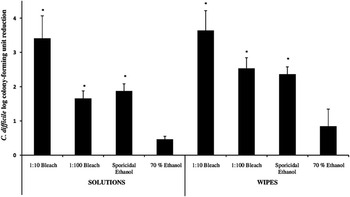
Figure 1 shows the efficacy of the test solutions for decontamination of artificially contaminated gloves. One-way analysis of variance showed significant differences across solutions (P<.0001). Pairwise comparisons demonstrated significant reductions for both bleach solutions and sporicidal ethanol in comparison with 70% ethanol (P<.0001). The reduction achieved by the sporicidal ethanol solution was equivalent to the 1:100 dilution of bleach (1.87 vs 1.69 logs; P=.97). The reduction achieved by sporicidal ethanol and the 1:100 dilution of bleach was significantly enhanced by application as a wipe (P<.01), whereas the 1:10 dilution of bleach and 70% ethanol were not (P>.1). When applied to fabric, the bleach solutions caused discoloration and fading, whereas the sporicidal ethanol solution had no visible effects, even after repeated applications.
Efficacy of a sporicidal ethanol formulation versus bleach for reduction of Clostridium difficile spores on gloves of volunteers. Gloves were inoculated with 4 log10 colony-forming units of spores and exposed to sporicidal ethanol (70% ethanol pH 1.3), a 1:10 or 1:100 dilution of household bleach, or 70% ethanol. The solutions were applied either as a 3 mL solution or as a wipe with rubbing to cover the entire surface of the glove for 30 seconds. The log10 colony-forming unit reductions were calculated by subtracting spore counts recovered from treated gloves from the counts recovered from untreated control gloves. The mean reductions from experiments conducted in triplicate are presented. Error bars show standard error. Asterisk indicates P value<.0001 compared with 70% ethanol.

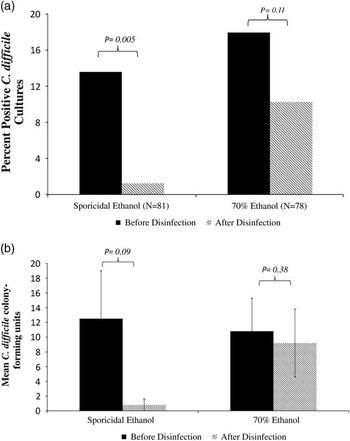
Figure 2 shows the results of the randomized trial of sporicidal ethanol versus 70% ethanol for glove decontamination after care of CDI patients. For 159 patient care episodes (67 by nurses, 52 by physicians, and 40 by allied health providers) involving 24 CDI patients, sporicidal ethanol significantly reduced the frequency of glove contamination and substantially reduced spore counts, whereas 70% ethanol did not. No personnel noted that the sporicidal ethanol solution had an adverse odor or caused respiratory irritation or staining of clothing.
Effect of sporicidal ethanol (70% ethanol pH 1.3) versus 70% ethanol on frequency of glove contamination (A) and mean number of spores recovered (B) from gloved hands of healthcare personnel caring for patients with Clostridium difficile infection. Error bars show standard error.

DISCUSSION
We found that a novel, sporicidal ethanol formulation was effective in rapidly reducing C. difficile spores by approximately 2 logs on artificially contaminated gloved hands, with a further reduction when applied as a wipe. The sporicidal ethanol solution also significantly reduced spore contamination on gloves of healthcare personnel caring for CDI patients. In contrast to bleach,Reference Tomas, Sunkesula, Kundrapu, Wilson and Donskey 8 the sporicidal ethanol solution did not stain clothing and was not associated with adverse odor or respiratory irritation. Our findings suggest that the sporicidal ethanol solution could be useful for glove disinfection before removal when caring for CDI patients. Further studies are needed to test whether use of the sporicidal ethanol solution will reduce the frequency of personnel hand contamination during removal of contaminated gloves.
Our study has some limitations. First, although personnel hand contamination with spores is not uncommon after removal of gloves during care of CDI patients,Reference Landelle, Verachten, Legrand, Girou, Barbut and Brun-Buisson 2 , Reference Tomas, Sunkesula, Kundrapu, Wilson and Donskey 8 it should be noted that hands were cultured before performance of hand hygiene. Glove disinfection might be useful to reduce the risk for hand contamination, but it would not replace the need for hand washing after glove removal when caring for CDI patients. Second, education to improve technique for glove removal might also be effective in reducing hand contamination. However, because educational interventions are not likely to reduce the risk for hand contamination to zero,Reference Tomas, Kundrapu and Thota 7 glove disinfection may still be a useful adjunctive measure. Third, use of a specific formulation of ethanol only for glove disinfection after care of CDI patients may be impractical to implement and might add to the cost of care. Finally, although the sporicidal ethanol solution was not associated with adverse effects, the formulation tested has an acidic pH that could potentially cause adverse effects with skin or mucous membrane exposure. We have developed sporicidal formulations with pH 3.5 that we anticipate will be safer if repeated skin exposure should occur.Reference Nerandzic, Sankar, Setlow and Donskey 10
ACKNOWLEDGMENTS
Financial support. Department of Veterans Affairs (Merit Review grant to C.J.D.).
Potential conflicts of interest. C.J.D. reports that he has received research grants from Steris, Clorox, Ecolab, GOJO, Avdibiotics, and Merck and has served on scientific advisory boards for 3M and Seres. All other authors report no conflicts of interest relevant to this article.