Introduction
The relationship between major depressive disorder (MDD) and personality disorder is complex but they may co-occur. When features of both are seen together, it may be that the patient has a personality disorder and is also depressed (personality disorder with MDD), or that the patient has depression with manifest behaviour superficially consistent with a personality disorder, only for that to resolve with successful treatment of the depression (MDD-only). Determining the correct focus of treatment and management can present a significant challenge to healthcare teams, especially those delivering care in an inpatient setting.
MDD and personality disorder are not mutually exclusive. A meta-analysis concluded that co-morbid cluster C personality disorders were common in unipolar depression (Friborg et al., Reference Friborg, Martinsen, Martinussen, Kaiser, Overgard and Rosenvinge2014), while others have reported that many patients with a diagnosis of borderline personality disorder have a lifetime comorbidity of MDD (Zanarini et al., Reference Zanarini, Frankenburg, Dubo, Sickel, Trikha, Levin and Reynolds1998). It is estimated that up to half of those presenting with current MDD in an inpatient setting have a concurrent personality disorder (Corruble, Ginestet, & Guelfi, Reference Corruble, Ginestet and Guelfi1996; Pfol, Stangl, & Zimmerman, Reference Pfol, Stangl and Zimmerman1984) and alterations in personality dimensions have been reported in those in a depressed state (Biachi & Fergusson, Reference Biachi and Fergusson1977; Coppen & Metcalfe, Reference Coppen and Metcalfe1965; Hirschfeld & Klerman, Reference Hirschfeld and Klerman1979; Hirschfeld, Klerman, Clayton, & Keller, Reference Hirschfeld, Klerman, Clayton and Keller1983a; Hirschfeld et al., Reference Hirschfeld, Klerman, Clayton, Keller, McDonald and Larkin1983b; Ingram, Reference Ingram1966; Kerr, Schapira, & Roth, Reference Kerr, Schapira and Roth1970). In some studies, a diagnosis of personality disorder was less likely to be made in a remitted state than when patients were depressed (Hakulinen et al., Reference Hakulinen, Elovainio, Pulkki-Raback, Virtanen, Kivimaki and Jokela2015; Russell & Joseph, Reference Russell and Joseph1988). Greater changes in personality rating scale scores have also been reported in patients receiving antidepressants compared to those taking a placebo, with the difference maintained after controlling for the effects of improvements in ratings of depression (Tang et al., Reference Tang, DeRubeis, Hollon, Amsterdam, Shelton and Schalet2009). Kool, Dekker, Duijsens, de Jonghe, and Puite (Reference Kool, Dekker, Duijsens, de Jonghe and Puite2003) found a reduction in personality pathology in patients whose depression responded to pharmacotherapy; importantly, in those receiving combined pharmacotherapy and psychotherapy, personality pathology was reduced in regardless of whether or not the depression resolved.
Kool et al. (Reference Kool, Dekker, Duijsens, de Jonghe and Puite2003) suggested that diagnosis of personality disorder could be made in the presence of depression but in contrast, Peselow, Sanfilipo, Fieve, and Gulbenkian (Reference Peselow, Sanfilipo, Fieve and Gulbenkian1994) maintained that the diagnosis of cluster A and cluster C personality traits could be affected by depression, arguing that personality traits were interwoven with depressive symptoms. Similarly, Hirschfeld et al. considered depression to have major effect on emotional intensity, interpersonal dependence and extraversion (Hirschfeld et al., Reference Hirschfeld, Klerman, Clayton, Keller, McDonald and Larkin1983b).
Further insight may be gained by exploring aspects other than mood. It is well established that MDD is associated with impairments in neuropsychological functioning (Ahern & Semkovska, Reference Ahern and Semkovska2017), which may improve with treatment but can persist into recovery (Semkovska et al., Reference Semkovska, Quinlivan, O'Grady, Johnson, Collins, O'Connor and Gload2019). Significant correlations have been found between depression severity scores and neuropsychological test performance in the domains of episodic memory, executive function and processing speed, but not with semantic memory or visuo-spatial memory (McDermott & Ebmeier, Reference McDermott and Ebmeier2009). Personality disorder is also associated with neuropsychological impairment. Burgess (Reference Burgess1990) found deficits in ‘frontal lobe’ (executive) function in patients with borderline personality disorder compared to control subjects, with executive dysfunction replicated in subsequent studies (Burgess, Reference Burgess1990, Reference Burgess1991a, Reference Burgess1991b, Reference Burgess1991c, Reference Burgess1992; O'Leary, Brouwers, Gardner, & Cowdry, Reference O'Leary, Brouwers, Gardner and Cowdry1991). Patients with a diagnosis of histrionic, narcissistic and borderline personality disorder have also been reported to have significant impairment on tests of cognition and information processing, particularly on subtests requiring multi-step, multi-element associative operations (Burgess, Reference Burgess1992). In patients with schizotypal personality disorder, severe childhood traumatic experiences (measured using Childhood Trauma Questionnaire)] have been associated with impairments in working memory, verbal fluency, visual and verbal learning and memory (Velikonja et al., Reference Velikonja, Velthorst, McClure, Rutter, Calabrese, Rosell and Perez-Rodriguez2019).
Subjective complaints of cognitive impairment are also common in patients with borderline personality disorder (Ruocco, Lam, & McMain, Reference Ruocco, Lam and McMain2014). A meta-analysis comparing borderline personality disorder and healthy controls on neuropsychological measures (attention, cognitive flexibility, learning and memory, planning, speeded processing and visuo-spatial abilities) found that borderline personality disorder was associated with a poorer performance across all neuropsychological domains (Ruocco, Reference Ruocco2005). Black et al. (Reference Black, Forbush, Langer, Shaw, Graeber, Moser and Blum2009) also concluded that borderline personality disorder was associated with deficits in perseveration and modest impairment in cognitive inhibition, decision-making and working memory, that was not accounted for by intelligence quotient (IQ) scores.
A systematic review of cognitive functioning in first-episode MDD found impairments in most cognitive domains, while remission from the episode was associated with improvements in processing speed, learning and memory, autobiographical memory, shifting and IQ (Ahern & Semkovska, Reference Ahern and Semkovska2017). Resolution of impairments may be incomplete, as the same authors explored differences in cognitive performance between those in remission from a major depressive episode and healthy controls, finding persistent deficits in selective attention, working memory and long-term memory in remitted patients compared to controls – the greater the number of previous episodes of depression, the poorer the cognitive performance even in remission (Semkovska et al., Reference Semkovska, Quinlivan, O'Grady, Johnson, Collins, O'Connor and Gload2019). In those with both personality disorder and MDD, it is unclear whether neurocognitive performance improves in line with improvements in mood, or whether it persists (objectively and/or subjectively).
In practice, distinguishing those with personality disorder (with or without MDD) from those with MDD-only is important because diagnosis can direct the primary focus of treatment, especially for inpatients. For instance, it is recognised that hospital admission is sometimes desirable or even necessary for MDD-only and physical treatments such as electroconvulsive therapy may also be indicated (NICE, 2009a). Conversely, for patients with a diagnosis of personality disorder the current practice favours community-based psychological and behavioural interventions, in as much as possible avoiding reliance on medication and prolonged hospital admission (Goodman, Roiff, Oakes, & Paris, Reference Goodman, Roiff, Oakes and Paris2012; Leonard, Reference Leonard2004; Van Veen et al., Reference Van Veen, Wierdsma, van Boeijen, Dekker, Zoeteman, Koekkoek and Mulder2019). National Institute for Health and Care Excellence (NICE, 2009b) guideline recommends first referring borderline personality disorder patients to alternative community services such as crisis resolution and home treatment before considering hospital admission.
Determining the correct management strategy is important as both conditions are associated with substantial morbidity and mortality, with personality disorder diagnosable in up to 50% of people who died by suicide (Foster, Gillespie, & McClelland, Reference Foster, Gillespie and McClelland1997). Silk (Reference Silk2010) reported that clinician-rated scales and diagnostic interviews do not easily differentiate the depression of MDD and the depression of borderline personality disorder. Clearer differentiation of MDD from personality disorder would assist in treatment decisions and may be aided by determining the profile of patients according to observer-based and subjective measures of mood, as well as neurocognitive assessments.
Our aim was to explore patterns of change in objective and subjective ratings of mood and cognitive function to see if there were differences in those with a diagnosis of personality disorder compared to those with MDD-only.
Methods
We conducted a structured observational study in which we identified all patients presenting to inpatient services with symptoms of depression, the severity of which was assessed soon (within days) after admission. At the point of discharge, patients underwent a structured diagnostic interview to formally ascertain diagnosis, after which, group allocation was determined for the purposes of analysis. Patients with symptoms of depression were recruited from three psychiatry inpatient wards at Cumbria, Northumberland, Tyne and Wear National Health Service (CNTW NHS) Foundation Trust. Patients were eligible for inclusion if they were aged 18 years or more, literate and had been an inpatient for more than 72 h. In routine practice, all patients admitted to the three wards involved in the study are discussed at a meeting within 72 h of their admission. Inpatient care teams were informed of the study inclusion and exclusion criteria and were asked to identify participants presenting with symptoms of depression. Identified patients were then referred to research team if they were considered eligible and were then assessed for enrolment into the study. Thus, the minimum effective length of stay was 3 days. Patients were not diagnosed by the research team on admission or recruitment to the study (doing so might have prejudiced the subsequent assessments). Patients may have been diagnosed on admission by their clinical team – the research team would likely have been aware of the diagnosis. We specifically invited treating teams to refer patients with symptoms of depression. Patients were ineligible for inclusion if they had a primary established diagnosis of a psychotic illness (other than MDD with psychosis), bipolar disorder, regular use of illicit psychoactive substances, alcohol or drug abuse (at the time of admission) or significant intellectual impairment (moderate, severe or very severe learning disability). The presence of exclusion criteria was confirmed by a review of case notes by a researcher and clarified with the responsible consultant psychiatrist if in doubt.
Patients would have become more familiar with their environment and clinical team as admission continued, but for the purposes of rating scales, these were conducted by the research team who saw the patient only at baseline and discharge. Individual participants discharge from the ward marked the end of participant's involvement in the study. No changes to the clinical management plans were made by the research team. All subjects provided written informed consent and the study was granted a favourable ethical opinion by a United Kingdom National Research Ethics Committee (15/WA/0219).
Procedures and measurements
Symptoms of depression were assessed by research staff using observer-based scales (Hamilton Rating Scale for Depression – HAMD; Hamilton, Reference Hamilton1960) and self-reported by patients using the Beck Depression Inventory (BDI; Beck, Ward, Mendelson, Mock, & Erbaugh, Reference Beck, Ward, Mendelson, Mock and Erbaugh1961 with revised version 1996; Beck, Steer, & Brown, Reference Beck, Steer and Brown1996). The Clinical Global Impression scale (CGI; Guy, Reference Guy1976, Reference Guy and Rush2000), which measures symptom severity and treatment response, was also used. Given our study was not a medication trial, the CGI efficacy index was not analysed and the CGI global improvement was used to compare groups at discharge. Diagnosis at discharge was assessed using Structured Clinical Interview for Diagnostic Statistical Manual-5 Disorders research version (SCID-5-RV; First, Williams, Karg, & Spitzer, Reference First, Williams, Karg and Spitzer2015a) and the Structured Clinical Interview for Diagnostic Statistical Manual-5 Disorders Personality Disorders (SCID-5-PD; First, Williams, Karg, & Spitzer, Reference First, Williams, Karg and Spitzer2015b). Selected neurocognitive functions were assessed using the Cognitive Failures Questionnaire (CFQ; Broadbent, Cooper, FitzGerald, & Parkes, Reference Broadbent, Cooper, FitzGerald and Parkes1982) and Digit Symbol Substitution Test (DSST; Lezak, Howieson, & Loring, Reference Lezak, Howieson and Loring2004), with the CFQ providing a subjective rating of function (expressed as total value of distractibility, memory, blunders and name scores) and the DSST an objective assessment. Broadbent et al. (Reference Broadbent, Cooper, FitzGerald and Parkes1982) developed the CFQ to assess the frequency of everyday errors (memory and cognition) and each item in the scale referred to a particular type of mistake (e.g. forgetting names). It further measures daily life attentiveness such as the frequency of lapses in attention (Bridger, Johnsen, & Brasher, Reference Bridger, Johnsen and Brasher2013). The DSST is sensitive to cognitive dysfunction, change in cognitive functioning, impairments and improvement in processing speed, executive functioning, working memory and real-world functional outcomes (Jaeger, Reference Jaeger2018). The entire spectrum of neurocognition was not assessed.
The study was conducted over 20 months (1 May 2016 to 31 December 2017) on three acute psychiatric inpatient units at the same CNTW NHS Foundation Trust hospital site. For individual participants, the duration of engagement in the study was directly determined by the duration of their admission, with discharge from the ward marking the end of their involvement.
Following enrolment in the study, patients underwent an initial assessment which comprised of completion of the HAMD, CGI, BDI, CFQ and DSST. No further study procedures were conducted until the patient was ready for discharge, at which point a diagnostic assessment was conducted (SCID-5-PD and SCID-5-RV) and the mood ratings and neurocognitive test battery were repeated (HAMD, CGI, BDI, CFQ and DSST). The SCID-5 interview was conducted by one assessor and the discharge HAMD and the CGI were conducted by another assessor; their findings were not disclosed to each other. All the assessments were conducted by trained senior mental health staff from the research team.
Statistical analysis
SPSS version 25 (SPSS Inc., USA) was used for the analysis. For group comparisons, the normality of distribution of data was assessed using Kolmogorov–Smirnov and Shapiro–Wilk tests, followed by paired t tests and independent sample t tests for normally distributed data, and Wilcoxon and Mann–Whitney U tests as non-parametric equivalents. Analysis of covariance was used to explore the effects of potential confounders and χ2 test was used for categorical data. All values are presented as mean ± standard deviation (s.d.) unless otherwise stated.
Results
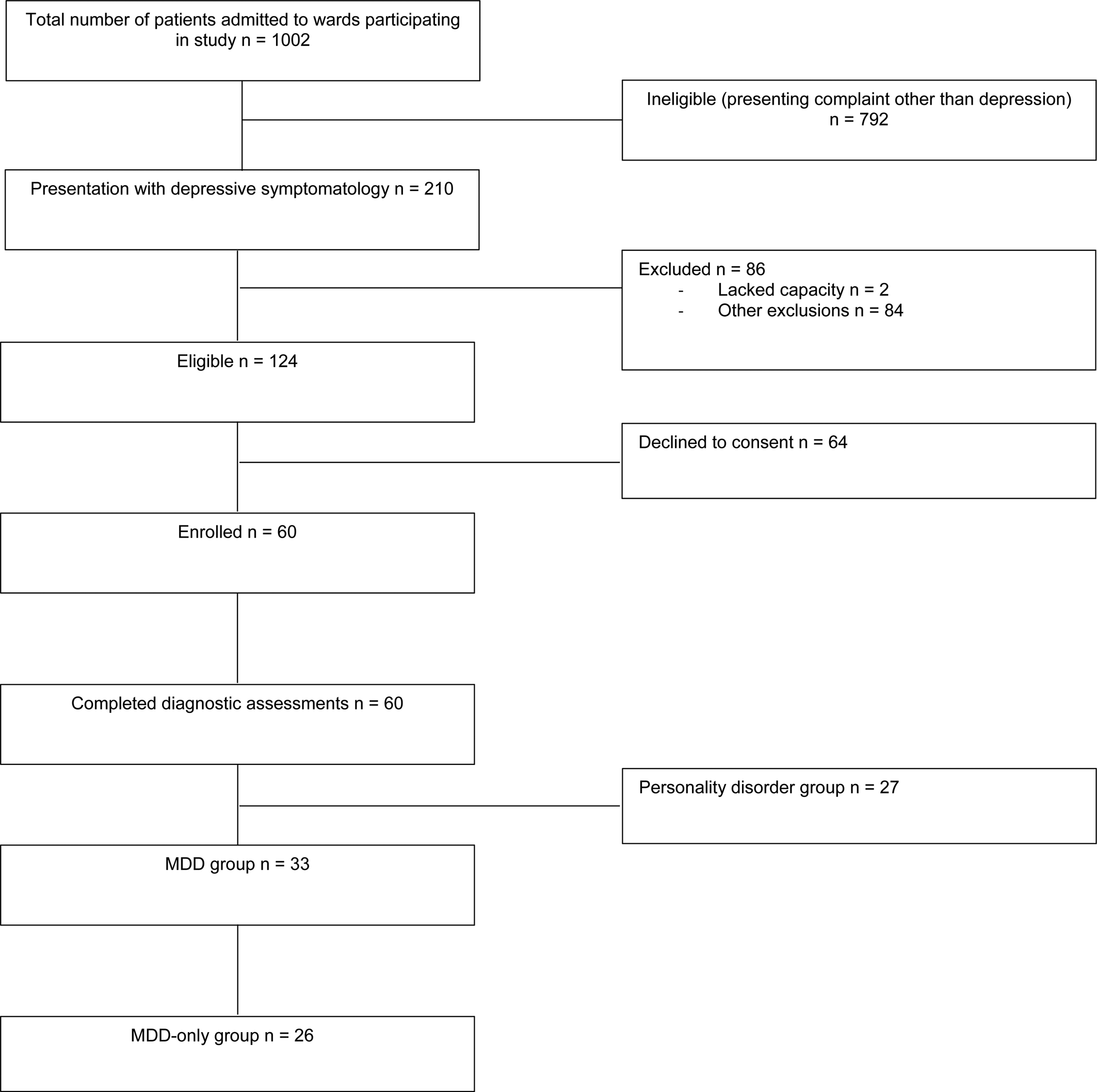
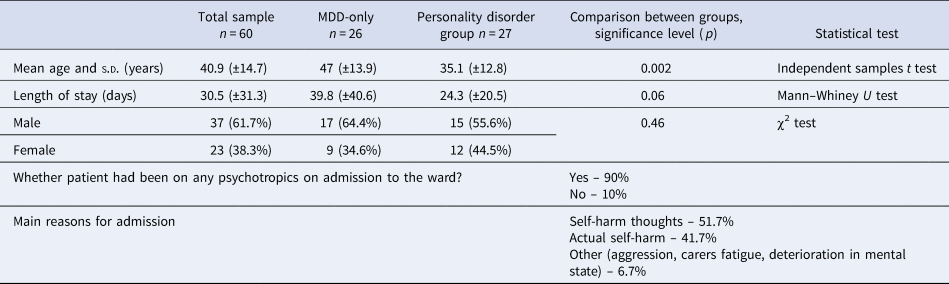
During the study, the total number of patients admitted for any reason to the wards involved in recruitment was n = 1002 (Fig. 1). Of those presenting with depression (n = 210), 60 eligible patients were enrolled. The sample demographics are shown in Table 1.
Consort diagram.

Sample demographics for 60 patients enrolled in the study

For the purpose of statistical analysis, patients were divided into two main groups according to their diagnosis established at the point of discharge:
(a) MDD-only group (n = 26) – this group included patients with DSM-5 diagnosis of MDD (n = 24) including dysthymia (n = 2). Patients presenting with features of depression but classified as having an alternative diagnosis [such as an anxiety disorder with depressive symptoms (subthreshold depressive symptoms)] were excluded from this group (n = 7; see Fig. 1 Consort diagram). A secondary analysis was conducted in which those with any depressive symptoms were included (n = 33; presented in online Supplementary Table S4).
(b) personality disorder group – patients with personality disorder diagnosed on SCID-5 assessment, with or without a diagnosis of MDD [n = 27 (personality disorder with MDD = 14 and personality disorder without MDD = 13)].
Sample characteristics
The mean length of stay for the MDD-only group was 39.8 ± 40.6 days compared to 24.3 ± 20.5 days for the personality disorder group (Z = −1.8, p = 0.06). The study was conducted in three wards in our hospital Trust. The Trust has distinct single-sex wards, and two wards in the study were for male patients, accounting for the sex distribution in the sample. No significant sex differences were observed between groups [χ2(1, N = 53) = 0.53, p = 0.46] but those with a personality disorder were significantly younger than those with a diagnosis of MDD-only (t = 3.2, df = 51, p = 0.002). Data on the number of previous admissions were not collected.
In the personality disorder group, 22 patients had borderline personality disorder, nine patients had avoidant personality disorder and seven patients had paranoid personality disorder. Out of 27 patients in the personality disorder group, 13 patients were diagnosed with single personality disorder [borderline (n = 8), avoidant (n = 3), obsessive compulsive (n = 2) personality disorders] while remaining 14 patients had personality disorder combinations. Seven patients had two personality disorders combined [borderline (n = 7), avoidant (n = 2), paranoid (n = 2), schizotypal (n = 1), antisocial (n = 1) personality disorders], six patients had three personality disorders combined [borderline (n = 6), paranoid (n = 4), avoidant (n = 4), antisocial (n = 2), dependent (n = 2), schizotypal (n = 1) personality disorders] and one patient had four co-morbid personality disorder (paranoid, schizoid, antisocial and borderline personality disorders). Out of total 27 patients in the personality disorder group, 15 patients had an additional diagnosis of co-morbid MDD while remaining 12 patients had a diagnosis of either personality disorder alone or other co-morbid diagnoses (without MDD) at the time of the study.
Mood rating scales
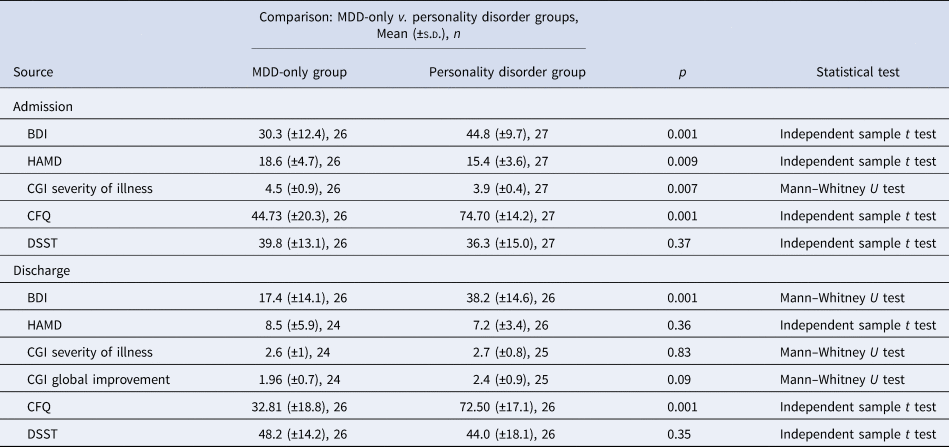
On admission, those in the personality disorder group rated themselves as more depressed compared to those with MDD-only (BDI scores on admission: personality disorder group 44.8 ± 9.7 v. MDD-only group 30.3 ± 12.4; t = −4.7, df = 51, p = 0.001). The converse was the case on observer-rated assessments, with the MDD-only group scoring more highly than the personality disorder group (HAMD scores on admission: personality disorder group 15.4 ± 3.6 v. MDD-only group 18.6 ± 4.7; t = 2.7, df = 51, p = 0.009).
At discharge, those in the personality disorder group continued to rate themselves as more depressed compared to those with MDD-only (BDI scores at discharge: personality disorder group 38.2 ± 14.6 v. MDD-only group 17.4 ± 14.1; Z = −0.69, p = 0.001). However, there was no difference between the groups on observer-based ratings of depression severity (HAMD scores at discharge: personality disorder group 7.2 ± 3.4 v. MDD-only group 8.5 ± 5.9; t = 0.90, df = 48, p = 0.36).
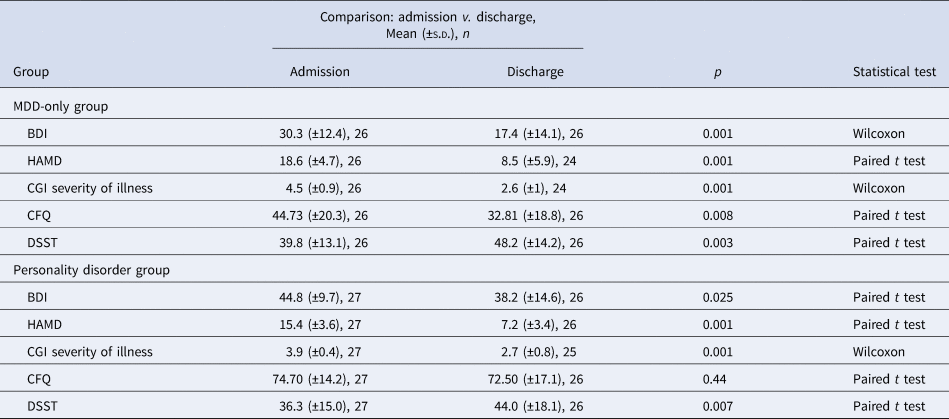
Both groups showed significant reductions in the severity of observer-rated and subjective depression over the span of the admission (Table 2). Observer-based ratings of depression reduced by over 50% in the MDD-only group (HAMD scores: admission 18.6 ± 4.7 to discharge 8.5 ± 5.9, mean reduction 10.1 ± 7.2; t = 6.9, df = 23, p = 0.001) and the personality disorder group (HAMD scores: admission 15.4 ± 3.6 to discharge 7.2 ± 3.4, mean reduction 8.2 ± 5.1; t = 8.1, df = 25, p = 0.001). Subjective improvements in mood were more significant for the MDD-only group (BDI scores: admission 30.3 ± 12.4 to discharge 17.4 ± 14.1; Z = −3.6, p = 0.001) in contrast to the lower reduction in rating scale scores for the personality disorder group (BDI scores: admission 44.8 ± 9.7 to discharge 38.2 ± 14.6, mean reduction 6.3 ± 13.4; t = 2.3, df = 25, p = 0.025).
MDD-only and personality disorder groups, admission and discharge comparisons

n = number of patients completed (after excluding missing data) the respective assessment.
Clinical global impression
On admission, the MDD-only group was judged to have a greater severity of illness compared to the personality disorder group (CGI severity of illness score admission: MDD-only group 4.5 ± 0.9 v. personality disorder group 3.9 ± 0.9; Z = −2.6, p = 0.007). At discharge, the groups did not differ in ratings of the severity of illness (CGI severity of illness score discharge: MDD-only group 2.6 ± 1.0 v. personality disorder group 2.7 ± 0.8; Z = −0.2, p = 0.83). Both groups had a significant reduction in the severity of illness over the span of the admission (Table 2) and had a comparable degree of improvement at discharge (CGI global improvement score at discharge: MDD-only group 1.96 ± 0.7 v. personality disorder group 2.4 ± 0.9; Z = −1.6, p = 0.09).
Neuropsychological findings assessed using CFQ and DSST
On admission, those in the personality disorder group rated themselves as more cognitively impaired than the MDD-only group (CFQ scores on admission: personality disorder group 74.70 ± 14.2 v. MDD-only group 44.7 ± 20.3; t = −6.2, df = 51, p = 0.001). There was no difference between the groups on objective assessments of neurocognitive function on admission (DSST scores on admission: personality disorder group 36.3 ± 15.0 v. MDD-only group 39.8 ± 13.1; t = 0.93, df = 50, p = 0.37). This profile was maintained at discharge, with the personality disorder group reporting more cognitive impairment subjectively compared to the MDD-only group (CFQ scores on discharge: personality disorder group 72.50 ± 17.1 v. MDD-only group 32.8 ± 18.8; t = −7.9, df = 50, p = 0.001), but with no difference discerned on objective measures (DSST scores on discharge: personality disorder group 44.0 ± 18.1 v. MDD-only group 48.2 ± 14.2; t = 0.93, df = 50, p = 0.35).
Cognitive function improved objectively and subjectively in the MDD-only group over the span of the admission (Table 3). In the personality disorder group, cognitive function improved objectively over the admission but subjective ratings at discharge did not differ from admission scores.
Comparison between the MDD-only group and the personality disorder group

n = number of patients completed the respective assessment (after excluding missing data).
Discussion
In this structured observational study, 60 eligible inpatients presenting with symptoms of depression were assessed on admission and discharge using subjective and observer-based ratings of mood, together with subjective and objective assessments of selected neurocognitive function (CFQ and DSST) prior to confirmation of diagnostic group. A structured diagnostic interview at the point of discharge was used to categorise patients as having MDD-only or a personality disorder (with or without MDD), and the groups compared on study measures. On admission, the MDD-only group was rated as more depressed by research staff, but the personality disorder group reported a greater severity of depressive symptoms subjectively. Improvements in observer-based assessments of mood and neurocognitive function were observed in both groups over the span of inpatient admission. Subjective ratings of mood also improved in both groups, but to a lesser extent in the personality disorder group. Those in the personality disorder group subjectively reported a greater degree of neurocognitive impairment and unlike the MDD-only group, these subjective ratings did not improve during the admission despite improvements being noted on observer-based measures.
In our study, patients with personality disorder consistently reported greater levels of depression subjectively despite similar or lower observer-based ratings of severity when compared to patients with MDD-only. Heightened subjective experience of depression in MDD co-morbid with borderline personality disorder has previously been reported (Stanley & Wilson, Reference Stanley and Wilson2006). Peirson and Heuchert (Reference Peirson and Heuchert2001) investigated the relationship between the BDI and the Temperament and Character Inventory and found that the personality traits of harm avoidance, self-directedness and cooperativeness correlated significantly with the BDI scores. Arguably, these traits may contribute to the self-recognition of depressive symptomatology in patients with a personality disorder, accounting for the higher subjective rating of depression severity observed in our study.
We found that the MDD-only group was more severely depressed on observer-based ratings at admission compared to the personality disorder group, with rating conducted prior to formal determination of diagnosis. A modest association between HAMD and BDI scores has previously been reported (Carter, Frampton, Mulder, Luty, & Joyce, Reference Carter, Frampton, Mulder, Luty and Joyce2010; Davies, Burrows, & Poynton, Reference Davies, Burrows and Poynton1975; Richter, Werner, Heerlein, Kraus, & Sauer, Reference Richter, Werner, Heerlein, Kraus and Sauer1998; Schnurr, Hoaken, & Jarrett, Reference Schnurr, Hoaken and Jarrett1976), which may be explained by the differences in the depressive symptoms sampled by using two scales (Bagby, Ryder, Schuller, & Marshall, Reference Bagby, Ryder, Schuller and Marshall2004; Lambert, Hatch, Kingston, & Edwards, Reference Lambert, Hatch, Kingston and Edwards1986). One interpretation of these findings is that the clinicians conducting the HAMD rating may not have identified the full range of depressive symptoms that those in the personality disorder group were experiencing subjectively. For instance, the past experiences of patients in this group may have resulted in difficulties in interpersonal communication with health care professionals. Alternatively, it could be argued that characteristics of major depression occurring in conjunction with personality disorder may differ from the profile in MDD alone, such that the HAMD inadequately assesses its severity, or that those with a diagnosis of personality disorder experience a greater level of distress for a given level of severity of depression. Silk (Reference Silk2010) reported the difficulties in differentiating MDD in personality disorders from MDD alone and suggested exploring patient's interpersonal relationships in detail to understand MDD in personality disorder. In a study investigating patients with treatment-resistant depression and co-morbid personality disorder, the divergence between the BDI and the HAMD was high and correlated positively with anxiety (Rane et al., Reference Rane, Fekadu, Wooderson, Poon, Markopoulou and Cleare2010). The discrepancy between the BDI and HAMD scores observed in our study could therefore be influenced by co-morbid anxiety, the severity of which we did not specifically assess. Personality characteristics such as high neuroticism have been associated with discrepant HAMD–BDI scores (Duberstein & Heisel, Reference Duberstein and Heisel2007; Enns, Larsen, & Cox, Reference Enns, Larsen and Cox2000; Paykel, Prusoff, Klerman, & DiMascio, Reference Paykel, Prusoff, Klerman and DiMascio1973; Prusoff, Klerman, & Paykel, Reference Prusoff, Klerman and Paykel1972). In our study, MDD-only group (n = 26) included patients with DSM-5 diagnosis of MDD (n = 24) and two patients with dysthymia. Out of those 24 patients diagnosed with MDD in the MDD-only group, 15 were diagnosed with MDD with anxiety distress while three patients had MDD with psychotic features (with or without melancholic features). One patient each had MDD with atypical features and MDD with melancholic features, while four patients had MDD without specifiers. In the personality disorder group (n = 27), 10 patients had MDD with anxiety distress (out of 15 patients having personality disorder plus MDD). We acknowledge that anxiety parameters itself have not been specifically assessed in our study. High BDI scores relative to HAMD scores have also been reported in younger patients and those with a higher level of education, and may vary according to the type of depression (Domken, Scott, & Kelly, Reference Domken, Scott and Kelly1994; Enns et al., Reference Enns, Larsen and Cox2000). A study comparing self-reported and clinician-rated symptom-severity measures found that dysthymic and ‘nonendogenous’ major depressive groups self-reported significantly more symptoms than their clinicians did (Rush, Hiser, & Giles, Reference Rush, Hiser and Giles1987). Caution has been advocated in characterising those with high BDI scores as clinically depressed, given that the scale is not a diagnostic tool (Joiner, Schmidt, & Metalsky, Reference Joiner, Schmidt and Metalsky1994; Rudd & Rajab, Reference Rudd and Rajab1995). In contrast, Peirson and Heuchert (Reference Peirson and Heuchert2001) suggested that individuals who scored highly on the BDI were likely to be experiencing negative or depressed mood with respect to a non-psychiatric population, while Richter, Polak, and Eisemann (Reference Richter, Polak and Eisemann2003) found that harm avoidance and self-directedness were substantially related to depressed mood. It has also been reported that those with a diagnosis of borderline personality disorder differ significantly in dimensions of ‘novelty seeking’ and ‘cooperativeness’ compared to controls (Fossati et al., Reference Fossati, Donati, Donini, Novella, Bagnato and Maffei2001), and that differences between self and clinician ratings correlate with dysfunctional attitudes and lower self-esteem (Domken et al., Reference Domken, Scott and Kelly1994). In our study, some of these characteristics may have contributed to inflated BDI scoring in the personality disorder group.
We found that the MDD-only group was rated more severely depressed on admission using the HAMD, but that our groups did not differ on this scale at discharge. The HAMD score alone is unlikely to differentiate those with MDD from those with a personality disorder. A study examining the psychometric properties of the HAMD identified that many scale items were poor contributors to the measurement of depression severity, criticising the scale for being psychometrically and conceptually flawed (Bagby et al., Reference Bagby, Ryder, Schuller and Marshall2004). The MDD-only group in the current study was rated as more severely ill using the CGI on admission, with groups not differing in severity at discharge. Conversely, Zimmerman et al. (Reference Zimmerman, Martinez, Morgan, Young, Chelminski and Dalrymple2013) found that major depression occurring with co-morbid borderline personality disorder was rated as significantly more severe using the CGI compared to those with depression, albeit depression occurring in bipolar disorder (type II).
In the current study, the personality disorder group reported greater subjective cognitive impairment compared to the MDD-only group, on admission and at discharge. The DSST performance improved in both groups at discharge, but the DSST failed to differentiate between groups (no significant difference was found in DSST mean scores between MDD-only group v. personality disorder group, both at admission and discharge). The personality disorder group scored highly on the subjective CFQ at baseline and discharge (expressing subjective cognitive deficits) despite objective findings on the DSST showing an improvement. The CFQ findings were consistent with the objective DSST scoring solely in the MDD-only group; a reduction in the CFQ scoring was seen at discharge together with an objective increase in the DSST scoring. In contrast, the personality disorder group improved on the DSST but not subjectively on the CFQ. Wagle, Berrios, and Ho (Reference Wagle, Berrios and Ho1999) reported a correlation between CFQ scores and psychiatric symptoms associated with stress, and Van der Linden, Keijers, Eling, and Van Schaijk (Reference Van der Linden, Keijers, Eling and Van Schaijk2005) found CFQ scores correlated with psychological strain and burnout. This raises the possibility that the high scoring on CFQ in the personality disorder group was due to increased vulnerability to stress, or at least the subjective experience of it (as objective assessments of neurocognitive function improved in the personality disorder group over the admission). Studies have also reported a link between childhood trauma and cognition which may be a factor affecting cognitive performance in the present study. Velikonja et al. (Reference Velikonja, Velthorst, McClure, Rutter, Calabrese, Rosell and Perez-Rodriguez2019) found neurocognitive deficits in patients with schizotypal personality disorder with childhood trauma compared to schizotypal personality disorder without childhood trauma. Although we observed a discrepancy in subjective and observer-based ratings of mood and neurocognitive function, Black et al. (Reference Black, Forbush, Langer, Shaw, Graeber, Moser and Blum2009) argue that selected personality traits such as impulsivity have a primary role in predicting borderline personality disorder over neuropsychological test abnormalities, such that we need to interpret our findings and the root cause of the discrepancy with caution.
In our study, the group differences (significant differences between MDD-only v. personality disorder) on admission and discharge for BDI and CFQ exist between the groups and the findings remain when the age and length of stay are included as covariates. Given the covariate, length of stay only affects the discharge data, it is not included on admission. The group differences (non-significant differences between MDD-only v. personality disorder) in discharge HAMD and DSST (both admission and discharge) exist between the groups and the findings remain when the age and length of stay are included as covariates. The only exception is that the significant difference between MDD-only v. personality disorder (on admission) for HAMD between the groups is not sustained when age is included as a covariate. This warrants further research in this area with a larger sample size.
The strengths of our study rest in its structured observational design and conduct in an inpatient setting, with assessments of mood and neurocognitive function conducted and concluded before determination of diagnosis with respect to the presence of a personality disorder. Friborg et al. (Reference Friborg, Martinsen, Martinussen, Kaiser, Overgard and Rosenvinge2014) concluded that co-morbid personality disorder was less commonly reported when the diagnosis was based on structured clinical interviews compared to self-reported measures, and that structured clinical interviews were beneficial in identifying false-positive diagnoses of personality disorder. We determined group allocation using interviewer-rated assessments of personality (SCID-5-PD) and self-reported personality questionnaire (self-reported screening personality questionnaire; SCID-5-SPQ; First, Williams, Karg, & Spitzer, Reference First, Williams, Karg and Spitzer2015c). We applied diagnostic tools (SCID) at discharge rather than admission to minimise bias.
There are a number of limitations to our study. Patients were not assessed immediately on admission but at a time deemed appropriate by the inpatient care team, though in all cases within 72 h of admission. Bias may therefore have been introduced to the study if there were differences in rapidity of referral to the research team, or differences in the likelihood of admission over weekend periods between those with MDD-only and those with personality disorder. Rating scale data were collected at a time deemed clinically appropriate rather than at a fixed point in the day, adding variability given the diurnal variations in mood associated with depression. The differentiation between objective and subjective distinction is firmer for the cognitive dimensions, and this is a clear strength of our study. Affective symptoms are inherently subjective and less informative, and we recognise that as a limitation of the work. While not significantly different, those with personality disorder had shorter admissions and the lower rate of subjective improvement may reflect the lag between observer-based and subjective improvements common in the treatment of depression. Although the SCID diagnosis was conducted at the end, assessors had access to read the provisional diagnosis from the treating team records on admission in some patients. Three patients in the MDD group had features of psychosis. This subgroup is too small to justify formal comparison, but we recognise this as a limitation that this may have influenced their engagement in the study and the rating scale scores. We do recognise that the heterogeneity in the sample and the relatively small size of the study limit the generalisability of the findings.
Conclusion
In this study, patients with MDD-only and those with a personality disorder presenting with depression differed in profile on subjective and observer-based ratings of mood and neurocognitive function. A higher clinician rating of depression on the HAMD was noted in the MDD-only group while higher subjective reporting of depression on BDI was seen in those with a diagnosis of personality disorder. Objective assessment of neurocognitive function (CFQ and DSST) demonstrated improvements over the course of an inpatient admission in both MDD-only and personality disorder groups, but those in the personality disorder group continued to report high levels of subjective cognitive deficits at discharge while the MDD-only group reported subjective improvement. The profiles of observed/objective and subjective ratings of mood and neurocognitive function on admission and discharge may help to differentiate those with a personality disorder from MDD alone, warranting further research with a view to guiding management strategies.
Supplementary material
The supplementary material for this article can be found at https://doi.org/10.1017/S003329172100547X
Acknowledgements
The authors thank staff and management at inpatient wards, Cumbria, Northumberland Tyne and Wear NHS Foundation Trust.
Financial support
The Royal College of Psychiatrists provided funding to obtain the Structured Clinical Interview for Diagnostic Statistical Manual-5 Disorders assessment materials and permission for their use was granted by the American Psychiatry Association.
Conflict of interest
Kaushadh Jayakody and Peter Gallagher: No conflicts of interest to declare. Adrian J. Lloyd: Main employment, Cumbria Northumberland Tyne and Wear NHS Foundation Trust (UK); Honorary Clinical Senior Lecturer, Newcastle University; Funded by Health Education England as Head of School of Psychiatry, Health Education England North-East and North Cumbria. No participation in advisory boards, no company shares and no enduring financial relationships with any company, consultancy or otherwise. Research has been funded by Efficacy and Mechanism Evaluation programme (Medical Research Council/National Institute for Health Research), Stanley Medical Research Institute, Welcome Foundation, Newcastle University, Newcastle Hospital Special Trustees. David A. Cousins: Employed by Newcastle University; Honorary Consultant Cumbria Northumberland Tyne and Wear NHS Foundation Trust (UK). Accepted honoraria for presenting at educational events organised by Lundbeck, paid to main employer Newcastle University. No participation in advisory boards, no company shares and no enduring financial relationships with any company, consultancy or otherwise. Research funding (past and present) from the Medical Research Council, European Union, Royal College of Psychiatrists and the Reece Foundation Studentship in Translational Systems Neuroscience (Newcastle University).