Milk plays a vital role in providing essential nutrients and enhancing the quality of the human diet. Among various dairy products, yoghurt stands out for its proposed therapeutic benefits, including potentially boosting immunity and improving cardiovascular and mental health (Facioni et al., Reference Facioni, Raspini, Pivari, Dogliotti and Cena2020; Azam et al., Reference Azam, Islam, Wahiduzzaman, Alam and Dhrubo2023). At the same time, a perceived consumer shift towards plant-based diets, driven by factors such as lactose intolerance, allergies and vegetarian trends, has prompted the exploration of hybrid yoghurts that blend dairy and plant-based derivatives. While dairy products remain readily available, plant-derived protein consumption is steadily increasing across Europe, with an 11% annual rise in dairy-free meals and drinks (Hoehnel et al., Reference Hoehnel, Zannini and Arendt2022; Dewan et al., Reference Dewan, Ahiduzzaman, Islam and Shozib2023). This trend is reflected globally, where plant-based yoghurt alternatives are seen as affordable dairy substitutes, particularly in developing nations (Medici et al., Reference Medici, Craig and Rowland2023). To address the needs of vegetarians and lactose-intolerant individuals, the food industry has initiated numerous pilot projects to develop dairy yoghurt alternatives (N Yadav, Reference N Yadav2017).
Soy drink is a close nutritional substitute for cow's milk, offering a reliable protein source that includes all nine essential amino acids. It is also low in carbohydrates and fats, cholesterol-free, and rich in minerals such as iron, calcium, potassium, zinc, phosphorus, copper, manganese and vitamins B, E, and K (Messina, Reference Messina2016). Nutritionists are particularly interested in soy drink (an aqueous extract from soybeans) as a potential cow's milk alternative (Jayarathna et al., Reference Jayarathna, Priyashantha, Johansson, Vidanarachchi, Jayawardana and Liyanage2020). Studies suggest that soy drink yoghurt contains more calcium, protein, and fat than soy drink, primarily due to added calcium salts and cultures. Additionally, the unsaturated fats in soy are potentially beneficial for health (Ugwona et al., Reference Ugwona, Obeta, Ejinkeonye and Aliyu2018). The antioxidants and micronutrient properties of soybeans are linked to various health benefits, including the prevention of cardiovascular disease, cancer and osteoporosis in older adults (Anderson et al., Reference Anderson, Smith and Washnock2020; Choudhury et al., Reference Choudhury, Islam, Khan, Ahiduzzaman, Masum and Ali2023). Furthermore, the oligosaccharides in soy drink make it an excellent substrate for the growth of probiotic bacteria like Lactobacillus and Bifidobacterium, which give yoghurt its unique flavour (Vij et al., Reference Vij, Hati and Yadav2011; Singh and Vij, Reference Singh and Vij2018). Consequently, soy derivatives are being incorporated into various food formulations aimed at increasing nutritional value for both children and adults (Verduci et al., Reference Verduci, Di Profio, Cerrato, Nuzzi, Riva, Vizzari, D'Auria, Giannì, Zuccotti and Peroni2020).
Oat drink has also gained considerable interest as a non-dairy drink alternative. Among cereals, oats are valued for their nutrient richness, providing proteins, carbohydrates, dietary fibre (β-glucans), vitamins, and phytochemicals. Oats contain high-quality proteins (albeit in small amounts), unsaturated fatty acids and natural antioxidants like tocopherols, phenolic compounds and avenanthramides (Luana et al., Reference Luana, Rossana, Curiel, Kaisa, Marco and Rizzello2014; Dewan et al., Reference Dewan, Islam, Azam, Kuddus, Syed Amir and Rahman2024). The potential benefits of oat fibre include reducing blood cholesterol levels and lowering post-meal blood glucose spikes due to β-glucans (Zurbau et al., Reference Zurbau, Noronha, Khan, Sievenpiper and Wolever2021). Despite these functional properties, the acrid flavour of oat drink, which mainly results from lipid oxidation by-products, adversely affects sensory acceptability (Molteberg et al., Reference Molteberg, Solheim, Dimberg and Frølich1996; Li et al., Reference Li, Li, Zhang, Wu and Yu2023).
Recent studies on consumer acceptance of hybrid yoghurts suggest a growing interest due to their ability to offer the familiar qualities of traditional yoghurts with added health and environmental benefits of plant-based ingredients (Cardello et al., Reference Cardello, Llobell, Jin, Ryan and Jaeger2024; Marlapati et al., Reference Marlapati, Kinchla and Nolden2024; Martinussi et al., Reference Martinussi, Poloto, Navarini, Marfil, Parra Baptista, Gigante and Merheb-Dini2024). Additionally, advancements in food technology such as micro and nano encapsulations have enabled better integration of plant-based components into dairy matrices, improving texture and flavour compatibility (Plamada et al., Reference Plamada, Teleky, Nemes, Mitrea, Szabo, Călinoiu, Pascuta, Varvara, Ciont and Martău2023). These developments reflect an evolving market landscape where hybrid products can satisfy diverse dietary preferences and nutritional requirements (Curutchet et al., Reference Curutchet, Arcia and Rodríguez Arzuaga2024).
Traditionally, yoghurt is produced by fermenting cow milk, maintaining parameters such as a pH of 4.5 and a high concentration of lactic acid bacteria like Streptococcus thermophilus and Lactobacillus delbrueckii subsp. bulgaricus (Paul et al., Reference Paul, Islam, Dewan, Alim and Ahmmed2024). The acidification during fermentation influences the stability of casein micelles, altering their charge, dissolving calcium phosphate crosslinks, and changing protein bonding, leading to gel formation. Achieving similar gel cohesiveness with plant-based drinks is challenging due to these acidification effects (Rahman et al., Reference Rahman, Islam, Mia, Hossen, Dewan and Mahomud2024). Although additives such as protein extracts, inulin, thickeners and emulsifiers can facilitate gel formation, they must meet quality standards for human consumption (Dewan et al., Reference Dewan, Islam, Azam, Kuddus, Syed Amir and Rahman2024).
This study aims to address these challenges to overcome gel network formation issues and investigate the potential of hybrid products to enhance consumer acceptance, providing a balance of taste, nutrition, and sensory appeal. The specific objectives of this research are to evaluate the physical, microbial and sensory properties of hybrid yoghurts formulated by combining cow's milk with soy and oat drinks in various combinations, and to identify the most promising formulations for consumers.
Materials and methods
Milk collection and pasteurization
Milk was collected from Dairy Campus (a part of Wageningen University and Livestock Research), Leeuwarden, the Netherlands, and stored at chilled temperature (4°C). Around 30 l of milk were transferred to the Food Application Centre and Technology (FACT) the day before production began. The milk was pasteurized using a pilot-scale UHT tubular pasteurizer built by OMVE (OMVE Netherlands BV Gessel 61 3454 MZ De Meern, the Netherlands) which allows for pasteurization, homogenization and manual and/or aseptic filling of liquid milk on a scale of 100 (l/h). Additionally, temperature sensors (Escort Junior High Temperature Logger HJ-FP-V-16-CI, Escort Messtechnik AG, Aesch, Switzerland) were calibrated according to the manufacturer's specifications and mounted to ensure accurate capture of actual values throughout the processes. The whole pasteurization was conducted by three steps of pre-heating and cooling (heating at 40, 55 and 85°C, and cooling at 60, 50, 45°C respectively), where milk was held up for 3 min in between, then homogenized using dual stages pressure at 200 and 120 bar.
Yoghurt production
Yoghurt production was carried out under sterile conditions to eliminate cross-contamination. Pasteurized milk was placed in a laminar airflow cabinet, and packaged plant-based drinks (soy and oats, kept at 6°C) were incorporated in the following ratios: 90:10, 70:30, and 50:50 milk:plant drink to form three experimental oat hybrid (CO) yoghurts and three soy hybrid soy (SO) yoghurts for comparison with the control milk yoghurt (CM). Soy and oat drinks were bought from the local supermarket, Leeuwarden, Netherlands. Then starter culture (YoFlex Freeze -dried Lactic Culture for Direct Vat Set, Denmark) was added up to 0.4% of the final volume of the mixed liquids and kept 5 min without stirring for the activation of cultures. To establish suitable sterile process conditions, plastic cups with lids (200 ml capacity) were soaked in the disinfectant (water with Oxonia) for one hour. The entire blended liquids were then poured into the cups under laminar airflow and placed in the oven for overnight fermentation (40°C for 15 h). Yoghurt samples were taken out from the oven and transferred to the storage compartment (4°C) once the pH level had reached 4.5 (Paul et al., Reference Paul, Islam, Dewan, Alim and Ahmmed2024).
pH analysis
The pH values of raw materials and processed yoghurts were measured in triplicate using a digital pH meter at specific time duration such as before fermentation, after fermentation and after 4 weeks of storage following Cao et al. (Reference Cao, Islam, Duan, Pan, Xu, Wei and Zhong2020a, Reference Cao, Islam, Xu, Chen, Chitrakar, Jia, Liu and Zhong2020b) methods. For enumeration of temperature and time effects on pH during fermentation, the advanced pH logger (PHT 830) was used, calibrated with pH 4.002, and pH 6.860.
Viscosity analysis
Viscosity of all yoghurt samples was measured at room temperature with a Brookfield DV-E Ultra rheometer (Brookfield Engineering Laboratories Inc., Middleboro, USA) and a CPE 40 spindle after one day of fermentation (week 0) and after 30 d of storage (week 4). To determine the mean value of viscosity, the samples were tested at various RPM on multiple sides of the cups. To monitor the change in viscosity, the shear rate was held constant (Kumer et al., Reference Kumer, Islam, Akther, Rana, Kabir and Ahmed2024).
Microbiological analysis
Microbiological analysis was done using the method described by Ali et al. (Reference Ali, Saha, Choudhury and Islam2022). For quality assurance, several controls were utilized throughout the microbial testing process. First, sterile water was used as a negative control to ensure that there was no contamination in the media or reagents. Additionally, known cultures of specific microorganisms were employed as positive controls to validate the effectiveness and accuracy of the media in growing and identifying bacteria and fungi. The media used include plate count agar (PCA), violet red bile glucose agar (VRBG), mannitol salt agar (MSA), tryptone bile X-glucuronide (TBX) and mount extract agar (MEA) (Feng et al., Reference Feng, Xu, Islam, Zhou, Wei, Wang, Ma and Chang2023). Each of the agar solutions was prepared following producer's specification and used in culturing for total viable bacterial count (TVBC), Coliforms, Staphylococcus, Escherichia coli, and yeast/moulds growth, respectively. The prepared media were sterilized at 121°C for 15 min, allowed to cool before being used. 1 ml of each yoghurt sample was measured aseptically and homogenized with 9 ml of sterile water inside a diluent bottle. The resulting mixture was serially diluted up to seven-fold dilution (10−1 to 10−7). 1 ml of the desired diluents (10−7 for TVBC and 10−3 for fungi; 10−1 for Coliforms, Staphylococcus, and E. coli) was dispensed into the sterile Petri dish after which it was overlaid with the respective cooling medium. The plates were closed and allowed to solidify and then inverted. The bacterial plates were incubated at 37°C for 24 h while that of fungi were incubated at 22°C for 72 h. After the incubation period, number of colonies and spore formed for bacterial and fungi, respectively, were counted and the results were expressed in colony-forming unit per ml (CFU/ml) using the following formula:
 $$N = \displaystyle{{S \times C_F\;} \over {V \times ( {n_1 + 0.1 \times n_2 \times 0.01 \times n_3 + 0.001 \times n_4 + 0.0001 \times n_5 + 0.00001 \times n_{6\;}} ) \times D_F}}$$
where, N is the number of colony forming units per millilitre of sample (CFU/ml), S is the sum of all colonies of the counting plates, C F is the conformation factor, V is the volume of the dilutions pipetted onto the media in ml, n 1 is the amount of Petri dishes of the lower dilution, n 2–n 6 = amount of Petri dishes of higher dilutions, D F is the dilution factor of the lowest dilution.
Sensory analysis
Participants were selected using a purposive sampling method, considering factors such as age, gender, cultural background and familiarity with the product category. Informed consent was obtained from the panellists. Appropriate protocols for protecting the rights and privacy of all panellists were utilized during the execution of the research. To ensure consistency in evaluations, the panellists participated in three practice sessions prior to the actual testing. These practice sessions included a brief introduction to the products, information about the ingredients used, safety protocols, and specific instructions related to the products being examined. In total, 72 respondents (both faculty members and students) from the institution (Van Hall Larenstein University of Applied Sciences) participated in the sensory evaluation of hybrid yoghurt with a balanced demographic of 39 males (54%) and 33 females (46%). Among 7 yoghurt samples, only four yoghurts ratios (C:O-50:50, C:O-70/30, C:S-50/50 and C:S-70/30) were served to the participants and provided a link to submit their remark in an electronic questionnaire (developed using the Eye-Question software) after consumption (Ahiduzzaman et al., Reference Ahiduzzaman, Islam, Jannati, Ali and Hossain2024). The order of presentation was randomized, and the portion size was standardized at 200 ml. Then all the reserved data employed to establish just-about-right (JAR) scales were used to establish the ideal levels of qualities of the product by measuring how appropriate a level of a particular attribute was (Xiaohuang et al., Reference Xiaohuang, Qianqian, Cong, Azam, Ahiduzzaman and Islam2022).
Statistical analysis
The R software (R version 3.0.1, R Foundation for Statistical Computing, Vienna, Austria) was used to do statistical analysis. The average of three measurements was used to report the results (Islam et al., Reference Islam, Nielsen, Stærke, Kjær, Jørgensen and Edelenbos2018). A single analysis of variance (ANOVA) was used to assess the statistical differences between the groups and the Tukey honest significant test was then carried out to establish whether the association between the two data sets was statistically significant (P < 0.05) (Islam, Reference Islam, Pathare and Rahman2022).
Results and discussion
Viscosity of yoghurt
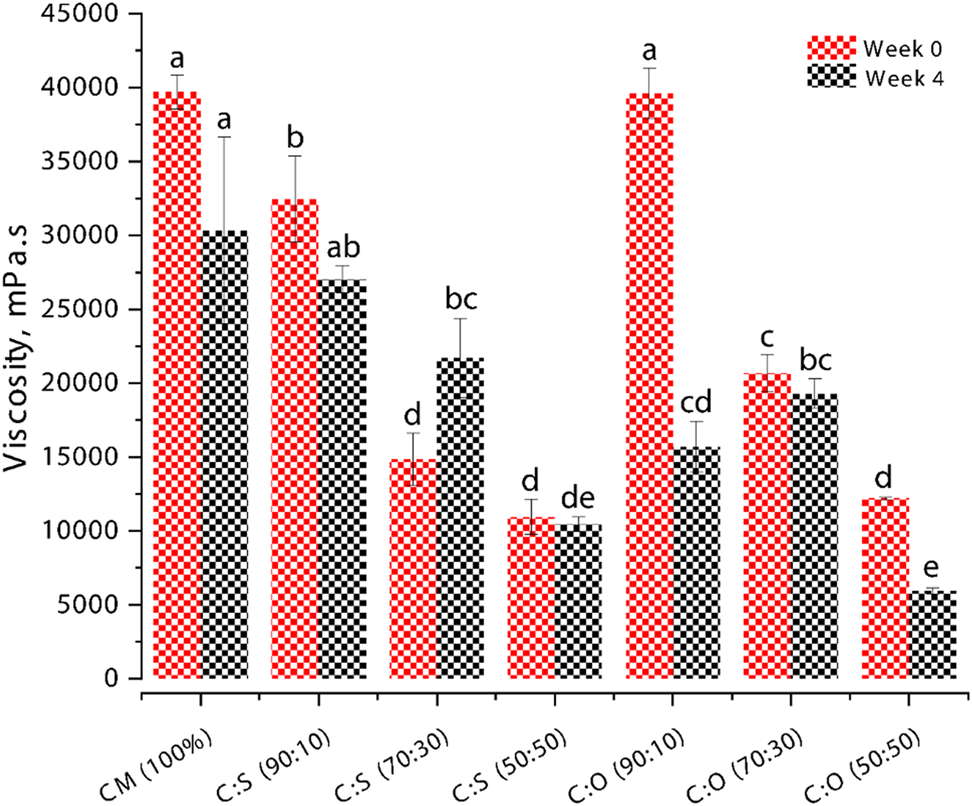
Viscosities of all yoghurt samples were analysed to find the effect of the incorporation of soy and oat drinks as well as storage (for 4 weeks) at low temperature (4–6°C) and the results are presented in Fig. 1. Immediately after fermentation there was no significant difference between and CM and either C:O or C:S at the highest milk:plant drink ratio (90:10). As the ratio of plant drink increased to 70:30 and 50:50, the viscosity decreased. The possible reason could be that as the cow milk reduced, the total solids also decreased which had crucial impact in the final product. These results are in accordance with the previous investigation where viscosity decreased from 3000 to 1300 mPa.s at a shear rate of 100 s−1 as the percentage of total solids in blended milk reduced from 22.7 to 9.3 (Penna et al., Reference Penna, Converti and De Oliveira2006).
Viscosity results of yoghurts prepared with cow's milk (CM) and cow's milk in combination with soy drink (C:S) or oat drink (C:O). Measurements were made immediately after fermentation (week 0) and then after 4 weeks of storage at 4°C.

This study affirms that cow's milk proteins, particularly casein, contribute significantly to gel strength and cohesiveness, and this effect is reduced by dilution with plant-based beverages increases (Hu et al., Reference Hu, Liu, Wang, Yang and Shao2022). Plant proteins from soy and oats do not undergo the same gelation processes as milk proteins, impacting the overall textural properties of the hybrid yoghurt (Kumar et al., Reference Kumar, Sehrawat and Kong2021; Ji et al., Reference Ji, Silva, Lin, Adhikari and Chandrapala2024). Furthermore, the heat treatment of milk prior to fermentation plays a crucial role in viscosity and gel formation. Heat-induced denaturation of whey proteins enhances their interaction with casein micelles, promoting a thicker, creamier gel matrix (Brodkorb et al., Reference Brodkorb, Croguennec, Bouhallab, Kehoe, McSweeney and O'Mahony2016; Cao et al., Reference Cao, Islam, Xu, Chen, Chitrakar, Jia, Liu and Zhong2020b). This thermal treatment effect was consistent across all formulations, suggesting that while plant-based additions alter viscosity, the heat treatment of milk can partly mitigate texture differences. Future research should explore optimizing heat treatment conditions for hybrid formulations to improve their texture while maintaining nutritional integrity.
After 4 weeks of storage the same trends in viscosity were apparent, with CM having the highest value. In this study, no stabilizers or thickeners were used to maintain the viscosity of products upon storage. The CM yoghurt showed a numerical (non-significant) decrease upon storage (39 600 to 30 350 mPa.s) and when considering the lowest addition of plant drink the same was true for soy but not for oats, in which the decrease was significant. At higher additions storage had variable and small effects. Addition of 3% soy fibre had 5.5 times higher viscosity upon 28 d of storage (Baú et al., Reference Baú, Garcia and Ida2014), and oat fibre showed greater impacts on maintaining proper viscosity of plant drink-based yoghurt upon storage (Fernandez-Garcia et al., Reference Fernandez-Garcia, McGregor and Traylor1998; Luca and Oroian, Reference Luca and Oroian2022) so our more variable outcomes contrast with these previous findings.
pH of yoghurt
Initial values of pH were 6.60, 7.25 and 7.05 for the milk, soy drink and oat drink, respectively. According to FDA requirements, pH of yoghurts should be minimum of 4.5 (Weerathilake et al., Reference Weerathilake, Rasika, Ruwanmali and Munasinghe2014). The tested yoghurt samples had a minimum pH value of 4.49 after fermentation. During the yoghurt fermentation, pH values decreased while the temperature gradually increased, as would be expected (representative data in online Supplementary Fig. S1). After an initial stabilization (rapid fall and rise in oat blend pH and temperature, respectively) there were no major differences in temperature but the hybrid yoghurts showed a more rapid fall in pH than the control CM, perhaps due to a higher nutrient content (Walther et al., Reference Walther, Guggisberg, Badertscher, Egger, Portmann, Dubois, Haldimann, Kopf-Bolanz, Rhyn and Zoller2022). Final values for temperature did not differ between yoghurts and there were only small differences in pH, with all of the blends having a slightly lower pH than the CM. The more soy that was added, the higher the pH, whereas the reverse was true for oats.
The primary yoghurt starter cultures, Streptococcus thermophilus and Lactobacillus delbrueckii subsp. bulgaricus, work symbiotically, proliferating as the pH declines to around 4.3 when the temperature reaches 37°C. S. thermophilus acts initially, producing lactic acid and lowering the pH, which subsequently activates L. bulgaricus to further acidify the medium and contribute to the distinct yogurt flavour (Rul, Reference Rul, Ray and Montet2017). This pH decline aligns with findings by Mårtensson et al. (Reference Mårtensson, Andersson, Andersson, Öste and Holst2001) and Luana et al. (Reference Luana, Rossana, Curiel, Kaisa, Marco and Rizzello2014), who reported similar fermentation dynamics in dairy-based fermented products. As pH decreases, its impact on casein micelle stability and milk protein gelation becomes evident, influencing yogurt texture. Lower pH levels lead to the dissolution of calcium phosphate, altering the protein networks and facilitating gel formation (Zhao et al., Reference Zhao, Wang, Tian and Mao2016). However, the integration of plant-based ingredients presents challenges, as these proteins do not co-gelate with dairy proteins effectively without further modification or the use of gelling agents, which could explain the observed variations in gel formation across different formulations.
The effect of storage on pH is shown in online Supplementary Fig. S2. Most of the yoghurt samples became more acidic as their pH value decreased compared to week 0, as would be expected. In an earlier study, when yoghurt made from oat drink was stored for 28 d pH also decreased (3.75–3.55: Luca and Oroian, Reference Luca and Oroian2022), but in our experiment the oat blends were inconsistent in this regard. Other cereal-based products sometimes show a similar decrease (from 3.4 to 4.4 for cereal-based puddings, for example: Helland et al., Reference Helland, Wicklund and Narvhus2004).
Sensory analysis
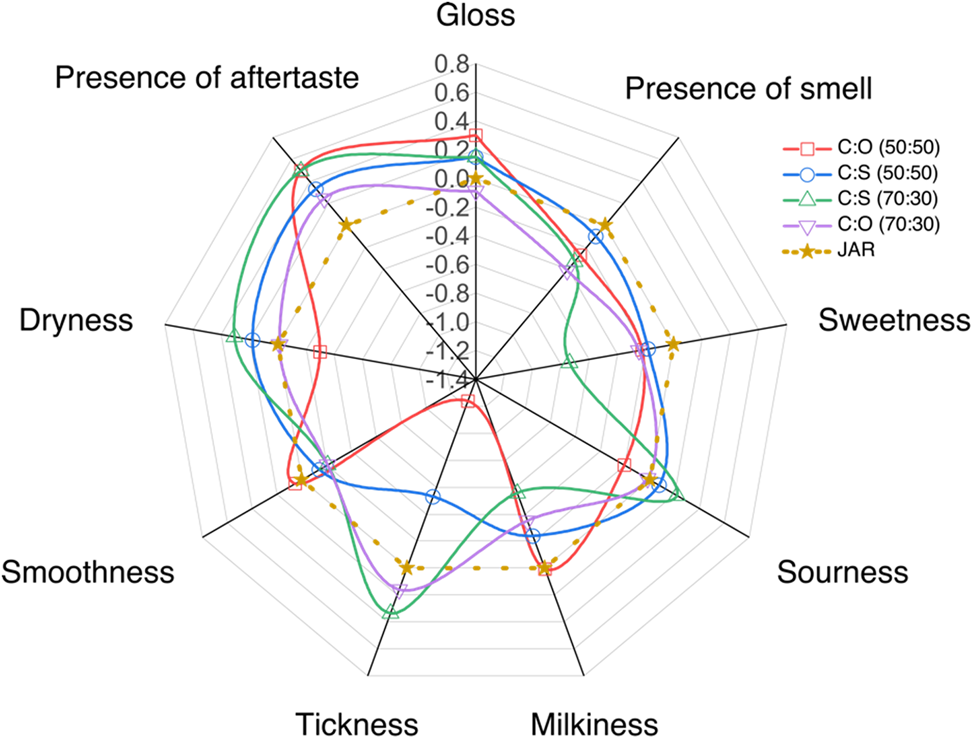
The sensory attribute results are presented in Fig. 2, which shows data received from the participants on various attributes of yoghurt alongside a JAR scale. We included only four yoghurts in this analysis, these being the blends with highest plant drink content. We cannot, therefore, compare their sensory attributes to the standard CM yoghurt. Comparing with the JAR scale indicates that the C:O (70:30) blend had better attributes in most cases, perhaps related to its higher viscosity. Yoghurt possesses a semisolid like structure where viscosity plays potential roles in sensory determination. Viscosity and total solids are corelated (Wu et al., Reference Wu, Li, Li, Bhandari, Yang, Chen and Mao2009) and the oat drink contained a total carbohydrate content lower than but not dissimilar to cow milk (3.67 vs. 4.9 g/100 g). This will have contributed to the gel formation during fermentation (Walther et al., Reference Walther, Guggisberg, Badertscher, Egger, Portmann, Dubois, Haldimann, Kopf-Bolanz, Rhyn and Zoller2022). In another study, yoghurt made with oat protein concentrate showed best mouthfeel and an enhanced, smooth texture with less particulate matter (Brückner-Gühmann et al., Reference Brückner-Gühmann, Benthin and Drusch2019).
Sensory attributes of yoghurts prepared with cow's milk (CM) and cow's milk in combination with soy drink (C:S) or oat drink (C:O). The just-about-right values are used for comparison.

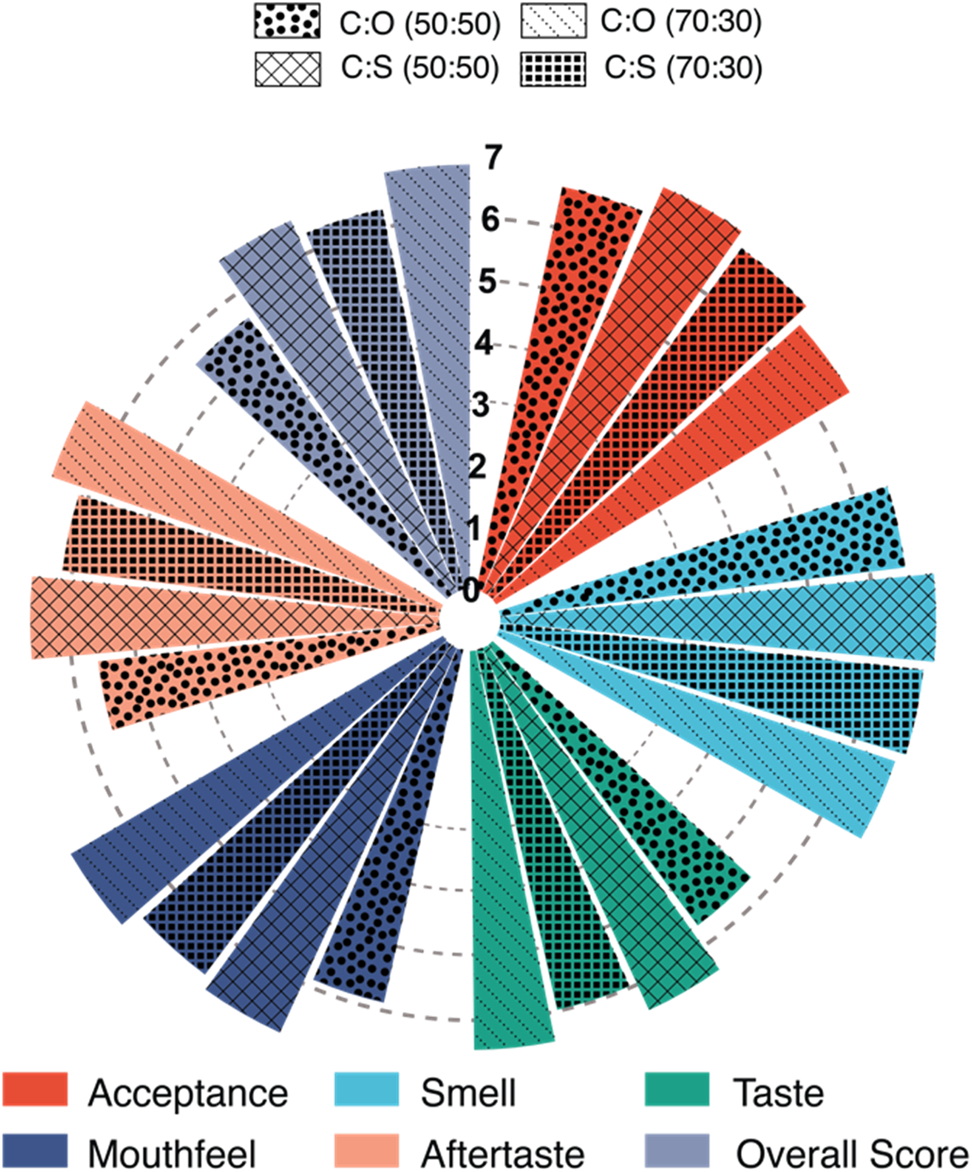
The overall mean product scores regarding specific sensory attributes are presented in Fig. 3. Each of the four hybrid yoghurts was marked out of ten. The smaller inclusion of oat drink was well received having the highest overall product score (6.86/10), which is similar to a reported score of 7.91/10 for for the same oat blend when comparing iron-fortified yoghurts (Pallavi, Reference Pallavi2018). However, adding more oat drink (ie 50:50 vs. 70:30) resulted in the poorest sensory values. Both soy blends had good sensory values, with the higher inclusion (50:50) having slightly better values such that C:S (50:50) and C:O (70:30) showed similarly good attributes. The higher soy blend had the best acceptance (7.16/10). This could be due to presence of globulin, the main soy drink protein that can entrap water inside the matrix more strongly than casein in cow milk (Stephen Ezeonu, Reference Stephen Ezeonu2016).
Overall attribute scores for yoghurts prepared with cow's milk (CM) and cow's milk in combination with soy drink (C:S) or oat drink (C:O).

Microbial analysis
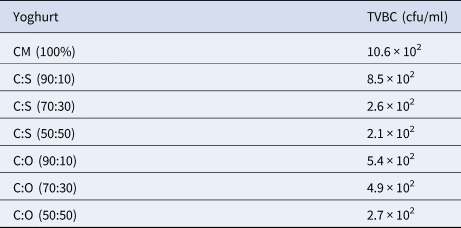
The total viable bacterial count (TVBC) data are reported in Table 1. The highest TVBC of 10.6 × 10² CFU/ml was found in the yoghurt sample formulated solely with cow milk (CM), whereas the lowest microbial load of 2.1 × 10² CFU/ml was found in the CS 50:50 blend. As the amount of plant drink increased, so the TVBC decreased. This is contrary to and much lower than the data of Otolowo et al. (Reference Otolowo, Omosebi, Araoye, Ernest and Osundahunsi2022) who obtained values of 3.0 and 5.0 × 10⁴ CFU/ml for cows milk yoghurt and cow/oat blend (50:50). The presence of plant-based drinks may affect the survival and activity of traditional yogurt starter cultures like S. thermophilus and L. delbrueckii subsp. bulgaricus. The variations in nutrient content between cow's milk and plant-based drinks can impact bacterial growth dynamics and the presence of antinutritional components in soy and oats may inhibit bacterial growth or enzymatic activity, affecting overall density and viability (Samtiya et al., Reference Samtiya, Aluko and Dhewa2020; Ziarno et al., Reference Ziarno, Zaręba, Dryzek, Hassaliu and Florowski2022). The lower pH and presence of specific fermentative substrates from plant sources might have also influenced bacterial resilience, necessitating further exploration into strain-specific adaptability and robustness (Ziarno et al., Reference Ziarno, Zaręba, Dryzek, Hassaliu and Florowski2022). On the other hand, plant based drinks, being rich in oligosaccharides, can serve as a substrate for probiotic bacteria, potentially enhancing the survival rate of these cultures (Singh and Vij, Reference Singh and Vij2018).
Microbial loads of hybrid yoghurts prepared with cows milk (CM) and cows milk in combination with soy drink (C:S) or oat drink (C:O)

We could not detect any potentially hazardous bacteria such as staphylococcus, coliforms, and E. coli in any of the yoghurt samples, which we ascribe to the hygiene procedures used during the manufacturing and packaging (the presence of coliforms in food samples is used as an indicator of contamination: Kirby et al., Reference Kirby, Nagel, Rosa, Iyakaremye, Zambrano and Clasen2016). Furthermore, the presence of yeast and moulds in all samples was negative except for the C:O (50:50) yoghurt, which acquired 4.5 × 10² CFU/ml during 4 weeks of storage at 4°C. However, the yeasts/moulds values were within the general standard safe limit (1.0 × 10⁶ CFU/g) for human consumption (Otolowo et al., Reference Otolowo, Araoye, Maderin and Ogunbusola2021). From these microbiological results we can suggest that the formulated hybrid yoghurts assumed to be safe for human consumption (Wang et al., Reference Wang, Islam, Johansen, Haapalainen, Latvala and Edelenbos2019; Akwasiam et al., Reference Akwasiam, Efiuvwevwere and Eruteya2023)
In conclusion, the findings of this study highlight the potential of hybrid yoghurts as a nutritious and consumer-friendly alternative to traditional dairy products. However, it is important to note that not all combinations of cow's milk to plant-based drinks yield equally desirable results. Specifically, the 70:30 ratios of cow's milk to both soy and oat drinks emerged as being superior to the 50:50 blends, consistently demonstrating superior viscosity, pH stability, and consumer acceptance. These specific combinations present a significant opportunity for the food industry to cater to consumers seeking to reduce dairy intake while maintaining a satisfying sensory experience. Despite the promising results, our study faced limitations, which suggest directions for future research. For instance, the sensory evaluation was restricted to the 70:30 and 50:50 blends and was conducted with a relatively small and specific demographic, which may not reflect broader consumer preferences. Application of advanced sensory techniques would provide deeper insights into consumer preferences. Additionally, long-term storage stability and the nutritional bioavailability of hybrid yoghurts need further investigation. Hybrid yoghurts hold great promise, but careful consideration of formulation ratios and methodical research into broader issues will be essential to fully realize their potential in the marketplace.
Supplementary material
The supplementary material for this article can be found at https://doi.org/10.1017/S0022029925000123
Acknowledgement
The authors would like to acknowledge the Dairy Campus, Leeuwarden, the Netherlands, and Food Application Centre for Technology (FACT) and Microbiology Laboratory of Van Hall Larenstein University of Applied Sciences, the Netherlands and Department of Agro-Processing, Bangabandhu Sheikh Mujibur Rahman Agricultural University, Gazipur for their intensive support and guidance.