Early adverse care experienced by internationally adopted (IA) children has been associated with impaired physical, social, and cognitive development. Although adoption into supportive families is followed by rapid return to more normative functioning, delays and deficits persist for many, particularly for those adopted from orphanages/institutions (for review, see Esposito & Gunnar, Reference Esposito and Gunnar2014). The most persistent deficits have been noted in self-regulatory competence. As a group, IA children continue to demonstrate regulatory deficits compared with non-adopted children in areas such as attention, inhibitory control, and emotion-regulation (e.g., Rutter et al., Reference Rutter, Sonuga-Barke, Becket, Castle, Kreppner and Bell2010; Tottenham et al., Reference Tottenham, Hare, Quinn, McCarry, Nurse and Casey2010). These deficits have been associated with neural correlates of attention and error monitoring (Loman et al., Reference Loman, Johnson, Westerlund, Pollak, Nelson and Gunnar2013) and brain areas implicated in executive control (Chugani et al., Reference Chugani, Behen, Muzik, Juhász, Nagy and Chugani2001; Eluvathingal et al., Reference Eluvathingal, Chugani, Behen, Juhász, Muzik, Maqbool and Makki2006). In typically developing populations, failure to appropriately regulate behavior and emotions is implicated in a plethora of negative outcomes such as poor school performance, numerous forms of mental illness, and diminished overall well-being (Blair, Reference Blair2002; Moffit et al., Reference Moffitt, Arseneault, Belsky, Dickson, Hancox, Harrington and Caspi2011). Among IA children, poor inhibitory control has been associated with socioemotional problems, such as disinhibited social engagement (Bruce, Tarullo, & Gunnar, Reference Bruce, Tarullo and Gunnar2009). Additionally, these deficits lead IA children to be at increased risk for developing attention deficit hyperactivity disorder (ADHD) (Wiik et al., Reference Wiik, Loman, Van Ryzin, Armstrong, Essex, Pollak and Gunnar2011). Because self-regulation is implicated in so many different outcomes, it is an ideal target for intervention, especially in a group at a heightened risk for problems in this area. The current study tests the efficacy of two intervention strategies for improving self-regulation in IA children: executive function training (EFT) and mindfulness training (MT).
Conceptual and terminology issues
Before discussing interventions to improve self-regulation, we must briefly discuss conceptual and terminology issues. There is no universally accepted definition of self-regulation; in fact, the concept has many different definitions, often depending on the theoretical perspective under which it is studied (Berger, Reference Berger2011; Nigg, Reference Nigg2017). Self-regulation can refer to a dimension of temperament (i.e., effortful control; e.g., Eisenberg, Hofer, & Vaughan, Reference Eisenberg, Hofer, Vaughan and Gross2007), to a set of cognitive processes involved in higher-order control (i.e., executive functions; e.g., Baumeister & Vohs, Reference Baumeister, Vohs, Leary and Tangney2003), or to the physiological regulation of the stress response (e.g., Blair, Reference Blair2010). Effortful control describes the ability to voluntarily manage attention and inhibit or activate behavior as needed to adapt. Executive functions are a set of frontal lobe mediated cognitive processes involved in higher-order cognitive and behavioral control and organization, including inhibitory control, attention, working memory, and cognitive flexibility (Zelazo & Müller, Reference Zelazo, Müller and Goswami2002). For the current purposes, we use self-regulation broadly to refer to the developing capacity for self-control of thoughts, behavior, and emotions in pursuit of a goal. It encompasses the inter-related constructs of effortful control and executive functioning. Self-regulation is widely considered a multidimensional construct, including multiple lower-order skills/processes (Nigg, Reference Nigg2017; Zhou, Chen, & Main, Reference Zhou, Chen and Main2012).
Tasks used to measure self-regulation often require the use of multiple subskills working in concert. For example, a flanker task in which individuals are asked to respond only to a central stimulus while ignoring flanking stimuli requires the working memory to remember the task rules, controlled attention to the central stimulus, and inhibitory control to inhibit reacting to the distracting flanker stimuli. Additionally, because of terminology differences across fields (e.g., temperament vs. developmental neuroscience focused researchers), the same task might be described as measuring different subskills depending on the perspective from which it is being studied. For example, the Dinky toys task, originally developed by Kochanska and colleagues (Kochanska, Murray, Jacques, Koenig, & Vandegeest, Reference Kochanska, Murray, Jacques, Koenig and Vandegeest1996), has been described as measuring effortful control (Dennis, Brotman, Huang, & Gouley, Reference Dennis, Brotman, Huang and Gouley2007), inhibitory control (Gagne, Saudino, & Asherson, Reference Gagne, Saudino and Asherson2011), and delay of gratification (Spinrad, Eisenberg, & Gaertner, Reference Spinrad, Eisenberg, Gaertner, Popp, Smith, Kupfer and Hofer2007). It has been noted elsewhere, and we reiterate, that an integrated model of self-regulation would benefit research in this area (Nigg, Reference Nigg2017; Zhou et al., Reference Zhou, Chen and Main2012). Despite differences in perspective and terminology, researchers generally agree that self-regulation is crucial for adaptive functioning and is malleable to intervention (Diamond, Reference Diamond2012).
One question of interest is whether these skills are better improved by practice that directly targets subcomponents (e.g., working memory, inhibitory control) or by a more holistic intervention. The current study is the first of its kind to test the effects of two different types of self-regulation interventions and compare them against one another.
Executive function training
EFT involves repeated practice of executive functioning skills, with increasing difficulty and complexity. Much early research into EFT focused on computerized activities (e.g., Cog Med working memory games; e.g., 5 weeks of computerized working memory games with 7- to 12-year-old children, Klingberg et al., Reference Klingberg, Fernell, Olesen, Johnson, Gustafsson, Dahlström and Westerberg2005). However, recent placebo-controlled trials and meta-analyses of computerized EFT show poor transfer and no significant effects when teachers are blind to condition (5 weeks, 5- to 7-year-old children, Dongen-Boomsma, Vollebregt, Buitelaar, & Slaats-Willemse, Reference Dongen-Boomsma, Vollebregt, Buitelaar and Slaats-Willemse2014; 4–18 weeks, children and adolescents with attention problems, Rapport, Orban, Kofler, & Friedman, Reference Rapport, Orban, Kofler and Friedman2013). More recently, researchers have explored group game-based executive function interventions to engage children and practice skills that may show better transfer to real-world settings. These game-based EFTs include activities such as red light/green light, Simon Says, and memory games that offer opportunities for practice of inhibitory control, working memory, attention, and cognitive flexibility. Thus, the games tap into the same domains as executive function assessment tasks, which have been associated with academic achievement (Brock, Rimm-Kaufman, Nathanson, & Grimm, Reference Brock, Rimm-Kaufman, Nathanson and Grimm2009), socioemotional functioning (Morgan & Lilienfeld, Reference Morgan and Lilienfeld2000; Riggs, Jahromi, Razza, Dillworth-Bart, & Mueller, Reference Riggs, Jahromi, Razza, Dillworth-Bart and Mueller2006), and occupational functioning (Miller, Nevado-Montenegro, & Hinshaw, Reference Miller, Nevado-Montenegro and Hinshaw2012). However, unlike computerized executive functioning games, they also parallel real-world self-regulation behaviors, such as needing to remember classroom rules, wait their turn, and inhibit impulses.
Games are repeated over the course of the intervention with increasing challenge and complexity to exercise and strengthen executive functions. Several such programs have shown promise for improving self-regulation and school readiness in preschool- to school-age children (3 week, integrated curriculum intervention with homeless preschool children, Casey et al., Reference Casey, Finsaas, Carlson, Zelazo, Murphy, Durkin and Masten2014; 5 week, 5 session with daily practice intervention with “difficult to manage” preschool children, Healey & Halperin, Reference Healey and Halperin2015, p. 470; 3-month, 24-session intervention with school-age children, Rybanska, McKay, Jong, & Whitehouse, Reference Rybanska, McKay, Jong and Whitehouse2017; 8-week, 16-session intervention with Headstart preschool children, Schmitt, McClelland, Tominey, & Acock, Reference Schmitt, McClelland, Tominey and Acock2015; 8-week, 16-session intervention with preschool children, Tominey & McClelland, Reference Tominey and McClelland2011; 8-week, 16-session intervention with school-age children with ADHD, Tamm & Nakonezny, Reference Tamm and Nakonezny2015). However, this type of training has not been tested in a group of neurodevelopmentally high-risk children such as IA children, nor have any previous studies compared EFT to another active intervention. The current study aims to investigate the efficacy of EFT in a group of IA children and compare it with a mindfulness-based intervention.
Mindfulness-based training
Mindfulness-based programs have garnered increasing popular attention for their promise in addressing self-regulation deficits (e.g., Harris, Reference Harris2015). Mindfulness is an awareness that results from purposeful, nonjudgmental, attention to the individual's moment-to-moment experience (Kabat-Zinn, Reference Kabat-Zinn2003). By emphasizing nonjudgment, the practice of mindfulness can foster the ability to observe internal and external experiences while decreasing interference from cognitive, affective, or physiological reactions. Mindfulness has been cited as an ideal intervention to improve self-regulation because of its potential to improve top-down regulatory control (e.g., by practicing focused attention and inhibitory control) while also ameliorating stress that may interfere with self-regulation from the bottom-up (e.g., breathing techniques, emotion-regulation strategies, and compassion exercises; Zelazo & Lyons, Reference Zelazo and Lyons2012). Mindfulness entails focused attention, including noticing when the mind has wandered from its attention target (monitoring) and returning attention back to the target (shifting/cognitive flexibility).
Research on mindfulness meditation and related practices in adults has demonstrated a wide range of benefits, including enhancing inhibitory control, attention, and cognitive flexibility, improving emotion-regulation, alleviating symptoms of anxiety and mood disorders, and improving immune function (e.g., Arias, Steinberg, Banga, & Trestman, Reference Arias, Steinberg, Banga and Trestman2006; Baer, Reference Baer2003; Davidson et al., Reference Davidson, Kabat-Zinn, Schumacher, Rosenkranz, Muller and Sheridan2003; Ortner, Kilner, & Zelazo, Reference Ortner, Kilner and Zelazo2007). Research has also demonstrated neurobiological bases of these benefits, including alterations in brain activity (Davidson et al., Reference Davidson, Kabat-Zinn, Schumacher, Rosenkranz, Muller and Sheridan2003) and HPA-axis (Hypothalamic-pituitary-adrenal; Carlson, Speca, Patel, & Faris, Reference Carlson, Speca, Faris and Patel2007), which may mediate the positive effects of mindfulness on functioning and health.
A growing body of research on mindfulness with children shows promise in improving attention, internalizing and externalizing symptoms, academic competence, physiological anxiety symptoms, and emotion-regulation (e.g., 8-week, 16-session intervention with 7- to 9-year-old children, Flook et al., Reference Flook, Smalley, Kitil, Galla, Kaiser-Greenland and Kasari2010; 12-week, 24-session intervention with preschool children, Flook et al., Reference Flook, Goldberg, Pinger and Davidson2015; 24-week, 12-session intervention with school-age children, Napoli, Krech, & Holley, Reference Napoli, Krech and Holley2005; 12-week, 12-session intervention with 9- to 13-year-old children, Semple, Lee, Rosa, & Miller, Reference Semple, Lee, Rosa and Miller2010; also see Black, Milam, & Sussman, Reference Black, Milam and Sussman2009). However, well-controlled research and replications are not yet available (for reviews, see Greenberg & Harris, Reference Greenberg and Harris2011; Kallapiran et al., Reference Kallapiran, Koo, Kirubakaran and Hancock2015; Mak, Whittingham, Cunnington, & Boyd, Reference Mak, Whittingham, Cunnington and Boyd2017). Specifically, outcomes often rely on parent and teacher report, without reporters being blind to condition. Few studies involve task-based assessments of child functioning. Finally, the specificity of mindfulness as an intervention that is equally or more effective than other interventions designed to improve executive functions has never been examined.
The Current Study
The aims of the current study were to address many of these short-comings in a preliminary randomized, controlled trial. The mindfulness and executive functioning trainings were compared, and both were contrasted to a no-intervention (NI) developmental comparison group. In this way, each intervention acted as an active control group for the other intervention. School-age youth adopted internationally from a range of pre-adoption conditions were the participants in this study, with the goal of improving various areas of self-regulation. Objective, task-based measures were used to assess the efficacy of the interventions. We predicted that both interventions would improve behavioral self-regulation (e.g., attention, inhibitory control, and delay of gratification), whereas only the mindfulness intervention was expected to improve emotion-regulation, due to its focus on internal states and arousal modulation.
Method
Participants and recruitment
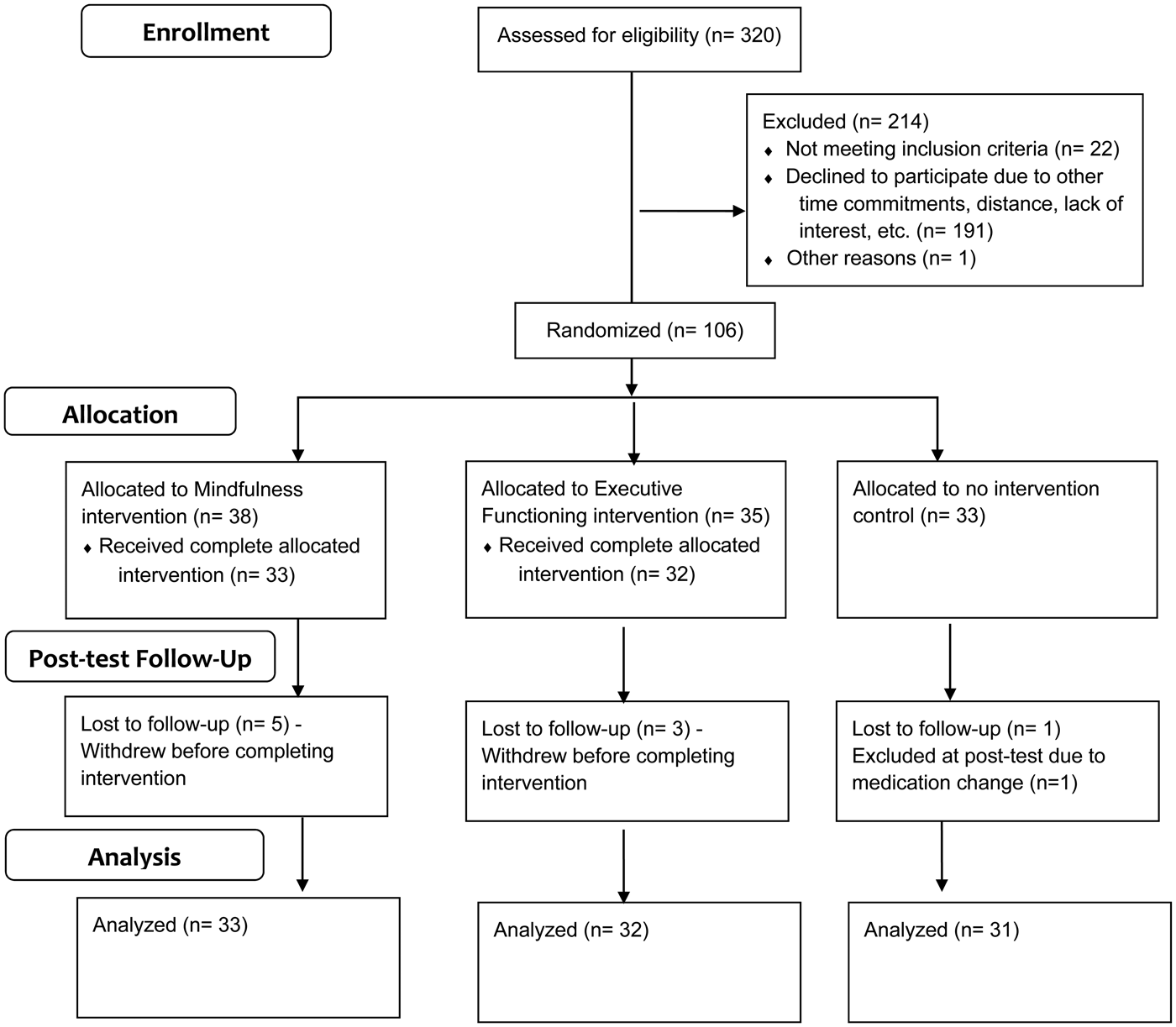
This study was approved by the Institutional Review Board. Participants were recruited by the current investigators from an existing database of families with IA children interested in research, in two waves from January–May 2013 and January–May 2014. Potential participants were recruited if the child's date of birth indicated that he or she would be between 6 and 10 years of age at the start of the intervention (June) and the family lived within a 50-mile radius of the university campus where the study took place. School-age children were selected due to the increasing self-regulation demands imposed on children over the early school years. Additionally, results from a pilot trial of this intervention with IA children found greater engagement in the interventions for this age range compared with younger children (Lawler, Esposito, Doyle, Johnson, & Gunnar, Reference Lawler, Esposito, Doyle, Johnson and Gunnar2013). Exclusionary criteria included parent report of a diagnosis of fetal alcohol syndrome, autism spectrum disorders, or severe cognitive impairment. Additionally, children with extensive yoga or traditional martial arts participation were excluded (due to the mindfulness components of each). This resulted in 106 eligible participants completing the informed consent process and pretest assessments (see Figure 1).
Participant flowchart.

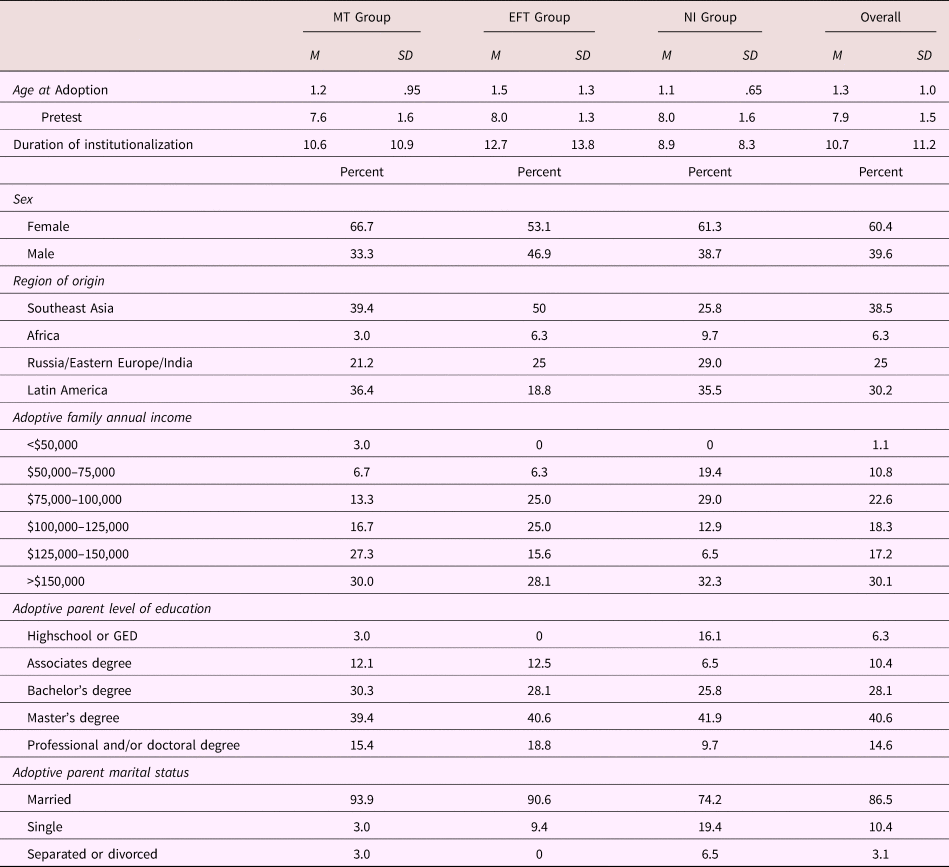
A two-wave stratified random sampling technique was used following the pretest to assign participants into the MT (n = 38), EFT (n =35), or NI (n = 33) group in a 1:1:1 multi-arm parallel design. The latter participated only in pretesting and posttesting, which allowed for assessment of developmental change in functioning over the pre-post interval and practice effects. The groups were stratified based on parent ratings of inattention and hyperactivity symptoms on the Strengths and Difficulties Questionnaire (SDQ) at pretesting to reduce the chance that the wide range of functioning typical of IA samples would be confounded with treatment effects. The SDQ was selected for this purpose given its ease and brevity of scoring given time constraints between pretest and intervention. Two strata blocks were created based on a cutoff score. Children were categorized into low- and high-risk blocks based on published scoring norms (using a cutoff score of 7 out of 10), and then randomization took place within each block. Randomization was based on a computer-generated list of random numbers and completed in two waves (66 children were randomized for the first wave of the intervention, followed by 40 children for the second wave). Nine participants withdrew, and data from one participant were excluded due to change in medication status, resulting in 96 participants with pretest and posttest data (MT, n = 33; EFT, n = 32; NI, n = 31; see Table 1 for participant characteristics and Figure 1 for participant flowchart).
Participant characteristics
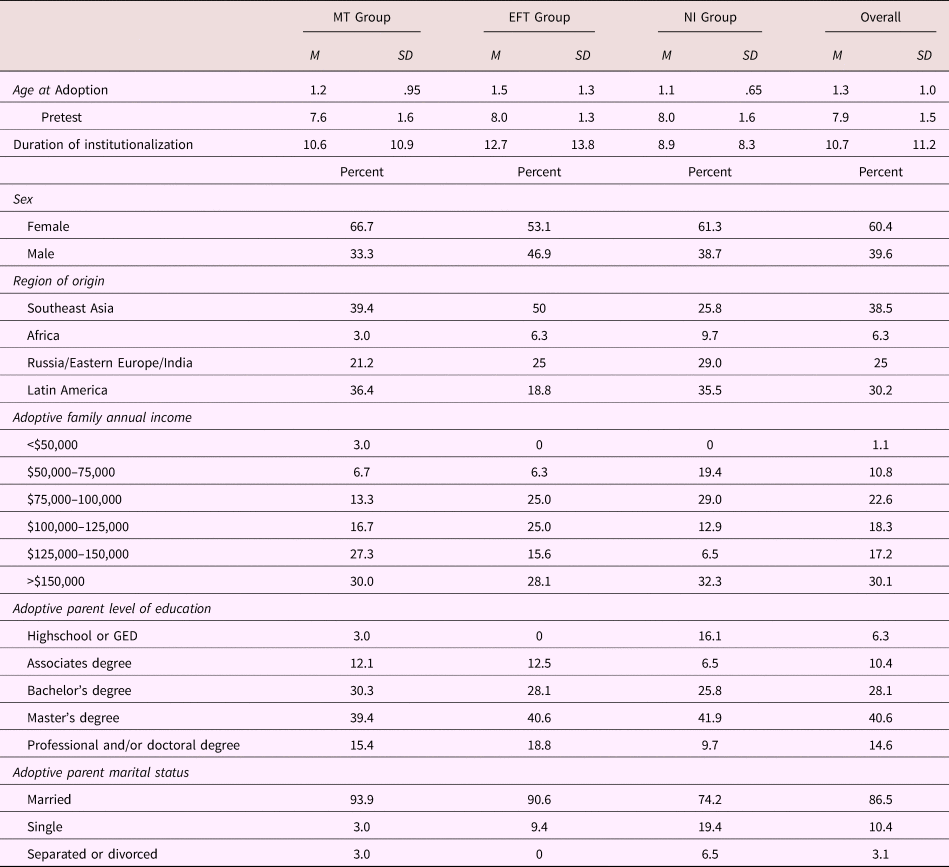
Note: Ages are reported in years. Duration of institutionalization is reported in months.
Training
The MT and EFT groups attended two 1-hour training sessions per week for 6 weeks (12 intervention hours total; June–July 2013 or June–July 2014) and completed training-related activities with their parents at home. Participants met in groups of seven to nine children with two to three instructors, on a Midwest university campus (data collection at pretest and posttest took place in a nearby building).
The MT group completed a curriculum that involved mindfulness and relaxation practices adapted for children (see Appendix A). These included brief, concrete exercises such as breathing activities, sensory awareness and internal state monitoring exercises, brief-guided meditation sessions (1–5 minutes, increasing in length over the course of the intervention), arousal modulation practice, and compassion activities. To maintain young children's interest while building a foundation of skills in mindful awareness, the training curriculum included both variety and repetition (Johnson, Forsten, Gunnar, & Zelazo, Reference Johnson, Forsten, Gunnar and Zelazo2011). Additionally, the curriculum included “homework” activities and games that parents were instructed to complete with their children. These home activities mirror the progression of the training curriculum by beginning with reinforcing basic skills and ending with scaffolded use of those skills as regulation strategies and as part of daily routines (See Appendix A).
The EFT group completed a curriculum that involved child-friendly attention, inhibitory control, and cognitive flexibility/imagination games (see Appendix B). These sessions were led by the same instructors and implemented at the same frequency as the MT. These small-group, non-computerized games involved paying attention, following instructions, inhibiting behaviors, and using the imagination (cognitive flexibility). Games were divided into three themes in each session: “Stopping our bodies,” “Paying attention,” and “Using our imagination.” The “Stopping our bodies” activities involved games designed to practice effortful/inhibitory control such as red-light/green-light, Freeze Dance, and Simon Says. The “Paying attention” activities involved games designed to practice selective and sustained attention and working memory, such as matching memory card games, Blink!® card game, and visual puzzle games. The “Using our imaginations” activities involved cognitive flexibility such as opposite games, guided imagination activities, and creative problem-solving tasks. None of the tasks used to measure self-regulation/executive functioning at pretest/posttest were practiced during the intervention. The curriculum also included “homework” activities and games that parents were instructed to complete with their children that offer additional practice on these skills, and methods for integrating practice into daily routines (e.g., chores, play time; See Appendix B).
Parents of children in both intervention groups were asked to report on homework completion at the beginning of the following session. Parents completed a written form indicating whether they completed the homework activity never, once, or two or more times since the prior session. Families reported a high level of homework compliance, on average completing 13 instances of homework, over 11 homework assignments. Compliance did not differ between interventions, t (63) = -.09, p = .93.
Versions of the MT and EFT programs have been used successfully with 4- to 5-year-old, typically developing children (Johnson et al., Reference Johnson, Forsten, Gunnar and Zelazo2011; Johnson, Lyons, & Zelazo, Reference Johnson, Lyons and Zelazo2013) and with 5- to 9-year-old IA children in a pilot study (Lawler et al., Reference Lawler, Esposito, Doyle, Johnson and Gunnar2013).
Three of the current investigators served as the primary instructors for the intervention classes and were supported by clinical psychology graduate student assistants. Each investigator led MT and EFT classes. A subset of classes was videotaped and later coded for instructor engagement by coders blind to the study hypotheses to ensure that there was no instructor bias toward one curriculum and no curriculum discrepancies between instructors. Coders rated instructors on a 1–5 scale for engagement where “5” indicated that the instructor appeared excited about the material, set the appropriate tone for the activity, and worked hard to engage children, whereas “1” indicated that the instructor appeared bored or otherwise disengaged or failed to complete the activities or interact meaningfully with children. A one-way analysis of variance (ANOVA) confirmed no significant differences between instructors on engagement, F (2,3) = 2.5, p = .23. Further, there were no differences between interventions on average instructor engagement, t (4) = -.76, p = .49.
Child engagement was rated by instructors following each class on a 1–5 scale; “5” indicated the child was consistently engaged and on-task throughout the session, whereas “1” indicated the child was actively disengaged, spending minimal time on task. There was no significant difference between interventions on child engagement, t (63) = .84, p = .41 (see Table 2).
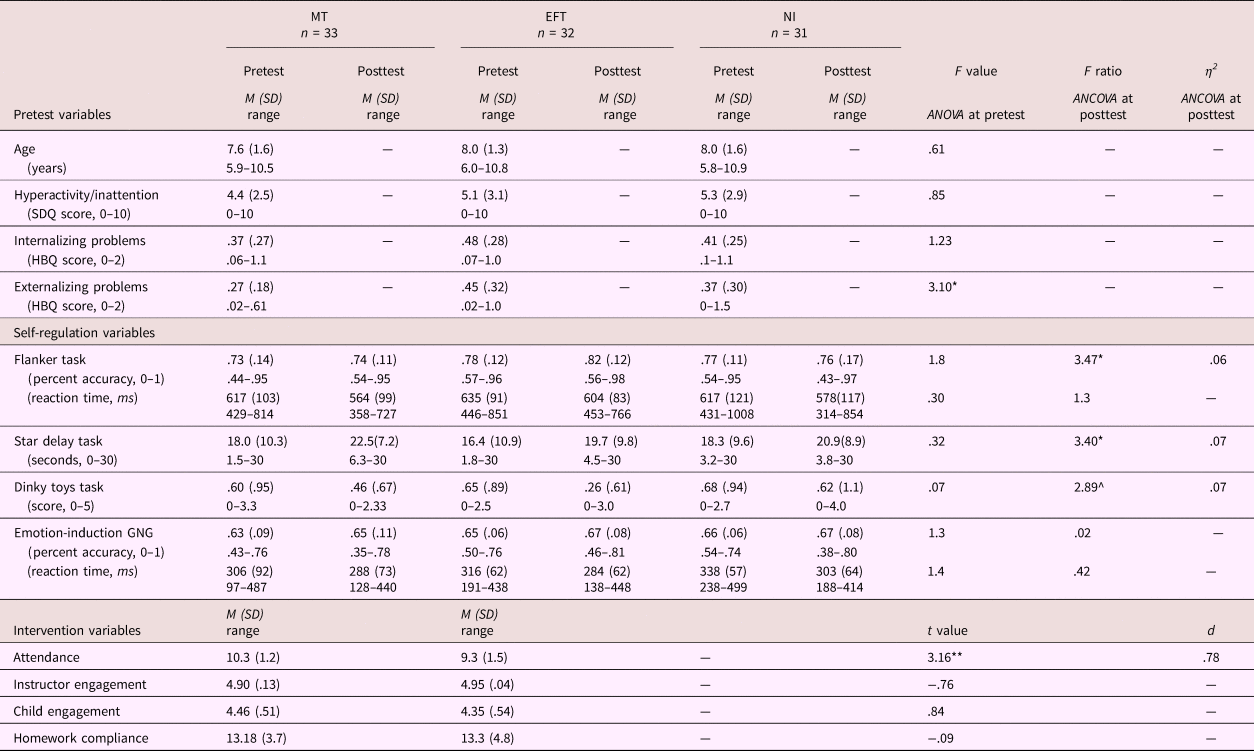
Descriptive statistics and ANOVA/ANCOVA results for study variables

Note: ^p < .10, *p < .05, **p < .01. GNG = go/no-go.
Assessment procedure
Ninety minute pretesting and posttesting sessions occurred before and after the 6-week training. The session began with two computerized self-regulation tasks, the flanker task and the emotion-induction go/no-go (GNG) task, both presented using E-Prime software (Psychological Software Tools). An electroencephalogram (EEG) net was worn during these tasks, however EEG data will be reported elsewhere (Esposito, Lawler, Doyle, & Gunnar, Reference Esposito, Lawler, Doyle and Gunnarin preparation). One trial of the dinky toys task was administered after each computerized game, and a short break was given following the completion of the EEG tasks. Next, the participants completed a false belief task, a prosocial sharing task, and a brief vocabulary test (these measures are outside the scope of the current investigation into behavioral measures of self-regulation and thus are not included here). The third dinky toys trial was administered at the completion of the vocabulary task. Finally, the session ended with the star delay task, also presented using E-Prime software. The intervention was registered with ISRCTN (Trial ID: ISRCTN17744284).
Measures
Flanker task
The color flanker task (McDermott et al., Reference McDermott, Perez-Edgar and Fox2007) is a computerized task that measures selective attention and inhibitory control. The flanker task assesses an individual's ability to implement regulatory control by selectively attending to target stimuli in the face of interfering stimuli. The task was adapted for young children and consists of color circles as stimuli (blue or red). While initially designed for use with preschool-age children, this task was selected for our study due to difficulty of some IA children performing above chance levels on more advanced flanker models (such as arrow flanker tasks; e.g., Loman et al., Reference Loman, Johnson, Westerlund, Pollak, Nelson and Gunnar2013).
In the color flanker task, three blocks of 60 trials are presented (180 trials total). Children are asked to press the button that matches the color of the central circle on the screen, regardless of the color of the flanking distracter circles (two on each side). Equal numbers of congruent (target circle and flanking circles of the same color) and incongruent (target circle and flanking circles differ in color) were presented in a pseudorandom order. First, a practice block of 24 trials was administered. Based on performance during the practice, participants then were given one of four versions of the task that varied in length of stimulus presentation (250 ms, 400 ms, 550 ms, 700 ms). This was to make the task adequately challenging across the age range (faster stimulus presentations make the task more challenging) and to avoid a ceiling effect. A chi-square test confirmed that the number of participants receiving each task version did not differ between groups, χ 2 (6, N = 96) = 3.6, p = .73. Accuracy and reaction time were scored by computer software.
Star delay task
The star delay task was adapted from the choice-delay task (Solanto et al., Reference Solanto, Abikoff, Sonuga-Barke, Schachar, Logan, Wigal and Turkel2001; Sonuga-Barke, Taylor, Sembi, & Smith, Reference Sonuga-Barke, Taylor, Sembi and Smith1992) and was used to measure delay of gratification. In the star delay task, children are presented with a small star on the computer screen. Children are told that they can either click on the small star immediately to earn a single point or wait for it to grow into a big star (30-second delay) to earn 5 points. Children were told that they needed “a lot of points to win the big prize” but that just for playing they would earn a small prize. Children were presented with a practice round with five stars and a shortened delay time (10 seconds) to ensure proper understanding of the task. The average delay times across the 25 trials were calculated by the software. This task was chosen to adequately challenge children in this age group compared with other delay tasks that are appropriate for only younger children (e.g., gift delay, see Carlson, Reference Carlson2005).
Dinky toys task
In the dinky toys task (Kochanska et al., Reference Kochanska, Murray, Jacques, Koenig and Vandegeest1996), a measure of behavioral inhibitory control/effortful control and delay of gratification, the child is shown a bin full of small prizes. Although it is impossible to see all of the prizes without riffling through the bin, the child is told to look carefully and then select a prize by verbally describing it to the experimenter while keeping their hands in their lap. The experimenter rates the child on a 0–5 scale on their ability to inhibit reaching for or touching the prize. A “0” on the scale indicated full compliance with the instructions, “1” indicated that the child's hands left their lap or otherwise started to grab, but quickly recovered and used words to indicate toy, “2” indicated that the child touched the toys but withdrew without grabbing and used words, “3” indicated the child grabbed the toy but simultaneously used words, a “4” indicated an uninhibited toy grab, and a “5” indicated that the child demonstrated extensive impulsivity, for example, digging excessively in the bin or attempting to take multiple toys. The task was administered three times over the course of the session, and scores were averaged (r’s > .59, α = .86 for pretest, α = .87 for posttest). Lower scores indicated greater ability to inhibit. This task was selected because of its high ecological validity, because children are often asked to control gross motor behavior in response to an instruction. Although this task is often used with younger children (e.g., preschool to early school-age children; Murray & Kochanska, Reference Murray and Kochanska2002), previous research with IA children has shown variability in school-age children (e.g., 6- to 8-year-old children, Bruce et al., Reference Bruce, Tarullo and Gunnar2009; 5- to 9-year-old children, Lawler et al., Reference Lawler, Esposito, Doyle, Johnson and Gunnar2013). No alternative gross motor inhibition task is available that has been validated across this full age range.
Emotion-induction GNG task
Emotion-induction GNG task (Lewis et al., Reference Lewis, Lamm, Segalowitz, Stieben and Zelazo2006) was included as a measure of emotion regulation and “hot” executive function (i.e., cognitive processes elicited in contexts that generate strong emotions and/or motivation). Similar to a traditional GNG task, children are instructed to press the button for each letter but refrain from pressing when a letter is repeated twice in a row. However, in this task, error feedback is given, and the child is awarded points for correct answers. At the beginning of the task, the child is told that a high number of points was needed to win the “big prize.” The task is adaptive to the child's performance (by decreasing and increasing stimulus presentation in response to correct and incorrect responses respectively) and includes three blocks of trials. The first block is a typical GNG and is designed to increase the child's points bank. The second block is designed to induce negative mood states such as frustration, anger, and sadness, by increasing the speed of presentation, thus increasing errors and depleting the child's points bank. The third block returns to the original contingencies; therefore, performance on this block indexes the child's ability to recover from negative mood states and is used here as our performance-based measure of emotion regulation. Blocks 1 and 3 consist of 200 trials, including 66 no-go trials presented in a pseudorandom order. Block 2 consisted of 150 trials (40 no-go trials) to limit the duration of children's distress during the points-loss condition. The task was discontinued if children became too distressed during the emotion-induction (n = 8 children at pretest and/or posttest). Pairs of letters (x,y in Block 1; o,p in Block 2, and u,d in Block 3) were used to enhance novelty without modifying the level of difficulty. This task was selected because it has been validated across this age range and has been associated with neural indices of emotion regulation and with behavioral dysregulation in clinical samples (Stieben et al., Reference Stieben, Lewis, Granic, Zelazo, Segalowitz and Pepler2007).
Questionnaires
Strengths and Difficulties Questionnaire (SDQ) (Goodman, Reference Goodman1997): The SDQ contains 25 items that assess emotional problems, peer relationship problems, hyperactivity/inattention, conduct problems, and prosocial behavior. Items are scored on a 3-point Likert scale (0 = not true, 1 = somewhat true, and 2 = certainly true). Scaled scores were constructed using the online scoring system (sdqscore.org). Hyperactivity/inattention scaled scores from pretest were used to stratify randomization groups. Internal consistency on this scale has been reported as adequate (α > .7; Du, Kou, & Coghill, Reference Du, Kou and Coghill2008; Muris, Meesters, & van den Berg, Reference Muris, Meesters and van den Berg2003).
MacArthur Health and Behavior Questionnaire (HBQ) (Essex et al., Reference Essex, Boyce, Goldstein, Armstrong, Kraemer and Kupfer2002): The HBQ is a 140-item parent report questionnaire that assesses the child's mental health, physical health, and academic and social functioning. Parent reported internalizing (α = .88) and externalizing (α = .92) symptoms were used to check for pre-existing differences between groups.
Data analysis plan
Preliminary analyses were first conducted to determine whether there were any differences between groups at pretest, or between participants who completed versus those who withdrew from the study. To address the study's main hypotheses, univariate analysis of covariance (ANCOVA) models were conducted in each domain. Differences between groups at posttest were analyzed, controlling for pretest performance. Thus, performance at posttest was entered as the dependent variable, intervention group entered as a fixed factor, and age in years, baseline behavior problems, and pretest performance entered as covariates. Sex was also covaried in the dinky toys task analyses because sex was associated with performance on that task. Planned comparisons between groups will be completed for significant (p < .05) and marginally significant (p < .10) ANCOVA models. Effect sizes (η 2 for ANCOVA models and Cohen d for planned contrasts) are presented and interpreted based on established guidelines (Cohen, Reference Cohen1992).
Results
Preliminary analyses
Data were assessed for normality and outliers using descriptive statistics, visual inspection, box plots, and Shapiro-Wilk tests. When necessary, variables were transformed to normalize and address outliers as suggested by Cousineau and Chartier (Reference Cousineau and Chartier2010). Star delay task delay times (pretest W = .87, p < .001; posttest W = .85, p < .001) and dinky toys task scores (pretest W = .72, p < .001; posttest W = .61, p < .001) were log transformed. No outliers remained in following transformation. A series of chi-square tests and one-way ANOVAs were conducted to examine differences between MT, EFT, and NI group participants on the various demographic measures and pre-intervention scale scores. Groups did not differ based on age at pretest, age at adoption, duration of time in an institution, or pretest task scores. Parent-reported baseline externalizing problems (on the HBQ) differed between groups and therefore was included as a covariate in analyses. Internalizing problems and attention problems did not differ between groups (see Table 2).
Only participants who completed the study were included in pre-post analyses. A series of t tests were conducted to examine differences between children who completed the study versus children who withdrew. Children who withdrew from the study before posttest were significantly more anxious than completers, t (103) = −2.86, p < .01, but did not differ on parent-reported behavioral difficulties, age, or other demographic variables. Withdrawal from the study did not significantly differ across groups, χ 2 (2, n = 106) = 2.33, p = .31.
Mean attendance in the MT group was 10.33 (SD = 1.19) classes and the EFT group attended a mean of 9.28 (SD = 1.49) classes (out of the 12 possible). This difference was statistically significant, t (63) = 3.16, p = .002. There was no significant difference between the two training groups on home activity compliance, t (63) = -.09, p = .93 , or child engagement with in-class activities, t (63) = .84, p = .41 .
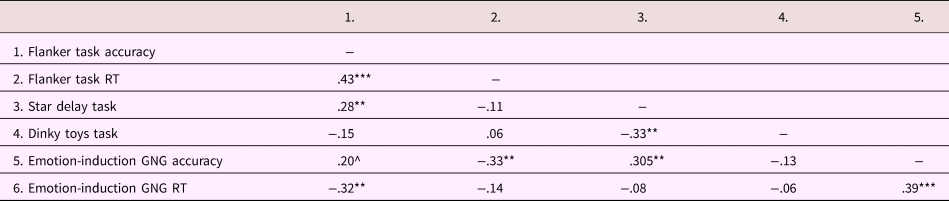
The different measures of self-regulation used in the study were generally moderately correlated with one another in the entire group at pretest, consistent with our conceptualization of self-regulation as a set of interrelated but separable skills (see Table 3).
Correlations between study measures at pretest

Note: ^p < .10, *p < .05; **p < .01, ***p < .001. RT = reaction time; GNG = go/no-go.
Intervention effects
Flanker task
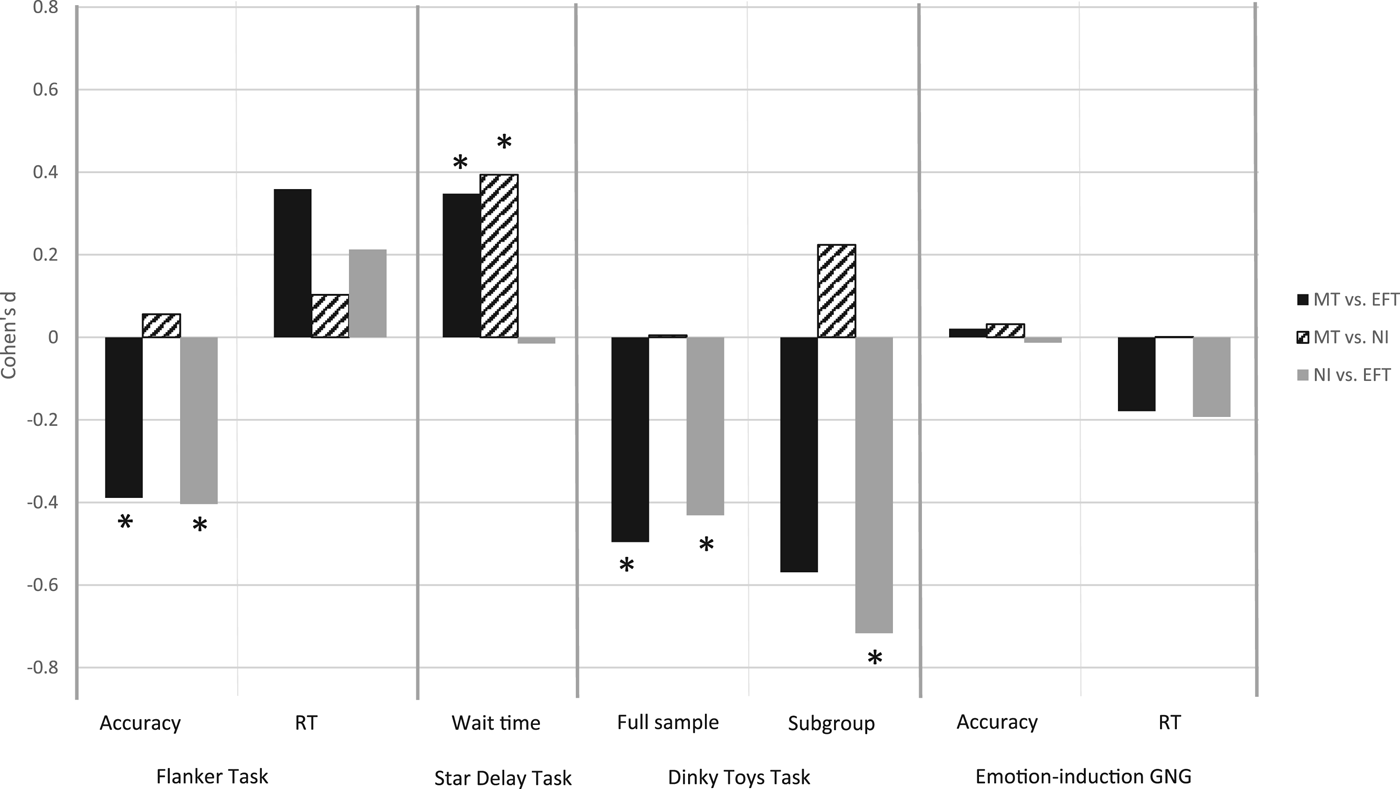
There was a significant effect of group on posttest flanker accuracy scores on incongruent trials, F (2, 90) = 3.33, p = .040, η 2 = .07. LSD post hoc analyses showed that the EFT group showed significantly more improvement in accuracy than the NI group, p = .018, d = .40, and the MT group, p = .045, d = .39 (see effect size comparisons in Figure 2). The MT and NI groups did not differ, p = .74. There was no significant effect of group on posttest flanker reaction times on incongruent trials, F (2, 89) = 1.33, p = .27.
Between-group effect sizes by task.

Star delay task
There was a significant effect of group on posttest average delay times, F (2, 90) = 3.20, p = .045, η 2 = .07. LSD post hoc analyses indicated that the MT group showed greater improvement in delay compared with the NI group, p = .026, d = .39, and the EFT group, p = .039, d = .35. There was no significant difference between NI and EFT groups (p = .92). At posttest, out of the 25 trials, the MT group waited the full 30 seconds for 16.3 stars on average, whereas the EFT group averaged 14.2 and the NI group averaged 15.3.
Dinky toys task
There was a trend for an overall effect of group on posttest average dinky toys score, F (2,89) = 2.80, p = .066, η 2 = .06. Post hoc analyses showed a significant effect of EFT group versus NI, p = .040, d = .43, and MT, p = .045, d = .50, but no significant effect of MT versus NI, p = .93.
Because many participants were at ceiling on this task (53 of 96), the analyses were repeated excluding participants who achieved a perfect score at pretest. In this subsample (MT n = 14, EFT n = 14, NI n = 15), the effect of group remained marginally significant despite a reduction of power, but with a large effect size, F (2,36) = 3.23, p = .051, η 2 = .152. Post hoc analyses showed a significant effect of EFT group versus NI, p = .017, d = .72.
Emotion-induction GNG task
Eight participants had to discontinue the task due to excessive distress, thus n = 88 for these analyses. There was no significant effect of group on posttest combined GNG accuracy in Block 3, F (2,82) = 0.02, p = .98, or go-trial reaction times, F (2,82) = 0.42, p = .66.
Discussion
Early adverse care, such as institutional deprivation or foster care, increases children's risk for poor self-regulation, a crucial competency for successful navigation of everyday life. The current study was a preliminary investigation of the impact of MT and EFT interventions on IA children's self-regulation using a randomized, controlled trial.
The first aim of this study was to examine the extent to which MT and EFT improve self-regulation across different domains. While findings remain preliminary, the MT and EFT both appear to improve various aspects of behavioral regulation. Specifically, MT improved delay of gratification ability and EFT improved inhibitory control and selective attention. Each result is considered in the following paragraphs.
In the area of delay of gratification, children in the MT group improved compared with NI or the EFT groups. Children's delay of gratification has demonstrated remarkable power in predicting future outcome (e.g., Mischel, Shoda, & Rodriguez, Reference Mischel, Shoda and Rodriguez1989); however, it has been notably difficult to improve through intervention (e.g., Diamond, Reference Diamond and Zelazo2013; Lillard & Else-Quest, Reference Lillard and Else-Quest2006; Raver et al., Reference Raver, Jones, Li-Grining, Zhai, Bub and Pressler2011). The task is complex and requires various self-regulation skills working in concert to support inhibitory control, sustained and selective attention, regulation of frustration/boredom, and persistence. Delay of gratification tasks tap into effortful control, considered a dimension of temperament, which may be less amenable to intervention compared with other areas of executive functioning. One reason that MT may have improved children's ability to delay gratification on this task is its increasing practice of brief meditation. This practice may have increased children's ability to avoid or tolerate the boredom associated with the delay of gratification. Children also might have used the focused attention practiced in mindfulness to direct their attention away from the little star and the button to other senses. Use of such attention strategies has been associated with better ability to delay gratification in past studies (Mischel et al., Reference Mischel, Shoda and Rodriguez1989).
Interestingly, however, selective attention and inhibitory control as measured by accuracy in the computerized flanker task, was improved in the EFT group but not the MT group. While practiced in different ways, selective attention was a target of both interventions. For example, in the EFT, children played games that asked them to focus on one aspect (such as color) while ignoring other aspects (such as shape). In the MT, children practiced attending to one sense while ignoring input from other senses, or paying attention to their breath while ignoring other stimuli (see Appendix C). It is not clear why only the EFT group improved, but one explanation could be that the EFT games may have been a closer proxy to the computerized task. Importantly, the mean for the MT group fell between the EFT group and NI group, so it is possible that the MT group may also have improved, but below the level of statistical significance. Neither intervention significantly affected children's average reaction time on this task, which means that the EFT group improved in accuracy without sacrificing speed. This result is in contrast to one study of a mindfulness-based intervention on a similar age group found that the intervention group did improve on reaction time; however, there were no significant effects of training on accuracy (Schonert-Reichl et al., Reference Schonert-Reichl, Oberle, Lawlor, Abbott, Thomson, Oberlander and Diamond2015). Accuracy is considered to be a better measure of voluntary, executive attention, whereas reaction time may index more automatic, non-voluntary attention processes (Prinzmetal, McCool, & Park, Reference Prinzmetal, McCool and Park2005). Thus, our results indicate that EFT may be a more optimal method for improvement in the domain of effortful attention.
Children in the EFT group also showed the most improvement in the behavioral inhibitory control task where participants had to refrain from reaching into a bin full of prizes. It is important to note, however, that many children (especially older children) were at ceiling on this task, so it is unclear whether the intervention improved inhibitory control for children across the full age/ability range or whether it was specific to children with lower levels of initial inhibitory control. In the subgroup that did not begin the study at ceiling, however, there was a large impact of the EF intervention on this skill. Additionally, the results of the flanker task, which measures both attention and inhibitory control, reinforce the conclusion that the EFT improved children's inhibitory control.
While both interventions practiced inhibition, the EFT practice was more of a direct parallel to the demands of this particular laboratory task. For example, activities in the EFT included playing red light/green light, Simon Says, and bear/dragon, all games that involve specific practice in listening for an instruction and then controlling body movements accordingly. In fact, “stopping our bodies” was one of three daily themes in the EFT (see Appendix B), and inhibitory control was practiced in every session. The MT group's practice of inhibitory control was still present but did not parallel the dinky toys task. This result supports the conclusion that interventions are most effective in improving the skills that are directly practiced (see Diamond, Reference Diamond2012). By the time of the posttest, 1 to 3 weeks following the conclusion of the interventions, there does not appear to be a great amount of transfer or generalization from skills practiced in the MT. However, it is possible that transfer and generalization following an intervention develop over time and may not be present so soon after a short-term intervention. Because these effects could be driven by narrow practice effects rather than sustained, meaningful change, a crucial next step will be to evaluate how these improvements translate to improvements in real-world behavior, such as classroom conduct.
Neither intervention improved emotion regulation as measured by the emotion-induction GNG task. It may be the case that emotion regulation will improve over time with improvements in the other skills; however, long-term follow-up would be needed to detect this type of cascade effect. Because children's emotion regulation is notably hard to capture in laboratory assessments (Cole, Martin, & Dennis, Reference Cole, Martin and Dennis2004), it is also possible that our measure of emotion regulation was not sensitive enough to detect differences in this area, or that other observation-based measures would more accurately capture emotion regulation. However, it also could be that short-term interventions such as these trainings are not sufficient to improve children's emotion regulation, and a longer term or more intense intervention would be required.
Limitations
Although there are a number of strengths to the present analyses, including the robust randomized, controlled design, there also are several limitations. First, the sample size yielded limited power for the analyses. These results are preliminary and require replication to fully interpret the extent to which MT and EFT exert significant and clinically meaningful effects. This study also lacks a measure of cognitive flexibility, which would have been useful given the focus of the interventions. It is also important to note that many assessments used to measure self-regulation (by us and other researchers more broadly) are similar in nature to the skills practiced in the EFT group, and thus it is hard to know at this point whether the change will lead to meaningful, lasting improvements in behavior. Future research will be needed to address this important limitation.
Additionally, the gold standard for treatment studies is intent-to-treat analyses, which were not possible in this preliminary trial. Thus, the withdrawal rate may affect the generalizability of the findings. The families who stayed in the study may have been more organized and/or more motivated. It was the case that children who withdrew from the study were rated by parents as more anxious at pretest, which may have implications for acceptability of these interventions in clinical populations. Future large-scale studies should identify predictors of withdrawal and attempt to address barriers to completion, as well as use intent-to-treat analyses. It is also possible that the families who agreed to participate in this study were more concerned about their child's self-regulation and more motivated than other families. Further, these families had sufficient time and resources (e.g., transportation) available to take part in this study, which required a significant time commitment, and thus, they might differ in meaningful ways (e.g., socioeconomic status) from families who declined participation. Also, in fact, our participant family income level and parent education level (see Table 1) is slightly higher than that reported in a population study of internationally adopting families (Hellerstedt et al., Reference Hellerstedt, Madsen, Gunnar, Grotevant, Lee and Johnson2008). Our sample shows a similar percentage of married families as Hellerstedt and colleagues (Reference Hellerstedt, Madsen, Gunnar, Grotevant, Lee and Johnson2008) report.
Finally, the internationally adopted population studied in this analysis is a specific group, and these results cannot speak to the potential for MT/EFT to affect self-regulation in typically developing populations, or even in populations experiencing other types of adversity. Future research should test these interventions in other populations.
Conclusions and future directions
Even with these limitations, our results indicate that MT and EFT show promise for improving self-regulation in IA children. Both interventions showed improvements in self-regulation, with each showing greater improvements in some specific areas. Direct practice of skills appears essential for change, at least in the short term. It is unclear at this point whether further generalization and transfer would occur over time. By comparing two interventions in the same study, each intervention acted as an active control for the other intervention, strengthening our ability to conclude that the interventions themselves are impacting self-regulation. Given our pattern of findings, mindfulness or EF interventions could be selected based on the identified target of change. Alternatively, a direction for future research will be to determine whether a combined MT/EFT intervention could improve all three aspects of self-regulation (and potentially other aspects as well). Interestingly, attendance was significantly higher in the mindfulness intervention group, which may indicate greater acceptability of the intervention.
Results of this study have important implications for both researchers and practitioners.
An important future direction is to complete follow-up studies to determine whether the improvements seen in the laboratory tasks are also seen in real-world behavior. If children only improve their ability to perform on time-limited, abstract laboratory assessments and not real-world behavior at home and in the classroom, there is little utility in the interventions. A small follow-up with classroom teachers is underway to begin to examine this question.
It will also be important to conduct long-term follow-up studies to detect whether improvements seen in self-regulation cascade into other areas of development, because this would be predicted by a model of self-regulation as a vital mechanism in child development trajectories. Follow-up studies of a year or more would be able to look at group differences in peer problems, academic success, and, in the case of IA children, deprivation specific problems such as disinhibited social engagement, and would be able to empirically test the mediating effects of self-regulation skills.
Moreover, future research with larger samples should examine the predictors of individual differences in improvement. Given that both interventions showed improvement, but in different areas, it would be useful to examine which children benefited more from the MT versus the EFT. These findings may guide efforts to tailor interventions to an individual child.
Given the specific high-risk population tested here, a next step would be to determine whether these interventions could be applied to either a clinical setting or a universal setting. Following replication, practitioners working with children who have weak self-regulatory skills could try applying the strategies of these interventions to therapeutic and educational settings to promote self-regulatory improvement. Future research will be needed to determine the effectiveness of these interventions in a clinical population.
Furthermore, it is possible that these interventions would be successful in improving self-regulation in all children if offered in a universal setting such as a school program. Research into the use of mindfulness in school programs is a rapidly growing area of research (see reviews: Klingbeil et al., Reference Klingbeil, Renshaw, Willenbrink, Copek, Chan, Haddock and Clifton2017; Waters, Barsky, Ridd, & Allen, Reference Waters, Barsky, Ridd and Allen2015; Zenner, Herrnleben-Kurz, & Walach, Reference Zenner, Herrnleben-Kurz and Walach2014) with promising initial results. However, some have argued that the current findings do not justify the rapid dissemination of mindfulness practices in schools (e.g., Greenberg & Harris, Reference Greenberg and Harris2012; Van Dam et al., Reference Van Dam, van Vugt, Vago, Schmalzl, Saron, Olendzki and Meyer2017). Recently, the use of executive functioning training in schools has also been examined in several preliminary studies (e.g., Dias & Seabra, Reference Dias and Seabra2017; Mackey, Park, Robinson, & Gabrieli, Reference Mackey, Park, Robinson and Gabrieli2017). Further quality research is needed to establish the effectiveness of these programs in a school setting. Our results suggest that schools should consider what aspect of self-regulation they believe to be most crucial for school success when deciding between an EFT or mindfulness-based intervention.
In conclusion, the findings of the current study are promising given the differences that emerged between groups following a relatively brief intervention period (12 hours of in-person training) in this relatively small sample. This is the first study, to our knowledge, to compare two non-pharmacological interventions for improving self-regulation. Following the replication of these results in a larger sample, effectiveness trials should look at these interventions in real world settings such as a mental health clinic or school. Introduction of these types of practices in elementary education may prove to be a viable and cost-effective way to improve self-regulation processes in general, and perhaps specifically in children with self-regulation difficulties, and thus enhance the development of young children at greater risk for negative outcomes.
Supplementary material
The supplementary material for this article can be found at https://doi.org/10.1017/S0954579418001190.
Author ORCIDs
Jamie M. Lawler, 0000-0002-7325-2095.
Acknowledgments
The authors thank the children and families who participated, Bonny Donzella, Kristin Frenn, Shanna Mliner, Bao Moua, Maria Kroupina, the International Adoption Project, and the Center for Neurobehavioral Development. This work was supported by the Eva O. Miller Fellowship to Jamie M. Lawler and seed grants by the Center for Neurobehavioral Development and the Institute of Child Development at the University of Minnesota.