INTRODUCTION
Endocrine disrupting chemicals (EDCs) are released into the coastal marine environment and are a well-known hazard to aquatic organisms including bivalves (Oehlmann et al., Reference Oehlmann, Schulte-Oehlmann, Kloas, Jagnvtsch, Lutz, Kusk, Wollenberger, Santos, Paull, Van Look and Tyler2009; Zhou et al., Reference Zhou, Zhu and Zhong-Hua2009). EDCs can include metals, organic compounds, steroids and steroid-mimicking compounds, which may impact upon the survival, growth and/or reproduction of organisms (Luckenbach et al., Reference Luckenbach, deFur, Kellogg and Van Veld2010). However, the exact mechanisms of endocrine disruption in many invertebrates are yet to be established (Hutchinson, Reference Hutchinson2002). Levels of the sex steroid, 17β-oestradiol (E2), have been reported between <0.5–4 ng g−1 in aquatic sediments (Liu et al., Reference Liu, Zhou and Wilding2004). Similarly, the oestrogen mimic, bisphenol-A (BPA), which is a monomer used primarily in the manufacture of plastic, has been detected in concentrations from 9–779 ng L−1 in water and from 343 µg kg−1 in sediments (Heemken et al., Reference Heemken, Reincke, Stachel and Theobald2001).
Polluted estuaries often contain mixtures of chemicals, and the relationship between the general health of the organisms, their susceptibility to endocrine disruption, and population survival is less clear (Gravato et al., Reference Gravato, Guimarães, Santos, Faria, Alves and Guilhermino2010). Most of the available data on molluscs comes from a few species of gastropods and bivalves, including Nucella lapillus (L.), Mytilus edulis (L.) and Crassostrea gigas (Thunberg, 1793) (Bryan et al., Reference Bryan, Gibbs, Burt and Hummerstone1987; Bauer et al., Reference Bauer, Fioroni, Ide, Liebe, Oehlmann, Stroben and Watermann1995; Nice et al., Reference Nice, Morritt, Crane and Thorndyke2003). Understanding the possible effects of EDCs on economically important bivalve species also has implications for the success of commercial aquaculture (Luckenbach et al., Reference Luckenbach, deFur, Kellogg and Van Veld2010). However, relatively little is known about the edible cockle, Cerastoderma edule (L.).
Some data are available on the ecotoxicity of chemicals to Cerastoderma species. Cockles show delayed gametogenesis, increased parasite load and reduced fecundity when exposed to contaminated harbour sediment (Timmermans et al., Reference Timmermans, Hummel and Bogaards1996). To date there have been no specific studies into the effects of EDCs on cockle reproduction. The only studies assessing the exposure of the Genus Cerastoderma to EDCs have focused on nonylphenol (NP). Laboratory exposure of cockles to 0.1 mg L−1 NP increased the total haemocyte count and induced vitellogenin synthesis (Marin et al., Reference Marin, Rigato, Ricciardi and Matozzo2008; Matozzo et al., Reference Matozzo, Rova, Ricciardi and Marin2008). However, in field populations of C. edule, delays in growth and/or reproductive maturity may also be attributed to the age, nutritional status, and disease state of the organisms. It is therefore important to interpret any apparent reproductive effects in wild populations with the physiological status and health of the animals, as well as their susceptibility to EDCs.
Bivalves tend to reach peak reproductive condition and have high body weight towards the summer following high temperatures and nutrient blooms in the environment (Zwarts, Reference Zwarts1991). The gametogenic cycle of C. edule was last assessed over 30 years ago in different sites around the British Isles and the results were variable between geographic locations (Newell & Bayne, Reference Newell and Bayne1980). Cockle growth and gametogenesis is affected by seasonality and the supply of nutrients, as with other bivalves (Navarro et al., Reference Navarro, Iglesias and Larrañaga1989). Early gametogenic studies documented that spawning started as early as March in Liverpool Bay (Johnstone, Reference Johnstone1899), whilst in Strangford Lock, Northern Ireland, spawning began in late June (Seed & Brown, Reference Seed and Brown1977). Moreover, the reported length of the spawning period differs at several of the locations in Britain; Hancock & Franklin (Reference Hancock and Franklin1972) reported short spawning periods between May and June in the Burry Inlet, South Wales, whereas spawning continued until August in the Tamar Estuary (Newell & Bayne, Reference Newell and Bayne1980).
The overall aim of the present study was to survey different locations in south-west England for evidence of reproductive effects, including the incidence of intersex, which might be attributed to endocrine disruption in C. edule. Given the paucity of contemporary field data on this species, it was first necessary to determine the spawning cycle of C. edule in south-west England. Two suitable locations (a reference site, and a more contaminated site with apparent EDC effects) were studied in detail to determine spawning cycles and the likely optimum month for collecting mature animals. Subsequently, all the sites were examined for health effects (size, body morphometrics) and the incidence of parasites in the animals, to determine whether or not these were confounding factors in reproductive maturity or intersex. Finally, to aid data interpretation and to demonstrate the sensitivity of C. edule to EDCs, animals collected from the field were exposed in the laboratory to two well-known EDCs: the hormone 17β-oestradiol (E2, Chesman & Langston, Reference Chesman and Langston2006) and the plasticizer bisphenol-A (BPA, Oehlmann et al., Reference Oehlmann, Schulte-Oehlmann, Tillmann and Markert2000).
MATERIALS AND METHODS
Sample collection
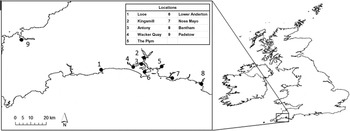
Only organisms above minimum catch size (>20 mm) were collected, as this is reportedly the size when they become reproductively active (Hancock & Franklin, Reference Hancock and Franklin1972; Seed & Brown, Reference Seed and Brown1977). A minimum sample size of 30 C. edule were hand collected with surface raking from each site in south-west England (Kingsmill 50°25.44′N 04°12.28′W, Looe 50°21.31′N 04°27.37′W, Padstow 50°31N 04°55W, Plym 50°22.45′N 04°06.02′W, Wacker Quay 50°22.27′N 04°16.01′W, Antony 50°23.31′N 04°13.16′W, Noss Mayo 50°18.43′04°02.25′W, Bantham 50°16.49′N 03°52.02′W, Lower Anderton 50°20.55′N 04°12.03′W, Figure 1). The sites have been classified under the River Basin Management Plan (RBMP) (EA, 2009). All of the nine study sites achieved a moderate overall status, Looe was classified as good ecological status, whereas the other eight sites achieved a moderate ecological status according to the RBMP (Table 1). Under the Water Framework Directive (WFD; 2000/60/EC), all sites achieved a good chemical status, with the exception of Lower Anderton on the River Tamar, which failed to achieve good chemical status. Some of the organisms collected from Kingsmill and Looe were used for laboratory exposure experiments (see below).
Map of sample sites in south-west England. Sites 1–9 were assessed at peak reproductive condition for the presence of intersex within populations of Cerastoderma edule, and sites 1 and 2 (Looe and Kingsmill) were used for the determination of the gametogenic cycle and exposure to endocrine disruptive chemicals (BPA and E2).

Site characteristics and classification of estuaries based on the River Basin Management Plan (EA, 2009).

Ecological and chemical status: High > Good > Moderate > Bad.
The sites at Looe (clean reference site) and Kingsmill (polluted site) were chosen for detailed investigations on the time course of reproductive maturation of the cockles in the region. The reproductive condition of C. edule was examined to assess the periodical progression of gametogenesis. Kingsmill failed to achieved high chemical status under the WFD, and had a higher level of anthropogenic influence (agriculture, industry, farming) in comparison to Looe (Table 1). At monthly intervals a minimum of 50 individuals were collected from each site between February and July 2012 to assess reproductive development and condition.
Additional sites (Table 1) were sampled at peak reproductive condition after the gametogenic cycle had been established at Kingsmill and Looe. Cockles were held in small aquaria (50% seawater with aeration, 12°C, 16:8 light:dark cycle), and left to expel any sediment for 2 days before the gonads were removed and examined (see below). The 50% seawater was prepared from offshore seawater (50°16N 04°15W) diluted with an equal volume of tap water, and left to aerate to remove chlorine gas.
Reproductive condition and body morphometrics
Assessment of the reproductive condition and body morphometrics was carried out for all cockles in this study including (1) individuals collected for an assessment of the reproductive cycle from Looe and Kingsmill populations, (2) individuals collected from sites in south-west England at peak reproductive condition, and (3) individuals collected for laboratory exposure.
Morphometric data were collected for individual whole cockles to assess body size, and the relative size of the reproductive tissue within each animal (Supplementary material, Table A). Total weight in the shell (±0.1 g) and the maximum length of shells was measured along the anterior-posterior axis using callipers (±0.1 mm). Cockles were carefully dissected and a sample of the gonad was removed and placed on a glass slide. Every effort was made to ensure that gonad samples were not contaminated. Instruments were cleaned between every gonad smear. Samples were gently compressed under a cover slip and examined systematically under a light microscope to determine the gender and stage of reproductive development (Chesman & Langston, Reference Chesman and Langston2006). Photographs of gonad smears were taken using a compound microscope with a mounted camera (Scopetec, DCM143). The reproductive stage of individuals was determined by (1) examination of the macroscopic appearance of the gonad and (2) microscopic examination of a sample of the gonad. Gonads were ranked in stages from zero to three which corresponds to the calculation of the Mean Gonad Index (MGI). MGI defines the reproductive condition of a population by multiplying the number of individuals in each stage of development by the numerical rating of that stage, then dividing the sum of the products by the total number of individuals in the sample (Seed & Brown, Reference Seed and Brown1977). The stages were ranked as follows: 0 = resting or spent gonad, 1 = developing gametes appear, no ripe gametes detectable, 2 = gonad half full, with few developing gametes still present, 3 = ripe gonad, S2 = spawning with a general reduction in density of gametes, S1 = gonad ~3/4 spawned or only residual gametes present. Photographs of the stages of reproductive cycle in C. edule from this study are provided in supplementary material (Supplementary material Figure A).
A number of individuals exhibited parasitic infestations within the gonad tissue, rendering the sex unidentifiable in some instances. Identification of parasites was limited to family level since further identification was outside of the aims of this study. Parasites include: Bucephalalidae (James & Bowers, Reference James and Bowers1967; De Montaudouin et al., Reference De Montaudouin, Thieltges, Gam, Krakau, Pina, Bazairi, Dabouineau, Russell-Pinto and Jensen2009), Gymnophallus spp. (Odhner, 1900), Monorchis parvus (Looss, 1902) and Turbellaria (Pike & Burt, Reference Pike and Burt1981; Azevedo et al., Reference Azevedo, Conchas and Montes2003).
The remaining soft tissue was weighed to the nearest 0.1 mg (wet tissue mass) and oven dried (80°C) to a constant dry weight. Internal volume of individual bivalves was estimated by filling half a shell with water, weighing the amount of water and multiplying the result by two. The Condition Index (CI) of each individual was then calculated to estimate the changes in development state. The equation for CI followed Gosling (Reference Gosling2003): CI = (DW/SV) × 1000, where DW is dry weight of tissue (g) and SV is the shell volume (mL).
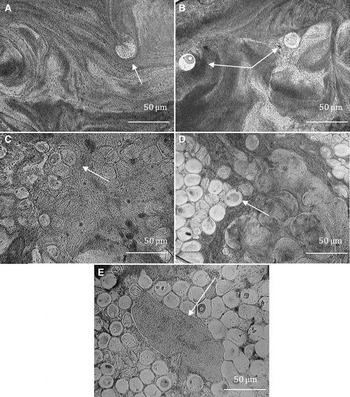
In addition, the gonads were scored for intersex according to Chesman & Langston (Reference Chesman and Langston2006). The score is based on the number and distribution pattern of oocytes within a field of view under a microscope at × 100 magnification. 1 = focal, predominantly male gonad, with a single oocyte; 2 = diffuse, predominantly male gonad, greater than one oocyte but no physical association with neighbouring oocytes; 3 = cluster, predominantly male gonad with 1–4 closely associated oocytes present; 4 = enclosed, predominantly male gonad, follicle(s) containing oocytes; 5 = advanced, predominantly female gonad, follicle(s) containing bundles of sperm. When cases of intersex were identified from gross morphology, a second gonad sample was taken from another section of the visceral mass in the animal to confirm the observation.
Laboratory exposures of C. edule to bisphenol-A and 17β-oestradiol
These experiments were performed to demonstrate the sensitivity of C. edule to EDCs, and were carried out at the Marine Biological Association, Plymouth, UK. Two hundred and eighty cockles were collected from Kingsmill, Cornwall (50°25.44′N 04°12.28′W) in March 2012, and held in aerated tanks of 50% seawater at 12°C for 4 days to acclimate and expel grit/sediment. The experimental design involved a semi-static exposure of duplicate glass tanks (each containing 5 L of water, 35 animals/tank) to different concentrations of each chemical (nominal concentrations: E2, 0.1 µg L−1; BPA: 0.1 µg L−1; and 0.01 µg L−1) for 60 days, with an appropriate solvent control (ethanol). The final concentration of ethanol dosed into the tanks was less than 0.1%. The test concentrations were chosen as sub-lethal doses that would likely cause some reproductive effects on the animals. Levels of E2 have been found in sewage treatment works as low as 1–50 ng L−1, which appear sufficient to induce oestrogenic activity (Desbrow et al., Reference Desbrow, Routledge, Sheehan, Waldock and Sumpter1996).
Bisphenol-A (BPA) and 17β-oestradiol (E2) were both analytical grade (Sigma Aldridge, Poole, UK). A primary stock of 1 g L−1 BPA was prepared by adding 0.1 g of BPA to 100 ml of 100% ethanol. This was then diluted to prepare a secondary stock of 10 mg L−1 BPA (1 mL of the primary stock made up to 100 mL with 100% ethanol, and finally a secondary stock of 1 mg L−1 BPA by a further dilution in the ethanol). The secondary stock solution of BPA was designated as a ‘high concentration’ (10 mg L−1 BPA) and the final stock solution of BPA as a ‘low concentration’ (1 mg L−1 BPA) in the experimental design.
The 17β-oestradiol (E2) exposures were conducted separately from those of BPA. A primary stock of 1 g L−1 E2 was prepared by adding 0.1 g of E2 to a 100 mL of 100% ethanol. A secondary stock (10 mg L−1 E2) was prepared by dilution using 100% ethanol as described above for BPA. The secondary stock solution was used for the E2 exposure.
The salinity and temperature were maintained at 17.5‰ and 15°C respectively during the exposure experiments. Static-renewal of the exposure water was conducted with 100% water changes every other day. The tanks were cleaned at each water change, rinsed with fresh water, and refilled with 5 L of 50% seawater. Animals in each tank were fed 15 minutes after the water change with 75 mL of Tetraselmis suecica (Butcher, 1959) (2 × 10⁶ cells L−1, equal to 1.5 × 10⁸ cells per feed), before re-dosing with the appropriate test chemical to maintain the exposure.
Dosing of the tanks was achieved by directly pipetting from stock solutions of each chemical in to each tank containing 5 L of 50% seawater. For the BPA exposure, the two exposure concentrations were achieved by pipetting 0.5 mL of the appropriate stock solution into duplicate tanks containing 5 L of 50% seawater to achieve a final nominal concentration in 0.1 µg L−1 and 0.01 µg L−1. For the E2 experiment, only one exposure concentration was used as the concentrations known to affect bivalves are relatively well-known (Langston et al., Reference Langston, Burt and Chesman2007). Dosing was achieved by adding 0.5 mL of 10 mg L−1 E2 into duplicate tanks containing 5 L of 50% seawater to achieve a final nominal concentration in each tank of 0.1 µg L−1. Finally two solvent control tanks were dosed with 0.5 mL of 100% ethanol (nominal ethanol concentration of 0.1% in each tank). Tanks were monitored every day for spawning, or dead organisms, which were removed. The exposure continued for 2 months (60 days). At the end of the exposure cockles were collected for morphometrics, body weight and histological examination of the gonads (gender, intersex frequency and intersex severity as above).
Statistical analysis
Statistical analysis was carried out using Minitab V.15. All data were checked for homogeneity of variance (Levene's test). Where variances were not homogeneous, raw data was transformed (square root) prior to analysis. In addition to the calculation of MGI, the CI of population samples each month for C. edule were analysed by a two-way analysis of variance (ANOVA) to investigate if there was variation in the condition of organisms between sites and over time. Data were tested for homogeneity of variance and normality, and transformed where necessary. Tukey's post hoc tests were applied to identify any significant differences. Pearson's correlation coefficient was performed against average CI and MGI to explore associations between the data. The calculation of sex ratios was only performed on identifiable gametes and was calculated as the number of males to females from a population, and a chi squared test was used to assess the significance of deviations from a 1:1 male:female sex ratio. Fisher's exact tests were applied to the gender data where the samples contained fewer than 30 individuals to see whether the sex ratios differed between the populations and exposure groups. Any differences between repetitions of exposed populations of C. edule were tested using a Student's t-test. Following this the data were pooled for repetitions and analysis of condition index was conducted without transformation using ANOVA. Finally, Pearson's correlations were performed between parasite data and measurements of reproductive condition, MGI and CI.
RESULTS
Gametogenic cycle of C. edule in south-west England
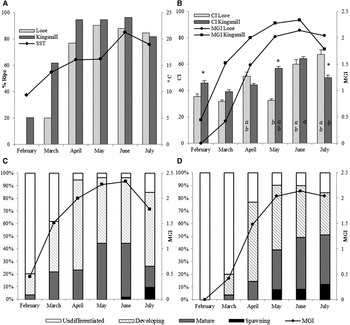
Samples of C. edule were collected from populations at Looe and Kingsmill each month to assess development and morphometric parameters. As the average sea-surface temperature rose over the 6-month period, there was an overall increase in the percentage of ripe individuals (calculated as the percentage of individuals with mature gonads) per site over time (Figure 2A). In order to understand the influence of variations in temperature on the condition of the organisms, average CI was plotted against temperature (not shown). There was a significant positive correlation between the temperature and the CI of cockles sampled from both sites over the 6-month period (Looe r = 0.877, P = 0.022; Kingsmill r = 0.861, P = 0.028). Both populations developed gonad tissue throughout spring and into summer and by July individuals from both sites began to spawn. The population for Looe showed a slight delay in gametogenesis in comparison to Kingsmill, however, both populations appear to decrease in CI in July.
(A) Reproductive cycles of Cerastoderma edule from Looe (control) and Kingsmill (polluted site) over a 6-month period, showing the percentage of ripe individuals (N = 50–60) together with the average sea surface temperature (°C) acquired from the Western Channel Observatory (2012). (B) Development of C. edule from two populations in Cornwall, showing Mean Gonad Index (MGI) and Condition Index (CI) over time (N = 50–60). Values for CI are expressed as mean ± SD. Significant difference in CI between sites are shown by *; a, signifies a significant difference in CI from beginning of the study; b, signifies significant difference in CI from the previous time point (GLM ANOVA, P < 0.05). (C) Seasonal distribution in percentage of C. edule at different stages of gonad development from Kingsmill (polluted site) and (D) Seasonal distribution in percentage of C. edule at different stages of gonad development from Looe (control site). Each stage is categorized by the maturity factor used to formulate Mean Gonad Index (Undifferentiated = 0; Developing = 1, 2; Mature = 3; Spawning = 2, 1).

CI and MGI were both used to assess gonad development over time (Figure 2B). The positive correlation between MGI and CI from both Kingsmill (Polluted site) and Looe (Reference site) (r 2 = 0.3771), suggests that the two methods of assessment are broadly comparable as 38.9% of the variation in MGI can be explained by CI. The CI of C. edule from both sites decreased in March compared with February but increased again in April. Kingsmill continues to increase through to June with a rapid decline in July. The population from Looe displayed a sudden decrease in CI in May compared with April, but resumed increasing in June and July. There was an overall significant difference between the CI on each sample occasion (GLM ANOVA, F 11, 642 = 30.45, P < 0.001). Over the 6-month period the CI is significantly different at Kingsmill over time (February to June, P < 0.0001) and there is a significant difference over time in Looe (February to July, P < 0.0001). The MGI of C. edule from both populations showed an increase over time. There was a plateau between May and June at Kingsmill before falling slightly in July. Conversely there is a large decrease between June and July at Looe (Figure 2B).
From the direct observation of changes in gametogenic stage over the 6-month period, Kingsmill showed a marked decrease in the percentage of individuals with undifferentiated gonads, whilst there was a steady increase in the proportion of animal with developing and mature gonads. Individuals from Kingsmill were spawning by June (Figure 2C). In comparison, the population from the reference site at Looe developed slower than Kingsmill during February and March, but then matured more rapidly and the population began spawning between May and July (Figure 2D). Overall, the sex ratios of samples from all sites over the 6-month period do not differ significantly from the expected value of 1:1. In the early months, February and March, it was easier to identify female gametes than males as oocytes appeared to develop faster than male gametes which gave rise to significantly different sex ratios (February χ2 = 11, P = 0.001; March χ2 = 6.1, P = 0.014).
Intersex, sex ratio and reproductive condition of native populations of C. edule in south-west England
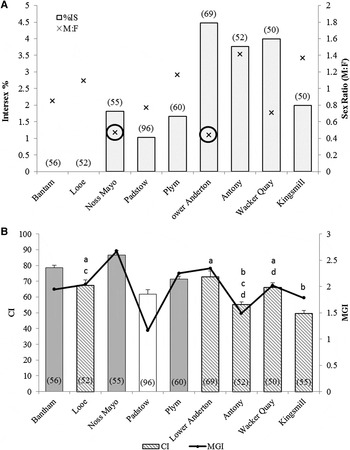
Sample populations of cockles from nine sites in south-west England were investigated for intersex. Eighty per cent of the native populations of C. edule displayed signs of intersex and the level varied between individuals and between populations (Figure 3). The incidence rates of intersex were too low to reliably obtain severity scores at each site for all animals. A total of 15 individuals were found to have intersex (Looe: N = 1, Noss Mayo N = 1, Padstow N = 1, Plym N = 1, Lower Anderton N = 3, Antony N = 2, Wacker Quay N = 3 and Kingsmill N = 3). The most severe cases of intersex were found at Lower Anderton and Looe. Both individuals had predominantly female gonads containing bundles of sperm, which in the case of Lower Anderton, motile sperm could be observed. The highest percentage of intersex within a population was identified in Lower Anderton (4.47%) and Wacker Quay (4%) (Figure 4A). The sex ratios of cockles at individual sites were calculated and compared to see if there was any deviation from the 1:1 expected ratio. The screening of the gonads indicated that only Noss Mayo (P = 0.009) and Lower Anderton (P = 0.003) had a significantly greater number of females than males.
Incidences of intersex found in native populations of Cerastoderma edule from south-west England. (A) stage 1, single oocycte (arrow) within sperm follicle; (B) stage 2, oocytes in male spermatozoa, not in association (arrow); (C) stage 3, male gonad with oocyte follicles (arrow), some in close association; (D) stage 4, follicles with several oocytes (arrow) within male gonads; (E) stage 5, predominantly female gonad with bundles of sperm (arrow).

(A) Percentage intersex and sex ratio of native Cerastoderma edule from sample populations in south-west England, circles around X indicate a significantly different sex ratio from the expected 1:1. (B) Average Condition Index (CI) and Mean Gonad Index (MGI) for native populations of C. edule; values displayed are means ± standard error. White = May; Grey = June; Hatched = July. Sites which are not significantly different within sampling month are indicated with the same letter (GLM ANOVA, P < 0.05). For both graphs, sites increase in pollution level from left to right (N = number sampled). As multiple samples have been taken at Kingsmill and Looe, data are from July sampling.

Reproductive condition was also assessed in the native sites. The MGI and CI of native populations were calculated to determine if there was any difference between the sites. There was a strong positive correlation between MGI and CI (Figure 4B), with 60.8% for the variance in MGI accounted for by CI (r = 0.780; P = 0.008). Samples collected in the same month (within month) have been compared between sites using GLM ANOVA to remove seasonal effects (Figure 4B). There was a significant difference between sites for the CI of native populations sampled in June (ANOVA F 2, 168 = 12.85; P < 0.001), and between those sampled in July (ANOVA F 4, 271 = 9.70; P < 0.001).
Laboratory exposure of C. edule to bisphenol-A and 17β-oestradiol
There was a lower survival rate of organisms exposed to both bisphenol-A (BPA) concentrations in comparison to 17β-oestradiol (E2) and the control over the 8-week exposure period. The cumulative per cent mortality was 19, 18, 34 and 31% for the control, E2, low and high BPA concentrations respectively by the end of the experiment.
There were no statistical differences in morphometrics between replicate tanks within treatments (Student's t-tests, P > 0.05), and data were pooled by treatment for statistical analysis. There was no significant difference in the CI of the cockles between treatments (ANOVA, F 3, 305 = 1.47, P = 0.225). The male:female sex ratio for the exposure experiment was dominated by females for all treatments (Control, 0.64; 0.1 µg L−1 E2, 0.36; 0.01 µg L−1 BPA, 0.78; 0.1 µg L−1 BPA, 0.57). There was a significant departure from the expected 1:1 sex ratio for E2 exposed C. edule (χ2 = 11.79, P = 0.0002), but no difference was observed in the control (χ2 = 1.97, P = 0.16). The sex ratio of C. edule exposed to the high level of BPA deviated significantly from the normal 1:1 ratio (0.1 µg l−1; χ2 = 0.07, P = 0.035), but there was no significant difference in the sex ratio for low level BPA (0.01 µg L−1; χ2 = 0.435, P = 0.22). However, no cases of intersex were identified in C. edule experimentally exposed to 17β-oestradiol (E2) or at either exposure concentration of BPA.
Parasitic infestations of cockles
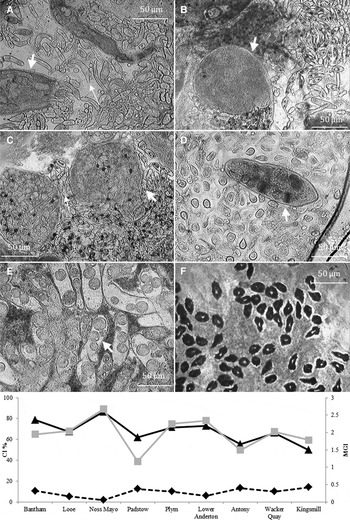
There were a number of different parasitic infections identified in the wild populations of C. edule. The highest levels of parasitic infestation were identified at Kingsmill (14%). Most of the parasitized cockles were infected by digenean trematodes. The dominant trematode family was Bucephalalidae: metacercaria and sporocysts containing enclosed cercaria, often filled large parts of the visceral mass and gonads of affected individuals. Gymnophallus sporocysts were often found in small groups and surrounded by cercaria larvae in different stages of development. A digenean trematode, displaying a daughter sporocysts containing metacercariae was tentatively identified as Monorchis parvus. In addition to digenean parasites, there were individual parasites identified from the class Turbellaria including Paravortex sp. and subclass Haplosporidia (Figure 5). Parasite load did influence reproductive maturity. Populations with higher CI and MGI had low parasite loads, whereas those with a higher percentage of parasites had lower CI and MGI (Figure 5G). There was a strong negative correlation between the CI and parasite percentage of populations (r = −0.854, P = 0.002), and there was also a strong negative correlation between the MGI and parasite percentage of populations from south-west England (r = −0.710, P = 0.021).
Photographs of parasites identified in Cerastoderma edule. Digenean trematodes: (A) Bucephalus sp. Branching daughter sporocyst (fat arrow) surrounded by cercaria larvae (thin arrow) in several stages of development; (B, C) Gymnophallus sp. daughter sporocysts, sporocyst (fat arrow) surrounded by larvae cercaria (thin arrow) in several stages of development. (D) Turbellaria possibly Paravortex sp.; (E) A daughter sporocyst containing metacercariae possibly Monorchis parvus; (F) Unidentified Haplosporadian; (G) Comparing the average Condition Index (CI, solid black line) and Mean Gonad Index (MGI, solid grey line) with the percentage of parasites (hatched line) within each C. edule population.

DISCUSSION
Reproductive cycle and spawning time in C. edule
The present study found that the gametogenic cycle of C. edule in south-west England started later than previously reported (Newell & Bayne, Reference Newell and Bayne1980). The gametogenic cycle was similar to previous observations on this genus, with differentiation of the gonad beginning in the spring (March), followed by spawning in the summer (Boyden, Reference Boyden1971; Seed & Brown, Reference Seed and Brown1977; Derbali et al., Reference Derbali, Jarboui and Ghorbel2009). In April, the percentage of ripe individuals appears to plateau in agreement with previous observations on C. glaucum (Brugière, 1789) (Derbali et al., Reference Derbali, Jarboui and Ghorbel2009). Mature gonadal development was achieved during June and July for both populations in the present study. Some minor differences in the progression of reproductive maturation were observed between the sites, with Kingsmill displaying a larger amount of ripe individuals throughout the study (Figure 2). The MGI was also higher at Kingsmill compared with the Looe reference site for the first 5 months. This suggests the animals at Kingsmill (polluted site) developed faster and spawned earlier than those at Looe (reference site).
However, the gametogenic cycle was also positively correlated with the average seasonal temperature, as expected (Derbali et al., Reference Derbali, Jarboui and Ghorbel2009); and may lead to some subtle variation in the maturation of the animals. In the present study, there was a slight drop in ambient temperature between April and May 2012, and this was followed by a fall in CI at the Looe site. Interestingly, the trends in both the MGI and CI were similar at each site; indicating that increasing biomass of the gonad was the main contributor to overall growth of the animals. Regardless, the observations at Kingsmill and Looe identified June and July as the best months for observations on mature animals, and these months were selected for studying the incidence of intersex at all the other field sites.
Intersex in field populations of C. edule
To our knowledge, these are the first recorded incidences of intersex within populations of C. edule in south-west England and the condition has not been observed in the genus Cerastoderma before. Cockles which displayed intersex were from estuaries which had previously displayed intersex in S. plana: including the Avon, the Tamar, the Lynher and the Plym (Langston et al., Reference Langston, Burt and Chesman2007). Intersex was more frequent in cockles from the sites with the highest levels of metal pollution in the sediments (data not shown). For example, Lower Anderton had elevated levels of intersex and is located on one of the more polluted water bodies, the Lynher. However, there was no clear trend between the chemical status classification of estuaries according to the WFD and the levels of intersex in the populations of molluscs. Intersex was observed in areas where the chemical status was rated as high under the WFD (Table 1, Figure 5). The WFD recommends a baseline measure of contaminants during environmental audits but inevitably not all the potential EDCs would be measured at each site.
Cockles (C. edule and C. glaucum) are inherently gonochoristic, with an expected 1:1 male to female sex ratio (Boyden, Reference Boyden1971). In all but two of the native sites sampled the sex ratio was balanced, as with previous studies (C. edule, Morgan et al., Reference Morgan, O'Riordan, Kelly and Culloty2012 and C. glaucum, Derbali et al., Reference Derbali, Jarboui and Ghorbel2009). The significantly female-biased sex ratios from Noss Mayo and Lower Anderton could suggest the presence of feminizing EDCs, similar to those reported for oestrogens and feminization of male clams (Langston et al., Reference Langston, Burt and Chesman2007). There appears to be a similarity between the sex ratio and the level of intersex in native populations. Lower Anderton had a significantly female-biased sex ratio and the most severe case of intersex, further implying that environmental factors were having a feminizing effect.
Studying the condition of organisms at the time of collection only provides a ‘snapshot’ of how they are affected by environmental stressors. A recent study found that pre-exposure history alters the susceptibility of bivalves to toxic chemicals (Sheir et al., Reference Sheir, Handy and Henry2013). Several EDCs are well-known to be bioaccumulative. Estimates of the bioaccumulation factor (BAF) for sessile benthic invertebrates exposed to oestradiol are around 2.23–3.97 (Lai et al., Reference Lai, Scrimshaw and Lester2002), and for BPA between 42 and 196 (Staples et al., Reference Staples, Dome, Klecka, Oblock and Harris1998). For BPA especially, the BAF suggests that trace amounts of BPA will bioaccumulate and previous exposure history will be important. The possibility that cockles survive in the field with reasonably good health, because they are already partially adapted to the presence of EDCs cannot be excluded. Interestingly, laboratory exposure cockles showed limited reproductive effects and were collected from Kingsmill, which was not a pristine site, and the possibility of some resistance to the EDCs due to historical exposure at the Kingsmill site cannot be excluded.
Past chemical exposure history is not the only variable that can affect organism health in the wild. Parasite load is also a reflection of water quality and aquatic organism health (Handy et al., Reference Handy, Runnalls and Russell2002). In theory, organisms at polluted sites will have a more vulnerable immune system, and be less able to cope with parasitic infection (Marcogliese & Pietrock, Reference Marcogliese and Pietrock2011). The present study appears to be the first report of parasitic infections in cockles where the reproductive state of the cockles has also been assessed. Trematodes were the main type of parasites found in the cockles, and this is consistent with other reports on cockles in intertidal estuarine ecosystems (Mouritsen & Poulin, Reference Mouritsen and Poulin2002). The sites with lower than average CI also had a higher incidence of parasitic infection. This observation may be explained in terms of bioenergetics theory, where energy for growth is diverted to deal with the infection (Sokolova et al., Reference Sokolova, Sokolov and Ponnappa2005). With the metacercariae occupying large parts of the visceral and gonadal mass, individuals will have to cope with the added burden of acting as a host for the parasite within the reproductive tissue. Further research is needed to obtain quantitative data of parasite loads in gonads from study areas to understand their impact on the reproductive cycle.
Laboratory exposures to BPA and E2
The effects of BPA or E2 in controlled laboratory exposures appear not to have been reported previously for C. edule. The laboratory experiments were conducted merely to aid the interpretation of the data from the fieldwork. There were some background incidences of mortalities in the solvent control (19%). This is not likely due to ethanol toxicity, since lethal concentrations to marine organisms are in the high mg–g range. The long-term laboratory culture of this species is not fully understood and steady incidences of mortality are also known at pristine locations (Burdon et al., Reference Burdon, Callaway, Elliott, Smith and Wither2014). Nonetheless, despite some additional toxicity from BPA compared with the solvent control, the exposure was mostly a sub-lethal event. Neither BPA nor E2 caused intersex in the cockles, and the gametes developed normally; although there was a female-biased sex ratio in the cockles exposed to the lowest BPA concentration and E2 compared with the control. The absence of effects of these EDCs on C. edule is not likely due to the loss of the test substances from the exposure media, since the media was frequently renewed. Whereas in Mytilus edulis exposed to 50 µm L−1 BPA for 3 weeks, gametogenesis was affected but spawning occurred in both sexes (Aarab et al., Reference Aarab, Lemaire-Gony, Unruh, Hansen, Larsen, Andersen and Narbonne2006). Cerastoderma edule might be less sensitive than M. edulis. It is possible that the gonad tissue is not a target organ, however the anatomy of C. edule is not fundamentally different to other bivalve species and reproductive effects of EDCs have been noted in Scrobicularia plana (Da Costa, 1778) and M. edulis (Aarab et al., Reference Aarab, Lemaire-Gony, Unruh, Hansen, Larsen, Andersen and Narbonne2006; Langston et al., Reference Langston, Burt and Chesman2007).
CONCLUSION
This study demonstrates the presence of intersex in C. edule in several estuaries in south-west England. However, intersex was not induced under laboratory conditions after 2 months of exposure to well-known EDCs, tentatively suggesting that the populations may be less sensitive to EDCs compared with other bivalves in the region. Historical effects of pollution and ecosystem change are a confounding factor. Cockle gonad development for the populations in the present study began later than what was previously described over 30 years ago. Parasite load and subtle changes in temperatures are likely factors in the reproductive status of C. edule, although further quantitative data are needed to verify this hypothesis.
SUPPLEMENTARY MATERIAL
To view supplementary material for this article, please visit http://dx.doi.org/10.1017/S0025315416000436
ACKNOWLEDGEMENTS
The authors would like to thank Dr W.J. Langston for his continued support and assistance throughout this research project. K. Child and S. O'Hara for assistance with field work and laboratory procedures. Average sea surface temperature data was provided by the NERC National Capability funded Western Channel Observatory by Dr T. Smyth. This research received no specific grant from any funding agency, commercial or not-for-profit sectors.