Kearns–Sayre syndrome is a rare mitochondrial disorder that is characterised by onset before the age of 20 years. The overall prevalence of mitochondrial disorders is 1:4300.Reference Gorman, Schaefer and Ng 1 The prevalence of Kearns–Sayre syndrome is 1–3/100,000 individuals. 2 The prevalence of cardiac defects in Kearns–Sayre syndrome is as high as 50% in patients.Reference van Beynum, Morava and Taher 3 Cardiac complications include conduction defects ranging from isolated left anterior fascicular block and right bundle branch block to complete atrioventricular block.Reference van Beynum, Morava and Taher 3 Clinical manifestations of conduction disease include syncopal attacks, congestive heart failure, and sudden cardiac arrest.Reference Young, Shah, Lee and Hayes 4 We report a case of an asymptomatic child who had electrocardiographic changes, which prompted prophylactic implantation of a single-chamber pacemaker. Within 3 years, she had progressed to complete atrioventricular block resulting in 100% ventricular pacing. To our knowledge, this is the youngest patient with Kearns–Sayre syndrome reported to undergo a pacemaker placement before the development of complete atrioventricular block.
Case Report
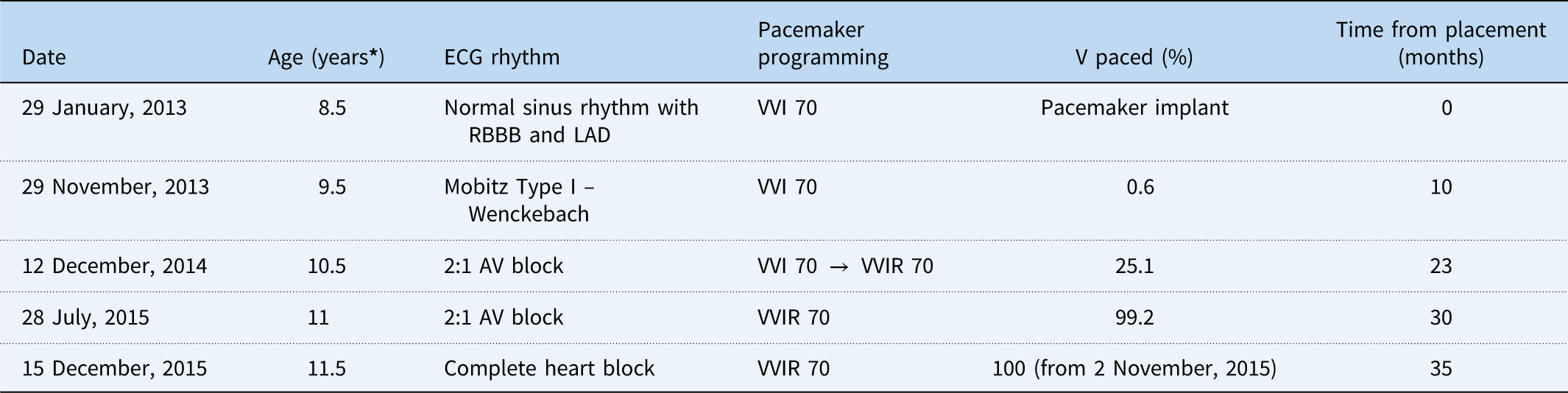
Our patient was a 7-year-old Caucasian female with a history of failure to thrive, since the age of 2.5 years, who initially presented to the Emergency department with tetanic hand spasms and was found to have hypocalcaemia and hypoparathyroidism. She was noted to have developmental delay, hypotonia, and ptosis. Her work-up revealed a large mitochondrial deletion consistent with Kearns–Sayre syndrome. Within 2 months, she presented to the Emergency department with new-onset diabetic ketoacidosis. She was clinically asymptomatic from a cardiac perspective. She had an abnormal electrocardiogram with low-voltage QRS, left-axis deviation, and a right bundle branch block. An echocardiogram showed a structurally normal heart with normal ventricular function. Her Holter monitor revealed intermittent bundle branch block with variable QRS morphology, especially at higher heart rates. These findings were suspicious for a potentially unstable infra-His conduction system. After discussion with the family about options, she underwent prophylactic placement of an epicardial single-chamber pacemaker in January 2013 at the age of 8.5 years. She was followed up regularly in Cardiology clinic with routine electrocardiograms, echocardiograms, and pacemaker interrogations. Less than a year after her pacemaker placement, she was found to have progressed to Mobitz Type I second-degree atrioventricular block. She only had 0.6% ventricular pacing and remained clinically asymptomatic from a cardiac standpoint. At 23 months post pacemaker placement, she had developed 2:1 atrioventricular block resulting in 25% ventricular pacing. As shown in Table 1, she had progression from Mobitz Type I to complete atrioventricular block with resultant increase in ventricular pacing to 100% over a period of 3 years.
Electrocardiogram (ECG) findings with concomitant ventricular pacing trend
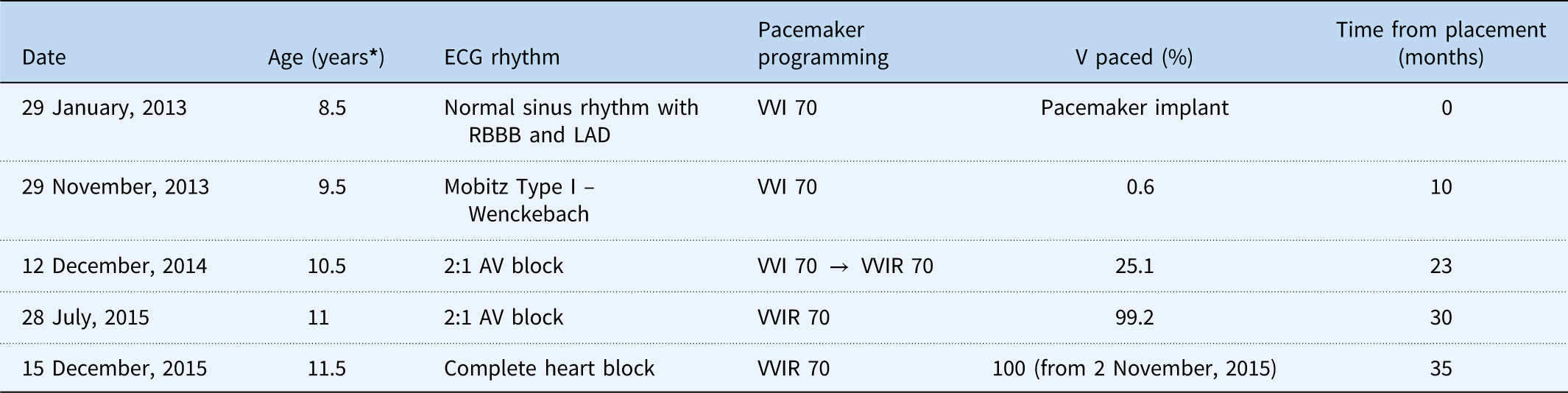
* AV=atrioventricular; LAD=left axis deviation; RBBB=right bundle branch block; V=ventricular
Rounded to the nearest half
Discussion
Kearns–Sayre syndrome is a multisystem disorder that includes a triad of progressive external opthalmoplegia, pigmentary retinopathy, and onset before the age of 20 years; in addition, endocrinopathies, short stature, and skeletal myopathy – weakness and exercise intolerance – are frequent symptoms.Reference DiMauro and Hirano 5 Development of cardiac conduction disease plays a large role in determining the prognosis in patients with Kearns–Sayre syndrome. It is recommended that patients with Kearns–Sayre syndrome undergo evaluation by means of electrocardiography every 6 months.Reference Kabunga, Lau and Phan 6 According to ACC/AHA/HRS 2008 Guidelines, permanent pacemaker implantation is indicated for third-degree and advanced second-degree atrioventricular block in patients with associated neuromuscular diseases including Kearns–Sayre syndrome.Reference Epstein, DiMarco and Ellenbogen 7 However, the occurrence and progression to high-grade atrioventricular block is unpredictable and can be rapid. In addition, non-compliance with follow-up visits may lead to difficulty with serial examinations. These factors make it difficult for the physician to determine the appropriate time frame to intervene with pacemaker placement.
Polak et. alReference Polak, Zulstra and Roelandt 8 reported a case of an 18-year-old patient with Kearns–Sayre syndrome who underwent a pacemaker placement when his routine electrocardiogram demonstrated normal sinus rhythm with right bundle branch block and left anterior fascicular block, and within 10 months of implantation he was completely pacemaker-dependent.
Our patient developed Mobitz Type I atrioventricular block within 10 months of her pacemaker placement, with progression to 2:1 atrioventricular block within 2 years and third-degree atrioventricular block within 3 years. She remained clinically asymptomatic from a cardiac standpoint. Therefore, it may be reasonable to consider prophylactic placement at the first sign of conduction disease in this patient population given the unpredictable progression. Ideally, pacemaker placement should occur immediately before the patient develops advanced atrioventricular block, but obviously this is difficult to predict. The progression of atrioventricular node disease in Kearns–Sayre syndrome is unpredictable, and patient and family follow-up is also unpredictable. Thus, the “optimal” timing for pacemaker placement is one that is patient-, family-, and provider-dependent, and best determined on a case-by-case basis.
The decision to follow closely with non-invasive monitoring, such as electrocardiogram and Holter monitor, versus prophylactic pacemaker placement must therefore be individualised with each patient and family. In addition, family understanding of the potential for disease progression and need for close follow-up should also play a role in the decision-making. Understanding the potential for rapid progression of underlying conduction disease in Kearns–Sayre syndrome patients will help providers counsel patients and their families regarding appropriate therapeutic options, which could include early pacemaker placement.
Acknowledgements
None.
Financial Support
This research received no specific grant from any funding agency or from commercial or not-for-profit sectors.
Conflicts of Interest
None.