

INTRODUCTION
During China's economic reform, there were millions of overseas Chinese (OCs) in capitalist societies: Hong Kong, Taiwan, and countries in Southeast Asia.Footnote 1 Many were financiers, developers, manufacturers, and exporters. Since 1978, diaspora entrepreneurs had returned home with ideas and resources that helped China implement pro-FDI policy. The other Asian giant, India, likewise had millions of people living abroad. Large shares of non-resident Indians (NRIs) were in South Asia and the Gulf region. Others had emerged as successful professionals with education and work experiences in the advanced societies. Professionals have been returning to India and influencing its economic reform since the 1980s. Their direct impacts on FDI were more limited than Chinese diasporas in the PRC. In short, Chinese and Indian diasporas have shaped the initiation, implementation, and consequences of FDI in their respective homelands, albeit in different ways.
Diffusion studies in international political economy (IPE), which emphasize the importance of external ideas and resources to a country's adoption of liberal policies, have not incorporated the roles of diasporas. Instead, they center on the influence of IOs, MNCs, and other actors via mechanisms of coercion, competition, emulation, and learning (Simmons, Dobbin, and Garrett Reference Simmons, Dobbin and Garrett2006, Reference Simmons, Dobbin and Garrett2008). Furthermore, existing diffusion studies end their exploration of a nation's liberal adoption at the national level and do not cover internal diffusion of liberalism after national adoption. It is indeed the internal diffusion that distinguishes successful liberalizations from less successful ones. And during the internal diffusion stage, diasporas that share ethnicity and social norms with domestic actors can play critical roles in their homeland's liberal transformation.
In this article, I explore the utility and conditions of diffusion by diasporas and apply the framework to FDI liberalization in China and India. I offer three findings: First, there is sufficient evidence to argue that diffusion by diasporas provides a novel and complementary mechanism for understanding the varied liberal adoption in China and India. Second, FDI liberalization in both countries was not implemented simply by a “strike of the pen,” but required compliance or further actions on the part of those at lower levels of government. Third, certain conditions made diasporas during the internal diffusion more effective in China than India, while similar conditions were present in India's software services sector and resulted in similarly expansive diffusion in this sector.
DIFFUSION, INTERNAL DIFFUSION, AND DIFFUSION BY DIASPORAS
IPE scholars have emphasized the impacts of major powers, international organizations (IOs), and multinational corporations (MNCs) on global spread of economic liberalism. Robert Gilpin (Reference Gilpin1987) and David Lake (Reference Lake, Frieden and Lake2000), for example, point to the importance of hegemonic powers. Robert Wade (Reference Wade1998–1999), John Williamson (Reference Williamson2002), and Ngaire Woods (Reference Woods2006) focus on the policy influence of IOs and MNCs, which reflect economic ideas and interests in the dominant powers. Stephen Nelsen (Reference Nelsen2014) finds a new connection between IOs and elites in the developing countries that share IOs' economic beliefs.
Diffusion studies, in particular, emphasize the dominance of interdependent economic liberalization across nations. Driving policy diffusion across nations are ideas and resources in the world's advanced societies that pressure or persuade policymakers in less developed countries to adopt particular policies. The mechanisms of diffusion include coercion, competition, learning, or emulation, as scholars like Beth Simmons, Frank Dobbin, and Geoffrey Garrett (Reference Simmons, Dobbin and Garrett2006, Reference Simmons, Dobbin and Garrett2008) have synthesized.
Zackary Elkin, Andrew Guzman, and Beth Simmons (Reference Elkin, Guzman and Simmons2006, 811) find that the cross-country spread of bilateral investment treaties (BITs) was driven by competition for FDI among potential host countries. Indeed, “potential hosts [of FDI] are more likely to sign BITs when their competitors have done so.” Duane Swank (Reference Swank2006, 847) additionally supports the competition mechanism in his study of diffusion of the neo-liberal tax reform in the United States to other developed nations. “[P]ressures to compete for mobile assets” result in diffusion that “in the long term, all nations move toward the U.S. neoliberal tax structure.” However, he believes that domestic political and institutional forces mediate policymakers' assessments of neoliberal reforms and result in possibly different adoptions across various countries.
On the learning and emulation mechanisms, Chang Kil Lee and David Strang (Reference Lee, Strang, Simmons, Dobbin and Garrett2008) study the diffusion of public-sector downsizing in the OECD nations. They find that neoliberal discourses in these countries helped to frame the “popularity” of downsizing (versus upsizing), accelerating the emulation and learning of downsizing measures. Dennis Quinn and Maria Toyoda (Reference Quinn, Toyoda, Simmons, Dobbin and Garrett2008) offer similar findings—global economic ideologies and voter sentiments determine whether more or less restrictive investment policies are adopted. On the spread of democracy, diffusion scholars argue, “although democratization could come about in multiple different ways and involve a wide range of potentially important actors in any one particular instance, external factors are generally better indicators of the prospects for transition than domestic country attributes” (Gleditsch and Ward Reference Gleditsch, Ward, Simmons, Dobbin and Garrett2008, 264).
There are two unaddressed gaps in the above diffusion studies. First, the research typically ends at the national level and pays little attention to implementation of the policy and internal diffusion within the country. To the adopting nation, however, implementation and internal diffusion are as important as, if not more important than, the national adoption of a liberal policy. Second, the diffusion studies do not specify diffusers or conditions that influence the effect of diffusion. Some diffusers are better than others at working with local governments and domestic companies to precipitate internal diffusion of a nationally adopted policy.
Previous diffusion studies have not examined the internal diffusion of liberal adoption, which is central to adopting nations. After the national adoption, internal diffusion can lead to three possible scenarios: expansive diffusion, partial diffusion, or reversal of diffusion, each of which has consequences in the adopting country and the global spread of liberalism. The first scenario, internal diffusion, expands initial adoption, as the new policy spreads from the national government to local implementation. For example, the national government allows FDI with foreign equity capped at less than 50 percent. Yet during internal diffusion, local authorities embrace FDI with foreign equity over 50 percent and override the national restriction in favor of liberalization. In the second scenario, national adoption leads to partial diffusion within the country. For example, only some parts of the new policy are implemented, or only some local governments implement the new policy, or the new policy is only applied to some sectors. In the last scenario, reversal of diffusion, the newly adopted policy faces domestic blowback. If the policy lacks adequate domestic support, or if implementation of the policy proves difficult, the new policy is likely to be reversed or severely cut back.
Internal diffusion is particularly important to liberalization in large developing countries, where policy changes cannot be simply implemented by a “strike of the pen,” but requires compliance and further actions on the part of those at the lower levels of government. In such countries, it is common to have disjuncture between national and local governments and mismatch between formal policies and informal practices. Indeed, while the national FDI policies have converged in China and India, according to economist Arvind Panagariya (Reference Panagariya2008), divergent internal diffusions, one being expansive and the other being partial, have resulted in continued gaps in FDI inflows and FDI performance between the two countries.Footnote 2
To elaborate, in China the national government initiated FDI liberalization in 1979–1980, and the initial policy was tentative and had many control clauses (Pearson Reference Pearson1991). Despite the national restrictions, internal diffusion was rapid and effectively overcame the national restrictions in favor of FDI. By 1993, China had emerged as the top FDI recipient among the developing countries. Expansive diffusion, scenario 1, continued in the country in the 1990s. UNCTAD (2006, 2012) has ranked China as a consistent “front-runner” in FDI liberalization. In India, the government attempted a national adoption in the mid-1980s but had to revert the adoption due to strong domestic opposition. It adopted new liberal policies in 1991, but internal diffusion was partial, as local implementation severely curtailed the national policies. Furthermore, in 1997–8 the government introduced new restrictions on FDI without changing the national codes passed in 1991. UNCTAD (2006, 2012) has consistently ranked India as an under-performer in terms of FDI liberalization, even 20 years after its 1991 adoption.Footnote 3
The importance of internal diffusion makes it imperative to spell out the types of diffusers in a country's liberal policy adoption. Even when external diffusers, such as foreign governments, IOs, and MNCs, persuade or pressure the national government of a developing country to adopt a new liberal policy, they are not suited to facilitate internal diffusion within the country. Beneath the level of national government, local officials, important to implementation of the newly adopted policy, tend not to have working relations with these external diffusers. On the contrary, diasporas share linguistic and social norms with local officials and can work with local governments to expand and deepen internal diffusion.
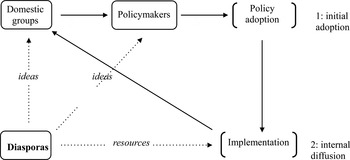
Publications in comparative politics, focusing on policymakers, interest groups, and policy implementation, have offered insights on how domestic mechanisms shape China's and India's economic liberalization, or the lack thereof.Footnote 4 Incorporating these insights, Figure 1 demonstrates how diasporas work on these previously identified mechanisms and processes during a country's liberal adoption. Policymakers, policy advocates (local governments and companies), and policy implementation constitute the domestic process of FDI liberalization. Typically, liberalization starts when some policy advocates persuade policymakers to adopt a new liberal policy. Implementation of the new policy then feeds back to policy advocates and policymakers, who either expand or narrow the previously adopted policy.
Diffusion by Diasporas: The Model

Figure 1 also shows that a complete liberal adoption has two main stages: initial adoption and internal diffusion. Initial adoption begins when policymakers decide to start a new liberal policy, which can be limited and tentative. It is uncertain whether initial adoption will result in internal diffusion and how profound the internal diffusion might be. Early implementation is critical. If implementation is successful, it feeds back on internal diffusion, expanding the scope and expediting the speed of liberalism in the country.
Diasporas who return from their experience in advanced societies are likely to have liberal economic ideas. They pass these ideas along to domestic policy advocates and policymakers who decide whether or not to adopt a new policy. Diasporas' influence on initial adoption is primarily through ideational influence, as captured in Figure 1, but their possession of resources provides additional incentives to domestic advocates who lobby policymakers to adopt the new policy. Resources are particularly important during the second stage: implementation and internal diffusion.
Entrepreneurial diasporas, in contrast to professionals or workers, have investible capital, skills, and perhaps connections with the global market. They can help to implement the new policy and generate early success that broadens domestic support for the new policy. Internal diffusion in such situations is likely to be rapid and expansive. Between China and India, as demonstrated in the empirical sections of this article, the Chinese entrepreneurial diasporas rendered FDI liberalization highly successful during implementation and precipitated internal diffusion. The Indian professional diasporas could not strongly help on-the-ground implementation; internal diffusion of new FDI policies was narrow and delayed, other factors notwithstanding.
Figure 1 emphasizes the ties between diasporas and domestic actors, and suggests that diasporas play stronger policy roles if they have multi-level linkages at home: at the national level with policymakers and at the sub-national level with local governments and domestic companies. While ties with national policymakers are important, ideas from diasporas to policy advocates tend to precede those to policymakers. Furthermore, involvement of local governments and companies is important to implementation of the new policy. If local governments and companies are not included in the support group of the new policy, diffusion by diasporas is likely to be partial, if not impossible. And during implementation, diasporas with resources are likely to incentivize local governments and companies to expand internal diffusion of the new policy.
In short, as demonstrated in Figure 1, diasporas first transfer ideas to both policy advocates and policymakers, and the stronger the diasporas' influence on policymakers is, the more likely the national government will be to adopt a new policy. Second, diasporas' resources are instrumental to implementation, and therefore enhance internal diffusion. Entrepreneurial diasporas who have resources are particularly useful to introduce transformative liberalization at home, through interaction with and incorporation of local governments and domestic companies during implementation of the new policy.
The two empirical sections of this article investigate China and India's FDI liberalization to demonstrate the utility and conditions of diffusion by diasporas. The Chinese case confirms the framework. When the country started reform, diaspora entrepreneurs supplied new ideas to policymakers and local governments, and helped initiate FDI liberalization. Their resources were investible funds, technology, and markets, precipitated implementation of the new policy. Visible success propelled the policy's internal diffusion, despite strong opposition from the Leftist groups in the country.
The Indian case partially supports diffusion by diasporas. Professional diasporas returned in the mid-1980s. Some, such as Sam Patrod, Manmohan Singh, and Montek Singh Ahluwalia, became members of the economic bureaucracy. Their ties outside the national government were limited. Domestic oppositions reversed the attempted new liberalization during this period.
Helped by the 1991 crisis, these diasporas-turned-bureaucrats were able to launch new liberal policies in India. Professional diasporas, however, lacked resources that would incentivize local governments and companies and could not help liberalization's internal diffusion in India. In the recent decade, FDI liberalization in India's software services emerged as an exception, in which entrepreneurial diasporas brought ideas, resources, and connections with the US market to India. They developed multi-level linkages with national government and sub-national actors. Liberalization in this sector was rapid and began to influence liberalization in other related sectors.
Two caveats are in order. First, the proposed model focuses on diasporas as ideas and resources providers to domestic elites in China and India. It does not reject the fact that diasporas receive initial ideas and resources from IOs and MNCs, or from their own life experience in the advanced societies. In China and India, however, due to anti-foreign nationalism, policy elites had difficulty embracing influence from foreign actors. Diasporas, as transmitters of Western ideas and resources, facilitated politics of FDI liberalization in these countries. Second, domestic legacies and institutions are inseparable conditions for diffusion by diasporas. Socialist China eradicated the capitalist class, while socialist India kept the capitalists. When reform started in China, in 1979, diaspora entrepreneurs became the natural ally of the national and local governments in pursuit for economic growth. Furthermore, local governments in China had developmental autonomy during socialism and were then offered incentives to promote growth during reform. Local governments were thus proactive and effective in embracing diasporas in their localities. In short, histories and home institutions are important conditions for diffusion by diasporas in China.
ENTREPRENEURIAL DIASPORAS AND EXPANSIVE DIFFUSION IN CHINA
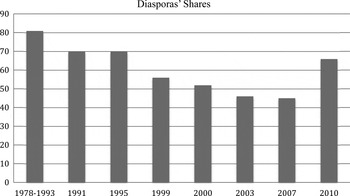
China is among the world's top recipients of FDI. During economic reform, the country opened to FDI relatively early. Internal diffusion of FDI liberalization was expansive and rapid. Figure 2 demonstrates that diaspora investors contributed the lion's share to total FDI inflows in China. From 1978 to 1993, by the number of firms, the share of diaspora investment was 81 percent. By FDI's volume, diasporas' share was 50 percent in 1985, 63 percent in 1990, and 70 percent in the mid-1990s.Footnote 5 Due to the Asian financial crisis (1997–1998) and China's WTO entry (2001), diaspora investment's shares fell to below 50 percent for a number of years, then rose again after 2008. In 2010, diaspora FDI constituted 66 percent of total FDI inflow.
The Predominance of Diasporas in China's FDI (Unit = %)

In short, Figure 2 demonstrates diaspora investors' overwhelming contributions to FDI inflows in China. It does not reveal diasporas' policy influence, or the mechanism of diffusion by diasporas. The following process tracing demonstrates that Chinese diasporas built policy networks at both national and local levels, their input helped initiate a national liberal FDI policy, and their involvement in implementation at the local level expanded internal diffusion.
CHINESE DIASPORAS HELPED INITIATE FDI POLICIES
When China's reform and opening began, the opening envisioned by policymakers was not FDI-led industrialization but rather what Nicholas Lardy (Reference Lardy1992) calls “socialist import substituting industrialization (SISI),” in which the government would encourage foreign loans, but not FDI, to boost the state-owned enterprises (SOEs) as main economic players. At the Communist Party Central Committee Work Meeting in November–December 1978, the leaders discussed development experiences abroad and deliberated various policy options.Footnote 6 They reached a consensus that FDI was “inappropriate” for China's development (Ye Reference Ye2009, Reference Ye2014). Following the work meeting, the government transferred foreign loans and imported technology meant for the use of SOEs. Around this time, diaspora entrepreneurs returned to their homeland. They influenced the beginning of FDI liberalization through the first EPZ (Shekou, early 1979) and the SEZ policy (1980).Footnote 7
In early 1979, Yuan Geng, head of China's Merchants' Group in Hong Kong, who had been born in Guangdong, proposed to establish an EPZ in Shekou to Zeng Sheng, chairman of Guangdong's Revolutionary Committee [gewuihui]. Together they advocated the EPZ idea to Minister of Communications Ye Fei, who was also a Guangdong native. The three policy advocates collectively sought approval from policy makers Gu Mu and Li Xiannian, who authorized Hong Kong businessmen to develop Shekou but warned that no central funds could be spent on the EPZ (Ju Reference Ju1998; Lu Reference Lu2000). Other diaspora investors were also brought to construct and invest in the Shekou EPZ.
Similarly, ideas from diaspora entrepreneurs also influenced the SEZ policy in 1980. Drafters of the SEZ policy, mostly local officials, correctly assessed that diaspora entrepreneurs would be the main investors in the proposed zones and held multiple meetings with representatives of diaspora businesses. They initially set the corporate tax rate in the zones at 33 percent, the same rate as the rest of the country. Diaspora representatives objected, and warned that if taxes in the SEZ were that high investors would not come. Instead, diasporas proposed 15 percent corporate tax (Li Reference Li2008). The drafters conceded. The SEZ policy was first applied to Shenzhen and was then expanded to other three SEZs in Southern China. In 1980, the SEZ policy was ratified by the National People's Congress (NPC) and became a national policy, although its application was bound to the SEZs.
The Shekou EPZ and the SEZ policy demonstrate that diaspora entrepreneurs provided ideas and incentives that served as essential “stimuli” for FDI liberalization in China (the term is borrowed from Solingen Reference Solingen2012). Yet national policymakers and proactive local officials were important. In the late 1970s, pro-growth policymakers restored and rebuilt ties with diaspora entrepreneurs. Lee Kashing, Y. K. Pao, Henry Fok, Stanley Ho, Gordon Wu, Ma Wangqi, and Tang Xiangqian, among others, visited Beijing in 1978 at the invitation of the Chinese government. Deng Xiaoping met them and solicited their advice.Footnote 8 In addition, the diaspora entrepreneurs built ties with local governments via donations as well as development contracts. Y. K. Pao donated funds to construct the first modern hotel in Beijing and a university in his birthplace in Zhejiang. Similarly, Lee Kashing provided funding for establishing a university in his birthplace in Shantou. Henry Fok constructed two modern hotels in Guangzhou. Gordon Wu built the country's largest power plant, which would supply 40 percent of electricity in Guangdong, in addition to constructing the Customs buildings and highways connecting the province and Hong Kong.
The above diasporas also served on the Chinese People's Political Consultative Conference (CPPCC), a policy organ that is at an equal rank as the NPC. From 1978 to 1983, Deng Xiaoping was chairman of the CPPCC, and he deepened ties between the diaspora entrepreneurs and policymakers. Deng Yingchao, who succeeded Deng Xiaoping as chairwoman of CPPCC from 1983 to 1988, was also open to diaspora influence. Throughout the 1980s, representatives of diaspora entrepreneurs held key positions in the CPPCC and their liberal economic ideas were incorporated into liberal policymaking. Y. K. Pao also served on the State Council and became a special advisor to General Secretary Zhao Ziyang on China's coastal development strategy (Li Reference Li2008).
In 1980, the State Council passed a regulation that allowed tax-exempt imports of equipment from diasporas to their relatives on the Mainland (up to $59,000 in 1981). This move accelerated the return and investments by smaller diaspora entrepreneurs in Southern China. With ancestral linkages in the area, these entrepreneurs set up factories to manufacture toys, textiles, and plastic flowers for export. By drawing on ideas, technologies, and markets from diaspora connections, private entrepreneurs, who had been eradicated under socialism, reemerged in Southern China. Diaspora entrepreneurs were common not only in the SEZs but also in other localities in Guangdong. They made Southern China highly successful and helped to spread the new policy in the country.Footnote 9
DOMESTIC OPPOSITION AND INTERNAL DIFFUSION
When China implemented the pro-FDI policy in the SEZs, the conservative faction in the Communist Party launched two campaigns against the new FDI policy: the “anti-spiritual pollution campaign” and “anti-bourgeois campaign” from 1982 to 1984. Deng Xiaoping conceded to pressures from the campaigns and reportedly maintained that the SEZs were only experiments that were allowed to fail. He further dictated that the pace of reform should be subject to the socialist “rectification” [zhengdun] campaign pushed by the opposition forces.
Diaspora entrepreneurs who visited Beijing during those years continued to transmit ideas in support of economic liberalization. More importantly, diaspora investments continued to flow into the SEZs and produced impressive economic successes there, thus enabling domestic advocates to praise the SEZs' achievements and spread the FDI policy in the country.
Faced with both criticism and praise, Deng Xiaoping toured Southern China for 27 days in 1984.Footnote 10 According to the daily accounts of Deng's activities, he was initially unsure of development in the SEZs, but his misgivings were soon dispelled. The high point of his tour was to the White Swan Hotel in Guangzhou, built by diaspora entrepreneur Henry Fok. Overlooking a newly built city, Deng was convinced of FDI's positive roles in development. He endorsed the SEZs during the remainder of his tour. When he returned to Beijing, he and other reformers expanded the four SEZs to 14 open coastal cities (OCCs).
In the late 1980s, the conservative opposition challenged FDI liberalization again, following the 1986 student demonstrations and removal of reformer Hu Yaobang and the 1989 Tiananmen crackdown and removal of reformer Zhao Ziyang. The latter crisis was particularly severe; liberalization was put on the back burner for three years. Deng Xiaoping made another Southern Tour in 1992. As in 1984, Deng's tour publicized the remarkable economic successes in the SEZs and rallied local governments' support for more FDI. The SEZs had been the envy of the nation, and local officials elsewhere had either channeled their resources there (Chan Reference Chan1985), or lobbied for similar FDI policies in their localities, or both. By contributing to the success of the SEZs, diasporas helped the expansive internal diffusion following Deng's 1992 Southern Tour.
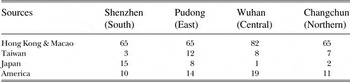
Diasporas' importance in the localities was compelling. Table 1 presents the sources of FDI in the four selected zones in 1993: Shenzhen, Shanghai (Pudong), Wuhan, and Changchun, representing four Chinese regions. Overseas Chinese overwhelmingly dominated investors from Japan and America, the two top investors in the world. Shenzhen had been a special zone since 1979. Pudong, approved in 1988, was the largest development zone in Shanghai. Diasporas contributed 65 percent of total FDI in these zones. They accounted for a staggering 90 percent in Wuhan in central China and 65 percent in northern Changchun.
FDI in China, by Region and Sources (%, 1993)

Data from: Zhongguo jingji tequ yu yanhai jingji jishu kaifaqu nianjian, 1993 (Beijing: Reform Publisher), 364–365; Wuhan Statistics Yearbook 1996 (Beijing: China Statistical Publishing), 359–360; Pudong Statistics Yearbook 1994 (Beijing: China Statistical Publishing), 139; Changchun Statistics Yearbook, 1994 (Beijing: China Statistical Publishing), 283.
Note: Japanese and American companies' investments in China via their Hong Kong subsidiaries were counted as Japanese and American FDI.
Interactions between local governments and diasporas were remarkable, and they expedited internal diffusion of FDI liberalization. In Shanghai in 1991, for example, at the invitation of Shanghai government, Tang Junnian, the chairman of Thompson Group who was born in Pudong, toured the new Pudong Development Zone and invested billions of dollars in Pudong and other parts of Shanghai in the early 1990s. In Kunshan, Taiwanese businessmen were the largest visitors in the early 1990s, taking up most of the hotel occupancies. Diasporas accounted for 12 of the 14 major foreign investment projects in Kunshan from 1992 to 1993.Footnote 11 When Kunshan received the authorization to establish an export-processing zone in 2000, 760 Taiwanese electronics makers were already operating there. By 2005, Kunshan had attracted one-tenth Taiwanese investment in China, mostly in electronics, making the small city a global hub of components manufacturing and exports.
To conclude this section, the process of FDI liberalization in China confirms the importance and conditions of diffusion by diasporas. First, diasporas transmitted liberal ideas and, with their resources, provided incentives for the initiation of FDI liberalization, as demonstrated in the Shekou EPZ and SEZ policy. Second, their involvement in the policy's implementation helped to create visible early successes in the zones. These compelling successes and intense interactions between diasporas and local governments enabled reformist policymakers to overcome opposition and therefore to achieve rapid internal diffusion of the new policy.
PROFESSIONAL DIASPORAS AND DELAYED DIFFUSION IN INDIA
In India, Prime Minister Rajiv Gandhi attempted external liberalization in 1984, and diaspora professionals returned to become policy advisors and economic bureaucrats in his cabinet. The diasporas had work and/or education experience in the advanced societies, either in the UK or the US. They included Montek Singh Ahluwalia, Manmohan Singh, Bimal Jalan, R. Venkitiraman, Jayanta Roy, Rakish Mohan, Shankar Acharya, Vijay Kelkar, Jairam Ramesh, Nitin Desai, and Madhur Srinivas. Some of them had served in the Indian government prior to 1980, but had been unsuccessful in promoting economic liberalism.Footnote 12 With Gandhi's support, these returned diaspora professionals, called the “lateral entrants” in the Prime Minister's Office and the Planning Commission, had stronger policy impact. Their roles continued after Mr. Gandhi's downfall in 1989 (Shastri Reference Shastri1997).
To elaborate, Rhodes Scholar Montek Singh Ahluwalia had strong influence on India's economic reform. An Oxford economics Ph.D., Ahluwalia worked for the World Bank and served in various capacities in the Indian government. In 1984, he was named Rajiv Gandhi's special secretary. Bimal Jalan another economist from Oxford, served as the prime minister's banking secretary. The most prominent diaspora, also an Oxford economics Ph.D., Manmohan Singh, was chairman of the Planning Commission. All these individuals continued to influence India's liberalization in the 1990s and beyond. Manmohan Singh became finance minister in 1991 and led the initiation of FDI liberalization in the early 1990s. He served as India's prime minister from 2004 to 2014, unfortunately a decade of relative inaction on economic liberalism.
Many US-trained Indian diasporas returned to work in policy inner circles. R. Venkitiraman, who was educated in the US and had worked at the World Bank, became finance secretary. Jayanta Roy, Rakish Mohan, Vijay Kelkar, Jairam Ramesh, Nitin Desai, Shankar Acharya, and Madhur Srinivas had all received education in the US and had experience working for the World Bank. Like Ahluwalia and Singh, these individuals continued to influence India's reform after Rajiv Gandhi's downfall in 1989.
Entrepreneurial diasporas also returned to India in the mid-1980s, but the number was small. Sam Pitroda, who had founded a successful business in America, returned in 1984 and helped build India's telecommunications industry. Raman Roy returned in the same year as the on-site manager for American Express. Such US-based entrepreneurs became more salient in the 1990s, particularly in software services and financial services.
The 1980s liberal initiation was not successful. A drastic opening came only in 1991, led by Manmohan Singh after a devastating debt crisis. Singh was favorable toward diaspora investment and provided more favorable terms to diaspora investments. Singh was also responsive to suggestions made by diaspora entrepreneurs. In 1991–1992, while visiting Thailand and Singapore, he listened to diaspora entrepreneurs there and returned to ease the preexisting restrictions and facilitate diaspora investments (Venkitaramanan Reference Venkitaramanan2003).
Unfortunately, such ideational diffusion took place mostly at the national level. Local governments were not included in the pro-FDI networks, and domestic companies were largely opposed to FDI. Furthermore, implementation of the new policy produced limited success at the national and local levels. By the late 1990s, the national government conceded to domestic opposition and imposed new restrictions on FDI.
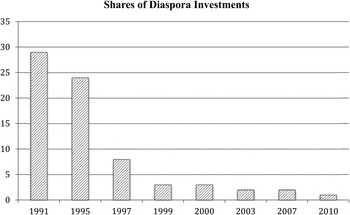
Over time, India's large population and market potential attracted Western investors. Via diaspora professionals' help, they formed alliances with Indian domestic business. Domestic companies, who needed new technology and capital to compete in the domestic market and expand abroad, welcomed such global partnership. The support for NRI investment did not revive, however. Figure 3 demonstrates that the shares of diaspora investments in India's total FDI, quite salient in the early 1990s, had declined sharply since the mid-1990s.
The Declining Importance of Diaspora Investments in India (Unit = %)

In 1991, diaspora investment accounted for 29 percent of FDI in India. In 1995, the share declined but was still 24 percent. Thereafter, the salience of diaspora investment dissipated rapidly. In 1997, the share was 8 percent; in 1998 and 1999, the share was 3 percent. From 2000 to 2010, diaspora investments have not exceeded 2 percent of annual FDI inflows in India.
Comparing Figure 3 with Figure 2, it is obvious that China has attracted a lot more diaspora investment than India during its reform. Such gaps are understandable, given that overseas Chinese were among the major business forces during the high-growth period in Asia Pacific. It is puzzling, however, that the diasporas' shares in India had declined so rapidly since the mid-1990s. Here politics and policies of FDI in India were partly responsible.
Mentioned earlier, finance minister Manmohan Singh was responsive to diaspora entrepreneurs' concerns in the early 1990s. During the mid-1990s, Indian business and the Leftists opposed FDI in the country. At the end 1990s, the national government adopted restrictive policies toward FDI. Diaspora investors were adversely affected, while Western MNCs who formed alliances with domestic companies were less deterred. In 2003, at the first Indian Diasporas Day (Pravasi Bharatiya Divas), co-organized by the government and domestic business associations, Prime Minister A. B. Vajpayee remarked, “We do not want your investment; we want your ideas. We do not want your riches; we want the richness of your experience.”Footnote 13
LIBERAL INITIATION AND LIMITED DIFFUSION
The Chinese FDI liberalization demonstrates that expansive internal diffusion, following limited national adoption, made the country highly attractive to foreign investors. 1980s India demonstrates that while the Rajiv Gandhi administration attempted national adoption, it reversed the measures during internal diffusion. The 1990s showed the third pattern of internal diffusion. The national government, prompted by the 1991 debt crisis, launched a major liberalization toward FDI. During internal diffusion, implementation of the measures was limited and new restriction was introduced. What we observe was truly partial internal diffusion. India remained much behind China in attracting FDI in the 2000s.
Comparing China and India's diffusion by diasporas, there were two similarities and three differences. In both countries, diasporas helped the initial adoption of FDI liberalization and they were also similar in that there had been considerable domestic opposition to FDI in both countries. The differences were three-fold: First, entrepreneurial diasporas in China provided significant resources, while professional diasporas in India had plenty of ideas but few resources. Second, Chinese diasporas had multi-level linkages at home and worked with policymakers and local governments. India's diasporas had few ties outside the national government. Third, early success, helped by diaspora entrepreneurs, was compelling during implementation of liberalism in China, but unclear in India. These differences were critical to divergent internal diffusions and complemented with political factors identified by Kohli (Reference Kohli1989, Reference Kohli2012), Bardhan (Reference Bardhan1999), and Kochanek (Reference Kochanek1995).Footnote 14
Coming back to the mid-1980s, Rajiv Gandhi was elected the Prime Minister and invited many diaspora professionals to serve in his cabinet. These diasporas-turned-bureaucrats drafted the 1985 Union Budget and included external liberalization.Footnote 15 The diaspora professionals had few ties outside of the national government, however. Domestic oppositions rose against the 1985 Budget. The first opposition came from the public sectors. In 1986, the opposition succeeded in pressuring the government to re-prioritize the public sectors. The main opposition to external opening came from private domestic producers, who were concerned about competition from foreign investments and foreign goods. They specifically argued against FDI: “After three decades of highly protected industrialization, liberalization cannot be taken up simultaneously on all fronts—it has to be phased in. The first stage has to be to allow domestic competitiveness. Only then, should we open up to outside forces” (Kohli Reference Kohli1989, 317).
Furthermore, while the diaspora professionals had abundant policy ideas, they did not possess resources that would help implement the new policy. As the 1985 Budget was in effect, India experienced unprecedented trade deficits. Investment flows were volatile. In other words, early success was lacking. Many began to question the soundness of external liberalization.Footnote 16 In May 1987, Rajiv Gandhi conceded to these concerns and passed a new industrial policy that detailed measures to promote private business and reduce government regulation, yet had no mentioning of external liberalization, which was a policy direction spelled out in the 1985 Union Budget.
Moving to the 1990s, the Congress Party came to power in June 1991, in the midst of a severe crisis. Using the crisis, the new government passed a new industrial policy that included extensive measures to welcome foreign direct investment. Policies governing diaspora investors were even more favorable, allowing diasporas to hold equity shares of 100 percent in selected sectors. Liberalization continued in the early 1990s. By 1994, the government offered automatic approval to foreign equity shares of up to 51 percent. Over 51 percent foreign equity shares were allowed in specific sectors. In the new software technology parks (STPs) and electronics hardware technology parks (EHTPs), foreigners could hold 100 percent equity and pay no import duties, provided that foreign exchange balances were maintained.Footnote 17
Disjuncture between national adoption and internal diffusion again developed in the 1990s. Once the government announced the 1991 policy, domestic opposition was strong. Senior Communist Party leader E. M. S. Namboodiripad criticized the government saying that it was like “a thirsty man taking a cup of poison” (Bajpai Reference Bajpai1992, 211). Renowned businessman K. K. Birla publicly opposed the increase in the foreign-equity cap to 51 percent.Footnote 18 Business representatives formed the Bombay Club in 1993 to rally opposition against FDI liberalization in the country. Like in the 1980s, economic gains were not compelling in the 1990s. Current accounts and trade deficits both worsened.Footnote 19
Furthermore, there had been little ideational diffusion to the local governments. Local politicians generally had limited incentives and expertise to carry out the newly adopted policies. Frustrated, Finance Minister Singh remarked, “[r]eform does not mean announcing a new policy and sitting back but involves working out the nuts and bolts of wide-ranging political initiatives and examining the various alternative sectorial policies. In India, there were not enough people of the right type to do this” (Roy Reference Roy1994, 201). Economic frustration grew in the country. Actual policy liberalization was limited. In 1996, a World Bank study (1996) characterized India as “moderately indebted” and “beyond investment grade.”
Lack of visible success led many in India, including those previously supportive of FDI liberalization, to turn skeptical of FDI. The government policy in turn became more restrictive. On May 2, 1998, BJP Prime Minister Vajpayee officially adopted a “carefully calibrated approach” to globalization and pledged to guard against FDI's negative impacts in the country. In December 1998, the BJP government passed a referendum, Press Note No. 18, requiring that foreign firms wishing to set up new Indian operations must obtain a “no-objection” certificate from all their Indian partners. In practice, foreign investors were pressured to team up with domestic companies and thus give indigenous businesses a check on FDI's entry and operation in India. Diaspora investment in India was already in decline before 1998 and fell even more sharply now.
To summarize, the process tracing shows that professional diasporas had a strong impact on the new national policy in India. Yet compared to China, sub-national ties between diasporas and local governments were limited. And professional diasporas did not bring sufficient resources to produce early success. Thus despite top-level consensus on liberalization, the ideas and incentives of local governments and companies did not change. After each liberal policy adoption, domestic opposition used India's democratic institutions, such as the press and industrial associations, to oppose FDI liberalization. When a different kind of diasporas emerged in the software services industry and transferred ideas and resources from the global market to local governments and companies, FDI liberalization in this sector followed expeditious diffusion, similar to that in China.
Analysis of the software serves three purposes. First, Indian diasporas' contribution confirms diasporas as diffusers of ideas and resources from the outside world to their homeland. Second, it demonstrates that diffusion by diasporas also works in India's political system. Thus, the political system itself is not against FDI liberalization, but ideas and incentives constituting the system decide whether there is effective liberalization. Third, the analysis supports the finding from China that entrepreneurial diasporas, by providing incentives to domestic companies and local governments, can expedite and expand the internal diffusion of liberalization.
DIFFUSION BY DIASPORAS IN INDIA'S SOFTWARE SERVICES
Growth of India's software services has been extraordinary. The industry barely existed before 1990 and grew to occupy a 1.7 percent of GDP in 2000/2001 and 3.5 percent in 2007/2008. In 2011, revenue from the sector accounted for seven percent of GDP and the sector constituted 26 percent of merchandise exports.Footnote 20 Biao Xiang (Reference Xiang2007), Anna-Lee Saxenian (Reference Saxenian2005), and Devesh Kapur (Reference Kapur2010) have noted the important roles that the US-based Indian diasporas played in the sector's growth and globalization. The analysis here shows that diaspora entrepreneurs returned and transferred ideas to both policymakers and domestic entrepreneurs and helped the country initiate FDI liberalization. Then, diasporas connected domestic business with global markets and resources and helped them benefit from globalization. Success in software brought local governments and industrial associations to fully support FDI in this sector. Unlike India in general, internal diffusion in software was rapid.
India's software development began in 1984, when Rajiv Gandhi appointed diaspora entrepreneur Sam Pitroda as Telecommunications Minister. While external liberalization was generally abandoned in 1987, telecommunications was developed in India. Along with launching the 1991 industrial policy, the government set up STPs and EHTPs that provide tax incentives and higher foreign equity shares to investors than elsewhere in the country.Footnote 21 In 1992, Minister of Science and Technology P. R. Kumaramangalam announced that, in addition to preferential taxes, imports, and equity policies, any foreign company wishing to set up an EHTP unit would be able to obtain all the required clearances (including for land use) within two weeks.Footnote 22 Infrastructure, in terms of roads, office buildings, electricity, and water supplies, was better in these parks than elsewhere.
FDI liberalization in the software sector further expanded in the latter half of the 1990s, as the government reduced duties on electronics products and simplified the approval process for foreign investments. Tariffs were reduced, and the directors of the STPs and EHTPs gained more power to approve projects. In 2002, internal diffusion also led to more liberalization in India's computer hardware (Ye Reference Ye2014).
Different from other sectors, entrepreneurial diasporas were abundant in software services. They circulated both ideas and resources to policymakers, local governments and entrepreneurs, forming multi-level linkages. Saxenian (Reference Saxenian2005) summarizes three types of connections and circulations that India's software industry established with the outside world. First, Indian entrepreneurs in Silicon Valley tapped into cheap labor at home and outsourced labor-intensive software services to India. Second, indigenous firms, such as WIPRO and Tata Consultancy Services (TCS), drew on resources and collaboration with diasporas located in Silicon Valley. Third, a new generation of transnational investors emerged in Bangalore and spread ideas, practices, and capital between India and the world.
Diasporas were also instrumental to Western MNCs that made investments in India. In 1984, when American Express invested in India, it hired Raman Roy to be the on-site manager. In 1995, Pramond Bhasin and Nigel Andrews at General Electric (GE) proposed to CEO Jack Welch to set up captive back-office operations in India. They executed GE's efforts to establish GE Capital International Services (GEcis) in Gurgaon and in 1997 hired Raman Roy as GEcis's CEO. Under Roy, GEcis grew rapidly and by 2000 it had hired over 10,000 people and had large facilities in Gurgaon, Hyderabad, and Bangalore. Similarly, Pulak Prasad and Dalip Pathak, working at New York-based Warburg Pincus, were responsible for the largest and most successful venture capital investment in India. Prasad and Pathak not only injected funds into India's IT company, Bharti Enterprises, but also, by working with Bharti's management team, led the company's global expansion.
Other entrepreneurial diasporas, leveraging on skills, funds, and markets they had acquired in the United States, returned to India to start new businesses, often with local partners. Sanjeev Agarwal, formerly a technician at Motorola, and Pavin Vanish, a private entrepreneur in India, founded Daksh in 1999. Their initial funds came from venture capital CDC that was controlled by an Indian diaspora. Drawing on Amazon's outsourcing services, Daksh took off and led to the birth of email-based outsourcing business in India.Footnote 23 In 2004, when IBM was expanding to India, it acquired and made itself a major player in the country, with 15,000 employees.Footnote 24
In software services, domestic players are influential, but they rarely oppose FDI. Indeed, in this sector, diasporas have helped domestic industries grow and succeed in the world market. TCS, a subsidiary of India's most prominent business house, the Tata Group, has drawn on the diasporas' help since the 1970s and grew rapidly, by relying on services exports to the US. TCS was so successful that it transformed the Tata Group's stance on liberalization and globalization (Khanna, Palepu, and Bullock Reference Khanna, Palepu and Bullock2009). Another services provider, WIPRO came into being in the late 1970s and boosted its technology and business by setting up offices in Silicon Valley. Infosys, a new company in the 1980s, grew from sending on-site technicians to work at American companies, commonly known as IT “body shopping.” The connections that Infosys built with diasporas and Western MNCs made the company the largest software services exporter in India, with three-quarters of its revenue coming from the US (Martinez-Jerez, Kaplan, and Miller Reference Martinez-Jerez, Kaplan and Miller2009).
Furthermore, industrial associations have been supportive of liberalization in software services. The National Association of Software and Services Companies (NASSCOM) consistently lobbied central ministries, politicians, and local officials to support the establishment of STPs and EHTPs in India.Footnote 25 As computer hardware was important to the growth of software outsourcing industries and yet was subject to investment and import restrictions, NASSCOM successfully influenced the government to ease the restrictions in the early 2000s. The growth of NASSCOM testifies to the astronomical gains in the software industry. The association had only 38 members in 1988, but membership increased to 850 in 2001, among which one-fifth were foreign companies. In 2013, NASSCOM had more than 1,500 members.
The Confederation of Indian Industry (CII) is a leading association that covers all industries. It has over 7,200 direct members and over 10,000 indirect members. Since the 1980s, CII has strongly advocated liberalization and “global linkages” in India's informatics. In 2002, CII urged the Indian government to adopt the global patent regime and provide patents for all inventions, especially computer software, so as to make the software sector more attractive to foreign investors. Yet in other sectors, CII's policy stances were similar to those of other industrial associations, such as the Federation of Indian Chambers of Commerce and Industry (FICCI) and the Associated Chambers of Commerce and Industry of India (ASSOCHAM), both known for protectionist advocacy on behalf of domestic business.
Local governments had been largely missing in liberalization in other sectors. They nevertheless supported FDI in software services. In Punjab, the local government provided software with the best available infrastructure. The Rajasthan government set up an EHTP at Kukas electronics city. Even the socialist West Bengal government encouraged the establishment of large IT complexes to ensure that the industry occupies a prominent place in the state economy.Footnote 26 Starting in the late 1980s, Andhra Pradesh (AP), with significant diasporas in IT services, branded itself as a destination for FDI in software services. Going beyond ordinary STP and EHTP incentives, AP bestowed ten-year tax holidays and other incentives on foreign companies in its capital city Hyderabad as well as an assured supply of power. The efforts to attract FDI in IT made AP the freest economy in India in 2009 (Debroy et al. Reference Debroy, Bhandari and Anklesaria2011).
Diffusion by diasporas in India's software services is similar to that in China, but different from the partial diffusion in India's other sectors. In software, ideational diffusion was multi-level: national and local. Policymakers, domestic companies, and local governments were all supportive of liberalization in this sector. Second, development success was compelling. With the help of Indian diasporas, software services provided quick returns to domestic companies and local governments, who therefore embraced diaspora (and foreign) investors. Third, Indian diasporas in software services included both professionals and entrepreneurs. The professionals at Western MNCs orchestrated foreign investments and connected indigenous companies with global markets. The entrepreneurs were quick to recognize and fill India's market niches in software services. In short, when diasporas transmit Western ideas and global resources to their homeland, they are more likely to help their homeland government initiate liberalization and produce convincing success that propels internal diffusion.
CONCLUSIONS
Diffusion scholars in IPE have rightly emphasized the importance of external ideas and resources to the liberal policy adoption in the developing countries. There remain two gaps in the literature. First, the literature has not spelled out diffusers—who are the actors that transfer external policy ideas and via what channels. Second, it has not taken into account the importance of internal diffusion. Indeed, divergent internal diffusion sets China's FDI liberalization apart from India's. Diaspora diffusers are more suited to help internal diffusion, due to their shared ethnicity and social norms with local governments and companies.
While this article centrally emphasizes the utility and conditions of diffusion by diasporas, diasporas are not miracle workers. Their salience in China was facilitated by historical and political dynamics in the country. On the one hand, socialist China eliminated the capitalist class and enhanced local governments' development propensity. Thus when reform began, both policymakers and local governments embraced diaspora entrepreneurs rapidly. On the other hand, reformist China adopted fiscal decentralization to enhance the power and incentives of local governments to pursue economic growth. This fiscal policy intensified collaboration between diaspora entrepreneurs and local governments throughout the reform period.
India, by contrast, had strong domestic capital that resisted FDI liberalization. And local politicians were used to central transfers for local development and did not become policy advocates for FDI either. Furthermore, in 1996 and 2004, national elections voted out two more or less reformist governments. The subsequent government became highly reluctant to pursue drastic liberalization. Despite such history and politics, in India's software sector, entrepreneurial diasporas formed multi-level linkages at home, brought ideas and resources, and contributed to early success during implementation. In this sector, FDI liberalization followed the speedy diffusion by diasporas model as in China.