Introduction
Lithium remains a highly effective treatment for bipolar disorder (Yatham et al., Reference Yatham2013). It is useful in mania and is believed to prevent long-term manic and depressive relapse better than other agents (Geddes et al., Reference Geddes2010; Simhandl et al., Reference Simhandl, Konig and Amann2014). Although other pharmacological agents can be helpful in bipolar disorder, including in acute bipolar depression (Yatham et al., Reference Yatham2013; Selle et al., Reference Selle, Schalkwijk, Vazquez and Baldessarini2014), up to 30–40% of patients may respond better to lithium than to alternative medications (Geddes et al., Reference Geddes2010; Grof, Reference Grof2010).
Despite lithium's effectiveness, it also has the potential for adverse effects such as renal disease, hypothyroidism, hyperparathyroidism, weight gain, and fine tremor (McKnight et al., Reference McKnight, Adida, Budge, Stockton, Goodwin and Geddes2012). Because of this increased risk and concern for drug interactions (Ghose, Reference Ghose1991), many psychiatrists avoid prescribing lithium, especially in older adults (Shulman et al., Reference Shulman2003). Interestingly, these effects often appear as a consequence of normal aging and medical comorbidity present in bipolar disorder rather than being caused by lithium itself (Rej et al., Reference Rej, Elie, Mucsi, Looper and Segal2015). Also, certain effects are seen in alternative pharmacotherapies (e.g. weight gain) (Dols et al., Reference Dols2013). Still, the general opinion about lithium is negative amongst clinicians (Strejilevich et al., Reference Strejilevich2011). This has contributed to less than 8% lithium prescription rates of bipolar disorder in North American patients (Carney and Goodwin, Reference Carney and Goodwin2005) compared to 30%–55% rates seen in Europe and worldwide (Hayes et al., Reference Hayes2011; Kessing et al., Reference Kessing, Hellmund, Geddes, Goodwin and Andersen2011; Renes et al., Reference Renes, Regeer, van der Voort, Nolen and Kupka2014). Because of the importance of the therapeutic alliance and clinicians’ support in maintaining patients’ positive attitudes towards bipolar treatment (Pompili et al., Reference Pompili2013; Chang et al., Reference Chang, Sajatovic and Tatsuoka2014), clinicians’ negative attitudes could translate into poor patient attitudes towards lithium.
Since patients’ negative attitudes towards lithium pharmacotherapy are closely associated with reduced adherence and bipolar disorder relapse (Rosa et al., Reference Rosa, Marco, Fachel, Kapczinski, Stein and Barros2007; Arvilommi et al., Reference Arvilommi, Suominen, Mantere, Leppamaki, Valtonen and Isometsa2014), this is potentially concerning. Amongst a variety of reasons for bipolar pharmacotherapy non-adherence such as illness severity, poor insight, poor therapeutic alliance, cognitive dysfunction, and other comorbidities (Pompili et al., Reference Pompili2013), one of the primary reasons for lithium non-adherence is adverse effects (73%), which is not the case for other bipolar medications (Arvilommi et al., Reference Arvilommi, Suominen, Mantere, Leppamaki, Valtonen and Isometsa2014). It is not known, though, whether negative pharmacotherapy attitudes are more frequent amongst lithium users in late life, a time when adverse medication effects become increasingly common (Dols et al., Reference Dols, Rhebergen, Beekman, Kupka, Sajatovic and Stek2014; Rej et al., Reference Rej2014). To the best of our knowledge, older patients’ attitudes towards lithium have not been investigated.
In this paper, we hypothesize that lithium use is independently associated with negative attitudes towards psychotropic pharmacotherapy in a Dutch sample of older adults diagnosed with bipolar disorder.
Methods
Study design
This was a cross-sectional study of 78 patients aged >60 years with bipolar disorder from a psychiatric catchment area in the new western and southern district of Amsterdam, the Netherlands, a geographically well-defined urban area comprising 18.4 % of Amsterdam's total population. Of all catchment area inhabitants, 27,199 (19.8%) were aged 60 years and over on January 1, 2012. Using an electronic record system, we included all 139 patients in the catchment area identified as having a diagnosis of bipolar disorder by their clinician. Of these, 25 were not eligible due to exclusion criteria: having an actual diagnosis other than bipolar disorder during our screening procedure (n = 10, please see Demographic and Clinical Characteristics), inability to communicate in Dutch or English (n = 1), a concurrent diagnosis of mental retardation (n = 4), dementia (n = 8), or highly unstable psychiatric status (n = 1, e.g. currently in a compulsory psychiatric admission). An additional 13 patients refused to provide consent and 23 declined participation in study interviews, consenting only to medical record review. This left 78 patients who provided written consent for complete study interview. The study was approved by the Medical Ethics Committee of the VU University Medical Center, Amsterdam, the Netherlands. The study's full methodology has been previously described (Dols et al., Reference Dols, Rhebergen, Beekman, Kupka, Sajatovic and Stek2014).
Demographic and clinical characteristics
Characteristics potentially affecting patients’ attitudes towards psychotropic pharmacotherapy were recorded, including age and sex. DSM-IV TR bipolar diagnosis and subtype was confirmed using the Mini International Neuropsychiatric Interview Plus (MINI), a structured diagnostic interview that assesses psychiatric patients’ diagnoses according to DSM-IV and ICD-10 criteria (Sheehan et al., Reference Sheehan1998; van Vliet and de Beurs, Reference van Vliet and de Beurs2007). Duration of illness and number of psychiatric admissions was assessed by psychiatric interview and medical record review. Mania symptoms were ascertained using the Young Mania Rating Scale (YMRS), an 11-item clinician-rated scale, with scores ranging 0–60, and a score of ≤12 indicating symptomatic remission (Young et al., Reference Young, Biggs, Ziegler and Meyer1978). Depression symptoms were examined using the Center for Epidemiologic Studies Depression Scale (CES-D), a 20-item self-report scale, with scores ranging 0–60, and a score of ≤12 indicating symptomatic remission (Radloff, Reference Radloff1977). Subjective overall quality of life was assessed using the Manchester Short Assessment of Quality of Life (MANSA) (Priebe et al., Reference Priebe, Huxley, Knight and Evans1999), a brief 12-item instrument for assessing quality of life. Current somatic complaints and somatic history (e.g. hypertension, diabetes) were obtained during a structured interview (Kriegsman et al., Reference Kriegsman, Penninx, van Eijk, Boeke and Deeg1996). Cognition was evaluated through the Mini-Mental State Examination (MMSE), a clinician-rated scale scored 0–30, with scores <24 highly specific for dementia (Folstein et al., Reference Folstein, Folstein and McHugh1975). Patient's psychiatrists assessed global social and occupational functioning on a scale of 0–100 using the Social and Occupational Functioning Assessment Scale (SOFAS) (American Psychiatric et al., Reference American Psychiatric, American Psychiatric and Task Force on2000). The presence of self-reported “severely-experienced” lithium-associated adverse effects was based on a previously developed tool (Wilting et al., Reference Wilting, Heerdink, Mersch, den Boer, Egberts and Nolen2009). Patients were asked in which capacity (none, slightly, moderately, severely), the following effects were experienced: headache, dizziness, fatigue, blurry/double vision, trouble concentrating, memory problems, nausea, diarrhea, appetite changes, dry mouth, thirst, polyuria, constipation, sexual dysfunction, sweating, tremor, muscle weakness, and coordination problems. Side effects self-reported as “severe” may not necessarily have been disabling.
Outcomes
Our main outcome was a well-validated measure of patients’ attitudes towards pharmacotherapy, the DAI-10 (Awad, Reference Awad1993). It included ten true/false questions such as “For me, the good things about medication outweigh the bad,” “Medications makes me feel tired and sluggish,” with some items reverse-scored. The DAI-10 is scored from 0 to 10, with higher scores indicating more positive attitudes towards psychotropic pharmacotherapy.
Statistical analysis
Demographic and clinical characteristics were described (mean, standard deviation, %). Bivariate associations between lithium use and demographic/clinical variables were assessed using χ 2 for binary variables, T-test for normally distributed continuous variables, and Mann–Whitney U tests, as appropriate.
To determine whether there was a significant difference between lithium and non-lithium patients in drug attitudes, we performed Analysis of Variance and Co-Variance (ANCOVA). Differences on relevant clinical and demographic variables between lithium and non-lithium users were entered as covariates to see if these may have had an effect.
Additionally, bivariate linear regression between number of severe adverse effects and DAI-10 scores was performed amongst lithium users, to see if these had an impact on drug attitudes in the lithium sample. Adverse effect data unfortunately were not available in non-lithium users. A two-tailed p < 0.05 was considered significant.
Results
Demographic and clinical characteristics
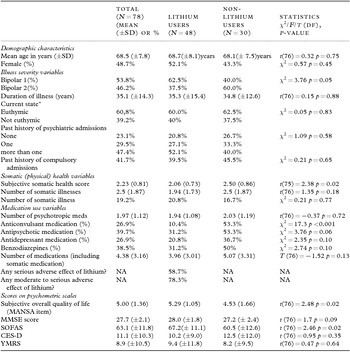
There were 48 lithium users and 30 non-users (using anticonvulsants and other agents). Lithium users had higher rates of type-I bipolar disorder, but better subjective quality of life, and somatic health, as well as social functioning (SOFAS) (Table 1).
Differences between lithium and non-lithium users in an out-patient sample of geriatric bipolar patients

Abbreviations: MMSE: Mini-Mental state examination, SOFAS: Social and Occupational Functioning Assessment Scale.CES-D: Center for Epidemiologic Studies Depression Scale, YMRS: Young Mania Rating Scale.
MANSA: Manchester Short Assessment of Quality of Life.
N.B. A euthymic state was defined as having both a YMRS ≤ 12 and a CES-D ≤12. Being “not euthymic” was defined as having a score of >12 on either the CES-D or the YMRS, or on both.
Adverse effects in the lithium sub-sample
Amongst lithium users, 58.7% reported at least one severely rated adverse effect. Over 78% reported at least one moderate to severely rated adverse effect, the most common being polyuria (42.6%), thirst (40.4 %), tremor (31.9%), and fatigue (25.5%). The mean number of moderate to severely rated adverse effects was 3.4 (SD 2.6).
Attitudes towards bipolar pharmacology (DAI-10) and correlates
Compared with non-lithium users, lithium users had more positive attitudes towards psychotropic pharmacotherapy (mean DAI-10 Score 6.0 (±2.8) vs. 3.9 (±4.6), (t (74) = 2.6, p = 0.01).
In ANCOVA analyses comparing lithium with non-lithium users, this significant difference in DAI-10 scores was confirmed, even when controlling for the difference in distribution of bipolar subtype, and the difference in subjective somatic health, subjective quality of life, and global social functioning between both groups (F (1, 69) = 7.62, p = 0.007). As well, lithium use was associated with higher DAI-10 scores, independently of euthymic versus not-euthymic state.
Amongst lithium users (n = 48), there was no significant relationship between the number of self-reported moderate to severely rated adverse effects and DAI-10 scores (β = 0.03, p = 0.84).
Discussion
This is the first study to demonstrate that geriatric bipolar patients on lithium have more positive attitudes towards their psychopharmacological treatment than counterparts using alternative medications. These attitudes appear independent of higher rates of type-I bipolar disorder and lower somatic comorbidity in lithium users. Furthermore, drug attitudes in geriatric bipolar patients on lithium seem to be unrelated to the presence of self-reported adverse effects. This contrasts with previous perspectives regarding patients’ attitudes toward mood stabilizers. For instance, Kessing et al. showed that depressed and bipolar disorder patients had negative views on mood stabilizer use, including lithium (Kessing et al., Reference Kessing, Hansen and Bech2006), although in that sample most of the largely non-geriatric patients were not currently using mood stabilizers.
Our study also shows that older lithium users report better subjective somatic health, even though more than 50% of them report having significant adverse effects. In a sense, our findings are counterintuitive, since medication adverse effects are usually correlated with negative attitudes toward medication and poor adherence (Arvilommi et al., Reference Arvilommi, Suominen, Mantere, Leppamaki, Valtonen and Isometsa2014). The positive effects of lithium treatment may have outweighed medication adverse effects. Similarly, the positive attitudes of treating physicians in the Netherlands, where most patients with bipolar disorder are prescribed lithium, may have had an impact on positive patient attitudes.
This suggests that our sample consisted mostly of lithium users who were physically well enough to be continued on lithium by their physicians. It is possible that in the 30–40% of bipolar disorder who respond preferentially to lithium (Geddes et al., Reference Geddes2010), lithium's considerable benefits on mental health may outweigh its negative aspects (Miura et al., Reference Miura2014), thereby leading to better medication attitudes. Future studies could assess whether positive medication attitudes lead to improved treatment adherence as an additional mechanism for reduced bipolar disorder relapse in lithium users (Geddes et al., Reference Geddes2010).
The possible reasons for the association between lithium use and more positive bipolar drug attitudes have interesting implications for future research and eventual knowledge translation into clinical practice. If patients’ attitudes and choice of lithium are based on clinicians’ positive attitudes (clinicians in our Dutch sample had very positive attitudes compared to some North American samples (Baldessarini et al., Reference Baldessarini, Leahy, Arcona, Gause, Zhang and Hennen2007), then the effects of greater clinician education around lithium prescribing should be investigated. If capacity for tolerating severe side effects is what might separate lithium users from non-users, then patient support for side effects might be important. If attitudes toward medications are a product of long-term lithium use and benefit, then “success stories” may help navigate consumers towards lithium.
Limitations
There are limitations of this study. Our cross-sectional design made causation difficult to assess. Our sample size was modest, but nonetheless adequate compared to other studies in late-life bipolar disorder. Because of the modest sample size, it was difficult to control for α-inflation, but we used a pre-specified hypothesis and multivariate analyses in our attempt to prevent a false-positive result. In lithium users, duration of lithium use and reason for using lithium (aside from bipolar disorder) were not available. For the non-lithium user group, subjective adverse effect data and previous history of lithium intolerance were not available, making it difficult to assess whether medication intolerance contributed to the more negative drug attitudes in the non-lithium users. A higher proportion of non-lithium users had bipolar disorder type II, which is sometimes associated with harder-to-treat depression (Selle et al., Reference Selle, Schalkwijk, Vazquez and Baldessarini2014) and can thus theoretically affect drug attitudes. However, depression (CES-D) scores did not differ between lithium/non-lithium groups, and bipolar disorder subtype did not independently predict medication attitudes.
Conclusions
Despite considerable adverse effects, older lithium users with bipolar disorder maintain a more positive attitude toward psychotropic pharmacotherapy compared to non-lithium users.
Conflicts of interest
None.
Description of authors’ roles
S. Rej co-designed the research question and statistical analysis plan, and wrote the paper. J. Schuurmans was responsible for statistical design of the study, conducted the statistical analyses, and critically reviewed all drafts of the manuscript. M. Stek, D. Elie, and K. Shulman contributed to formulation of the research question and statistical design, and contributed significantly to the writing of the manuscript, reviewing all drafts. A. Dols designed and conducted the parent study, was involved in data collection, co-designed the research question and statistical analysis plan, and critically reviewed all manuscript drafts.
Acknowledgments
Soham Rej has received training and salary support from the Canadian Institutes of Health Research (CIHR) and the Fonds de Recherche Quebec – Santé (FRQS). No specific funding was received for this study.