Introduction
Tomato production is economically important in Florida. In 2015, approximately 0.48 million kg of fresh tomato was harvested from 13,030 ha (USDA-NASS 2019). Purple nutsedge and yellow nutsedge (Cyperus esculentus L.) are troublesome weed species in tomato in Florida (Van Wychen Reference Van Wychen2016; Webster Reference Webster2010). Polyethylene mulches do not adequately control nutsedges, because the plant’s pointed shoot tips allow them to pierce through the mulch. Under polyethylene mulch, purple nutsedge can propagate rapidly (Stoller and Sweet Reference Stoller and Sweet1987; Wills Reference Wills1987). Webster (Reference Webster2005a) reported that one purple nutsedge tuber under polyethylene mulch resulted in 22.1 m2-patch with 3,440 shoots within 60 wk.
Multiple factors, such as nutsedge density and timing of competition, could influence tomato yield (Morales-Payan et al. Reference Morales-Payan, Santos, Stall and Bewick1997, Reference Morales-Payan, Stall, Shilling, Charudattan, Dusky and Bewick2003; Motis et al. Reference Motis, Locascio and Gilreath2001; Shrestha and Grantz Reference Shrestha and Grantz2005). Moreover, the allelopathic potential of nutsedge on various crops has been documented (Alsaadawi and Salih Reference Alsaadawi and Salih2009; Chivinge Reference Chivinge1985; Drost and Doll Reference Drost and Doll1980). Alsaadawi and Salih (Reference Alsaadawi and Salih2009) reported that purple nutsedge root exudates reduced cucumber (Cucumis sativus L.) and tomato growth, and its residues significantly inhibited cowpea [Vigna unguiculata (L.) Walp.], sorghum [Sorghum bicolor (L.) Moench], and soybean [Glycine max (L.) Merr.] seedling growth. In field conditions, Boyd and Reed (Reference Boyd and Reed2016) found that a density of 20 purple nutsedge shoots m−2 at the time of transplant did not affect strawberry [Fragaria × ananassa (Weston) Duchesne ex Rozier] yield. However, under greenhouse conditions, Morales-Payan et al. (Reference Morales-Payan, Santos, Stall and Bewick1997) observed that purple nutsedge at 200 shoots m−2 resulted in 44% yield reduction in tomato.
Several PRE herbicides, including fomesafen, sulfentrazone, and S-metolachlor, are registered for use in tomato (Boyd et al. Reference Boyd, Kanissery and Dittmar2019; Mohseni-Moghadam and Doohan Reference Mohseni-Moghadam and Doohan2017a; Shaner Reference Shaner2014). PRE herbicides applied under polyethylene mulch may reduce the need for in-season weed control (Boyd Reference Boyd2015). However, studies have documented the inconsistent control by these herbicides over time and space (Adcock et al. Reference Adcock, Foshee, Wehtje and Gilliam2008; Boyd Reference Boyd2015; Boyd and Reed Reference Boyd and Reed2016; Johnson and Mullinix Reference Johnson and Mullinix2005; Yu and Boyd Reference Yu and Boyd2017; Yu et al. Reference Yu, Boyd and Dittmar2018). It is generally acknowledged that a combination of preplant soil fumigants and herbicides enhances nutsedge control in polyethylene-mulched vegetable crops (Dayton et al. Reference Dayton, Chaudhari, Jennings, Monks and Hoyt2017; Hanson and Shrestha, Reference Hanson and Shrestha2006; Yu et al. Reference Yu, Sharpe and Boyd2019). Yu et al. (Reference Yu, Sharpe and Boyd2019) reported that fumigation with 1,3-dichloropropene or dimethyl disulfide plus chloropicrin in conjunction with S-metolachlor applied prior to laying the polyethylene mulch improved purple nutsedge control; however, poor control was observed by season end. Eure and Culpepper (Reference Eure and Culpepper2017) suggested that preplant soil fumigation fb PRE and POST herbicide applications is required to provide effective yellow nutsedge control.
Halosulfuron controls nutsedge when applied to the soil or on the foliage (Shaner Reference Shaner2014; Vencill et al. Reference Vencill, Richburg, Wilcut and Hawf1995; Yu and Boyd Reference Yu and Boyd2017). Tomato plants are tolerant to halosulfuron at 26 to 52 g ai ha−1 when applied topically (Buker et al. Reference Buker, Rathinasabapathi, Stall, MacDonald and Olson2004; Chaudhari et al. Reference Chaudhari, Jennings, Monks and Jordan2016a; Monday et al. Reference Monday, Foshee, Blythe and Wehtje2015; Mohseni-Moghadam and Doohan Reference Mohseni-Moghadam and Doohan2017b). Currently, halosulfuron is registered for PRE or POST over-the-top application from the 4-leaf stage until 30 d prior to harvest.
We speculated that pretransplanting (pre-T) application of herbicides on the raised beds before the installation of plastic mulch followed by (fb) halosulfuron application post-transplanting (post-T) over the top might reduce polyethylene piercing by purple nutsedge and provide season-long control. Sulfentrazone recently was registered for use in tomato production in Florida. Thus, there is a need to determine its effectiveness alone or fb halosulfuron, compared with S-metolachlor, for purple nutsedge control. Therefore, field experiments were conducted to assess pre-T S-metolachlor or sulfentrazone treatment fb post-T application of halosulfuron for purple nutsedge control in polyethylene-mulched tomato.
Materials and Methods
Trials were conducted in separate fields at the Gulf Coast Research and Education Center (27.76°N, 82.26°W) in Balm, FL, in 2017 and 2018. Soil was a Myakka fine sand (sandy, siliceous hyperthermic Oxyaquic Alorthod) with a pH of 7.6 and 0.8% organic matter. Planting beds were created using bed-pressing equipment (Kennco Manufacturing, Ruskin, FL). The experimental site had a history of purple nutsedge.
Plot size was single 10.6-m bed with 1.5 m between beds. Bed base and top were 0.8- and 0.71-m wide, respectively. Beds were prepared on July 26, 2017, and January 31, 2018. When beds were being formed, a single drip tape was installed in the bed center at 2.5-cm below the soil surface. Immediately after bed formation, 220 kg ha−1 chloropicrin (Tri-Pic 100 Fumigant; TriEst Ag Group, Inc., Greenville, NC) was applied using a three-shank fumigation rig (Kennco Manufacturing), and then the beds were covered with virtually impermeable film (Berry Plastics Corp., Evansville, IN). Holes were punched in a single row with 0.60-m spacing with a mechanical hole puncher (Kennco Manufacturing). Tomato cultivar ‘HM 1823’ was transplanted immediately after punching the planting holes on August 31 in fall 2017 and March 6 in spring 2018.
The experiments were performed as a randomized complete block with four replications. Herbicide treatments included halosulfuron (Sandea®; Gowan Co., Yuma, AZ) at 52 g ai ha−1 post-T; 200 g ai ha−1 sulfentrazone (Spartan® 4F; Agricultural Products Group, Philadelphia PA) pre-T alone or fb 52 g ai ha−1 halosulfuron post-T; 1,366 g ai ha−1 S-metolachlor (Dual II Magnum®, Syngenta Crop Protection, Greensboro, NC) pre-T alone or fb 52 g ai ha−1 halosulfuron post-T. Immediately after the soil fumigation, pre-T herbicide treatments were sprayed on the raised beds and covered immediately with virtually impermeable film plastic mulch. Post-T herbicide treatments were sprayed over the top of tomato plants 8 wk after pre-T. Post-T herbicide treatments were applied 4 wk after transplanting when tomato plants were staked and flowering. Treatments were broadcast-sprayed with a CO2-pressurized backpack sprayer (Bellspray Inc., Opelousas, LA) equipped with a single flat-fan nozzle (Teejet Technologies, Wheaton, IL) calibrated to deliver 187 L ha−1. A nontreated weedy control was included for comparison.
Purple nutsedge shoots in the entire plots were counted 4, 12, and 17 wk after initial treatment (WAIT) in 2017 and 4 and 17 WAIT in 2018. Tomato injury (noted as irregular plant growth, such as malformed leaves or stunted leaves or stems) was visually evaluated on a percent scale rating from 0 (no injury) to 100 (plant death) 2 and 4 wk after post-T treatments (Frans et al. Reference Frans, Talbert, Marx, Crowley and Camper1986). Tomato height (measured from plant base to the growing point) was determined by measuring 10 plants per plot at 8 WAIT in 2017 and 3 WAIT in 2018. Marketable tomato fruit, regardless of size and color, was harvested on November 28 and December 5 in fall 2017 and May 24 and June 6 in spring 2018. Before weighing, tomato fruit size was classified with a tomato size sorting machine as small (<5.5-cm diam), medium (between 5.5- and 6.5-cm diam), large (between 6.5- and 7-cm diam), or extra large (>7-cm diam) (USDA-AMS 2005).
Data were subjected to ANOVA in SAS, version 9.4 (SAS Institute, Cary, NC), with mixed procedure; herbicide treatments were considered the fixed factor, whereas blocks were considered the random factor. Experimental runs were analyzed separately because they were performed in separate seasons, and weed pressures and weather conditions differed between seasons. Normality and homogeneity of equal variance were checked before analysis. Data were normalized with square or cube-root transformation when needed. Back-transformed data are presented. Treatment means were compared with Tukey adjustment means comparison at the 0.05 significance level. Tomato injury data recorded at multiple dates were analyzed with the function of the repeated statement.
Results and Discussion
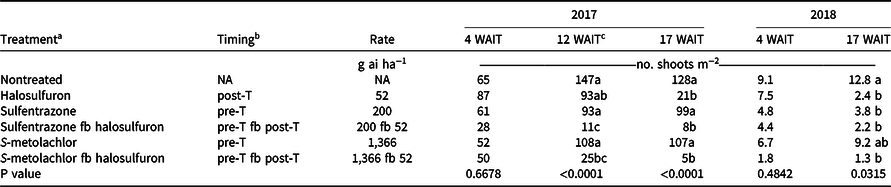
Application of sulfentrazone and S-metolachlor alone pre-T did not reduce purple nutsedge population compared with the nontreated control (Table 1). Sulfentrazone applied pre-T did not reduce nutsedge population compared with the nontreated control at any date in 2017; however, this treatment significantly reduced purple nutsedge density at 17 WAIT in 2018. Halosulfuron post-T did not decrease nutsedge counts at 12 WAIT in 2017; however, this treatment was effective at season end and reduced nutsedge number at 17 WAIT in 2017 and 2018.
Purple nutsedge counts after herbicide treatments in plasticulture tomato in Balm, FL, in 2017 and 2018.

a Abbreviations: fb, followed by; NA, not applicable; post-T, post-transplanting; pre-T, pretransplanting; WAIT, wk after initial treatment.
b Post-T applied at 8 wk after pre-T.
c Means within columns followed by different letters are significantly different using Tukey adjustment means comparison at the 0.05 significance level.
Sulfentrazone or S-metolachlor applied pre-T fb halosulfuron post-T provided greater purple nutsedge control compared with sulfentrazone or S-metolachlor applied pre-T in 2017. However, except for S-metolachlor pre-T, all herbicide program results were statistically equivalent compared with the nontreated control and significantly reduced purple nutsedge density at 17 WAIT in spring 2018. Purple nutsedge density in fall 2017 was considerably greater than in spring 2018. The inconsistent efficacy between seasons might be related to the variability of purple nutsedge density. In previous investigations, Miller and Dittmar (Reference Miller and Dittmar2014) documented that a high density of nutsedge with more than 100 shoot m−2 (a mixed, natural stand of 40% purple plus 60% yellow nutsedge) was difficult to control in plastic-mulched bell pepper (Capsicum annuum L.) when relying on a PRE application of fomesafen or S-metolachlor alone.
In this study, sulfentrazone or S-metolachlor applied pre-T fb halosulfuron applied post-T tended to be the most effective treatment and consistently reduced purple nutsedge density. Halosulfuron is effective for nutsedge control (Adcock et al. Reference Adcock, Foshee, Wehtje and Gilliam2008; Grichar et al. Reference Grichar, Besler and Brewer2003; Shaner Reference Shaner2014; Vencill et al. Reference Vencill, Richburg, Wilcut and Hawf1995). Halosulfuron applied POST is also effective for control of many commonly encountered broadleaf weeds in Florida tomato fields, including common purslane (Portulaca oleracea L.), hairy indigo (Indigofera hirsuta L.) (Webster Reference Webster2010; Yu and Boyd Reference Yu and Boyd2018), cutleaf groundcherry (Physalis angulata L), eclipta [Eclipta alba (L.) Hassk.], and pigweed (Amaranthus spp.) (Shrefler et al. Reference Shrefler, Brandenberger, Webber, Roberts, Payton and Wells2007; Webster Reference Webster2010). However, the likelihood of evolution of resistance to acetolactate synthase–inhibiting herbicides, such as halosulfuron, in weeds is high (McCullough et al. Reference McCullough, McElroy, Yu, Zhang, Miller, Chen, Johnston and Czarnota2016a, b; Preston and Powles Reference Preston and Powles2002; Tehranchian et al. Reference Tehranchian, Norsworthy, Nandula, McElroy, Chen and Scott2015; Yu and Powles Reference Yu and Powles2014). Sequential application of herbicides with different sites of action may reduce the selection pressure from halosulfuron alone.
Sulfentrazone or S-metolachlor applied alone pre-T did not reduce purple nutsedge counts (Table 1). Similarly, previous researchers reported that control of purple nutsedge with S-metolachlor applied PRE was unreliable, inconsistent, and varied over time and space (Boyd Reference Boyd2015, Grichar et al. Reference Grichar, Nester and Colburn1992; Yu and Boyd Reference Yu and Boyd2017). Sulfentrazone or S-metolachlor residues may not persist long enough to provide adequate control of late-emerging weeds. It was reported that the half-life of sulfentrazone was 121 to 302 d, whereas the half-life of S-metolachlor was only 15 to 25 d in southern U.S. soil, based on laboratory assays (Braverman et al. Reference Braverman, Lavy and Barnes1986; Shaner Reference Shaner2014). Thus, application of these PRE herbicides alone before transplanting tomato might not be adequate for late-season weed control. Halosulfuron applied POST may provide nutsedge control after the dissipation of PRE herbicides.
Chaudhari et al. (Reference Chaudhari, Jennings, Monks, Jordan, Gunter, McGowen and Louws2016b) reported that the critical weed-free period of nongrafted tomato was 3.3 to 5.8 wk after transplant in North Carolina. Purple nutsedge populations emerging after the critical weed-free period might not be competitive to reduce tomato yield. However, controlling purple nutsedge that emerges in the late season is important. Purple nutsedge tubers can reproduce rapidly and persist in soil for several seasons (Neeser et al. Reference Neeser, Aguero and Swanton1997; Webster Reference Webster2005a, Reference Webster2005b). Halosulfuron application not only can control purple nutsedge foliage but also can effectively reduce the quantity of tuber production and viability (Webster and Grey Reference Webster and Grey2014). In other studies, S-metolachlor applied PRE provided 60% to 80% yellow nutsedge control at 4 to 6 wk after treatment, but control of purple nutsedge was markedly reduced and inconsistent (Bangarwa et al. Reference Bangarwa, Norsworthy and Gbur2009; Boyd Reference Boyd2015; Grichar et al. Reference Grichar2008; Miller and Dittmar Reference Miller and Dittmar2014). Overall, because of the erratic control provided by sulfentrazone and S-metolachlor applied alone pre-T, halosulfuron applied post-T is necessary for season-long purple nutsedge control in Florida tomato.
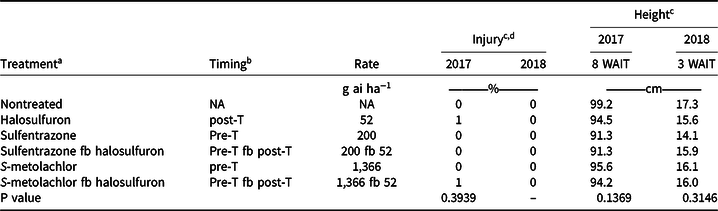
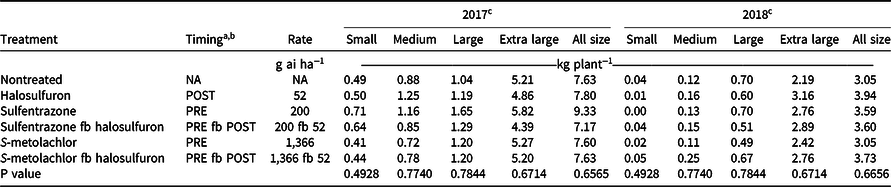
Repeated measures analysis showed that the treatment by rating date interaction was insignificant in both years (P > 0.05); therefore, visual injury results are presented as an average of all rating dates (Table 2). Tomato injury was no greater than 1% and none of the herbicide treatments reduced tomato height. No differences in tomato yield in any size category were observed among herbicide treatment and the nontreated control (Table 3). Tomato fruit yield was substantially greater in 2017 than in 2018. The variation in tomato yield between growing seasons is expected due to differences in weather and field conditions at planting.
Tomato visual injury and height after herbicide treatments in plasticulture tomato in Balm, FL, in 2017 and 2018.

a Abbreviations: fb, followed by; NA, not applicable; post-T, post-transplanting; pre-T, pretransplanting; WAIT, wk after initial treatment.
b Post-T applied at 8 wk after pre-T.
c There were no statistically significant differences in plant injury and height among treatments in each of the two study years.
d Tomato injury averaged over 2 and 4 wk after post-T application.
Tomato yield after herbicide treatments in plasticulture tomato in Balm, FL, in 2017 and 2018.a

a Abbreviations: fb, followed by; NA, not applicable; post-T, post-transplanting; pre-T, pretransplanting.
b Post-T applied at 8 wk after pre-T.
c Before weighing, tomato fruit was graded as small (<5.5-cm diam), medium (between 5.5- and 6.5-cm diam), large (between 6.5- and 7-cm diam), or extra large (>7-cm diam).
The observed tomato crop safety with these herbicides was expected because registered rates were used (Anonymous 2014a, 2014b; 2015). In previous investigations, researchers reported that tomato is tolerant to PRE or POST application of halosulfuron (Adcock et al. Reference Adcock, Foshee, Wehtje and Gilliam2008; Buker et al. Reference Buker, Rathinasabapathi, Stall, MacDonald and Olson2004). Boyd (Reference Boyd2015) reported that PRE application of halosulfuron or S-metolachlor under plastic mulch did not injure tomato growth or negatively affect yield. Although sulfentrazone is currently registered for transplanted tomato (Anonymous 2015), no studies, to our knowledge, reported tomato tolerance and safety after PRE application of sulfentrazone, and results of this study confirmed the safety of sulfentrazone applied PRE for transplanted tomato.
In conclusion, sulfentrazone or S-metolachlor applied alone pre-T did not provide adequate purple nutsedge control. Halosulfuron applied post-T was required to ensure effective season-long purple nutsedge control. Control from sulfentrazone or S-metolachlor applied pre-T fb halosulfuron applied post-T was similar. Results from these studies indicate that these herbicide programs are safe for Florida tomato plasticulture production. Overall, these results suggest the necessity of a pre-T fb post-T herbicide program for purple nutsedge control in plasticulture tomato. Sulfentrazone or S-metolachlor applied pre-T fb halosulfuron applied post-T would be an important tool for providing season-long control of purple nutsedge.
Acknowledgements
The authors thank Michael Sweat for his technical assistance. Funding for this research was provided by a block grant from the Florida Department of Agriculture and Consumer Services. No conflicts of interest have been declared.