“The public is learning to observe earthquakes.” (Forel Reference Forel1881a, 463)
In February 1909, a boarding-house dweller on the outskirts of Neuchâtel, Switzerland, wrote a nine-page letter to the local geologist Hans Schardt in which she described, among other things, sounds heard by one neighbor at half past two in the morning; another neighbor's nightmare of crossing a collapsing bridge; and a distant memory of her own of a sudden storm of such violence that she had been thrown from her bed, only to be mocked the next morning when she recounted the experience to fellow lodgers. Two weeks later, she wrote to Schardt of what admittedly might have been “an effect of the imagination”Footnote 1 (Hs 389: 1077.10 and 1077.8, ETH Archiv, Zurich). Schardt might have been forgiven for dismissing these letters as the rantings of a lonely lunatic. Instead, he published them. In the report of the Swiss Earthquake Commission for the year 1909, much of the testimony of this lodger appears word for word, preserving even her metaphors and analogies (Quervain Reference Quervain1910, 3–4). This paper asks why Swiss scientists solicited letters like these and what they gained from them. It is a question that goes to the heart of the ambitions of science on the cusp of the technocratic age.
Between 1878 and 1880, Switzerland, Italy, and Japan initiated the first national earthquake commissions, but only the Swiss made ordinary citizens a vital part of this undertaking. The nation was divided into seven regions, in each of which one scientist was responsible for soliciting and redacting observations of ground motion, to be penned by volunteers on questionnaires or postcards and mailed free of charge. It was a system that would be imitated around the world, echoed even today in the United States Geological Survey's website “Did You Feel It?” The immediate goals of the Swiss observing network were to locate epicenters by mapping the felt intensity of tremors, determine their depth, and distinguish among different types of earthquake according to felt motion. Implicit was the goal of providing information on seismic hazards for the grand engineering projects for which Switzerland became famous in the nineteenth century – ranging from mines to Alpine trains and tunnels, to dams and canals along the Rhine and its subsidiaries.Footnote 2
Still, one might wonder, earthquakes? In Switzerland?
Geologists today view earthquakes on Swiss territory as the continuing effect of the collision between the European and African plates that began the formation of the Alps approximately 80–90 million years ago. Strong earthquakes occur infrequently, but small tremors are common and often accompanied by distinctive sounds. In the Alps, earthquakes can trigger rockslides or avalanches or make rivers impassable. Today earthquakes are estimated to represent one third of Switzerland's total disaster risk (Gisler, Fäh, et al. Reference Gisler, Kozák, Vanĕk, Fréchet, Meghraoui and Stucci2008).
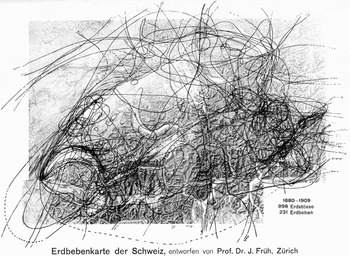
According to the calculations of the Swiss Earthquake Commission, between 1880 and 1904 there was an average of 6–7 “Swiss” earthquakes per year – meaning seismic events separated in time, observed by at least two people, and with epicenters inside the Swiss borders (Früh Reference Früh1905, 146) (see fig. 1). Before the commission began its work, earthquakes in Switzerland were often not recognized as such. Many residents mistook them for strong winds or thunder. It was not uncommon for people to accuse their upstairs neighbors of making noise that was actually seismic in origin. In some cases witnesses were aware only that the horse pulling their carriage had stopped dead in its tracks (Forel Reference Forel and Forster1880, 14). Some residents attributed the vibrations to an “invasion of a legion of cats, mice, or rats in the garrets” (Favre Reference Favre1883, 134). Even stronger tremors in Switzerland rarely caused much damage:
In general buildings have very rarely been damaged, thanks to their solid construction, in particular of the wooden buildings of the mountain region. In many cases cracks in walls and in the ground, avalanches, and rockslides have been reported, as well as the ringing of church bells and general panic of the inhabitants. Springs have been clouded, run dry, or appeared in new places. The local formation of waves on lakes in the absence of wind has repeatedly been observed. (Früh Reference Früh1905, 146)
In an age before reliable seismographs, such frequent sensible but not destructive seismic activity furnished ideal specimens for naked-eye research (Westermann Reference Westermann2010).
Earthquake map of Switzerland, based on the first thirty years of the Earthquake Commission's activities, during which it collected 7,000 felt reports.

Earthquakes were being explained in new ways in the nineteenth century. Around 1800, H. B. de Saussure – Swiss physicist and mountaineer – studied earthquakes as part of the process of mountain building and dismissed theological implications (Gisler Reference Gisler2007). For much of the nineteenth century, Switzerland's earthquakes were attributed variously to mine explosions, meteor strikes, the sinking deltas of lakes, and the collapse of hollow subterranean strata. But the explanation that became increasingly dominant in the course of the Earthquake Commission's activities was tectonic: earthquakes resulted from movement along fractures in the earth's crust (Greene Reference Greene1982; Strehlau Reference Strehlau2006). The defense of this hypothesis would rest on correlating the location and direction of earthquakes with features of local geology. A new approach to seismology arose that drew on intimate familiarity with a region's geology, alongside historical evidence of past quakes culled from local archives. Among the fruits of the Commission's first two decades of work was the conclusion that tectonic quakes occurred principally in three “habitual regions of shock” – in the Rhine valley near St Gallen, in the corner between the Alps and the Jura near Lake Geneva, and around the three lakes of the Jura (Früh Reference Früh1905, 147). At the same time, geologists began to interpret tectonic earthquakes as symptoms of mountain formation. As Albert Heim, one of the Commission's founders, explained to potential observers: “Most earthquakes are the expressions of the ongoing formation of mountains beneath our feet” (Heim Reference Heim1880, 19).
1855: Volger's Democratic Example
On a wet and foggy day in late July, 1855, the strongest Swiss earthquake of the past 300 years struck the Visp Valley in the canton of Wallis/Valais. It was accompanied by “thundrous rumbling, stormy booming, heaving whooshing, cracking, crashing, crackling, braying, whistling and clanging. . .the mountains rocked up and down, countless rocks from all the peaks and cliffs slipped and rolled, the walls of the houses tilted and fell over in a heap of rubble, balconies broke, roofs slipped or collapsed” (Volger Reference Volger1858, 67). The shock was felt through most of Switzerland and into neighboring parts of Germany, France, and Italy, and aftershocks were reported into November (Gisler, Kozak, et al. Reference Gisler, Kozák, Vanĕk, Fréchet, Meghraoui and Stucci2008).
At the time of the Visp earthquake, Otto Volger was a Privatdozent (unsalaried lecturer) in geology at the University of Zurich, having fled his native Saxony after participating in the failed revolution of 1848 (Daum Reference Daum1998, 168). Apparently unaware of the magnitude of the project he was undertaking, Volger began collecting eyewitness reports of damage from the earthquake. In order to assess the quake's more remote effects, he put in place the first nodes of what grew into an extensive network of correspondents. As Volger emphasized in his monograph on the 1855 earthquake, his evidence came from “people with a great variety of backgrounds” (Personen von verschiedensten Bildung) (Volger Reference Volger1858, 67).
Volger's monograph on the earthquake would not see the light of day for another three years. Meanwhile, he took a part-time teaching position at a natural scientific society in Frankfurt. It was in Frankfurt that Volger became, according to the historian Andreas Daum, one of the German-speaking world's first semi-professional popularizers of science. Volger brought his earthquake research to bear on his efforts to popularize a stridently secular, cyclical view of geohistory – a challenge to biblical catastrophism. As he explained, “The rocking of the earth's surface does not announce the decline of the world, but rather the rule of the eternal order of nature, which in transformation furnishes the certain guarantee of its everlasting constancy” (Volger Reference Volger1857, 266). Volger also became active as an organizer, aiming to counteract the growing specialization of the sciences. In 1859 he founded the “Free German Foundation for Science, Art, and Public Education” (Freie Deutsche Hochstift für Wissenschaften, Künste und allgemeine Bildung) (FDH), a feat of networking among existing institutions. According to Daum, Volger was “driven by a democratic impulse. Through the FDH [Volger] promised not only an improved exchange of information, but also the opening of research and teaching institutes to the public” (Daum Reference Daum1998, 170, 253). In keeping with his goal of making science accessible to the public, Volger studiously avoided foreign terms in his publications. Nonetheless, he styled himself as a researcher and scorned writers who viewed the world merely as “material for penny-a-line articles” (Volger to K. F. Mohr, quoted in Daum Reference Daum1998, 406). Indeed, in his own estimation, his monograph on the Visp earthquake offered no reward to its publisher beyond the satisfaction of seeing his name on the title page. (In the event, the publisher died before enjoying even that compensation [Volger Reference Volger1858, preface]). While the book itself was no work of popularization, its methods and rhetoric conveyed Volger's democratic vision for the sciences.
Volger thought he knew what caused earthquakes, and his theory was not unrelated to his politics of knowledge. Earthquakes were caused by the collapse of underground caves due to the inflow of water. He branded those who insisted on volcanic causes with the eighteenth-century label “Plutonist.” Referring to a “Plutonic hierarchy,” Volger repeatedly characterized Plutonism as a kind of elitist superstition (Volger Reference Volger1858, 363). For instance, correlations between earthquakes and volcanic eruptions amounted to “downright mischief with the temporal relations. . .to make ‘the earthquake’ look like a certain ghostly something which has its seat beneath the earth's surface and capriciously materializes first here, then there, in a way all too reminiscent of table-turning and spirit-rapping” (ibid., 380). He thus cast Plutonism as a high-born fallacy, and this rhetorical strategy shaped the way he reported eyewitness observations. For instance, he discounted reports that the quake had opened cracks in the earth or sprouted thermal springs (potentially evidence for a Plutonist account of lava surging from below), by attacking the character of the reporters. These were either “superstitious” and “pseudo-scientific” “travelers” or sensationalistic journalists:
If the reports of travelers that have been spread in the newspapers spoke of ruptures in the mountains, of cracks in the ground, of the opening of the earth, of rivers of mud spewed from the earth, and similar scenes of horror, then what this depiction revealed was only a wholly amateur [laienhafte] viewpoint, characterized by superstitious, pseudoscientific prejudices. (Ibid., 81)
Thus Volger embraced the testimony of eyewitnesses whose ability to “appreciate these phenomena” may have derived simply from their experience as locals, at the expense of the descriptions of “travelers” who refused to acknowledge their “lay” status. By stigmatizing travelers’ reports as both “superstitious” and “pseudo-scientific,” both pretentious and “lay,” Volger was challenging a class-based claim to adjudicate “science.”
At the same time, Volger's trust in the testimony of local residents suited his explanation of seismic activity. If water seepage could bring on tremors by causing the collapse of subterranean caves, then rainfall and humidity were a proximate cause of earthquakes. Volger therefore needed reports on meteorological conditions not merely at the time of the quake, but also in the preceding weeks. He needed to trust the local residents, and he did. He spiritedly defended the experiential knowledge of locals against the exaggerations of well-to-do travelers. For example, he rejected a “traveler's” account of a sulfurous smell (associated with “Plutonistic” explanations) on the ground that the witness lacked the experience to recognize the “half-musty, half-smoky scent of freshly overturned earth” (ibid., 84).
However, what might appear to have been the work of a pugnacious upstart turned out to be a pioneering contribution to seismology. Volger's research was original both in its conclusions and methods. His critique of Plutonism was apt, in so far as it cast earthquakes not as the product of eruptive forces but as a result of pre-existing ground conditions, exascerbated by fleeting external factors (Oeser Reference Oeser2001). Volger himself drew an analogy to the breaking up of a layer of ice on a lake. His point of view stimulated further studies of the local geology of earthquake zones. It also inspired the compilation of historical earthquake catalogs on the model of Volger's own Chronik der Erdbeben in der Schweiz, the first volume of his publication on the Visp quake. Volger also succeeded in developing one of the first quantitative scales for measuring an earthquake's intensity, as well as one of the first maps of the geographic distribution of intensity (Kozák and Vaněk Reference Kozák and Vaněk2006).Footnote 3 There is little sign, however, that these innovations were appreciated by his contemporaries. Instead, Volger's study had an immediate impact by demonstrating that a thorough survey of eyewitnesses and of historical sources could produce rich evidence for the scientific analysis of an earthquake (Gisler et al. Reference Gisler, Kozák, Vanĕk, Fréchet, Meghraoui and Stucci2008; Heim Reference Heim1880, 10). Equally influential was Volger's populist spirit: as one director of the Swiss Earthquake Commission later noted with approval, Volger “seemed not to have found the required tone of subservience toward the official custodians of scientific knowledge of the earth, but dared rather to forge his own paths” (Quervain Reference Quervain1923, 75).
Earthquakes, Experts, and the Nation
“In this case it is very difficult. . .to specify the limit where someone starts or stops being an expert.”
(Schmidt Reference Schmidt1858, 131)Volger's study of the Visp earthquake was quickly overshadowed by the introduction of “objective” methods of earthquake research. In 1862 Robert Mallet published what is often considered the first work of empirical macroseismology, subtitled First Principles of Observational Seismology (Mallet Reference Mallet1862). Mallet, a civil engineer by training, demonstrated how cracks in masonry and overturned objects could be used to infer the direction from which seismic waves had propagated. He based his research primarily on architectural damage and topographical changes, and he found little use for eyewitness accounts of the tremors. In Mallet's judgment, lay observers lacked the “observational tact and largeness [sic] of a disciplined imagination and eye that are amongst the accomplishments of the physical field-geologist” (ibid., 7). Mallet's disregard of human observers was echoed by many British, Italian, and Japanese contributors to seismology in the second half of the nineteenth century. When the Italian earthquake commission was established in 1879, it focused on constructing seismographic observatories, not a permanent network of observers. This was in keeping with the move to exclude amateur observers from Italian astronomy in the aftermath of national unification. The private seismic network developed by Count Michele Stefano De Rossi in the 1870s consisted entirely of fellow gentlemen-naturalists, nearly half of whom owned seismoscopes or seismographs (Mazzotti Reference Mazzotti, Aubin, Bigg and Sibum2010, 76–77; Davison Reference Davison1927, 99–100).
In Japan, where John Milne and Fusakichi Omori pioneered instrumental seismology in the 1880s and ‘90s, lay observers played little role in earthquake investigations. According to Milne, “Attempts to find out what sensations were experienced by the people at the time of the shock are unsatisfactory. People questioned will tell trivial circumstances – how they tumbled from the top to the bottom of the stairs whilst hurrying to get out of doors – girls tell how they began to cry, etc.” (Clancey Reference Clancey2006, 157). Why then did Swiss scientists place so much trust in the observational abilities of ordinary people?
One answer is that the Swiss did not trust instruments, and with good reason. The pendulum seismometers of the 1870s were plagued by problems of self-resonance which were not addressed until the late 1890s. For assessing local earthquakes, the Swiss Earthquake Service judged human observers more reliable than instruments:
the number of cases in which, in the same location, people took due note of tremors, while simultaneously instruments remained indifferent, is in all countries too high. The horizontal pendulum and related complicated and expensive instruments register distant earthquakes, elastically propagated through the earth, well enough, but not in general local earthquakes. . .We still lack a simple instrument with which, as with meteorological instruments, any non-physicist can successfully make observations. (Früh Reference Früh1905, 148)
Observers thus recorded local earthquakes more reliably and less expensively than instruments (Heim Reference Heim and de Kövesligethy1910). (However, a full tally of the expense of using human observers would have to consider the considerable cost of printing and mailing the questionnaires and the time required for experts to evaluate them.) As Heim advised the Princeton mathematician and seismologist Charles Rockwood around 1885,
The simple reports of observers without instruments have consistently been more valuable to us than instruments. Even if they contain many errors, nonetheless one finds that if a really large number of reports are available from the same place, it is always easy enough to distinguish what is generally objective from an accidental error of a subjective kind [das allgemeine objective von zufälliger Täuschung subjectiver Art zu unterscheiden]. (Heim to Charles Rockwood, no date, Book 3, Rockwood Papers, Princeton University Archives)
This judgment reflects the specific goals of the Swiss Commission. While seismologists in Germany poured their resources into the study of distant earthquakes via the new instruments, the Swiss wanted to know about Swiss earthquakes and the seismic hazards of their own territory. But suppose that the Swiss could have found an inexpensive instrument that could reliably register local quakes? Would they have eliminated lay volunteers from their program? Note that the Commission further stipulated that such an instrument would also need to be easy for the “non-physicist” to use. Why would Swiss scientists have wanted to be dependent on non-expert observers?
It is tempting to attribute this eagerness for popular participation to the Swiss political tradition. In 1848 the country had become a federation with four official languages, significant cantonal autonomy, and direct democracy through referenda. This claim needs to be carefully qualified, however. An illuminating comparison can be made to the system of meteorological observation likewise set up by the Swiss Naturforschende Gesellschaft (Natural Scientific Society) in the 1860s. The comparison is a natural one, since key members of the Swiss Earthquake Commission were meteorologists, and it was common at the time for seismic phenomena to be noted by weather observers. A national network of weather observers was inaugurated in Switzerland in 1864.
It was a historic moment in the eyes of Albert Mousson, an engineer and naturalist and the son of a chancellor of the Swiss Confederation of the Napoleonic era:
Without enjoying the advantages of a strong centralized administration, as its strong monarchical neighbors are able to provide, Switzerland has in this respect, thanks to its freedom of movement and advanced learning, not entirely fallen behind; namely the Naturforschende Gesellschaft can pride itself on having inspired, initiated, and completed much on its own initiative, which elsewhere is achieved only on the basis of official organization, through learned academies and through numerous paid employees. (Mousson Reference Mousson1864, 197)
Mousson thus presented the establishment of a network of volunteer meteorological observers as evidence of the success of Swiss federalism and liberalism in the 1860s. While monarchical states had to mobilize money and elites to achieve scientific progress, the Swiss could do the same “on its own initiative [aus freien Stücken],” thanks to liberal policies (freie Bewegung) and an educated public. Still, as Mousson went on to make clear, there was a high bar to becoming a meteorological observer. It required familiarity with instruments (if not their purchase, since instruments were supplied by the Swiss Natural Scientific Society [SNG]), sufficient leisure time for making regular observations, and a background in mathematics to perform data reduction. Indeed, his notes show that more than half of the original meteorological observers belonged to the learned professions. In Switzerland's most mountainous areas, however, it proved hard to find men with higher education to serve as observers. There the Society experimented with enlisting innkeepers. This made Mousson nervous: “there remains the question of whether it was appropriate to entrust such fine instruments to the hands of non-physicists.” The situation called for a cautious attitude: “The three-year experiment will at best teach us which observers can definitely be counted on and which would better be abandoned” (ibid., 104). Looking back on the network's first year of operation, the best Mousson could say was that no instruments had been broken. It seems that democratic rhetoric alone did not ensure that all citizens would participate in Swiss science on equal terms.
Tellingly, earthquake observing proved a more genuinely populist enterprise than meteorology. This was evident in the Earthquake Commission's instructions to observers, which were distributed to “all telegraphic and meteorological stations, all natural scientific societies, to physicians, pastors and many teachers” (Heim to Charles Rockwood, 5 March 1885, Book 3, Rockwood Papers, Princeton University Archives). They were written explicitly “to stimulate interest and understanding for the observations in wider circles. . .For the investigation of every earthquake numerous observations from as many different locations as possible are necessary. The scientist [Naturforscher] is dependent here on the help of numerous friends of science. He turns not only to his colleagues, but to everyone who takes an interest in the observation of nature.” The author, Albert Heim, suggested that laypeople could contribute to scientific research in many ways. The questionnaires guided the observer through a set of questions that demanded certain standardized responses, but also prompted attention to multiple “associated phenomena.” Ample blank space was provided for elaboration. Moreover, observers were explicitly free to choose to dispense with the questionnaire and write a free-form letter if they wished. Indeed, Heim instructed observers to report anything and everything: “The observations should not be limited by our questionnaires; rather every further observation, beyond those to which we have drawn attention, can be valuable” (Heim Reference Heim1880, 27). This openness derived in part from the lingering uncertainty in the field of seismology as a whole about what actually constituted data: seismological evidence potentially included phenomena from the astronomical and meteorological to the electrical, magnetic, and zoological. As Heim put it: “Nature is far more complicated in its phenomena than we could guess” (Heim Reference Heim1887, 141). In this sense, keeping an open mind was a sensible research strategy for seismology.
Heim also made clear that the call for volunteer observers was motivated by more than a need for data. It was meant to condition a new set of responses to the earth's volatility. Heim acknowledged that the experience of an earthquake could impair reason, if unaided by scientific preparation: “When the most solid thing that we can perceive with our senses wavers, and we do not know whereby and how far, then the imagination is easily excited to a fever-pitch and clouds rational observation” (Heim Reference Heim1880, 5). Indeed, the belief was widespread at the time, voiced most famously by Charles Darwin, that frequent earthquakes could drive a civilized society back to barbarism (see introduction and White's article in this issue). Science, however, might fortify human reason in the face of natural hazards: “Every new discovery about the relationship between cause and effect in nature has a great value for humanity, for it helps free the human spirit from the chains in which it was early imprisoned by the base fear of what is not understood and therefore seems arbitrary [vor dem nicht zu Begreifenden und desshalb vielleicht Willkürlichen]” (ibid., 22). In this sense, earthquake observing was a project of popular enlightenment, an effort to liberate society from the bonds of an irrational view of nature's threats. A parallel was evident in Heim's response to the rockslide in Elm, in the Glarus Alps, which killed over a hundred people in 1881. He called for public participation in recognizing and reporting the warning signs of disaster: “Even with respect to rockslides we want to enter the enlightened age [Zeitalter der Erkenntnis]” (Heim Reference Heim1931, 128).
Scientific earthquake observation was thus fundamentally different from weather observation, and the difference derived not just from the absence of instruments. More fundamental was the human threat that earthquakes posed. Historians have argued that the Swiss nation was forged to a significant degree through common measures to protect against natural disasters. As Daniel Speich shows, Hans Conrad Escher's canalization of the Linth River aimed to improve not just the land but the moral fabric of the nation. Nature, Escher wrote, “forces us into a social condition, as we have to act united, if one man alone is without help.” The swamp-like conditions in the valley were considered morally debilitating to the local peasantry. To reverse these effects, the workers recruited to build the canal were given special schooling. Speich points out that such a combination of environmental engineering and public education was unlikely after the early nineteenth century, due to growing technical specialization (Speich Reference Speich2003).
In this light, the Swiss Earthquake Service is all the more surprising. It was a combination of environmental defense and popular enlightenment in the mold of Escher's canal. And it was an undertaking that was perhaps more urgent in late nineteenth-century Switzerland than ever before, as the rise of ethnic nationalism in the rest of Europe threatened the civic nationalism of the Federation. The Swiss cultivated an ethic of “civic exceptionalism,” a “voluntary commitment to a set of values and institutions, which in turn secured Switzerland's existence as a polyethnic state.” As historians have noted, Swiss nationalism increasingly emphasized the role of the Alpine landscape in forging a supra-linguistic unity. In 1891, for instance, at a festival celebrating 600 years of Swiss history, the character Helvetia, the embodiment of the Swiss nation, was said to be “shaped by mountain peaks and valleys alike” (Zimmer Reference Zimmer2003, 206).Footnote 4 The physical barrier of the Alps was likewise central to the emerging Swiss ethos of isolationism. In this context, earthquake observing was part of a lesson on civic identity. Not for nothing did the Swiss Alpine Club, promoter of the nation's identification with its landscape, contribute the cost of printing 1450 German and 850 French copies of the Commission's instructions to observers (Forster Reference Forster1880, 102). The Swiss were being taught to feel the forces exerted by the mountains that united them.
Switzerland's network of volunteer earthquake observers self-consciously harked back to a pre-technical era in which science stood for enlightenment and civic conscience. It also looked ahead, to an age of rapid communication and precision time-keeping. It is a case that justifies Ted Porter's assertion that “The Enlightenment – if this term may be taken to designate a faith in progress through the popular diffusion of knowledge – took place in the nineteenth century” (Porter Reference Porter2009, 299). What's more, enlightenment in this case was potentially a more radical project than the mere diffusion of knowledge. It aimed to enlist the public in the co-production of knowledge (cf. Bensaude-Vincent Reference Bensaude-Vincent2009).
Albert Heim, Nature's Physician
We can better grasp the ambitions of the Earthquake Commission by considering the public personae of its directors. Many of its members were affiliated with the Swiss Polytechnic Institute (ETH), founded in 1855 to serve the practical needs of a modernizing nation. Many also served as geological consultants on state-sponsored engineering projects. One such project was the Simplon Tunnel, a landmark feat that bored a road beneath a 5,000-foot peak. Most of Switzerland's top geologists advised on the Simplon at some stage in its design and construction, which stretched from the 1870s into the 1920s. Earthquakes were not prominent among the hazards that imperiled its construction (though a quake did cause a fissure in the first section of the tunnel). The real dangers would turn out to come from flooding and unexpectedly high temperatures.
Scientists faced accusations that they should have warned of the risks involved. Albert Heim, who consulted on the tunnel from the 1880s, gave a revealing response to these charges. Rather than shifting the blame, Heim retorted that a geologist's knowledge was inherently uncertain (Anon. 1914; Sulzer-Ziegler Reference Sulzer-Ziegler1904; Heim Reference Heim1904). As he later put it, “It is self-evident that the viewpoint emerging from the geological investigation cannot alone be decisive. What strikes us though, is the uncertainty in the assessment of many natural circumstances” (Brockmann-Jerosch et al. Reference Brockmann-Jerosch1952, 206). Indeed, Heim had phrased his original assessment of the tunnel project similarly. It was, he wrote, “impossible for me to foresee” the subterranean dimensions of decomposing gneiss. Likewise, he and his colleagues could not say for sure how high the temperatures might climb during construction; they could only judge which of the proposed routes would be safest in this respect (Heim et al. Reference Heim1883, 20, 24). Repeatedly in his role as scientific consultant, Heim stressed the limits of his ability to predict the environmental consequences of engineering projects. In this way, Heim circumscribed his own authority as an adviser on matters of public interest. “How it would have pleased me to have been able to present a clear and completely satisfying solution to the question,” he wrote in an expert report on the provision of drinking water to an alpine town. “Nature, however, which has distributed its gifts so unequally, can not be made other than it is – we can only observe how it is, and use it according to its possibilities. Much of the how is hidden and only within certain limits to be discovered, so that much uncertainty still attends our judgment and our foresight” (Brockmann-Jerosch et al. Reference Brockmann-Jerosch1952, 181; emphasis in the original). That nature was to be used only “according to its possibilities” was a wise counterweight to the ambitions of nineteenth-century engineering.
In keeping with Heim's sense of caution, the Earthquake Commission helped remind the Swiss of the principle of unintended consequences. A remarkable illustration occurred in 1913, when moderate earthquakes shook the vicinity of Grenchen near Solothurn. Never before in the history of the Commission had earthquakes originating in this region been reported. Two years earlier, construction had begun on a tunnel through the Grenchen mountain. In early 1913, the engineers struck the local spring, flooding the tunnel and cutting off the village's water supply – the first of several such mishaps. Four months later the tremors began. The press began to raise questions. The director of the Earthquake Commission, Alfred de Quervain, studied the reports of earthquake observers alongside the engineering of the tunnel. This, he concluded, was the first clear evidence that the boring of tunnels could trigger earthquakes (De Quervain Reference Quervain1914). “Induced seismicity,” as this hazard is known today, has recently been recognized as a major problem for twenty-first century schemes of energy production and waste disposal.
The lesson of such investigations was that nature should be used only “according to its possibilities” and in full recognition of the limits of human knowledge. This principle found echo in Switzerland's burgeoning nature protection movement, in which Heim and other members of the Earthquake Commission took leading roles. (Heim also had a hand in other progressive causes, including temperance, abstinence, and cremation [Brockmann-Jerosch et al. Reference Brockmann-Jerosch1952].) The nature protection movement had its immediate origins in the effort to preserve a mammoth rock, fondly known as the “Pierre de Marmettes,” from the hands of a granite speculator. This 2000-cubic-meter landmark was an “erratic block,” one of the massive boulders poised at precarious angles on the outskirts of the Jura mountains. These imposing objects had long been treasured as curiosities. In the late nineteenth century, they came to be recognized as relics of the last ice age, transported by glaciers to their unlikely perches. In 1906, an alliance of Swiss scientific societies paid over 30,000 francs to rescue the Pierre de Marmettes. Thus was a movement born that stressed the aesthetic, scientific, and historic value of natural monuments, against their mere economic worth (Aubert Reference Aubert1989; Bachmann Reference Bachmann1999).
The Pierre de Marmettes came to symbolize nature's need for protection against human self-interest. Tellingly, Heim likened himself to nature's physician. On the topic of rockslides, he described the geologist as providing “diagnosis,” “prognosis” and “therapy.” Implicit was an analogy to the work of Heim's wife, Marie, Switzerland's first female doctor. Marie Heim herself saw the similarity:
My husband's and my occupation are actually very similar and therefore make equal demands on us. As I get called to suffering people, he is suddenly called to avalanches, failures of tunnels and dams, and potential rockslides. Like the physician, the geologist is also very often exposed to dangers. As the physician above all observes and judges and thereafter must prescribe and treat, so is the main activity of the practical geologist likewise observation, thorough investigation, and considered judgment. (Brockmann-Jerosch et al. Reference Brockmann-Jerosch1952, 24)
Indeed, Albert Heim seems to have worked according to a kind of geological Hippocratic oath – a recognition of his limitations as planetary healer and a promise to, at worst, do no harm.
For Heim and his colleagues in the Earthquake Commission, enlisting lay observers was not a last resort but an end in itself. He went so far as to suggest that non-expert observers might have an advantage over scientists themselves. In an essay on “Seeing and Drawing,” Heim argued that modernity had dulled man's alertness to nature. Pointing to the verisimilitude of prehistoric cave drawings, Heim noted: “The savage sees much more consciously than civilized man, he devotes himself to sensory impressions with his full interest, without allowing his attention to be disturbed by other series of thoughts.” From this perspective, the “technical exercises” of modern -scientific drawing could do little to improve one's ability to represent nature. Improvement could come only from “intimacy with the things represented.” Scientific travelers of his own day were often surprised to find that present-day “savages” (Wilde) were often the better draftsmen. Heim suggested that man's observational capacity had been corroded by religion, which had “overstimulated the imagination” (Heim Reference Heim1894, 13, 21). Heim was hardly the first European to have credited “primitives” with exceptional observational powers. Charles Darwin had commented famously on the Tierra del Fuegians’ “more practiced habits of perception and keener senses, common to all men in a savage state, as compared with those long civilized” (Taussig Reference Taussig1993, 81). Darwin saw no reason to assume that a British scientist was a better observer of nature than a “savage” – nor even than an insect or reptile endowed with the capacity for mimicry. The scientific problem of observing earthquakes was often considered from this anthropological perspective, with observers compared by race and even species. (Snakes and catfish were considered especially acute [Tributsch Reference Tributsch and Langner1982].) If scientists might turn to savages for scientific drawings, why shouldn't geologists turn to Swiss citizens for earthquake reports?
Heim and his colleagues were therefore optimistic when they approached the Swiss public in 1878. The instructions did hint at one source of apprehension, when Heim urged an attentiveness that steered clear of the modern extreme of nervous sensibility: “The sense organs should be kept alert in the appropriate state of tension, without exciting them to a state that would exaggerate sensations” (Heim Reference Heim1880, 23). Perhaps he feared that the natural keenness of untrained eyes might have been dulled by the effects of civilization. Nonetheless, Heim's primary concern was to open as wide a gate as possible to communication between scientists and lay observers. Unlike botanists or meteorologists who required their lay correspondents to adhere to a rigid format and vocabulary, the Earthquake Commission invited open-ended communication. Heim continued:
If the reporter does not feel himself entirely certain of an observation, he should not withhold from us the uncertain observation, but rather mark it in his report as uncertain. . . .Therefore: observe conscientiously, but have no fearfulness with respect to us in the transmission of observations. All that is genuinely observed is welcome, even what is perceived in uncertainty, as long as it is marked as such. (Ibid., 24)
Heim maintained this capacious idea of seismological observation even as other seismologists increasingly restricted their data to instrumental traces. He had little faith in the objectivity of self-registering instruments (Daston and Galison Reference Daston and Galison2008). As he argued to the International Seismological Association in 1909, “Above all, a more precise observation of all earthquake phenomena is necessary, in order to learn to understand them. One cannot say from the start, how they are to be observed. One must experiment, experience; and theoretical perspectives and hypotheses can and will enrich observation” (Heim Reference Heim and de Kövesligethy1910, 147; emphasis in the original).
François Alphonse Forel: Bridging Disciplines and Audiences
Heim was not the only scientist whose personality and politics shaped the Earthquake Commission's outreach efforts. The Neuchâtel-based naturalist F. A. Forel is better known today as a founder of an early strain of ecology: limnology, the study of the physical and organic conditions of mountain lakes. Limnology stood as a critique of the modern splintering of scientific expertise and the estrangement of scientists from those with practical interests in the natural world. As Forel wrote in his seminal treatise on Lac Léman, the study of limnology forced the scholar “to transform himself successively into a physicist, chemist, zoologist, botanist, archeologist, historian, economist” (Forel Reference Forel1892, x). On their own, none of these disciplines could come to know a lake in the holistic manner of limnology. Forel echoed the comprehensive vision of Alexander von Humboldt:
Geography has, in effect, a noble ambition and a magnificent program: propelled by its definition, it aspires to embrace in a vast generalization the ensemble of the sciences that deal with the earth and its inhabitants, that is, all the human sciences. . .The description of the earth is not the enumeration and individual description of each of the categories of creatures and things that encounter each other on our planet; it is rather the picture of the whole furnished by the union of these diverse categories, by their relationships to each other, by the reactions that they have to the environment in which they are immersed and which they produce on this environment. (Forel Reference Forel1901, 668–669)
In striving for a holistic understanding of living things in relation to each other and to their physical environment, Forel's limnology can rightly be termed ecological.
Limnology was also a practical endeavor, and Forel addressed his study in part to a lay audience, a “diversity of readers,” from ship captains and fishermen to those who made their homes on the lake. All such individuals would profit from knowledge of the lake's life cycles and the conditions that made it livable (Forel Reference Forel1892, xi). Forel wrote for “general readers,” for whose sake he eschewed jargon: “Rarely can an idea or act not be expressed in familiar language. . . . If our beautiful science is not to become repulsive, we must avoid deforming it with too many foreign words. We must beware of making limnology incomprehensible to the many readers with an interest in limnology by the use of foreign words” (Forel Reference Forel1901, 171). By the time he penned these lines, the ideal of communicating science in “familiar language” had also become central to Forel's work for the Earthquake Commission.
Like Heim, Forel presented the Commission's work as an opportunity to train citizens in a scientific mode of observation. Reflecting on the observations collected in the network's first year, Forel expressed guarded optimism:
The value of these documents is very unequal, as one could expect; some of them have all the characteristics of excellent scientific observations. But if there are some that are less precise and exact, there are very few from which there is absolutely nothing to be drawn. The general impression that results from the study I have made is that the method adopted by our commission, consisting of calling on the observations of the public, can, as it develops, give excellent results. (Forel Reference Forel and Forster1880, 1, 2)
More specifically, he deemed the majority of reports “very authentic,” while only twelve were “imprecise, rather doubtful,” marked by a lack of coincidence in the reported times. One of the “best” observations was that of a Monsieur Clement, butcher in Yverdon. Indeed, as Forel's report for the following year would point out, observations came from “all the classes of society.” To his satisfaction, moreover, the public was making progress: “A particularly interesting fact is that the relative value of these observations has notably risen, and that, after two years of collecting these documents, we recognize a very evident superiority in those that were sent to us most recently: the public is learning to observe earthquakes.” Still, Forel urged a critical attitude: “Let us not however go too far, and let us not overestimate the precision of our documents” (Forel Reference Forel1881a, 463, 481).
Forel did not place the burden of improvement solely on the public: scientists themselves needed to learn to interpret the observations of laypeople. Thus Forel judged that “there are very few of them, even among the most simple and modest, from which an intelligent comparison and critique can not draw something useful.” Not only would the public need to learn how to report to scientists; scientists would have to learn how to listen to the public. In this vein, Forel began: “I have first of all some definitions to make which will spare us fruitless repetition and will simplify description” (ibid., 463, 464). These definitions would lay the foundation for a dialogue between scientists and lay observers.
On one hand, Forel picked up on phrases that observers themselves were using. “The tremor [secousse] can be composed of several distinct movements that I will call according to circumstances: oscillations when there is a predominance of swaying movement; vibrations when the movement has the character of a vibration; shocks when there is a violent, brief, sudden impulse, etc.” On the other hand, he offered new terms that members of the Commission could use to compare the reports of different observers. For instance, descriptions of a “violent,” “brief” or “sudden” event could now be classed together and labelled as a single “shock.” With the exception of the term sismique, which Forel explained derived from the Greek for earthquake, all of the terms he used were drawn from “familiar language” (ibid., 465).
Forel did not deny that the reports were colored by the subjectivity of the observers. For instance, reports of the wavelike movement of fixed objects were likely a “subjective illusion.” Yet such reports were not insignificant. They could not be dismissed as the bias of observers familiar with theories of seismic waves. More likely, the slight movement of the observer's body during the earthquake produced the apparent wave-like motion of other objects. Subjective here implied a physiological rather than psychological bias. Forel further distinguished between “objective observations, based on the direction of swaying of a hanging object, or on the displaced of mobile objects, and subjective observations, based on the simple appreciation of the sensations of the observer.” Here, “subjective” did not imply unreliable. It meant simply that the object under observation was the observer's own body (Forel Reference Forel and Forster1880, 8).
Critics of the use of lay observers often pointed to the difficulty of extracting precise reports of the time of an earthquake. The factor of time was of the essence, necessary for determining whether separate reports related to the same shock, calculating the velocity of the wave as it moved through the earth's crust, and localizing the epicenter. In the moment of alarm, however, people rarely bothered to look at a clock. And if they did, it was all too likely that the clock was wrong. With standardized time still a novelty, few people could be relied on to calibrate their household clock or pocket watch to the “telegraphic” clock at the local railway station. At the start, Forel was disappointed to find that Switzerland's famed culture of precision time-keeping fell short of scientific standards, “that the setting of the clocks of towns, railways, and telegraph stations leaves much to desire from the perspective of precision” (Forel Reference Forel1881a, 490). Even thirty years later, in the case of the strong 1910 tremor in the Berner Jura, Quervain was aghast to find that “among the many men of science who encountered the earthquake fully awake, none saw fit to look at his second hand and verify the setting of his watch” (Quervain Reference Quervain1910, 9). Again, the Commission saw an opportunity for public enlightenment. They “aspired to educate the public to be able to tell time with real precision.” In 1907 Quervain published 500 copies of a pamphlet in German and French, “Introduction to Precise Timekeeping for Observers” (Früh Reference Früh1908, 68). The point is that in Switzerland it was not out of place for a scientist to berate the public to “to recognize the moral duty, during an earthquake, first thing to look at the second hand” (Quervain Reference Quervain1912, 12). Already in 1881, Forel attested, “We believe we see, however, in the successive observations that are sent to us, a progress and an improvement in the determination of time, apparently the result of habituation and attention to the art of observing” (Forel Reference Forel1881a, 490). In 1910 the Commission remarked, “Often it is complete amateurs who distinguish themselves by a pleasing sense for precision” (Quervain Reference Quervain1910, 2).
In addition to codifying a language of observation and developing methods for interpreting observation reports, Forel presented a scheme for moving from discursive to quantitative description: a scale of seismic intensity, measured according to “the intensity of tremors by the simple observation of the effects produced on man and his dwellings” (Forel Reference Forel1881a, 465). The ten degrees of Forel's scale ranged from barely perceptible to disastrous, making it far more widely applicable than the seven-degree scale that Volger had used to classify damage from the 1855 earthquake. Forel only intended his scale to be used “while awaiting more precise observation by standardized recorders,” but it would form the basis of scales used in Switzerland and elsewhere into the 1960s (ibid.). Modified in collaboration with an Italian colleague, the “Rossi-Forel” scale was by far the most widely used internationally circa 1900 (Rossi Reference Rossi1883, 67–68; Davison Reference Davison1900, 47). As part of a carefully constructed scientific vernacular, the Rossi-Forel scale bears comparison to the scales and idioms that emerged in the nineteenth century for the observation of winds and clouds (Anderson 2005; Huler Reference Huler2004). Cloud taxonomies and the Beaufort wind scale were scientific tools based on the experiences of laypeople – artists, farmers, fishermen, and sailors. Unlike seismological intensity scales, however, they were not designed to register the subjective effects of geophysical phenomena on humans. This peculiarity of earthquake science was decisive.
The Rossi-Forel scale committed seismology to a culture-bound perspective on earthquakes. Intensity measures the felt effects of shaking and is assessed primarily with respect to humans and their habitations. It can be used both to compare seismic events and to identify regions of seismic hazard, but it is not possible to measure intensity in uninhabited areas (Musson et al. Reference Musson, Grünthal and Stucchi2010). Forel's scale confirmed the new science's dependence on lay participation. In fact, the scale operated in part by calibrating the reactions of the general public. For instance, degree VI: “Some frightened people leave their dwellings,” vs degree VII: “general panic.” In the Italian version of the scale, degree III tremors were “felt by people who are not concerned with seismology.” By contrast, a degree I quake would be noted only by a “practiced observer” [exercé, geubten]. Word choice was telling: the relevant criterion for such sensitivity was not expertise but practice. The Commission would find that weak tremors were more frequently reported in the wake of a widely felt one, an effect that seemed to be too robust to attribute to suggestion. Indeed, the public could learn to observe earthquakes. And scientists could learn to work with their observations. Hence Forel's comment that “This scale will be able to be corrected once we have more experience in this line of research” (Forel Reference Forel and Forster1880, 4).
Forel's scale reflected the ambiguous status of eyewitness reporters: both observers and objects of observation. Certain constructions suggested that the witness's role was passive, merely a human seismograph. Thus, for instance, the parallel constructions of “shocks registered by different seismographs” and “shocks reported by persons at rest” or “by active persons.” Other phrases attributed a degree of discernment to the witness. Only a shock of degree III, for instance, was “strong enough that the duration or direction could be appreciated.” Only a shock of degree VI would produce an “apparent shaking of trees and bushes.” These phrases hinted at the mindfulness expected of witnesses. Inherent in the scale itself was thus the dual status of earthquake observers as experimental subjects and as amateur naturalists.
In these ways, the Commission treated an earthquake's effects on people as part of the phenomenon itself. As in Forel's definition of geography, seismology was interested in “the reactions they [people] have to the environment in which they are immersed and which they produce on this environment.” Details and idiosyncracies of ordinary people's responses were recorded, remarked on, and preserved. An analogous approach could be found in the field of “cosmic physics” in late nineteenth-century central Europe. Phenomena like atmospheric electricity and the mountain wind called föhn were analyzed according to new theories of microphysics or hydrodynamics but also, in an ecological vein, as phenomena that shaped and were shaped by particular places. In all these cases, human reactions were part of a holistic understanding of the physical process. Thus föhn could trigger heart failure or even criminal behavior; atmospheric electricity could aggravate epidemics of cholera and influenza. A similar perspective underwrote the Commission's commitment to using human observers alongside improved seismographs. As the Commission's director put it in 1910, “To study the relationship of man to earthquakes was from the start a special goal of Swiss earthquake research” (Quervain Reference Quervain1910, 1).
As the Swiss public was learning to observe earthquakes, an unusual picture was emerging of the scientific observer. Scientific observation was usually associated with a self-effacing, sober, emotionally disengaged expert, by default male (Daston and Galison Reference Daston and Galison2008; Daston and Lunbeck Reference Daston and Lunbeck2011). Some earthquake observers fit this description. For instance, a professor of physics in Mélan described the conditions under which he had observed a tremor: “I was in the garden occupied with thermometric observations; I was watching a hair-hygrometer, and I saw with astonishment that its needle had convulsive movements, which I had never noticed to the same degree. Suddenly I heard an underground thunder, then I felt myself falter a little” (Forel Reference Forel and Forster1880, 7). Certainly, there were observers who regularly engaged in other forms of scientific observation and happened to have a sensitive instrument at hand when an earthquake struck. In general, though, successful earthquake observers were a motley group. Interestingly, women were thought to excel. As the Italian seismologist Mercalli remarked when proposing his revisions to the Rossi-Forel scale in 1902, “very sensitive and nervous people, especially women, feel earth quakes much better than me” (Mercalli Reference Mercalli1902, 189). His Degree II therefore specified: “felt by many sensitive and nervous people.” Looking back on thirty years of the Earthquake Commission's activity, one director noted: “Very interesting is the physiological fact that certain individuals of both sexes have an almost astonishing sensitivity for ground movements – [they] represent real seismoscopes” (Früh Reference Früh1911, 65).
Already in the first years of the Commission's work, it was becoming clear that the typical conditions of scholarly work were not the most favorable to earthquake observing. Attentive watching and listening seemed of secondary importance. For instance, more earthquakes tended to be reported at night than during the day (Früh Reference Früh1905, 146; Davison Reference Davison1907, 69). Though some events were certainly missed by those asleep, people at rest – even if half-conscious – were more likely to feel the earth move than people in motion. Scholars who spent most of their days indoors were more likely to notice a slight tremor by means of an object's shift in position; but those who worked outdoors could more reliably report the direction of shaking, being free of the distorting effects of human constructions. In one vivid example of these paradoxes, a young mother sent in a report with observations made by herself and her two sons. It was the little boy, playing on the floor with his toy soldiers when the earthquake struck, who “saw his little cardboard soldiers fall before him while saluting the Duke of Brunswick!” A statue of the Duke of Brunswick stood just to the south of the family's home in Geneva, and the local Commission member commented that the “fall of the little soldiers. . .seems to demonstrate this direction” (Forel Reference Forel and Forster1880, 8). With no hint of amusement, the Commission deemed the little boy's observation the best of the lot.
The Earthquake Observers
The most consistent and prolific lay earthquake observers in nineteenth-century central Europe tended to be individuals who were otherwise involved with Landeskunde, the term for regional history, both natural and human. As Lynn Nyhart argues, the suffix kunde in the nineteenth-century German-speaking world indicated a form of knowledge marked by three characteristics: it was comprehensive even at the expense of intellectual coherence; it derived from personal, sensory experience; and it was open to popular participation (Nyhart Reference Nyhart2009, 253–256). Likewise the adjective lokalkundig designated individuals endowed with scientifically relevant local knowledge, as in the geologist Melchior Neumayr's conviction that “a sharp and localkundiger observer who knows a volcano near his home in detail, will often foresee its eruption” (Neumayr Reference Neumayr1887, 263). For proponents of the monographic method, the depth of their local knowledge was one marker of the distance between their Erdbebenkunde and the mere “theories” of earthquake “prophets.”
Habitual earthquake observers tended to be active in their local scientific societies, in a mountaineering club like the Swiss Alpine Club, or, by the end of the century, in the emerging nature protection movement. For instance, the feat of observing over 300 seismic shocks in the year 1885 was achieved by secondary school teacher David Gempeler in Zweisimmen (Canton Bern), who won praise from the Commission for his “conscientious, persistent observation and numerous, clear and precise reports.” Gempeler was a member of the Alpine Club, a contributor to a regional botanical catalog, and the author of a Heimatkunde and a collection of local folklore, including tales reproduced in the local dialect. In 1885, the second most valued observer was a pastor in Mett (Bern) by the name of Ischer, brother of the geologist Gottfried Ischer. Pfarrer Ischer was a member of the Alpine Club and the Bern Naturforschende Gesellschaft and a collector of minerals. His report on the events of 1885 was remarkable for its detailed exposition of the geography of the affected region. As the Commission director Forster put it when introducing a long quotation from Ischer, “Herr Pfarrer Ischer was all the more suited to deliver a competent judgment on this situation, as he brings together precise knowledge of general geology with a special local knowledge [Lokalkenntniss] of the Obersimmenthal, where for years he had a parish” (Forster Reference Forster1885, 17).
However, devoted naturalists like Gempeler and Ischer could have contributed only a small fraction of the thousands of observations collected by the Commission. What about the many people who contributed irregularly? Their experiences can be glimpsed from the surviving original correspondence, which comes from the Jura region, with its capital in Neuchâtel. These letters and questionnaires are preserved in the papers of the reporter for the region, the geologist Hans Schardt, and date from 1898 and 1907–1910. Schardt was a specialist on the tectonics of the Alps and, like Heim, a frequent consultant on engineering projects like the Simplon. He was also active in local scientific societies, became president of the Neuchatel branch of the Swiss League for the Protection of Nature in 1910, and compiled a glossary of the dialect of the Valais region (Suter Reference Suter1931). His geology courses at the University of Neuchâtel “were attended not only by students, but also by adults eager to cultivate their minds, and by colleagues” (Leuba Reference Leuba1931, 106).
The city of Neuchâtel, situated between Lake Neuchâtel and the Jura Mountains, was home to a famed watchmaking industry in the nineteenth century. Socially, it was marked by a pronounced division between the hills and valley, between the “montagnons” peasants and the patrician and bourgeois dwellers of the town below. Neuchâtel prided itself on several institutions of learning – it was an academic town, a ville-école. It was also home to a thriving community of naturalists, which included Louis Agassiz before his departure for Harvard. One might well expect the Neuchâtelois to observe earthquakes much as they collected minerals or mollusks. Indeed, many of those active in the Earthquake Commission also contributed as amateur naturalists to local scientific societies. In short, the area for which Schardt was responsible was quiet, provincial, and tight-laced. Its horizons were narrow. The typical inhabitant was in thrall to the natural landscape, and in many cases lived alone in a room of a boarding house. In the eyes of an unforgiving observer, “In Neuchatel everyone is a boarding-house owner, the town being characterized by Protestant honesty, pedagogical pedantry, Prussian haughtiness, Dutch cleanliness, catacomb-like tranquillity, and pastoral stupidity” (Vidal Reference Vidal1994, 11).
One common feature of the reports Schardt received was the desire for corroboration of an experience that many feared was a mere figment of the imagination. Observers often hadn't mentioned their sensations to anyone until they saw Schardt's notice in the local paper. They “feared having perhaps had a bad dream” (Hs. 389:1080.5); “I don't know if other people will have noticed something” (Hs 389:1080.2). “I am sure that I then rose to go put on my hat and go outside, telling myself: One would say a light quake. But I changed my mind and sat down, thinking I was mistaken” (Hs 389: 1077.15). “Even during the day I seemed to feel small tremors, but I didn't note them, fearing that they were an effect of the imagination” (Hs 389:1077.8). “People made fun of my idea” (Hs 389:1077.10). In an era when an individual known for his or her “sensitivity” might be diagnosed with neurasthenia or hysteria, earthquake observing offered affirmation to “sensitive,” “nervous” individuals, especially women. “Being a person who is very sensitive to these phenomena, I have often felt them in this area without daring to speak of them” (Hs. 389:1080.5).
Another common feature of this correspondence is the respect that writers expressed for “science” and, more particularly, for Schardt as its representative. Most wrote of their hope that their reports would be of use to Schardt. Many expressed concern that their observations were not “scientific” enough. “Since I know that you like to be informed on the subject of earthquakes,” one letter opened, as if the writer were doing Schardt a personal favor (Hs 389: 1079.3.2). A witness identifying himself only as “un honnête citoyen” wished “to come to the aid of science, of which you are one of the representatives.” He closed: “hoping that my information will help you in your research” (Hs 389: 1077.2.7). Another observer begged Schardt three times to forgive him for supplying information that was “imprecise” (Hs 389: 1080.3, 1080.4). On the other hand, the correspondents’ respect for Schardt made them reluctant to send reports if they had not witnessed an earthquake. Scientists actively solicited negative reports due to their importance for mapping the limits of the earthquake's effects. Yet they were rarely supplied. As one observer in Graubünden wrote to the Canton's reporter Christian Brügger, “The earthquake was hardly felt here in Sils, it was so brief and weak; for that reason people naturally balk at being given such a long questionnaire, which they can only fill out very incompletely” (Brügger Nachlass B 564/4).
Personal contact between scientists and volunteers had likewise been a cornerstone of the Swiss meteorological network since the 1860s. The Meteorological Commission explained that its members visited each station in their region regularly, not only to inspect instruments and practices but also because “personal acquaintance with the observers brought moreover transparency and trust to their mutual relations and secured the further course of the enterprise to no small degree” (Mousson Reference Mousson1864, 223). In the nineteenth-century American West, it was likewise personal contact that maintained local networks of scientific observation (Vetter Reference Vetter2005). Still, Swiss seismology drew more specifically on the central European tradition of regional natural history societies, where bonds between scientists and amateurs were often forged through research excursions to noteworthy local sites (Phillips Reference Phillips2003).
Earthquake observing was also, surprisingly, a social opportunity, particularly for those living in isolation. In the novels of Balzac and his contemporaries, boarding houses were a nineteenth-century symbol of the atomization of modern society. The injunction to collect testimony from other eyewitnesses offered a welcome excuse to penetrate the social walls that separated neighbors from each other. Reports often mentioned the conversations that took place as people sought confirmation of their own observations. People discussed their intimate moments alone in bed at night, even their dreams. “It is only in chatting with other people that I realized that it was indeed an earthquake” (Hs 389: 1078.7).
In one case, a Madame Bel-Perrin in Colombier responded to one of Schardt's requests for observations with a report that offered little in the way of seismology per se, but was highly suggestive in other ways. There is no space here to cite her effusive letters at length; for now, a brief sample will have to suffice: “If all the thoughts that I have had for you were ‘seismic sensations,’ I assure you that you would be satisfied and that science would perhaps benefit. One must believe that our thoughts encountered each other just the same without however producing the expected tremor. Pardon my irreverance” (Hs 389:1077.1.3.). Mme Bel-Perrin's communications highlight how earthquake reporting could be assimilated to an intimate discourse of “sensations” and private thoughts. For the “sake of science,” a (presumably) respectable woman could adopt a remarkably confidential tone with a distinguished man of science, to whom she was a complete stranger. Would the breathless Mme Bel-Perrin have been pleased or disappointed to learn that her letters to Schardt were filed as research, rather than as personal correspondence?
Even setting aside the case of Bel-Perrin, it is clear that Schardt's correspondents were motivated not only by respect for “science” but, more particularly, for Schardt as its representative. They were “coming to the aid of science, of which you are one of the representatives.” Some used their devotion to science to differentiate themselves from members of the lower classes. Thus one writer noted that neighboring buildings were inhabited “by a population of workers who without doubt will not themselves relate observations of this sort.” What is striking is the desire the respondents articulated to be of assistance to Schardt himself. It seems to have meant something to them that they were addressing a genuine man of science, whom many would know from his contributions to the local scientific society.
As macroseismological networks grew larger toward the end of the nineteenth century, they became increasingly bureaucratic. Observers lost the motivation of personal contact with charismatic personalities like Schardt, Forel, and Heim. In Austria, for instance, when the state Earthquake Service outgrew the oversight of the Vienna Academy of Sciences and was transferred to the Central Institute for Meteorology and Geophysics (ZAMG), scientists worried that the network would suffer. The ZAMG's director expressed his concern to the ministry of culture: “People always see a state institute only as a bureaucratic institution and regard the directorate as functionaries [Beamten]. Particularly for those circles that have enjoyed higher education, this is enough to make them stand aside or even to behave decidedly hostilely, because they are willing to subordinate themselves to the scientific authority of the imperial academy, but not to a functionary. This trait is certainly not justified, however it exists and must be reckoned with” (Josef Pernter to education ministry, 19 March 1903, Staatsarchiv, Vienna, Allgemeines Verwaltungsarchiv, fascicle 678 signature 4A: Meteorologische Zentralanstalt 1902–1906: sign. 9523). As William Clark has argued, the modern bureaucratic state's demand for technical competence has competed with, but never succeeded in undercutting, the value of personal charisma in the sciences (Clark Reference Clark2006).
Telling Global Stories
How did scientists weave the idiosyncratic content of such correspondence into a publishable account of a geophysical phenomenon? In part, the challenge was to tell a convincing story: to stitch the partial reports of individual observers into the narrative of an earthquake. One approach was to reinterpret personal experiences as communal ones. Schardt, for instance, recounted how those who were sleeping were awakened with a start with the “impression of being instantaneously suspended before coming back into contact with the mattress. . . .There were many who went to find the cause in one or another floor of their house, entirely surprised to find there tenants busy with the same investigation” (Schardt Reference Schardt1907, 314). By the same token, the published reports sometimes transferred the quality of “sensitivity” from individuals to places. The church tower of Morges, for instance, was a “seismophone of the first rank; its bells ring every time that a seismic wave passes underneath.” Various lakes and springs had also become known as natural earthquake detectors. One area of the Neuchatel Lake was considered an “entirely peculiar point of pulsation” after school children spotted waves of 50–60 cm during the earthquake of 1898 (Anon. 1910). Forel explained this effect by analogy to the Chladni figures formed by vibrating membranes, thus certifying the lake's status as seismically sensitive (Forel Reference Forel1881b).
Attributing experiences to communities and places rather than individuals was one way to move from felt reports to geoscience. Another was to embed local phenomena in larger-scale narratives. By substituting a tectonic explanation for theories of collapsing strata or volcanic forces, scientists had begun to interpret tremors as evidence of the broader structure of the earth's crust. “The longer the observations persist, the more clearly certain lines of dislocation in Switzerland become noticeable, along which the tremors are far more numerous than in other places” (Forster Reference Forster1888, 127). Three years before the founding of the Earthquake Commission, in 1876, a weak earthquake had piqued the interest of the Neuchatelois. At the local scientific society, the event was described as an Einsturzbeben, caused by the collapse of underground caves as water seeped into them. A local geologist had deemed it an “essentially Jurassic phenomenon” (Tribelot Reference Tribelot1876, 373). After three decades of nation-wide earthquake observation, however, scientists recognized Neuchâtel to be part of a tectonically active area (Früh Reference Früh1911). They reinterpreted “Jurassic” quakes as of tectonic origin, the consequence of a planetary process of contraction.
As they developed a picture of global tectonics, Commission members looked to correlate Swiss earthquakes with reports from abroad. The push for global narratives was evident in the Swiss response to the Messina earthquake of 1908 – the most deadly one in European history, with estimates of fatalities ranging from sixty to two hundred thousand. Sensational reports appeared in Swiss newspapers, describing crowds gone mad in southern Italy. “Will the countries to the north of Italy also be threatened?” demanded one Swiss paper (Anon. 1908). Across central Europe, the disaster drew sympathy and aid; it seemed that nature had undermined Europe's war-mongers. In the Jura, meanwhile, many observers reported tremors coinciding with the Italian catastrophe. Schardt in turn framed these reports as evidence of “closely related movements” across the planet.
We are struck by the impression that we are in the presence of closely related movements, of which some are, by a kind of triggering effect, the consequences of others; as a strong barometric low can be followed by a light shaking of the ground. This is how we must consider the barely perceptible seismic phenomena that were observed in our region, while neighboring countries and those between us and the great center of the quake were not perceptibly affected. (Schardt Reference Schardt1909, 111)
Nonetheless, the observers themselves seemed unsure about the bearing of their observations on events in Italy. None but Mme Bel-Perrin mentioned the victims. One recalled thinking, “If Switzerland were in Italy, one would say that this is an earthquake” (Hs 389: 1076.6).
Even when scientists’ narratives diverged from the perspectives of lay observers, they were still the product of a dialogue. Consider the case of the 1885 earthquake in Bern, so meticulously observed by the volunteers Gempeler and Ischer. Gempeler's experience of the shaking had convinced him that this was an Einsturzbeben: “for the impression of this writer was none other than that under his feet a rockslide must be taking place.” At first, Commission director Forster agreed that this was indeed an Einsturzbeben. Then, like a detective inspecting his clues, he arranged and rearranged the collection of felt reports. Epiphany struck in the “moment, in which the compilation of the times of impact. . .lay before me.” It appeared that the earthquake had been felt nearly simultaneously throughout the affected region, with reports clustering along a long axis – a line that corresponded to the area struck by another quake four years earlier. Before drawing a conclusion, however, Forster introduced a skeptical interlocuter: “But the enormously strong effects in Zweisimmen? and the hundreds of shocks that followed there daily for months on the smallest area? was this then not an Einsturzbeben?” This voice breaking into his train of thought was apparently none other than that of Gempeler and his neighbors, insisting, in Forster's imagination, on the legitimacy of their observations and even of their interpretation thereof. Forster continued: “Certainly! but. . .” With that “but” he went on to reconcile the lay and expert points of view. Namely, a tectonic earthquake could have produced, as a secondary effect, an Einsturzbeben in the Bernese village of Zweisimmen. The horizon of the narrative had expanded, but the local story survived (Forster Reference Forster1885, 19, 29, 30).
Conclusion: A Scientific Vernacular
By 1910, with the proliferation of accurate recording instruments, the science of seismology moved increasingly further from the populations who had once served as its witnesses – the populations vulnerable to seismic disaster. The Swiss, by contrast, set themselves the task of bringing “the existing macroseismic and the new microseismic observations into the closest relationship possible, to exploit them as reciprocally as possible.” As the director of the Swiss earthquake service argued in 1914, “In and of themselves instruments do not give the complete picture of quakes as a natural phenomenon” (Früh Reference Früh1914, 121). A decade later, the earthquake commission's next director was still arguing the same point: “One must still begin with the careful collection and analysis of the observations that have been made directly by man. . .They will need to be tended to in the future as well.” Using a metaphor of “interpreting” or “translating” between instruments and humans, Swiss scientists pursued the question of “how in general objective and subjective conclusions can be translated [umgedeutet] into one another.” For instance, seismographic curves indicated a distinction between two phases of seismic wave, a shorter period “primary” (compression) wave and a longer period “secondary” (transverse) wave. It soon became clear that many apparent contradictions in the reports of years past – conflicting accounts of jolts and rolling motion – were resolved if one admitted that people, too, could accurately sense the difference between the primary and secondary waves. In this way, “much of what has been contradictory and puzzling in such observations can be explained” (Quervain Reference Quervain1923, 79, 85).
The metaphor of translation is revealing for what it did not imply. In the twentieth century it became common to assume that scientific knowledge must be “translated” into a form that will be comprehensible to the public. It was in these terms that Arnold Meltsner, a Reaganite political scientist, described seismology's problems with public communication in the 1970s. Meltsner concluded that it was often necessary for seismologists to withhold scientific information from the public in order to protect property values and business interests (Meltsner Reference Meltsner1978). Because it was impossible to “translate” science fully into lay terms, the public was too likely to “misunderstand it.” As he summed up: “The problem of how to convert or translate scientific language into ordinary language is fundamental. The assumption of the undertaking is that popular speech is adequate for this translation. Yet, in making the translation, some of the meaning is bound to be lost” (Meltsner Reference Meltsner1979, 331). Swiss scientists disagreed.
The foremost achievement of the Swiss earthquake service was to have generated, through open-ended communication between scientists and laypeople, a vernacular idiom for seismology. Unlike other cases in which scientists have relied on non-expert observers, macroseismological reports were not merely reduced to quantitative or standardized input; they were not abstracted from the personal, bodily, and local contexts of experience. Instead, scientists spent decades developing new scales of intensity with descriptive criteria that would more readily correspond to observers’ experiences. The information they gleaned allowed them to map seismic hazards in unprecedented detail. It also gave them insights into what is today described as the variability of risk perception. The observers themselves learned to talk about earthquakes in naturalistic terms, not as sources of terror but as part of the living landscape to which their communities needed to adapt. At the dawn of the twentieth century, earthquake observing provided a key for translating between urban experiences of the built environment and perceptions of elemental nature. What might sound like furniture being rearranged in an upstairs apartment could be recognized as a seismic tremor; a heavy wagon on pavement became seismic thunder. As Schardt's correspondence confirms, this skill of translation was highly valued by the turn-of-the-century inhabitants of a small European city like Neuchâtel. It offered them a sense of connection: to the surrounding countryside, to the earth and its raw elements, to the cosmos, and even to each other. Moreover, by learning to calibrate the uncertainty of their own observations, observers could acquire something of the epistemic foundations of modern science. In hewing to a vernacular dialogue about environmental hazard, Swiss scientists and citizens were inventing a “living alternative” to the technical (Porter Reference Porter2009, 307).