Introduction
Discouraging the uptake and encouraging the cessation of cigarette smoking remain a critical focus across primary, secondary and tertiary health sectors. Rates of tobacco use in developed countries are dropping (Shafey et al. Reference Shafey, Dolwick and Guindon2003) and are responsive to price signals (Lewit et al. Reference Lewit, Hyland, Kerrebrock and Cummings1997; World Bank, 1999), broader health promotion strategies (quit campaigns, advertising restrictions, etc.) (Pierce et al. Reference Pierce, Macaskill and Hill1990; Farrelly et al. Reference Farrelly, Davis, Haviland, Messeri and Healton2005; Beiner et al. Reference Beiner, Reimer, Wakefield, Szczypka, Rigotti and Connolly2006), legislative regulation (Albers et al. Reference Albers, Siegel, Cheng, Biener and Rigotti2007) and exposure to early childhood education (D'Onise et al. Reference D'Onise, Lynch, Sawyer and McDermott2010). Amid these successes is the evidence that rates of smoking among those with mental illness remain persistently high (Lawrence et al. Reference Lawrence, Mitrou and Zubrick2009, Reference Lawrence, Considine, Mitrou and Zubrick2010). Indeed, the tobacco tax base – a proportion of which is often diverted towards health promotion and tobacco control in some developed countries – is disproportionately contributed to by people with mental illnesses, and yet they appear to benefit the least from efforts to assist them in quitting. Moreover, individuals with mental illness say they want to quit as much as people without mental illness (Lawrence et al. Reference Lawrence, Mitrou and Zubrick2011). And yet, effective health management strategies for this segment of the population remain elusive.
The causal relationship between smoking and mental illness has been the subject of considerable scrutiny. Cross-sectional studies have long noted positive associations between smoking and mental illness. Glassman concluded that there was ‘compelling’ evidence linking smoking with depression, alcoholism and schizophrenia (Glassman, Reference Glassman1993). More recently prospective longitudinal studies have offered insights into the relationship between smoking and mental illness. These studies have provided a range of methodological advances entailing improved sample selection and statistical power, better standards of measures for both smoking and mental health status, inclusion of genetically informed data and enhanced statistical analyses (Kendler et al. Reference Kendler, Neale, Maclean, Heath, Eaves and Kessler1993; Breslau et al. Reference Breslau, Peterson, Schultz, Chilcoat and Andreski1998; Boden et al. Reference Boden, Fergusson and Horwood2010).
From these studies, the basis of the causal pathway that links smoking with the onset of mental illness is increasingly thought to entail a shared predisposition. Kendler et al. (Reference Kendler, Neale, Maclean, Heath, Eaves and Kessler1993), analysing female twin data using a co-twin control method, concluded that the association between smoking and major depression in women arose from probable genetic mechanisms that predispose to both smoking and major depression. Fergusson et al. analysing data from their New Zealand birth cohort (Fergusson et al. Reference Fergusson, Lynskey and Horwood1996) concluded that the co-morbidity between depression and nicotine was probably explained by common or correlated risk factors associated with both – a finding echoed by Breslau et al. (Reference Breslau, Peterson, Schultz, Chilcoat and Andreski1998) in their 5-year longitudinal study of adults in the USA.
Studies of the causal ordering of smoking and mental illness have produced mixed results. There is some evidence that supports a causal ordering from antecedent cigarette smoking to subsequent onset of major depressive disorder (Brown et al. Reference Brown, Lewinsohn, Seeley and Wagner1996), depressed mood (Wu & Anthony, Reference Wu and Anthony1999) and anxiety (Johnson et al. Reference Johnson, Cohen, Pine, Klein, Kasen and Brook2000). However, Chaiton et al. (Reference Chaiton, Cohen, O'Loughlin and Rehm2009), in their systematic review of longitudinal studies of depression and smoking in adolescents, concluded that the association between smoking and depression, while bidirectional, showed a stronger effect of depression predicting smoking (Chaiton et al. Reference Chaiton, Cohen, O'Loughlin and Rehm2009). This is in contrast to more recent findings by Boden et al. (Reference Boden, Fergusson and Horwood2010) who, returning to data from the New Zealand birth cohort, found that antecedent smoking increases the risk of symptoms of depression.
Researchers have informed the causal pathway that links smoking to mental illness by examining different developmental epochs. Some have exclusively examined causal associations of smoking and mental illness in adults (Kendler et al. Reference Kendler, Neale, Maclean, Heath, Eaves and Kessler1993; Breslau et al. Reference Breslau, Peterson, Schultz, Chilcoat and Andreski1998). Others have predominately modelled starting from onset of cigarette smoking in early adolescence or late adolescence and predicted to subsequent mental illness in late adolescence or early adulthood (Brown et al. Reference Brown, Lewinsohn, Seeley and Wagner1996; Patton et al. Reference Patton, Carlin, Coffey, Wolfe, Hibbert and Bowes1998; Goodman & Capitman, Reference Goodman and Capitman2000; Johnson et al. Reference Johnson, Cohen, Pine, Klein, Kasen and Brook2000). Obviously there is interplay between developmental age/stage and exposure to cigarette smoking. In many developed countries access to tobacco products and cigarettes, specifically, is legally restricted to late adolescence and adulthood. The effect of this restriction is to censor the lower age boundary of cigarette smoking by (at least) reducing available sample size of younger children and effectively limiting the lower age boundary of studies of smoking and its relationship to mental illness to the early teenage years. In one of the rare studies of smoking and depressed mood that included children as young as age 8–9 years, Wu & Anthony (Reference Wu and Anthony1999) concluded that there was evidence for a possible causal link from smoking to later depressed mood. This relationship was estimated over two time points.
We assess here the relationship between early onset and pattern of childhood mental health disorder and later commencement of cigarette smoking. This is a portion of the putative causal pathway underpinning cigarette smoking and mental illness that remains relatively unknown. We undertake analysis of this using a longitudinal study of children who have reached the age of 17 years and who have identified themselves as current smokers. The mental health of these children was repeatedly assessed from infancy permitting an examination of that portion of the causal relationship that may be related to earlier and emergent mental health disorder and later cigarette smoking.
Method
Study design
The Western Australian Pregnancy Cohort (Raine) Study is a prospective pregnancy cohort study of 2868 live births followed to 17 years of age.
Setting
Women were recruited between May 1989 and November 1991 (n=2900) through the public antenatal clinic at King Edward Memorial Hospital (KEMH) and nearby private clinics in Perth, Western Australia (Newnham et al. Reference Newnham, Evans, Michael, Stanley and Landau1993). Comprehensive data regarding social and demographic characteristics were collected at 18 weeks' and 34 weeks' gestation. Data were collected at birth, including physiological and clinical information, and the study children and their families were followed up at 2, 3, 5, 8, 10, 14 and 17 years of age by questionnaire, which collected sociodemographic and behavioural data.
Participants
Complete details of enrolment methods have been published elsewhere (Newnham et al. Reference Newnham, Evans, Michael, Stanley and Landau1993). Briefly, to be eligible, recruited pregnant women were between 16 and 20 weeks' gestation (average 18 weeks), spoke sufficient English, were expected to deliver at KEMH with an intention to reside in Western Australia to allow for future follow-up of their child. Informed consent to participate in the study was obtained from the mother of each child at enrolment and at each subsequent follow-up. The Human Ethics Committee at KEMH and/or Princess Margaret Hospital for Children approved the protocols for the study.
Loss to follow-up
Of the 2868 infants in the original cohort, 1358 were present at the follow-up at age 17 years, of which 1064 of these young people supplied information about their current smoking behaviour. Relative to those children who were no longer in the sample at age 17 years, significantly higher proportions of those children in the retained sample came from families where: (a) the mother had attained a Year 11–12 education (66.8% v. 51.5%); (b) the family was a two-parent couple family (89.7% v. 83.7%); (c) the family income at 18 weeks' gestation was >A$ 36 000 (Australian dollars) per year (39.4% v. 26.6%); (d) the mother reported a low level of mental health distress when the child was 3 years of age (37.7% v. 33.7%); or (e) the mother reported not smoking cigarettes at 18 weeks' gestation (80.7% v. 68.2%).
In addition to this we also compared the 1064 children who supplied information about their current smoking behaviour at age 17 years with their respective Child Behavior Checklist (CBCL) total score results at age 5 years to assess the extent to which the mental health status of those followed differed from those lost to follow-up. Relative to those who supplied information about their current smoking behaviour at age 17 years, 23.4% v. 19.2% [χ2=5.7, degrees of freedom (df)=1, p<0.02] had a mental health morbidity at age 5 years.
Response variable: current smoking at age 17 years
Subjects in this study were deemed to be current smokers if they reported that they ‘smoked cigarettes in the past 4 weeks’. This permitted the creation of a binary response variable to distinguish those young people who were not current smokers and those who were current smokers.
Predictor variable
The CBCL, an empirically validated measure of child behaviour by parent report, was used to measure child and adolescent behaviour. The CBCL for ages 2–3 (CBCL/2–3), with 99 items, was used at the 2-year follow-up and the CBCL for ages 4–18 (CBCL/4–18), with 118 items, was administered at the 5-, 8-, 10- and 14-year follow-ups (Achenbach et al. Reference Achenbach, Edelbrock and Howell1987; Achenbach, Reference Achenbach1991). The CBCL demonstrated good sensitivity (83% overall) and reasonable specificity (67% overall) to a clinical psychiatric diagnosis and good test–retest reliability in a Western Australian clinical calibration (Zubrick et al. Reference Zubrick, Silburn, Gurrin, Teoh, Shepherd, Carlton and Lawrence1997).
For each of the follow-up periods, the CBCL provides 11 summary measures of emotional and behavioural status: T scores for (1) total behaviour, (2) internalizing behaviour and (3) externalizing behaviour as well as eight syndrome scores. Each of these measures is available scaled as a continuous measure or scaled dichotomously to classify children above or below clinical thresholds (Achenbach, Reference Achenbach1991). Selecting an analytic approach required us to do two things: first, we assessed which of the CBCL summary measures showed relationships to smoking at age 17 years and second, we examined how sensitive our analytic approach might be to the use of a dichotomous as opposed to a continuous scaling of the CBCL measure.
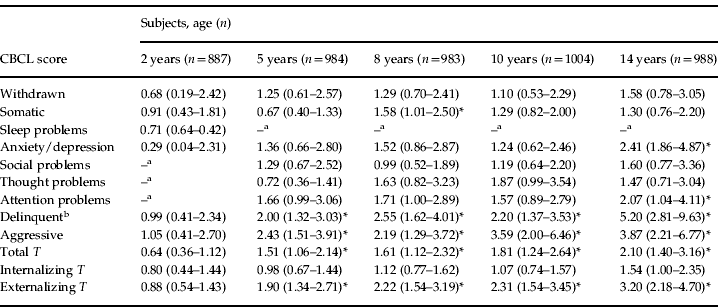
For each of the follow-up periods, we initially created binary scores for the internalizing, externalizing and total CBCL scores (i.e. total T⩾60) as well as for the eight individual syndrome scores (syndrome score ⩾67) (Achenbach, Reference Achenbach1991) and calculated unadjusted odds ratios (ORs) for each of these on the response variable of regular smoking at 17 years for each period of assessment. The unadjusted ORs (Table 1) suggested that most of the predictive relationship on regular smoking at age 17 years was carried by the CBCL delinquent and aggressive syndrome scores. These effects are then reflected in the composite externalizing score and, subsequently, into the composite CBCL total score. The internalizing score was not a significant predictor of regular smoking at age 17 years nor were the vast majority of the syndrome scores (i.e. withdrawn, somatic, anxiety-depression, social problems, and thought problems) that make up the internalizing score. We did note that at age 14 years the unadjusted OR of regular smoking at age 17 years was 2.41 (95% CI 1.86–4.87) for those 14-year-olds with anxiety/depression. Broadly though, the pattern of findings suggested that our analytic approach should use the externalising T score as the principal indicator of mental health morbidity.
Relationship between regular smoking at age 17 years and CBCL syndrome, internalizing, externalizing and total scores

CBCL, Child Behavior Checklist.
Data are given as unadjusted odds ratio (95% confidence interval).
a Not applicable.
b For the CBCL at age 2 years this estimate is for ‘Destructive’.
* p<0.05.
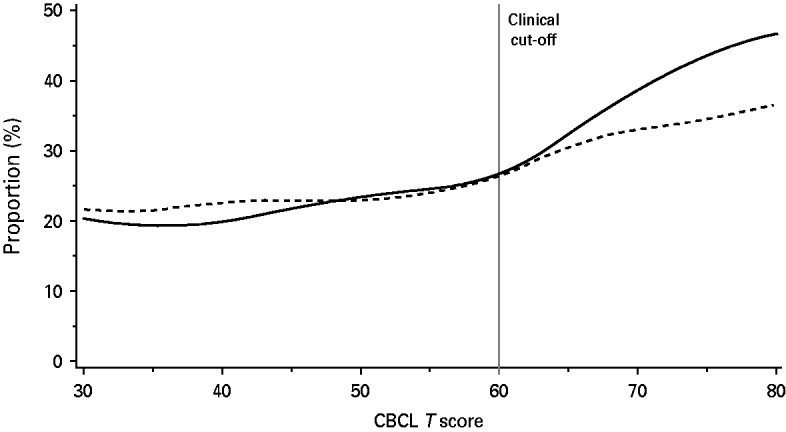
In regard to using the categorical rather than the continuous CBCL externalizing score, we had no a priori reason to assume a particular functional form for the relationship between T scores and smoking rates, either linear or otherwise. We fitted a non-parametric spline curve to the relationship using the generalized additive models framework (Hastie & Tibshirani, Reference Hastie and Tibshirani1986) for both the total T score and the externalizing T score and found that there was no appreciable variation in smoking rates in children with T scores that fell below the clinical cut-off. This suggested that there was no linear increasing relationship across the whole T score range, and that there was no appreciable loss of information in dichotomizing the T score at the recommended clinical cut-off (T⩾60) (Fig. 1). Thus, we use here the binary CBCL externalizing T score as our principal measure of what we will term here ‘clinically significant externalizing disorder’.
Proportion (%) of children smoking at age 17 years by Child Behavior Checklist (CBCL) total T score (– – –) and externalizing T score (——) measured at the age of 5 years.

Study participants were measured on the CBCL externalizing score at ages 2, 5, 8, 10 and 14 years and we created two variables to represent: (1) the age of first onset of clinically significant externalizing disorder (i.e. 2, 5, 8, 10 and 14 years); and (2) the pattern of clinically significant externalizing disorder over time. We identified three patterns of clinically significant externalizing disorder: (a) an ongoing pattern characterized by first onset at any age with a current clinically significant externalizing disorder at the last age of assessment; (b) a remitting pattern characterized by an onset of clinically significant externalizing disorder followed by a return to normal mental health status with no further periods of clinically significant externalizing disorder; and (c) an intermittent pattern characterized by periods of abnormal and normal mental health function.
Covariates
The reported longitudinal relationship between smoking and prior mental health status required the selection of several candidate covariates for possible inclusion in multivariate modelling.
Family-level variables
Total family income (before tax) at birth was classified into three groups: those earning less than A$24 000, those earning A$24 000 or more per year and those families who refused this item (n=38, 3.5%).
Family structure was differentiated as couple families v. sole parent families. For 11 families (1.0%) there was not sufficient information from which to classify family structure.
Maternal variables
Maternal age in years at the time of the birth of the study child was grouped into those mothers aged 14–19 years, those who were 20–34 years and those who were 35 years or more.
In Australia, at the time of the birth of the cohort, attending school for 10 years of education was compulsory. Maternal education at the birth of the child was classified into those mothers that had less than 10 years of schooling, 10 years of schooling, and 11 or more years of schooling.
At 18 weeks' gestation mothers were interviewed regarding their general health and well-being. They were asked about their use of cigarettes. Mothers were classified into six groups: those who reported smoking no cigarettes at the time of the interview, and those that were smoking 1–5, 6–10, 11–15, 16–20, or 20 or more cigarettes daily.
At 34 weeks of pregnancy, mothers were asked about selected life events in the period during the last 4 months. These life events included: death of a close relative; death of a close friend; separation or divorce; marital problems; problems with your children; your own job loss (non-voluntary); your partner's job loss (non-voluntary); money problems and residential move. These individual items were used to create a nine-point composite variable where higher scores represented higher levels of life events. For the purpose of this report three groups were created: Those with none, those with one or two life events and those with three or more.
In addition to this, when the child was 3 years of age, mothers were asked to complete the Bradburn Happiness Scale. This was one of the few survey scales available to measure aspects of self-reported mental health distress in the era in which the early years of the cohort data collection took place (McDowell & Praught, Reference McDowell and Praught1982). We used five of the Bradburn Happiness Scale items to create a composite measure of maternal mental health distress. Mothers were asked to report how often, over the past week, they had felt: (a) lonely or remote from other people; (b) depressed or very unhappy; (c) bored; (d) restless; and (e) upset because someone criticized you. We fitted a weighted least-squares model to estimate a composite measure using a congeneric measurement error model with polychoric correlations and an asymptotic covariance matrix as input. This resulted in an adequate fit (root mean square error of approximation <0.07). From this we used proportionally adjusted factor score regression weights (Rowe, Reference Rowe2006) to create a final composite measure with a very good scale reliability (H=0.85) (Hancock & Mueller, Reference Hancock, Mueller, Cudeck, Du Toit and Sörbom2001). Because the Bradburn data were collected of primary carers at the 3-, 5-, 8-, 10- and 14-year follow-ups we were able to establish the concurrent validity of this weighted composite measure with a well-established measure of mental health distress, the Depression, Anxiety and Stress Scales (DASS; Lovibond & Lovibond, Reference Lovibond and Lovibond1995). The DASS were administered at the 14-year follow-up. We observed that the distribution of the Bradburn composite score was similarly shaped to the distributions of the three DASS scores, and these DASS scores were each moderately correlated with the Bradburn composite score (ρ=0.58, 0.53, 0.58). We chose cut-points on the Bradburn composite scale measure that matched the percentile distribution of the DASS, and calibrated our composite measure into categories representing ‘low’, ‘moderate’, ‘mild’, ‘high’ and ‘severe’ mental health distress.
Child variables
Because of the known variation in mental health morbidity by gender, we included the child's gender as a covariate in the model.
Results
Data were screened and distributions inspected for outliers and incorrect values. Of the variables used in the logistic regression models, five had no missing data. For the other variables used, the amount of missing data ranged from 1.0% for the family composition variable to 28.7% for the onset and trajectory variables. The proportion of missing data for the onset and trajectory variables reflected the more complex composition of these variables – with the amount of missing data in the CBCL variables ranging from 5.8% at year 10 to 16.8% at year 2. To address this problem we carried out multiple imputation using IVEware (Imputation and Variance Estimation Software; University of Michigan, USA), which implements the fully conditional specification model of Raghunathan et al. (Reference Raghunathan, Lepkowski, Van Hoewyk and Solenberger2001, Reference Raghunathan, Solenberger and Van Hoewyk2002). We first imputed the CBCL abnormal binary scores for the total externalizing scores at each wave of data collection and then constructed the onset and pattern variables using all available data and imputed data. A total of 45 complete datasets were generated; each subsequent analysis was performed on each of the datasets and results were then combined using the mianalyze procedure in SAS (SAS Institute Inc., USA). This imputation approach is preferable to single imputation which substitutes a single number for each missing value in that the multiple imputation approach accounts for the variability in plausible replacement values (Rubin, Reference Rubin1987).
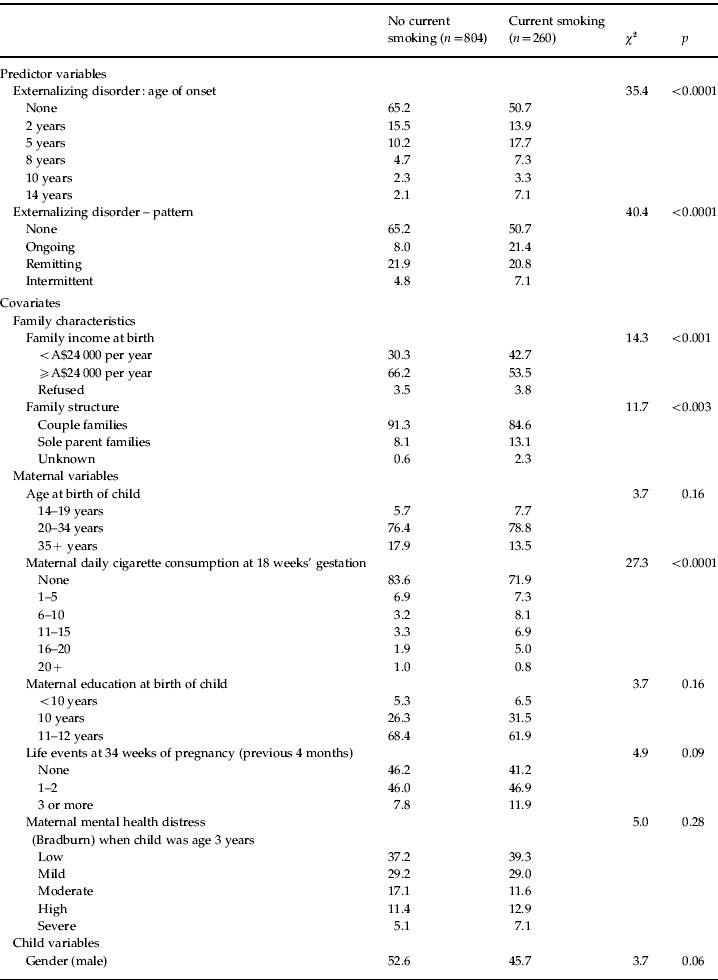
Table 2 summarizes the onset and pattern of clinically significant externalizing disorder for the study children, as well as the participant characteristics of the family, the mother and the child differentiated by current smoking status of the study child at age 17 years.
Participant characteristics: 17-year follow-up status differentiated by current smoking

Data are given as percentage.
A$, Australian dollars.
Statistically significant associations for both onset and pattern of clinically significant externalizing disorder and current smoking at age 17 years were evident. Relative to 17-year-old study children who were not current smokers, higher proportions of 17-year-old current smokers had clinically significant externalizing disorders at age 5 years (17.7% v. 10.2%) and at age 14 years (7.1% v. 2.1%, χ2=35.4, df=5, p<0.0001). With respect to pattern of clinically significant externalizing disorder, relative to 17-year-old study children who were not current smokers, those who were current smokers were significantly more likely to have an ongoing pattern of clinically significant externalizing disorder (21.4% v. 8.0%, χ2=40.4, df=3, p<0.0001).
There were significant associations between some covariates and current smoking at age 17 years. Relative to non-smokers, greater proportions of 17-year-old current smokers were observed where family income was less than A$24 000 per year at the time of the birth of the study child (42.7% v. 30.3%; χ2=14.3, df=2, p<0.001); in sole parent families (13.1% v. 8.1%, χ2=11.7, df=2, p<0.003); and where mothers reported at 18 weeks' gestation that their daily cigarette consumption was variously between six and 20 cigarettes per day (χ2=27.3, df=5, p<0.0001).
No statistically significant bivariate associations were observed between age 17 years current smoking status and the mother's age at the birth of the study child, maternal educational status at the time of the birth of the child, level of life events, maternal mental health distress when the study child was age 3 years, and the study child's gender.
Because of the known association between maternal mental health and maternal smoking, as well as between maternal mental health and mental health status in their offspring, we undertook adjustment for these factors through multiple logistic regression. However, because these multivariable analyses rely heavily on the parent as the informant for the study child's mental health status, we first undertook assessment of the extent to which changes in the informant affected the relationship between the child's current smoking status at age 17 years and prior assessment of the child's clinically significant externalizing disorder. We also collected self-report CBCL data at age 14 years from the study child (i.e. CBCL youth self report) as well as from the study child's classroom teacher (i.e. CBCL teacher report).
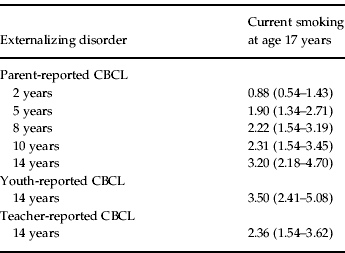
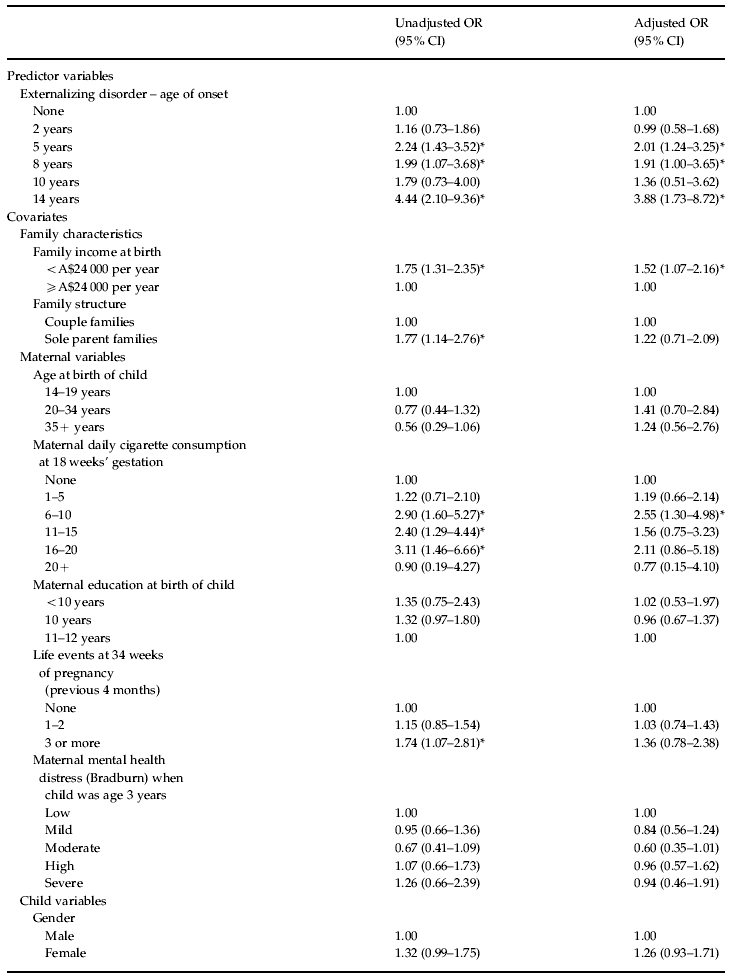
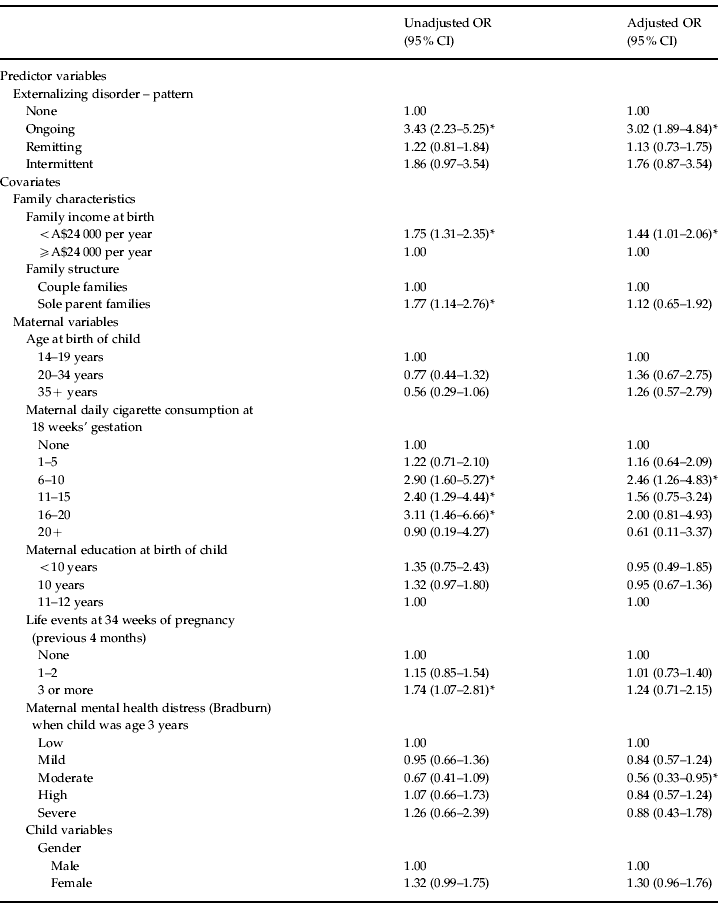
Table 3 shows the unadjusted ORs of current smoking at age 17 years estimated from parent report, youth self-report and teacher report of CBCL morbidity at various ages. For parent-reported CBCL, with the exception of the age 2 years estimate, the ORs of current smoking at age 17 years increased at each subsequent age, from 1.90 (95% CI 1.34–2.71) at age 5 years to 3.20 (95% CI 2.18–4.70) at age 14 years. We also observed a significantly increased OR of current smoking at age 17 years where the youth self-report of clinically significant externalizing disorder at age 14 years was positive (OR 3.50, 95% CI 2.41–5.08). This association held as well for the CBCL teacher reports of this at age 14 years (OR 2.36, 95% CI 1.54–3.62). Broadly then, we were encouraged that the relationship between the child's current smoking status at age 17 years and prior assessment of the child's clinically significant externalizing disorder appeared relatively robust across different informants. With this in hand, we used current smoking at age 17 years as the response variable to estimate two models – one for onset and one for pattern of clinically significant externalizing disorder as reported by the parent and adjusted for the covariates in a single step. Tables 4 and 5 contain the unadjusted and adjusted ORs along with their 95% CIs derived from the imputation method described above.
Logistic regression: risk for current smoking at age 17 years by prior parent, teacher and youth report of clinically significant externalizing disorderFootnote a

CBCL, Child Behavior Checklist.
Data are given as unadjusted odds ratio (95% confidence interval).
a Reference category is ‘no’ clinically significant externalizing disorder.
Logistic regression: risk for current smoking at age 17 years by age of onset for clinically significant externalizing disorder

OR, Odds ratio; CI, confidence interval; A$, Australian dollars.
* p<0.05.
Logistic regression: risk for current smoking at age 17 years by pattern of clinically significant externalizing disorder

OR, Odds ratio; CI, confidence interval; A$, Australian dollars.
* p<0.05.
Results with respect to age of onset showed that, relative to 17-year-olds who never had a clinically significant externalizing disorder, 17-year-olds who had an onset of clinically significant externalizing disorder at age 5, 8 or 14 years were, respectively, 2.0 (95% CI 1.24–3.25), 1.9 (95% CI 1.00–3.65) or 3.9 times (95% CI 1.73–8.72) more likely to be a current smoker (Table 4). Children from families with low income at the time of their birth were also about 1.5 times (95% CI 1.07–2.16) more likely to be a current smoker. Effects for family structure, age of the mother at the time of the birth of the study child, maternal education, number of life events, maternal mental health distress and study child gender were non-significant.
Results for the pattern variable showed that those children with an ongoing pattern of clinically significant externalizing disorder were 3.0 times (95% CI 1.89–4.84) more likely to be smokers at the age of 17 years and those whose mothers reported daily consumption of 6–10 cigarettes at 18 weeks' gestation were 2.5 times (OR 2.46, 95% CI 1.26–4.83) more likely to report smoking at 17 years of age (Table 5). Effects for remitting and intermittent patterns of clinically significant externalizing disorder were non-significant. For the covariates, effects for both low family income at 18 weeks' gestation and maternal smoking at 18 weeks' gestation remained significant with ORs similar to those reported for onset of clinically significant externalizing disorder. Effects for family structure, age of the mother at the time of the birth of the study child, maternal education, number of life events, and study child gender were non-significant, while maternal mental health distress when the child was aged 3 years was associated with the reduced risk of the child being a regular smoker at the age of 17 years (OR 0.6, 95% CI 0.33–0.95) when considered concurrently with a range of other factors.
Finally, we were interested to note from Table 1 that at age 14 years there was a significant relationship between the CBCL anxiety/depression syndrome score and subsequent regular smoking at age 17 years (OR 2.41, 95% CI 1.86–4.87). As some of these 14-year-olds could have been regarded as regular smokers by this age, we removed them and recalculated this effect for the 14-year-olds who were not regular smokers. The estimated OR was non-significant.
Discussion
Current scientific findings addressing the relationship between cigarette smoking and mental health increasingly demonstrate causal complexity in putative contributing factors and their ordering. The repeated finding across time, location and varying methodologies that cigarette smoking and clinically significant mental health disorders are correlated has demanded greater longitudinal scrutiny of the range of processes – environmental, biological and genetic – and their causal ordering that underpin this association. Boden et al. (Reference Boden, Fergusson and Horwood2010) observed: ‘... [in] establishing that smoking and depression are related even following control for confounding is an important step in ascertaining a causal relationship between smoking and depression. However, such analysis does not resolve the issue of the direction of causality: even with well collected data, establishing which factor is antecedent and which factor is consequent proves difficult (p. 440)’.
There are some features of our findings that merit specific comment. First, much of the existing literature has supported a relatively robust association between smoking and depression specifically, with some findings extending this to include anxiety. As we noted in our Introduction, these associations are predominately based upon adult and adolescent samples modelled in cross-sectional and longitudinal data (Brown et al. Reference Brown, Lewinsohn, Seeley and Wagner1996; Breslau et al. Reference Breslau, Peterson, Schultz, Chilcoat and Andreski1998; Wu & Anthony, Reference Wu and Anthony1999; Johnson et al. Reference Johnson, Cohen, Pine, Klein, Kasen and Brook2000; Boden et al. Reference Boden, Fergusson and Horwood2010). While the association between early internalizing mental health disorders (i.e. depression and anxiety) and subsequent regular smoking might be expected on the basis of research findings from predominately older samples, our findings in early childhood demonstrate that this association is evident for externalizing symptomology, not internalizing symptomology.
Kessler (Reference Kessler2004) noted that retrospective data consistently found mental disorders to start earlier than substance disorders. He also noted that when using prospectively collected data, relationships between mental health disorder and smoking showed more mixed associations, with both externalizing and internalizing outcomes and more reciprocal effects between smoking and mental health outcomes (Kessler, Reference Kessler2004). Where antecedent maternal smoking is modelled from pregnancy, the documented effects in the mental health of offspring have predominately revealed associations with externalizing disorder (Fergusson et al. Reference Fergusson, Woodward and Horwood1998; Brennan et al. Reference Brennan, Grekin and Mednick1999; D'Onofrio et al. Reference D'Onofrio, Van Hulle, Waldman, Rodgers, Harden, Rathouz and Lahey2008), but, once again, this is not exclusively so (Ashford et al. Reference Ashford, Van Lier, Timmermans, Cuijpers and Koot2008). It is important though to emphasize here the general lack of longitudinal studies that have ascertained the mental health status of children at points before the emergence of regular smoking by them. Our findings suggest that the early pathway to later regular smoking may be through early maternal exposure to smoking, subsequent emergent externalizing disorder with the onward uptake of regular smoking. Despite this, it is noteworthy that by age 14 years emergent depression/anxiety is a risk factor for subsequent smoking.
Second, we found no significant independent association between early maternal mental health distress (i.e. when the child was age 3 years) and the child's subsequent current smoking status when they were age 17 years. In fact, the only significant effect observed here was for a reduction in the odds of regular smoking at age 17 years associated with moderate maternal mental health distress for children with an ongoing pattern of externalizing disorder. In contrast, early maternal smoking (i.e. in pregnancy) independently predicted the child's smoking status when the child was age 17 years. These findings suggest that current smoking in 17-year-olds may be underpinned by antecedent contributions from exposure to early maternal smoking and early emergent, and then, ongoing, clinically significant externalizing disorder that commenced as young as age 5 years. So the pathways that govern the observed association between clinically significant externalizing disorder and smoking may have their genesis at very early points in development. Note that while the value of these findings is in the extension of the observation of the association between mental health and smoking to earlier developmental epochs, the findings still leave open the larger question of causal ordering. The findings here suggest that the associations documented in adults and adolescents that link tobacco smoking and mental health are likely to be in play at these equally early points in development.
There are limitations to this report. First, the sample size is small relative to the power needed to rigorously test all of the causal pathways of interest and examine extensively for confounding. The principal concerns here are in interpreting the relationships between early maternal smoking, early maternal mental health distress, emergent child mental health morbidity and subsequent child smoking at age 17 years. Only a partial view of all of these relationships across time is possible to construct from these data. Second, sample attrition over time has biased the sample in favour of families that are more highly educated, intact and affluent, where the mother was less likely to smoke or less likely to report higher levels of mental health distress and where children were more mentally healthy. The broad effect of this bias is likely to result in an underestimate of the effects reported here.
With these limitations in mind, what can be taken from these findings?
First, the pathways that link smoking and mental health start quite early in life. In finding a unidirectional relationship from smoking in late childhood to subsequent depressed mood in early adolescence, Wu & Anthony (Reference Wu and Anthony1999) suggested that a focus on this developmental stage had the advantage of limiting the ‘array of confounding variables’ that might govern this relationship. It is not clear from what we observe here that this is so. Our findings suggest that smoking and mental health continue to be associated at very early developmental periods. In this regard our findings are more similar to the observations made by Fergusson et al. (Reference Fergusson, Lynskey and Horwood1996) that common or correlated factors in late childhood (i.e. about the age of 11 years) explain the association between smoking and depression and nicotine dependence at age 16 years.
Second, with respect to the causal ordering of smoking and clinically significant externalizing disorder, our findings beg the more general question – when do children ‘start’ to smoke. Certainly we see in these findings the onward independent contribution of the child's clinically significant externalizing disorder from age 5 years to the increasing odds of smoking at age 17 years. And we also see the contribution that maternal smoking during pregnancy makes to the increased odds of the child smoking at age 17 years. However, we have also previously shown that maternal smoking in pregnancy resulted in clinically significant behaviour problems in children from ages 2 to 14 years (Robinson et al. Reference Robinson, McLean, Oddy, Mattes, Bulsara, Li, Zubrick, Stanley and Newnham2010). Taken together these findings, at an earlier developmental epoch, echo observations made by Hemmingsson et al. (Reference Hemmingsson, Kriebel, Tynelius, Rasmussen and Lundberg2008) that individuals with good mental health in adolescence were better than those with poor mental health at quitting smoking later in life. They also give force to Breslau & Peterson's observation that early smoking predisposes to later chronic use (Breslau & Peterson, Reference Breslau and Peterson1996) where, in the case of our findings here, ‘early’ may also include prenatal and early childhood exposures to smoking.
Finally, in calling for a ‘general model that shows the linkages between genetic and life course factors, and smoking and depression onset’, Fergusson et al. (Reference Fergusson, Lynskey and Horwood1996) noted the considerable difficulties faced by researchers in reconciling the causal pathways that were likely to govern this relationship. Our findings here should encourage steps toward a more comprehensive longitudinal model that assesses the magnitude of association between early tobacco exposures, the onset and pattern of clinically significant externalizing disorder, and the subsequent establishment of tobacco use and nicotine dependence. In the development of this more general model the ability to observe the onset and duration of both smoking and clinically significant externalizing disorder over time, in samples sufficiently powered to enable assessing confounding will be critical to advancing our understanding of these processes (Kessler, Reference Kessler2004; Ziedonis et al. Reference Ziedonis, Hitsman, Beckham, Zvolensky, Adler, Audrain-McGovern, Breslau, Brown, George, Williams, Calhoun and Riley2008). Of particular value will be those studies that have adequately measured passive exposures to smoking in utero and that have better longitudinal measurement of child and parental mental health, coupled with measures of parental smoking and the initiation and subsequent smoking behaviour of children as they develop.
Acknowledgements
We are grateful to all the families who took part in this study. We also thank the Raine Study Team for cohort coordination and data collection. Funding for Core Management of the Raine Study is provided by The University of Western Australia (UWA); The Telethon Institute for Child Health Research; Raine Medical Research Foundation; UWA Faculty of Medicine, Dentistry and Health Sciences; Women and Infants Research Foundation; Curtin University of Technology. We also acknowledge the National Health and Medical Research Council (NH&MRC) for long-term contribution to funding as well as The Telethon Institute for Child Health Research.
Declaration of Interest
None.