Introduction
It is widely acknowledged in the post-conflict field that the family environment plays an important role in shaping individual mental health responses to trauma exposure (Hinton et al. Reference Hinton, Rasmussen, Nou, Pollack and Good2009; Rees et al. Reference Rees, Thorpe, Tol, Fonseca and Silove2015). Remarkably, however, there is a dearth of community-based studies examining the mental health of partners of survivors exposed to high levels of trauma in these settings. Drawing on data from an epidemiological survey in post-conflict Timor-Leste, we apply latent class analysis (LCA) to assess rates of post-traumatic stress disorder (PTSD), severe psychological distress, explosive anger and grief symptoms amongst men and women partners of survivors of high levels of trauma (Silove et al. Reference Silove, Liddell, Rees, Chey, Nickerson, Tam, Zwi, Brooks, Sila and Steel2014b ).
Relevant past studies in the field have focused exclusively on women partners of combat and war veterans (Solomon et al. Reference Solomon, Waysman, Levy, Fried, Mikulincer, Benbenishty, Florian and Bleich1992; Ben Arzi et al. Reference Ben Arzi, Solomon and Dekel2000; Dekel & Solomon, Reference Dekel and Solomon2006; Greene et al. Reference Greene, Lahav, Bronstein and Solomon2014; Zerach et al. Reference Zerach, Greene and Solomon2015). In the war-affected former Yugoslavia, wives of combat and other war veterans were found to manifest high levels of depression, generalized anxiety, panic, suicidal ideation and interpersonal difficulties (Francisković et al. Reference Francisković, Stevanović, Jelusić, Roganović, Klarić and Grković2007; Klarić et al. Reference Klarić, Frančišković, Obrdalj, Petrić, Britvić and Zovko2012; Peraica et al. Reference Peraica, Vidović, Petrović and Kozarić-Kovačić2014). Mechanisms postulated to account for these dyadic patterns include: vicarious traumatization (the notion that partners over-identify with and/or incorporate the survivor's mental health symptoms); loss of intimacy; aggressive tendencies amongst male combat veterans; and family isolation and loss of social support (Ben Arzi et al. Reference Ben Arzi, Solomon and Dekel2000; Dekel & Solomon, Reference Dekel and Solomon2006; Francisković et al. Reference Francisković, Stevanović, Jelusić, Roganović, Klarić and Grković2007; Klarić et al. Reference Klarić, Frančišković, Obrdalj, Petrić, Britvić and Zovko2012; Greene et al. Reference Greene, Lahav, Bronstein and Solomon2014).
The sole focus on women partners of male combat veterans represents a major limitation in the field (Solomon et al. Reference Solomon, Waysman, Levy, Fried, Mikulincer, Benbenishty, Florian and Bleich1992; Ben Arzi et al. Reference Ben Arzi, Solomon and Dekel2000). It is common for members of both genders to be exposed to mass conflict, as exemplified by the recent history of Timor-Leste, the site of the present study. During the long period of the Indonesian occupation (1975–1999) of the country, all sectors of the population were exposed to widespread human rights violations, including murder, atrocities, disappearances and forced separations (Modvig et al. Reference Modvig, Pagaduan-Lopez, Rodenburg, Salud, Cabigon and Panelo2000). Men engaged in the armed resistance were directly exposed to combat, incarceration and torture. Women who assisted the resistance movement were targeted by the military for abuse, assault and other forms of victimization (Rees et al. Reference Rees, Silove, Verdial, Tam, Savio, Fonseca, Thorpe, Liddell, Zwi, Tay, Brooks and Steel2013; Silove et al. Reference Silove, Ivancic, Rees, Bateman-Steel and Steel2014a ). Following national independence (2002), a period of internal violence (2006–2007) resulted in further deaths, injuries, the burning of houses and the extensive internal displacement of communities (Silove et al. Reference Silove, Zwi and le Touze2006). In our past studies, we demonstrated that both men and women exposed to violence in Timor-Leste exhibited symptoms of PTSD, severe psychological distress (including depression, anxiety and somatic complaints) and explosive anger and aggression (Silove et al. Reference Silove, Brooks, Bateman Steel, Steel, Hewage, Rodger and Soosay2009; Brooks et al. Reference Brooks, Silove, Steel, Steel and Rees2011; Rees et al. Reference Rees, Silove, Verdial, Tam, Savio, Fonseca, Thorpe, Liddell, Zwi, Tay, Brooks and Steel2013, Reference Rees, Thorpe, Tol, Fonseca and Silove2015).
As yet, however, there are no studies examining whether men and women differ in their patterns of mental health responses when living with a partner exposed to high levels of trauma in post-conflict settings. In general, women in both conflict-affected and civilian environments show higher rates of common mental disorders such as depression, anxiety and PTSD (Tolin & Foa, Reference Tolin and Foa2006; Rees et al. Reference Rees, Silove, Verdial, Tam, Savio, Fonseca, Thorpe, Liddell, Zwi, Tay, Brooks and Steel2013). Women appear to be especially susceptible to PTSD after exposure to interpersonal traumas such as witnessing or hearing of the death or injury of someone close (Tolin & Foa, Reference Tolin and Foa2006). Whether this increased susceptibility amongst women extends to living with a partner exposed to high levels of trauma remains to be determined.
Classifying couples according to joint patterns of trauma exposure presents several challenges. In all conflicts, the level of exposure to persecution and trauma varies across individuals and within families. Given that many members of couples in our study were children or adolescents during the major period of conflict associated with the Indonesian occupation (1975–1999), we anticipated finding a heterogeneous pattern of trauma exposure within dyads. In order to achieve an independent typology, we employed a widely used statistical method, multilevel LCA, in this instance using trauma exposure as the clustering variable and the dyad as the unit of classification. The utility of LCA in related fields of research has been well demonstrated, for example, in generating a typology based on patterns of intimate partner violence (Sipsma et al. Reference Sipsma, Falb, Willie, Bradley, Bienkowski, Meerdink and Gupta2015).
The aims of the study were: (1) to identify classes of couples based on their dyadic patterns of trauma exposure; (2) based on the derived classes, to test whether partners living with survivors with higher levels of trauma exposure exhibited increased symptoms of PTSD, severe psychological distress, explosive anger and grief; and (3) to examine whether women showed higher rates of mental health symptoms compared with men when living with a partner exposed to high levels of trauma.
Method
Sample
The study was undertaken between May 2010 and November 2011 in an urban administrative area (suco) of Dili, the capital of Timor-Leste, and a rural location an hour's drive away. Each suco is defined by contiguous hamlets (aldeias) administered by one chief (chefe). We achieved maximal coverage of households, including those in mountainous areas, by using Global Positioning System (GPS) coordinates and aerial maps generated by the National Directorate of Statistics. Both the rural and urban sites were directly affected by the longstanding resistance war against the Indonesian occupation and by the subsequent episode of internecine conflict of 2006–2007.
Participants and procedure
All residents 18 years and older were eligible to participate. Excluded were persons with overt psychosis, severe cognitive impairment or other disabilities preventing participation. We conducted door-to-door visits of all households, returning up to five times (including in the evenings and weekends) to attempt to make contact with all adult residents. Of the 3597 adults identified, 165 persons were excluded because of disability (mental, intellectual or physical). Of the remaining 3432 adults, 2964 individuals completed interviews, a response rate of 86.4% [non-response was due to refusal (n = 81) and inability to make contact (n = 387)]. The analytic sample comprised 677 dyads (n = 1354 individuals) defined as men and women who were married or living in marital-type relationships in the same household. We refrain from referring to husbands and wives because couples commonly live in conjugal relationships prior to formal marriage in Timor-Leste. We did not attempt to identify same-sex couples because of prevailing taboos against this practice in Timorese society.
Interviews in participants’ homes lasted approximately 1 h and were conducted under conditions of strict privacy and confidentiality. Items and response options were read out to non-literate participants. Questionnaires were checked on-site for missing values and again on return to the research office. Random checks were made on electronically entered data for missing or out-of-range values.
The study was approved by the Human Research Ethics Committee of the University of New South Wales, the Ministry of Health of Timor-Leste, and the chiefs of each village.
Field team
A total of 18 Timorese field workers with extensive prior mental health survey experience, most holding psychology or public health degrees, undertook the interviews. The field personnel received a 2-week training course followed by 2 months of field testing and piloting of survey measures under supervision. Pairs of interviewers were required to achieve a consistent 100% level of inter-rater reliability on the core symptom measures.
Measures
All measures were translated into Tetum, the most widely spoken language in Timor. The final versions were back-translated using recommended international procedures (Van Ommeren et al. Reference Van Ommeren, Sharma, Thapa, Makaju, Prasain, Bhattarai and De Jong1999).
Exposure to conflict-related traumatic events (TEs)
We assessed the 17 conflict-related TEs listed in the Harvard Trauma Questionnaire (HTQ) (Mollica et al. Reference Mollica, Caspi-Yavin, Bollini, Truong, Tor and Lavelle1992), modified to the context of Timor-Leste. To assist recall, we dated TEs according to two historical periods: the period leading up to independence in 2002 which included the Indonesian occupation (1975–1999) and humanitarian emergency (1999–2000), and the subsequent period which included the internal conflict (2006–2007). The 10 TEs used herein represented those previously identified by confirmatory factor analysis as being directly related to mass conflict. Typical items referred to torture, arbitrary imprisonment, physical assault, witnessing murder, experiencing traumatic loss of family or others and exposure to atrocities (Brooks et al. Reference Brooks, Silove, Steel, Steel and Rees2011). A score of 1 was assigned for exposure to a TE occurring at any time during these two epochs of conflict, generating a total TE score of 0–10 for each person.
Mental health measures
In the development of measures, we conducted an iterative process of field testing and review by a committee comprising Timorese members from a range of backgrounds and members of the expatriate research team, the procedure allowing serial refinement of constructs, items and response options. The overall objective was to ensure the cultural, semantic and linguistic appropriateness of the measures, an outcome that was judged to have been achieved when no further refinements were deemed necessary by the committee (Silove et al. Reference Silove, Liddell, Rees, Chey, Nickerson, Tam, Zwi, Brooks, Sila and Steel2014b ).
Symptoms of PTSD and severe psychological distress
PTSD symptoms were assessed using the HTQ (Mollica et al. Reference Mollica, Caspi-Yavin, Bollini, Truong, Tor and Lavelle1992), comprising 16 items scored on a four-point scale (1 = none, 2 = some of the time, 3 = a lot of the time, 4 = most of the time). The total symptom score is derived by dividing the sum of item scores by the number of items (range 1.0–4.0). The Kessler-10 (K10) scale (Furukawa et al. Reference Furukawa, Kessler, Slade and Andrews2003) consists of 10 items that generated an index of psychological distress comprising mainly depressive but also some anxiety and somatic symptoms. Each item is scored on a five-point scale (1 = none, 2 = a little of the time, 3 = some of the time, 4 = most of the time, 5 = all of the time). Both the HTQ and K10 symptom scales demonstrated high levels of internal reliability (HTQ PTSD, α = 0.95; K10 psychological distress, α = 0.92).
A previous study drawing on a stratified sample of 97 community participants in Timor-Leste compared the HTQ and K10 with the relevant categories of PTSD and major depressive disorder assigned independently by psychologists using the Structured Clinical Interview for the Diagnostic and Statistical Manual of Mental Disorders, 4th edition (DSM-IV) (Liddell et al. Reference Liddell, Silove, Tay, Tam, Nickerson, Brooks, Rees, Zwi and Steel2013). We found sound levels of convergence for each measure: area under the curve (AUC) for PTSD 0.82 [95% confidence interval (CI) 0.71–0.94]; for the K10, AUC 0.79 (95% CI 0.67–0.91). Based on the best balance between sensitivity (77.3%) and specificity (87.5%), a score of 2.2 was adopted as the cut-off for PTSD on the HTQ (correct classification 83%), and for the K10, the international cut-off ⩾30 (sensitivity 92.3%; specificity 66%; correct classification 71%), noting that the inclusion of symptoms of anxiety and somatic complaints in the K10 most probably contributed to the lower level of specificity for that measure. In addition, a 6-year longitudinal study found a manifold increase in PTSD and severe psychological distress following the internal conflict that intervened at the midpoint of the follow-up period (Silove et al. Reference Silove, Liddell, Rees, Chey, Nickerson, Tam, Zwi, Brooks, Sila and Steel2014b ), attesting to the ecological validity of the two measures as sensitive indicators of trauma-related distress in this setting.
Symptoms of explosive anger
Our community measure of explosive anger was tested and modified serially during piloting to ensure its cultural appropriateness and comprehensibility in the local language, Tetum. In a two-stage procedure, screening questions determined the presence of sudden episodes or attacks of anger (at least once a month over several months), leading to inquiry into core symptoms of DSM-IV intermittent explosive disorder (IED; loss of control, destruction of property, verbal aggression, and physical aggression towards others). The measure yielded a high level of concordance (AUC 0.90, 95% CI 0.83–0.98) with IED assignments made independently by psychologists using the Structured Clinical Interview for DSM-IV (Liddell et al. Reference Liddell, Silove, Tay, Tam, Nickerson, Brooks, Rees, Zwi and Steel2013). We applied the total explosive anger score based on a previously established algorithm (Liddell et al. Reference Liddell, Silove, Tay, Tam, Nickerson, Brooks, Rees, Zwi and Steel2013).
Grief symptoms
We inquired whether participants had experienced a loss, represented by the death of someone close (for example, a family member, relative, or friend) in one of five consecutive time periods: the last 6 months, the last 5 years, following national independence (1999), during the Indonesian occupation (1975–1999), and prior to that period (pre-1975). Those identifying a loss rated four items on a five-point scale (0 = almost never, 1 = rarely, 2 = sometimes, 3 = often, 4 = always) as experienced in the past 4 weeks. The item pool was derived from common descriptions of grief (Maercker et al. Reference Maercker, Brewin, Bryant, Cloitre, van Ommeren, Jones, Humayan, Kagee, Llosa, Rousseau, Somasundaram, Souza, Suzuki, Weissbecker, Wessely, First and Reed2013), the process of field testing and refinement identifying symptoms that were comprehensible and judged to be common in the community. These symptoms comprised persistent yearning/longing for the deceased, feelings of intense bitterness, a sense of emptiness in relation to the death, and level of functional impairment related to the loss. The addition of endorsed items (present = 1, absent = 0) generated a total symptom score (0–4). Internal reliability was a satisfactory 0.87.
Statistical analysis
In the first step, descriptive statistics were generated for sociodemographic variables, prevalence of TEs, and mental health indices for men and women partners. McNemar's test assessed the level of concordance within dyads on core indices. Following the recommended preliminary step in undertaking a dyadic analysis (Ledermann & Macho, Reference Ledermann and Macho2009), we assessed the independence of trauma counts within couples by applying intra-class correlations based on one-way analysis of covariance.
We applied mixture multilevel LCA with the dyad as the unit of analysis. We followed the standard practice of testing serial models, commencing with one class and increasing the number of classes progressively until a best-fitting solution was achieved. Conventional indicators assessed change in model fit as the number of classes was increased seriatim (see online Supplementary Table S1). The sample size-adjusted Bayesian information criterion (SS-BIC) and the Akaike information criterion (AIC) introduce penalties for adding additional variables, adjusting for over-fitting of models. Entropy assesses classification accuracy on a score of 0–1 (Nylund et al. Reference Nylund, Asparouhov and Muthen2007). Overall, lower values of the BIC and SS-BIC and higher values of entropy indicate a better fit in comparing successive latent class models. In addition, we applied the Vuong–Lo–Mendell–Rubin adjusted likelihood ratio test which compares the fit of a preceding latent class model (of n classes) with the one that follows (n + 1 classes) (Collins et al. Reference Collins, Fidler, Wugalter and Long1996). A statistically significant test indicates that the model with an additional class is an improvement on the preceding model.
Consistent with convention, we considered a comprehensive set of factors in selecting the final model, including the model fit indicators, the principle of parsimony (fewer classes generally being preferred), the degree of class separation, homogeneity of conditional probabilities within classes; and, importantly, in this context, the interpretability of the class structure both in relation to the known history of Timor-Leste and the capacity of the model to test our hypotheses.
In the final step, we examined associations between the derived classes and the four mental health indices using random-effects multilevel logistic regression models. The models were multilevel in that they accounted for both dyadic (the couple as a unit) and individual effects, that is, the pattern of trauma experienced by each member. The four mental health outcomes were specified as covariates of level-1 latent classes.
Our primary focus was to compare members of dyads in classes where partners had higher v. lower levels of trauma exposure. The results of our comparisons, expressed as odds ratios (ORs) and 95% CIs, indicate higher rates of the relevant mental health index in partners of survivors with higher levels of trauma exposure, the reference class representing couples where both members had relatively lower levels of trauma exposure. For brevity and clarity, we use the terms higher, intermediate and lower to characterize relative differences in trauma exposure, acknowledging the substantial level of trauma that the population as a whole had experienced. The analysis was performed using STATA version 13 (USA) and Mplus version 7 (http://statmodel2.com/verhistory.shtml).
Results
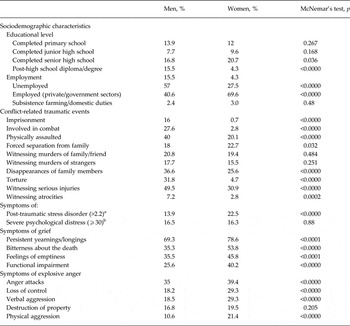
Table 1 details the descriptive statistics of the sociodemographic characteristics, TEs and mental health indices recorded by gender. The mean age of men and women was 43.5 (s.d. = 12.47) and 38.9 (s.d. = 12.1) years, respectively. Men had higher levels of education, in relation to post-school degrees or diplomas, compared with women. More women than men were in paid employment in the private or government sectors.
Sociodemographic characteristics, conflict-related trauma exposure and mental health indices by gender across the sample of couples (n = 677 persons)

a Measured by the Harvard Trauma Questionnaire. Cut-off score of total symptom count based on prior convergence study using the Structured Clinical Interview for post-traumatic stress disorder in Timor-Leste.
b Based on the international threshold symptom count which provided the best balance between sensitivity and specificity in the convergence study in Timor-Leste.
As anticipated, both men and women experienced high rates of trauma. Men reported greater exposure to torture, incarceration and combat but gender differences were less marked for common events of conflict such as forced separations, witnessing murders and atrocities, and exposure to injury of others.
There was negligible clustering in relation to trauma exposure within couples, allowing further analysis to be conducted at both the dyadic and individual level without violating assumptions of independence of the data.
Dyadic latent class analysis
Testing of serial LCA models offered support for a three-class solution, as indicated by lower values of the BIC, SS-BIC and AIC compared with the preceding two-class model (online Supplementary Table S1). The addition of a fourth class yielded only marginal and non-significant gains on all indicators. In addition, the difference in entropy was modest when progressing from a three- to a four-class model. Importantly, the clusters yielded by the three-class model were readily interpretable in relation to the context of Timor-Leste and allowed a critical test of our hypotheses.
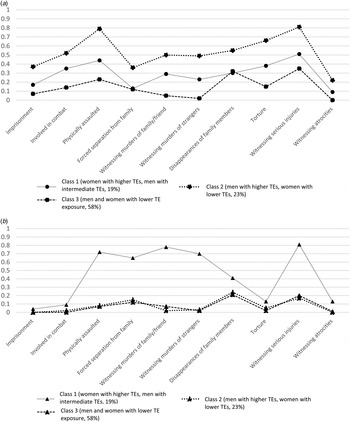
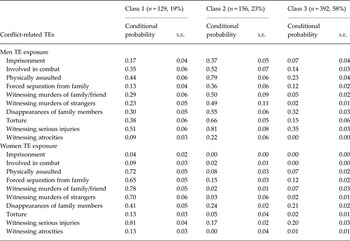
Table 2 and Fig. 1 present the posterior probabilities for TEs for men and women in the three-class dyadic model. Class 1 (n = 129 couples, 19% of sample) comprised women with higher levels of TE exposure and men with intermediate TE exposure; class 2 (n = 156, 23%) included men with higher TE exposure and women with lower TE exposure; and class 3 (n = 392, 58%) included couples in which men and women both had lower levels of TE exposure.
Conditional item probabilities for endorsement of conflict-related traumatic events (TEs) based on the estimated joint three-class latent class analysis model for men and women partners. (a) Men's reports of TEs. (b) Women partners’ reports of TEs.

Conditional probabilities of conflict-related TEs across the three latent classes (class 1: women with higher, men with intermediate trauma exposure; class 2: men with higher, women with lower trauma exposure; class 3: lower trauma exposure in both men and women) a

TE, Traumatic event; s.e., standard error.
a Note that the terms higher, intermediate and lower indicate relative differences within each gender, given that there was substantial TE exposure across the sample as a whole.
In class 1 (comprising women with higher and men with intermediate TE exposure), women exhibited very high conditional probabilities for physical assault, witnessing the murder of family, friends and strangers, and witnessing serious injuries. Although conditional probabilities for witnessing serious injuries, combat and physical assault amongst men partners in this class were appreciable, these indices did not approach the high level exhibited by women. In class 2 (higher TE exposure amongst men, lower exposure amongst women), men exhibited high to moderate conditional probabilities for physical assault, torture, witnessing serious injuries, and witnessing the murder of family, friends and strangers. For women partners in class 2, conditional probabilities for TEs were generally low, although some TEs fell into the low–moderate range including forced separation, disappearances of family members, and witnessing serious injuries. In class 3 (lower TE exposure for both men and women), most conditional probabilities for both genders fell into the low/low–moderate probability range.
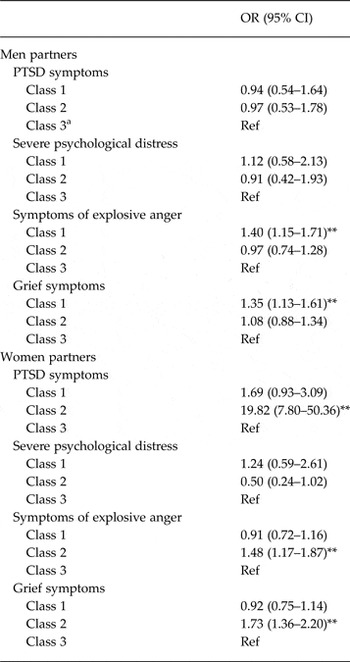
Table 3 reports the findings of the multilevel, conditional LCA model that includes the four mental health indices as covariates. Statistically significant ORs indicate that there is an increased prevalence of the relevant mental health index relative to the reference class (class 3). Men in class 1 (comprising women with higher TEs and men with intermediate TEs) manifested increased rates of explosive anger (OR = 1.40, 95% CI 1.15–1.71, p < 0.001) and grief (OR = 1.35, 95% CI 1.13–1.61, p < 0.001) compared with their counterparts in the reference group. Symmetrical findings were evident in class 2 (women living with men with higher TE exposure) in that women exhibited higher levels of explosive anger (OR = 1.48, 95% CI 1.17–1.87, p < 0.001) and grief (OR = 1.73, 95% CI 1.36–2.20, p < 0.001) compared with women in the reference class.
Associations of classes with mental health indices (PTSD, severe psychological distress, explosive anger, grief) in partners: a conditional multilevel latent class analysis

PTSD, Post-traumatic stress disorder; OR, odds ratio; CI, confidence interval; Ref, reference.
a In all analyses, class 3 is the reference class.
** p < 0.01.
The singular gender difference that emerged related to PTSD symptoms. Women in class 2 (where men had higher TE exposure and women lower TE exposure) exhibited a marked increase in PTSD symptoms (OR = 19.82, 95% CI 7.80–50.36, p < 0.001) noting, however, that the CIs for this analysis were wide, indicating heterogeneity in the findings. In contrast, men exposed to intermediate levels of trauma living with women partners with higher levels of trauma (class 1) exhibited no increase in PTSD symptoms compared with their counterparts in the reference class 3.
Discussion
The study is novel in demonstrating a distinctive pattern of mental health responses amongst partners of survivors of high levels of trauma in this post-conflict setting. Both men and women showed increased rates of explosive anger and grief when living with opposite-gender survivors who had been exposed to higher levels of trauma during the preceding periods of mass conflict. However, only women showed an increased level of PTSD symptoms when living with a partner with higher TE exposure; men in the comparable dyadic setting exhibited no greater PTSD rates than counterparts in the reference group.
The strengths and limitations of the study require consideration. The analysis was based on a large and rigorously recruited sample and we achieved a high response rate. There was no evidence of clustering in relation to key variables, allowing analyses to be conducted at the dyadic and individual levels. Although the risk of retrospective bias in reporting past trauma is a possible confound, the pattern of events recorded for men and women was consistent with the known history of conflict in the country. Restriction of sampling to two localities limits the generalizability of our findings, making it imperative to replicate the study in other communities in Timor-Leste and in post-conflict countries worldwide.
A systematic approach was followed in the transcultural adaptation, translation and testing of measures (Liddell et al. Reference Liddell, Silove, Tay, Tam, Nickerson, Brooks, Rees, Zwi and Steel2013). Although the transcultural validity of PTSD as a construct has been questioned in the past (Summerfield, Reference Summerfield2001), there now is ample evidence that the reaction occurs across diverse societies (Steel et al. Reference Steel, Chey, Silove, Marnane, Bryant and Ommeren2009). We pursued a rigorous process of field testing and consultation to ensure that the PTSD construct was recognized as a form of distress in the community. In addition, the measure of PTSD was tested against a ‘gold standard’ clinical interview in Timor-Leste, yielding a sound level of convergence. Furthermore, a past longitudinal study found that PTSD levels escalated substantially following the period of internal conflict in Timor-Leste, attesting to the ecological validity of our measure in identifying an index of distress that was highly sensitive to recurrent trauma exposure (Silove et al. Reference Silove, Liddell, Rees, Chey, Nickerson, Tam, Zwi, Brooks, Sila and Steel2014b ; Tay et al. Reference Tay, Rees, Steel, Tam, Soares, Soares and Silove2016).
LCA is an appropriate statistical approach for deriving a typology based on the variable of interest, in this instance, exposure to conflict-related trauma. The strength of the method is that an independent set of indicators guides the researcher in selecting the best-fitting model. In reaching that judgement, however, other considerations are taken into account, including the ecological validity of the class structure produced, in this instance, based on the extent to which the classes conformed to the known history of conflict in Timor-Leste. In addition, the principle of parsimony guides the researcher towards selecting the model of good fit that includes the smallest number of classes. The risk of including a wide array of classes (for example, all those listed in online Supplementary Table S2) is that statistical analysis would be confounded by small cell sizes and the need for multiple comparisons (each class v. all others). Even if these analyses could be undertaken, it is unlikely that the findings would allow meaningful interpretation.
It is noteworthy that no dyadic pattern emerged for the index of severe psychological distress, consistent with past evidence that symptoms of depression and anxiety in post-conflict settings may be more directly associated with broader influences such as socio-economic deprivations and extreme poverty (Porter & Haslam, Reference Porter and Haslam2005). There was a symmetrical gender pattern for explosive anger and grief, manifesting in both men and women living with a survivor exposed to higher levels of trauma. A full 40% of couples conformed to this pattern (that is, those in classes 1 and 2). Families in which one partner has been exposed to extensive conflict-related trauma and the other is experiencing high levels of grief and anger are likely to be unstable and prone to conjugal conflict, creating conditions of adversity in the home that have the potential to threaten the psychosocial wellbeing and development of offspring. Our previous qualitative studies in Timor-Leste found that women experiencing recurrent episodes of explosive anger encountered major difficulties in their parenting, several acknowledging that during bouts of anger, their aggression was directed at children in the household. In some instances, exposed children incurred serious injuries, an adverse longer-term transgenerational impact of mass conflict (Rees et al. Reference Rees, Silove, Verdial, Tam, Savio, Fonseca, Thorpe, Liddell, Zwi, Tay, Brooks and Steel2013).
The gender pattern we observed for PTSD is of substantial heuristic interest. Women with low levels of TE exposure living with men with high levels of trauma exposure reported a manifold increase in PTSD symptoms compared with women living in relationships where both members had experienced lower levels of trauma. In contrast, men living with women with high TE exposure exhibited no increase in PTSD symptoms. Our study is the first to report this differential gender effect in relation to PTSD amongst partners of survivors of trauma in a post-conflict setting. However, the wide CIs found in the analysis make it essential to replicate our findings before any definitive inferences are drawn concerning the robustness of this apparent gender difference.
From a clinical perspective, our data underscore the importance of assessing the mental health profiles of both members of a couple when presented with a survivor of extensive trauma in a post-conflict setting. Such an assessment is likely to identify a substantial number of partners with explosive anger and grief, reactions which in some instances may require attention in their own right. Our observations also encourage clinicians to consider a range of options in providing psychotherapeutic interventions for trauma survivors in post-conflict environments, including the use of dyadic or family interventions.
Conclusions
Our study aimed to establish whether living with a survivor of higher levels of trauma in a post-conflict country is associated with increased levels of common mental health symptoms in the partner. Both men and women living with a partner with higher levels of trauma exhibited increased rates of explosive anger and grief. Only women living with a partner exposed to higher levels of trauma exhibited an increase in PTSD symptoms, a finding that warrants replication. If confirmed, the possible mechanisms underlying that gender difference in PTSD should be investigated. One possibility is that the increased levels of PTSD symptoms amongst women in these settings may be related to elevated rates of intimate partner violence in families where men have been exposed to high levels of conflict-related trauma (Rees et al. Reference Rees, Tol, Mohsin, Tay, Tam, Dos Reis, Da Costa, Soares and Silove2016). In general, our findings focus attention on the importance of assessing the mental health of spouses of survivors of trauma and the potential to apply dyadic approaches in psychotherapeutic interventions in the common situation where both members of the couple manifest ongoing psychological problems.
Supplementary material
The supplementary material for this article can be found at http://dx.doi.org/10.1017/S0033291716002233
Acknowledgements
This work was supported by the National Health and Medical Research Council Australia (grant RM08333). We thank all our field personnel for their contributions to this project.
Declaration of Interest
None.