IntroductionFootnote 1
Despite the long and shared history of “East” and “Central” Africa on both sides of Lake Tanganyika, European colonialisms, academia, and museums have constructed a political, intellectual, and artificial divide between two “zones.”Footnote 2 Due to an oppositional and competing Belgian versus German-English colonization, a “metageographical myth” was created, disregarding shared local realities on both sides of the “boundary.” While Lewis and Wigen have already concentrated on ideological metageographies made in Europe, such as “Third World” and “Sub Sahara Africa,” this article zooms in on the latter “region” and discusses the consequences of colonial “cartographic ethnocentrism” around Lake Tanganyika.Footnote 3 Following Jan Vansina’s argument, we can state that, just like the Nubian and Somalian tectonic plate on each side of the East African Rift are pushed away from each other physically, an “imaginary rift” has increasingly separated “Central” from “East” Africa throughout the colonial period, with continuing effects in the postcolonial era. As Vansina already explained, differences still “run deep” between the “Afro-Arab,” “Afro-Saxon,” and “Afro-Latin” world, resulting not only in a selective geographical research focus, but also in dichotomous styles of scholarship in Europe and Africa, despite UNESCO initiatives to improve intra-African communication, such as the General History of Africa.Footnote 4 A striking example of this “rift in thoughts,” is that Senegalese students “continue to mentally view Africa as West-Africa with a sort of Bantu island next to Madagascar!”Footnote 5
This article will show how the (Belgian) Congo Museum, now called Royal Museum for Central Africa (RMCA), helped to create (or still creates?) this separation, setting “Central” and “East” Africa apart. As will be demonstrated, the first Congo Museum focused solely on Congo. Anything east of Lake Tanganyika was neither collected nor shown. However, the exclusion was twofold, because all “eastern” material culture that was collected on rare occasions in Congo, west of Lake Tanganyika, was linked to the presence of “Arabs” and Islam and thus was seen as “imported” into Congolese culture.Footnote 6 By doing so, an intra-Congolese “East” was created and represented as the utter enemy and the complete opposite of a Belgian “civilizing” colonization. Hence, the museum as a “Rift Zone” excluded two “Easts’: an ignored geographical “external” East Africa that belonged to English and German colonial territory, and an imaginary “internal” East that was diabolized as an “Arab” zone of war, slavery, and cannibalism; a zone that consequently had to be conquered in order to install “civilization” and prosperity.Footnote 7
As Edward Said has shown in his groundbreaking Orientalism, this image of “Arab” culture was of course not new: hegemonic European discourse on “the Orient has helped to define Europe (or the West) as its contrasting image, idea, personality, experience.”Footnote 8 Nineteenth century European historiography on the Reconquista and the crusades for example, not only helped to construct national identities, it also provided elements that later on legitimized colonization in Africa. In Hendrik Conscience’s Geschiedenis van België [History of Belgium] Charles Martel is described as a “happy and brave warrior” who conquered the “bloody swarm” of “Saracens” during the battle of Poitiers in 732, thereby “saving Christian Europe.” The adversaries of Godfrey of Bouillon during the first crusade were described as murderers, torturers and “enemies of Christ.”Footnote 9 Tree years later, a statue was inaugurated on the Royal Square in Brussels, representing Godfrey of Bouillon as a victorious hero. A few decades later, the same discourse on the Orient was reused to legitimize colonization in Congo; an “African crusade” was needed to stop the “Arab” trade in “human merchandise” and to save “Africa” that was losing “blood from all its pores.”Footnote 10 We will return to the notion of crusade later on.
Even after Congolese independence, when the renamed Royal Museum for Central Africa widened its scope to other parts of Africa, the external and internal “East” remained largely excluded. Temporary exhibitions for example focused on Senegal, Niger, Zimbabwe, Morocco, and even Taiwan, Panama, and Brazil, but failed to deal with Swahili culture in Central Africa. In the permanent exhibition, a “comparative approach” was envisioned in the ethnography rooms since the 1970s, with the exhibition of Congolese objects next to material culture from Oceania and America, but “East Africa” remained excluded. Only in a few showcases, made by curators of the history section in 1976, “Arab” objects were shown. This material culture was however not valued for its aesthetic or historic qualities, but rather functioned as a barbaric element that had to be eradicated during a heroic battle, won by European colonizers. Hence, showcases in the permanent collection kept focusing on Central Africa and were still characterized by a double exclusion of the “East” even after Congolese independence.
Those familiar with museum anthropology, will have noticed that this article offers a critique on the notion of the museum as a “contact zone.” Introduced by Mary Louise Pratt in her analysis of travel writing, and applied by James Clifford to the world of museums, the contact zone idea has been widely and successfully used to discuss intercultural museum collaboration.Footnote 11 Although the notion was already the object of debate in recent years, most academics only discuss museums as contact zones in the postcolonial era.Footnote 12 However, when you talk about the museum as a contact zone, as Clifford did, in the colonial period, the main focus of Pratt, the limits of that space immediately become apparent; limits that are still present in more recent forms of “clinical collaborations,” or “consultations,” “in and for the center.”Footnote 13
Note that Pratt, on the one hand, used the concept of contact zone to discuss colonial “encounters,” “copresence,” “intersecting trajectories,” and “ongoing relations” between “geographically and historically separated” people, “usually invoking conditions of coercion, radical inequality, intractable conflict.”Footnote 14 Clifford, on the other hand, convincingly used the contact zone to talk about actual (descriptive) and utopian (prescriptive) museum collaborations between “colonizers” and “colonized,” resulting in relations, reciprocity, appropriation, translation but also in power imbalances, hostility, miscomprehension, and exploitation. Still, in both cases, people were actually meeting each other. In the colonial museum in Tervuren however, no one met anyone directly. Not only was East Africa separated from Central Africa, the contact between the “colonizer” and the “colonized” was also avoided. In colonial times, Congolese were not allowed to travel to Europe and for most European visitors, Congo was a faraway place that they would never visit. Hence, they depended entirely on the representation of Africa made by Belgian curators working in their offices in the attic of the museum.Footnote 15 As a result, the colonial museum did not function as a contact zone but rather as a rift zone, putting people apart in different geographical and historical zones.Footnote 16
Shared Histories
Recent academic research provides much factual information on pre-colonial, colonial, and post-colonial shared histories on both sides of Lake Tanganyika linked to migration movements, economic long distance contacts, state formation and conflict, and cultural influences. Archaeologists found cowries from the Indian Ocean and butterfly cones from the Atlantic Ocean in tenth century graves in what is now Katanga in Congo (DRC), pointing to the very long history of long distance trade in the region with both the west and the east coast.Footnote 17 Recently, archaeological investigations were conducted in Maniema (DRC) to document Arabo-Swahili presence and trade.Footnote 18 Historians and anthropologists have also studied migrations and mobility across and around the lake. The Yeke for example, Nyamwezi in origin (now Tanzania), moved west to present Katanga as a strategic group of traders aspiring political control in the area. In the second half of the nineteenth century, their economic contacts reached from the capital in Bunkeya to Zanzibar at the African east coast and the west coast in present Angola. African copper, salt, cowries, food, slaves, and ivory were traded, but also European guns, alcohol, musical instruments, mirrors, clothing, etc. The reign of the Yeke leader Msiri only came to an end in 1891 when he and his son were killed in a gun fight with the Belgian soldier Bodson, a member of the William G. Stairs expedition.Footnote 19 Others have studied the multilevel Arab-Swahili influence in east and central Africa.Footnote 20 Their trading routes connected the East African coast with regions around Lake Malawi (also known as Lake Nyassa), Lake Victoria, and Lake Tanganyika. In the direction of the Congo River, important economic and political centers were created on both sides of Lake Tanganyika in Tabora, Ujiji, Nyangwe, Kasongo, etc. Since Swahili traders also sailed the Indian Ocean, African trading goods circulated far and wide.Footnote 21
In his autobiography, originally written in Swahili but in Arabic script, Hamed ben Mohammed el-Murjebi (also known as Tippu Tip in English or Tippo Tip in French) explained in detail how he traded ivory, copper, copal, and salt during his multiple voyages, via la grande piste or central caravan route, connecting the center of the African continent to the east coast via Tabora.Footnote 22 Because of his knowledge of the terrain, language, and local culture, Tippu Tip was contacted by several Europeans, like David Livingstone and Henri M. Stanley. He helped the latter to reach the Congo River in 1876 and also recruited troops for the German colonial army.Footnote 23 In 1887, Tippu Tip again traveled with Stanley to “save” Eduard Schnitzer (aka Emin Pacha). After a voyage from Zanzibar, over Cape Town and on the Congo River, Tippu Tip was nominated wali (governor) at Stanley Falls. He was allowed to trade goods with the east coast, but he had to hoist the flag of the Congo Free State (CFS) and was ordered to fight slavery.Footnote 24 Subsequently however, state agents tried to convince Tippu Tip to use the Congo River to export ivory to the west coast – and European harbors – but the latter refused because demands and prices were higher on the eastern side of the continent.Footnote 25 Later on, Tippu Tip was falsely accused by Stanley of the murder on the British Army officer Edmund M. Barttelot in 1888, forcing the former to leave Congo and to retreat to the east coast.Footnote 26 So, people cross “borders,” and as Jan Vansina already pointed out, Stanley and other European travelers and colonials were not moving Through the Dark Continent in the Lake Tanganyika region.Footnote 27 Other scholars have also demonstrated that Central Africa was not a hermetically sealed region and that European travelers and colonials used existing routes and depended on local knowledge and expertise.Footnote 28
Although the creation of the CFS (1885–1908) and the Belgian Congo (1908–1960) would contribute to a political and economic, as well as an intellectual divide between East and Central Africa, one can state that the incipient European presence in this part of Sub-Saharan Africa did not create these multiple separations immediately. At the onset of this process, a parallel colonization was organized from the East and from the West. The Comité d’Etudes du Haut-Congo (1878), later called the Association Internationale du Congo (AIC) with Stanley, Camille Coquilhat, Alphonse Vangele, Edmond Hanssens, and many others, operated from the west coast and created colonial posts, among others, in Léopoldville (Kinshasa), Equateur (Mbandaka), Stanley Falls (Kisangani). However, the Association Internationale pour la Civilisation de l’Afrique, created two years earlier (1876), and later called the Association Internationale Africaine (AIA), operated from the east coast. The AIA organized five expeditions, all starting in Zanzibar and Dar es Salaam. These international colonial enterprises, supported by the Belgian king Leopold II, resulted in the creation of colonial outposts in Karema (1879) and Mpala (1883) on both sides of Lake Tanganyika.
As Laurent Pochet has shown, European colonials traveling in Africa – in the “contact zone” – had a much more positive and complex idea of “Arab” culture. Jérôme Becker was impressed by local markets, trading networks, agriculture, religion and knowledge. He was convinced that “Arab slavery” was as an “indispensable stage in a distant and hypothetical emancipation” of a “vast continent.”Footnote 29 This opinion was not shared by Leopold II. During the Geographical Conference in Brussels in 1876, he already stated that “opening for civilization the only part of our globe where she hasn’t penetrated yet, breaking through the darkness that envelops entire populations, I dare to say, this is a worthy crusade of this century of progress.”Footnote 30 The organization of such a “crusade” in a new temporal and spatial context was discussed during the Anti-Slavery Conference in Brussels (1889–1890). Afterwards the “Arab campaign” was launched, a war of the “Force Publique” or colonial army of the CFS against so-called “Arab slavery,” but in reality against the political and economic influence of Arab-Swahili in Eastern Congo. Once conquered or chased, Leopold II started with the economic exploitation of the “open space,” for example by creating railroads between the Lualaba and Lake Tanganyika with the help of Edouard Empain.Footnote 31
Again, Europeans traveling in the “contact zone” did not always agree with colonial propaganda. During the last joined voyage of Henry M. Stanley and Tippu Tip, the former did state that “every tusk, piece and scrap in the possession of an Arab trader has been steeped and dyed in blood” and that traders “should be made to sweat out the remainder of their piratical lives in the severest penal servitude.” Yet, he also commented on the “crusade that has been preached by Cardinal Lavigerie, and of a rising desire in Europe to effect by force of arms in the old crusader style and to attack the Arabs and their followers in their strongholds in Central Africa. It is just such a scheme (…).” Not by accident, he alluded to the book of Miguel de Cervantes: “We pride ourselves upon being practical and sensible men, and yet every now and then let some enthusiast [like Lavigerie] speak, and a wave of Quixotism spreads over many lands.”Footnote 32
Perhaps tilting at windmills, but with the AIA operating from the east coast and the AIC from the west, Leopold II already stated in 1879 that he wanted to link the African east coast to the west coast with a uninterrupted chain of stations hospitalières.Footnote 33 In an 1884 memorandum to von Bismarck, Leopold II claimed, probably willingly naive, the possession of certain provinces in Central Africa and “a strip of land” towards the Indian Ocean, allegedly to eradicate the slave trade at its root.Footnote 34 Note that eventually “giving up” these absurd pretentions resulted in Leopold II probably obtaining more than he would have gotten if he had asked politely to receive what he really wanted.Footnote 35 In August 1884, the Belgian king sent a map to Bismarck with new borders, limited in the east to Lake Tanganyika; borders that were accepted by Bismarck in November of the same year.Footnote 36 Note also that the border between the CFS and the German colonial empire was only decided upon in August 1885, after the Berlin Conference and after the creation of the CFS and German East Africa.Footnote 37
However, even after that date, Leopold II still tried to extend his enormous colonial territory to the Nile and Lake Victoria for example, and hoped to obtain the support of “Arabs” in doing so. He also tried to connect Congo, via the more southern Lake Malawi, with Portuguese colonial harbors in Quelimane and Chinde (now in Mozambique) at the Indian Ocean.Footnote 38 Hence, the creation of the CFS did not imply the end of east coast expeditions, as some scholars have stated. The expedition Le Marinel for example had the plan to return to Europe via Lake Malawi, but was unable to do so due to the lack of food and resources.Footnote 39 The remaining members of the aforementioned Stairs expedition did reach the east coast after they left Bunkeya, taking the severed head of Msiri with them. The body part would however never reach the coast and was left behind at an unknown location.Footnote 40 It was only in May 1894 that the CFS and Great-Britain signed a treaty confirming colonial borders. Still, even after that date the members of the Charles Lemaire expedition (1898–1900) traveled through the Suez Canal and started their voyage in Chinde, crossed Lake Malawi, and entered the territory of the CFS south of Lake Tanganyika. However, although the Lemaire expedition traveled through a big part of East Africa, later publications by Lemaire paid only limited attention to the area east of Lake Tanganyika.Footnote 41 Lemaire’s sole focus on the Congo colony was emblematic for the imaginary boundaries created by Belgian, German, French, Portuguese, and British colonial policies. Not only Belgian colonials and publishers, but also scientific societies and museums, such as the Anthropological Society of Brussels (1882), the Society of Colonial Studies (1894), and the Congo Museum (1898), which is at the heart of this article, would focus more and more on a distinctly conceived Central Africa, set in opposition to an excluded East. This process is analyzed in the rest of this article.
Palais des Colonies (1897–1909)
The first Congo Museum was inaugurated one year after the World Exhibition Brussels-Tervuren 1897.Footnote 42 In the U-shaped Palace of the Colonies, visitors could admire a remarkable combination of an art, ethnography, and military exposition in the left wing, a natural history section at the base of the building, and an economy exhibition in the last wing.Footnote 43 Since most Belgians had only limited interest in the colony, one of the main goals of king Leopold II was to convince Belgian industrials to invest in his colonial project and the museum became an important tool of colonial propaganda.Footnote 44 A view on the exhibition in the first wing of the building, beautifully designed by the Art Nouveau artist Paul Hankar, already makes clear the colonial gaze primarily concentrated on the Belgian empire. In contrast to the Museum Volkenkunde in Leiden, the British Museum in London, and the Museum für Völkerkunde in Berlin, the Congo Museum in Tervuren did not collect items worldwide. Moreover, the few “Arab” items in the first wing of the exhibition referred to a by then already diabolized internal “East” and the “war on slave trade” since the “Arab campaign” war officially had started in 1892. Although violence occurred on both sides – Europeans had military supremacy – “Arabs” were portrayed in the museum as man-eating bandits, ravaging the country.
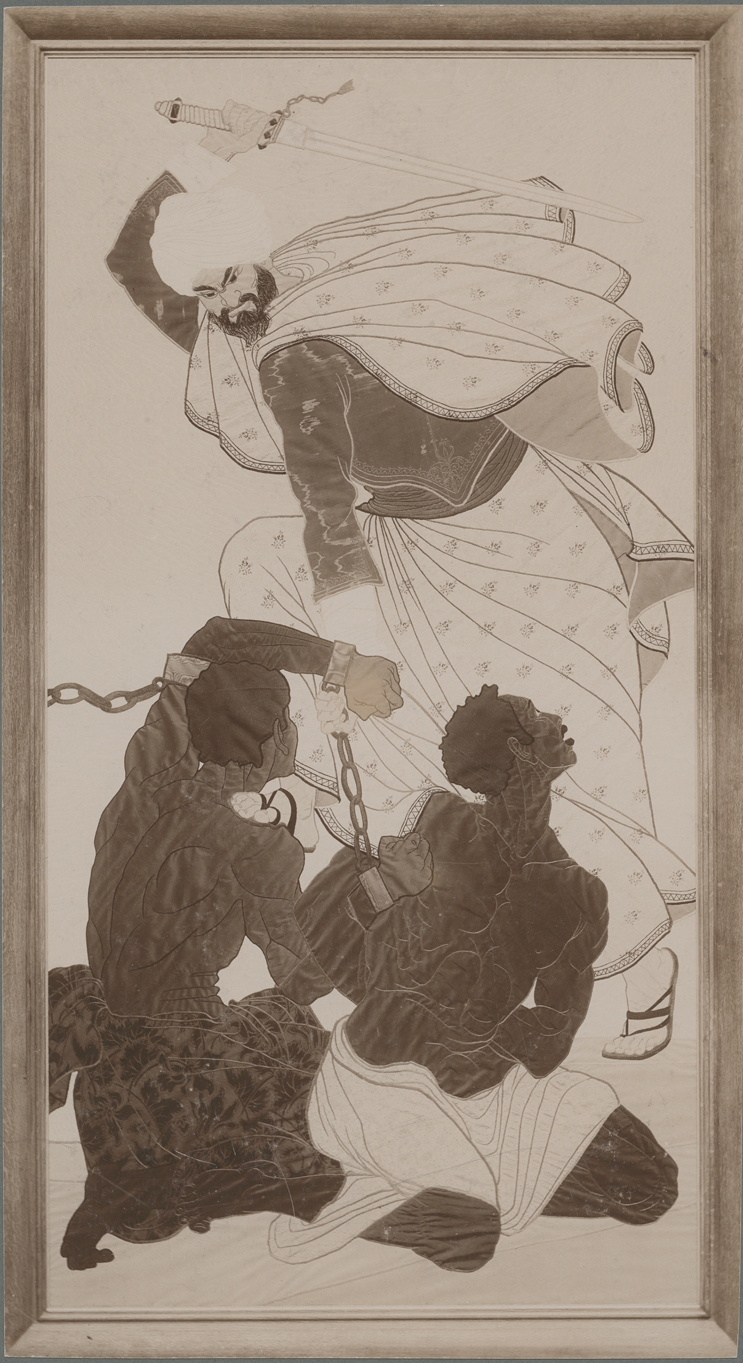
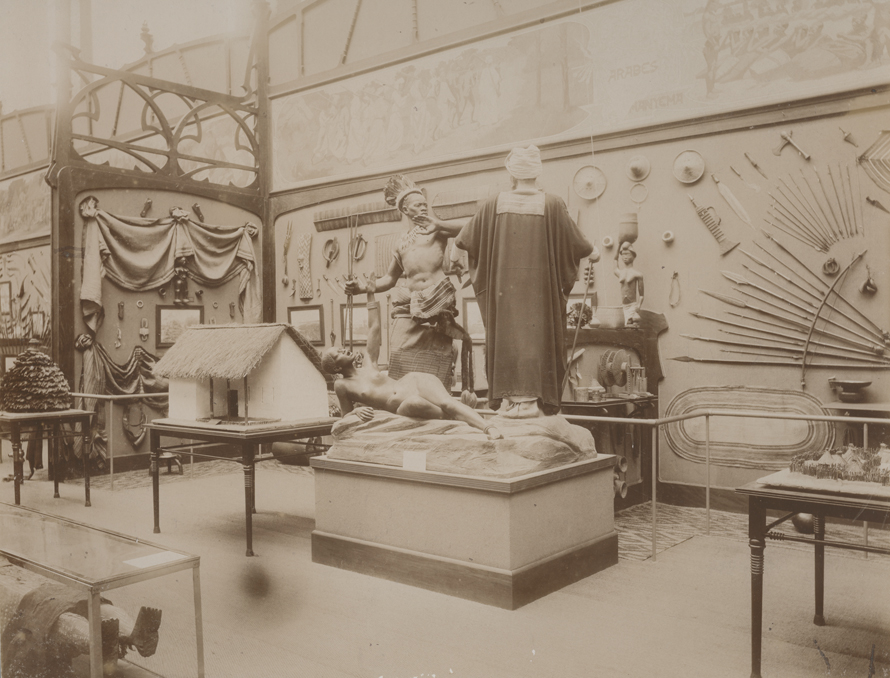
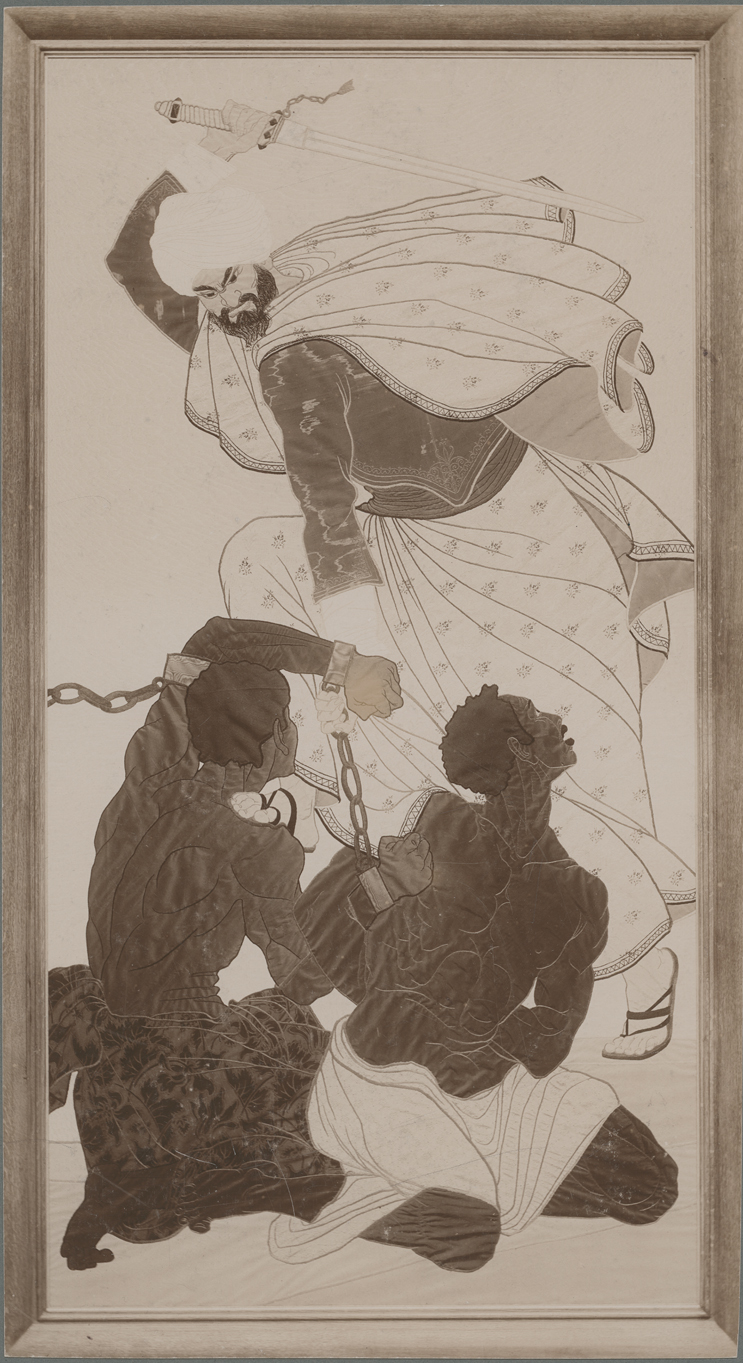
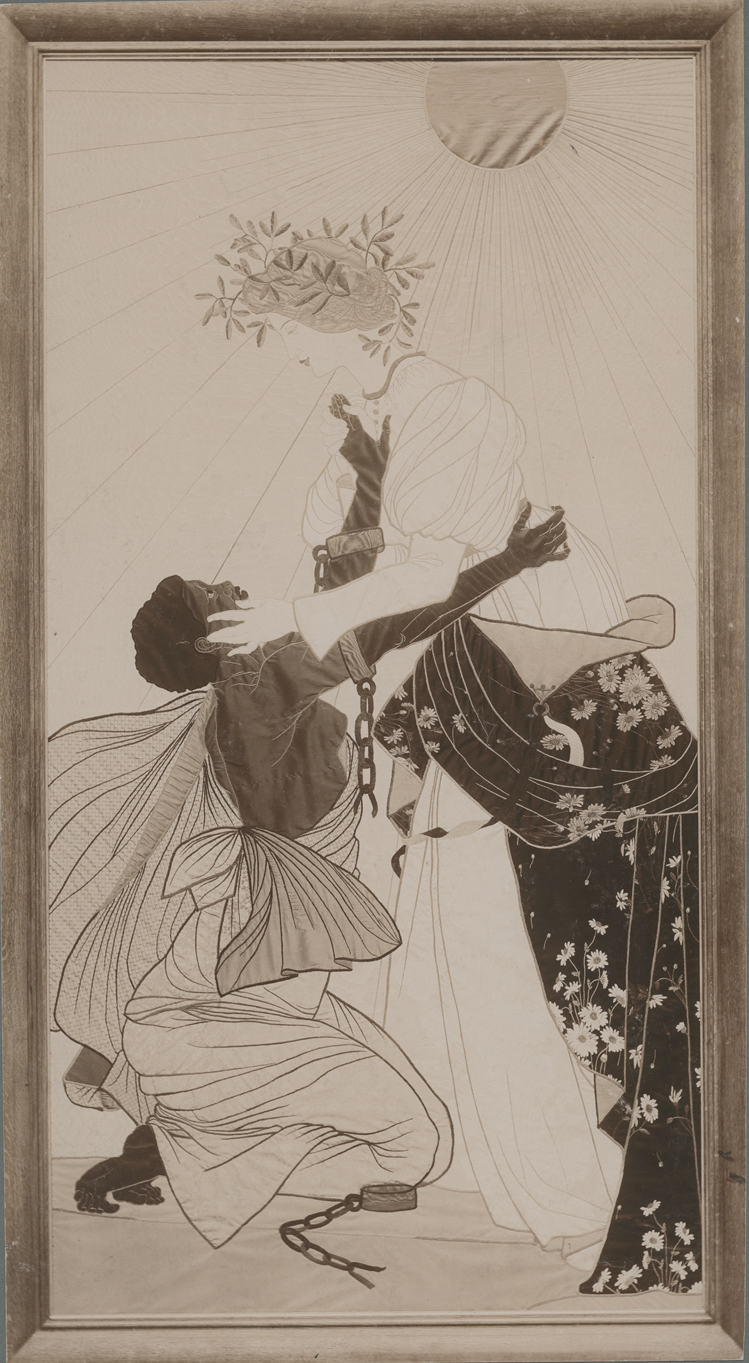
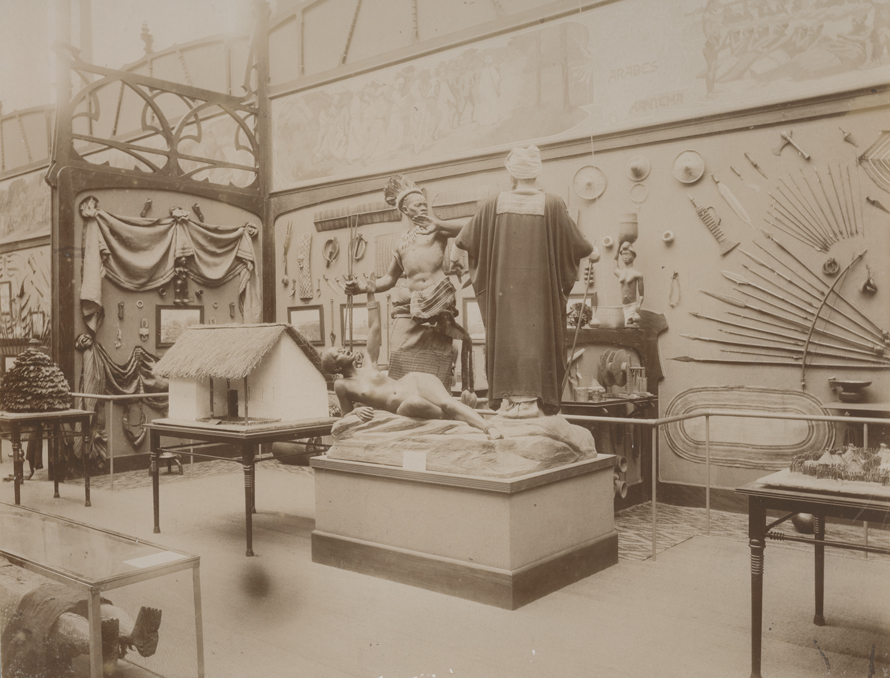
In the first room dedicated to art, silk embroidery entitled Slavery, designed by Isidore de Rudder and made by his wife Hélène du Menil, showed an “Arab” on the verge of killing chained Africans. It was exhibited in opposition to Freedom, represented by a white female breaking chains and bringing light to the “Dark Continent” (Figures 1 and 2).Footnote 45 In the next ethnography room, where Congolese “tribes” were arranged geographically, the same stereotypes returned. In the section on the eastern region, the life group A Vuakusu-Batetela defending a woman from an Arab, made by the Belgian artist Charles Samuel, represented a Bantu man protecting a woman from being abducted or killed by an Arabo-Swahili man (Figure 3). The “Arab” was the only fully dressed figure. The “Vuakusu-Batetela” had a naked torso. The woman was completely naked. The life group, a very popular exhibition method, was installed beneath the painting Les arabes – Bande d’esclavagistes revenant de razzia showing “Arabs” returning with enslaved prisoners, after a photograph by Emile Lemery, member of the Force Publique and engaged in the “Arab campaign.”Footnote 46 In sum, the internal “Arab” “East Africa” was represented as a barbaric evil that had to be conquered – the battle was still ongoing in 1897 – by Belgian colonialism and civilization.
“Slavery” and “Freedom” by Isidore de Rudder and Hélène du Menil. HP.1961.1.1581, collection RMCA Tervuren; photo Alexandre, 1897. HP.1961.1.1587, collection RMCA Tervuren; photo Alexandre, 1897.
The life group on the eastern region is still preserved today. Originally, eight plaster life groups were installed in the room. Only two survived multiple moves and two World Wars. HP.1960.5.1615, collection RMCA Tervuren; photo Alexandre, 1897.
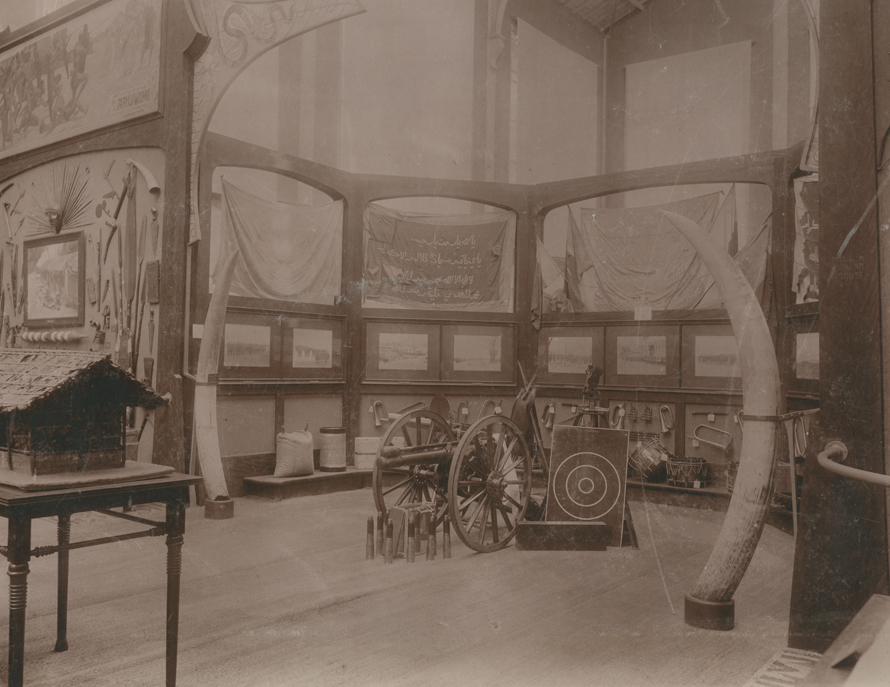
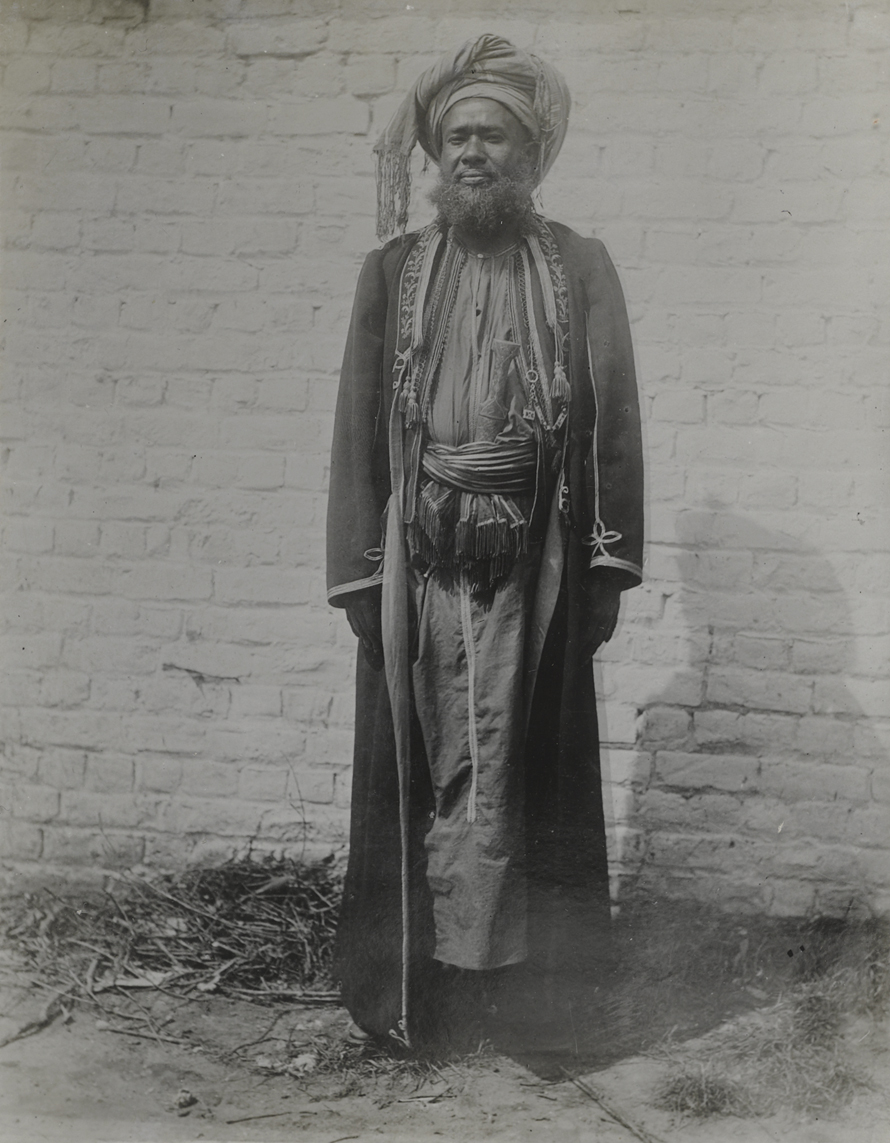
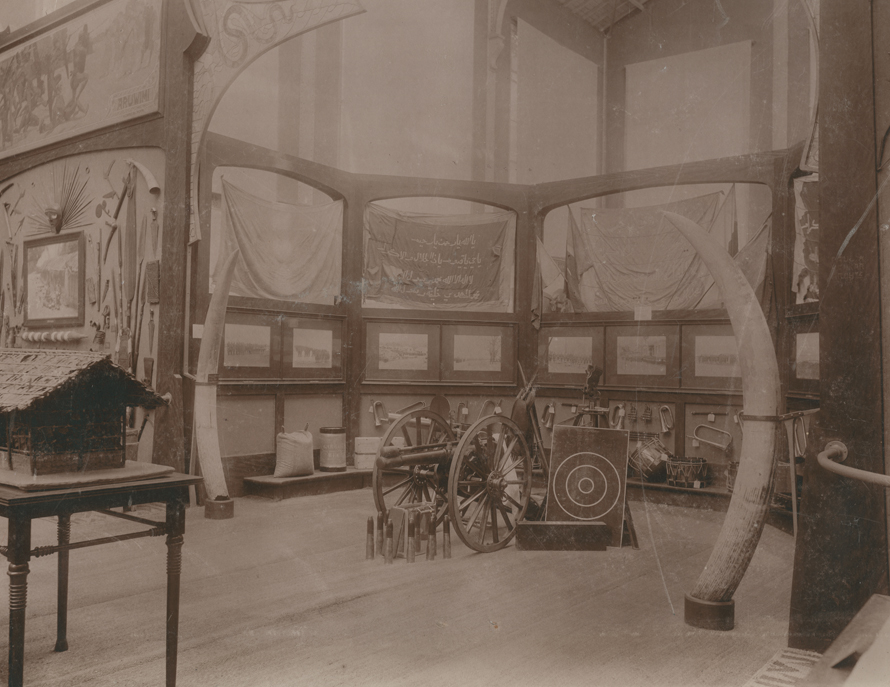
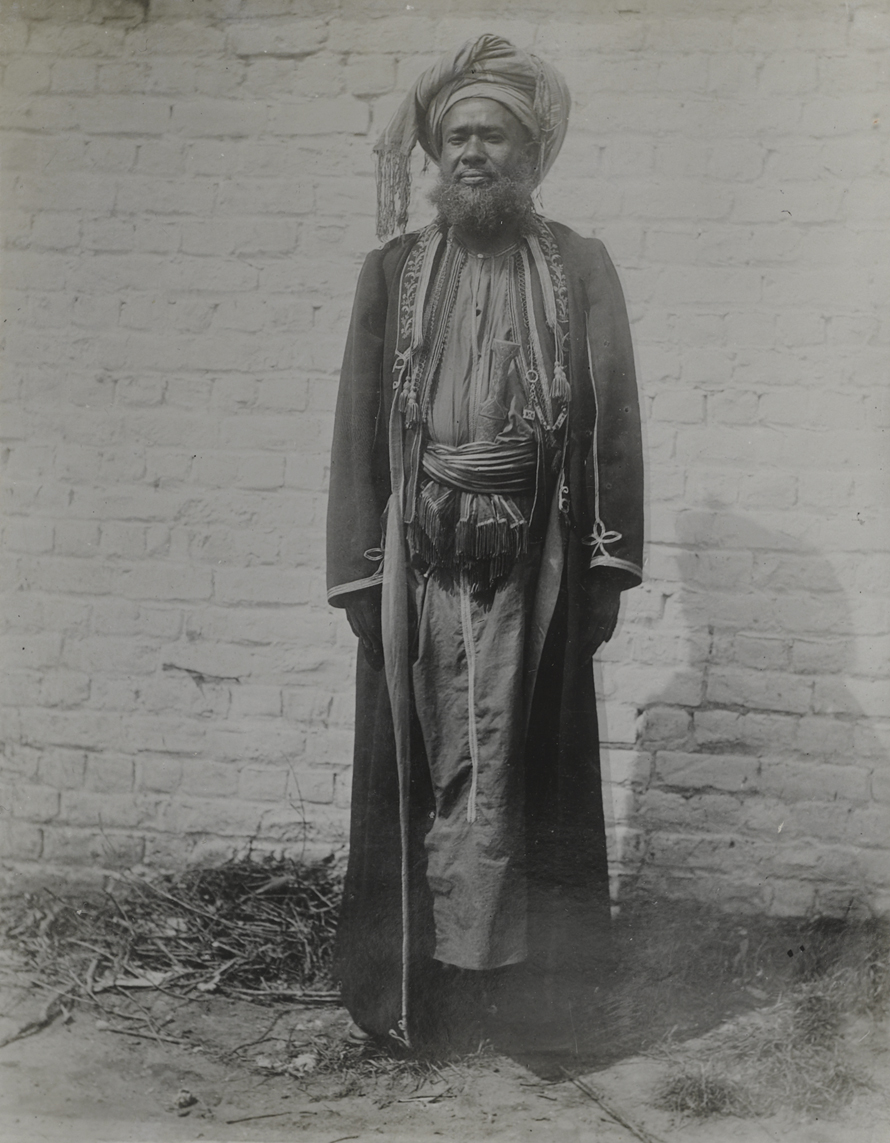
At the end of the first wing, separated from the ethnography room by two large tusks, a military exposition was installed. Flags with Arab writings, “taken from the enemy,” were shown as war trophies, next to a Nordenfelt canon, guns, ammunition, and targets of the Force Publique (Figure 4). Already in 1893, Leopold II understood the symbolic power of these flags. In a letter to Edmond Van Eetvelde, the Secretary of State in the Internal Affairs Department of the CFS administration in Brussels, the king stated: “It seems to me that it might be interesting to bring flags taken from Arabs to Belgium. Order that. We can make a ceremony on their arrival and that would have a good effect on the officers.”Footnote 47 Finally, in the “negro village” in the park (Figure 5), where 267 Africans were exhibited in a human zoo, visitors could “admire” one Arabo-Swahili man, three women, and a son.Footnote 48 Apparently the man, Bwana Mzé, Swahili for “Mister Sir,” refused contact with the Congolese and only wanted to speak with Europeans.Footnote 49
Military section of the 1897 colonial exhibition in Tervuren. HP.1960.5.1672, collection RMCA Tervuren; photo Alexandre, 1897.
“Arab” exhibited in human zoo in 1897. AP.0.0.28547, collection RMCA Tervuren; photo Lefèbvre de Sardans, 1897.
Musée du Congo Belge (1910–1960)
Colonial propaganda presented colonization as an abolitionist movement and the introduction of “civilization,” even though historical research has conclusively shown that colonization was mainly driven by political and economic interests of different European stakeholders. “Arab-Swahili” slave trade was replaced by new, European forms of economic exploitation, military occupation, and disruptive colonization of the region.Footnote 50 In the end, the colonial politics of king Leopold II caused national and international protest, eventually leading to the “donation” of the colony to the Belgian state in 1908. However, this change in regime did not profoundly affect the representation of the Belgian colony and colonization in the new building of the Musée du Congo belge. Because collections grew ever more rapidly, Leopold II had already decided to create a new museum, built between 1902 and 1908. The opening was planned for the beginning of 1910, but Leopold died a few weeks before and never saw the finished result. After a period of national mourning, the new building was opened by his nephew king Albert I in April 1910.
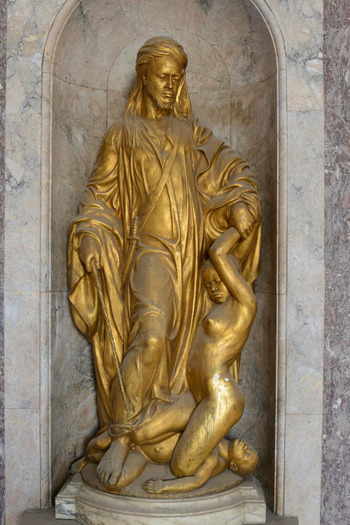
Almost halfway through the visit of the new museum – the first part dealt with natural sciences such as biology and geology – the visitors entered two ethnography rooms, situated on each side of an impressive rotunda. Attention again was strictly limited to the Belgian colonial empire, west of Lake Tanganyika. In the first ethnography room preceding the rotunda, objects from the central district Equateur were exhibited. In the second one, visited by the public after leaving the rotunda, objects of the eastern district, Uele (in the north of the colony), and Bangala (near present Mbandaka) were shown.Footnote 51 In the rotunda itself, larger than life statues by Arsène Matton were installed. Slavery represented an “Arab” holding a naked African women and trampling a defenseless child (Figure 6). Three other statues in contrast showed how Belgium brought “security,” “civilization,” and “welfare” to Congo. After the ethnography rooms the exhibition on Congo stopped. The last part of the museum primarily dealt with the history of Belgian presence in Congo, African natural resources that could be of interest to Belgian economy, and Belgian products to be exported to Congo, such as cloth, beads, camping material, etc. The history room in 1910 only showed the positive realizations of Belgian colonization. The walls of the room were decorated with the 1897 silk embroideries and reinforced the imaginary image on the Arab-Swahili world. The life group A Vuakusu-Batetela defending a woman from an Arab, was now installed in an economy room, next to ivory sculptures.Footnote 52 As a result, only an internal “East” survived in the new setup, but again only as the “slave raiding and trading Arab devil,” an “other” that was the anti-thesis of CFS colonization that operated using the motto “Work and Progress.”
Arsène Matton, “Slavery.” HO.0.1.330, collection RMCA Tervuren; photo J. Van de Vyver, RMCA Tervuren ©

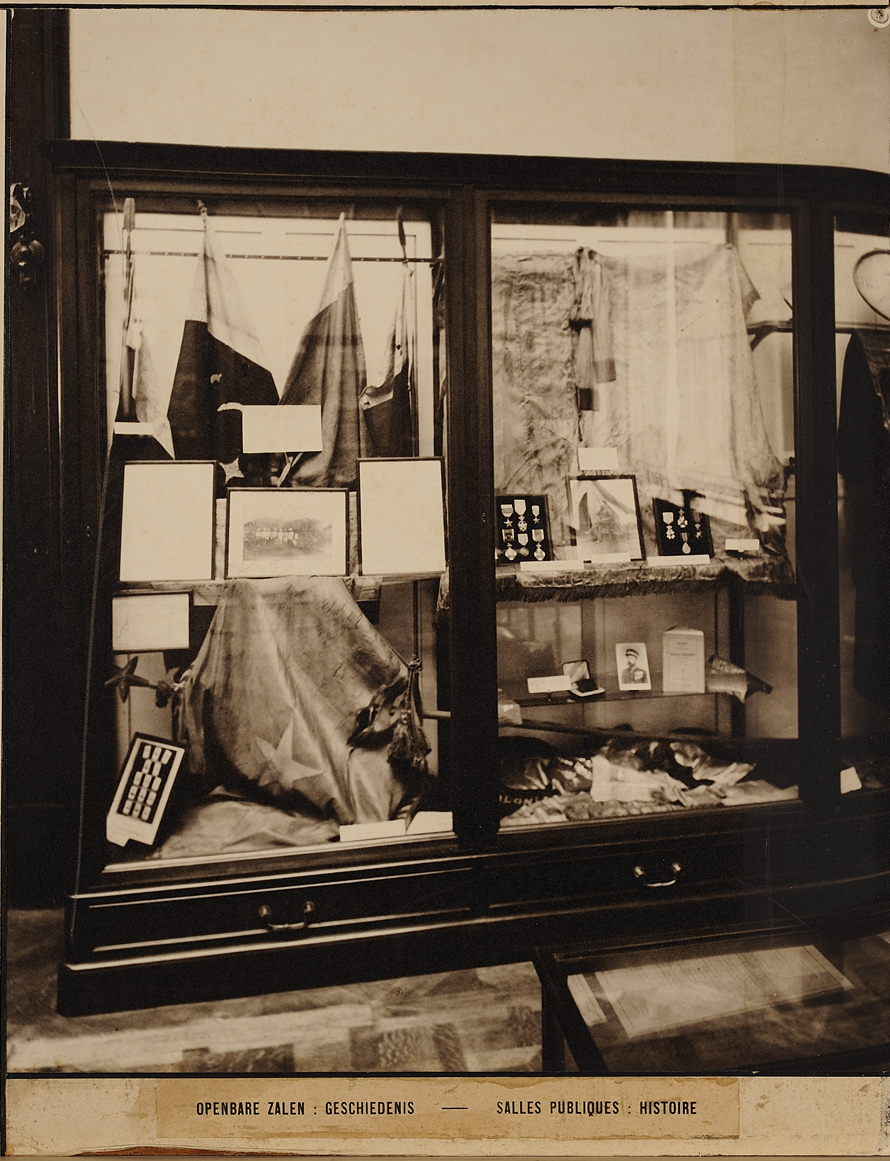
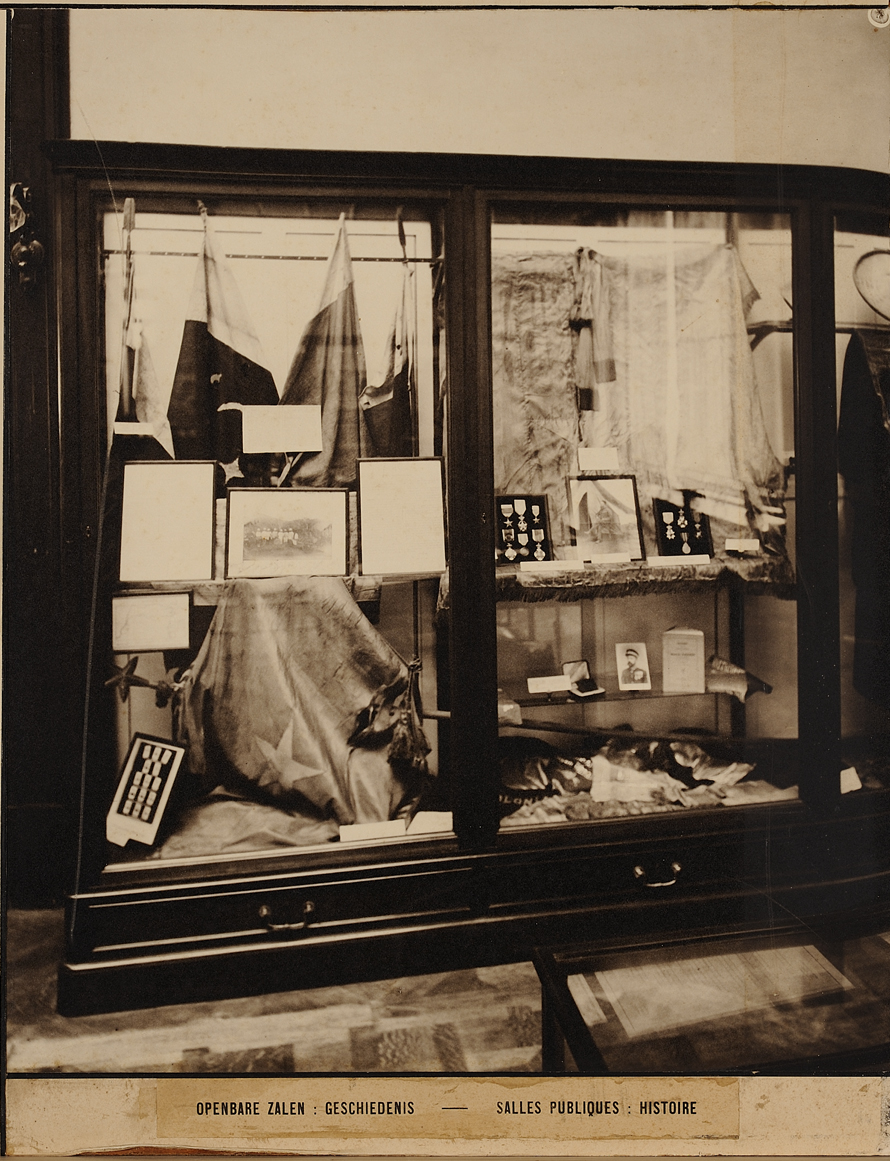
Let us now take a closer look at changes in the history rooms after 1910. A new installation created in the 1930s provided an overview of the most important steps in the creation of the Belgian colony.Footnote 53 In a showcase on the “Arab campaign,” photographs, diaries, and medals were used in the process of heroization of Belgian soldiers fighting the “Arab slave traders” and to honor the “martyrs” – European soldiers who did not return – of the “pacification” (Figure 7). One photograph represented Francis Dhanis, member of the Force Publique during the “Arab campaign.”Footnote 54 After his return to Belgium in 1894, he was celebrated as “the liberator of the black race” and the “conqueror of slave trade” in Central Africa. A fleet of ships welcomed him in Vlissingen and Leopold II made him baron. Dhanis returned to Congo in 1896–1900 and continued to fight the “Arabs,” but his next return to Belgium was not celebrated. In 1897 he had lost his brother and several members of his avant-garde. The deaths casted a “bloody veil” on his memory and he refused to serve actively in the Belgian army again. He returned to Congo once more, in the service of the infamous rubber-collecting Anglo-Belgian India Rubber Company (ABIR), after Leopold II kept insisting. He died in 1909 at the early age of forty-seven. As was the case with many other colonial officers, a “biographic illusion” was created concerning Dhanis, a heroic “social surface” that supported Belgian colonial propaganda.Footnote 55 The “Arab” adversary on the contrary was depicted as an aggressor, by displaying weapons and slave chains. Flags and clothing of “Arabs” were again exhibited as war trophies.
Showcase in the history room in the 1930s with the photograph of Dhanis (in the middle of the right window). HP.2009.15.18, collection RMCA Tervuren, rights reserved.
The same process of remembering and forgetting, was also active in yet another history room, opened in 1934 after closing the inner court arcade.Footnote 56 The Memorial Room was named after a monument in memory of 1508 Belgian colonizers who died in the Congo between 1876 and 1908. Remarkably, only the names of Belgian men, and not those of foreigners, were remembered and painted on Memorial Room walls, although the AIA, AIC, and the CFS were all very international projects with many non-Belgians working in the service of Leopold II. The names of women and children were also left out. Dead men could still be portrayed as “heroes,” but dead children and women could have been used by the anti-colonial movement to question the “Congo-Minotaur.”Footnote 57 An ivory bust of King Albert I, who just had died in a climbing accident, was placed in the middle of the Memorial Room. In front stood the pillar of the grave of Louis Crespel, leader of the first AIA expedition. The pillar originally marked Crespel’s burial site in Zanzibar, where he had died in 1878, but it was removed, probably by a local fisherman who used it as ballast. The pillar was relocated more than 3,000 km away near the Persian Gulf in 1913. Remarkably, Crespel was also mentioned on the wall among the 1508 names although he never set foot in Congo; a rare example of inclusion of the “East” in the Belgian Congo Museum. In the niches next to Albert I’s bust, busts of Emile Storms and Edmond Hanssens respectively represented the occupation of Central Africa from the east coast by the AIA and from the west coast by the AIC. In line with the principle “no documents, no history,” the existence of a precolonial African history, based on oral accounts, was denied.Footnote 58 No reference was made to precolonial empires of, among others, the Kongo, Luba, Kuba, and Lunda, because their history was solely based on oral testimonies, belonging to the realm of the imaginary according to European understanding, and not on written documents, the only trustworthy basis for historians.
Another example of erasing precolonial history and the influence of East Africa can be found in one of the economy rooms of the Belgian Congo Museum. On a monumental map showing the European “explorations” between 1816 and 1900, an inextricable web of dotted and colored lines, Bunkeya, the capital of the Yeke empire, is still mentioned. Visitors can see how Charles Lemaire passed by in 1898. However, the next 1910 political map in the same room no longer mentions Bunkeya. The capital of a polity arising from intense connections all the way up to the eastern coast is replaced by the names of colonial posts like Lukafu, one of the first political centers in Katanga, and Kambove and Elisabethville (Lubumbashi), two well-known mining sites. Lake Victoria and Lake Malawi are still visible, but the east coast is not represented on the mural map, another powerful tool of empire claiming the new “Central African” space, the Congo.Footnote 59 Metageographies had changed dramatically since the time of Msiri. When the colonial world again changed considerably around 1960 its representation in the museum did not.
Royal Museum for Central Africa (1960–2013)
After the troublesome independence and the “loss” of the colony as the museum’s main field of research, the museum changed its name in 1960 to Royal Museum for Central Africa (RMCA). Ironically, metageographies that once underpinned Belgian colonial claims and the museum’s colonial narrative, were now used in a postcolonial context to conceal the museum’s connections with it. At the same time, however, the term “Central Africa” also allowed for a widening of its scope beyond the former colonial borders. Biologists, geologists, anthropologists, ethnomusicologists, linguists, archaeologists, and art historians working at the scientific departments of the museum now also traveled to other countries than Congo and conducted fieldwork in West and East Africa, and even in South America. “Comparative collections” from South American and Australian “illiterate cultures” were installed in the ethnography rooms in the 1970s as already explained. Other rooms, however, hardly changed, slowly turning large parts of the Tervuren museum into “a museum of a museum,” showing how Congo used to be represented in the colonial era. In the rotunda, art work of Herbert Ward was added, but the statues of Arsène Matton remained in place. The result was quite heterogeneous in narrative and spatial organization.
Personnel in the Section of “History of the Belgian Presence Abroad,” as the research unit was called after 1967, were still mainly interested in the actions of Belgians in Congo. A case in point was the new exhibition in the Memorial Room, inaugurated “without brass band or speech” on 5 March 1976.Footnote 60 The exposition was designed by Marcel Luwel, head of the history section in the period 1949–1986. The aim was to avoid the pile-up of objects in showcases and to restore the items in their honor:
The choice of the exhibited objects was determined by the goal to represent, as good as possible, life as it happened in Congo. Therefore, the visitor will find a series of unusual objects that will bring him closer to the former traveler, explorer, colonial, missionary and military man, and also to the ones with whom they had stood at that time in a hostile relationship. In one word: a lesson in colonial archaeology.Footnote 61
According the a reporter of De Standaard, “the accumulated material even makes a non-colonial think with nostalgia about a complete past and superseded period.”Footnote 62 The showcases remained almost unchanged until December 2013 when all museum items were removed for the complete renovation, which is still underway at the time of writing this article.
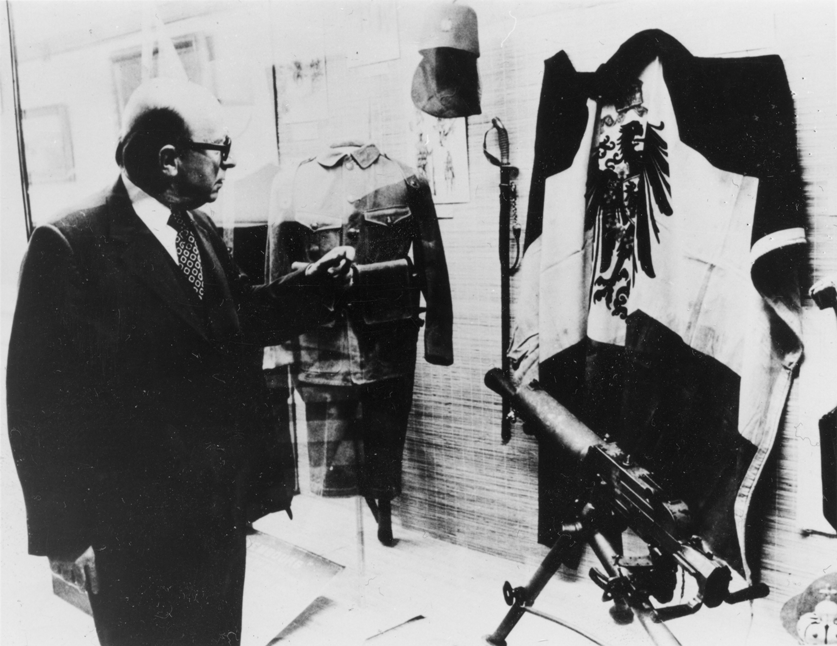
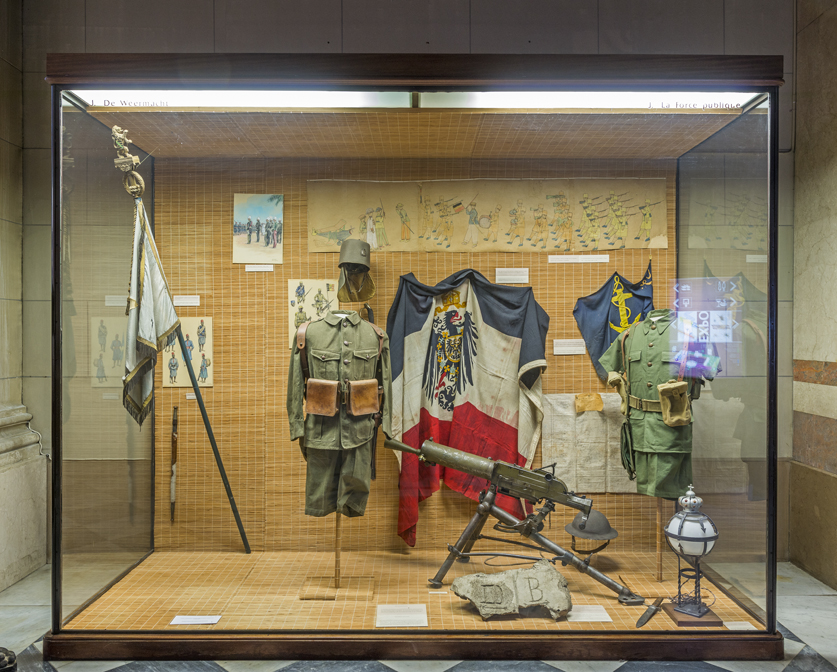
Between 1976 and 2013, the attention to “East Africa” in the showcases of the Memorial Room was limited to colonial campaigns of the AIA before the actual establishment of the CFS, the “war on slave trade” within the Congo, and the presence of Belgian military men in German East Africa during the First World War (Figures 8 and 9). Incidentally, the Belgian encounter with East Africa during the First World War underscores the imagination of the East as an enemy space. In the showcase on the AIA, visitors could see the gun, clothing, and instruments used by Emile Storms. A painting of the Strauch, a sailing boat constructed by Storms to cross Lake Tanganyika to Karema, was also included. In another showcase on the Force Publique and the First World War, a remnant of a boundary stone with the letters D(eutschland) and B(elgium) was exhibited. The stone had been part of a larger monument marking the boundary between Belgian Congo and German East Africa between Kisenyi and Goma after the agreements of May and August 1910. The site was destroyed during the First World War. The object with the capital D and B, and the additional arrows beneath them pointing in opposite directions, is perhaps the most emblematic of the creation of an imaginary opposition between Central and East Africa. In a new showcase on “the war on slave trade,” Luwel reused Dhanis’s photograph and added a shell and a case used by the Belgian officer. A colonial flag was decorated with the names of Congolese cities and the date of the respective victory of the Force Publique: Kasongo 1893, Nyangwe 1893, Lomami 1895, and Urua 1901. Also on show, a dagger previously owned by Sefu ben Mohammed ben Said el-Murjebi, the son of Tippu Tip. The presence of this remarkable object in Tervuren is telling of his fate, but also of the construction of a mental separation between “East” and “Central” Africa.
The showcase on the Force Publique and the First World War was inaugurated in 1976 by Marcel Luwel and was dismantled in 2013. HP.2013.12.6, collection RMCA Tervuren; 1976, RMCA Tervuren © HP.2012.17.193, collection RMCA Tervuren; photo J. Van de Vyver, RMCA Tervuren ©

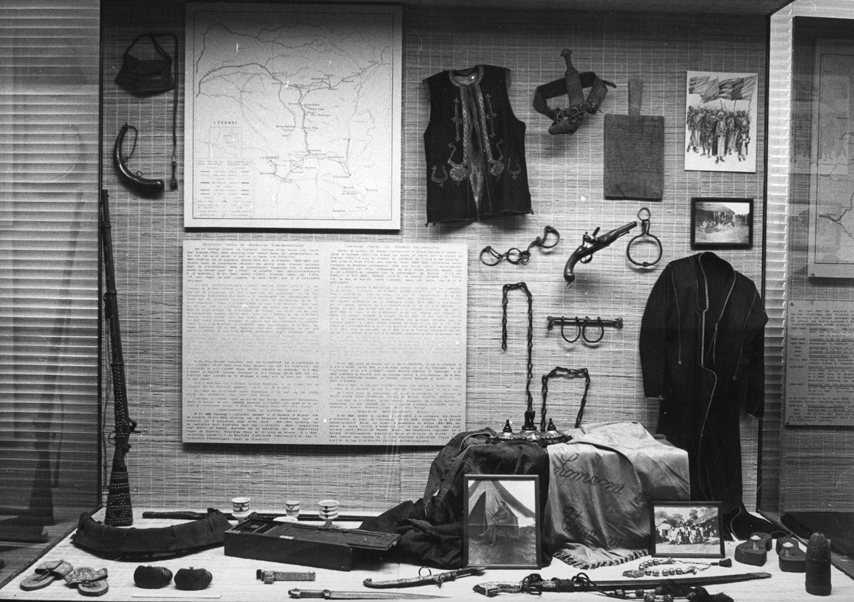
After Tippu Tip had left Stanley Falls, Sefu and other allies still residing in Congo, like Rumaliza, were attacked by members of the Force Publique from military outposts in Basoko and Lusambo. During an attack by Dhanis on Chigé, 22 November 1892, 3,000 people died. The son of Sefu was severely injured. The latter reacted with the murder on Jozef Lippens and Henri August De Bruyne, two Belgian residents in Kasongo. Sefu retreated to Kasongo where he was attacked again by Dhanis and 2,000 soldiers of the Force Publique (April 1893). The town was bombed during one hour resulting in a bloodshed. After the attack, twenty-five tons of ivory were seized. Sefu escaped and sought refuge with Rumaliza, but was eventually murdered, almost by accident, on 17 November 1893 during the battle near Luama. “With him, one of the most tenacious enemies of the CFS disappeared,” Marthe Coosemans stated in the Belgian Colonial Biography.Footnote 63 The dagger of Sefu, on show in Tervuren between 1976 and 2013, symbolized that Arab-Swahili were “violent slave traders,” from which Congo had to be redeemed. Later on, an “Arab door” was transferred from Kasongo, the former residence of Tippu Tip and Sefu, to Tervuren. The item was exhibited until recently without mentioning the context in which it was “collected.”
Other items, which today can be interpreted as testimonies of African or “Arab-Swahili” agency and resistance, included clothing and weapons of Mohammed bin Khalfan al Barwani, or Rumaliza. The objects were captured during the battle of Kabambare, 25 January 1894, when the troops of Rumaliza were defeated by the Force Publique. In the same showcase, a writing box of Rumaliza was shown. The beautiful object was bought from the widow of Léon Rom in 1946. The latter participated in attacks on Rumaliza and was put in charge of Kasongo (January 1894) and Stanley Falls (April 1894) where he used human skulls “as a decoration round a flower-bed in front of his house!”Footnote 64 Unwittingly, the items on show (in Tervuren) might have conveyed a rather different picture of the brutal “Arabs” from the east: their literacy and education (Figures 10 and 11). However, it is highly questionable if an image of “civilized Arabs” came across, as the public could only have noticed sophistication if it wasn’t already too convinced of their “barbarism” by then. After all, visitors had already been consuming the image of the “violent, Arab slave trader” from a very young age at school and by collecting chromos of Anco flour products for example.Footnote 65 They simultaneously shared the idea that Belgian colonization had purged the Congo from this evil “foreign” influence from the East. Given the track record of Belgian colonialism, this assertion is of course quite cynical.
Exhibition on “the war on slave trade” in the RMCA. Between 1976 and 2013, “frozen” showcases and representations of the “Arab” changed little. HP.2013.12.2, collection RMCA Tervuren; 1976, RMCA Tervuren © HP.2012.17.189, collection RMCA Tervuren; photo J. Van de Vyver, RMCA Tervuren ©


Rumaliza’s life history shows again that the “border” between “East” and “Central” Africa was in reality “inexistent.” Rumaliza was born in the southeast of what is today known as Tanzania, lived in Zanzibar, but left after political turmoil in 1856 and moved to Tabora and Ujiji where he became one of the allies of Tippu Tip. After the arrival of the German troops in 1890, Rumaliza hoisted the German flag and tried to become nominated as the liwali (governor) of Ujiji, much like Tippu Tip managed to realize in Stanley Falls.Footnote 66 However, after the hanging of his friend Muhammed bin Qasim, suspected of the murder on a German ivory trader, Rumaliza fled and crossed the “border” to the CFS.Footnote 67 In the period 1891–1894 he became one of the main opponents of the Belgian colonial troops in Congo. In colonial press, he was portrayed as a slave hunter, ravaging villages. According to Stairs, Rumaliza considered the west coast of Lake Tanganyika as his territory. Allegedly, he saw “whites” as intruders which had to be expelled by force.Footnote 68 However, it was Rumaliza who was attacked, although he did inflict severe damage to the Force Publique and always managed to escape. In March 1894, after the battle near Kabambare, Rumaliza fled from CFS territory. Several of his allies, like Monlina and Toka Toka were killed.Footnote 69 According to Jules Jacques, Rumaliza afterwards sought refuge in English colonial territory: “Today, I have heard that Rumaliza fled on board of a dhow and has asked the English for shelter south of Tanganyika (which hardly surprised me).”Footnote 70 In fact, Rumaliza returned to Ujiji in German East Africa.Footnote 71 In Belgian colonial discourse, the campaign against Rumaliza was again described as “a triumph over slavery, one of the greatest plagues of Africa at the end of the 19th century.”Footnote 72
Again emblematic for the imaginary divide between Central and East Africa is the fact that the lemma on Rumaliza in the Belgian Colonial Biography, stops on the date that Rumaliza left the CFS territory.Footnote 73 Further information on the later life of Rumaliza after 1894 is to be found in German and British publications on the history of German and British colonization.Footnote 74 These tell us that after his arrival in Ujiji in 1894, where he found out that somebody else had been nominated as liwali, Rumaliza helped the Hehe in their battle against the German colonizer. Defeated again, he traveled back to Dar es Salam and started a trial against Tippu Tip. Rumaliza was assisted by Heinrich Brode, the later biographer of Tippu Tip. Again, note that the autobiography of Tippu Tip was written after Tippu Tip had left the Congo territory, and was first translated into German by Heinrich Brode, and later into English by H. Havelock.Footnote 75 It was only in the 1970s that the Maisha was translated – and meticulously annotated – into French by François Bontinck.Footnote 76 As can be seen from Rumaliza’s and Tippu Tip’s life history, the East-Central divide did not play a significant role in their own decisions, wanderings, and action, only in subsequent European writings and exhibitions about them.
Conclusion
For many Belgians, “Central Africa” was, and perhaps still is, the Democratic Republic of the Congo, Rwanda, and Burundi, whereas French and English people will probably point out different countries.Footnote 77 The multiple definitions of “Central Africa” can partly be explained by different colonial histories and the construction of diverse metageographies, but geometry also plays a role. What does “central” mean if you talk about North and South Africa, and West and East Africa? Where does one zone stop and another start? This article has offered multiple examples of how the museum in Tervuren, as a rift zone, has created artificial boundaries in spaces that are lived as one. If Arabo-Swahili were included in RMCA exhibitions, the “East” was represented as a relic of violent slave traders that had been “pacified” by European force, offering justification for capitalist colonialism, and excluding both an internal and an external “East” from Congo. However, by focusing on this rift east and west of Lake Tanganyika, north-south connections are easily overlooked. One could write another article on the artificial colonial and postcolonial boundaries to the north and the south. Moreover, not only did the colonial museum as a rift zone create distance between Europeans and Africans, as already explained in the introduction, but also between Africans themselves, as “different” Bantu “tribes” were isolated in separate “glass boxes.”Footnote 78 It is a basic problem within anthropology since diffusionism, a dogmatic paradigm that created “bad history:” cultures cannot be divided into Kulturkreisen or “nations,” but remain hybrid due to contact, conflict, trade, etc.Footnote 79 Hybridity remains problematic within museums: how can one represent overlapping cultures into separate glass cuboids and cubes?
Maarten Couttenier is a historian and anthropologist currently based at the Royal Museum for Central Africa in Tervuren. He has published on the history of museums, colonial sciences and culture, and African history. More recently, he also dealt with restitution in former colonial museums and eurocentrism in history education. E-mail: maarten.couttenier@africamuseum.be