


Introduction
Extant research acknowledges the importance of employees' engagement in organizational citizenship behavior (OCB), whereby they undertake voluntary work efforts that go beyond their formal job duties. A key objective of this study is to understand when employees might be less likely to engage in such behavior. The notion of OCB originates from Katz's (Reference Katz1964) early argument that an organization's effectiveness will increase to the extent it can encourage employees to perform extra-role work activities that exceed their formal job duties. OCB accordingly has been defined as ‘individual behavior that is discretionary, not directly or explicitly recognized by the formal rewards system, and that in the aggregate promotes the effective functioning of the organization’ (Organ, Reference Organ1988: 4). Such behavior may comprise several dimensions, including altruism, civic virtue, conscientiousness, courtesy, sportsmanship (Organ, Reference Organ1988), organizational loyalty, compliance, participation (Graham, Reference Graham1991), and discretionary behaviors targeted at coworkers or the organization in general (Williams & Anderson, Reference Williams and Anderson1991). Consistent with recent studies (e.g., De Clercq & Belausteguigoitia, Reference De Clercq and Belausteguigoitia2017a; Pooja, De Clercq, & Belausteguigoitia, Reference Pooja, De Clercq and Belausteguigoitia2016), we draw specifically from De Cremer, Mayer, van Dijke, Schouten, and Bardes's (Reference De Cremer, Mayer, van Dijke, Schouten and Bardes2009) concise conceptualization of OCB as employees' ‘helping in ways that are not formally required by the organization’ (p. 887), operationalized as voluntary efforts to improve the organization's status quo and safeguard it from potential threats, the motivation to long work hours, and a propensity to develop and maintain supportive relationships with organizational peers.
Employees' OCB or voluntary work activities – two terms often used interchangeably – can contribute to both their organization's and their own well-being (Chan & Lai, Reference Chan and Lai2017; Devece, Palacios-Marqués, & Alguacil, Reference Devece, Palacios-Marqués and Alguacil2016; Imer, Kabasakal, & Dastmalchian, Reference Imer, Kabasakal and Dastmalchian2014; LePine, Erez, & Johnson, Reference LePine, Erez and Johnson2002; Ye, Cardon, & Rivera, Reference Ye, Cardon and Rivera2012). For organizations, the OCB of their employee bases can enhance their competitive advantages and performance (Jain, Giga, & Cooper, Reference Jain, Giga and Cooper2011; Podsakoff, Whiting, Podsakoff, & Blume, Reference Podsakoff, Whiting, Podsakoff and Blume2009). For employees themselves, their undertaking of OCB can fuel their work motivation (Borman & Motowidlo, Reference Borman, Motowidlo, Schmitt and Borman1993; Lee, Kim, & Kim, Reference Lee, Kim and Kim2013), sense of personal meaningfulness (Hoption, Reference Hoption2016; Lemoine, Parsons, & Kansara, Reference Lemoine, Parsons and Kansara2015), and career success (Russo, Guo, & Baruch, Reference Russo, Guo and Baruch2014). Yet, expending significant energy on voluntary work activities also can create important challenges for employees and interfere with their regular job tasks (Bergeron, Reference Bergeron2007; Bolino, Hsiung, Harvey, & LePine, Reference Bolino, Hsiung, Harvey and LePine2015). That is, when employees take on extra responsibilities that they technically are not required to do, the associated distractions may diminish their ability to reach formally assigned performance targets (Bolino, Turnley, & Niehoff, Reference Bolino, Turnley and Niehoff2004; Culbertson & Mills, Reference Culbertson and Mills2011; Van Dyne & Ellis, Reference Van Dyne, Ellis, Coyle-Shapiro, Shore, Taylor and Tetrick2004).
Considering this possible dark side of being a ‘good soldier’ (Bolino, Turnley, Gilstrap, & Suazo, Reference Bolino, Turnley, Gilstrap and Suazo2010; Organ, Reference Organ1988) and the associated reluctance that some employees might exhibit to going out of their way to take on extra responsibilities, further research is required to elucidate how adverse job situations might steer employees away from voluntary work efforts (Baer et al., Reference Baer, Rodell, Dhensa-Kahlon, Colquitt, Zipay, Burgess and Outlaw2018; Pooja, De Clercq, & Belausteguigoitia, Reference Pooja, De Clercq and Belausteguigoitia2016; Priesemuth & Taylor, Reference Priesemuth and Taylor2016). When they confront adversity in the workplace, employees struggle in their organizational functioning and develop concerns about their future career prospects (e.g., Eschleman, Bowling, & LaHuis, Reference Eschleman, Bowling and LaHuis2015; Hobfoll, Reference Hobfoll2001; Hu & Cheng, Reference Hu and Cheng2010; Johnson, Cooper, Cartwright, Donald, Taylor, & Millet, Reference Johnson, Cooper, Cartwright, Donald, Taylor and Millet2006; Perko, Kinnunen, & Feldt, Reference Perko, Kinnunen and Feldt2017), as might be manifested in their experience of job stress, or a sense of being overwhelmed or overburdened by the job situation (Jam, Donia, Raja, & Ling, Reference Jam, Donia, Raja and Ling2017; Parker & DeCotiis, Reference Parker and DeCotiis1983). This job-related feeling of anxiety or stress is a persistent phenomenon in many organizations, including those that operate in competitive markets that impose significant pressures on their employee bases (Abdelmoteleb, Reference Abdelmoteleb2018; Elfering, Grebner, & de Tribolet-Hardy, Reference Elfering, Grebner and de Tribolet-Hardy2013; Hon & Chan, Reference Hon and Chan2013). Due to their experience of job stress, employees may feel nervous about their jobs, sense that their job affects them more than it should, or even suffer physical discomfort when thinking about their jobs (Baba & Jamal, Reference Baba and Jamal1991; Parker & DeCotiis, Reference Parker and DeCotiis1983; Xie, Reference Xie1996).
Despite a general acknowledgment that exposure to stress-inducing work conditions can steer employees away from OCB (e.g., Chang, Rosen, Siemieniec, & Johnson, Reference Chang, Rosen, Siemieniec and Johnson2012; Cheung & Cheung, Reference Cheung and Cheung2013; Paillé, Reference Paillé2011; Pooja, De Clercq, & Belausteguigoitia, Reference Pooja, De Clercq and Belausteguigoitia2016), research that explicitly connects the experience of job stress to voluntary work efforts is sparse, with the exception of a study that pinpoints the role of the stress due to job-limiting pain (Ferris, Rogers, Blass, & Hochwarter, Reference Ferris, Rogers, Blass and Hochwarter2009) and another that addresses stress invoked by conflict situations (Karam, Reference Karam2011). This gap is important, because it prevents organizations from fully understanding how energy depletion due to pressing feelings of being overburdened might make employees reluctant to go beyond the call of duty. We accordingly investigate the direct connection between felt job stress and OCB.
In addition, we attempt to identify unexplored circumstances in which job stress might be less likely to steer employees away from voluntary work behaviors. To this end, we first explicitly acknowledge that experienced job-related stress can compromise discretionary work activities, for both ability and motivation reasons. In particular, the depletion of energy resources that arises with experienced job stress likely undermines employees' confidence that they can combine their regular job tasks with voluntary work efforts, and it might also thwart their desire to engage in such extra-role activities (Organ, Podsakoff, & MacKenzie, Reference Organ, Podsakoff and MacKenzie2006; Pooja, De Clercq, & Belausteguigoitia, Reference Pooja, De Clercq and Belausteguigoitia2016). In turn, the conversion of job stress into reduced OCB may be less likely if employees can draw from pertinent resources that fuel both their ability and their motivation to engage in voluntary work behavior, even in the presence of experienced job stress. That is, employees' reliance on these resources may diminish the risk that they avoid productive, voluntary work efforts when they suffer job-related stress.
COR theory
Conservation of resources (COR) theory helps substantiate these arguments. This theory holds that employees' work behaviors are driven by their desires to generate resource gains and to prevent their current resource bases from being depleted (Hobfoll, Reference Hobfoll1989, Reference Hobfoll2001). The motivation to avoid resource losses also supersedes the motivation to acquire additional resources (Hobfoll, Reference Hobfoll1989; Hobfoll & Shirom, Reference Hobfoll, Shirom and Golembiewski2000). Consistent with this argument, employees are less likely to invest significant time in extra-role activities to the extent that their energy resource reservoirs already are depleted, so that they can avoid further resource losses (De Clercq & Belausteguigoita, Reference De Clercq and Belausteguigoita2019; Priesemuth & Taylor, Reference Priesemuth and Taylor2016). For example, the experience of job stress might drain employees' energy levels so much that they conserve their current resource reservoirs when choosing which behaviors to adopt – including energy-consuming OCB that exceed their formal job descriptions (Trougakos, Beal, Cheng, Hideg, & Zweig, Reference Trougakos, Beal, Cheng, Hideg and Zweig2015).
Yet, COR theory also posits that such negative behavioral responses are contingent on whether employees can draw from relevant resources that serve as buffers (Hobfoll, Reference Hobfoll2001; Hobfoll & Shirom, Reference Hobfoll, Shirom and Golembiewski2000). We focus specifically on two personal resources (passion for work and adaptive humor) and two contextual resources (peer communication and forgiving climate) that might help immunize employees somewhat from the resource losses that stem from experienced job stress, such that they may be less likely to completely avoid OCB. Employees' passion for work pertains to their love for the work and the enjoyment that they derive from working hard (Baum & Locke, Reference Baum and Locke2004). Adaptive humor captures employees' reliance on their wit to cope with and master challenging situations (José, Parreira, Thorson, & Allwardt, Reference José, Parreira, Thorson and Allwardt2007). Peer communication reflects the extent to which employees engage in regular knowledge sharing with other organizational members (Cabrera & Cabrera, Reference Cabrera and Cabrera2002), and a forgiving climate relates to employees' beliefs that their organization overlooks errors and does not hold grudges against people who commit mistakes (Guchait, Lanza-Abbott, Madera, & Dawson, Reference Guchait, Lanza-Abbott, Madera and Dawson2016).
Engaging these four resources as potential moderators is consistent with the COR logic, in that they could mitigate the risk of further resource losses for employees who pursue some degree of energy-consuming voluntarism, despite suffering from energy-depleting job stress (Hobfoll & Shirom, Reference Hobfoll, Shirom and Golembiewski2000). Moreover, each resource instills positive energy in employees, which may counter their limited ability or motivation to undertake voluntary work efforts in the presence of experienced job stress (Parker & DeCotiis, Reference Parker and DeCotiis1983; Quinn, Spreitzer, & Lam, Reference Quinn, Spreitzer and Lam2012). Finally, these resources complement one another. First, they combine elements that employees might draw from internally, based on personal characteristics, or externally, through the work environment. Employees possess a passion for work and adaptive humor individually, but peer communication and beliefs about a forgiving climate are resources that are part of the organizational context. Second, complementary mechanisms underlie their potential buffering roles. In particular, the beneficial roles of passion for work and peer communication speak to employees' access to prevailing energy-enhancing resources (held internally or embedded in peer relationships) that help them cope with experienced job stress; their adaptive humor and beliefs about a forgiving climate speak to their flexibility to adjust to the frustrations that arise with experienced job stress (through their own wit or options to try different things at work without worrying about negative organizational repercussions). The four focal contingent resources accordingly offer a comprehensive, consistent perspective on how employees' resource access may diminish their reluctance to engage in OCB in response to felt job stress (Hobfoll & Shirom, Reference Hobfoll, Shirom and Golembiewski2000).
We also note explicitly that our conceptual focus is on the simultaneous interplay of job stress and the four complementary resources to predict OCB, instead of how the resources might influence whether employees feel stressed at work. As prior research indicates, people tend to experience less stress to the extent that they exhibit high levels of harmonious passion (Tomkins, Neighbors, & Steers, Reference Tomkins, Neighbors and Steers2019), have a good sense of humor (Yovetich, Dale, & Hudak, Reference Yovetich, Dale and Hudak1990), share information with others (Mackie, Holahan, & Gottlieb, Reference Mackie, Holahan and Gottlieb2001), and believe that individual errors tend to be forgiven (Suchday, Friedberg, & Almeida, Reference Suchday, Friedberg and Almeida2006). Missing from these assessments though is a consideration of how the four focal resources – passion for work, adaptive humor, peer communication, and a forgiveness climate – might influence the likelihood that employees undertake voluntary work behaviors when they already are experiencing high stress levels. In other words, we address an important question: Which circumstances help contain the danger that felt job stress translates into reduced OCB? Already stressed-out employees may seek to protect against the risk that their in-role job performance will suffer if they combine their regular job tasks with voluntary activities, but this protective reaction may be mitigated to the extent that they have access to relevant personal and contextual resources.
Contributions
This study seeks to make several contributions. First, the energy depletion that arises with experienced job stress might make employees reluctant to go above and beyond the call of duty and undertake work activities on a voluntary basis (Podsakoff, MacKenzie, Paine, & Bachrach, Reference Podsakoff, MacKenzie, Paine and Bachrach2000; Trougakos et al., Reference Trougakos, Beal, Cheng, Hideg and Zweig2015). Explicating this negative relationship is highly relevant, to help organizational decision makers predict how employees' stress-related frustrations might turn them away from productive extra-role activities that could enhance organizational effectiveness (Eatough, Chang, Miloslavic, & Johnson, Reference Eatough, Chang, Miloslavic and Johnson2011; Ferris et al., Reference Ferris, Rogers, Blass and Hochwarter2009; Pooja, De Clercq, & Belausteguigoitia, Reference Pooja, De Clercq and Belausteguigoitia2016). Notably, this study does not investigate the sources of job stress but rather takes the perspective that actual stress symptoms are more direct determinants of whether employees allocate their time to productive work activities (Burton, Hoobler, & Scheuer, Reference Burton, Hoobler and Scheuer2012; Jamal, Reference Jamal1985; Lazarus & Folkman, Reference Lazarus and Folkman1984; McCarthy, Trougakos, & Cheng, Reference McCarthy, Trougakos and Cheng2016). With this focus on employees' actual experience of job stress, we complement studies of the consequences of employees' exposure to stress-invoking work conditions – such as psychological contract violations (Priesemuth & Taylor, Reference Priesemuth and Taylor2016), despotic leadership (Naseer, Raja, Syed, Donia, & Darr, Reference Naseer, Raja, Syed, Donia and Darr2016), dysfunctional organizational politics (Chang et al., Reference Chang, Rosen, Siemieniec and Johnson2012), or interpersonal conflicts (Pooja, De Clercq, & Belausteguigoitia, Reference Pooja, De Clercq and Belausteguigoitia2016) – for their behaviors that extend beyond formal job duties. The influence of felt job stress, which might arise with unfavorable work conditions, thus emphasizes a poignant, proximate cause of OCB: actual negative emotions experienced, instead of their origins (Baba & Jamal, Reference Baba and Jamal1991; Jam et al., Reference Jam, Donia, Raja and Ling2017).
Second, we theorize and empirically assess how this process might be mitigated or buffered by four selected resources that have not been examined previously in relation to the link between experienced job stress and OCB. By explicating the buffering roles of passion for work, adaptive humor, peer communication, and a forgiving climate, this study responds to calls for contingency approaches that pinpoint the harmful consequences of job stress on employees' organizational functioning and detail when the energy depletion due to felt job stress might be less likely to escalate into diminished productive work behaviors (Billing & Steverson, Reference Billing and Steverson2013; Ferris et al., Reference Ferris, Rogers, Blass and Hochwarter2009). The insights also complement research that has focused on the direct positive effects of these resources on positive work behaviors. That is, we know that such behaviors are more likely to the extent that employees feel passionate about their work (Gulyani & Bhatnagar, Reference Gulyani and Bhatnagar2017), have a good sense of humor (Mesmer-Magnus, Glew, & Chockalingam, Reference Mesmer-Magnus, Glew and Chockalingam2012), maintain communication with colleagues (Zhang, Sun, Lin, & Ren, Reference Zhang, Sun, Lin and Ren2018), and believe their organization is forgiving of mistakes (Guchait et al., Reference Guchait, Lanza-Abbott, Madera and Dawson2016). Instead, the current study reveals that these resources represent critical means by which organizations can better protect their employee bases against the risk that job stress curtails their voluntarism (Hobfoll & Shirom, Reference Hobfoll, Shirom and Golembiewski2000).
Third, the empirical context of this study, Mexico, addresses calls for more investigations of extra-role behaviors in international settings (e.g., Felfe, Yan, & Six, Reference Felfe, Yan and Six2008; Ko, Ma, Kang, English, & Haney, Reference Ko, Ma, Kang, English and Haney2017; More & Tzafrir, Reference More and Tzafrir2009; Newman, Schwarz, Cooper, & Sendjaya, Reference Newman, Schwarz, Cooper and Sendjaya2017; Rurkkhum & Bartlett, Reference Rurkkhum and Bartlett2012), and its cultural features make the study's theoretical scope particularly notable. On the one hand, the strong collectivism that marks Mexican culture (Hofstede, Hofstede, & Minkov, Reference Hofstede, Hofstede and Minkov2010) may lead employees to go out of their way to help their organization through voluntary work behaviors, irrespective of any job-related stress that they experience. In this sense, this study provides a conservative test of the basic premise that felt job stress may translate into a reduced propensity to undertake OCB. On the other hand, the high levels of uncertainty avoidance that marks Mexican culture (Hofstede, Hofstede, & Minkov, Reference Hofstede, Hofstede and Minkov2010) indicate that uncertainty-inducing job stress might be perceived as very upsetting, such that the likelihood that employees respond to this adverse job situation with reduced voluntarism, as well as the buffering roles of pertinent resources, might be highly salient. The findings accordingly could have important implications for countries with cultural characteristics similar to Mexico's.
Conceptual framework
The proposed framework and its constitutive hypotheses are shown in Figure 1. It first links employees' felt job stress to their reduced OCB, then indicates how this negative relationship might be mitigated in the presence of two types of resources – personally held (passion for work and adaptive humor) and contextually embedded (peer communication and forgiving climate) – that inform employees' ability and motivation to perform extra-role activities despite job stress. Consistent with COR theory (Hobfoll, Reference Hobfoll1989), employees' experience of job stress should steer them away from voluntary work efforts to a lesser extent if they can draw from these resources.
Conceptual model.

Hypotheses
Job stress and organizational citizenship behavior
We predict a negative relationship between employees' job stress and their OCB. Previous applications of COR theory indicate that experiences of resource-draining workplace adversity may turn employees away from energy-consuming voluntary behaviors (Naseer, Raja, Syed, & Bouckenooghe, Reference Naseer, Raja, Syed and Bouckenooghe2018). For example, when employees experience unfair decision-making processes or dysfunctional organizational politics, their energy resources become depleted, and they lack the stamina to engage in discretionary activities or extra responsibilities (Baer et al., Reference Baer, Rodell, Dhensa-Kahlon, Colquitt, Zipay, Burgess and Outlaw2018; Chang et al., Reference Chang, Rosen, Siemieniec and Johnson2012). Similarly, when employees feel distressed by their job situation and suffer emotionally or physically from it, their ruminations about their organizational functioning might be so distracting that they grow worried about their ability to complete their regular job tasks (McCarthy, Trougakos, & Cheng, Reference McCarthy, Trougakos and Cheng2016; Russ-Eft, Reference Russ-Eft2001) and lack the time to consider any other activities (Trougakos et al., Reference Trougakos, Beal, Cheng, Hideg and Zweig2015). Thus, to the extent that employees suffer significant job stress, they can only devote attention to fulfilling their formal job duties, instead of being a good soldier who takes on additional duties voluntarily (Bergeron, Reference Bergeron2007). Ultimately, the energy-depleting effect that comes with the experience of job stress may lead to passivity at work, such that employees are unable to undertake voluntary work efforts (Hobfoll, Reference Hobfoll2001; Johnson et al., Reference Johnson, Cooper, Cartwright, Donald, Taylor and Millet2006).
In addition to undermining people's ability to engage in OCB, job stress may diminish their motivation to consider such discretionary behaviors. As mentioned, the emotional or physical hardships that come with experienced job stress make employees fearful about their ability to meet the formal work goals set out by their employer (Jamal, Reference Jamal1985; McCarthy, Trougakos, & Cheng, Reference McCarthy, Trougakos and Cheng2016), so they likely worry about the threat of future resource losses, perhaps due to negative performance evaluations (De Clercq, Haq, & Azeem, Reference De Clercq, Haq and Azeem2018). According to COR theory, this anticipated resource loss can translate into a diminished propensity to undertake voluntary work efforts, because of employees' desire to avoid further resource losses and conserve their energy for work activities that offer more immediate returns (Hobfoll, Reference Hobfoll2001). Moreover, employees who feel distressed by their job situation may blame their employer for not caring for their personal well-being (Chen, Sparrow, & Cooper, Reference Chen, Sparrow and Cooper2016; Pooja, De Clercq, & Belausteguigoitia, Reference Pooja, De Clercq and Belausteguigoitia2016) and accordingly refuse any voluntary activities that otherwise could contribute to organizational effectiveness (Chin, Reference Chin2015). Similarly, employees who suffer from significant job stress may experience this negative situation as a signal of disrespect for their daily work contributions (Avery, Tonidandel, Volpone, & Raghuram, Reference Avery, Tonidandel, Volpone and Raghuram2010; Hu & Cheng, Reference Hu and Cheng2010) and exhibit little emotional attachment to their employer (Abdelmoteleb, Reference Abdelmoteleb2018), such that they come to believe their employer does not deserve voluntary activities beyond formal requirements. The frustration that arises with felt job stress may thus undermine employees' willingness to undertake OCB, because they compensate for it by conserving personal energy and avoiding extra-role responsibilities (Hobfoll & Shirom, Reference Hobfoll, Shirom and Golembiewski2000).
Hypothesis 1: Employees' experience of job stress is negatively related to their undertaking of organizational citizenship behavior.
Moderating role of passion for work
Employees' passion for work may buffer this negative relationship between their felt job stress and OCB. According to COR theory, employees' negative behavioral responses to the experience of workplace adversity vary with the extent to which they can draw from relevant personal resources that enhance their ability to deal successfully with this adversity (Hobfoll, Reference Hobfoll2001). Employees marked by a strong passion for work feel enthusiasm and excitement when executing their job tasks (Baum & Locke, Reference Baum and Locke2004; Vallerand et al., Reference Vallerand, Blanchard, Mageau, Koestner, Ratelle, Leonard and Marsolais2003). These positive emotions increase their ability to cope with the stress that they might experience in relation to their organizational functioning (Lazarus & Folkman, Reference Lazarus and Folkman1984; Quinn, Spreitzer, & Lam, Reference Quinn, Spreitzer and Lam2012), so they can reserve some residual energy for discretionary activities that extend their formal job duties (Klaukien, Shepherd, & Patzelt, Reference Klaukien, Shepherd and Patzelt2013). That is, the positive feelings that come with a strong passion for work widen the set of cognitive tools that employees have at their disposal to complete their regular job tasks, even when they feel overburdened (Vallerand et al., Reference Vallerand, Blanchard, Mageau, Koestner, Ratelle, Leonard and Marsolais2003), leaving additional room for other, discretionary behaviors. In contrast, employees with little passion for work do not possess the ability to take on extra assignments when they already feel stressed about their job situation (Gulyani & Bhatnagar, Reference Gulyani and Bhatnagar2017; Quinn, Spreitzer, and Lam, Reference Quinn, Spreitzer and Lam2012), so they likely focus on meeting formal job duties rather than going out of their way to do things that they technically do not have to do.
Moreover, employees with a strong passion for work tend to feel attracted to difficult job situations, because being able to thrive in the workplace despite these difficulties can give them feelings of personal accomplishment (Baum & Locke, Reference Baum and Locke2004; Vallerand et al., Reference Vallerand, Blanchard, Mageau, Koestner, Ratelle, Leonard and Marsolais2003). Thus, their passion for work may buffer the likelihood that employees' experience of job stress undermines their voluntary work efforts, because the challenge of successfully combining regular job duties with extra-ordinary activities in the presence of such stress offers a desirable goal (De Clercq & Belausteguigoitia, Reference De Clercq and Belausteguigoitia2017b; Klaukien, Shepherd, & Patzelt, Reference Klaukien, Shepherd and Patzelt2013). Their passion for work accordingly could boost not only employees' ability to cope with worries about their job situation but also provide a sense of intrinsic motivation to dedicate themselves to voluntary activities (Ryan & Deci, Reference Ryan and Deci2000). Conversely, employees without a passion for work do not feel particularly attracted to the possibility of taking on extra responsibilities if they are already suffer from job stress, and they adopt a more laissez-fair approach (Gulyani & Bhatnagar, Reference Gulyani and Bhatnagar2017; Vallerand et al., Reference Vallerand, Blanchard, Mageau, Koestner, Ratelle, Leonard and Marsolais2003), such that they likely use their experience of job stress as an excuse to focus solely on formally listed job duties, at the expense of engaging in any OCB.
Hypothesis 2: The negative relationship between employees' experience of job stress and their organizational citizenship behavior is moderated by their passion for work, such that the relationship is weaker at higher levels of passion for work.
Moderating role of adaptive humor
A similar buffering role may emerge from employees' adaptive humor or ability to use their humor skills to master difficult situations (Thorson & Powell, Reference Thorson and Powell1993). This personal resource informs employees' ability to cope with negative work situations flexibly, as well as to learn from them (José et al., Reference José, Parreira, Thorson and Allwardt2007). To undertake voluntary work efforts in the presence of resource-draining job stress, employees must be able to recover from any negative effects of their voluntarism on their ability to meet their regular job requirements (Bergeron, Reference Bergeron2007). Because a sense of humor replenishes employees' energy levels and enhances their ability to find effective solutions (Lehmann-Willenbrock & Allen, Reference Lehmann-Willenbrock and Allen2014), the likelihood that humorous employees refrain from extra-role activities, even when they feel overburdened by their work, should diminish. Moreover, employees who feel distressed by their job but exhibit high levels of adaptive humor may consider the challenge of combining regular and voluntary work activities as opportunities to learn (José et al., Reference José, Parreira, Thorson and Allwardt2007; Romero & Cruthirds, Reference Romero and Cruthirds2006), such that they feel motivated to engage in OCB in the presence of resource-draining stress (Ryan & Deci, Reference Ryan and Deci2000). That is, the learning motivation evoked by adaptive humor might stimulate employees to develop new insights into how to align their stressful work conditions with their voluntary activities (Mesmer-Magnus, Glew, & Chockalingam, Reference Mesmer-Magnus, Glew and Chockalingam2012).
Moreover, employees who use humor to cope with difficult situations tend to see their work environment in a more positive light, even if the organization cannot provide a stress-free experience (Pouthier, Reference Pouthier2017). Relativism, which stems from a sense of humor, may encourage employees to accept the organization's work practices, even if some of them are stressful and make it difficult to meet formally expected job duties (Lyttle, Reference Lyttle2007; Mesmer-Magnus, Glew, & Chockalingam, Reference Mesmer-Magnus, Glew and Chockalingam2012). Thus, adaptive humor can help employees counter the frustration associated with a sense of being overburdened (Baba & Jamal, Reference Baba and Jamal1991; Johnson et al., Reference Johnson, Cooper, Cartwright, Donald, Taylor and Millet2006) and mitigate the damage to their motivation to perform extra-role work activities. Employees with a good sense of humor also tend to focus less on their personal well-being and more on how they can contribute to their organization's success (Lehmann-Willenbrock & Allen, Reference Lehmann-Willenbrock and Allen2014; Lyttle, Reference Lyttle2007), so they may be less inclined to use experienced job stress as a reason to avoid productive work activities that are not explicitly mentioned in their job descriptions.
Hypothesis 3: The negative relationship between employees' experience of job stress and their organizational citizenship behavior is moderated by their adaptive humor, such that the relationship is weaker at higher levels of adaptive humor.
Moderating role of peer communication
The risk that employees' job stress translates into diminished OCB also may be mitigated when they regularly communicate with colleagues (Cabrera & Cabrera, Reference Cabrera and Cabrera2002). When employees feel overburdened by their work, access to relevant knowledge held by other organizational members can diminish the chances that the adverse job situation keeps them from performing voluntary activities, because the advice and feedback that comes with regular communication can offer important insights into how they can combine formal job duties with energy-consuming extra-role behaviors (Gong, Kim, Lee, & Zhu, Reference Gong, Kim, Lee and Zhu2013; Wang & Noe, Reference Wang and Noe2010). That is, peer communication can help employees cope more effectively with the hardship of worrying about their job situation and enable them to learn, for example, how to manage their time when taking on voluntary responsibilities (Cabrera & Cabrera, Reference Cabrera and Cabrera2005; Podsakoff et al., Reference Podsakoff, Whiting, Podsakoff and Blume2009). Without peer communication, employees instead may suffer a more limited understanding of how to deal successfully with experienced job stress (Chiang, Hsu, & Shih, Reference Chiang, Hsu and Shih2015; Henry, Reference Henry1995). The energy resource drainage due to stress then would become prominent (Hobfoll & Shirom, Reference Hobfoll, Shirom and Golembiewski2000; Russ-Eft, Reference Russ-Eft2001), with especially harmful effects on their ability to take on extra work responsibilities.
Furthermore, peer communication might make employees realize that they are not the only members who feel overburdened by their work, which can create a sense of shared fate (Nahapiet & Ghoshal, Reference Nahapiet and Ghoshal1998; Wang & Noe, Reference Wang and Noe2010). The associated feelings of solidarity may thus generate motivational energy that reduces the chances that resource-depleting job stress leads to a reluctance to engage in OCB (Chan & Lai, Reference Chan and Lai2017; Hobfoll & Shirom, Reference Hobfoll, Shirom and Golembiewski2000). Similarly, extensive peer communication can provide employees with adequate emotional support for dealing with the challenge of completing formal job tasks in the presence of job-related stress (Cabrera & Cabrera, Reference Cabrera and Cabrera2002), leaving sufficient emotional space to perform activities that extend formal job descriptions (Podsakoff et al., Reference Podsakoff, MacKenzie, Paine and Bachrach2000). Employees should experience their job-related stress as less threatening in this case and be more willing to reserve some energy to devote to extra assignments (Quinn, Spreitzer, & Lam, Reference Quinn, Spreitzer and Lam2012). In contrast, when their relationships with peers are marked by limited communication, employees feel isolated in their experience of job stress (Wang & Noe, Reference Wang and Noe2010), which could invigorate the negative effect of that stress on their voluntary work efforts.
Hypothesis 4: The negative relationship between employees' experience of job stress and their organizational citizenship behavior is moderated by their peer communication, such that the relationship is weaker at higher levels of peer communication.
Moderating role of forgiving climate
Finally, the harmful effect of employees' experience of job stress on their OCB should diminish when they believe that their organizational climate is more forgiving of mistakes. Extant research reveals that such beliefs can protect employees against the harmful effects of unfavorable work circumstances on work outcomes (Cameron & Caza, Reference Cameron and Caza2002). Similarly, beliefs about the presence of a forgiving climate may increase the likelihood that employees are willing to maintain some level of voluntarism, even when they feel distressed by their job situation, because they are less fearful that any negative interference by voluntary work efforts to their ability to meet their formal job duties will lead to sanctions (Cameron & Caza, Reference Cameron and Caza2002; Guchait et al., Reference Guchait, Lanza-Abbott, Madera and Dawson2016). They accordingly should be more motivated to take on extra assignments that can add to their own and their organization's well-being, even if they are already stressed by their current job situation (Hoption, Reference Hoption2016; Jain, Giga, & Cooper, Reference Jain, Giga and Cooper2011). An organizational environment that overlooks mistakes acknowledges how employees' experience of job stress might undermine their ability to meet formal performance targets (Fehr & Gelfand, Reference Fehr and Gelfand2012), so employees should feel more motivated to maintain some level of voluntarism.
Perceptions of a forgiving climate also might stimulate employees' propensity to speak up about work-related challenges and try different solutions (Guchait et al., Reference Guchait, Lanza-Abbott, Madera and Dawson2016; McCarthy, Trougakos, & Cheng, Reference McCarthy, Trougakos and Cheng2016). That is, if employees are not afraid that they will be reprimanded for individual weaknesses or errors, they might be more proactive in reaching out to organizational decision makers and asking them how to combine their stressful job situation with extra-role activities (Werner, Reference Werner2000), which should increase their ability to maintain a certain level of OCB in the presence of felt job stress. Accordingly, they should be less fearful of the negative repercussions of voluntarism on their completion of formal job tasks, such that their experience of job stress is less likely to interfere with their OCB. Ultimately, a forgiving climate increases the likelihood that employees take on extra responsibilities, even if they feel overwhelmed by the existing job situation.
Hypothesis 5: The negative relationship between employees' experience of job stress and their organizational citizenship behavior is moderated by their beliefs about a forgiving climate, such that the relationship is weaker at higher levels of such beliefs.
Research Method
Sample and data collection
We collected data from employees who work in a Mexican-based organization that operates in the construction sector.Footnote 1 The company, located in Mexico City, employs around 1,000 employees and specializes in the construction of roads, malls, and other large infrastructure projects. Study of one organization offers the advantage of avoiding bias due to unobserved differences in pertinent external factors, such as external competitive dynamics that may influence the feasibility and desirability of employees spending significant amounts of time on extra-role activities (Hodson, Reference Hodson2002; Organ, Reference Organ1988). The national context also is appropriate and interesting, because voluntary work generally is expected and welcomed in Mexican culture – which scores high on the cultural value of collectivism (Hofstede, Hofstede, & Minkov, Reference Hofstede, Hofstede and Minkov2010) – yet, employees also might exhibit strong negative responses to the experience of uncertainty-inducing job stress because of the cultural value of uncertainty avoidance.
The data came from a survey distributed to 320 randomly selected employees. The survey was in Spanish, translated according to well-established methods (Brislin, Lonner, & Thorndike, Reference Brislin, Lonner and Thorndike1973). In particular, the survey items were prepared in English, translated into Spanish by a bilingual translator, and then back-translated into English by another bilingual translator. Any discrepancies between the two English versions were resolved to generate the final version of the Spanish-language survey. To reduce the risk of social desirability bias, the cover letter to the survey explained the general research purpose, assured participants of complete confidentiality, explicated that their participation was completely voluntary, and indicated that no individual-level data would ever be made public. The participants also read that there were no right or wrong answers and that employees typically vary in their scores; the instructions asked them to respond to questions as truthfully as possible too, all of which help diminish concerns about social desirability bias (Spector, Reference Spector2006). Finally, respondents could withdraw from the research at any point. Even though social desirability bias cannot be ruled out completely, these standard practices reduce this potential concern. Of the 320 originally distributed surveys, we received 152 completed ones, with a response rate of 48%. Among the respondents, 23% were women, their average age was about 35 years, and they operated at different levels of the organization (41% had no supervisory responsibilities, 43% had a junior management position with supervisory responsibilities, and 16% were senior managers).
Measures
The six focal constructs were measured with validated scales from previous research, on 7-point Likert scales, ranging from 1 (‘strongly disagree’) to 7 (‘strongly agree’).
Organizational citizenship behavior
We assessed employees' voluntary work efforts with a 4-item scale based on previous research (De Cremer et al., Reference De Cremer, Mayer, van Dijke, Schouten and Bardes2009; Pooja, De Clercq, & Belausteguigoitia, Reference Pooja, De Clercq and Belausteguigoitia2016). Two sample items were ‘If necessary, I am prepared to work overtime’ and ‘I undertake voluntary action to protect the company from potential problems’ (Cronbach's α = .75). The self-assessment measure aligns with arguments that employees offer more valuable and comprehensive assessments of their own voluntary work efforts than do other raters (e.g., supervisors and peers), who have less accurate knowledge about how much actual time employees devote to such behaviors (Chan, Reference Chan, Lance and Vandenberg2009). In a related vein, employees may target their voluntary activities toward certain members but not others, such that other-rated assessments may not capture the exact amount of voluntarism (e.g., Harris & Schaubroeck, Reference Harris and Schaubroeck1988; Organ, Podsakoff, & MacKenzie, Reference Organ, Podsakoff and MacKenzie2006). A recent meta-analysis also finds only small differences between self- and other-rated measures of OCB (Carpenter, Berry, & Houston, Reference Carpenter, Berry and Houston2014).
Job stress
To assess employees' experience of job stress, we used four items of the job-related feelings of anxiety scale (Baba & Jamal, Reference Baba and Jamal1991; Parker & DeCotiis, Reference Parker and DeCotiis1983; Xie, Reference Xie1996).Footnote 2 Two example items were ‘My job gets to me more than it should’ and ‘Sometimes when I think about my job I get a tight feeling in my chest’ (Cronbach's α = .77).
Passion for work
The measure of the personal resource of passion for work used a 5-item scale, based on previous studies (Baum & Locke, Reference Baum and Locke2004). Two items indicated ‘I love to work’ and ‘I derive most of my life satisfaction from my work’ (Cronbach's α = .84).
Adaptive humor
To assess the extent to which employees use humor skills to cope with challenging work situations, we applied the 4-item adaptive humor subscale of the Multidimensional Sense of Humor Scale (José et al., Reference José, Parreira, Thorson and Allwardt2007; Thorson & Powell, Reference Thorson and Powell1993). For example, participants indicated agreement with two statements: ‘The use of wit helps me master difficult situations’ and ‘The use of humor helps put me at ease’ (Cronbach's α = .92).
Peer communication
The extent to which employees regularly communicate with organizational peers was assessed with a 4-item scale of knowledge sharing (De Clercq & Belausteguigoitia, Reference De Clercq and Belausteguigoitia2017a). Two examples items were ‘My colleagues and I regularly communicate with each other’ and ‘My colleagues and I provide each other with a lot of feedback’ (Cronbach's α = .93).
Forgiving climate
We assessed employees' beliefs that their organizational climate is forgiving with a 3-item scale (Guchait et al., Reference Guchait, Lanza-Abbott, Madera and Dawson2016), including ‘People within my organization are willing to overlook most errors, mistakes, and offenses’ and ‘People within my organization do not hold grudges’ (Cronbach's α = .85).
Control variables
This study included three control variables: employees' gender (0 = male, 1 = female), age (1 = less than 20 years, 2 = 20–25 years, 3 = 26–30 years, 4 = 31–35 years, 5 = 36–40 years, 6 = 41–45 years, 7 = above 45 years), and organizational tenure (1 = 5 years or less, 2 = 6–10 years, 3 = 11–15 years, 4 = 16–20 years, 5 = more than 20 years). Women may tend to volunteer more than men (Belansky & Boggiano, Reference Belansky and Boggiano1994); older employees may be more likely to regard voluntary work efforts as part of their moral duty (Kanungo & Conger, Reference Kanungo and Conger1993); and employees who have worked for a longer time in their organization might feel more loyal to their employer and want to reciprocate by being good soldiers (Emerson, Reference Emerson, Rosenberg and Turner1981).
Because all the data came from a common respondent, we used two statistical tests to assess the potential for common source bias. First, Harman's single-factor test (Podsakoff & Organ, Reference Podsakoff and Organ1986) revealed that a one-factor model that contained all six focal constructs – OCB, job stress, passion for work, adaptive humor, peer communication, and forgiving climate – accounted for only 27% of the total variance in the data, so common method bias does not seem to be a significant concern. Second, a confirmatory factor analysis (CFA) compared the relative fit of a six-factor model against that of a one-factor model in which all items were forced to load on one factor. The first model achieved a superior fit (Δχ2(15) = 1,226.20, p < .001), which further mitigates concerns about the use of a common respondent (Lattin, Carroll, & Green, Reference Lattin, Carroll and Green2003). The chances that respondents can figure out the nature of the research hypotheses, and adapt their answers to be consistent with them, also is significantly diminished in theoretical frameworks that contain multiple moderating effects, as was the case in this study (Simons & Peterson, Reference Simons and Peterson2000).
A CFA also assessed the validity of the study constructs. The fit of a measurement model that included the six focal constructs was good (χ2(237) = 468.78, incremental fit index [IFI] = .90, Tucker–Lewis index [TLI] = .88, confirmatory fit index [CFI] = .90, and root mean-squared error of approximation [RMSEA] = .08). In support of the presence of convergent validity for the measurement scales, the factor loadings of each item on its corresponding construct were strongly significant (p < .001) in the six-factor model (Gerbing & Anderson, Reference Gerbing and Anderson1988), and most average variance extracted (AVE) values were greater than .50 (Bagozzi & Yi, Reference Bagozzi and Yi1988), except for job stress, which reached .49. In support of discriminant validity, the AVE values also were greater than the squared correlation coefficients of the corresponding constructs (Fornell & Larcker, Reference Fornell and Larcker1981), and there were significant differences between the chi-square values of the models with constrained construct pairs (correlations between constructs set to equal 1) and their unconstrained counterparts (correlations between constructs set free) for all 15 construct pairs (Δχ2(1) > 3.84, p < .01; Anderson and Gerbing, Reference Anderson and Gerbing1988).
Results
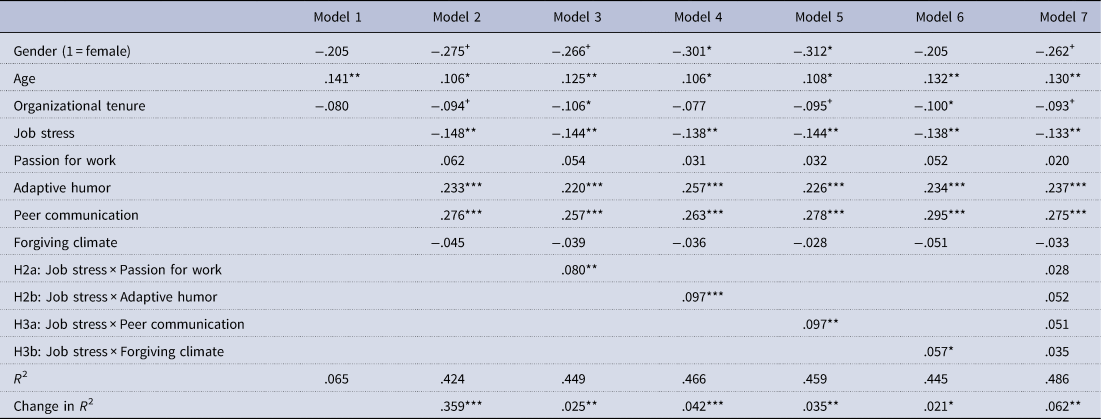
Table 1 shows the bivariate correlations and descriptive statistics. The hypotheses were tested with hierarchical moderated regression analysis, using the SPSS 25 software package. This statistical analysis technique adds variables or variable groups in a sequential manner to different regression equations (Lattin, Carroll, & Green, Reference Lattin, Carroll and Green2003). The results of this analysis are shown in Table 2. Model 1 includes the control variables. Model 2 adds job stress and the four moderators. Models 3–6 add the job stress × passion for work, job stress × adaptive humor, job stress × peer communication, and job stress × forgiving climate interactions, respectively. For comprehensiveness, Model 7 includes all four two-way product terms simultaneously, though prior literature recommends assessing multiple interactions in separate equations, because their simultaneous inclusion can hide true moderating effects due to the complex constellations of multiple variables (Aiken & West, Reference Aiken and West1991; Covin, Green, & Slevin, Reference Covin, Green and Slevin2006; Thongpapanl, De Clercq, & Dimov, Reference Thongpapanl, De Clercq and Dimov2012; Zahra & Hayton, Reference Zahra and Hayton2008). Before calculating each two-way interaction term, we applied Aiken and West's (Reference Aiken and West1991) well-established practice for mean-centering their constitutive product terms.
Correlations and descriptive statistics

Note: N = 152; the Cronbach's alpha values are shown in parentheses on the diagonal.
*p < .05; **p < .01.
Regression results (dependent variable: OCB)
Note: N = 152; unstandardized coefficients (standard errors are reported in parentheses).
+p < .10; *p < .05; **p < .01; ***p < .001 (two-tailed).
In support of the central premise that the energy depletion that arises when employees feel distressed by their job situation undermines their voluntary work efforts, Model 2 reveals a negative relationship between job stress and OCB (β = −.148, p < .01), consistent with Hypothesis 1. Revealing results that are not part of our conceptual framework, Model 2 also shows direct positive relationships of adaptive humor (β = .233, p < .001) and peer communication (β = .276, p < .001) with OCB, whereas the direct effects of passion for work and forgiving climate are not significant.
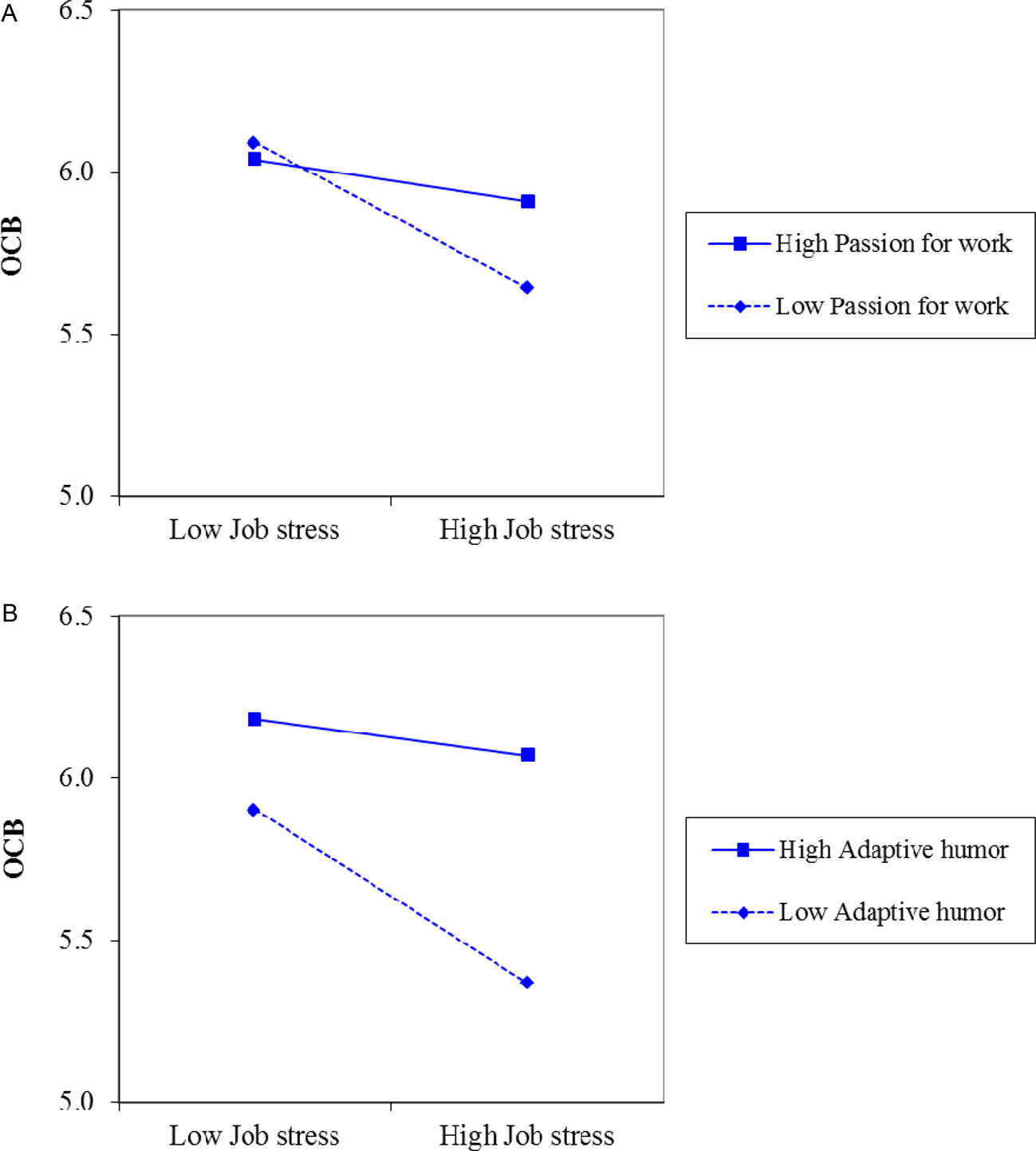
Models 3 and 4 support the hypothesized buffering effects of the two personal resources. In particular, the likelihood that employees refrain from voluntary work efforts in response to the experience of job stress is subdued to the extent that they can draw from their passion for work (β = .080, p < .01) and adaptive humor (β = .097, p < .001). Figure 2, panels A and B, depicts these interactions, by plotting the effects of job stress on OCB at high and low levels of the two personal resources, that is, at one standard deviation above and below their respective means (Aiken & West, Reference Aiken and West1991). The patterns show that increasing levels of job stress lead to lower OCB, but to varying degrees depending on the value of the moderators. A corresponding simple slope analysis reveals that the relationship between job stress and OCB is negative and significant at low levels of passion for work (β = −.224, p < .001) and adaptive humor (β = −.235, p < .001), but it becomes non-significant at high levels (β = −.064, β = −.041, respectively, both ns), in line with Hypotheses 2 and 3.
Moderating effects. (A) Passion for work on the relationship of job stress and OCB. (B) Adaptive humor on the relationship of job stress and OCB.
Models 5 and 6 similarly indicate support for the hypothesized buffering effects of the two contextual resources, featuring positive interaction terms for peer communication (β = .097, p < .01) and forgiving climate (β = .057, p < .05). The likelihood that employees' increasing job stress levels curtail their voluntary work efforts is lower when they can draw from peer knowledge or an organizational climate that forgives errors. As Figure 3, panels A and B – which feature negative slopes but with different strengths contingent on the moderator values – and the associated simple slope analyses reveal, the relationship between job stress and OCB is negative and significant when peer communication (β = −.241, p < .001) and forgiving climate (β = −.195, p < .01) are at one standard deviation below their means, but this relationship loses its significance when these two contextual resources are at one standard deviation above their means (β = −.047; β = −.081, respectively, both ns), in support of Hypotheses 4 and 5.Footnote 3
Further moderating effects. (A) Peer communication on the relationship of job stress and OCB. (B) Forgiving climate on the relationship of job stress and OCB.

In Model 7, none of the two-way interaction terms is significant when considered simultaneously in a single regression equation. As mentioned, the simultaneous estimation of multiple interaction or product terms tends to prevent the identification of true moderating effects, due to multicollinearity and the complex combinations of multiple factors. Nonetheless, such a comprehensive model can indicate the robustness of the results, to the extent that the signs of the interaction terms are similar to those that feature in the equations that include individual interaction terms (Arnold, Reference Arnold1982; Covin, Green, & Slevin, Reference Covin, Green and Slevin2006), as is the case for this study (Table 2).Footnote 4
Post hoc analyses
To confirm that the regression analyses are appropriate for the relatively small sample in this study, we undertook an a priori power analysis, using the G*Power statistical program (Faul, Erdfelder, Lang, & Buchner, Reference Faul, Erdfelder, Lang and Buchner2007). For a standard power level of .80 for a multiple regression model with nine predictors – gender, age, organizational tenure, job stress, passion for work, adaptive humor, peer communication, forgiving climate, and job stress × passion for work – combined with an effect size of Cohen's f 2 = .081 (or R 2-value of .449 in Model 3, Table 2) – the sample must contain at least 29 respondents for Model 3. Our sample size of 152 participants clearly exceeds this benchmark. Similar results were obtained for Models 4–6. Moreover, a post hoc power analysis, using the same G*Power software, affirms that our sample generated power levels of almost 100% for each of the regression models.
Despite our conceptual focus on the simultaneous interplay of job stress with the four selected resources, we still evaluated the empirical possibility that job stress may be influenced directly by these resources. However, a path model in which job stress functioned as a mediator between the four resources and OCB produced very poor fit (IFI = .25, TLI = −.18; CFI = .22, and RMSEA = .44). Furthermore, we assessed four path models that each entailed one of the four interaction terms and estimated the covariances of job stress with passion for work, adaptive humor, peer communication, and forgiveness climate. These models account for potential interdependencies between the extent to which employees have access to the four resources and the stress that they experience at work. The signs and significance levels of the four interaction terms are consistent with those reported in Table 3, confirming their critical moderating effects on the extent to which job stress escalates into lower OCB, beyond any interdependencies or causal connections that might exist between job stress and the resources. It thus provides pertinent evidence of the robustness of the theoretical framework (De Clercq, Thongpapanl, & Dimov, Reference De Clercq, Thongpapanl and Dimov2009).
Discussion
Drawing on COR theory (Hobfoll & Shirom, Reference Hobfoll, Shirom and Golembiewski2000), this study details how employees' experience of job stress might undermine their OCB and how their access to four diverse resources – passion for work, adaptive humor, peer communication, and a forgiving climate – might diminish such negative behavioral responses. The relatively limited attention to these influences in prior research is striking, in light of evidence that the energy-depleting effects of felt job stress on employees' reluctance to perform productive work activities can be countered by their access to pertinent resources (Billing & Steverson, Reference Billing and Steverson2013; Ferris et al., Reference Ferris, Rogers, Blass and Hochwarter2009). This evidence has evoked the need for studies that explicate which factors influence the connection of experienced workplace adversity with reduced voluntarism (Montani & Dagenais-Desmarais, Reference Montani and Dagenais-Desmarais2018; Naseer et al., Reference Naseer, Raja, Syed and Bouckenooghe2018).
The direct negative relationship between job stress and OCB aligns with the findings of previous studies pertaining to the detrimental effects of job-related adversity on employees' voluntary work behaviors (Baer et al., Reference Baer, Rodell, Dhensa-Kahlon, Colquitt, Zipay, Burgess and Outlaw2018; Chang et al., Reference Chang, Rosen, Siemieniec and Johnson2012; Pooja, De Clercq, & Belausteguigoitia, Reference Pooja, De Clercq and Belausteguigoitia2016). The sense of being overburdened by their job depletes employees' energy bases (Johnson et al., Reference Johnson, Cooper, Cartwright, Donald, Taylor and Millet2006) and reduces their ability and motivation to go beyond the call of duty and devote their energy to activities that are not formally expected of them (Hobfoll & Shirom, Reference Hobfoll, Shirom and Golembiewski2000). When their job gets to them emotionally or physically, employees do not have the discretionary energy needed to be a good corporate citizen (Quinn, Spreitzer, & Lam, Reference Quinn, Spreitzer and Lam2012), and their beliefs that they can volunteer for assignments beyond their regular job tasks are thwarted (Bergeron, Reference Bergeron2007; Johnson et al., Reference Johnson, Cooper, Cartwright, Donald, Taylor and Millet2006). Moreover, employees may interpret their suffering from job stress as a signal that their employer does not respect them and experience this suffering as offensive, reducing their willingness to perform any activities that benefit the organization (Chen, Sparrow, & Cooper, Reference Chen, Sparrow and Cooper2016; McCarthy, Trougakos, & Cheng, Reference McCarthy, Trougakos and Cheng2016).
As a notable contribution, this study also explicates how the extent to which the negative effect of experienced job stress escalates into reduced OCB depends on employees' access to relevant energy-enhancing resources (passion for work, adaptive humor, peer communication, and forgiving climate). Their buffering roles reflect the COR argument that the relative influence of workplace adversity on curtailing energy-consuming work behaviors tends to diminish when pertinent resources are available (Hobfoll, Reference Hobfoll2001; Hobfoll & Shirom, Reference Hobfoll, Shirom and Golembiewski2000). Employees are less likely to channel any negative energy that they might experience due to felt job stress into reduced OCB to the extent that they (1) derive personal satisfaction from working hard, (2) have a good sense of humor that helps them cope with difficult situations, (3) communicate with their peers on a regular basis, and (4) believe in the presence of organizational forgiveness. Moreover, and as explained in the Introduction, the four resources are complementary, in that they (1) each help counter the reduced ability and motivation of already stressed-out employees to undertake voluntary work efforts, (2) capture both personally held resources (passion for work and adaptive humor) and resources embedded in the organizational context (knowledge sharing and forgiveness climate), and (3) speak to the ability to draw from resources based on steady personal or relational features (passion for work and knowledge sharing) versus resources that imply the flexibility to adjust to or change the organizational status quo (adaptive humor and forgiveness climate).
By focusing explicitly on the buffering effects of these complementary resources on the incremental role of job stress in reducing OCB, this study provides insights into the circumstances in which the sense of being overburdened is less likely to hinder voluntary efforts. From an empirical perspective, these buffering effects come to the fore in the slope differences at various levels of the moderating resources. The comparison of the slopes in the interaction plots featured in Figures 2 and 3, together with the corresponding simple slope analyses, reveal that increasing levels of experienced job stress hinder voluntary work efforts to a much lesser extent when employees feel passionate about work, possess adaptive humor skills, regularly communicate with peers, and perceive organizational forgiveness. But the strong significance of the slopes at low levels of these resources indicates that a propensity to stay away from OCB, in response to felt job stress, is high when employees cannot draw from valuable resources that otherwise could help them cope with the associated hardships. The risk that experienced job stress curtails voluntarism is more salient to the extent that employees do not have access to these resources.
Overall, this study thus provides extended insights into when energy depletion due to job stress keeps employees from taking on additional responsibilities, thereby explicating the interactive roles of job stress and pertinent resources in spurring workplace voluntarism. As indicated in the Introduction, these contingency findings extend prior research on the direct roles of the four focal resources in shaping employees' experience of stress (e.g., Mackie, Holahan, & Gottlieb, Reference Mackie, Holahan and Gottlieb2001; Suchday, Friedberg, & Almeida, Reference Suchday, Friedberg and Almeida2006; Tomkins, Neighbors, & Steers, Reference Tomkins, Neighbors and Steers2019; Yovetich, Dale, & Hudak, Reference Yovetich, Dale and Hudak1990) and undertaking of voluntary work activities (e.g., Guchait et al., Reference Guchait, Lanza-Abbott, Madera and Dawson2016; Gulyani & Bhatnagar, Reference Gulyani and Bhatnagar2017; Mesmer-Magnus, Glew, & Chockalingam, Reference Mesmer-Magnus, Glew and Chockalingam2012; Zhang et al., Reference Zhang, Sun, Lin and Ren2018). Our research findings offer extended conceptual insights into the conditions in which felt job stress is less likely to translate into reduced OCB.
Limitations and future research
This study admittedly has some shortcomings, which suggest further investigations. First, previous research has indicated that OCB by itself might lead to exhaustion (Bolino et al., Reference Bolino, Turnley, Gilstrap and Suazo2010), so caution is warranted, regarding the possibility of reverse causality. Well-established COR theory (Hobfoll, Reference Hobfoll1989; Hobfoll & Shirom, Reference Hobfoll, Shirom and Golembiewski2000) underlies our theorizing, and the negative relationship between job stress and OCB indicates that this reverse logic is unlikely to be a concern. Nonetheless, continued research could apply longitudinal designs to measure job stress and voluntary work efforts over time. Nor does this study include explicit measures of the causal mechanisms that underpin the hypothesized relationships. The experience of job stress theoretically should drain employees' energy levels, which may undermine their ability and motivation to devote substantial energy to voluntary efforts (Hobfoll & Shirom, Reference Hobfoll, Shirom and Golembiewski2000; Johnson et al., Reference Johnson, Cooper, Cartwright, Donald, Taylor and Millet2006; McCarthy, Trougakos, & Cheng, Reference McCarthy, Trougakos and Cheng2016). The resources studied herein also theoretically should exert buffering effects on these ability and motivation mechanisms. Additional research could measure these mechanisms more directly to establish whether ability- or motivation-based arguments are more potent.
Second, in investigating four specific contingency factors, this study overlooks other potential buffers of the negative relationship between job stress and OCB. Alternative personal factors could serve as buffers too, such as employees' emotional intelligence (Newton, Teo, Pick, Ho, & Thomas, Reference Newton, Teo, Pick, Ho and Thomas2016), tenacity (Baum & Locke, Reference Baum and Locke2004), or psychological capital (i.e., self-efficacy, hope, optimism, and resilience; Luthans, Avey, Avolio, & Peterson, Reference Luthans, Avey, Avolio and Peterson2010). Each of these resources could provide employees with the drive to maintain some level of voluntarism, despite job-related adversity and experienced stress. Other contextual resources might beneficially mitigate the negative impact of felt job stress, such as adequate reward policies that recognize employee voluntarism (Werner, Reference Werner2000), perceived organizational justice (Colquitt, Conlon, Wesson, Porter, & Ng, Reference Colquitt, Conlon, Wesson, Porter and Ng2001), or decision autonomy that enables employees to make their own decisions about when and how to allocate their personal energy to different work activity types (Prem, Kubicek, Diestel, & Korunka, Reference Prem, Kubicek, Diestel and Korunka2016).
Third, an empirical shortcoming of this research pertains to its focus on one organization only and the associated small sample of employees. Smaller samples offer more conservative tests of the hypothesized relationships (Bouckenooghe, De Clercq, & Deprez, Reference Bouckenooghe, De Clercq and Deprez2014), and the power tests revealed that the sample was sufficiently large from an empirical perspective. Still, it would be useful to assess the external validity of the results by testing the conceptual framework in larger samples that include multiple organizations. In a related vein, the focal organization operates in one specific sector (construction), so we cannot address how relevant industry characteristics might influence the theoretical framework. Organizational decision makers who operate in very competitive external markets may inflict substantial pressures on their employee bases for example, such that the experience of job stress would be a common feature among many employees. In this scenario though, employees may also more easily accept that their leaders are not in a position to generate a stress-free work environment (Cui, Griffith, & Cavusgil, Reference Cui, Griffith and Cavusgil2005). Continued research accordingly should assess empirically how different forces that originate from outside the organization influence the hypothesized relationships.
Fourth, this study is based solely in Mexico, which raises questions of generalizability and whether cultural factors interfere with the framework. As explained in the Introduction, the contrasting impacts of certain cultural features – such that high uncertainty avoidance may stimulate negative reactions to experienced job stress, but collectivism could mitigate such reactions (Hofstede, Hofstede, & Minkov, Reference Hofstede, Hofstede and Minkov2010) – make Mexico a highly relevant context for testing the proposed theoretical framework. The empirical support we find for each of the research hypotheses might suggest the first dynamic is more important than the second. Notably, our theoretical arguments are country-neutral, and we expect that the strength, but not the nature, of the proposed relationships may vary across country contexts. It would thus be insightful to undertake cross-country studies that compare the salience of job stress for reducing job performance, as well as the prominence of different resources in this process, in countries other than Mexico. It would also be interesting to examine how associated individual factors may interfere with our model, such as employees' own risk aversion (Chow, Ng, & Gong, Reference Chow, Ng and Gong2012) or collectivistic orientation (Oyserman, Coon, & Kemmelmeier, Reference Oyserman, Coon and Kemmelmeier2002).
Practical implications
This study of the interplay of job stress and resource access as a means to predict OCB has important managerial implications. The sense of being overwhelmed by job situations can be an important source of suffering for employees, and organizational decision makers should find ways to limit the associated hardships. A challenge is that many employees may be reluctant to admit that they feel overwhelmed or distressed by their jobs, to avoid looking inadequate, weak, or needy (Avery, Tonidandel, Volpone, & Raghuram, Reference Avery, Tonidandel, Volpone and Raghuram2010; Johnson et al., Reference Johnson, Cooper, Cartwright, Donald, Taylor and Millet2006). Organizations thus must take proactive steps to detect signals of excessive stress, such as by creating an open culture in which employees do not worry about voicing concerns about stress-inducing aspects of their jobs. They also should take care not to make employees feel overly pressured to take on extra assignments that exceed regular job tasks (Bolino et al., Reference Bolino, Turnley, Gilstrap and Suazo2010). Adequate training initiatives – through formal education programs, on-the-job training initiatives, or informal learning (Enos, Kehrhahn, & Bell, Reference Enos, Kehrhahn and Bell2003; Werner, Reference Werner2000) – can help employees retain discretionary energy for voluntary activities, even in the presence of burdensome job circumstances.
The significant moderating effects of personal resources suggest additional advice in this regard. Employees who feel passionate about their work are better positioned to deal with experienced job stress, so the recruitment and retention of employees who score high on this personal characteristic can play an instrumental role in organizations that are marked by stressful work conditions but still want to encourage OCB within their ranks. Organizations could leverage their employees' passion, perhaps by providing them with specific examples of how helping other organizational members voluntarily, even when experiencing a stressful job situation themselves, can evoke personal satisfaction and make a meaningful contribution to the organization (Vallerand et al., Reference Vallerand, Blanchard, Mageau, Koestner, Ratelle, Leonard and Marsolais2003). To leverage adaptive humor skills, organizations similarly could underscore the value of maintaining a healthy dose of relativism and help employees put their job-related disappointments into perspective, so that they remain willing to reserve some minimum level of energy to devote to voluntarism, even in unfavorable job circumstances (Romero & Cruthirds, Reference Romero and Cruthirds2006).
To reduce the risk that experienced job stress escalates into diminished voluntary efforts, organizations also could stimulate more frequent information flows among employees, so they feel knowledgeable and supported. If employees can draw from the expertise of their peers, they likely are in a better position to fulfill their formal job obligations, even if they feel distressed by their job, which should reduce any tendencies to avoid voluntary work efforts (Wang & Noe, Reference Wang and Noe2010). In the absence of such peer communication, employees' ability to learn from others, in terms of how to deal with job stress, decreases. Thus, organizations should select and evaluate employees according to their willingness to share their skills and experiences with others and to contribute to the organization's well-being when these opportunities arise. Another means to encourage voluntarism in the face of job stress would be to convince employees that their employer will forgive mistakes, particularly those resulting from employees' overconfidence that they can take on extra-role responsibilities, beyond formal obligations (Fehr & Gelfand, Reference Fehr and Gelfand2012).
Conclusion
Employees who experience job stress may stay away from voluntary work behaviors, but the likelihood that this process unfolds is lower in the presence of specific resources: a strong passion for work, a strong sense of humor that helps employees adapt to hardships, frequent communication with peers, and a forgiveness-oriented climate. These resources help employees contain the frustration that comes with their feelings of distress, such that it becomes less likely that they avoid work behaviors that extend beyond their formal job duties. Further research could use these insights as a foundation for considering additional, complementary means for organizations to manage the risk that adverse job conditions stifle voluntarism within their ranks.



