I. INTRODUCTION
Lithium-ion batteries (LIBs), as one of the most promising power source candidates for widespread consumer electronics and upcoming electric vehicles evolution, have gained great attention for past decades, due to their high energy density, light weight, fast charge and discharge efficiency, and long service life. To date, numerous materials, such as lithium alloys/multinary alloy, Reference Liu, Wu, McDowell, Yao, Wang and Cui1,Reference Shin and Liu2 graphitic/nongraphitic carbon, Reference Bhardwaj, Antic, Pavan, Barone and Fahlman3 transition metal dichalcogenides, Reference Li, Wu, Zhou, Cabrera and Chen4–Reference Bhandavat, David and Singh6 transition metal oxides, Reference Chan, Peng, Twesten, Jarausch, Zhang and Cui7,Reference Mai, Hu, Chen, Qi, Lao, Yang, Dai and Wang8 polymers, Reference Kil, Choi, Ha, Xu, Rogers, Kim, Lee, Kim, Cho and Lee9 and their composites, Reference Chang and Chen10 have been exploited as electrode materials of LIBs. Nevertheless, in spite of the extensive investigations, it remains a great challenge to further improve the capacity and cyclic life of the electrodes of LIBs.
To enhance the structural stability and electrical conductivity of electrode materials, major efforts have been made to reduce the size and dimensionality of the materials mentioned above in past decades, Reference Arico, Bruce, Scrosati, Tarascon and van Schalkwijk11 owing to the quantum confinement effect and boundary effect. Reference Uthaisar and Barone12,Reference Tang and Zhou13 Due to the high specific surface area and short lithium diffusion paths, nanomaterials displayed notably improved electrochemical performances. Reference Holtz, Yu, Gunceler, Gao, Sundararaman, Schwarz, Arias, Abruña and Muller14,Reference Jing, Zhou, Cabrera and Chen15
Recently, transition metal dicalcogenides have been demonstrated as very promising candidates for LIB electrodes on the basis of their unique chemical and physical properties, such as good conductivity, thermal stability, mechanical properties, and high charge–discharge cycles. Reference Hwang, Kim and Cho16 For instance, MoS2 monolayer showed an excellent Li mobility and dynamic negative compressibility. Reference Mak, Lee, Hone, Shan and Heinz17 Furthermore, Li et al.'s theoretical work demonstrated that 1-D MoS2 nanoribbons (NRs) were promising cathode materials for Li-ion batteries with a remarkably enhanced Li binding interaction and high Li mobility. Reference Bhardwaj, Antic, Pavan, Barone and Fahlman3
Tin disulfide (SnS2) is a typical post-transition metal dichalgenide material, which was first synthesized around 200 years ago Reference Woulfe18 and has more than 70 polytypic structures. Reference Palosz, Steurer and Schulz19 While at ambient temperature, the thermodynamically stable polytope of SnS2 (1T) consists of a trigonal lattice P3m1 (a = 3.65 Å; c = 5.90 Å) Reference Jiang and Ozin20 with one layer per unit cell, where Sn(IV) ion is coordinated to six S ions in an octahedral environment. Reference Fong and Cohen21 Similar to graphite, these layers are held together by van der Waals (vdW) interactions. Such a unique structure endows SnS2 as a key material for fundamental research and technological applications in opto-electronic devices, Reference Suryawanshi, Warule, Chaudhari, Ogale and More22 catalysts, Reference Zhang, Li, Zhang and Dionysiou23 sensors, Reference Li, Yang, Tang, Zhang and Hu24 and electrochemical storage. Reference Luo, Fang, Wang, Zhou, Song and Zhi25
Meanwhile, various morphologies of SnS2 materials including nanoparticles, Reference Hong, Popovitz-Biro, Prior and Tenne26 nanoplates, Reference Seo, Jang, Park, Kim, Park and Cheon27 nanobelts, Reference Yujie, Hui, Xiangyang, Jin and Deren28 nanowires, Reference Lin, Shi, Chen, Chen and Wu29 and nanotubes Reference Chen, Shen, Tang, Liu and Qian30 have been synthesized by different approaches and found to show efficient electrochemical performance, Reference Momma, Shiraishi, Yoshizawa, Osaka, Gedanken, Zhu and Sominski31–Reference Zhong, Yang, Song, Liao, Cui, Shen and Wang35 since these nanostructures could better release the huge strain and stresses, buffer the volume change, and enhance lithiation/delithiation ability. For example, Luo et al. Reference Luo, Fang, Wang, Zhou, Song and Zhi25 demonstrated that SnS2 nanoplates possess highly reversible capacity (∼583 mA h/g) and excellent rate performance.
Very recently, Huang et al. Reference Huang, Ling, Chen, Zhou and Wang36 theoretically explored the Li adsorption and diffusion behavior on various SnS2 nanostructures (bulk, bilayer, monolayer, zigzag NRs, and nanotubes) by means of density functional theory (DFT) computations with Vienna Ab-initio Simulation Package (VASP) code. Their results showed that Li adsorption in SnS2 bulk and bilayer is stronger than the counterparts (monolayer, zigzag NRs, and nanotubes), but the diffusion is kinetically not as favorable as others. Besides, SnS2 nanotubes gains Li binding strength, while sacrifices Li mobility and capacity when compared to SnS2 monolayer.
Hence we further investigated the Li adsorption and diffusion properties on SnS2 NRs in comparison with SnS2 counterparts, to explore the potential of SnS2 NRs for LIB anodes. Our computations show that SnS2 NRs can provide improved Li binding strength, fast Li mobility, and high theoretical capacity, which indicates that SnS2 NRs are a promising candidate of anode materials for LIBs with a high power density and fast charge–discharge rates.
II. COMPUTATIONAL METHODS
All the calculations were performed by using an all-electron method, as implemented in the DMol3 code. Reference Delley37,Reference Delley38 The generalized gradient approximation parameterization of Perdew–Burke–Ernzerhof (PBE) Reference Perdew, Burke and Ernzerhof39 of the exchange-correlation functional was adopted, together with the double numerical plus polarization basis set. Reference Perdew and Wang40 The convergence tolerance of the total energy and electron density was set to 10−6 a.u. for self-consistent field computations. We fixed the real-space global orbital cutoff radius as high as 5.1 Å in all computations to guarantee high-quality numerical results. The Brillouin zones of SnS2 bulk, nanosheets, and NRs were represented by Monkhorst-Pack special k-point mesh of 4 × 4 × 4, 4 × 4 × 1 and 1 × 1 × 8, respectively.
To investigate the Li adsorption and diffusion in the SnS2 bulk/bilayers, a 3 × 3 supercell with one adsorbed Li atom was used, and the Grimme's PBE + D2 (D stands for dispersion) method, Reference Grimme41 which introduces dispersion correction by using an empirical potential of the form C6R−6, was adopted, Reference Ortmann, Bechstedt and Schmidt42 since the standard PBE functional cannot well describe the vdW interactions between individual layers, Li binding energies, and diffusion barriers in layered materials. Reference Carrasco43 Furthermore, the transition states were located via the synchronous method with conjugated gradient (CG) refinements. Reference Govind, Petersen, Fitzgerald, King-Smith and Andzelm44 This method consists of repeated CG minimization after linear synchronous transit (LST) maximization, followed by repeated CG minimization next to quadratic synchronous transit (QST) maximizations until a transition state is located.
In our work, the Li binding energy, E b(Li), is defined as E b(Li) = E tot(SnS2) + E tot(Li) – E tot(SnS2–Li), where E tot(SnS2), E tot(Li), and E tot(SnS2–Li) are the total energies of SnS2 (bulk, bilayer, monolayer, or NRs), Li chemical potential, and Li-adsorbed SnS2, respectively. According to this definition, the more positive the binding energy is, the higher exothermicity the lithiation in SnS2 proceeds with.
III. RESULTS AND DISCUSSION
A. Li atom adsorption and diffusion in bulk SnS2
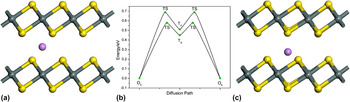
We first studied the Li adsorption and diffusion behavior in a bulk phase of SnS2. The optimized lattice constant c of SnS2 bulk (5.91 Å) is in good consistence with experiment value (5.85–5.90 Å) Reference Palosz and Salje45 and previous theoretical works. Reference Lefebvre-Devos, Olivier-Fourcade, Jumas and Lavela46 A 3 × 3 × 1 supercell was used for SnS2 bulk, which comprises 9 Sn atoms and 18 S atoms. There are two typical sites feasible for lithiation in SnS2 bulk: (i) the octahedral (Oh) site, located in the center of nearest 6 S atoms from both of the triple layer [Fig. 1(a)]; and (ii) the tetrahedral (Td) site, symmetrically located in the gap, where Li atom can bind to three S atoms from upper triple layer and a S atom from lower triple layer [Fig. 1(b)].
Schematics of a Li atom adsorbed at the octahedral site (a) and tetrahedral site (c) of SnS2 bulk in side view. (b) Lithium diffusion path (Oh–Td–Oh) and barrier from an octahedral (Oh) site to another, passing through a tetrahedral (Td) site in SnS2 bulk, and bilayer. The gray, yellow and violet balls denote Sn, S, and Li atoms, respectively.

For the two examined adsorption sites, Li atom prefers to be adsorbed at the octahedral site with a binding energy of 1.85 eV, and the optimal mean distance between Li and surrounded S atoms is 2.58 Å. For lithiation at the tetrahedral site, it is also energetically favorable (with a binding energy of 1.39 eV); in this case, the lengths for upper and lower Li–S bonds are 2.24 and 2.35 Å, respectively.
In general, the electrochemical performance of an electrode is primarily determined by the Li mobility. Therefore it is necessary to study the diffusion path and barrier of Li in SnS2 bulk. We considered the pathway that Li moving from an octahedral site to a nearby tetrahedral site, then to another octahedral site by adopting LST/QST method [Fig. 1(c)]. The computation showed a barrier of 0.69 eV, indicating that Li can migrate in bulk SnS2. To further improve the Li mobility, we still need to reduce the diffusion barrier. And the SnS2 nanosheets are expected to have a higher Li mobility than in SnS2 bulk phase. The calculated binding energies, bond distances, and reaction barriers are consistence with recent study. Reference Liu, Yin, Hao, Zhang, Li, Chen, Li, Wang and Wang34
B. Single Li atom adsorption and diffusion in bilayer and on monolayer
As a comparison, we also examined the Li adsorption and diffusion in both SnS2 bilayer and SnS2 monolayer, to check whether there is an improved Li mobility.
In SnS2 bilayer, the interlayer distance is a little larger than that in bulk phase (5.95 Å versus 5.91 Å). Consequently, the newly formed Li–S bonds are also slightly longer than those in SnS2 bulk (2.60 Å versus 2.58 Å). The octahedral site is more favorable for lithiation than the tetrahedral site (with a 1.8 and 1.32 eV binding energy, respectively), which is lower than that for corresponding site in SnS2 bulk (1.85 and 1.32 eV, respectively). As expected, reducing the dimension from 3D bulk to 2D bilayer facilitates Li diffusion: SnS2 bilayer showed a decreased diffusion barrier, which is 0.11 eV lower than that of SnS2 bulk [Fig. 1(c)], when migrating between two neighboring Oh sites (0.58 eV versus 0.69 eV).
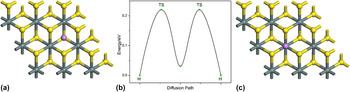
On SnS2 monolayer, the hollow site (H), above the center of the hexagon [Fig. 2(a)], is more favorable for lithiation with a binding energy of 1.20 eV, slightly larger than that of the top site (T), directly above one Sn atom [Fig. 2(b)], with a binding energy of 1.07 eV. The other possibility for Li adsorption site, namely, atop of S atom, was also considered. But it is excluded since the Li atom spontaneously moves to nearby H site upon full relaxation.
Optimized geometries of a Li atom adsorbed at the H site (a) and T site (c) of SnS2 monolayer. (b) Energy profile for Li diffusion on SnS2 monolayer from an H site to another, passing through a T site.

We examined the Li diffusion routes on SnS2 monolayer by migrating from an H site to another, while passing through a T site. The computed energy barrier is only 0.22 eV [Fig. 2(c)], which is smaller than that on MoS2 monolayer (0.25 eV), Reference Li, Wu, Zhou, Cabrera and Chen4 and the same as that of commercialized graphite anode (0.22 eV) Reference Uthaisar and Barone12 at the same theoretical level. Besides, it is dramatically lower than the diffusion barrier in SnS2 bulk (0.69 eV) and SnS2 bilayer (0.58 eV). This property was also found in TiS2-related materials. Reference Tibbetts, Miranda, Meng and Ceder47
We also estimated Li mobility (D) on the surface of SnS2, as the Li mobility has a dominant effect on the rate performance of an electrode. By using the Arrhenius equation (D ∝ e−Ea/kT ), it can be quantitatively estimated that Li mobility D in SnS2 bilayer and on SnS2 monolayer can be improved by a factor of 107 and 109, compared with that in SnS2 bulk at room temperature, respectively.
C. Single Li atom adsorption and diffusion in 8-ZSnS2NR
Even though the 2D SnS2 nanosheets have much higher Li mobility, their decreased Li binding energies cannot make them ideal candidates for anode materials. Note that high Li binding energy is important to ensure the thermodynamic stability in anode materials. Though the recent theoretical work Reference Momma, Shiraishi, Yoshizawa, Osaka, Gedanken, Zhu and Sominski31 showed that zigzag SnS2 NRs have weak Li binding energies, the Li diffusion behaviors have not been addressed, and the armchair NRs have not been examined. Therefore, we further investigated the performance of Li adsorption and diffusion on 1D NRs, since these behaviors may be affected via reducing the 2D materials into 1D nanostructure owing to the edge effect. Followed by the pronounced success in graphene and MoS2 system Reference Uthaisar, Barone and Peralta48 for improving Li binding energies, we expected that it is also possible to see the enhanced Li interactions with SnS2NRs.
Similar to previous study, Reference Li, Li, Zhou, Lu, Qin, Gao and Mei49 two types of SnS2NRs can be generated from the SnS2 monolayer, namely, zigzag and armchair SnS2NRs. Following the previous definition of graphene NRs, N z-ZSnS2NR (N a-ASnS2NR) is used to denote the zigzag-edged (armchair edged) SnS2NR with a width of N z zigzag chairs (N a armchair chains). Here, we chose 8-ZSnS2NR with the length of 25.53 Å and 15-ASnS2NR with the length of 26.59 Å as the models for further study.
To evaluate the stabilities of SnS2 NRs, we calculated the formation energy per atom (E
f) using the following definition:
 $E_{\rm{f}} = {{\left( {nE_{{\rm{Sn}}} + {{mE_{{\rm{S8}}} } \mathord{\left/ {\vphantom {{mE_{{\rm{S8}}} } {8 - E_{{\rm{SnS}}_{\rm{2}} } }}} \right. \kern-\nulldelimiterspace} {8 - E_{{\rm{SnS}}_{\rm{2}} } }}} \right)} \mathord{\left/ {\vphantom {{\left( {nE_{{\rm{Sn}}} + {{mE_{{\rm{S8}}} } \mathord{\left/ {\vphantom {{mE_{{\rm{S8}}} } {8 - E_{{\rm{SnS}}_{\rm{2}} } }}} \right. \kern-\nulldelimiterspace} {8 - E_{{\rm{SnS}}_{\rm{2}} } }}} \right)} {\left( {n + m} \right)}}} \right. \kern-\nulldelimiterspace} {\left( {n + m} \right)}}$
, where E
Sn, E
S8, and
 ${E_{{\rm{Sn}}{{\rm{S}}_{\rm{2}}}}}$
represents the total energies of free Sn atom, crown-like S8 molecular and SnS2 NR, respectively, n (m) denotes the number of Sn (S) atoms in unit cell. Based on the definition, systems with larger E
f values (positive) are energetically more favorable. Our computations showed that 8-ZSnS2NR and 15-ASnS2NR have very close E
f values (1.54 and 1.53 eV/atom, respectively), which is in line to previous study
Reference Govind, Petersen, Fitzgerald, King-Smith and Andzelm44
; therefore it seems very promising to synthesize the SnS2 NRs in both armchair and zigzag forms.
For the electronic properties, SnS2 NRs have smaller band gaps (1.67 eV for Z8SnS2, 1.52 eV for A15SnS2) than the SnS2 monolayer (2.09 eV). The electronic property change due to the reduced dimensionality in NRs, or the edge effect, also occurs in other systems, such as in graphene, Reference Uthaisar and Barone12 MoS2, Reference Li, Wu, Zhou, Cabrera and Chen4 and MoO3. Reference Li, Cabrera and Chen50
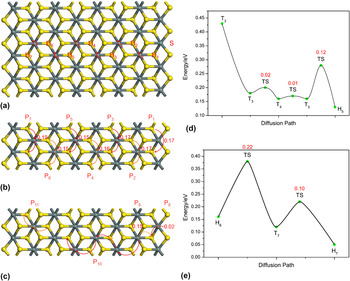
Because of the low symmetry properties, there are many unique sites for Li adsorption available on the 8-ZSnS2NR. In this study, we examined all the possible sites throughout the ribbon for lithiation on 8-ZSnS2NR, containing 7 Hollow sites (H1–H7) and 8 Top sites (T1–T8) on the basal plane, and 4 sites on the side plane (S1–S4), as shown in Fig. 3(a).
Top view of the geometry of 8-ZSnS2NR (a). All examined Li adsorption sites are marked with red characters. Li diffusion paths and energy barriers on 8-ZSnS2NR along the axis direction (b). Li diffusion paths and energy barriers on 8-ZSnS2NR along the transverse direction (c). Energy profiles for Li diffusion on P10 (d) and P11 (e) paths, respectively. The numbers indicate the energy barriers in electrovolts, and E b(H1) is set as zero point energy.

The computed Li binding energies (E b) and mean Li–S bond length (L Li–S) for all the examined sites for 8-ZSnS2NR and 15-ASnS2NR are summarized in Table I. The T1, T8, are not local minimum sites for lithium adsorption. As upon relaxation, the Li atom on the T1, and T8 sites move to the near edge site H1 and H7, respectively. And S2 and S4 sites move to the corresponding S1 and S3 sites.
Computed Li binding energies (E b), and mean Li–S bond length (L Li–S) for all the examined Li adsorption sites of 8-ZSnS2NR.

Similar to previous study, Reference Momma, Shiraishi, Yoshizawa, Osaka, Gedanken, Zhu and Sominski31 the lithiation energies of all the considered binding sites on 8-ZSnS2NR, except the high values at H1 (E b = 1.13 eV) and H7 (E b = 1.08 eV) sites, are in the range of 0.7–1.01 eV, which are slightly lower than those on the SnS2 monolayer sheet (1.08 and 1.10 eV). On the basal plane, the H i sites have a generally more favorable binding energy than the corresponding T i sites, which is similar to the case on the SnS2 monolayer. While, among all the considered adsorption sites, the 4-fold site H1 near the edge region has the highest Li binding energy, followed by the edge hollow site H7. The Li binding energies in the center sites are lower than that on the near-edge sites. At the edge site, the chemical environment of edge atoms is different from the central ones. For example, the edge S atoms only have two coordinated Sn atoms, while in the basal plane they are three coordinated; hence the edge S atoms are typically considered having dangling bond character. This special chemical environment may be the reason for the enhanced Li binding energy at the edge sites.
To examine whether dimension reduction affects the Li mobility, we further investigated the Li diffusion behavior along both the periodic direction [Fig. 3(b)] and transverse direction [Fig. 3(c)] of 8-ZSnS2NR. Due to the asymmetrical structure property, various diffusion pathways have to be considered.
For Li diffusion routes along the periodic direction (as illustrated in Fig. 3), there are seven paths (p i = H i –T i –H i , i = 1–7) on the basal plane. The diffusion barriers decrease gradually from the edge to the center, with the magnitude between 0.15 and 0.19 eV, which are all smaller than those of similar diffusion route on SnS2 monolayer (0.22 eV), and P5 has the lowest diffusion barrier among the seven P i routes (0.15 eV), implying the considerable edge effect.
For Li diffusing along transverse direction of 8-ZSnS2NRs, there are four paths (P8 = S–H1, P9 = H1–T2, P10 = T2–T3–T4–T5–H5, P11 = H6–T7–H7, see Fig. 1) on the basal plane. The energy barriers for Li migration of P8–P10 are in the range of 0.02–0.13 eV, which have lower activation barriers than the periodic direction considered above, while P11 with a higher energy barrier of 0.22 eV. Obviously, Li prefers to diffuse along the transverse direction (P8), which is similar to the case of Li diffusion on the MoS2 NRs, indicating certain percent of edge effect.
D. Single Li atom adsorption and diffusion in 15-ASnS2NR
We also explored the lithiation behavior on 15-ASnS2NR NR, since it has comparable stability as 8-ZSnS2NR. More adsorption sites were involved, though it is symmetric, the structures of the two basal planes are different [Fig. 4(a)]. The Li binding strength on 15-ASnS2NR (Table II) is slightly stronger than that on 8-ZSnS2NR (Table I): the binding energies at hollow sites, top sites, upper hollow sites (UH), upper top sites (UT), and edge sites are in the range of 0.94–1.08, 0.99–1.03, 1.08–1.30, 1.00–1.02, and 1.20 eV, respectively. Among all the investigated lithiation sites, UH1 has the largest E b value (1.30 eV), which is much stronger than that of the energetically most favored site in monolayer. However, T1/UT1 site are not local minimum for lithiation, the Li atom on these sites move to the nearby H1/UH1 sites spontaneously upon relaxation.
Top view of geometry of 15-ASnS2NR (a). All examined Li adsorption sites are marked with red characters. Li diffusion paths and energy barriers on 15-ASnS2NR along the axis direction (b). Li diffusion paths and energy barriers on 8-ZSnS2NR along the transverse direction (c). The numbers indicate the energy barriers in electrovolts and E b(UH1) is set as zero point energy.

Computed Li binding energies (E b), and mean Li–S bond length (L Li–S) for all the examined Li adsorption sites of 15-ASnS2NR.

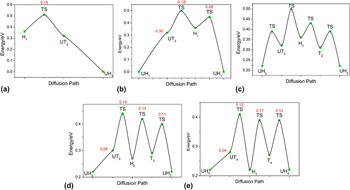
Similar to the case on 8-ZSnS2NRs, we examined all the possible Li diffusion routes along periodic direction (P i = UH i –UT i –H i−1–T i –UH i , i = 2–4; P1 = UH1–UT2–H1–UH1) and that along transverse direction on the basal plane (P5 = S–UH1, P6 = H1–UT2–UH1, and P7 = T2–H2).
For Li diffusion along the periodic directions [Fig. 4(b)], the diffusion barrier is in the range of 0.17–0.48 eV [as shown in Figure 5], and P4 has the lowest diffusion barrier (0.17 eV); moreover, the barrier of P1 (0.48 eV), where the UH1 has the strongest Li binding energy, is higher compared to the E d value of similar diffusion pathway on SnS2 monolayer (0.22 eV).
Energy profiles for Li diffusion on P6 (a) path along the transverse direction. Energy profiles for Li diffusion on P1 (b), P2 (c), P3 (d), and P4 (e) paths along the periodic direction, respectively. The numbers indicate the energy barriers in electrovolts.

Along the transverse direction [Fig. 4(c)] on 15-ASnS2NR, the Li diffusion barriers are in the range of 0.14 and 0.19 eV, while P7 routes are relatively low (0.14 eV), which is lower than that corresponding route on 8-ZSnS2NR (0.17 eV) and that on monolayer (0.22 eV), implying the considerable edge effect.
Apparently, it is likely for Li to diffuse along both the periodic direction and transverse direction on 15-ASnS2NR, which is more complicated than the 8-ZSnS2NR system. Similar to the situation of 8-ZSnS2NR, Li diffusion barrier gradually decreases from edge to center in periodic direction, while the barrier is smaller near the edge in transverse direction. Similar behavior has also been demonstrated in the graphene Reference Uthaisar and Barone12 and MoS2 (Ref. Reference Li, Wu, Zhou, Cabrera and Chen4) NR systems.
Finally, we calculated the Li storage capacity. The unit cell of 8-ZSnS2NR and 15-ASnS2NR can accumulate up to 20 and 36 Li atoms (to avoid phase separation, the distances of any adjacent Li atoms are all larger than that in Li metal), which correspond to the chemical stoichiometry of SnS2Li2.5 and SnS2Li2.4, respectively. Accordingly, their theoretical Li storage capacities are correspondingly 366 and 352 mA h/g, much larger than the counterparts of SnS2 bulk (192 mA h/g), bilayer (228 mA h/g), and monolayer (293 mA h/g). Due to the edge and curvature effect, the Li storage capacity of SnS2 NRs is expected to be higher than the nanotubes.
In the preceding section, we compared the Li adsorption, Li diffusion, and Li capacity in different SnS2 nanostructures. The dimension reduction to 1D NRs, especially the armchair NRs, brings many advantages: the binding strength is enhanced as high as 0.2 eV compared to 2D monolayer; the Li diffusion barrier is lowered by up to 0.55 eV compare to bulk phase, correspondingly the mobility is improved by a factor of 109 according to the Arrhenius equation; the Li storage capacity is higher than the other structural morphologies. These exceptional features render SnS2 NRs as promising LIB anode materials.
IV. CONCLUSIONS
In conclusion, we preformed DFT computations to investigate the Li adsorption and diffusion in SnS2 bulk, bilayer, monolayer, and NRs. Comprehensive computations demonstrated that the Li mobility on SnS2 monolayer can be remarkably increased compared with that in SnS2 bulk. However, the Li binding energy of SnS2 nanosheets is lower than that of SnS2 bulk, which makes SnS2 nanosheets not idea anode materials for LIB. While cutting SnS2 nanosheets into SnS2NRs can not only enhance the Li binding strength and Li capacity, but also preserve the high Li mobility. Therefore, SnS2 NRs, particularly the armchair NRs, are promising as anode materials of Li-ion batteries with high performance. Our theoretical studies will hopefully inspire experimental studies on SnS2NRs as anode materials.
ACKNOWLEDGMENTS
This work was supported by Department of Defense (Grant W911NF-12-1-0083) and NSF (Grant EPS-1002410).