Coronavirus disease 2019 (COVID-19) was first reported in late December 2019 in Wuhan, China. The new coronavirus, which causes COVID-19 disease, is transmitted mostly through the respiratory tract. The economic impacts of the virus on the whole world have not been fully clarified yet. Almost 10% of the health-care workers (HCW), which are at the forefront of combating this disease, were affected by this disease. The World Health Organization announced that 115,000 health-care workers died of this disease by May 24, 2021.
Nurses are the core of the care team and are the largest human resources in the health-care system. Given the key role of nurses in the care and the treatment of patients and considering the destructive impacts of stress on nurses’ performance and various aspects of life, intervention to reduce nurses’ stress and its consequences seems necessary. In recent years, the sources of stress in the workplace and coping strategies have been studied, and it has been shown that the use of coping strategies has reduced stress. Reference Lambert and Lambert1 Also, new views emphasize the role of psychological resources in coping with stressors, instead of focusing on the nature of stress. In other words, coping with stress is more important than the severity and frequency of stress exposure. Reference Alkhawaldeh, Soh and Mukhtar2 One of the coping strategies helping them deal with stressful situations effectively is resiliency skills. Reference Finstad, Giorgi and Lulli3 Resiliency is one of the characteristics helping nurses cope with the stress of their work environment. Reference Goodwin4 Nurses in the 21st century need to develop resiliency to cope with occupational problems overcome negative experiences and turn those experiences into positive ones. Reference Warelow and Edward5
The work pressures that nurses face in dynamic health care and deficiency of resources affect their mental state especially during COVID-19. Reference Warelow and Edward5–Reference Ghahramani, Omidifar, Garayemi, Sayari and Bagheri Lankarani8
For example Shechter et al., found that 57% of health-care providers during the COVID-19 pandemic, had symptoms of acute stress and 48% had depression, and 33% had symptoms of anxiety. Reference Shechter, Diaz and Moise9 A study by Song et al. to evaluate the mental health of health workers in the emergency department during the COVID-19 epidemic in China showed that the prevalence of depressive symptoms and posttraumatic stress disorder (PTSD) was 25.2% and 9.1%, respectively. The prevalence of features was different in males, nurses, and the province they work in. Reference Song, Fu and Liu10
Thus, officials and management of health-care personnel should plan emotional and physical support, and identify psychological and reciprocal social strategies against COVID-19 epidemics. To identify the impact of health on health personnel, we can take a step by addressing strategic measures to reduce burnout and strengthen resiliency. The present study was conducted to investigate the factors related to nurses’ resiliency in hospitals in Shiraz, Iran.
Methods
The present study was a cross-sectional study conducted in 2021. In this study the resiliency of nurses working in the COVID-19 and non-COVID-19 wards were compared.
Study Samples
In this study, nurses working in the COVID-19 wards and nurses working in non-COVID-19 wards who met inclusion criteria were included. The research setting was the four referral hospitals in Shiraz that provided tertiary care for COVID-19 patients. Two of them only provided care for COVID-19 patients, in which nurses from COVID-19 wards were selected, and the other two hospitals had both COVID-19 and non-COVID-19 wards, and non-COVID-19 nurses were selected among those. Inclusion criteria in this study were nurses with a bachelor’s degree, employment in nursing for at least 2 years, employment in the COVID-19 wards for at least 30 full days (for COVID-19 nurses). A total of 280 nurses were chosen, with 145 nurses working in COVID-19 wards and 143 nurses from other wards. Using stratified random sampling, the desired number of samples from each educational center considering the proportion of nurses working in COVID-19 and non-COVID-19 wards in study settings was calculated, and after obtaining the list of nurses who met study inclusion criteria, the researcher invited the participants conveniently. After explaining the objectives of the research and executive information about the research and obtaining the consent of the participants, a self-administered questionnaire was completed, giving a 2-d deadline and 2 reminders.
Data Collection Tools
Data collection tool included 2 questionnaires. First, demographic and occupational characteristics questionnaire (gender, age, marital status, education, employment status, employment history, workplace unit, work experience in that unit, job shift, number of patients under care, job (head nurse vs. nurse), morbidity, attendance a workshop on resiliency, the suggestion of job, give up job). Morbidity was defined as acquiring the COVID-19 infection by the nurse. Employment status consists of five types: official, conventional, contractual, compulsory employment after graduation, and corporate. Job shift includes one of the following options: rotating shift work, fixed which maybe morning, afternoon, night, or afternoon and night. For the suggestion of a job, nurses were asked to answer yes/ no: Would you recommend your children pursue your career?
Intention to give up the job was asked through a question: “Have you thought about changing jobs in the last three months?”
The second questionnaire was the Connor and Davidson Resiliency Questionnaire, which consists of 25 items scored on a Likert scale ranging from 0 (completely incorrect) to 5 (always correct). In Iran, validity and reliability of this questionnaire has been confirmed. Reference Mohammadi, Jazayeri and Rafiei11 Regional Ethics Committee for Research in Shiraz University of Medical Sciences, has approved the study.
Statistical Analysis
In this research, 2 nonparametric statistical procedures, classification and regression trees (CART), and gradient boosted regression trees (GBRT), were used to identify the main factors related to resiliency of nurses (dependent variable). Moreover, Kolmogorov-Smirnov test was used to assess the normality of dependent variables. Mann-Whitney U- and Kruskal Wallis tests were used for assessing the hypothesis of no difference across groups. The significance level was set at 0.05. The CART and GBRT procedures were carried out using rpar and gbm packages in the R (ver. 4.1.1). Reference Boehmke and Greenwell12
Classification and Regression Trees
As a machine-learning procedure, CARTs were based on the nature of the dependent variable, which could be applied for classification and regression. This tree-based procedure aimed to partition the dataset into homogeneous subsets (namely, terminal nodes) with regard to the dependent variable. Reference Breiman, Friedman and Stone13
GBRT
As a machine-learning method, GBRT is a modification of the CART. GBRT generates regression trees sequentially drawing upon the information from previous trees to enhance prediction performance. The final model is the result of aggregation of weak prediction models (learners). Reference Friedman14
Results
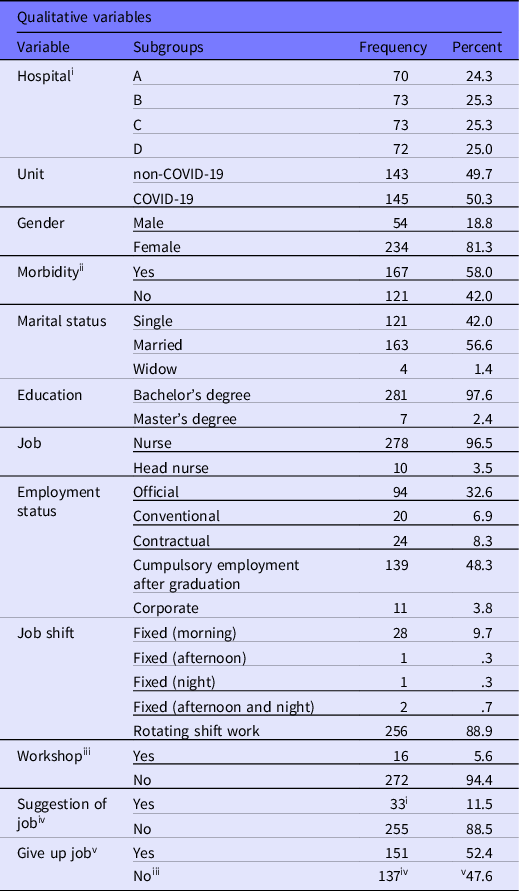
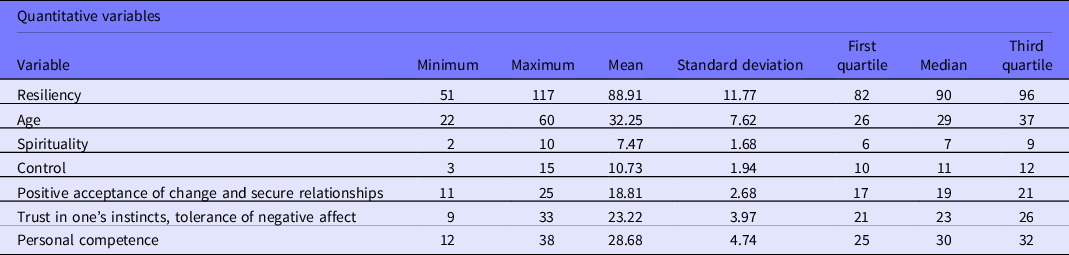
The subgroups of qualitative variables and their frequencies are represented in Table 1. The descriptive statistics of resiliency, age and 5 dimensions of resiliency (“Spirituality”, “Control”, “Positive acceptance of change and secure relationships”, “Trust in one’s instincts”, “tolerance of negative affect”, and “personal competence”) are presented in Table 2. The results of the Kolmogorov-Smirnov test indicate the nonnormal distribution of resiliency (Additional file 1: Table S1). The results of Kruskal-Wallis test were not significant for variables with 3 or more groups (Additional file 1: Table S2). Mann-Whitney U-test indicates no differences in resiliency between COVID-19 and non-COVID-19 wards (p = 0.31). However, the results of the Mann-Whitney U-test show differences across the groups of gender, job, hope in job and job offer(Additional file 1: Table S3). The frequency of participants based on gender and marital status in COVID-19 and non-COVID-19 wards and their associated mean of resiliency are displayed in Table 3.
Frequency of qualitative variables (N = 288)

i Non-COVID-19 nurses were selected from hospitals A, B, and COVID-19 nurses were selected from C, and D hospitals.
ii Morbidity: positive history of acquiring of the COVID-19 infection by the nurse.
iii Workshop: Have you attended a workshop on job resiliency?
iv The suggestion of a job was asked through the question: Would you recommend your children pursue your career?
v Give up job: Intention to give up the job was asked through a question: Have you thought about changing jobs in the last three months?
Summary of quantitative variables

5 dimensions of resiliency include: Spirituality, Control, Positive acceptance of change and secure relationships, Trust in one’s instincts, tolerance of negative affect and Personal competence.
Frequency of participants based on gender and marital status in COVID-19 and non-COVID-19 wards

CART
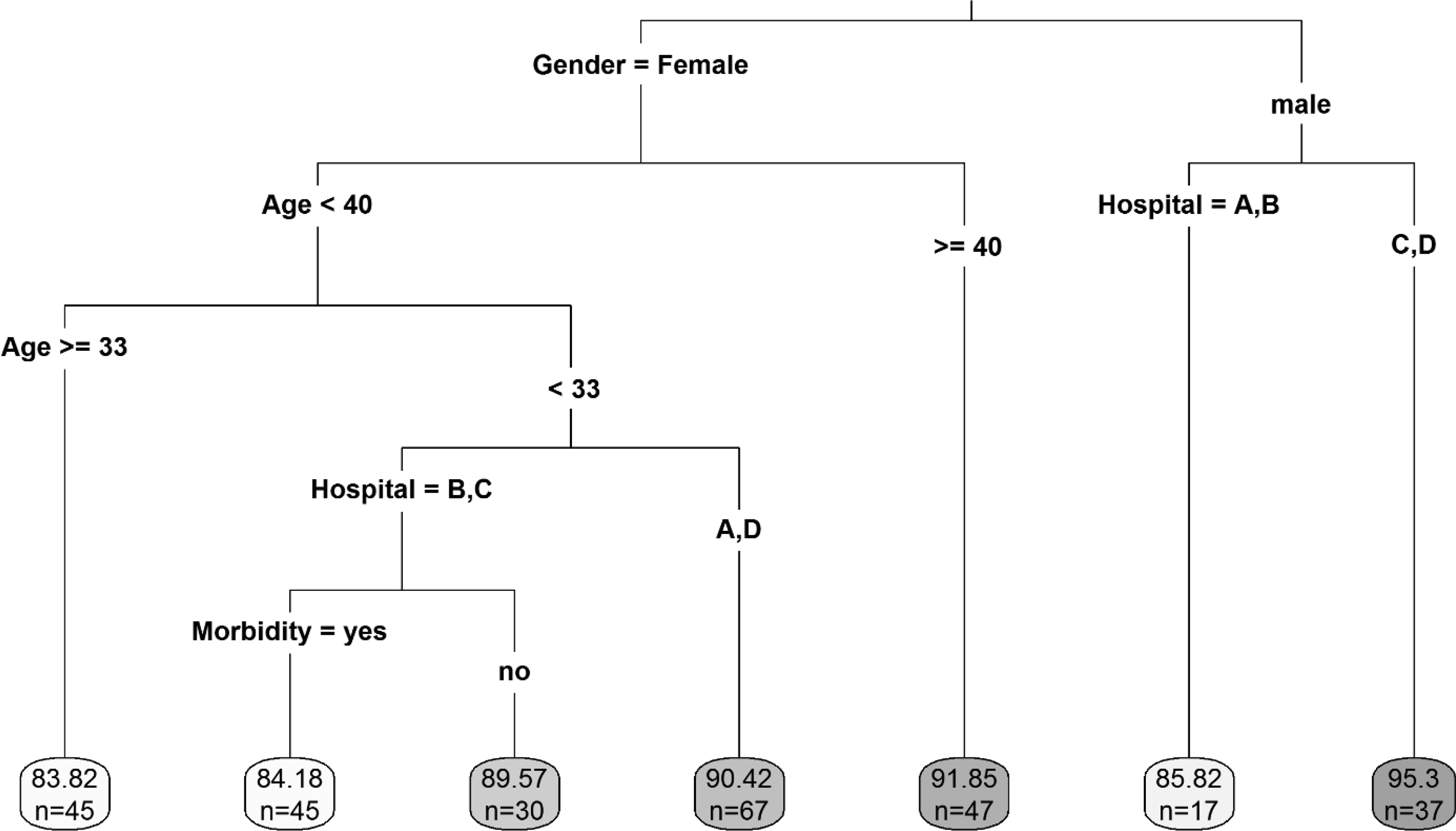
The result of CART is a tree with 7 terminal nodes and 6 nonterminal nodes. CART used age, hospital, gender, and morbidity to create the optimal model (Figure 1). According to the Figure 1, male nurses working in hospitals C and D (COVID-19 nurses) had highest values of resiliency. The female gender aged between 33 and 40 y were associated with lower resiliency compared with participants younger than 33 y old and those over 40 y old.
Optimal tree created by CART. The number of nurses and their associated mean of resiliency are shown at each terminal node.

GBRT
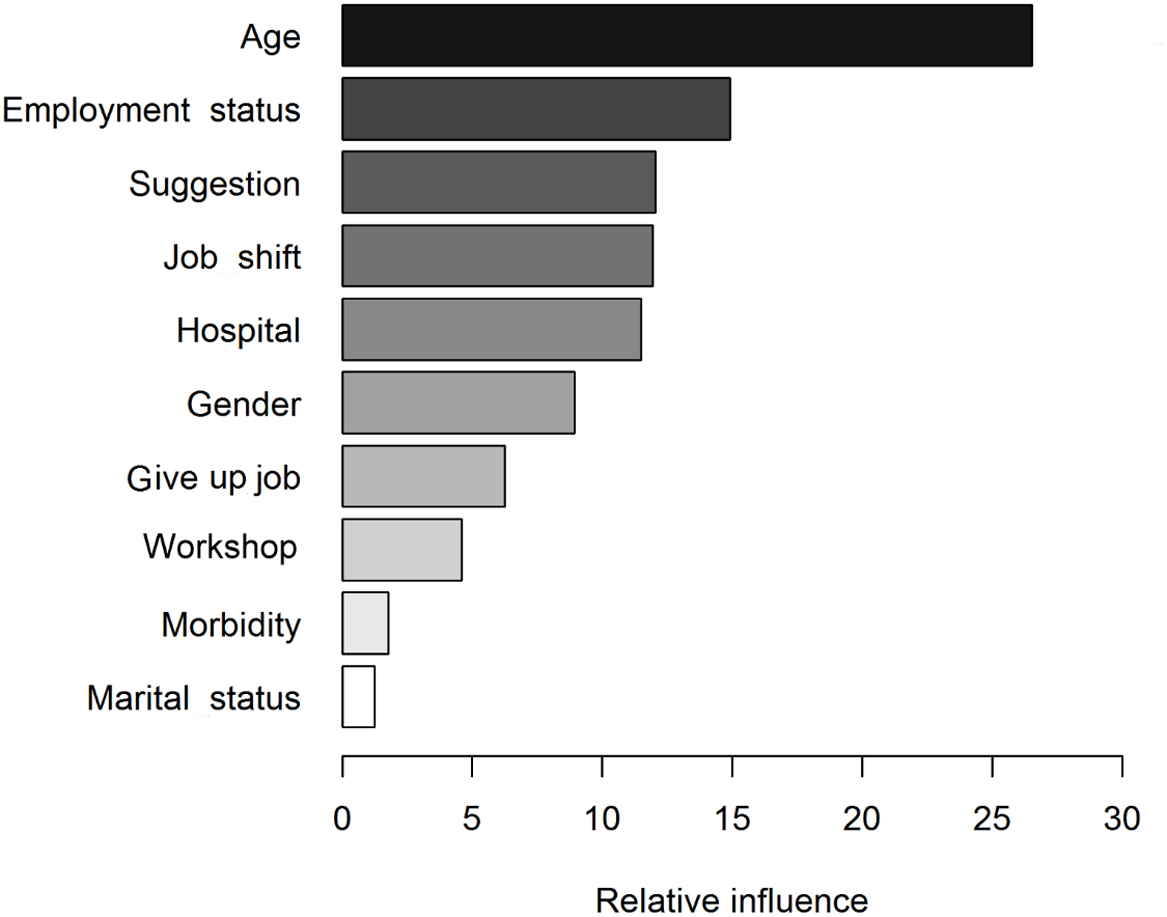
The result of GBRT in terms of relative influence, which shows the impact of the explanatory variables in predicting resiliency, is illustrated in Figure 2. As can be seen in Figure 2, age is the most important variable followed by employment status.
Relative influence of variables in the GBRT model.

Discussion
The present study was a cross-sectional study conducted on 288 nurses working in referral COVID-19 hospitals with the aim of determining resiliency score and contributing factors. The results showed that the mean resiliency scores of nurses working in COVID-19 wards were not significantly differed from non-COVID-19 ones. However, the results of previous studies are not consistence in this regard Reference Ju, Lee and Ahn15,Reference Doo, Kim and Lee16 and and psychological trauma was higher among forefront nurses than in health-care workers in exposure to the Coronaviruses pandemics such as severe acute respiratory syndrome [SARS] and Middle East respiratory syndrome [MERS]). Reference Cabarkapa, Nadjidai and Murgier17 In this study, both nurses (COVID-19 and non-COVID-19 wards) were affected by this pandemic. The specific characteristics of societies may partly justify these differences or training programs might encourage them and can be one of the reasons why nurses in COVID-19 wards are as resilient as nurses of other wards.
Growth and excellence after disasters, especially COVID-19, can increase the resilience of health-care personnel. It can also explain the fact that these people who have experienced previous disasters can have a high level of tolerance and have reached mental and physical growth and excellence. Reference Mo, Tao and Liu18
In the study conducted by Kamali et al., nurses working in the surgical wards reported more burnout in the emotional exhaustion dimension. Reference Kamali, Sadati and Khademi19 Also, in the systematic study of review and meta-analysis conducted by Ghahramani and her colleagues, no significant difference in terms of burnout was observed between nurses in COVID-19 and non-COVID-19 wards. Reference Ghahramani, Lankarani and Yousefi20
Knowing the mortality rate of COVID-19 and vulnerability to infection, fears, and worries about personal and family health, and increasing the prevalence of the new virus may affect the resiliency of nurses in other wards. A significant difference was observed between resiliency levels based on gender, job, attendance a workshop on resiliency, and suggestion of own job to children which may be due to the psychological stress and pressure imposed on nurses through the health-care system. Reference Qi, Xu and Li21
Considering the effect of age, there is not consistency among studies. In some studies, younger people were more prone to generalized anxiety disorder. Reference Ju, Lee and Ahn15 For example, nurses under 25 y old and senior nurses over 35 y old had the highest burnout. In our study, the mean resiliency score was generally higher for female nurses of more than 40 y. In a study conducted by Afshari et al., with increasing age, resiliency score increased significantly. Reference Afshari, Nourollahi-Darabad and Chinisaz22 The study conducted by Gillespie et al. on nurses’ resiliency in the operating room showed that their resiliency increased with aging. Reference Gillespie, Chaboyer and Wallis23
Another research conducted in Iran revealed that older age and a higher level of education were better predictors of mental health. Reference Afshari, Nourollahi-Darabad and Chinisaz22 During the COVID-19 pandemic, nurses’ ability to adapt to this conditions increased. Reference Udod, MacPhee and Baxter24 Participants under 35 y of age were more likely to develop symptoms of anxiety and depression during the COVID-19 epidemic than participants over 35 y of age. Therefore, to increase resiliency in younger medical staff, it is necessary to increase their knowledge and skills, which lead to better stress management and better performance in the COVID-19 pandemic. Reference Qiu, Shen and Zhao25,26
Workload and stress during the COVID-19 pandemic seem to be one of the main reasons for reduced resiliency scores in nurses. Nurses’ resiliency should be considered in epidemics such as COVID-19. Hospital managers should consider gender, age, and marital status in their respective interventions. In this study, the decision tree model was used to divide our data into subgroups based on the dependent variable (resiliency). The CART decision tree model revealed that the resiliency scores of males in the COVID and non-COVID wards were different, and in females, the variables of age (33 y), place of service (hospital type), and acquiring the COVID-19 infection (morbidity) were the predictors of resiliency scores.
The results of the GBRT model showed that the variables of age, employment status, job offer, job shift, hospital type, gender, give up the job, attending a workshop on resiliency, acquiring the COVID-19 infection and marital status were predictors of resiliency score. In our study, gender was one of the predictors of resiliency score. It should be mentioned that there is inconsistency in the findings of studies about the effect of gender on resiliency. Some found no difference. Reference LaFromboise, Hoyt and Oliver27 Others are in favor of gender differences in coping and management of COVID-19. Reference Afshari, Nourollahi-Darabad and Chinisaz22,Reference Eisenbarth28,Reference Campbell-Sills, Forde and Stein29 For example, the resiliency score was lower in women than men. Reference Gillespie, Chaboyer and Wallis23,Reference Udod, MacPhee and Baxter24,Reference Huang and Zhao30 According to finding of current study we recommend to consider the gender roles and differences in stress education and training programs.
Men are also more confident in their abilities and have healthier judgment power, Reference Lee31,Reference Norlander, Erixon and Archer32 as they showed that masculinity can have significant effects on improving the level of psychological hardiness and resiliency. However, some studies Reference Henley33 showed that there is no significant difference between men and women in this regard.
This study was strengthen by using the CART decision tree algorithm and GBRT model to sort the importance of variables. However the findings are limited by the study population and further multicenter studies considering the opinions of nursing managers and nurses working in other units are recommended. Also, the psychological condition of the participants at the time of completing the questionnaires might affect the results of the study.
Conclusion
The resiliency of nurses working in COVID-19 wards did not differ from that of nurses working in non-COVID-19 wards in this study. This result should be further investigated and elaborated.
Health policymakers should consider job expectations, gender, age, and employment status of nurses when making plans for future pandemics.
Supplementary material
For supplementary material accompanying this paper visit https://doi.org/10.1017/dmp.2022.264
Acknowledgment
We thank all the nurses of the educational and medical centers affiliated to Shiraz University of Medical Sciences for their participation in this study. It should be noted that this article was derived from a research project approved under the code of IR.SUMS.REC.1400.390 in Shiraz University of Medical Sciences.
Author contributions
Sulmaz Ghahramani, Hekmatollah Moradi, were responsible for the study conception and design. Sulmaz Ghahramani supervised the whole thesis. All authors prepared the first draft of the manuscript. All authors did the data analysis, made critical revisions to the article for important intellectual content, and supervised the study. All authors read and approved the final manuscript.
Funding
This project was supported in part by a grant from Shiraz University of Medical Sciences.
Financial disclosure
None declared.
Conflict of interest
The authors have no conflict of interests to declare.
Ethical approval
The research was approved by the Ethics Committee of Shiraz University of Medical Sciences (code: IR.SUMS.REC.1400.390).
Informed consent
The informed consent form was completed by all the participants.