Only a modest percentage of patients receive treatment for a mental disorder, even though untreated mental health problems confer high economic, personal, and health burden (Smit et al., Reference Smit, Cuijpers, Oostenbrink, Batelaan, de Graaf and Beekman2006). In light of this, health care systems are searching for efficient ways to deliver evidence-based treatments in a cost-effective manner to reach as many patients as possible. A potentially useful approach is a stepped care model of delivering interventions in which one begins with the least intensive treatment followed by more intensive interventions if necessary (Loeb et al., Reference Loeb, Wilson, Gilbert and Labouvie2000; Ho et al., Reference Ho, Yeung, Ng and Chan2016). For example, in the UK the National Institute for Health and Care Excellence (NICE) considers cognitive-behavioral therapy (CBT)-oriented guided self-help as a first-line intervention for individuals with specific disorders, such as binge-eating disorder (BED) (NICE, 2017). If the first treatment were ineffective, then the patient would move incrementally to more intensive therapies. However, there is little evidence testing a sequential or stepped care model in BED, despite its potential to make treatment more widely available and more cost effective.
BED is characterized by persistent and recurrent episodes of over-eating accompanied by a sense of a loss of control (i.e. binge eating), significant distress over binge eating, but no compensatory behaviors (e.g. vomiting; American Psychiatric Association, 2013). BED is the most common eating disorder, with worldwide prevalence estimates ranging from <1.0 to 4.7% (Cossrow et al., Reference Cossrow, Pawaskar, Witt, Ming, Victor, Herman, Wadden and Erder2016; Keski-Rahkonen and Mustelin, Reference Keski-Rahkonen and Mustelin2016). More than 80% of community or treatment-seeking patients with BED meet the criteria for at least one other mental disorder, such as anxiety or mood disorders (Grilo et al., Reference Grilo, White and Masheb2009; Kessler et al., Reference Kessler, Berglund, Chiu, Deitz, Hudson, Shahly, Aguilar-Gaxiola, Alonso, Angermeyer, Benjet, Bruffaerts, De Girolamo, De Graaf, Maria Haro, Kovess-Masfety, O'Neill, Posada-Villa, Sasu, Scott, Viana and Xavier2013).
The most commonly studied treatment for BED is CBT. The CBT model of eating disorders suggests that dietary restraint, eating concerns, and overvaluation of weight and shape are the core maintenance factors across eating disorders (Fairburn et al., Reference Fairburn, Cooper and Shafran2003; Murphy et al., Reference Murphy, Straebler, Cooper and Fairburn2010). Recent meta-analyses suggest that CBT is an effective treatment for BED (Brownley et al., Reference Brownley, Berkman, Peat, Lohr, Cullen, Bann and Bulik2016; Peat et al., Reference Peat, Berkman, Lohr, Brownley, Bann, Cullen, Quattlebaum and Bulik2017).
Some patients with eating disorders respond to simple, non-specialist treatments, such as self-help books (Perkins et al., Reference Perkins, Murphy, Schmidt and Williams2006; Beintner et al., Reference Beintner, Jacobi and Schmidt2014; Traviss-Turner et al., Reference Traviss-Turner, West and Hill2017). A meta-analysis showed that guided self-help for EDs is effective in reducing binge eating episodes and eating disorder psychopathology, compared with both waiting list and other active treatments (Traviss-Turner et al., Reference Traviss-Turner, West and Hill2017). Also, Perkins and colleagues (Reference Perkins, Murphy, Schmidt and Williams2006) in their systematic review found no differences on several outcome measures between guided and unguided self-help (USH) for eating disorders. These findings are relevant since medical professionals in real-world primary care settings are likely to administer self-help interventions with minimal or no support. Not everyone with BED may require an expensive and difficult-to-access specialized treatment, suggesting the potential usefulness of a sequential or stepped care approach beginning with self-help. However, long-term remission rates from depression or anxiety symptoms after low-intensity treatment appear to be low (Ali et al., Reference Ali, Rhodes, Moreea, McMillan, Gilbody, Leach, Lucock, Lutz and Delgadillo2017) and dropout rates are high (So et al., Reference So, Yamaguchi, Hashimoto, Sado, Furukawa and McCrone2013), which may result in further demoralization and reduced treatment seeking. A second more intensive step after low-intensity treatment may help to maintain gains achieved in the first step by addressing maintenance factors that may precipitate relapse.
The interpersonal model of binge eating, which has received some empirical support, posits that binge eating may be triggered by interpersonal problems, and this association is partially explained by higher negative affect (Ivanova et al., Reference Ivanova, Tasca, Hammond, Balfour, Ritchie, Koszycki and Bissada2015). Given the likely importance of maladaptive interpersonal relationships in maintaining BED, a group therapy format that focuses on relational patterns could represent a good treatment choice. Past research suggests the efficacy of group psychodynamic interpersonal psychotherapy (GPIP) in the treatment of BED (Tasca et al., Reference Tasca, Illing, Ogrodniczuk and Joyce2006; Grenon et al., Reference Grenon, Schwartze, Hammond, Ivanova, Mcquaid, Proulx and Tasca2017). In a randomized controlled trial, GPIP was as effective as group CBT, and both were more effective than a wait-list control condition in reducing binge eating and other outcomes up to 1 year post-treatment (Tasca et al., Reference Tasca, Illing, Ogrodniczuk and Joyce2006).
The goal of this two-step randomized controlled trial was to investigate the utility of a stepped care approach for the treatment of BED by sequencing low to high-intensity treatment. In step 1, using an uncontrolled pre- post-treatment design, all participants received a CBT-oriented USH (Fairburn, Reference Fairburn2013). Prior to step 2, using a randomized controlled trial design, participants were randomized to either GPIP or a no-treatment control condition for 16 weeks, with follow-ups at 3- and 6-months post-treatment (Fig. 1). We tested two hypotheses: (1) USH will significantly reduce the frequency of binge eating episodes, as well as reduce global eating disorder psychopathology; and (2) GPIP offered in the second step will further reduce frequency of binge eating episodes and significantly improve those factors related to maintaining the disorder (e.g. global eating disorder psychopathology, depressive symptoms, interpersonal problems, and attachment insecurity).
CONSORT Diagram.

Method
Participants
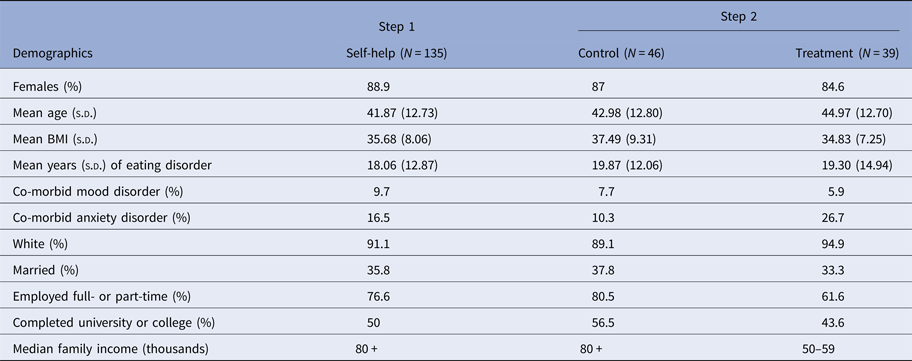
Participants in the first step, USH, were 135 individuals who met DSM-5 (American Psychiatric Association, 2013) diagnostic criteria for BED. After USH, the 85 participants who remained in the study were randomly allocated to either GPIP (n = 39) or to a no-treatment control condition (n = 46). Demographic characteristics for each step and condition appear in Table 1. Exclusion criteria included: not speaking English, pregnancy (current or planned within next year), enrolment in other psychotherapies/weight loss programs (current or planned within next year), or comorbid bipolar, psychotic, or substance use disorders.
Demographic characteristics of the participants at each step

BMI, Body Mass Index. Income was reported in Canadian dollars. Compared with participants in the treatment condition, those in the control condition had significantly lower percentage of anxiety disorder (p = 0.04), higher median income (p = 0.03), and higher percentage employment (p = 0.02).
Measures
Diagnosis
The Structured Clinical Interview for DSM–IV Axis I Disorders (SCID-I/P; First et al., Reference First, Spitzer, Gibbon and Williams1996) is a semi-structured interview to diagnose Axis I mental disorders in accordance with DSM-IV-TR (American Psychiatric Association, 2000). The interview was administered at pre-USH by clinical psychologists or supervised trainees and slightly modified to account for DSM-5 diagnostic criteria for BED. Inter-rater reliability of BED diagnosis between two independent judges on a random sample of 10% of participants in this study was good, κ = 0.81.
Binge eating
The frequency of binge eating episodes in the past 28 days was evaluated using the diagnostic items from the Eating Disorder Examination (EDE; Cooper and Fairburn, Reference Cooper and Fairburn1987). A trained research coordinator and experienced psychologists blind to the allocation of participants in the study conducted the assessment. Inter-rater agreement between two independent judges at pre-USH was high, intra-class correlation coefficient (ICC) = 0.91. Abstinence from binge eating was defined as zero binges in the past 28 days.
Depressive symptoms
The Center for Epidemiologic Studies Depression Scale (CES-D; Radloff, Reference Radloff1977) is a 20-item self-report measure of depressive symptoms with higher total scores indicating greater depressive symptoms. In this study, the mean coefficient alpha was 0.92.
Interpersonal problems
The Inventory of Interpersonal Problems (IIP64; Horowitz et al., Reference Horowitz, Rosenberg, Baer, Ureño and Villaseñor1988) is a 64-item self-report scale that assesses overall interpersonal distress with higher total scores indicating greater interpersonal problems. In this study, mean coefficient alpha for the total score was 0.96.
Attachment
The Experiences in Close Relationships Scale (ECR; Brennan et al., Reference Brennan, Clark, Shaver, Simpson and Rholes1998) is a 36-item self-report measure of two dimensions: Attachment Avoidance and Attachment Anxiety, with higher scores indicating greater attachment avoidance or anxiety. In this study, mean alpha coefficients were 0.96 for Attachment Avoidance and 0.94 for Attachment Anxiety scales.
Global eating disorder psychopathology
The EDE – Questionnaire (EDE-Q; Fairburn and Beglin, Reference Fairburn and Beglin1994) is a 28-item self-report measure of eating disorder symptoms and psychopathology The EDE-Q contains four subscales: Dietary Restraint, Eating Concern, Shape Concern, and Weight Concern. We derived a global score by summing the four scales and dividing by the number of scales (Fairburn, Reference Fairburn2008). In this study, the mean alpha coefficient was 0.72 for the global score.
Adherence to the group therapy manual
The Tape Rating Instrument for Psychotherapy of Eating Disorders (TRIPED; Olmsted et al., Reference Olmsted, Isaacs, Bemis and Garner1988) has an adherence to psychodynamic therapy scale, with higher mean item ratings indicating greater therapist adherence. Previous research used a mean cut-off >3 to indicate adequate adherence (Tasca et al., Reference Tasca, Illing, Ogrodniczuk and Joyce2006). Two judges rated three recordings from weeks 3, 9, and 14 of group therapy. Judges received 30 h of training to rate sessions. In the present study, the mean alpha coefficient for the adherence scale was 0.85, and inter-rater agreement between two independent judges on a randomly selected week for each therapist was good, ICC = 0.77.
Interventions
Unguided self-help
All participants were given a 10-week program of USH in step 1 based on a CBT-oriented self-help program for binge eating described in the book, Overcoming Binge Eating (2013). The book was provided to each participant for the study. Participants also received a typed version of the six steps of the program, which was slightly edited to make it specific to BED by removing references to purging behaviors. In addition, participants received email reminders with a link to a short 2-min video to encourage them to remain on track. A participant could contact the study research coordinator for technical help, but received no other contact with a mental health professional. The USH program follows six steps: (1) Self-monitoring, weekly weighing; (2) Establishing a pattern of regular eating; (3) Substituting alternatives to binge eating; (4) Practicing problem solving and reviewing progress; (5) Tackling dieting and other forms of avoidance; and (6) Preventing relapse.
Group psychodynamic interpersonal psychotherapy
Those assigned to GPIP in step 2 received a pre-group preparation session plus 16 weekly 90-min sessions of GPIP (Tasca et al., Reference Tasca, Illing, Ogrodniczuk and Joyce2006). The treatment model focuses on the client's cyclical relational patterns (CRP), based on Strupp and Binder's (Reference Strupp and Binder1984) individual therapy model. CRPs include three interpersonal elements: Acts of Self (one's own behaviors, cognitions, feelings, wishes), Acts of Others (behaviors of others towards the self), and Expectations of Others (assumptions about others’ behaviors, cognitions, and feelings). These interpersonal aspects define an intrapersonal element indicating a sense of self or Introject (how one acts towards one's self). CRPs represent maladaptive interpersonal patterns and a means of coping that may underlie binge eating. GPIP is informed by an attachment model of eating disorders (Tasca and Balfour, Reference Tasca and Balfour2014) and the interpersonal model of binge eating (Wilfley et al., Reference Wilfley, MacKenzie, Welch, Ayres and Weissman2000). In the early stage of GPIP, the therapist focused on understanding participants’ CRPs, its role in maintaining binge eating and related emotional and interpersonal distress, and on helping to develop a cohesive group. In the middle stage, therapists challenged patients’ CRPs as they were expressed in the group interactions, with the intent of modifying the interactions to help to reduce interpersonal distress, negative affect, and binge eating. In the late stage, therapists focused on reinforcing new CRPs and self-concepts.
Procedures
Participants were recruited from an eating disorder treatment center of a medium-sized urban center, and some participants self-referred by responding to media advertisements. Recruitment took place between November 2012 and September 2014. Figure 1 indicates the flow of participants through the study, assessment points, and reasons for dropping out or exclusions at each stage. Participants were screened by telephone by a research coordinator, who provided preliminary information on the study and assessed exclusion criteria and frequency of binge eating. Qualified participants were subsequently invited to an interview with a member of the study team to assess for binge eating, and exclusion criteria. Participants underwent the SCID-I/P modified for DSM-5 criteria for BED, and completed the psychometric battery and parts of the EDE interview. Dropping out of step 1 was defined as any participant not providing a post-USH assessment and indicating their decision to withdraw. At step 2, we used a simple randomization procedure for every 20 participants that were consecutively available, which allowed us to populate a therapy group with 7 to 10 participants at a time. The average time between the end of USH and the start of GPIP (i.e. the pre-group preparation) was 6.27 weeks (s.d = 6.35). Drop-outs from group therapy were defined as attending less than 10 sessions and/or unilaterally leaving the group. After the 6-month follow-up period, individuals in the control condition were offered group therapy but these group therapy data were not used in this study.
All group therapy sessions were video recorded for supervision and assessment of therapist adherence to the manual. One of five therapists conducted a group: three Ph.D. psychologists, one psychiatrist and one social worker (mean age = 41.4 years; s.d = 9.53). Four of the therapists were women, and all had least 3 years of experience in providing group therapy for eating disorders. Therapists attended a 2-day workshop that focused on the GPIP manualized treatment. Therapists received individual and group supervision weekly by an author of the manual.
Participants received a reimbursement for travel expenses but no other inducements. After participants received a description of the study, and written informed consent was obtained prior to enrolment. The study was approved by the local research ethics board and registered at ClinicalTrials.gov (registration number: NCT01837953).
Data analysis
Initially, we assessed for dependence in the data with three-level hierarchical linear models (HLM; repeated measurements at level 1 nested within individuals at level 2, nested within groups at level 3) to calculate an ICC (Tasca et al., Reference Tasca, Ritchie, Conrad, Balfour, Gayton, Lybanon and Bissada2009). The dichotomous variable data (i.e. abstinence of binge eating) were analyzed using hierarchical generalized linear models (HGLM) with population-average model estimates. For the HGLM model, the ICC to assess data dependence was computed using the method suggested by Snijders and Boskers (Reference Snijders and Bosker1999). Nesting at the group level accounted for less than 1% of the variance (ICC<0.01) for each outcome variable, indicating very small and ignorable dependence in the data (Murnane and Willet, Reference Murnane and Willet2011). The only exception was for the frequency of binge eating (ICC = 0.37). Due to very small dependence in most of the outcome data, we adopted two-level models with repeated measurements at level 1 nested within individuals at level 2. For frequency of binge eating, we ran two-level models but set the Type I error rate at p = 0.003 using values suggested by Kenny and colleagues (Reference Kenny, Kashy, Bolger, Gilbert, Fiske and Lindzey1998) to adjust for Type I error inflation due to dependence in these data.
We tested the hypotheses using regression discontinuity models in HLM in which two level-1 ‘time’ parameters were included to model the slope discontinuity from step 1 to step 2 (Singer and Willett, Reference Singer and Willett2003). To assess the uncontrolled effects of the first step, USH, the first ‘time’ parameter (T1) at level-1 was set at ‘0’ for baseline and ‘10’ representing 10 weeks of USH for post-USH, and ‘10’ also for all subsequent measurement occasions. This modeled a linear increase from baseline to post-USH, but no further improvement. To assess the effects of the second step, the second level-1 time parameter (T2) was set at ‘0’ for baseline and for post-USH/pre-group treatment. To indicate the number of weeks from introducing step 2 of the design, time was then coded as ‘16’, ‘28’, and ‘40’ to represent post-, 3 months post-, and 6 months post-group treatment. The effect of treatment condition was modeled at level-2 (online Supplementary Appendix A). For the dichotomous variable representing abstinence from binge eating, we ran 2-level growth models for the data from pre-group treatment to 6 months post-group treatment using HGLM. Parameters were estimated using a full maximum likelihood approach (online Supplementary Appendix A). Effect sizes were estimated as pseudo-R 2 statistics, in which R 2⩾0.02 was interpreted as a small effect, R 2⩾0.15 was a medium effect, and R 2⩾0.26 was a large effect (Cohen, Reference Cohen1992).
The HLM and HGLM models allow one to estimate reliable parameters for each individual without imputing missing data if the data are assumed missing at random. This essentially results in analysing an intent to treat sample. We ran several pattern mixture models testing if patterns of dropping out or of having any missing data in the study were significantly related to outcomes (Gallop and Tasca, Reference Gallop and Tasca2009). All analyses were performed using Hierarchical Linear Modeling software, version 7 (Raudenbush et al., Reference Raudenbush, Bryk, Cheong, Congdon and du Toit2011). All statistical tests were based on a 2-sided distribution, and a p value < 0.05 was considered statistically significant for a test of any a priori hypothesis.
Results
Preliminary analyses
We found no violation of univariate normality assumptions except for frequency of binge eating which was positively skewed at post-USH. A square root transformation corrected the non-normality. Analyses run with and without transformed data gave similar results, thus we used non-transformed data for ease of interpretation (Tabachnick and Fidell, Reference Tabachnick and Fidell2007). We also found few outliers at any time points for frequency of binge eating, and extreme scores were brought into range (Tabachnick and Fidell, Reference Tabachnick and Fidell2007). The mean item rating in the TRIPED Psychodynamic Therapy Adherence scale was 3.25 ± 0.78 with no mean score below 3, suggesting adequate adherence to the GPIP manual by each therapist. Finally, there were no significant effects of missing data patterns on any variable and all effects were small, so we proceeded on the assumption that the data were missing at random (Gallop and Tasca, Reference Gallop and Tasca2009).
Step 1: unguided self-help
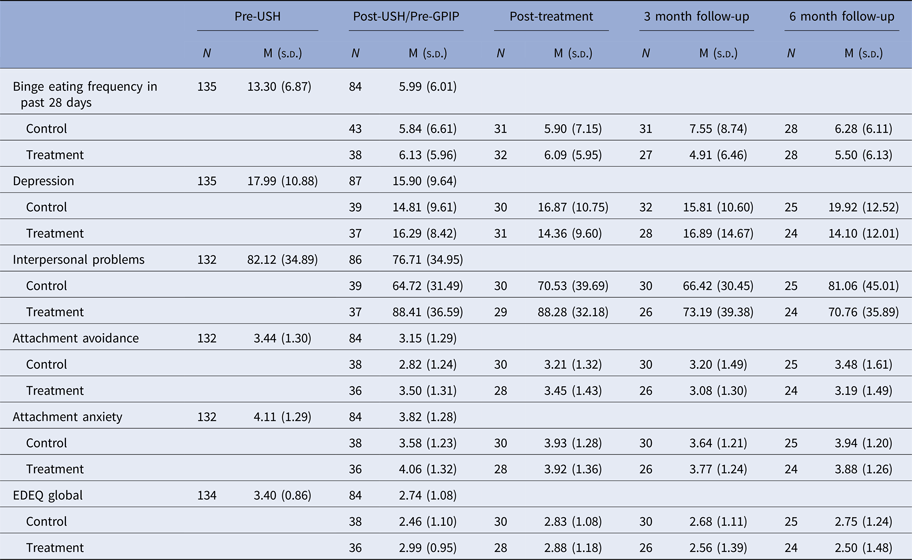
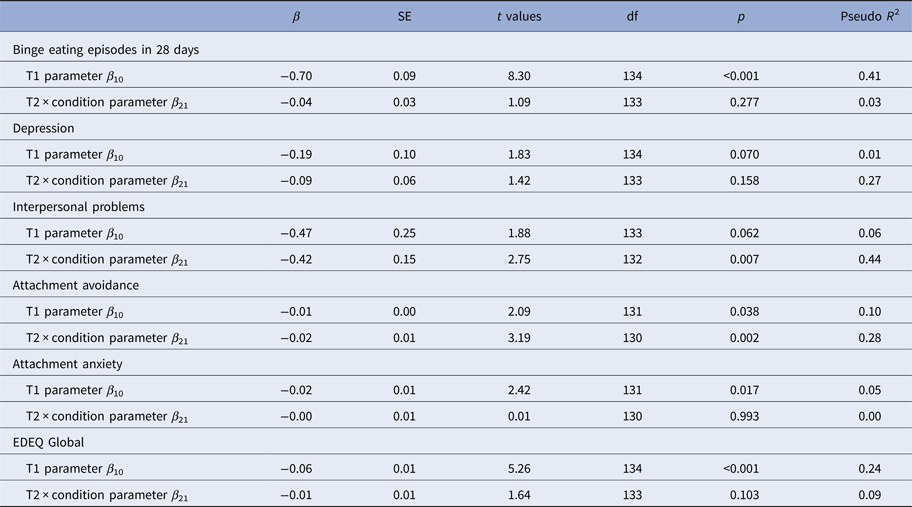
We tested hypothesis 1 by analyzing changes in outcomes from pre- to post-USH (Table 2). Of the 135 participants who began USH, 47 (34.82%) did not complete the treatment (Fig. 1). Table 3 presents the results for the T1 parameters from the multilevel models (online Supplementary Appendix A). We found a statistically significant decline in binge eating episodes from pre- to post-USH with a large effect. We also found statistically significant decreases in global EDEQ scores with medium effects. Although declines in attachment avoidance and attachment anxiety were statistically significant, effect sizes were small. Changes in depression and interpersonal problems were not statistically significant and effects were small. Of the 84 individuals who provided data at post-USH 15.5% were abstinent of binge eating in the past month.
Mean (M), standard deviation (s.d.) and sample size (N) of the main outcome variables at each time point and by study condition in step 2

EDEQ, the Eating Disorder Examination Questionnaire; USH, unguided self help; GPIP, group psychodynamic interpersonal psychotherapy.
Results from the multilevel regression discontinuity models indicating: the uncontrolled effects of unguided self-help (USH) on pre- to post-USH outcomes (T1 parameter β10); and controlled effects of the interaction between study condition in step 2 and the T2 growth parameter (β21) for each variable

Note: β 10 indicates the person-level effect of the T1 parameter. β 10 indicates the interaction between condition and the T2 time parameter. Pseudo R 2 refers to the amount of within-person variance accounted for by adding the T1 time parameter to level 1 of the completely unconditional multilevel model, or the amount of between-person variance accounted for in the T2 parameter by adding the study condition × T2 parameter interaction to level 2 of the multilevel model. EDEQ, the Eating Disorder Examination Questionnaire. See online Supplementary Appendix A.
Step 2: adding intensive group therapy
Means and standard deviations for all outcome variables across all time points and by study condition in step 2 are reported in Table 2. In GPIP, 26 participants completed the entire group therapy, four never began treatment, and 9 (25.7%) dropped-out (Fig. 1). We tested the second hypothesis by examining the effect of condition on the T2 growth parameter for each variable (Table 3). There was no significant difference in the decline in binge eating episodes between the GPIP and control condition and effects were small. Change in binge eating within each condition was not significant. Compared with the control condition, GPIP resulted in a significantly greater decline in interpersonal problems and attachment avoidance with large effects. Decline in interpersonal problems (p = 0.004) and attachment avoidance (p = 0.009) was significant within the GPIP condition but not within the control condition. The decline in depression was not significantly different between GPIP and control participants, but the effect size for a difference in favor of GPIP was large, however, change in a depression within each condition was not significant. There were no significant differences between GPIP and control for EDEQ global scores or attachment anxiety and the effect sizes were small. Despite randomization, some variables appeared different between GPIP and the control condition at the baseline for step 2 (Table 2). So, we re-ran all slope discontinuity models without treatment condition in the equation for the intercept at level 2. This forced both conditions to start at the same step 2 baseline. The results of these models were nearly identical and so we do not report them here. We also re-ran the models controlling for the three participants’ data in step 2 who were abstinent of binge eating following USH but went on to receive GPIP. Again, the results were nearly identical to those reported above.
Table 4 shows the frequencies and percentages of participants in control and treatment groups abstinent of binge eating across all time points. The 2-level HGLM showed a significant effect of study condition on abstinence from binge eating, β 11 = 0.04, s.e. = 0.01, t(83) = 2.93, p = 0.004, OR 1.04 (95% CI = 1.01–1.07). Compared with the control condition, receiving GPIP resulted in a 1.04 greater odds of changing from non-abstinent to abstinent status pre-step 2 –6 months post-treatment. Inspection of Table 2 indicates that the proportion of abstinence from binge eating at the start of step 2 was lower in GPIP compared with the control condition, and this difference disappeared by 6 months post-treatment. We re-ran these models while controlling for baseline abstinence rates at level 2 and we also re-ran the models removing the effects of participants in GPIP who were abstinent of binge eating after USH, and the results in both cases were very similar to those reported above. The proportion of individuals who were abstinent of binge eating at the final measurement point (6 months post) was not significantly different between the two conditions, χ2(1, N = 56) = 0.03, p = 0.866.
Proportion of abstinence from binge eating at step 2 in treatment and control groups

Discussion
We investigated the utility of sequencing lower to higher intensity interventions as a means of assessing a stepped care treatment model for BED. USH resulted in a significant reduction in binge eating frequency and in eating disorder psychopathology with large effects. There was no significant effect on these variables of adding GPIP in step 2. Although the addition of GPIP resulted in a greater proportion of those who changed from symptomatic to abstinent from binge eating, the percentage who remained abstinent after GPIP at 6 months post-treatment was modest at 25% and not significantly different from controls. However, compared with the control condition, those receiving GPIP experienced greater improvements in some outcomes (i.e. interpersonal problems, attachment avoidance) thought to maintain binge eating (Wilfley et al., Reference Wilfley, MacKenzie, Welch, Ayres and Weissman2000; Ivanova et al., Reference Ivanova, Tasca, Hammond, Balfour, Ritchie, Koszycki and Bissada2015). This is the first study to demonstrate that a stepped care model can result in some improvement in binge eating in the first step, and further improvement in interpersonally-based maintenance factors in the second step for patients with the BED. The latter findings may be important given recent findings that the effects of low-intensity treatment for other disorders may not be maintained in the longer run (So et al., Reference So, Yamaguchi, Hashimoto, Sado, Furukawa and McCrone2013; Ali et al., Reference Ali, Rhodes, Moreea, McMillan, Gilbody, Leach, Lucock, Lutz and Delgadillo2017).
The USH findings were consistent with previous meta-analyses (Perkins et al., Reference Perkins, Murphy, Schmidt and Williams2006; Beintner et al., Reference Beintner, Jacobi and Schmidt2014; Traviss-Turner et al., Reference Traviss-Turner, West and Hill2017). Although there was a significant decline in binge eating, only 15% were asymptomatic after step 1, potentially leaving many at risk for relapse or deterioration. Based on our results and those of previous findings (Perkins et al., Reference Perkins, Murphy, Schmidt and Williams2006), USH may be an adequate first-line intervention for some patients with BED, especially considering that it requires the minimum involvement of mental health professionals, similar to what would occur in primary care.
However, an important caveat to delivering USH was the high rate of drop out, such that more than one third (34.82%) of those who started USH unilaterally decided not to continue. Drop out rates from low-intensity treatments tend to be high (So et al., Reference So, Yamaguchi, Hashimoto, Sado, Furukawa and McCrone2013; Beintner et al., Reference Beintner, Jacobi and Schmidt2014), and the drop out rate in this study was higher than the 19.7% rate commonly reported in psychotherapy research (Swift and Greenberg, Reference Swift and Greenberg2012). USH may have resulted in higher than average dropout due to the absence of contact with a professional who could provide support and encouragement. This is a concern because dropping out is probably associated with demoralization and reluctance to seek further treatment. Future studies should identify those at higher risk of dropping out in order to provide them alternatives or extra support.
It is important to note that participants who entered the second step of the study reported a lower mean number of binge eating episodes (see Table 3) due to the previous positive effects of USH. This reduced the pre group-treatment mean and an upper limit of binge eating frequency that one might typically see in a sample seeking treatment for BED, which in turn diminished possible further improvement in binge eating episodes. This study design set a high bar for the group treatment to achieve a further decline in binge eating and possibly in other outcomes.
Nevertheless, GPIP led to significant improvements in interpersonal problems and attachment avoidance compared with the control condition over and above the improvements achieved by USH. Attachment insecurity and relational problems are commonly-reported among those with eating disorders (Tasca and Balfour, Reference Tasca and Balfour2014). Binge eating may be a means of coping with negative affect caused by unmet attachment needs and interpersonal problems (Tasca et al., Reference Tasca, Illing, Ogrodniczuk and Joyce2006). Since interpersonal problems are considered a maintenance factor of binge eating in some models (Wilfley et al., Reference Wilfley, MacKenzie, Welch, Ayres and Weissman2000; Fairburn, Reference Fairburn2008), it is possible that those treated with GPIP could potentially show a reduced risk of relapse or lower risk of deterioration over the longer term.
Taken together, our results provide qualified support for the use of a sequential or stepped care approach to treat BED. Delivering USH in primary care could increase access and reduce binge eating and core eating disorder psychopathology, at least in some individuals. For those who do not respond or who require further treatment for known maintenance factors that may cause relapse or exacerbation of binge eating (i.e. mood intolerance, interpersonal problems, attachment insecurity; Tasca et al., Reference Tasca, Illing, Ogrodniczuk and Joyce2006; Fairburn, Reference Fairburn2008), care systems could deliver specialized group treatment like GPIP, group IPT, or group enhanced CBT. Group therapy may be more cost-effective than individual therapy as a second step, and future research might include an economic analysis to assess this.
There are several limitations to this study. First, despite randomization, the GPIP and control condition participants had different mean values on several variables at the outset of step 2. In parallel analyses, we took steps to control for baseline differences in the models, and found very similar results. Nevertheless, the higher level of psychopathology in the GPIP condition may have negatively affected therapeutic group processes in ways that are not yet known. Second, our sample was composed mainly of educated Caucasian women, thus additional research in different populations and with lower socio-economic status is necessary. Finally, we enrolled all participants who were willing to continue after self-help into the second step of the study, but we recognize that in a typical stepped care model the second step may be offered only to patients who do not improve. In parallel analyses, we controlled for those participants who were abstinent of binge eating after USH but went on to receive GPIP. The results were almost identical suggesting that the findings from this study may generalize to common stepped care approaches. Future research may explicitly test a stepped care model in which only those who do not respond to step 1 receive a more intensive intervention in step 2.
In conclusion, this is the first study that we are aware of that tests a sequential stepped care approach for BED. USH was useful in reducing binge eating for some with BED, though drop out was high. The findings did not provide evidence for the efficacy of a second more intensive step to reduce binge-eating symptoms following initial USH. However, GPIP in a second step did reduce further the interpersonal problems and attachment avoidance that may maintain BED symptoms and that may create a vulnerability to relapse or deterioration in the longer term.
Supplementary material
The supplementary material for this article can be found at https://doi.org/10.1017/S0033291718001277
Acknowledgement
This study was funded by an Ontario Mental Health Foundation Type A Research Grant.